Fuzzy Logic
(Knowledge-Based Systems; R Akerkar, P Sajja)

Prepared By: Ashique Rasool
Fuzzy Logic
 Flexible machine learning technique
 Mimicking the logic of human thought
 Logic may have two values and represents two possible

solutions
 Fuzzy logic is a multi valued logic and allows
intermediate values to be defined
 Provides an inference mechanism which can interpret
and execute commands
 Fuzzy systems are suitable for uncertain or
approximate reasoning

Prepared By: Ashique Rasool
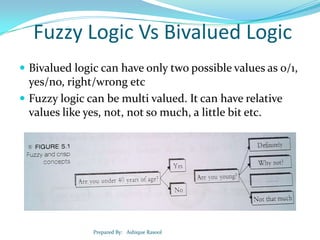
Fuzzy Logic Vs Bivalued Logic
 Bivalued logic can have only two possible values as 0/1,

yes/no, right/wrong etc
 Fuzzy logic can be multi valued. It can have relative
values like yes, not, not so much, a little bit etc.

Prepared By: Ashique Rasool
Characteristics of Fuzzy Logic
 Exact reasoning is viewed as a limiting case of







approximate reasoning
Everything is a matter of degree
Knowledge is interpreted as a collection of elastic or
equivalently fuzzy constraints on a collection of
variables
Inference is viewed as a process of propagating elastic
constraints
Any logical system can be fuzzified

Prepared By: Ashique Rasool
Fuzzy Set
 Let X be a non empty set, A fuzzy set A in X is

characterized by its membership function μA: X ->
[0,1], where μA(x) is the degree of membership of
element x in fuzzy set A for each x ∈ X

Prepared By: Ashique Rasool
Membership Function
 Maps elements of a fuzzy set to real numbered values

in the interval 0 to 1.
 The curve representing the mathematical function is a
membership function that determines the degree of
belonging of member x to the fuzzy set T.

Prepared By: Ashique Rasool
Fuzzification
The process of transforming crisp(bivalued) input values
into linguistic values is called fuzzification
Steps of Fuzzification:
Step 1: Input values are translated into linguistic
concepts, which are represented by fuzzy set.
Step 2: Membership functions are applied to the
measurements, and the degree of membership is
determined

Prepared By: Ashique Rasool
Defuzzification
Defuzzification converts the fuzzy values into crisp
(bivalued) value.
Example methods of defuzzification:
 Max-membership method: This method chooses
the elements with maximum value
 Centroid method: This method find the centre point
of the targeted fuzzy region by calculating the
weighted mean of the output fuzzy region
 Weighted average method: Assigns weight to each
membership function in the output by its respective
maximum membership value
Prepared By: Ashique Rasool
Operations on Fuzzy set
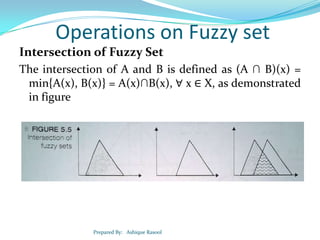
Intersection of Fuzzy Set
The intersection of A and B is defined as (A ∩ B)(x) =
min{A(x), B(x)} = A(x)∩B(x), ∀ x ∈ X, as demonstrated
in figure

Prepared By: Ashique Rasool
Operations on Fuzzy set
Union of Fuzzy Set
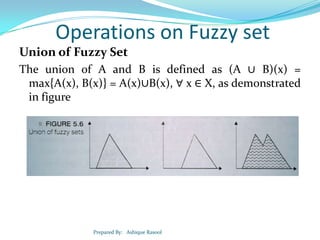
The union of A and B is defined as (A ∪ B)(x) =
max{A(x), B(x)} = A(x)∪B(x), ∀ x ∈ X, as demonstrated
in figure

Prepared By: Ashique Rasool
Operations on Fuzzy set
Complement of Fuzzy Set
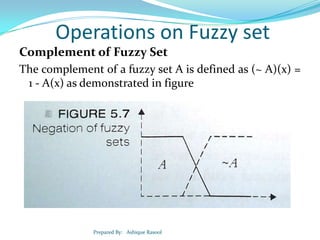
The complement of a fuzzy set A is defined as (~ A)(x) =
1 - A(x) as demonstrated in figure

Prepared By: Ashique Rasool
Operations on Fuzzy set
Equality of Fuzzy Sets
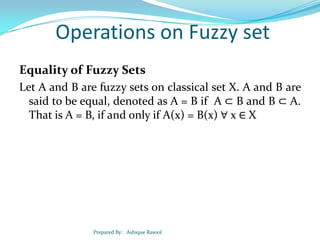
Let A and B are fuzzy sets on classical set X. A and B are
said to be equal, denoted as A = B if A ⊂ B and B ⊂ A.
That is A = B, if and only if A(x) = B(x) ∀ x ∈ X

Prepared By: Ashique Rasool
Types of Fuzzy Function
Quasi-Fuzzy Membership Functions:
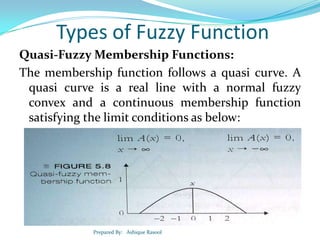
The membership function follows a quasi curve. A
quasi curve is a real line with a normal fuzzy
convex and a continuous membership function
satisfying the limit conditions as below:

Prepared By: Ashique Rasool
Types of Fuzzy Function
Triangular Fuzzy Membership Functions:
The membership curve follows a triangular shape
then it is triangular membership function. Fuzzy
function
A
is
called
triangular
fuzzy
function(A=a,α,β) with peak a, left width α>0 and
right width β>0

Prepared By: Ashique Rasool
Types of Fuzzy Function
Trapezoidal Fuzzy Membership Functions:
The membership curve follows a trapezoidal shape.
Fuzzy function A is called triangular fuzzy
function(A=a,α,β) with tolerance interval [a, b],
left width α and right width β

Prepared By: Ashique Rasool
Linguistic Variable
A variable whose values are words or sentences in
natural language. Example: Temperature is linguistic
variable if it takes values hot, cool, warm, comfortable
etc.
The framework of linguistic variable is given as (X, Lx, χ,
µx) where
 X denotes the symbolic name of linguistic variable
 Lx is a set of linguistic values that X can take
 χ is the physical domain that defines crisp values


µx is a fuzzy function that maps linguistic terms of
variables to the equivalent crisp values
Prepared By: Ashique Rasool
Fuzzy Propositions
A fuzzy proposition is a statement that drives a fuzzy
truth value.
 Fuzzy Connectives: Fuzzy connectives are used to
join simple fuzzy propositions to make compound
propositions. Examples of fuzzy connectives are:
 Negation
 Disjunction
 Conjunction
 Imlication

Prepared By: Ashique Rasool
Fuzzy Rules
The power and flexibility of simple If-Then-Else logic
rules is enhanced by adding linguistic parameter.
Fuzzy rules are expressed in the form:
IF variable IS set THEN action
 Examples:
 IF temperature is very cold THEN stop air conditioner
 IF temperature is normal THEN adjust air conditioner
 IF temperature is hot THEN start air conditioner

Prepared By: Ashique Rasool
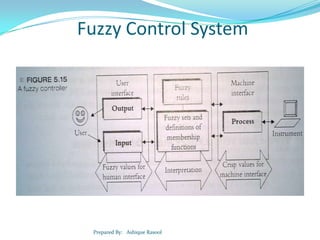
Fuzzy Control System
A fuzzy control system is based on Fuzzy Logic. The
process of designing fuzzy control system can be
described using following steps
 Step 1: Identify the principal input, output and
process tasks
 Step 2: Identify linguistic variables used and define
fuzzy sets and memberships accordingly
 Step 3: Use these fuzzy sets and linguistic variables to
form procedural rules
 Step 4: Determine the defuzzification method
 Step 5: Test the system and modify if necessary
Prepared By: Ashique Rasool
Fuzzy Control System

Prepared By: Ashique Rasool
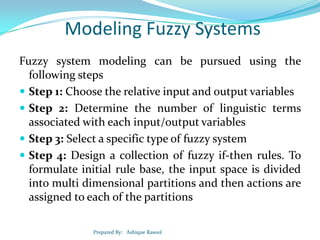
Modeling Fuzzy Systems
Fuzzy system modeling can be pursued using the
following steps
 Step 1: Choose the relative input and output variables
 Step 2: Determine the number of linguistic terms
associated with each input/output variables
 Step 3: Select a specific type of fuzzy system
 Step 4: Design a collection of fuzzy if-then rules. To
formulate initial rule base, the input space is divided
into multi dimensional partitions and then actions are
assigned to each of the partitions
Prepared By: Ashique Rasool
Limitations of Fuzzy Systems
 Fuzzy systems lack the capability of machine learning

as-well-as neural network type pattern recognition
 Verification and validation of a fuzzy knowledge-based
system require extensive testing with hardware
 Determining exact fuzzy rules and membership
functions is a hard task
 Stability is an important concern for fuzzy control

Prepared By: Ashique Rasool
Applications of Fuzzy Logic
 Automatic control system

 Prediction, diagnostic and advisory systems
 User interface and neural language processing
 Domestic appliances and embedded systems
 Soft computing and hybrid systems with artificial

neural networks
 Very Large Scale Integrated circuits (VLSI) micro
controller
 Fuzzy expert system and fuzzy inference

Prepared By: Ashique Rasool

Chapter 5 - Fuzzy Logic

  • 1.
    Fuzzy Logic (Knowledge-Based Systems;R Akerkar, P Sajja) Prepared By: Ashique Rasool
  • 2.
    Fuzzy Logic  Flexiblemachine learning technique  Mimicking the logic of human thought  Logic may have two values and represents two possible solutions  Fuzzy logic is a multi valued logic and allows intermediate values to be defined  Provides an inference mechanism which can interpret and execute commands  Fuzzy systems are suitable for uncertain or approximate reasoning Prepared By: Ashique Rasool
  • 3.
    Fuzzy Logic VsBivalued Logic  Bivalued logic can have only two possible values as 0/1, yes/no, right/wrong etc  Fuzzy logic can be multi valued. It can have relative values like yes, not, not so much, a little bit etc. Prepared By: Ashique Rasool
  • 4.
    Characteristics of FuzzyLogic  Exact reasoning is viewed as a limiting case of     approximate reasoning Everything is a matter of degree Knowledge is interpreted as a collection of elastic or equivalently fuzzy constraints on a collection of variables Inference is viewed as a process of propagating elastic constraints Any logical system can be fuzzified Prepared By: Ashique Rasool
  • 5.
    Fuzzy Set  LetX be a non empty set, A fuzzy set A in X is characterized by its membership function μA: X -> [0,1], where μA(x) is the degree of membership of element x in fuzzy set A for each x ∈ X Prepared By: Ashique Rasool
  • 6.
    Membership Function  Mapselements of a fuzzy set to real numbered values in the interval 0 to 1.  The curve representing the mathematical function is a membership function that determines the degree of belonging of member x to the fuzzy set T. Prepared By: Ashique Rasool
  • 7.
    Fuzzification The process oftransforming crisp(bivalued) input values into linguistic values is called fuzzification Steps of Fuzzification: Step 1: Input values are translated into linguistic concepts, which are represented by fuzzy set. Step 2: Membership functions are applied to the measurements, and the degree of membership is determined Prepared By: Ashique Rasool
  • 8.
    Defuzzification Defuzzification converts thefuzzy values into crisp (bivalued) value. Example methods of defuzzification:  Max-membership method: This method chooses the elements with maximum value  Centroid method: This method find the centre point of the targeted fuzzy region by calculating the weighted mean of the output fuzzy region  Weighted average method: Assigns weight to each membership function in the output by its respective maximum membership value Prepared By: Ashique Rasool
  • 9.
    Operations on Fuzzyset Intersection of Fuzzy Set The intersection of A and B is defined as (A ∩ B)(x) = min{A(x), B(x)} = A(x)∩B(x), ∀ x ∈ X, as demonstrated in figure Prepared By: Ashique Rasool
  • 10.
    Operations on Fuzzyset Union of Fuzzy Set The union of A and B is defined as (A ∪ B)(x) = max{A(x), B(x)} = A(x)∪B(x), ∀ x ∈ X, as demonstrated in figure Prepared By: Ashique Rasool
  • 11.
    Operations on Fuzzyset Complement of Fuzzy Set The complement of a fuzzy set A is defined as (~ A)(x) = 1 - A(x) as demonstrated in figure Prepared By: Ashique Rasool
  • 12.
    Operations on Fuzzyset Equality of Fuzzy Sets Let A and B are fuzzy sets on classical set X. A and B are said to be equal, denoted as A = B if A ⊂ B and B ⊂ A. That is A = B, if and only if A(x) = B(x) ∀ x ∈ X Prepared By: Ashique Rasool
  • 13.
    Types of FuzzyFunction Quasi-Fuzzy Membership Functions: The membership function follows a quasi curve. A quasi curve is a real line with a normal fuzzy convex and a continuous membership function satisfying the limit conditions as below: Prepared By: Ashique Rasool
  • 14.
    Types of FuzzyFunction Triangular Fuzzy Membership Functions: The membership curve follows a triangular shape then it is triangular membership function. Fuzzy function A is called triangular fuzzy function(A=a,α,β) with peak a, left width α>0 and right width β>0 Prepared By: Ashique Rasool
  • 15.
    Types of FuzzyFunction Trapezoidal Fuzzy Membership Functions: The membership curve follows a trapezoidal shape. Fuzzy function A is called triangular fuzzy function(A=a,α,β) with tolerance interval [a, b], left width α and right width β Prepared By: Ashique Rasool
  • 16.
    Linguistic Variable A variablewhose values are words or sentences in natural language. Example: Temperature is linguistic variable if it takes values hot, cool, warm, comfortable etc. The framework of linguistic variable is given as (X, Lx, χ, µx) where  X denotes the symbolic name of linguistic variable  Lx is a set of linguistic values that X can take  χ is the physical domain that defines crisp values  µx is a fuzzy function that maps linguistic terms of variables to the equivalent crisp values Prepared By: Ashique Rasool
  • 17.
    Fuzzy Propositions A fuzzyproposition is a statement that drives a fuzzy truth value.  Fuzzy Connectives: Fuzzy connectives are used to join simple fuzzy propositions to make compound propositions. Examples of fuzzy connectives are:  Negation  Disjunction  Conjunction  Imlication Prepared By: Ashique Rasool
  • 18.
    Fuzzy Rules The powerand flexibility of simple If-Then-Else logic rules is enhanced by adding linguistic parameter. Fuzzy rules are expressed in the form: IF variable IS set THEN action  Examples:  IF temperature is very cold THEN stop air conditioner  IF temperature is normal THEN adjust air conditioner  IF temperature is hot THEN start air conditioner Prepared By: Ashique Rasool
  • 19.
    Fuzzy Control System Afuzzy control system is based on Fuzzy Logic. The process of designing fuzzy control system can be described using following steps  Step 1: Identify the principal input, output and process tasks  Step 2: Identify linguistic variables used and define fuzzy sets and memberships accordingly  Step 3: Use these fuzzy sets and linguistic variables to form procedural rules  Step 4: Determine the defuzzification method  Step 5: Test the system and modify if necessary Prepared By: Ashique Rasool
  • 20.
  • 21.
    Modeling Fuzzy Systems Fuzzysystem modeling can be pursued using the following steps  Step 1: Choose the relative input and output variables  Step 2: Determine the number of linguistic terms associated with each input/output variables  Step 3: Select a specific type of fuzzy system  Step 4: Design a collection of fuzzy if-then rules. To formulate initial rule base, the input space is divided into multi dimensional partitions and then actions are assigned to each of the partitions Prepared By: Ashique Rasool
  • 22.
    Limitations of FuzzySystems  Fuzzy systems lack the capability of machine learning as-well-as neural network type pattern recognition  Verification and validation of a fuzzy knowledge-based system require extensive testing with hardware  Determining exact fuzzy rules and membership functions is a hard task  Stability is an important concern for fuzzy control Prepared By: Ashique Rasool
  • 23.
    Applications of FuzzyLogic  Automatic control system  Prediction, diagnostic and advisory systems  User interface and neural language processing  Domestic appliances and embedded systems  Soft computing and hybrid systems with artificial neural networks  Very Large Scale Integrated circuits (VLSI) micro controller  Fuzzy expert system and fuzzy inference Prepared By: Ashique Rasool