Presentation on Fuzzy Logic And Fuzzy Systems
D E PA RT M E N T O F E LE C T R IC A L E N G IN E E R IN G
D E LH I T E C H N O LO G IC A L U N IV E R S IT Y
P R E PA R E D B Y: S H R E YA S A H U
R O LL N U M B E R : 2 K 1 9 / C & I/ 0 9
Content
Introduction to fuzzy logic and fuzzy systems
What is fuzzy logic
Architecture of fuzzy logic
Crisp set and logic
Fuzzy sets
Application of fuzzy logic and fuzzy systems
Advantages and disadvantages of fuzzy systems
Introduction To Fuzzy Logic And Fuzzy Systems
The word fuzzy refers to things which are not clear or are vague. Any event, process or function that is changing
continuously cannot always be defined as either true or false, which means that we need to define such activities
in a fuzzy manner.
Fuzzy logic is derived from fuzzy set theory dealing with reasoning that is approximate rather than precisely
deduced from classical predicate logic.
What is fuzzy set theory?
Fuzzy set theory is an extension of classical set theory where elements have varying degrees of membership.
A logic based on the two truth values, True and False, is sometimes inadequate when describing human reasoning.
Fuzzy logic uses the whole interval between 0 (false) and 1(true)to describe human reasoning.
A Fuzzy Set is any set that allows its members to have different degree of membership, called membership function, in the
interval [0, 1].
Fuzzy set theory defines Fuzzy Operators on Fuzzy Sets.
What is Fuzzy Logic?
Fuzzy Logic was introduced in 1965 by Lofti A. Zadeh in his research
paper “Fuzzy Sets”. He is considered as the father of Fuzzy Logic.
Fuzzy Logic resembles the human decision-making methodology. It
deals with vague and imprecise information.
In other words, we can say that fuzzy logic is not logic that is fuzzy, but
logic that is used to describe fuzziness.
It may not be designed to give accurate reasoning but it is designed to
give acceptable reasoning.
It can emulate human deductive thinking, that is, the process people use
to infer conclusions from what they know.
Any uncertainties can be easily dealt with the help of fuzzy logic.
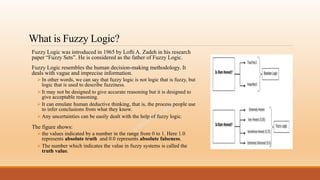
The figure shows:
the values indicated by a number in the range from 0 to 1. Here 1.0
represents absolute truth and 0.0 represents absolute falseness.
The number which indicates the value in fuzzy systems is called the
truth value.
Architecture Of Fuzzy Logic
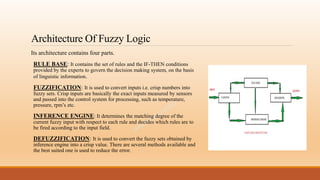
Its architecture contains four parts.
RULE BASE: It contains the set of rules and the IF-THEN conditions
provided by the experts to govern the decision making system, on the basis
of linguistic information.
FUZZIFICATION: It is used to convert inputs i.e. crisp numbers into
fuzzy sets. Crisp inputs are basically the exact inputs measured by sensors
and passed into the control system for processing, such as temperature,
pressure, rpm’s etc.
INFERENCE ENGINE: It determines the matching degree of the
current fuzzy input with respect to each rule and decides which rules are to
be fired according to the input field.
DEFUZZIFICATION: It is used to convert the fuzzy sets obtained by
inference engine into a crisp value. There are several methods available and
the best suited one is used to reduce the error.
Crisp Set And Logic
Classical logic is based on the crisp set, where a group of distinct objects are considered as a collection.
For example, the colors white and red are both separate objects in their own right, but they can be
regarded as a collection using the notation {red, white}. Crisp sets are, by convection designated a
capital letter so the example can be described by,
F = {red, white}
A crisp subset can be defined from a more extensive set where the elements of the set belong to the subset
according to some condition.
For example, set A can be defined as the set of numbers that are greater or equal to 4 and smaller or
equal to 12. This can be described by using the following notation:
A ={i |i is an integer and 4 < = i < =12}
Fuzzy Sets
Unlike crisp sets, a fuzzy set allows partial belonging to a set, that is defined by a degree of membership,
denoted by µ, that can take any value from 0 (element does not belong at all in the set) to 1 (element
belongs fully to the set).
It is evident that if we remove all the values of belonging except from 0 to 1, the fuzzy set will collapse to
crisp set.
The membership function of the set is the relationship between the elements of the sets and their degree-
of-belonging.
Fuzzy Sets
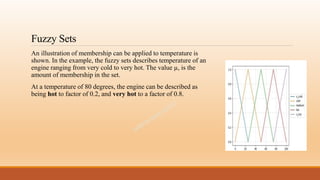
An illustration of membership can be applied to temperature is
shown. In the example, the fuzzy sets describes temperature of an
engine ranging from very cold to very hot. The value µ, is the
amount of membership in the set.
At a temperature of 80 degrees, the engine can be described as
being hot to factor of 0.2, and very hot to a factor of 0.8.
Applications of Fuzzy Logic and Fuzzy Systems
Aerospace
◦ In aerospace, fuzzy logic is used in the following areas −
◦ Altitude control of spacecraft
◦ Satellite altitude control
◦ Flow and mixture regulation in aircraft deicing vehicles
Automotive
◦ In automotive, fuzzy logic is used in the following areas −
◦ Trainable fuzzy systems for idle speed control
◦ Intelligent highway systems
◦ Traffic control
◦ Improving efficiency of automatic transmissions
Many other fields are Business, Defense, Electronics, Finance, Industrial Sector, Manufacturing, Marine,
Medical, Security , Transportation, Pattern recognition and classification
Advantages And Disadvantages Of Fuzzy Systems
ADVANTAGES
This system can work with any type of inputs
whether it is imprecise, distorted or noisy input
information.
The construction of fuzzy logic systems is easy and
understandable.
Fuzzy logic comes with mathematical concepts of
set theory and the reasoning of that is quite simple.
The algorithms can be described with little data, so
little memory is required.
DISADVANTAGES
There is no systematic approach to solve a given
problem through fuzzy logic.
Proof of its characteristics is difficult or impossible
in most cases because every time we do not get
mathematical description of the approach.
As fuzzy logic works on precise as well as
imprecise data so most of the time accuracy is
compromised.

Presentation on fuzzy logic and fuzzy systems

  • 1.
    Presentation on FuzzyLogic And Fuzzy Systems D E PA RT M E N T O F E LE C T R IC A L E N G IN E E R IN G D E LH I T E C H N O LO G IC A L U N IV E R S IT Y P R E PA R E D B Y: S H R E YA S A H U R O LL N U M B E R : 2 K 1 9 / C & I/ 0 9
  • 2.
    Content Introduction to fuzzylogic and fuzzy systems What is fuzzy logic Architecture of fuzzy logic Crisp set and logic Fuzzy sets Application of fuzzy logic and fuzzy systems Advantages and disadvantages of fuzzy systems
  • 3.
    Introduction To FuzzyLogic And Fuzzy Systems The word fuzzy refers to things which are not clear or are vague. Any event, process or function that is changing continuously cannot always be defined as either true or false, which means that we need to define such activities in a fuzzy manner. Fuzzy logic is derived from fuzzy set theory dealing with reasoning that is approximate rather than precisely deduced from classical predicate logic. What is fuzzy set theory? Fuzzy set theory is an extension of classical set theory where elements have varying degrees of membership. A logic based on the two truth values, True and False, is sometimes inadequate when describing human reasoning. Fuzzy logic uses the whole interval between 0 (false) and 1(true)to describe human reasoning. A Fuzzy Set is any set that allows its members to have different degree of membership, called membership function, in the interval [0, 1]. Fuzzy set theory defines Fuzzy Operators on Fuzzy Sets.
  • 4.
    What is FuzzyLogic? Fuzzy Logic was introduced in 1965 by Lofti A. Zadeh in his research paper “Fuzzy Sets”. He is considered as the father of Fuzzy Logic. Fuzzy Logic resembles the human decision-making methodology. It deals with vague and imprecise information. In other words, we can say that fuzzy logic is not logic that is fuzzy, but logic that is used to describe fuzziness. It may not be designed to give accurate reasoning but it is designed to give acceptable reasoning. It can emulate human deductive thinking, that is, the process people use to infer conclusions from what they know. Any uncertainties can be easily dealt with the help of fuzzy logic. The figure shows: the values indicated by a number in the range from 0 to 1. Here 1.0 represents absolute truth and 0.0 represents absolute falseness. The number which indicates the value in fuzzy systems is called the truth value.
  • 5.
    Architecture Of FuzzyLogic Its architecture contains four parts. RULE BASE: It contains the set of rules and the IF-THEN conditions provided by the experts to govern the decision making system, on the basis of linguistic information. FUZZIFICATION: It is used to convert inputs i.e. crisp numbers into fuzzy sets. Crisp inputs are basically the exact inputs measured by sensors and passed into the control system for processing, such as temperature, pressure, rpm’s etc. INFERENCE ENGINE: It determines the matching degree of the current fuzzy input with respect to each rule and decides which rules are to be fired according to the input field. DEFUZZIFICATION: It is used to convert the fuzzy sets obtained by inference engine into a crisp value. There are several methods available and the best suited one is used to reduce the error.
  • 6.
    Crisp Set AndLogic Classical logic is based on the crisp set, where a group of distinct objects are considered as a collection. For example, the colors white and red are both separate objects in their own right, but they can be regarded as a collection using the notation {red, white}. Crisp sets are, by convection designated a capital letter so the example can be described by, F = {red, white} A crisp subset can be defined from a more extensive set where the elements of the set belong to the subset according to some condition. For example, set A can be defined as the set of numbers that are greater or equal to 4 and smaller or equal to 12. This can be described by using the following notation: A ={i |i is an integer and 4 < = i < =12}
  • 7.
    Fuzzy Sets Unlike crispsets, a fuzzy set allows partial belonging to a set, that is defined by a degree of membership, denoted by µ, that can take any value from 0 (element does not belong at all in the set) to 1 (element belongs fully to the set). It is evident that if we remove all the values of belonging except from 0 to 1, the fuzzy set will collapse to crisp set. The membership function of the set is the relationship between the elements of the sets and their degree- of-belonging.
  • 8.
    Fuzzy Sets An illustrationof membership can be applied to temperature is shown. In the example, the fuzzy sets describes temperature of an engine ranging from very cold to very hot. The value µ, is the amount of membership in the set. At a temperature of 80 degrees, the engine can be described as being hot to factor of 0.2, and very hot to a factor of 0.8.
  • 9.
    Applications of FuzzyLogic and Fuzzy Systems Aerospace ◦ In aerospace, fuzzy logic is used in the following areas − ◦ Altitude control of spacecraft ◦ Satellite altitude control ◦ Flow and mixture regulation in aircraft deicing vehicles Automotive ◦ In automotive, fuzzy logic is used in the following areas − ◦ Trainable fuzzy systems for idle speed control ◦ Intelligent highway systems ◦ Traffic control ◦ Improving efficiency of automatic transmissions Many other fields are Business, Defense, Electronics, Finance, Industrial Sector, Manufacturing, Marine, Medical, Security , Transportation, Pattern recognition and classification
  • 10.
    Advantages And DisadvantagesOf Fuzzy Systems ADVANTAGES This system can work with any type of inputs whether it is imprecise, distorted or noisy input information. The construction of fuzzy logic systems is easy and understandable. Fuzzy logic comes with mathematical concepts of set theory and the reasoning of that is quite simple. The algorithms can be described with little data, so little memory is required. DISADVANTAGES There is no systematic approach to solve a given problem through fuzzy logic. Proof of its characteristics is difficult or impossible in most cases because every time we do not get mathematical description of the approach. As fuzzy logic works on precise as well as imprecise data so most of the time accuracy is compromised.