FUZZY RELATIONS,
FUZZY GRAPHS, AND
FUZZY ARITHMETIC
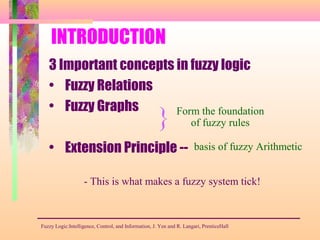
INTRODUCTION
3 Important concepts in fuzzy logic
• Fuzzy Relations
• Fuzzy Graphs
• Extension Principle --
Fuzzy Logic:Intelligence, Control, and Information, J. Yen and R. Langari, PrenticeHall
} Form the foundation
of fuzzy rules
basis of fuzzy Arithmetic
- This is what makes a fuzzy system tick!
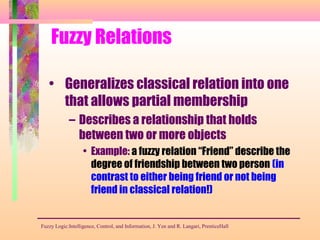
Fuzzy Relations
• Generalizes classical relation into one
that allows partial membership
– Describes a relationship that holds
between two or more objects
• Example: a fuzzy relation “Friend” describe the
degree of friendship between two person (in
contrast to either being friend or not being
friend in classical relation!)
Fuzzy Logic:Intelligence, Control, and Information, J. Yen and R. Langari, PrenticeHall
Fuzzy Relations
• A fuzzy relation is a mapping from the
Cartesian space X x Y to the interval [0,1],
where the strength of the mapping is
expressed by the membership function of the
relation µ (x,y)
• The “strength” of the relation between ordered
pairs of the two universes is measured with a
membership function expressing various
“degree” of strength [0,1]
Fuzzy Logic with Engineering Applications: Timothy J. Ross, McGraw-Hill
˜R
˜R
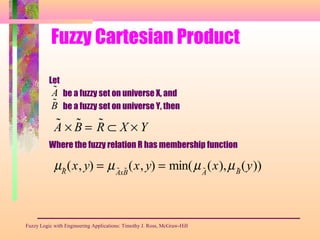
Fuzzy Cartesian Product
Let
be a fuzzy set on universe X, and
be a fuzzy set on universe Y, then
Where the fuzzy relation R has membership function
Fuzzy Logic with Engineering Applications: Timothy J. Ross, McGraw-Hill
˜A × ˜B = ˜R ⊂ X × Y
µ˜R
(x, y) = µ ˜Ax˜B
(x, y) = min(µ ˜A
(x),µ ˜B
(y))
˜A
˜B
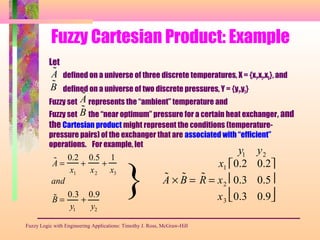
Fuzzy Cartesian Product: Example
Let
defined on a universe of three discrete temperatures, X = {x1,x2,x3}, and
defined on a universe of two discrete pressures, Y = {y1,y2}
Fuzzy set represents the “ambient” temperature and
Fuzzy set the “near optimum” pressure for a certain heat exchanger, and
the Cartesian product might represent the conditions (temperature-
pressure pairs) of the exchanger that are associated with “efficient”
operations. For example, let
Fuzzy Logic with Engineering Applications: Timothy J. Ross, McGraw-Hill
˜A
˜B
˜A
˜B
˜A =
0.2
x1
+
0.5
x2
+
1
x3
and
˜B =
0.3
y1
+
0.9
y2
} ˜A × ˜B = ˜R =
x1
x2
x3
0.2 0.2
0.3 0.5
0.3 0.9








y1 y2
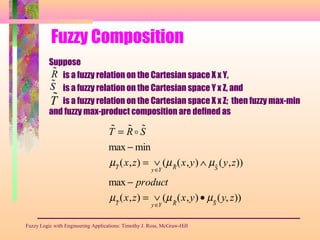
Fuzzy Composition
Suppose
is a fuzzy relation on the Cartesian space X x Y,
is a fuzzy relation on the Cartesian space Y x Z, and
is a fuzzy relation on the Cartesian space X x Z; then fuzzy max-min
and fuzzy max-product composition are defined as
Fuzzy Logic with Engineering Applications: Timothy J. Ross, McGraw-Hill
˜R
˜S
˜T
˜T = ˜Ro ˜S
max − min
µ˜T
(x,z) = ∨
y∈Y
(µ ˜R
(x,y) ∧ µ˜S
(y,z))
max − product
µ˜T
(x,z) = ∨
y∈Y
(µ ˜R
(x,y) • µ˜S
(y, z))
Fuzzy Composition: Example (max-min)
Fuzzy Logic with Engineering Applications: Timothy J. Ross, McGraw-Hill
X = {x1, x2},
µ˜T
(x1,z1) = ∨
y∈Y
(µ ˜R
(x1,y) ∧ µ˜S
(y,z1))
= max[min( 0.7,0.9),min(0.5, 0.1)]
= 0.7
Y ={y1, y2},and Z = {z1,z2, z3}
Consider the following fuzzy relations:
˜R =
x1
x2
0.7 0.5
0.8 0.4




y1 y2
and ˜S =
y1
y2
0.9 0.6 0.5
0.1 0.7 0.5




z1 z2 z3
Using max-min composition,
}˜T =
x1
x2
0.7 0.6 0.5
0.8 0.6 0.4




z1 z2 z3
Fuzzy Composition: Example (max-Prod)
Fuzzy Logic with Engineering Applications: Timothy J. Ross, McGraw-Hill
X = {x1, x2},
µ˜T
(x2, z2 ) = ∨
y∈Y
(µ ˜R
(x2 , y) • µ˜S
(y, z2))
= max[( 0.8,0.6),(0.4, 0.7)]
= 0.48
Y ={y1, y2},and Z = {z1,z2, z3}
Consider the following fuzzy relations:
˜R =
x1
x2
0.7 0.5
0.8 0.4




y1 y2
and ˜S =
y1
y2
0.9 0.6 0.5
0.1 0.7 0.5




z1 z2 z3
Using max-product composition,
}˜T =
x1
x2
.63 .42 .25
.72 .48 .20




z1 z2 z3
Application: Computer Engineering
Fuzzy Logic with Engineering Applications: Timothy J. Ross, McGraw-Hill
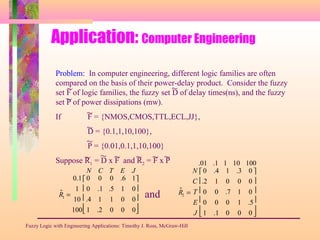
Problem: In computer engineering, different logic families are often
compared on the basis of their power-delay product. Consider the fuzzy
set F of logic families, the fuzzy set D of delay times(ns), and the fuzzy
set P of power dissipations (mw).
If F = {NMOS,CMOS,TTL,ECL,JJ},
D = {0.1,1,10,100},
P = {0.01,0.1,1,10,100}
Suppose R1 = D x F and R2 = F x P
~
~
~
~ ~ ~ ~ ~ ~
~
~
~
˜R1 =
0.1
1
10
100
0 0 0 .6 1
0 .1 .5 1 0
.4 1 1 0 0
1 .2 0 0 0










N C T E J
and ˜R2 =
N
C
T
E
J
0 .4 1 .3 0
.2 1 0 0 0
0 0 .7 1 0
0 0 0 1 .5
1 .1 0 0 0












.01 .1 1 10 100
Application: Computer Engineering (Cont)
Fuzzy Logic with Engineering Applications: Timothy J. Ross, McGraw-Hill
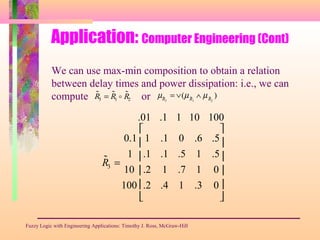
We can use max-min composition to obtain a relation
between delay times and power dissipation: i.e., we can
compute or˜R3 = ˜R1 o ˜R2
µ˜R3
= ∨(µ ˜R1
∧ µ ˜R2
)
˜R3 =
0.1
1
10
100
1 .1 0 .6 .5
.1 .1 .5 1 .5
.2 1 .7 1 0
.2 .4 1 .3 0












.01 .1 1 10 100
Application: Fuzzy Relation Petite
Fuzzy Logic:Intelligence, Control, and Information, J. Yen and R. Langari, PrenticeHall
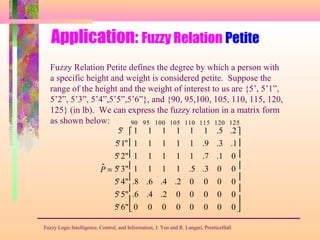
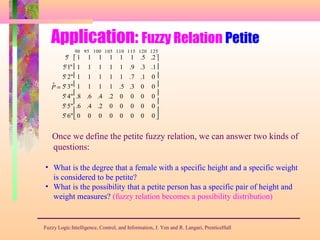
Fuzzy Relation Petite defines the degree by which a person with
a specific height and weight is considered petite. Suppose the
range of the height and the weight of interest to us are {5’, 5’1”,
5’2”, 5’3”, 5’4”,5’5”,5’6”}, and {90, 95,100, 105, 110, 115, 120,
125} (in lb). We can express the fuzzy relation in a matrix form
as shown below:
˜P =
5'
5'1"
5' 2"
5' 3"
5' 4"
5' 5"
5' 6"
1 1 1 1 1 1 .5 .2
1 1 1 1 1 .9 .3 .1
1 1 1 1 1 .7 .1 0
1 1 1 1 .5 .3 0 0
.8 .6 .4 .2 0 0 0 0
.6 .4 .2 0 0 0 0 0
0 0 0 0 0 0 0 0
















90 95 100 105 110 115 120 125
Application: Fuzzy Relation Petite
Fuzzy Logic:Intelligence, Control, and Information, J. Yen and R. Langari, PrenticeHall
˜P =
5'
5'1"
5' 2"
5' 3"
5' 4"
5' 5"
5' 6"
1 1 1 1 1 1 .5 .2
1 1 1 1 1 .9 .3 .1
1 1 1 1 1 .7 .1 0
1 1 1 1 .5 .3 0 0
.8 .6 .4 .2 0 0 0 0
.6 .4 .2 0 0 0 0 0
0 0 0 0 0 0 0 0
















90 95 100 105 110 115 120 125
Once we define the petite fuzzy relation, we can answer two kinds of
questions:
• What is the degree that a female with a specific height and a specific weight
is considered to be petite?
• What is the possibility that a petite person has a specific pair of height and
weight measures? (fuzzy relation becomes a possibility distribution)
Application: Fuzzy Relation Petite
Fuzzy Logic:Intelligence, Control, and Information, J. Yen and R. Langari, PrenticeHall
Given a two-dimensional fuzzy relation and the possible values of
one variable, infer the possible values of the other variable using
similar fuzzy composition as described earlier.
Definition: Let X and Y be the universes of discourse for variables x
and y, respectively, and xi and yj be elements of X and Y. Let R be a
fuzzy relation that maps X x Y to [0,1] and the possibility
distribution of X is known to be Πx(xi). The compositional rule of
inference infers the possibility distribution of Y as follows:
max-min composition:
max-product composition:
ΠY (yj ) = max
xi
(min(ΠX (xi),ΠR (xi, yj )))
ΠY (yj ) = max
xi
(ΠX (xi) × ΠR(xi, yj ))
Application: Fuzzy Relation Petite
Fuzzy Logic:Intelligence, Control, and Information, J. Yen and R. Langari, PrenticeHall
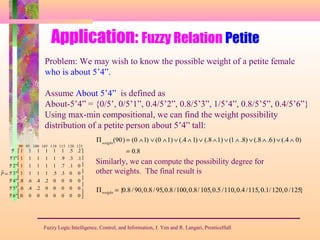
Problem: We may wish to know the possible weight of a petite female
who is about 5’4”.
Assume About 5’4” is defined as
About-5’4” = {0/5’, 0/5’1”, 0.4/5’2”, 0.8/5’3”, 1/5’4”, 0.8/5’5”, 0.4/5’6”}
Using max-min compositional, we can find the weight possibility
distribution of a petite person about 5’4” tall:
Πweight
(90) = (0 ∧1) ∨ (0 ∧1) ∨ (.4 ∧ 1) ∨ (.8 ∧1) ∨ (1 ∧ .8) ∨ (.8 ∧ .6) ∨ (.4 ∧ 0)
= 0.8
˜P =
5'
5'1"
5'2"
5'3"
5'4"
5'5"
5'6"
1 1 1 1 1 1 .5 .2
1 1 1 1 1 .9 .3 .1
1 1 1 1 1 .7 .1 0
1 1 1 1 .5 .3 0 0
.8 .6 .4 .2 0 0 0 0
.6 .4 .2 0 0 0 0 0
0 0 0 0 0 0 0 0
















90 95 100 105 110 115 120 125
Similarly, we can compute the possibility degree for
other weights. The final result is
Πweight = {0.8 /90,0.8 /95,0.8 /100,0.8/105,0.5 /110,0.4 /115, 0.1/120,0 /125}
Fuzzy Graphs
Fuzzy Logic:Intelligence, Control, and Information, J. Yen and R. Langari, PrenticeHall
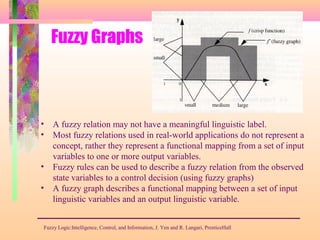
• A fuzzy relation may not have a meaningful linguistic label.
• Most fuzzy relations used in real-world applications do not represent a
concept, rather they represent a functional mapping from a set of input
variables to one or more output variables.
• Fuzzy rules can be used to describe a fuzzy relation from the observed
state variables to a control decision (using fuzzy graphs)
• A fuzzy graph describes a functional mapping between a set of input
linguistic variables and an output linguistic variable.
Extension Principle
Neuro-Fuzzy and Soft Computing, J. Jang, C. Sun, and E. Mitzutani, Prentice Hall
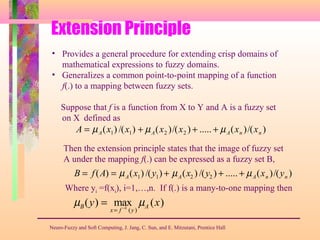
• Provides a general procedure for extending crisp domains of
mathematical expressions to fuzzy domains.
• Generalizes a common point-to-point mapping of a function
f(.) to a mapping between fuzzy sets.
Suppose that f is a function from X to Y and A is a fuzzy set
on X defined as
A = µA(x1) /(x1) + µA(x2 )/(x2 ) + ..... + µA(xn )/(xn )
Then the extension principle states that the image of fuzzy set
A under the mapping f(.) can be expressed as a fuzzy set B,
B = f(A) = µA(x1) /(y1) + µA(x2 ) /(y2 ) + ..... + µA(xn )/(yn )
Where yi =f(xi), i=1,…,n. If f(.) is a many-to-one mapping then
µB(y) = max
x= f −1
(y)
µA (x)
Extension Principle: Example
Neuro-Fuzzy and Soft Computing, J. Jang, C. Sun, and E. Mitzutani, Prentice Hall
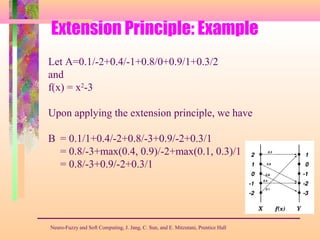
Let A=0.1/-2+0.4/-1+0.8/0+0.9/1+0.3/2
and
f(x) = x2
-3
Upon applying the extension principle, we have
B = 0.1/1+0.4/-2+0.8/-3+0.9/-2+0.3/1
= 0.8/-3+max(0.4, 0.9)/-2+max(0.1, 0.3)/1
= 0.8/-3+0.9/-2+0.3/1
Extension Principle: Example
Neuro-Fuzzy and Soft Computing, J. Jang, C. Sun, and E. Mitzutani, Prentice Hall
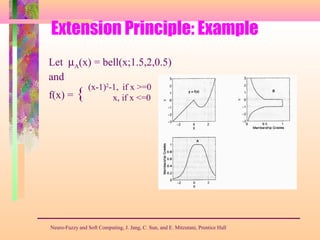
Let µA(x) = bell(x;1.5,2,0.5)
and
f(x) = {
(x-1)2
-1, if x >=0
x, if x <=0
Extension Principle: Example
Fuzzy Logic:Intelligence, Control, and Information, J. Yen and R. Langari, PrenticeHall
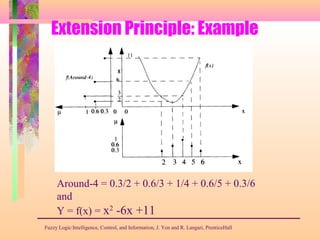
Around-4 = 0.3/2 + 0.6/3 + 1/4 + 0.6/5 + 0.3/6
and
Y = f(x) = x2
-6x +11
Arithmetic Operations on Fuzzy Numbers
Fuzzy Logic:Intelligence, Control, and Information, J. Yen and R. Langari, PrenticeHall
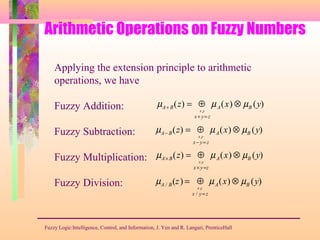
Applying the extension principle to arithmetic
operations, we have
Fuzzy Addition:
Fuzzy Subtraction:
Fuzzy Multiplication:
Fuzzy Division:
µA+ B(z) = ⊕
x ,y
x+ y= z
µA(x) ⊗ µB (y)
µA− B(z) = ⊕
x ,y
x− y= z
µA(x) ⊗ µB (y)
µA× B(z) = ⊕
x ,y
x× y=z
µA(x) ⊗ µB (y)
µA / B(z) = ⊕
x ,y
x / y= z
µA(x) ⊗ µB (y)
Arithmetic Operations on Fuzzy Numbers
Fuzzy Logic:Intelligence, Control, and Information, J. Yen and R. Langari, PrenticeHall
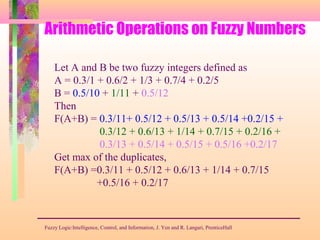
Let A and B be two fuzzy integers defined as
A = 0.3/1 + 0.6/2 + 1/3 + 0.7/4 + 0.2/5
B = 0.5/10 + 1/11 + 0.5/12
Then
F(A+B) = 0.3/11+ 0.5/12 + 0.5/13 + 0.5/14 +0.2/15 +
0.3/12 + 0.6/13 + 1/14 + 0.7/15 + 0.2/16 +
0.3/13 + 0.5/14 + 0.5/15 + 0.5/16 +0.2/17
Get max of the duplicates,
F(A+B) =0.3/11 + 0.5/12 + 0.6/13 + 1/14 + 0.7/15
+0.5/16 + 0.2/17
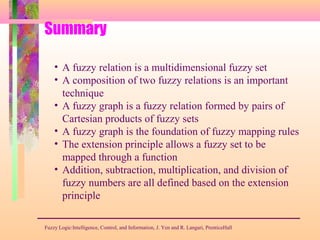
Summary
Fuzzy Logic:Intelligence, Control, and Information, J. Yen and R. Langari, PrenticeHall
• A fuzzy relation is a multidimensional fuzzy set
• A composition of two fuzzy relations is an important
technique
• A fuzzy graph is a fuzzy relation formed by pairs of
Cartesian products of fuzzy sets
• A fuzzy graph is the foundation of fuzzy mapping rules
• The extension principle allows a fuzzy set to be
mapped through a function
• Addition, subtraction, multiplication, and division of
fuzzy numbers are all defined based on the extension
principle

Fuzzy relations

  • 1.
    FUZZY RELATIONS, FUZZY GRAPHS,AND FUZZY ARITHMETIC
  • 2.
    INTRODUCTION 3 Important conceptsin fuzzy logic • Fuzzy Relations • Fuzzy Graphs • Extension Principle -- Fuzzy Logic:Intelligence, Control, and Information, J. Yen and R. Langari, PrenticeHall } Form the foundation of fuzzy rules basis of fuzzy Arithmetic - This is what makes a fuzzy system tick!
  • 3.
    Fuzzy Relations • Generalizesclassical relation into one that allows partial membership – Describes a relationship that holds between two or more objects • Example: a fuzzy relation “Friend” describe the degree of friendship between two person (in contrast to either being friend or not being friend in classical relation!) Fuzzy Logic:Intelligence, Control, and Information, J. Yen and R. Langari, PrenticeHall
  • 4.
    Fuzzy Relations • Afuzzy relation is a mapping from the Cartesian space X x Y to the interval [0,1], where the strength of the mapping is expressed by the membership function of the relation µ (x,y) • The “strength” of the relation between ordered pairs of the two universes is measured with a membership function expressing various “degree” of strength [0,1] Fuzzy Logic with Engineering Applications: Timothy J. Ross, McGraw-Hill ˜R ˜R
  • 5.
    Fuzzy Cartesian Product Let bea fuzzy set on universe X, and be a fuzzy set on universe Y, then Where the fuzzy relation R has membership function Fuzzy Logic with Engineering Applications: Timothy J. Ross, McGraw-Hill ˜A × ˜B = ˜R ⊂ X × Y µ˜R (x, y) = µ ˜Ax˜B (x, y) = min(µ ˜A (x),µ ˜B (y)) ˜A ˜B
  • 6.
    Fuzzy Cartesian Product:Example Let defined on a universe of three discrete temperatures, X = {x1,x2,x3}, and defined on a universe of two discrete pressures, Y = {y1,y2} Fuzzy set represents the “ambient” temperature and Fuzzy set the “near optimum” pressure for a certain heat exchanger, and the Cartesian product might represent the conditions (temperature- pressure pairs) of the exchanger that are associated with “efficient” operations. For example, let Fuzzy Logic with Engineering Applications: Timothy J. Ross, McGraw-Hill ˜A ˜B ˜A ˜B ˜A = 0.2 x1 + 0.5 x2 + 1 x3 and ˜B = 0.3 y1 + 0.9 y2 } ˜A × ˜B = ˜R = x1 x2 x3 0.2 0.2 0.3 0.5 0.3 0.9         y1 y2
  • 7.
    Fuzzy Composition Suppose is afuzzy relation on the Cartesian space X x Y, is a fuzzy relation on the Cartesian space Y x Z, and is a fuzzy relation on the Cartesian space X x Z; then fuzzy max-min and fuzzy max-product composition are defined as Fuzzy Logic with Engineering Applications: Timothy J. Ross, McGraw-Hill ˜R ˜S ˜T ˜T = ˜Ro ˜S max − min µ˜T (x,z) = ∨ y∈Y (µ ˜R (x,y) ∧ µ˜S (y,z)) max − product µ˜T (x,z) = ∨ y∈Y (µ ˜R (x,y) • µ˜S (y, z))
  • 8.
    Fuzzy Composition: Example(max-min) Fuzzy Logic with Engineering Applications: Timothy J. Ross, McGraw-Hill X = {x1, x2}, µ˜T (x1,z1) = ∨ y∈Y (µ ˜R (x1,y) ∧ µ˜S (y,z1)) = max[min( 0.7,0.9),min(0.5, 0.1)] = 0.7 Y ={y1, y2},and Z = {z1,z2, z3} Consider the following fuzzy relations: ˜R = x1 x2 0.7 0.5 0.8 0.4     y1 y2 and ˜S = y1 y2 0.9 0.6 0.5 0.1 0.7 0.5     z1 z2 z3 Using max-min composition, }˜T = x1 x2 0.7 0.6 0.5 0.8 0.6 0.4     z1 z2 z3
  • 9.
    Fuzzy Composition: Example(max-Prod) Fuzzy Logic with Engineering Applications: Timothy J. Ross, McGraw-Hill X = {x1, x2}, µ˜T (x2, z2 ) = ∨ y∈Y (µ ˜R (x2 , y) • µ˜S (y, z2)) = max[( 0.8,0.6),(0.4, 0.7)] = 0.48 Y ={y1, y2},and Z = {z1,z2, z3} Consider the following fuzzy relations: ˜R = x1 x2 0.7 0.5 0.8 0.4     y1 y2 and ˜S = y1 y2 0.9 0.6 0.5 0.1 0.7 0.5     z1 z2 z3 Using max-product composition, }˜T = x1 x2 .63 .42 .25 .72 .48 .20     z1 z2 z3
  • 10.
    Application: Computer Engineering FuzzyLogic with Engineering Applications: Timothy J. Ross, McGraw-Hill Problem: In computer engineering, different logic families are often compared on the basis of their power-delay product. Consider the fuzzy set F of logic families, the fuzzy set D of delay times(ns), and the fuzzy set P of power dissipations (mw). If F = {NMOS,CMOS,TTL,ECL,JJ}, D = {0.1,1,10,100}, P = {0.01,0.1,1,10,100} Suppose R1 = D x F and R2 = F x P ~ ~ ~ ~ ~ ~ ~ ~ ~ ~ ~ ~ ˜R1 = 0.1 1 10 100 0 0 0 .6 1 0 .1 .5 1 0 .4 1 1 0 0 1 .2 0 0 0           N C T E J and ˜R2 = N C T E J 0 .4 1 .3 0 .2 1 0 0 0 0 0 .7 1 0 0 0 0 1 .5 1 .1 0 0 0             .01 .1 1 10 100
  • 11.
    Application: Computer Engineering(Cont) Fuzzy Logic with Engineering Applications: Timothy J. Ross, McGraw-Hill We can use max-min composition to obtain a relation between delay times and power dissipation: i.e., we can compute or˜R3 = ˜R1 o ˜R2 µ˜R3 = ∨(µ ˜R1 ∧ µ ˜R2 ) ˜R3 = 0.1 1 10 100 1 .1 0 .6 .5 .1 .1 .5 1 .5 .2 1 .7 1 0 .2 .4 1 .3 0             .01 .1 1 10 100
  • 12.
    Application: Fuzzy RelationPetite Fuzzy Logic:Intelligence, Control, and Information, J. Yen and R. Langari, PrenticeHall Fuzzy Relation Petite defines the degree by which a person with a specific height and weight is considered petite. Suppose the range of the height and the weight of interest to us are {5’, 5’1”, 5’2”, 5’3”, 5’4”,5’5”,5’6”}, and {90, 95,100, 105, 110, 115, 120, 125} (in lb). We can express the fuzzy relation in a matrix form as shown below: ˜P = 5' 5'1" 5' 2" 5' 3" 5' 4" 5' 5" 5' 6" 1 1 1 1 1 1 .5 .2 1 1 1 1 1 .9 .3 .1 1 1 1 1 1 .7 .1 0 1 1 1 1 .5 .3 0 0 .8 .6 .4 .2 0 0 0 0 .6 .4 .2 0 0 0 0 0 0 0 0 0 0 0 0 0                 90 95 100 105 110 115 120 125
  • 13.
    Application: Fuzzy RelationPetite Fuzzy Logic:Intelligence, Control, and Information, J. Yen and R. Langari, PrenticeHall ˜P = 5' 5'1" 5' 2" 5' 3" 5' 4" 5' 5" 5' 6" 1 1 1 1 1 1 .5 .2 1 1 1 1 1 .9 .3 .1 1 1 1 1 1 .7 .1 0 1 1 1 1 .5 .3 0 0 .8 .6 .4 .2 0 0 0 0 .6 .4 .2 0 0 0 0 0 0 0 0 0 0 0 0 0                 90 95 100 105 110 115 120 125 Once we define the petite fuzzy relation, we can answer two kinds of questions: • What is the degree that a female with a specific height and a specific weight is considered to be petite? • What is the possibility that a petite person has a specific pair of height and weight measures? (fuzzy relation becomes a possibility distribution)
  • 14.
    Application: Fuzzy RelationPetite Fuzzy Logic:Intelligence, Control, and Information, J. Yen and R. Langari, PrenticeHall Given a two-dimensional fuzzy relation and the possible values of one variable, infer the possible values of the other variable using similar fuzzy composition as described earlier. Definition: Let X and Y be the universes of discourse for variables x and y, respectively, and xi and yj be elements of X and Y. Let R be a fuzzy relation that maps X x Y to [0,1] and the possibility distribution of X is known to be Πx(xi). The compositional rule of inference infers the possibility distribution of Y as follows: max-min composition: max-product composition: ΠY (yj ) = max xi (min(ΠX (xi),ΠR (xi, yj ))) ΠY (yj ) = max xi (ΠX (xi) × ΠR(xi, yj ))
  • 15.
    Application: Fuzzy RelationPetite Fuzzy Logic:Intelligence, Control, and Information, J. Yen and R. Langari, PrenticeHall Problem: We may wish to know the possible weight of a petite female who is about 5’4”. Assume About 5’4” is defined as About-5’4” = {0/5’, 0/5’1”, 0.4/5’2”, 0.8/5’3”, 1/5’4”, 0.8/5’5”, 0.4/5’6”} Using max-min compositional, we can find the weight possibility distribution of a petite person about 5’4” tall: Πweight (90) = (0 ∧1) ∨ (0 ∧1) ∨ (.4 ∧ 1) ∨ (.8 ∧1) ∨ (1 ∧ .8) ∨ (.8 ∧ .6) ∨ (.4 ∧ 0) = 0.8 ˜P = 5' 5'1" 5'2" 5'3" 5'4" 5'5" 5'6" 1 1 1 1 1 1 .5 .2 1 1 1 1 1 .9 .3 .1 1 1 1 1 1 .7 .1 0 1 1 1 1 .5 .3 0 0 .8 .6 .4 .2 0 0 0 0 .6 .4 .2 0 0 0 0 0 0 0 0 0 0 0 0 0                 90 95 100 105 110 115 120 125 Similarly, we can compute the possibility degree for other weights. The final result is Πweight = {0.8 /90,0.8 /95,0.8 /100,0.8/105,0.5 /110,0.4 /115, 0.1/120,0 /125}
  • 16.
    Fuzzy Graphs Fuzzy Logic:Intelligence,Control, and Information, J. Yen and R. Langari, PrenticeHall • A fuzzy relation may not have a meaningful linguistic label. • Most fuzzy relations used in real-world applications do not represent a concept, rather they represent a functional mapping from a set of input variables to one or more output variables. • Fuzzy rules can be used to describe a fuzzy relation from the observed state variables to a control decision (using fuzzy graphs) • A fuzzy graph describes a functional mapping between a set of input linguistic variables and an output linguistic variable.
  • 17.
    Extension Principle Neuro-Fuzzy andSoft Computing, J. Jang, C. Sun, and E. Mitzutani, Prentice Hall • Provides a general procedure for extending crisp domains of mathematical expressions to fuzzy domains. • Generalizes a common point-to-point mapping of a function f(.) to a mapping between fuzzy sets. Suppose that f is a function from X to Y and A is a fuzzy set on X defined as A = µA(x1) /(x1) + µA(x2 )/(x2 ) + ..... + µA(xn )/(xn ) Then the extension principle states that the image of fuzzy set A under the mapping f(.) can be expressed as a fuzzy set B, B = f(A) = µA(x1) /(y1) + µA(x2 ) /(y2 ) + ..... + µA(xn )/(yn ) Where yi =f(xi), i=1,…,n. If f(.) is a many-to-one mapping then µB(y) = max x= f −1 (y) µA (x)
  • 18.
    Extension Principle: Example Neuro-Fuzzyand Soft Computing, J. Jang, C. Sun, and E. Mitzutani, Prentice Hall Let A=0.1/-2+0.4/-1+0.8/0+0.9/1+0.3/2 and f(x) = x2 -3 Upon applying the extension principle, we have B = 0.1/1+0.4/-2+0.8/-3+0.9/-2+0.3/1 = 0.8/-3+max(0.4, 0.9)/-2+max(0.1, 0.3)/1 = 0.8/-3+0.9/-2+0.3/1
  • 19.
    Extension Principle: Example Neuro-Fuzzyand Soft Computing, J. Jang, C. Sun, and E. Mitzutani, Prentice Hall Let µA(x) = bell(x;1.5,2,0.5) and f(x) = { (x-1)2 -1, if x >=0 x, if x <=0
  • 20.
    Extension Principle: Example FuzzyLogic:Intelligence, Control, and Information, J. Yen and R. Langari, PrenticeHall Around-4 = 0.3/2 + 0.6/3 + 1/4 + 0.6/5 + 0.3/6 and Y = f(x) = x2 -6x +11
  • 21.
    Arithmetic Operations onFuzzy Numbers Fuzzy Logic:Intelligence, Control, and Information, J. Yen and R. Langari, PrenticeHall Applying the extension principle to arithmetic operations, we have Fuzzy Addition: Fuzzy Subtraction: Fuzzy Multiplication: Fuzzy Division: µA+ B(z) = ⊕ x ,y x+ y= z µA(x) ⊗ µB (y) µA− B(z) = ⊕ x ,y x− y= z µA(x) ⊗ µB (y) µA× B(z) = ⊕ x ,y x× y=z µA(x) ⊗ µB (y) µA / B(z) = ⊕ x ,y x / y= z µA(x) ⊗ µB (y)
  • 22.
    Arithmetic Operations onFuzzy Numbers Fuzzy Logic:Intelligence, Control, and Information, J. Yen and R. Langari, PrenticeHall Let A and B be two fuzzy integers defined as A = 0.3/1 + 0.6/2 + 1/3 + 0.7/4 + 0.2/5 B = 0.5/10 + 1/11 + 0.5/12 Then F(A+B) = 0.3/11+ 0.5/12 + 0.5/13 + 0.5/14 +0.2/15 + 0.3/12 + 0.6/13 + 1/14 + 0.7/15 + 0.2/16 + 0.3/13 + 0.5/14 + 0.5/15 + 0.5/16 +0.2/17 Get max of the duplicates, F(A+B) =0.3/11 + 0.5/12 + 0.6/13 + 1/14 + 0.7/15 +0.5/16 + 0.2/17
  • 23.
    Summary Fuzzy Logic:Intelligence, Control,and Information, J. Yen and R. Langari, PrenticeHall • A fuzzy relation is a multidimensional fuzzy set • A composition of two fuzzy relations is an important technique • A fuzzy graph is a fuzzy relation formed by pairs of Cartesian products of fuzzy sets • A fuzzy graph is the foundation of fuzzy mapping rules • The extension principle allows a fuzzy set to be mapped through a function • Addition, subtraction, multiplication, and division of fuzzy numbers are all defined based on the extension principle