Introduction to Soft
Computing
Course: Computational Intelligence In Engineering (Soft Computing )
Prof. (Dr.) Pravat Kumar Rout
Department of EEE, ITER
Siksha ‘O’Anusandhan (Deemed to be University),
Bhubaneswar, Odisha, India
1
Computing
 The process or act of calculation
 The action of mathematical calculation.
 Computing is any activity that uses computers to manage, process, and communicate
information.
 It includes development of both hardware and software.
 Computing is a critical, integral component of modern industrial technology.
 Major computing disciplines include computer engineering, software engineering,
computer science, information systems, and information technology.
2
3
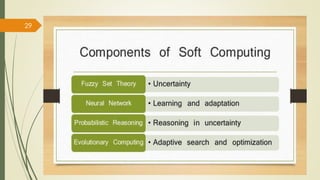
Soft Computing
 Soft computing is the use of approximate calculations to provide imprecise but usable
solutions to complex computational problems.
 The approach enables solutions for problems that may be either unsolvable or just too
time-consuming to solve with current hardware.
 Soft computing is sometimes referred to as computational intelligence.
 With the human mind as a role model, soft computing is tolerant of partial truths,
uncertainty, imprecision and approximation, unlike traditional computing models.
 The tolerance of soft computing allows researchers to approach some problems that
traditional computing can't process.
4
Continue...
 Soft computing differs from conventional (hard) computing in that, unlike hard
computing, it is tolerant of imprecision, uncertainty, partial truth, and approximation.
 In effect, the role model for soft computing is the human mind.
 It does not require any mathematical modelling for solving any given problem
 It gives different solutions when we solve a problem of one input from time to time
 Uses some biologically inspired methodologies such as genetics, evolution, particles
swarming, the human nervous system, etc.
 Adaptive in nature.
5
Few Facts on Soft Computing
 tolerance of imprecision: the result obtained using soft-computing is not precise.
 uncertainty: the soft-computing algorithm may give different results every time for
the same problem.
 robustness: soft-computing algorithms can tackle any kind of input noise
 low solution cost: soft-computing makes it feasible to solve some of the problems
which could be computationally very expensive if solved using hard computing.
6
Advantages of Soft Computing
 Since Soft computing methods do not call for wide-ranging mathematical formulation
pertaining to the problem, the need for explicit knowledge in a particular domain can
be reduced.
 These tools can handle multiple variables simultaneously.
 For optimization problems, the solutions can be prevented from falling into local minima
by using global optimization strategies.
 These techniques are mostly cost effective.
 Dependency on expensive traditional simulations packages can be reduced to some
degree by efficient hybridization of soft computing methods.
 These methods are generally adaptive in nature and are scalable.
7
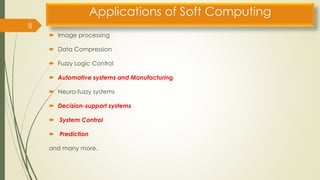
Applications of Soft Computing
 Image processing
 Data Compression
 Fuzzy Logic Control
 Automative systems and Manufacturing
 Neuro-fuzzy systems
 Decision-support systems
 System Control
 Prediction
and many more.
8
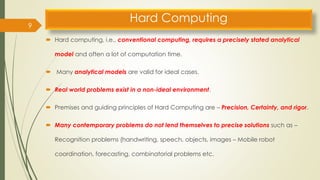
 Hard computing, i.e., conventional computing, requires a precisely stated analytical
model and often a lot of computation time.
 Many analytical models are valid for ideal cases.
 Real world problems exist in a non-ideal environment.
 Premises and guiding principles of Hard Computing are – Precision, Certainty, and rigor.
 Many contemporary problems do not lend themselves to precise solutions such as –
Recognition problems (handwriting, speech, objects, images – Mobile robot
coordination, forecasting, combinatorial problems etc.
Hard Computing
9
Difference Between Hard Computing and Soft
Computing
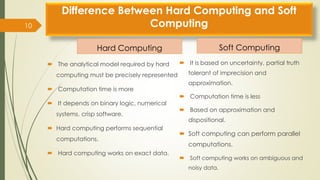
Hard Computing
 The analytical model required by hard
computing must be precisely represented
 Computation time is more
 It depends on binary logic, numerical
systems, crisp software.
 Hard computing performs sequential
computations.
 Hard computing works on exact data.
Soft Computing
 It is based on uncertainty, partial truth
tolerant of imprecision and
approximation.
 Computation time is less
 Based on approximation and
dispositional.
 Soft computing can perform parallel
computations.
 Soft computing works on ambiguous and
noisy data.
10
Difference Between Hard Computing and Soft
Computing....
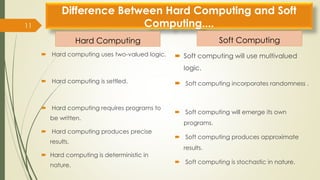
Hard Computing
 Hard computing uses two-valued logic.
 Hard computing is settled.
 Hard computing requires programs to
be written.
 Hard computing produces precise
results.
 Hard computing is deterministic in
nature.
Soft Computing
 Soft computing will use multivalued
logic.
 Soft computing incorporates randomness .
 Soft computing will emerge its own
programs.
 Soft computing produces approximate
results.
 Soft computing is stochastic in nature.
11
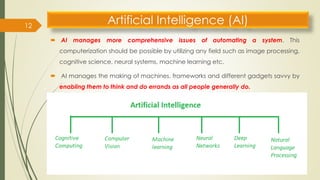
Artificial Intelligence (AI)
 AI manages more comprehensive issues of automating a system. This
computerization should be possible by utilizing any field such as image processing,
cognitive science, neural systems, machine learning etc.
 AI manages the making of machines, frameworks and different gadgets savvy by
enabling them to think and do errands as all people generally do.
12
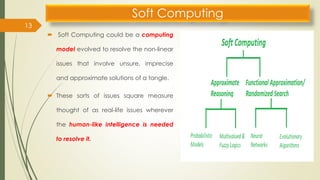
Soft Computing
 Soft Computing could be a computing
model evolved to resolve the non-linear
issues that involve unsure, imprecise
and approximate solutions of a tangle.
 These sorts of issues square measure
thought of as real-life issues wherever
the human-like intelligence is needed
to resolve it.
13
Differentiate Between AI and Soft Computing
AI
 Artificial Intelligence is the art and science of
developing intelligent machines.
 AI plays a fundamental role in finding missing
pieces between the interesting real world
problems.
 Branches of AI :
1. Reasoning
2. Perception
3. Natural language processing
Soft Computing
 Soft Computing aims to exploit tolerance for
uncertainty, imprecision, and partial truth
 Soft Computing comprises techniques which
are inspired by human reasoning and have
the potential in handling imprecision,
uncertainty and partial truth.
 Branches of soft computing :
1. Fuzzy systems
2. Evolutionary computation
3. Artificial neural computing
14
Differentiate Between AI and Soft Computing
AI
 AI has countless applications in
healthcare and widely used in analyzing
complicated medical data.
 Goal is to stimulate human-level
intelligence in machines
 They require programs to be written.
 They require exact input sample.
Soft Computing
 They are used in science and engineering
disciplines such as data mining,
electronics, automotive, etc.
 It aims at accommodation with the
pervasive imprecision of the real world.
 They not require all programs to be written,
they can evolve its own programs.
 They can deal with ambiguous and
noisy data.
15
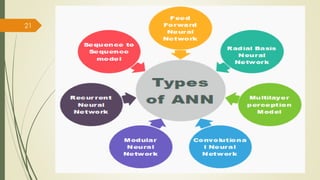
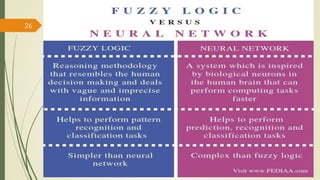
Artificial Neural Network
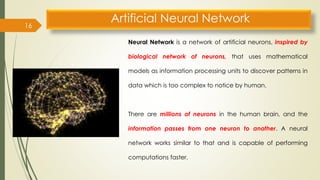
Neural Network is a network of artificial neurons, inspired by
biological network of neurons, that uses mathematical
models as information processing units to discover patterns in
data which is too complex to notice by human.
There are millions of neurons in the human brain, and the
information passes from one neuron to another. A neural
network works similar to that and is capable of performing
computations faster.
16
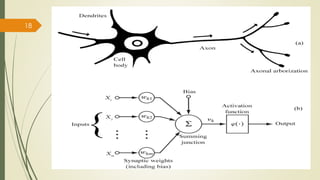
Artificial Neural Network
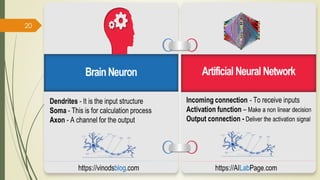
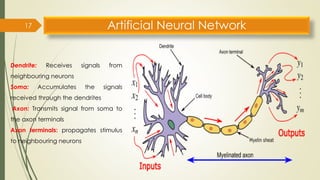
Dendrite: Receives signals from
neighbouring neurons
Soma: Accumulates the signals
received through the dendrites
Axon: Transmits signal from soma to
the axon terminals
Axon terminals: propagates stimulus
to neighbouring neurons
17
18
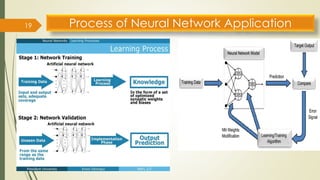
Process of Neural Network Application19
20
21
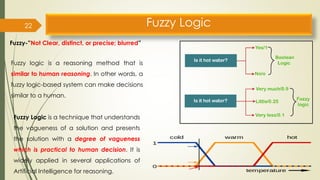
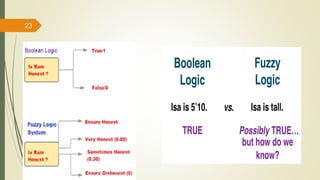
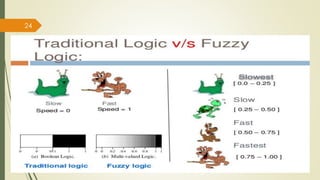
Fuzzy Logic
Fuzzy Logic is a technique that understands
the vagueness of a solution and presents
the solution with a degree of vagueness
which is practical to human decision. It is
widely applied in several applications of
Artificial Intelligence for reasoning.
Fuzzy-”Not Clear, distinct, or precise; blurred”
Fuzzy logic is a reasoning method that is
similar to human reasoning. In other words, a
fuzzy logic-based system can make decisions
similar to a human.
22
23
24
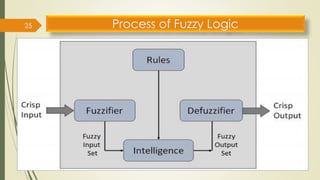
Process of Fuzzy Logic25
26
Evolutionary Computation
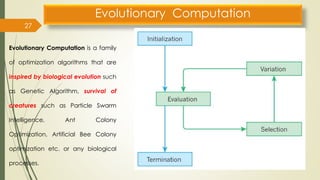
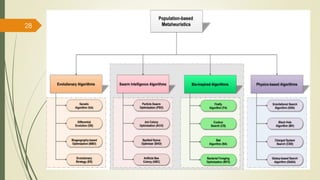
Evolutionary Computation is a family
of optimization algorithms that are
inspired by biological evolution such
as Genetic Algorithm, survival of
creatures such as Particle Swarm
Intelligence, Ant Colony
Optimization, Artificial Bee Colony
optimization etc. or any biological
processes.
27
28
29
30
Haykin, Simon S. "Neural networks and learning machines/Simon
Haykin." (2009).
Sivanandam, S. N., and S. N. Deepa. Principles of soft
computing (with CD). John Wiley & Sons, 2007.
Jang, Jyh-Shing Roger, Chuen-Tsai Sun, and Eiji Mizutani. "Neuro-
fuzzy and soft computing-a computational approach to
learning and machine intelligence [Book Review]." IEEE
Transactions on automatic control 42.10 (1997): 1482-1484.
Books
Ross, Timothy J. Fuzzy logic with engineering applications. Vol. 2.
New York: wiley, 2004.
Questions
 Differentiate between Soft Computing and Hard Computing?
 How the concept of ANN, FL and Evolutionary Optimization is applied in various
engineering applications? Give a general outline briefly on these three
techniques?
 What is fuzzy Logic?
 What is Artificial Neural Network?
 What is Evolutionary based Computation/Optimization ?
 Differentiate between the Biological Neuron and Artificial Neuron?
 Differentiate between a Boolean logic and fuzzy logic
31
32

Introduction to soft computing

  • 1.
    Introduction to Soft Computing Course:Computational Intelligence In Engineering (Soft Computing ) Prof. (Dr.) Pravat Kumar Rout Department of EEE, ITER Siksha ‘O’Anusandhan (Deemed to be University), Bhubaneswar, Odisha, India 1
  • 2.
    Computing  The processor act of calculation  The action of mathematical calculation.  Computing is any activity that uses computers to manage, process, and communicate information.  It includes development of both hardware and software.  Computing is a critical, integral component of modern industrial technology.  Major computing disciplines include computer engineering, software engineering, computer science, information systems, and information technology. 2
  • 3.
  • 4.
    Soft Computing  Softcomputing is the use of approximate calculations to provide imprecise but usable solutions to complex computational problems.  The approach enables solutions for problems that may be either unsolvable or just too time-consuming to solve with current hardware.  Soft computing is sometimes referred to as computational intelligence.  With the human mind as a role model, soft computing is tolerant of partial truths, uncertainty, imprecision and approximation, unlike traditional computing models.  The tolerance of soft computing allows researchers to approach some problems that traditional computing can't process. 4
  • 5.
    Continue...  Soft computingdiffers from conventional (hard) computing in that, unlike hard computing, it is tolerant of imprecision, uncertainty, partial truth, and approximation.  In effect, the role model for soft computing is the human mind.  It does not require any mathematical modelling for solving any given problem  It gives different solutions when we solve a problem of one input from time to time  Uses some biologically inspired methodologies such as genetics, evolution, particles swarming, the human nervous system, etc.  Adaptive in nature. 5
  • 6.
    Few Facts onSoft Computing  tolerance of imprecision: the result obtained using soft-computing is not precise.  uncertainty: the soft-computing algorithm may give different results every time for the same problem.  robustness: soft-computing algorithms can tackle any kind of input noise  low solution cost: soft-computing makes it feasible to solve some of the problems which could be computationally very expensive if solved using hard computing. 6
  • 7.
    Advantages of SoftComputing  Since Soft computing methods do not call for wide-ranging mathematical formulation pertaining to the problem, the need for explicit knowledge in a particular domain can be reduced.  These tools can handle multiple variables simultaneously.  For optimization problems, the solutions can be prevented from falling into local minima by using global optimization strategies.  These techniques are mostly cost effective.  Dependency on expensive traditional simulations packages can be reduced to some degree by efficient hybridization of soft computing methods.  These methods are generally adaptive in nature and are scalable. 7
  • 8.
    Applications of SoftComputing  Image processing  Data Compression  Fuzzy Logic Control  Automative systems and Manufacturing  Neuro-fuzzy systems  Decision-support systems  System Control  Prediction and many more. 8
  • 9.
     Hard computing,i.e., conventional computing, requires a precisely stated analytical model and often a lot of computation time.  Many analytical models are valid for ideal cases.  Real world problems exist in a non-ideal environment.  Premises and guiding principles of Hard Computing are – Precision, Certainty, and rigor.  Many contemporary problems do not lend themselves to precise solutions such as – Recognition problems (handwriting, speech, objects, images – Mobile robot coordination, forecasting, combinatorial problems etc. Hard Computing 9
  • 10.
    Difference Between HardComputing and Soft Computing Hard Computing  The analytical model required by hard computing must be precisely represented  Computation time is more  It depends on binary logic, numerical systems, crisp software.  Hard computing performs sequential computations.  Hard computing works on exact data. Soft Computing  It is based on uncertainty, partial truth tolerant of imprecision and approximation.  Computation time is less  Based on approximation and dispositional.  Soft computing can perform parallel computations.  Soft computing works on ambiguous and noisy data. 10
  • 11.
    Difference Between HardComputing and Soft Computing.... Hard Computing  Hard computing uses two-valued logic.  Hard computing is settled.  Hard computing requires programs to be written.  Hard computing produces precise results.  Hard computing is deterministic in nature. Soft Computing  Soft computing will use multivalued logic.  Soft computing incorporates randomness .  Soft computing will emerge its own programs.  Soft computing produces approximate results.  Soft computing is stochastic in nature. 11
  • 12.
    Artificial Intelligence (AI) AI manages more comprehensive issues of automating a system. This computerization should be possible by utilizing any field such as image processing, cognitive science, neural systems, machine learning etc.  AI manages the making of machines, frameworks and different gadgets savvy by enabling them to think and do errands as all people generally do. 12
  • 13.
    Soft Computing  SoftComputing could be a computing model evolved to resolve the non-linear issues that involve unsure, imprecise and approximate solutions of a tangle.  These sorts of issues square measure thought of as real-life issues wherever the human-like intelligence is needed to resolve it. 13
  • 14.
    Differentiate Between AIand Soft Computing AI  Artificial Intelligence is the art and science of developing intelligent machines.  AI plays a fundamental role in finding missing pieces between the interesting real world problems.  Branches of AI : 1. Reasoning 2. Perception 3. Natural language processing Soft Computing  Soft Computing aims to exploit tolerance for uncertainty, imprecision, and partial truth  Soft Computing comprises techniques which are inspired by human reasoning and have the potential in handling imprecision, uncertainty and partial truth.  Branches of soft computing : 1. Fuzzy systems 2. Evolutionary computation 3. Artificial neural computing 14
  • 15.
    Differentiate Between AIand Soft Computing AI  AI has countless applications in healthcare and widely used in analyzing complicated medical data.  Goal is to stimulate human-level intelligence in machines  They require programs to be written.  They require exact input sample. Soft Computing  They are used in science and engineering disciplines such as data mining, electronics, automotive, etc.  It aims at accommodation with the pervasive imprecision of the real world.  They not require all programs to be written, they can evolve its own programs.  They can deal with ambiguous and noisy data. 15
  • 16.
    Artificial Neural Network NeuralNetwork is a network of artificial neurons, inspired by biological network of neurons, that uses mathematical models as information processing units to discover patterns in data which is too complex to notice by human. There are millions of neurons in the human brain, and the information passes from one neuron to another. A neural network works similar to that and is capable of performing computations faster. 16
  • 17.
    Artificial Neural Network Dendrite:Receives signals from neighbouring neurons Soma: Accumulates the signals received through the dendrites Axon: Transmits signal from soma to the axon terminals Axon terminals: propagates stimulus to neighbouring neurons 17
  • 18.
  • 19.
    Process of NeuralNetwork Application19
  • 20.
  • 21.
  • 22.
    Fuzzy Logic Fuzzy Logicis a technique that understands the vagueness of a solution and presents the solution with a degree of vagueness which is practical to human decision. It is widely applied in several applications of Artificial Intelligence for reasoning. Fuzzy-”Not Clear, distinct, or precise; blurred” Fuzzy logic is a reasoning method that is similar to human reasoning. In other words, a fuzzy logic-based system can make decisions similar to a human. 22
  • 23.
  • 24.
  • 25.
  • 26.
  • 27.
    Evolutionary Computation Evolutionary Computationis a family of optimization algorithms that are inspired by biological evolution such as Genetic Algorithm, survival of creatures such as Particle Swarm Intelligence, Ant Colony Optimization, Artificial Bee Colony optimization etc. or any biological processes. 27
  • 28.
  • 29.
  • 30.
    30 Haykin, Simon S."Neural networks and learning machines/Simon Haykin." (2009). Sivanandam, S. N., and S. N. Deepa. Principles of soft computing (with CD). John Wiley & Sons, 2007. Jang, Jyh-Shing Roger, Chuen-Tsai Sun, and Eiji Mizutani. "Neuro- fuzzy and soft computing-a computational approach to learning and machine intelligence [Book Review]." IEEE Transactions on automatic control 42.10 (1997): 1482-1484. Books Ross, Timothy J. Fuzzy logic with engineering applications. Vol. 2. New York: wiley, 2004.
  • 31.
    Questions  Differentiate betweenSoft Computing and Hard Computing?  How the concept of ANN, FL and Evolutionary Optimization is applied in various engineering applications? Give a general outline briefly on these three techniques?  What is fuzzy Logic?  What is Artificial Neural Network?  What is Evolutionary based Computation/Optimization ?  Differentiate between the Biological Neuron and Artificial Neuron?  Differentiate between a Boolean logic and fuzzy logic 31
  • 32.