Fuzzy Set Theory
UNIT-2
Introduction
• The word “fuzzy” means “vaguness (ambiguity)”.
• Fuzziness occurs when the boundary of a piece of
information is not clear-cut.
• Fuzzy sets - 1965 Lotfi Zadeh as an extension of classical
notation set.
• Classical set theory allows the membership of the elements
in the set in binary terms.
• Fuzzy set theory permits membership function valued in
the interval [0,1].
Introduction
Example:
Words like young, tall, good or high are fuzzy.
• There is no single quantitative value which defines the term
young.
• For some people, age 25 is young, and for others, age 35 is
young.
• The concept young has no clean boundary.
• Age 35 has some possibility of being young and usually
depends on the context in which it is being considered.
Fuzzy set theory is an extension of classical set theory where
elements have degree of membership.
Introduction
• In real world, there exist much fuzzy knowledge (i.e. vague,
uncertain inexact etc).
• Human thinking and reasoning (analysis, logic,
interpretation) frequently involved fuzzy information.
• Human can give satisfactory answers, which are probably
true.
• Our systems are unable to answer many question because
the systems are designed based upon classical set theory
(Unreliable and incomplete).
• We want, our system should be able to cope with
unreliable and incomplete information.
• Fuzzy system have been provide solution.
Introduction
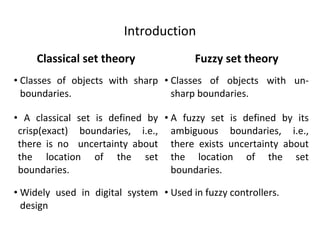
Classical set theory Fuzzy set theory
• Classes of objects with sharp
boundaries.
• Classes of objects with un-
sharp boundaries.
• A classical set is defined by
crisp(exact) boundaries, i.e.,
there is no uncertainty about
the location of the set
boundaries.
• A fuzzy set is defined by its
ambiguous boundaries, i.e.,
there exists uncertainty about
the location of the set
boundaries.
• Widely used in digital system
design
• Used in fuzzy controllers.
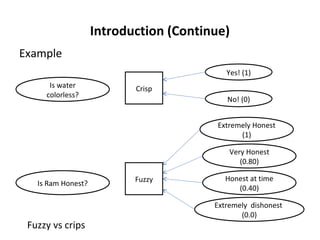
Introduction (Continue)
Is water
colorless?
Is Ram Honest?
Crisp
Yes! (1)
No! (0)
Fuzzy
Extremely Honest
(1)
Very Honest
(0.80)
Honest at time
(0.40)
Extremely dishonest
(0.0)
Fuzzy vs crips
Example
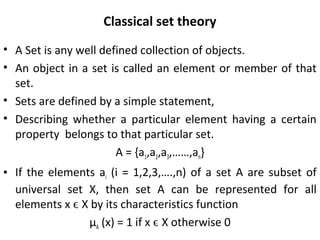
Classical set theory
• A Set is any well defined collection of objects.
• An object in a set is called an element or member of that
set.
• Sets are defined by a simple statement,
• Describing whether a particular element having a certain
property belongs to that particular set.
A = {a1,a2,a3,……,an}
• If the elements ai (i = 1,2,3,….,n) of a set A are subset of
universal set X, then set A can be represented for all
elements x ϵ X by its characteristics function
µA (x) = 1 if x ϵ X otherwise 0
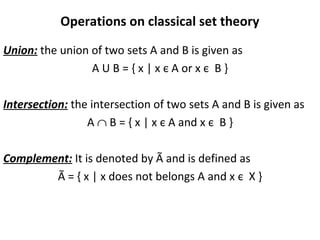
Operations on classical set theory
Union: the union of two sets A and B is given as
A U B = { x | x є A or x є B }
Intersection: the intersection of two sets A and B is given as
A ∩ B = { x | x є A and x є B }
Complement: It is denoted by à and is defined as
à = { x | x does not belongs A and x є X }
Fuzzy Sets
• Fuzzy sets theory is an extension of classical set theory.
• Elements have varying degree of membership. A logic based
on two truth values,
• True and False is sometimes insufficient when describing
human reasoning.
• Fuzzy Logic uses the whole interval between 0 (false) and 1
(true) to describe human reasoning.
• A Fuzzy Set is any set that allows its members to have
different degree of membership, called membership
function, having interval [0,1].
Fuzzy Sets
• Fuzzy Logic is derived from fuzzy set theory
• Many degree of membership (between 0 to 1) are allowed.
• Thus a membership function µA
(x)
is associated with a fuzzy
sets à such that the function maps every element of
universe of discourse X to the interval [0,1].
• The mapping is written as: µÃ(x): X  [0,1].
• Fuzzy Logic is capable of handing inherently imprecise
(vague or inexact or rough or inaccurate) concepts
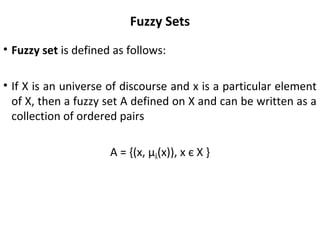
Fuzzy Sets
• Fuzzy set is defined as follows:
• If X is an universe of discourse and x is a particular element
of X, then a fuzzy set A defined on X and can be written as a
collection of ordered pairs
A = {(x, µÃ(x)), x є X }
Fuzzy Sets (Continue)
Example
• Let X = {g1, g2, g3, g4, g5} be the reference set of students.
• Let à be the fuzzy set of “smart” students, where “smart” is
fuzzy term.
à = {(g1,0.4)(g2,0.5)(g3,1)(g4,0.9)(g5,0.8)}
Here à indicates that the smartness of g1 is 0.4 and so on
Fuzzy Sets (Continue)
Membership Function
• The membership function fully defines the fuzzy set
• A membership function provides a measure of the degree of
similarity of an element to a fuzzy set
Membership functions can
– either be chosen by the user arbitrarily, based on the
user’s experience (MF chosen by two users could be
different depending upon their experiences,
perspectives, etc.)
– Or be designed using machine learning methods (e.g.,
artificial neural networks, genetic algorithms, etc.)
Fuzzy Sets (Continue)
There are different shapes of membership functions;
• Triangular,
• Trapezoidal,
• Gaussian, etc
Fuzzy Sets (Continue)
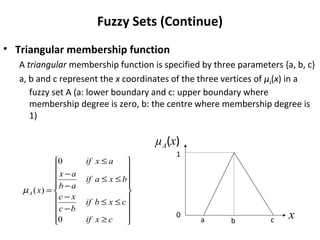
• Triangular membership function
A triangular membership function is specified by three parameters {a, b, c}
a, b and c represent the x coordinates of the three vertices of µA(x) in a
fuzzy set A (a: lower boundary and c: upper boundary where
membership degree is zero, b: the centre where membership degree is
1)


















≥
≤≤
−
−
≤≤
−
−
≤
=
cxif
cxbif
bc
xc
bxaif
ab
ax
axif
xA
0
0
)(µ
a b c x
µA(x)
1
0
Fuzzy Sets (Continue)
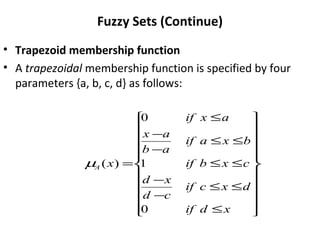
• Trapezoid membership function
• A trapezoidal membership function is specified by four
parameters {a, b, c, d} as follows:






















≤
≤≤
−
−
≤≤
≤≤
−
−
≤
=
xdif
dxcif
cd
xd
cxbif
bxaif
ab
ax
axif
xA
0
1
0
)(µ
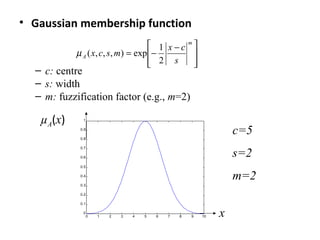
• Gaussian membership function
– c: centre
– s: width
– m: fuzzification factor (e.g., m=2)
µA(x)







 −
−=
m
A
s
cx
mscx
2
1
exp),,,(µ
0 1 2 3 4 5 6 7 8 9 10
0
0.1
0.2
0.3
0.4
0.5
0.6
0.7
0.8
0.9
1
x
c=5
s=2
m=2
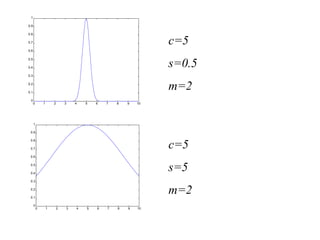
c=5
s=0.5
m=2
0 1 2 3 4 5 6 7 8 9 10
0
0.1
0.2
0.3
0.4
0.5
0.6
0.7
0.8
0.9
1
0 1 2 3 4 5 6 7 8 9 10
0
0.1
0.2
0.3
0.4
0.5
0.6
0.7
0.8
0.9
1
c=5
s=5
m=2
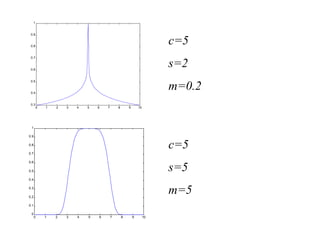
c=5
s=2
m=0.2
c=5
s=5
m=5
0 1 2 3 4 5 6 7 8 9 10
0.3
0.4
0.5
0.6
0.7
0.8
0.9
1
0 1 2 3 4 5 6 7 8 9 10
0
0.1
0.2
0.3
0.4
0.5
0.6
0.7
0.8
0.9
1
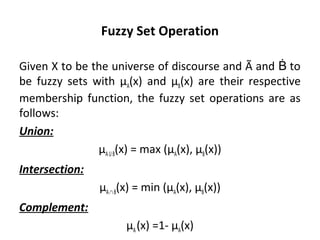
Fuzzy Set Operation
Given X to be the universe of discourse and à and toḂ
be fuzzy sets with µA(x) and µB(x) are their respective
membership function, the fuzzy set operations are as
follows:
Union:
µAUB(x) = max (µA(x), µB(x))
Intersection:
µA∩B(x) = min (µA(x), µB(x))
Complement:
µA(x) =1- µA(x)
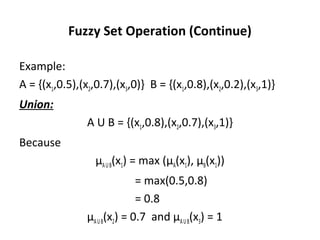
Fuzzy Set Operation (Continue)
Example:
A = {(x1,0.5),(x2,0.7),(x3,0)} B = {(x1,0.8),(x2,0.2),(x3,1)}
Union:
A U B = {(x1,0.8),(x2,0.7),(x3,1)}
Because
µAUB(x1) = max (µA(x1), µB(x1))
= max(0.5,0.8)
= 0.8
µAUB(x2) = 0.7 and µAUB(x3) = 1
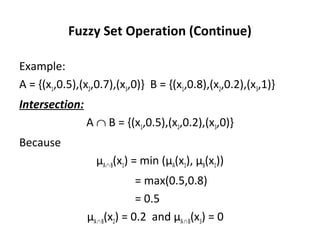
Fuzzy Set Operation (Continue)
Example:
A = {(x1,0.5),(x2,0.7),(x3,0)} B = {(x1,0.8),(x2,0.2),(x3,1)}
Intersection:
A ∩ B = {(x1,0.5),(x2,0.2),(x3,0)}
Because
µA∩B(x1) = min (µA(x1), µB(x1))
= max(0.5,0.8)
= 0.5
µA∩B(x2) = 0.2 and µA∩B(x3) = 0
Fuzzy Set Operation (Continue)
Example:
A = {(x1,0.5),(x2,0.7),(x3,0)}
Complement:
Ac
= {(x1,0.5),(x2,0.3),(x3,1)}
Because
µA(x1) =1- µA(x1)
= 1 – 0.5
= 0.5
µA(x2) = 0.3 and µA(x3) = 1
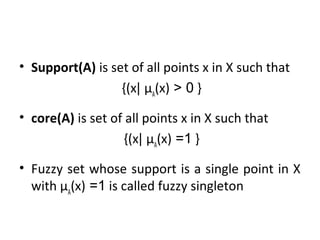
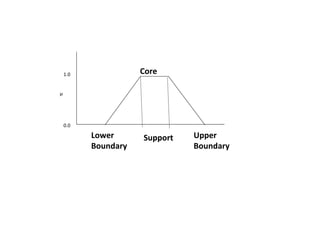
• Support(A) is set of all points x in X such that
{(x∣ µA
(x) > 0 }
• core(A) is set of all points x in X such that
{(x∣ µA
(x) =1 }
• Fuzzy set whose support is a single point in X
with µA
(x) =1 is called fuzzy singleton
Support
1.0
µ
0.0
Core
Lower
Boundary
Upper
Boundary
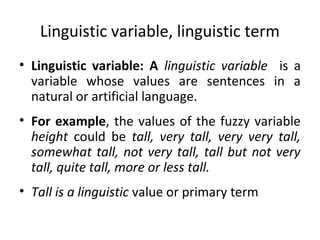
Linguistic variable, linguistic term
• Linguistic variable: A linguistic variable is a
variable whose values are sentences in a
natural or artificial language.
• For example, the values of the fuzzy variable
height could be tall, very tall, very very tall,
somewhat tall, not very tall, tall but not very
tall, quite tall, more or less tall.
• Tall is a linguistic value or primary term
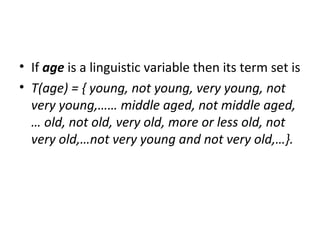
• If age is a linguistic variable then its term set is
• T(age) = { young, not young, very young, not
very young,…… middle aged, not middle aged,
… old, not old, very old, more or less old, not
very old,…not very young and not very old,…}.
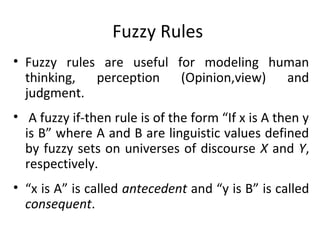
Fuzzy Rules
• Fuzzy rules are useful for modeling human
thinking, perception (Opinion,view) and
judgment.
• A fuzzy if-then rule is of the form “If x is A then y
is B” where A and B are linguistic values defined
by fuzzy sets on universes of discourse X and Y,
respectively.
• “x is A” is called antecedent and “y is B” is called
consequent.
Examples, for such a rule are
• If pressure is high, then volume is small.
• If the road is slippery, then driving is
dangerous.
• If the fruit is ripe, then it is soft.
Binary fuzzy relation
• A binary fuzzy relation is a fuzzy set in X × Y
which maps each element in X × Y to a
membership value between 0 and 1.
• If X and Y are two universes of discourse, then
• R = {((x,y), µR
(x, y)) | (x,y) Є X × Y } is a binary
fuzzy relation in X × Y.
• X × Y indicates cartesian product of X and Y
• The fuzzy rule “If x is A then y is B” may be
abbreviated as A→ B and is interpreted as A × B.
• A fuzzy if then rule may be defined (Mamdani) as a
binary fuzzy relation R on the product space X × Y.
• R = A→ B = A × B =∫X×Y
µA
(x) T-norm µB
(y)/ (x,y).
expert systems: Fuzzy inference
Mamdani fuzzy inference
Sugeno fuzzy inference
Fuzzy inference
• The most commonly used fuzzy inference
technique is the so-called Mamdani method.
In 1975,
• Professor Ebrahim Mamdani of London
University built one of the first fuzzy systems
• To control a steam engine and boiler
combination.
• He applied a set of fuzzy rules supplied by
experienced human operators..
Fuzzy inference
Mamdani fuzzy inference
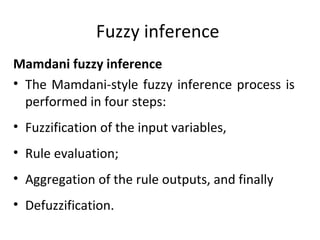
• The Mamdani-style fuzzy inference process is
performed in four steps:
• Fuzzification of the input variables,
• Rule evaluation;
• Aggregation of the rule outputs, and finally
• Defuzzification.
Fuzzy inference
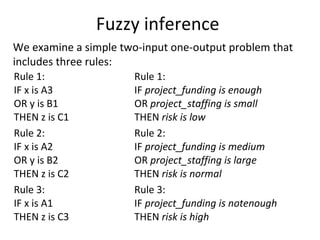
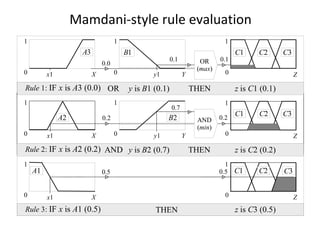
We examine a simple two-input one-output problem that
includes three rules:
Rule 1:
IF x is A3
OR y is B1
THEN z is C1
Rule 1:
IF project_funding is enough
OR project_staffing is small
THEN risk is low
Rule 2:
IF x is A2
OR y is B2
THEN z is C2
Rule 2:
IF project_funding is medium
OR project_staffing is large
THEN risk is normal
Rule 3:
IF x is A1
THEN z is C3
Rule 3:
IF project_funding is notenough
THEN risk is high
Step 1: Fuzzification
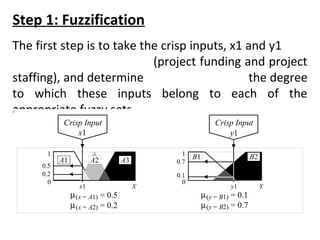
The first step is to take the crisp inputs, x1 and y1
(project funding and project
staffing), and determine the degree
to which these inputs belong to each of the
appropriate fuzzy sets.
Crisp Input
0.1
0.7
1
0
y1
B1 B2
Y
Crisp Input
0.2
0.5
1
0
A1 A2 A3
x1
x1 X
µ(x = A1) = 0.5
µ(x = A2) = 0.2
µ(y = B1) = 0.1
µ(y = B2) = 0.7
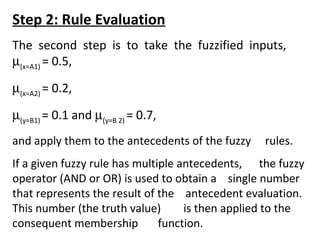
Step 2: Rule Evaluation
The second step is to take the fuzzified inputs,
µ(x=A1) = 0.5,
µ(x=A2) = 0.2,
µ(y=B1) = 0.1 and µ(y=B 2) = 0.7,
and apply them to the antecedents of the fuzzy rules.
If a given fuzzy rule has multiple antecedents, the fuzzy
operator (AND or OR) is used to obtain a single number
that represents the result of the antecedent evaluation.
This number (the truth value) is then applied to the
consequent membership function.
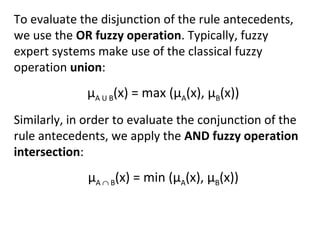
To evaluate the disjunction of the rule antecedents,
we use the OR fuzzy operation. Typically, fuzzy
expert systems make use of the classical fuzzy
operation union:
µA U B(x) = max (µA(x), µB(x))
Similarly, in order to evaluate the conjunction of the
rule antecedents, we apply the AND fuzzy operation
intersection:
µA ∩ B(x) = min (µA(x), µB(x))
A3
1
0 X
1
y10 Y
0.0
x1 0
0.1
C1
1
C2
Z
1
0 X
0.2
0
0.2
C1
1
C2
Z
A2
x1
Rule 3: IF x is A1 (0.5)
A1
1
0 X 0
1
Zx1
THEN
C1 C2
1
y1
B2
0 Y
0.7
B1
0.1
C3
C3
C30.5 0.5
OR
(max)
AND
(min)
OR THENRule 1: IF x is A3 (0.0)
AND THENRule 2: IF x is A2 (0.2)
y is B1 (0.1) z is C1 (0.1)
y is B2 (0.7) z is C2 (0.2)
z is C3 (0.5)
Mamdani-style rule evaluation
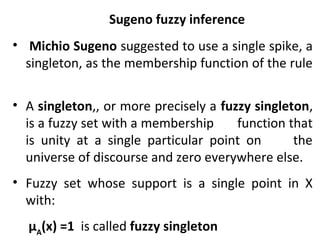
• Michio Sugeno suggested to use a single spike, a
singleton, as the membership function of the rule
• A singleton,, or more precisely a fuzzy singleton,
is a fuzzy set with a membership function that
is unity at a single particular point on the
universe of discourse and zero everywhere else.
• Fuzzy set whose support is a single point in X
with:
µA
(x) =1 is called fuzzy singleton
Sugeno fuzzy inference
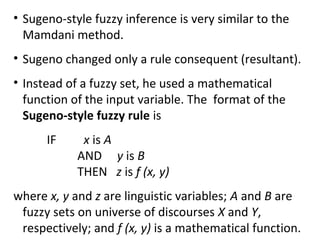
• Sugeno-style fuzzy inference is very similar to the
Mamdani method.
• Sugeno changed only a rule consequent (resultant).
• Instead of a fuzzy set, he used a mathematical
function of the input variable. The format of the
Sugeno-style fuzzy rule is
IF x is A
AND y is B
THEN z is f (x, y)
where x, y and z are linguistic variables; A and B are
fuzzy sets on universe of discourses X and Y,
respectively; and f (x, y) is a mathematical function.
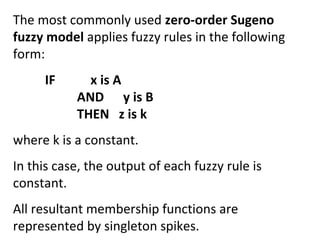
The most commonly used zero-order Sugeno
fuzzy model applies fuzzy rules in the following
form:
IF x is A
AND y is B
THEN z is k
where k is a constant.
In this case, the output of each fuzzy rule is
constant.
All resultant membership functions are
represented by singleton spikes.
A3
1
0 X
1
y10 Y
0.0
x1 0
0.1
1
Z
1
0 X
0.2
0
0.2
1
Z
A2
x1
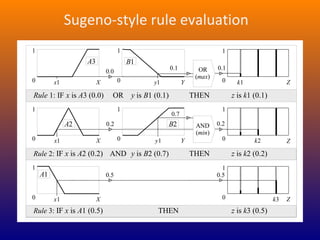
z is k3 (0.5)Rule 3: IF x is A1 (0.5)
A1
1
0 X 0
1
Zx1
THEN
1
y1
B2
0 Y
0.7
B1
0.1
0.5 0.5
OR
(max)
AND
(min)
OR y is B1 (0.1) THEN z is k1 (0.1)Rule 1: IF x is A3 (0.0)
AND y is B2 (0.7) THEN z is k2 (0.2)Rule 2: IF x is A2 (0.2)
k1
k2
k3
Sugeno-style rule evaluation
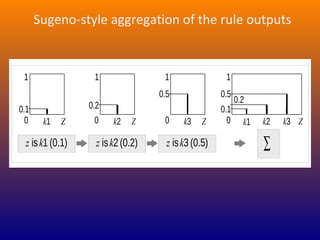
z isk1 (0.1) z isk2 (0.2) z isk3 (0.5) ∑
0
1
0.1
Z 0
0.5
1
Z0
0.2
1
Zk1 k2 k3 0
1
0.1
Zk1 k2 k3
0.2
0.5
Sugeno-style aggregation of the rule outputs
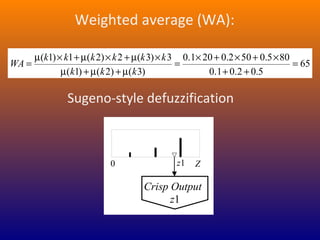
65
5.02.01.0
805.0502.0201.0
)3()2()1(
3)3(2)2(1)1(
=
++
×+×+×
=
µ+µ+µ
×µ+×µ+×µ
=
kkk
kkkkkk
WA
0 Z
Crisp Output
z1
z1
Weighted average (WA):
Sugeno-style defuzzification

Fuzzy Set Theory

  • 1.
  • 2.
    Introduction • The word“fuzzy” means “vaguness (ambiguity)”. • Fuzziness occurs when the boundary of a piece of information is not clear-cut. • Fuzzy sets - 1965 Lotfi Zadeh as an extension of classical notation set. • Classical set theory allows the membership of the elements in the set in binary terms. • Fuzzy set theory permits membership function valued in the interval [0,1].
  • 3.
    Introduction Example: Words like young,tall, good or high are fuzzy. • There is no single quantitative value which defines the term young. • For some people, age 25 is young, and for others, age 35 is young. • The concept young has no clean boundary. • Age 35 has some possibility of being young and usually depends on the context in which it is being considered. Fuzzy set theory is an extension of classical set theory where elements have degree of membership.
  • 4.
    Introduction • In realworld, there exist much fuzzy knowledge (i.e. vague, uncertain inexact etc). • Human thinking and reasoning (analysis, logic, interpretation) frequently involved fuzzy information. • Human can give satisfactory answers, which are probably true. • Our systems are unable to answer many question because the systems are designed based upon classical set theory (Unreliable and incomplete). • We want, our system should be able to cope with unreliable and incomplete information. • Fuzzy system have been provide solution.
  • 5.
    Introduction Classical set theoryFuzzy set theory • Classes of objects with sharp boundaries. • Classes of objects with un- sharp boundaries. • A classical set is defined by crisp(exact) boundaries, i.e., there is no uncertainty about the location of the set boundaries. • A fuzzy set is defined by its ambiguous boundaries, i.e., there exists uncertainty about the location of the set boundaries. • Widely used in digital system design • Used in fuzzy controllers.
  • 6.
    Introduction (Continue) Is water colorless? IsRam Honest? Crisp Yes! (1) No! (0) Fuzzy Extremely Honest (1) Very Honest (0.80) Honest at time (0.40) Extremely dishonest (0.0) Fuzzy vs crips Example
  • 7.
    Classical set theory •A Set is any well defined collection of objects. • An object in a set is called an element or member of that set. • Sets are defined by a simple statement, • Describing whether a particular element having a certain property belongs to that particular set. A = {a1,a2,a3,……,an} • If the elements ai (i = 1,2,3,….,n) of a set A are subset of universal set X, then set A can be represented for all elements x ϵ X by its characteristics function µA (x) = 1 if x ϵ X otherwise 0
  • 8.
    Operations on classicalset theory Union: the union of two sets A and B is given as A U B = { x | x є A or x є B } Intersection: the intersection of two sets A and B is given as A ∩ B = { x | x є A and x є B } Complement: It is denoted by à and is defined as à = { x | x does not belongs A and x є X }
  • 9.
    Fuzzy Sets • Fuzzysets theory is an extension of classical set theory. • Elements have varying degree of membership. A logic based on two truth values, • True and False is sometimes insufficient when describing human reasoning. • Fuzzy Logic uses the whole interval between 0 (false) and 1 (true) to describe human reasoning. • A Fuzzy Set is any set that allows its members to have different degree of membership, called membership function, having interval [0,1].
  • 10.
    Fuzzy Sets • FuzzyLogic is derived from fuzzy set theory • Many degree of membership (between 0 to 1) are allowed. • Thus a membership function µA (x) is associated with a fuzzy sets à such that the function maps every element of universe of discourse X to the interval [0,1]. • The mapping is written as: µÃ(x): X  [0,1]. • Fuzzy Logic is capable of handing inherently imprecise (vague or inexact or rough or inaccurate) concepts
  • 11.
    Fuzzy Sets • Fuzzyset is defined as follows: • If X is an universe of discourse and x is a particular element of X, then a fuzzy set A defined on X and can be written as a collection of ordered pairs A = {(x, µÃ(x)), x є X }
  • 12.
    Fuzzy Sets (Continue) Example •Let X = {g1, g2, g3, g4, g5} be the reference set of students. • Let à be the fuzzy set of “smart” students, where “smart” is fuzzy term. à = {(g1,0.4)(g2,0.5)(g3,1)(g4,0.9)(g5,0.8)} Here à indicates that the smartness of g1 is 0.4 and so on
  • 13.
    Fuzzy Sets (Continue) MembershipFunction • The membership function fully defines the fuzzy set • A membership function provides a measure of the degree of similarity of an element to a fuzzy set Membership functions can – either be chosen by the user arbitrarily, based on the user’s experience (MF chosen by two users could be different depending upon their experiences, perspectives, etc.) – Or be designed using machine learning methods (e.g., artificial neural networks, genetic algorithms, etc.)
  • 14.
    Fuzzy Sets (Continue) Thereare different shapes of membership functions; • Triangular, • Trapezoidal, • Gaussian, etc
  • 15.
    Fuzzy Sets (Continue) •Triangular membership function A triangular membership function is specified by three parameters {a, b, c} a, b and c represent the x coordinates of the three vertices of µA(x) in a fuzzy set A (a: lower boundary and c: upper boundary where membership degree is zero, b: the centre where membership degree is 1)                   ≥ ≤≤ − − ≤≤ − − ≤ = cxif cxbif bc xc bxaif ab ax axif xA 0 0 )(µ a b c x µA(x) 1 0
  • 16.
    Fuzzy Sets (Continue) •Trapezoid membership function • A trapezoidal membership function is specified by four parameters {a, b, c, d} as follows:                       ≤ ≤≤ − − ≤≤ ≤≤ − − ≤ = xdif dxcif cd xd cxbif bxaif ab ax axif xA 0 1 0 )(µ
  • 17.
    • Gaussian membershipfunction – c: centre – s: width – m: fuzzification factor (e.g., m=2) µA(x)         − −= m A s cx mscx 2 1 exp),,,(µ 0 1 2 3 4 5 6 7 8 9 10 0 0.1 0.2 0.3 0.4 0.5 0.6 0.7 0.8 0.9 1 x c=5 s=2 m=2
  • 18.
    c=5 s=0.5 m=2 0 1 23 4 5 6 7 8 9 10 0 0.1 0.2 0.3 0.4 0.5 0.6 0.7 0.8 0.9 1 0 1 2 3 4 5 6 7 8 9 10 0 0.1 0.2 0.3 0.4 0.5 0.6 0.7 0.8 0.9 1 c=5 s=5 m=2
  • 19.
    c=5 s=2 m=0.2 c=5 s=5 m=5 0 1 23 4 5 6 7 8 9 10 0.3 0.4 0.5 0.6 0.7 0.8 0.9 1 0 1 2 3 4 5 6 7 8 9 10 0 0.1 0.2 0.3 0.4 0.5 0.6 0.7 0.8 0.9 1
  • 20.
    Fuzzy Set Operation GivenX to be the universe of discourse and à and toḂ be fuzzy sets with µA(x) and µB(x) are their respective membership function, the fuzzy set operations are as follows: Union: µAUB(x) = max (µA(x), µB(x)) Intersection: µA∩B(x) = min (µA(x), µB(x)) Complement: µA(x) =1- µA(x)
  • 21.
    Fuzzy Set Operation(Continue) Example: A = {(x1,0.5),(x2,0.7),(x3,0)} B = {(x1,0.8),(x2,0.2),(x3,1)} Union: A U B = {(x1,0.8),(x2,0.7),(x3,1)} Because µAUB(x1) = max (µA(x1), µB(x1)) = max(0.5,0.8) = 0.8 µAUB(x2) = 0.7 and µAUB(x3) = 1
  • 22.
    Fuzzy Set Operation(Continue) Example: A = {(x1,0.5),(x2,0.7),(x3,0)} B = {(x1,0.8),(x2,0.2),(x3,1)} Intersection: A ∩ B = {(x1,0.5),(x2,0.2),(x3,0)} Because µA∩B(x1) = min (µA(x1), µB(x1)) = max(0.5,0.8) = 0.5 µA∩B(x2) = 0.2 and µA∩B(x3) = 0
  • 23.
    Fuzzy Set Operation(Continue) Example: A = {(x1,0.5),(x2,0.7),(x3,0)} Complement: Ac = {(x1,0.5),(x2,0.3),(x3,1)} Because µA(x1) =1- µA(x1) = 1 – 0.5 = 0.5 µA(x2) = 0.3 and µA(x3) = 1
  • 24.
    • Support(A) isset of all points x in X such that {(x∣ µA (x) > 0 } • core(A) is set of all points x in X such that {(x∣ µA (x) =1 } • Fuzzy set whose support is a single point in X with µA (x) =1 is called fuzzy singleton
  • 25.
  • 26.
    Linguistic variable, linguisticterm • Linguistic variable: A linguistic variable is a variable whose values are sentences in a natural or artificial language. • For example, the values of the fuzzy variable height could be tall, very tall, very very tall, somewhat tall, not very tall, tall but not very tall, quite tall, more or less tall. • Tall is a linguistic value or primary term
  • 27.
    • If ageis a linguistic variable then its term set is • T(age) = { young, not young, very young, not very young,…… middle aged, not middle aged, … old, not old, very old, more or less old, not very old,…not very young and not very old,…}.
  • 28.
    Fuzzy Rules • Fuzzyrules are useful for modeling human thinking, perception (Opinion,view) and judgment. • A fuzzy if-then rule is of the form “If x is A then y is B” where A and B are linguistic values defined by fuzzy sets on universes of discourse X and Y, respectively. • “x is A” is called antecedent and “y is B” is called consequent.
  • 29.
    Examples, for sucha rule are • If pressure is high, then volume is small. • If the road is slippery, then driving is dangerous. • If the fruit is ripe, then it is soft.
  • 30.
    Binary fuzzy relation •A binary fuzzy relation is a fuzzy set in X × Y which maps each element in X × Y to a membership value between 0 and 1. • If X and Y are two universes of discourse, then • R = {((x,y), µR (x, y)) | (x,y) Є X × Y } is a binary fuzzy relation in X × Y. • X × Y indicates cartesian product of X and Y
  • 31.
    • The fuzzyrule “If x is A then y is B” may be abbreviated as A→ B and is interpreted as A × B. • A fuzzy if then rule may be defined (Mamdani) as a binary fuzzy relation R on the product space X × Y. • R = A→ B = A × B =∫X×Y µA (x) T-norm µB (y)/ (x,y).
  • 32.
    expert systems: Fuzzyinference Mamdani fuzzy inference Sugeno fuzzy inference
  • 33.
    Fuzzy inference • Themost commonly used fuzzy inference technique is the so-called Mamdani method. In 1975, • Professor Ebrahim Mamdani of London University built one of the first fuzzy systems • To control a steam engine and boiler combination. • He applied a set of fuzzy rules supplied by experienced human operators..
  • 34.
    Fuzzy inference Mamdani fuzzyinference • The Mamdani-style fuzzy inference process is performed in four steps: • Fuzzification of the input variables, • Rule evaluation; • Aggregation of the rule outputs, and finally • Defuzzification.
  • 35.
    Fuzzy inference We examinea simple two-input one-output problem that includes three rules: Rule 1: IF x is A3 OR y is B1 THEN z is C1 Rule 1: IF project_funding is enough OR project_staffing is small THEN risk is low Rule 2: IF x is A2 OR y is B2 THEN z is C2 Rule 2: IF project_funding is medium OR project_staffing is large THEN risk is normal Rule 3: IF x is A1 THEN z is C3 Rule 3: IF project_funding is notenough THEN risk is high
  • 36.
    Step 1: Fuzzification Thefirst step is to take the crisp inputs, x1 and y1 (project funding and project staffing), and determine the degree to which these inputs belong to each of the appropriate fuzzy sets. Crisp Input 0.1 0.7 1 0 y1 B1 B2 Y Crisp Input 0.2 0.5 1 0 A1 A2 A3 x1 x1 X µ(x = A1) = 0.5 µ(x = A2) = 0.2 µ(y = B1) = 0.1 µ(y = B2) = 0.7
  • 37.
    Step 2: RuleEvaluation The second step is to take the fuzzified inputs, µ(x=A1) = 0.5, µ(x=A2) = 0.2, µ(y=B1) = 0.1 and µ(y=B 2) = 0.7, and apply them to the antecedents of the fuzzy rules. If a given fuzzy rule has multiple antecedents, the fuzzy operator (AND or OR) is used to obtain a single number that represents the result of the antecedent evaluation. This number (the truth value) is then applied to the consequent membership function.
  • 38.
    To evaluate thedisjunction of the rule antecedents, we use the OR fuzzy operation. Typically, fuzzy expert systems make use of the classical fuzzy operation union: µA U B(x) = max (µA(x), µB(x)) Similarly, in order to evaluate the conjunction of the rule antecedents, we apply the AND fuzzy operation intersection: µA ∩ B(x) = min (µA(x), µB(x))
  • 39.
    A3 1 0 X 1 y10 Y 0.0 x10 0.1 C1 1 C2 Z 1 0 X 0.2 0 0.2 C1 1 C2 Z A2 x1 Rule 3: IF x is A1 (0.5) A1 1 0 X 0 1 Zx1 THEN C1 C2 1 y1 B2 0 Y 0.7 B1 0.1 C3 C3 C30.5 0.5 OR (max) AND (min) OR THENRule 1: IF x is A3 (0.0) AND THENRule 2: IF x is A2 (0.2) y is B1 (0.1) z is C1 (0.1) y is B2 (0.7) z is C2 (0.2) z is C3 (0.5) Mamdani-style rule evaluation
  • 40.
    • Michio Sugenosuggested to use a single spike, a singleton, as the membership function of the rule • A singleton,, or more precisely a fuzzy singleton, is a fuzzy set with a membership function that is unity at a single particular point on the universe of discourse and zero everywhere else. • Fuzzy set whose support is a single point in X with: µA (x) =1 is called fuzzy singleton Sugeno fuzzy inference
  • 41.
    • Sugeno-style fuzzyinference is very similar to the Mamdani method. • Sugeno changed only a rule consequent (resultant). • Instead of a fuzzy set, he used a mathematical function of the input variable. The format of the Sugeno-style fuzzy rule is IF x is A AND y is B THEN z is f (x, y) where x, y and z are linguistic variables; A and B are fuzzy sets on universe of discourses X and Y, respectively; and f (x, y) is a mathematical function.
  • 42.
    The most commonlyused zero-order Sugeno fuzzy model applies fuzzy rules in the following form: IF x is A AND y is B THEN z is k where k is a constant. In this case, the output of each fuzzy rule is constant. All resultant membership functions are represented by singleton spikes.
  • 43.
    A3 1 0 X 1 y10 Y 0.0 x10 0.1 1 Z 1 0 X 0.2 0 0.2 1 Z A2 x1 z is k3 (0.5)Rule 3: IF x is A1 (0.5) A1 1 0 X 0 1 Zx1 THEN 1 y1 B2 0 Y 0.7 B1 0.1 0.5 0.5 OR (max) AND (min) OR y is B1 (0.1) THEN z is k1 (0.1)Rule 1: IF x is A3 (0.0) AND y is B2 (0.7) THEN z is k2 (0.2)Rule 2: IF x is A2 (0.2) k1 k2 k3 Sugeno-style rule evaluation
  • 44.
    z isk1 (0.1)z isk2 (0.2) z isk3 (0.5) ∑ 0 1 0.1 Z 0 0.5 1 Z0 0.2 1 Zk1 k2 k3 0 1 0.1 Zk1 k2 k3 0.2 0.5 Sugeno-style aggregation of the rule outputs
  • 45.