A
Seminar
On
Design and Application of an Analog Fuzzy Logic Controller
of
BACHELOR OF TECHNOLOGY
IN
ELECTRICAL &ELECTRONICS ENGINEERING
Submitted
By
V.VINAY (16705A0248)
IV B.TECH II-SEM
Under The Esteemed Guidance Of
Mr. A.BHASKAR, M.Tech.,
Assistant Professor
DEPARTMENT Of EEE
DEPARTMENT OF ELECTRICAL AND ELECTRONICS ENGINEERING
ANNAMACHARYA INSTITUTE OF TECHNOLOGY AND SCIENCES
(AUTONOMOUS)
(Affiliated to J.N.T UNIVERSITY ANANTAPUR)
RAJAMPET-516 126(A.P)
Overview
 Introduction
 Why Use Fuzzy Logic in Control System
 Architecture of Fuzzy Logic Control
 Working of Fuzzy Logic System
 Application of FLC
 Advantages of Fuzzy Logic Control
 Disadvantages of Fuzzy Logic Control
 Conclusion
Introduction
Fuzzy logic starts with and builds on a set of user-
supplied human language rules. The fuzzy systems convert these
rules to their mathematical equivalents. This simplifies the job of
the system designer and the computer, and results in much more
accurate representations of the way systems behave in the real
world.
Why Use Fuzzy Logic in Control Systems
The reasons of using Fuzzy Logic in Control Systems −
 While applying traditional control, one needs to know about the
model and the objective function formulated in precise terms.
This makes it very difficult to apply in many cases.
 By applying fuzzy logic for control we can utilize the human
expertise and experience for designing a controller.
 The fuzzy control rules, basically the IF-THEN rules, can be best
utilized in designing a controller.
Architecture of Fuzzy Logic Control
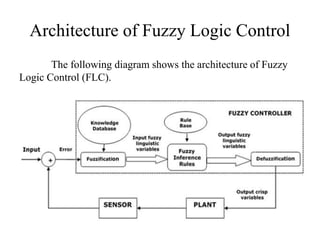
The following diagram shows the architecture of Fuzzy
Logic Control (FLC).
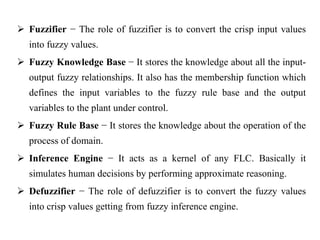
 Fuzzifier − The role of fuzzifier is to convert the crisp input values
into fuzzy values.
 Fuzzy Knowledge Base − It stores the knowledge about all the input-
output fuzzy relationships. It also has the membership function which
defines the input variables to the fuzzy rule base and the output
variables to the plant under control.
 Fuzzy Rule Base − It stores the knowledge about the operation of the
process of domain.
 Inference Engine − It acts as a kernel of any FLC. Basically it
simulates human decisions by performing approximate reasoning.
 Defuzzifier − The role of defuzzifier is to convert the fuzzy values
into crisp values getting from fuzzy inference engine.
Working of Fuzzy Logic System
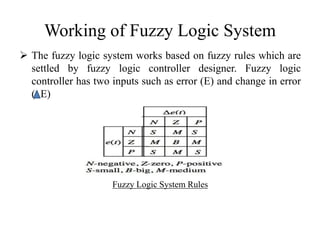
 The fuzzy logic system works based on fuzzy rules which are
settled by fuzzy logic controller designer. Fuzzy logic
controller has two inputs such as error (E) and change in error
( E)
Fuzzy Logic System Rules
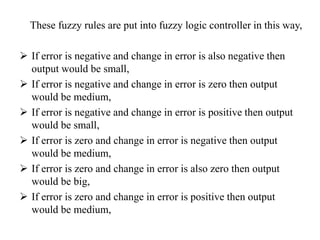
These fuzzy rules are put into fuzzy logic controller in this way,
 If error is negative and change in error is also negative then
output would be small,
 If error is negative and change in error is zero then output
would be medium,
 If error is negative and change in error is positive then output
would be small,
 If error is zero and change in error is negative then output
would be medium,
 If error is zero and change in error is also zero then output
would be big,
 If error is zero and change in error is positive then output
would be medium,
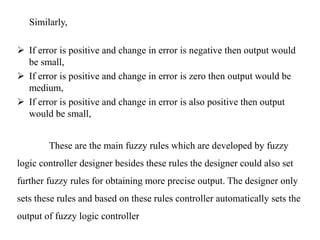
Similarly,
 If error is positive and change in error is negative then output would
be small,
 If error is positive and change in error is zero then output would be
medium,
 If error is positive and change in error is also positive then output
would be small,
These are the main fuzzy rules which are developed by fuzzy
logic controller designer besides these rules the designer could also set
further fuzzy rules for obtaining more precise output. The designer only
sets these rules and based on these rules controller automatically sets the
output of fuzzy logic controller
Application of FLC
The temperature sensor measures the temperature values of the
rooms. The obtained values are taken and then given to the fuzzifier.
The fuzzifier assigns linguistic variables for each measured value and the rate
of change of measured value.
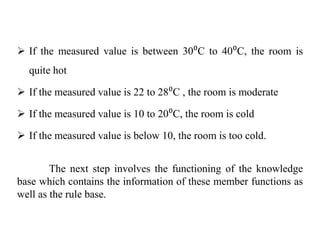
For example if the measured value is 40⁰C and above, then the room is too hot
 If the measured value is between 30⁰C to 40⁰C, the room is
quite hot
 If the measured value is 22 to 28⁰C , the room is moderate
 If the measured value is 10 to 20⁰C, the room is cold
 If the measured value is below 10, the room is too cold.
The next step involves the functioning of the knowledge
base which contains the information of these member functions as
well as the rule base.
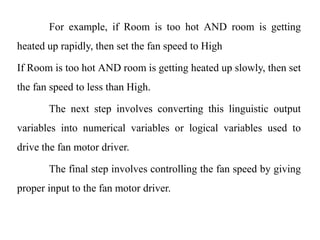
For example, if Room is too hot AND room is getting
heated up rapidly, then set the fan speed to High
If Room is too hot AND room is getting heated up slowly, then set
the fan speed to less than High.
The next step involves converting this linguistic output
variables into numerical variables or logical variables used to
drive the fan motor driver.
The final step involves controlling the fan speed by giving
proper input to the fan motor driver.
Advantages of Fuzzy Logic Control
 FLC is cheaper than developing model based or other controller in
terms of performance.
 FLCs are more robust than PID controllers
 FLCs are customizable.
 Emulate human deductive thinking
 FLC is more reliable than conventional control system.
 Fuzzy logic provides more efficiency when applied in control
system.
Disadvantages of Fuzzy Logic Control
 Requires lots of data
 FLC is not useful for programs much smaller
 Needs high human expertise
 Needs regular updating of rules
Conclusion
The aimed towards fuzzy logic control system. We saw all
aspects of FLC by taking a control system used for illumination
control. Illumination control system controls the environment
wherever unpredictable change in illumination is expected.
References
 H.R. Beom and H.S. Cho. A Sensor-based Obstacle Avoidance
Controller for a Mobile Robot Using Fuzzy Logic and Neural
Networks.
 J. L. Castro, Fuzzy logic controllers are universal approximators,
Technical Report.
 H. Eichfeld, M. Löhner and M. Müller, Architecture of a Fuzzy
Logic Controller with optimized memory organisation and operator
design.
Thank you

Fuzzy Logic Controller

  • 1.
    A Seminar On Design and Applicationof an Analog Fuzzy Logic Controller of BACHELOR OF TECHNOLOGY IN ELECTRICAL &ELECTRONICS ENGINEERING Submitted By V.VINAY (16705A0248) IV B.TECH II-SEM Under The Esteemed Guidance Of Mr. A.BHASKAR, M.Tech., Assistant Professor DEPARTMENT Of EEE DEPARTMENT OF ELECTRICAL AND ELECTRONICS ENGINEERING ANNAMACHARYA INSTITUTE OF TECHNOLOGY AND SCIENCES (AUTONOMOUS) (Affiliated to J.N.T UNIVERSITY ANANTAPUR) RAJAMPET-516 126(A.P)
  • 2.
    Overview  Introduction  WhyUse Fuzzy Logic in Control System  Architecture of Fuzzy Logic Control  Working of Fuzzy Logic System  Application of FLC  Advantages of Fuzzy Logic Control  Disadvantages of Fuzzy Logic Control  Conclusion
  • 3.
    Introduction Fuzzy logic startswith and builds on a set of user- supplied human language rules. The fuzzy systems convert these rules to their mathematical equivalents. This simplifies the job of the system designer and the computer, and results in much more accurate representations of the way systems behave in the real world.
  • 4.
    Why Use FuzzyLogic in Control Systems The reasons of using Fuzzy Logic in Control Systems −  While applying traditional control, one needs to know about the model and the objective function formulated in precise terms. This makes it very difficult to apply in many cases.  By applying fuzzy logic for control we can utilize the human expertise and experience for designing a controller.  The fuzzy control rules, basically the IF-THEN rules, can be best utilized in designing a controller.
  • 5.
    Architecture of FuzzyLogic Control The following diagram shows the architecture of Fuzzy Logic Control (FLC).
  • 6.
     Fuzzifier −The role of fuzzifier is to convert the crisp input values into fuzzy values.  Fuzzy Knowledge Base − It stores the knowledge about all the input- output fuzzy relationships. It also has the membership function which defines the input variables to the fuzzy rule base and the output variables to the plant under control.  Fuzzy Rule Base − It stores the knowledge about the operation of the process of domain.  Inference Engine − It acts as a kernel of any FLC. Basically it simulates human decisions by performing approximate reasoning.  Defuzzifier − The role of defuzzifier is to convert the fuzzy values into crisp values getting from fuzzy inference engine.
  • 7.
    Working of FuzzyLogic System  The fuzzy logic system works based on fuzzy rules which are settled by fuzzy logic controller designer. Fuzzy logic controller has two inputs such as error (E) and change in error ( E) Fuzzy Logic System Rules
  • 8.
    These fuzzy rulesare put into fuzzy logic controller in this way,  If error is negative and change in error is also negative then output would be small,  If error is negative and change in error is zero then output would be medium,  If error is negative and change in error is positive then output would be small,  If error is zero and change in error is negative then output would be medium,  If error is zero and change in error is also zero then output would be big,  If error is zero and change in error is positive then output would be medium,
  • 9.
    Similarly,  If erroris positive and change in error is negative then output would be small,  If error is positive and change in error is zero then output would be medium,  If error is positive and change in error is also positive then output would be small, These are the main fuzzy rules which are developed by fuzzy logic controller designer besides these rules the designer could also set further fuzzy rules for obtaining more precise output. The designer only sets these rules and based on these rules controller automatically sets the output of fuzzy logic controller
  • 10.
    Application of FLC Thetemperature sensor measures the temperature values of the rooms. The obtained values are taken and then given to the fuzzifier. The fuzzifier assigns linguistic variables for each measured value and the rate of change of measured value. For example if the measured value is 40⁰C and above, then the room is too hot
  • 11.
     If themeasured value is between 30⁰C to 40⁰C, the room is quite hot  If the measured value is 22 to 28⁰C , the room is moderate  If the measured value is 10 to 20⁰C, the room is cold  If the measured value is below 10, the room is too cold. The next step involves the functioning of the knowledge base which contains the information of these member functions as well as the rule base.
  • 12.
    For example, ifRoom is too hot AND room is getting heated up rapidly, then set the fan speed to High If Room is too hot AND room is getting heated up slowly, then set the fan speed to less than High. The next step involves converting this linguistic output variables into numerical variables or logical variables used to drive the fan motor driver. The final step involves controlling the fan speed by giving proper input to the fan motor driver.
  • 13.
    Advantages of FuzzyLogic Control  FLC is cheaper than developing model based or other controller in terms of performance.  FLCs are more robust than PID controllers  FLCs are customizable.  Emulate human deductive thinking  FLC is more reliable than conventional control system.  Fuzzy logic provides more efficiency when applied in control system.
  • 14.
    Disadvantages of FuzzyLogic Control  Requires lots of data  FLC is not useful for programs much smaller  Needs high human expertise  Needs regular updating of rules
  • 15.
    Conclusion The aimed towardsfuzzy logic control system. We saw all aspects of FLC by taking a control system used for illumination control. Illumination control system controls the environment wherever unpredictable change in illumination is expected.
  • 16.
    References  H.R. Beomand H.S. Cho. A Sensor-based Obstacle Avoidance Controller for a Mobile Robot Using Fuzzy Logic and Neural Networks.  J. L. Castro, Fuzzy logic controllers are universal approximators, Technical Report.  H. Eichfeld, M. Löhner and M. Müller, Architecture of a Fuzzy Logic Controller with optimized memory organisation and operator design.
  • 17.