1 
Soft Computing 
(ANN & Fuzzy Logic) 
Dr. Purnima Pandit 
(pkpandit@yahoo.com) 
Department of Applied Mathematics 
Faculty of Tech. and Engg. 
The M.S. University of Baroda
What is soft computing ? 
Techniques used in soft 
computing?
What is Soft Computing ? 
(adapted from L.A. Zadeh) 
• Soft computing differs from 
conventional (hard) computing in that, 
unlike hard computing, it is tolerant 
of imprecision, uncertainty, partial 
truth, and approximation. In effect, 
the role model for soft computing is 
the human mind.
What is Hard Computing? 
• Hard computing, i.e., conventional 
computing, requires a precisely stated 
analytical model and often a lot of 
computation time. 
• Many analytical models are valid for ideal 
cases. 
• Real world problems exist in a non-ideal 
environment.
Techniques of Soft Computing 
• The principal constituents, i.e., tools, 
techniques, of Soft Computing (SC) are 
– Fuzzy Logic (FL), Neural Networks (NN), 
Support Vector Machines (SVM), 
Evolutionary Computation (EC), and 
– Machine Learning (ML) and Probabilistic 
Reasoning (PR)
Premises of Soft Computing 
• The real world problems are 
pervasively imprecise and uncertain 
• Precision and certainty carry a cost
Guiding Principles of Soft 
Computing 
• The guiding principle of soft computing 
is: 
– Exploit the tolerance for imprecision, 
uncertainty, partial truth, and 
approximation to achieve tractability, 
robustness and low solution cost.
Hard Computing 
• Premises and guiding principles of Hard 
Computing are 
– Precision, Certainty, and rigor. 
• Many contemporary problems do not lend 
themselves to precise solutions such as 
– Recognition problems (handwriting, 
speech, objects, images) 
– Mobile robot coordination, forecasting, 
combinatorial problems etc.
Implications of Soft Computing 
• Soft computing employs NN, SVM, FL etc, in a 
complementary rather than a competitive way. 
• One example of a particularly effective 
combination is what has come to be known as 
"neurofuzzy systems.” 
• Such systems are becoming increasingly visible 
as consumer products ranging from air 
conditioners and washing machines to 
photocopiers, camcorders and many industrial 
applications.
Unique Property of Soft computing 
• Learning from experimental data 
• Soft computing techniques derive their 
power of generalization from 
approximating or interpolating to 
produce outputs from previously unseen 
inputs by using outputs from previous 
learned inputs 
• Generalization is usually done in a high 
dimensional space.
Current Applications using Soft 
Computing 
• Application of soft computing to handwriting recognition 
• Application of soft computing to automotive systems 
and manufacturing 
• Application of soft computing to image processing and 
data compression 
• Application of soft computing to architecture 
• Application of soft computing to decision-support 
systems 
• Application of soft computing to power systems 
• Neurofuzzy systems 
• Fuzzy logic control
Future of Soft Computing 
(adapted from L.A. Zadeh) 
• Soft computing is likely to play an especially 
important role in science and engineering, but 
eventually its influence may extend much 
farther. 
• Soft computing represents a significant paradigm 
shift in the aims of computing 
– a shift which reflects the fact that the human 
mind, unlike present day computers, possesses a 
remarkable ability to store and process 
information which is pervasively imprecise, 
uncertain and lacking in categorization.
Techniques in Soft 
Computing 
• Neural networks 
• Support Vector Machines 
• Fuzzy Logic 
• Genetic Algorithms in Evolutionary 
Computation
14 
Artificial Neural Networks 
– What are they? 
– How do they work? 
– Different architecture 
– Learning Algorithms 
– Application to simple parameter 
estimation
15 
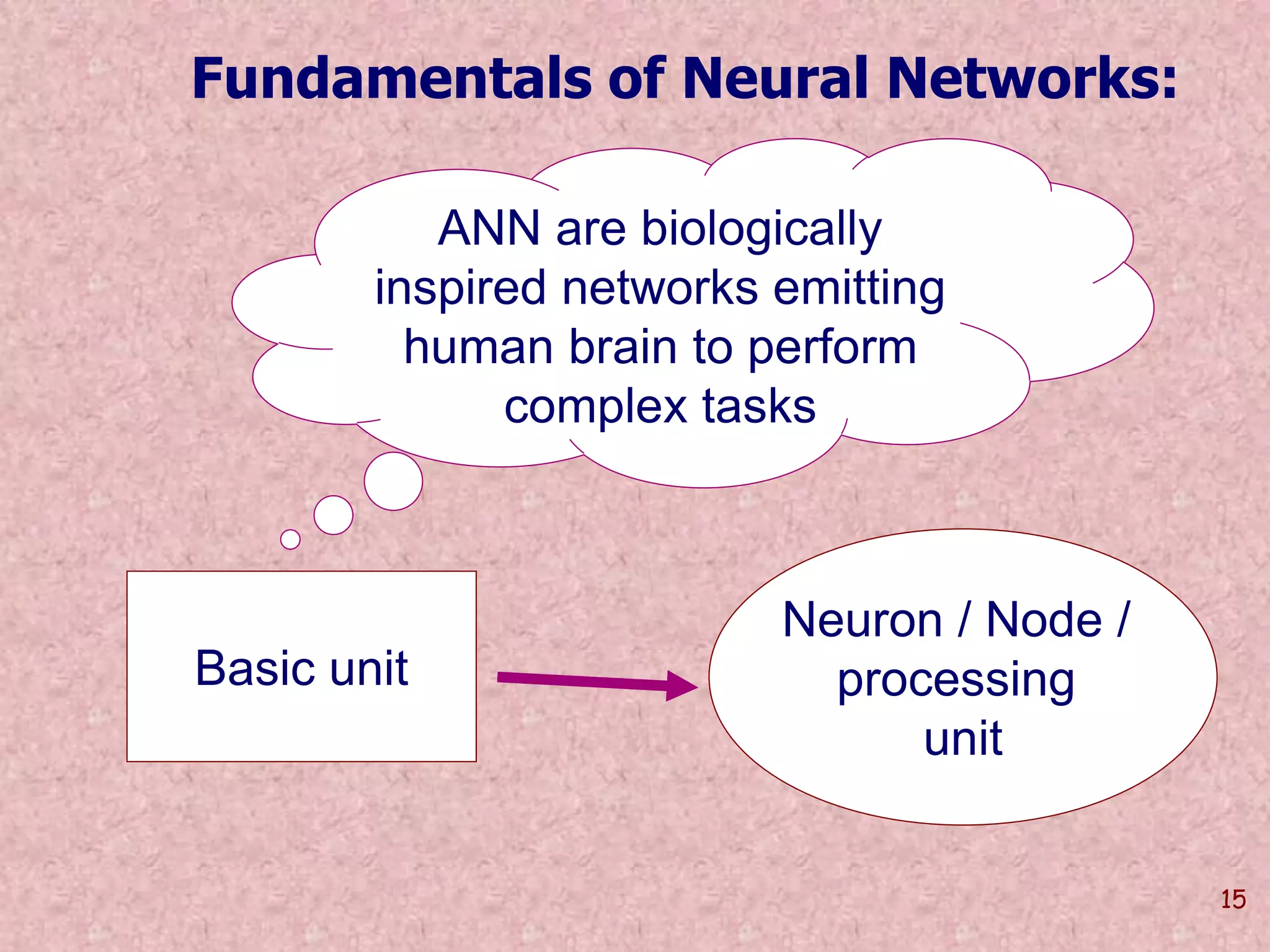
Fundamentals of Neural Networks: 
Basic unit 
Neuron / Node / 
processing 
unit 
ANN are biologically 
inspired networks emitting 
human brain to perform 
complex tasks
Introduction 
• Why ANN 
– Some tasks can be done easily (effortlessly) 
by humans but are hard by conventional 
paradigms on Von Neumann machine with 
algorithmic approach 
• Pattern recognition (old friends, hand-written 
characters) 
• Content addressable recall 
• Approximate, common sense reasoning (driving, 
playing piano, baseball player) 
– These tasks are often ill-defined, 
experience based, hard to apply logic
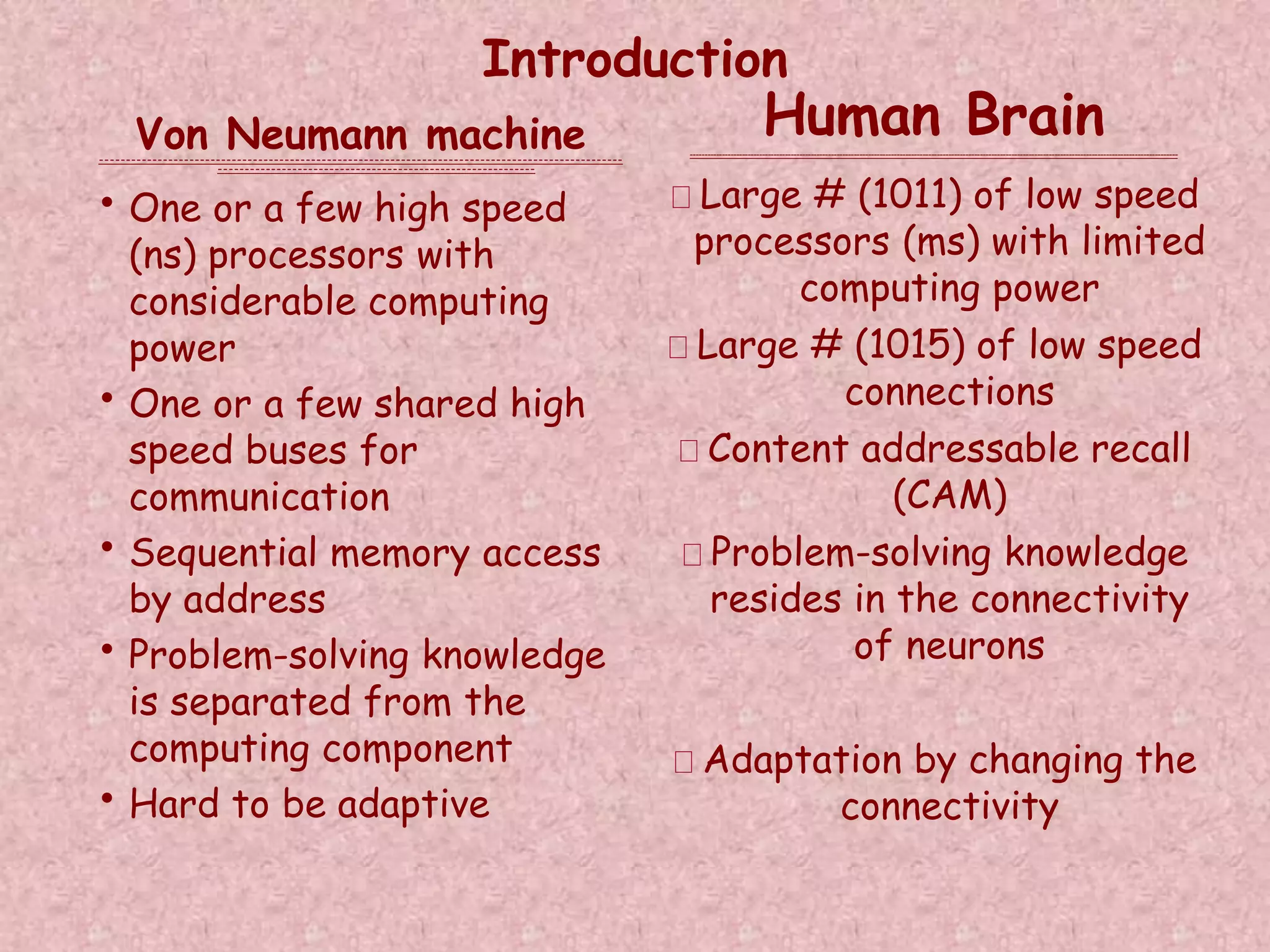
Introduction 
Von Neumann machine 
--------------------------------------------------------------------------------------------------- 
------------------------------------------------------------ 
• One or a few high speed 
(ns) processors with 
considerable computing 
power 
• One or a few shared high 
speed buses for 
communication 
• Sequential memory access 
by address 
• Problem-solving knowledge 
is separated from the 
computing component 
• Hard to be adaptive 
Human Brain 
-------------------------------------------------------------------------------------------------------------------------------------------------------------------------- 
Large # (1011) of low speed 
processors (ms) with limited 
computing power 
Large # (1015) of low speed 
connections 
Content addressable recall 
(CAM) 
Problem-solving knowledge 
resides in the connectivity 
of neurons 
Adaptation by changing the 
connectivity
18 
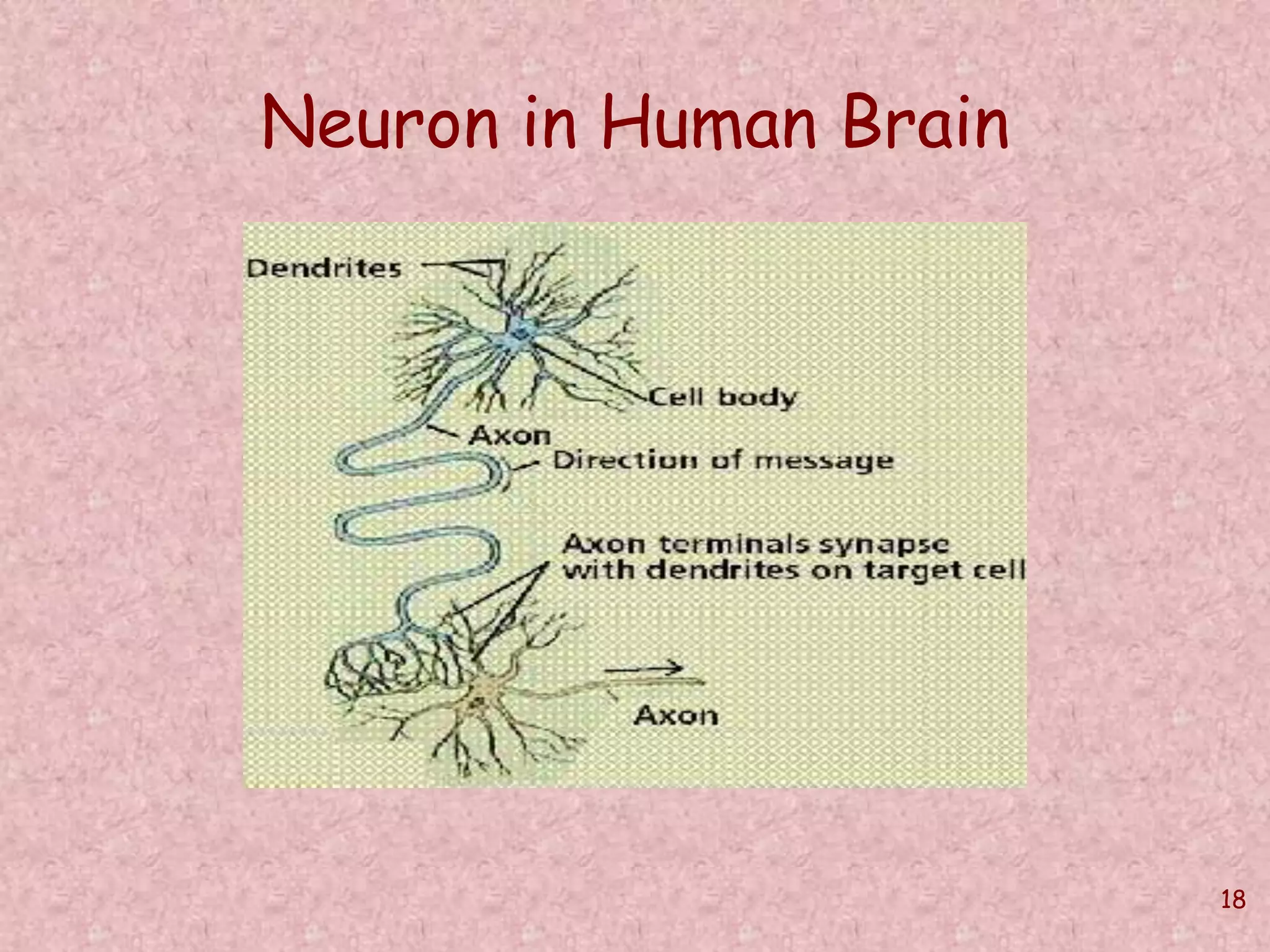
Neuron in Human Brain
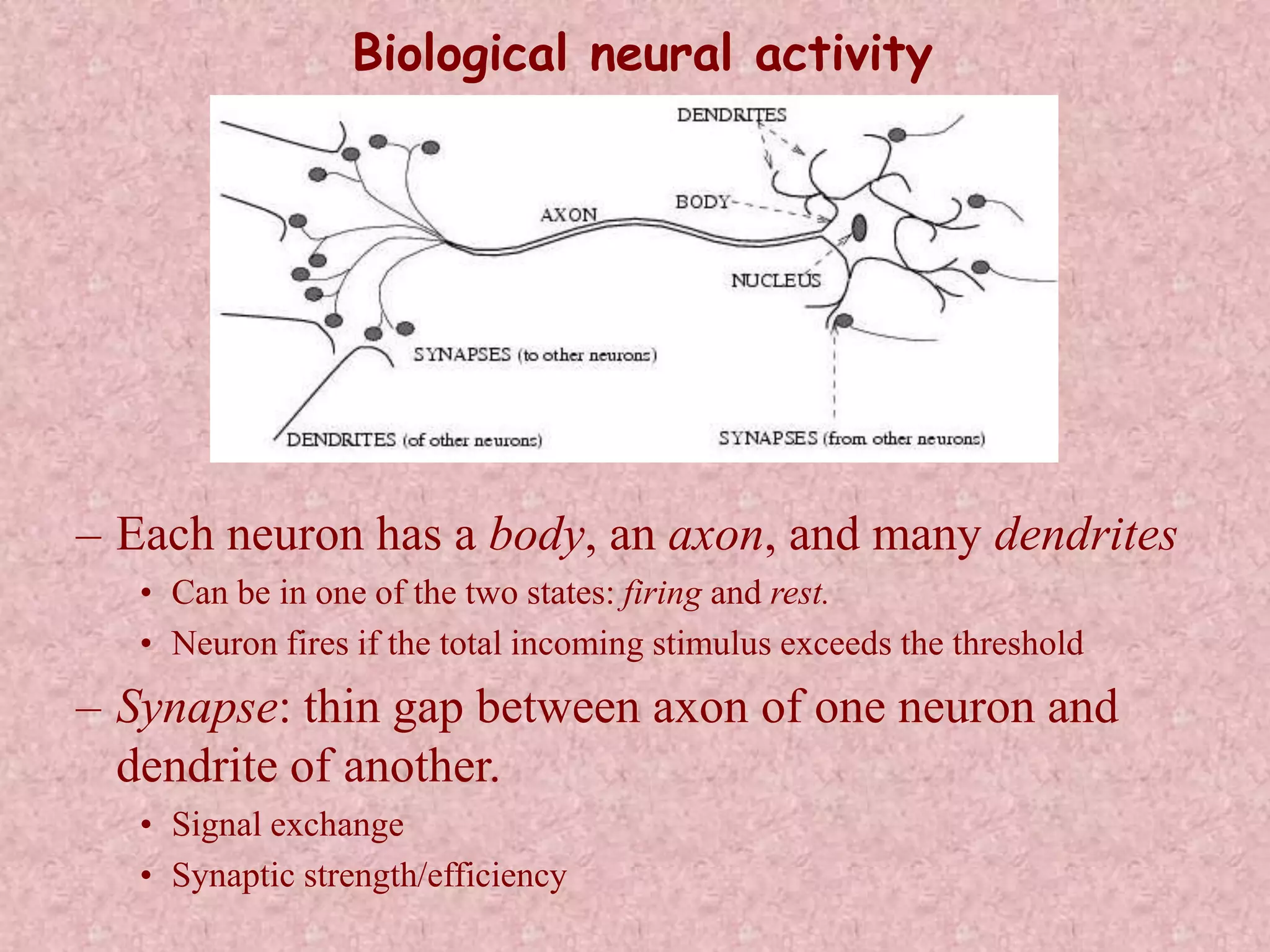
Biological neural activity 
– Each neuron has a body, an axon, and many dendrites 
• Can be in one of the two states: firing and rest. 
• Neuron fires if the total incoming stimulus exceeds the threshold 
– Synapse: thin gap between axon of one neuron and 
dendrite of another. 
• Signal exchange 
• Synaptic strength/efficiency
An (artificial) neural network has: 
– A set of nodes (units, neurons, processing 
elements) 
• Each node has input and output 
• Each node performs a simple computation by its 
node function 
– Weighted connections between nodes 
• Connectivity gives the structure/architecture 
of the net 
• What can be computed by a NN is primarily 
determined by the connections and their 
weights 
– A very much simplified version of networks of 
neurons in animal nerve systems
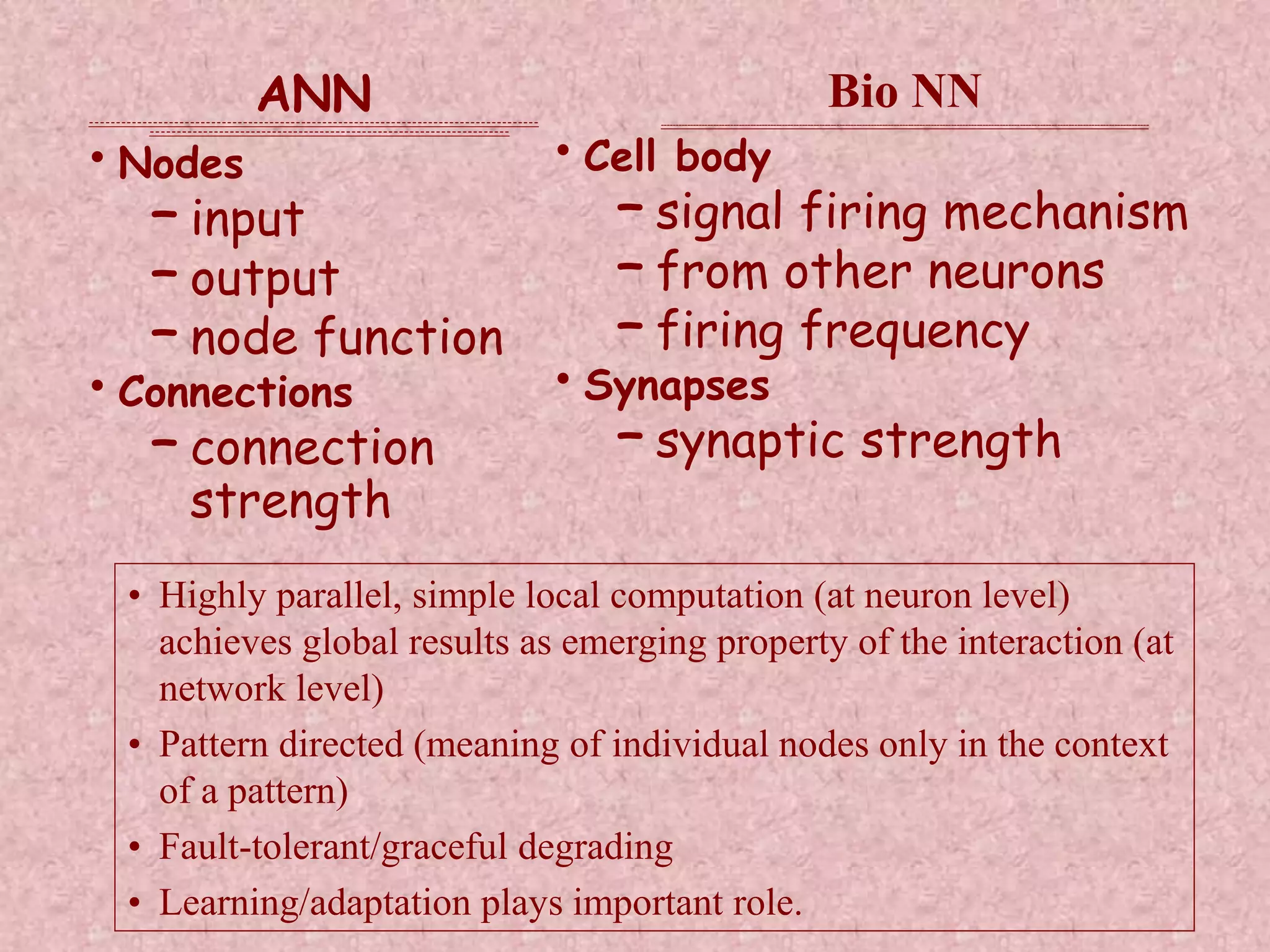
ANN ------------------------------------------------------------------------------------- 
-------------------------------------------------------------------- 
• Nodes 
– input 
– output 
– node function 
• Connections 
– connection 
strength 
Bio NN 
-------------------------------------------------------------------------------------------------------------------------------------------------------------------------- 
• Cell body 
– signal firing mechanism 
– from other neurons 
– firing frequency 
• Synapses 
– synaptic strength 
• Highly parallel, simple local computation (at neuron level) 
achieves global results as emerging property of the interaction (at 
network level) 
• Pattern directed (meaning of individual nodes only in the context 
of a pattern) 
• Fault-tolerant/graceful degrading 
• Learning/adaptation plays important role.
History of NN 
• Pitts & McCulloch (1943) 
– First mathematical model of biological neurons 
– All Boolean operations can be implemented by these 
neuron-like nodes (with different threshold and 
excitatory/inhibitory connections). 
– Competitor to Von Neumann model for general purpose 
computing device 
– Origin of automata theory. 
• Hebb (1949) 
– Hebbian rule of learning: increase the connection 
strength between neurons i and j whenever both i and j 
are activated. 
– Or increase the connection strength between nodes i 
and j whenever both nodes are simultaneously ON or 
OFF.
History of NN 
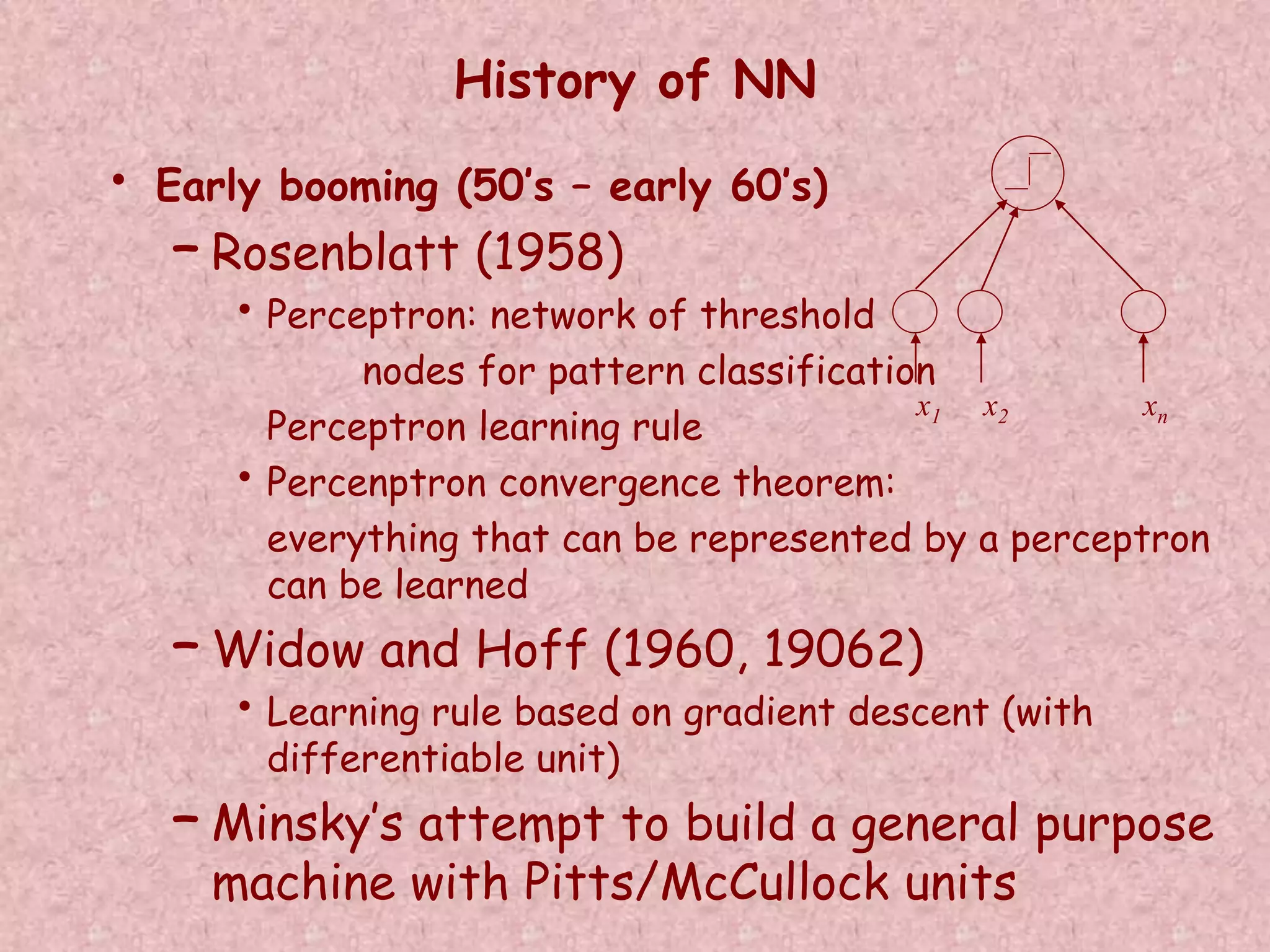
• Early booming (50’s – early 60’s) 
– Rosenblatt (1958) 
• Perceptron: network of threshold 
nodes for pattern classification 
x1 x2 xn 
Perceptron learning rule 
• Percenptron convergence theorem: 
everything that can be represented by a perceptron 
can be learned 
– Widow and Hoff (1960, 19062) 
• Learning rule based on gradient descent (with 
differentiable unit) 
– Minsky’s attempt to build a general purpose 
machine with Pitts/McCullock units
History of NN 
• The setback (mid 60’s – late 70’s) 
– Serious problems with perceptron model 
(Minsky’s book 1969) 
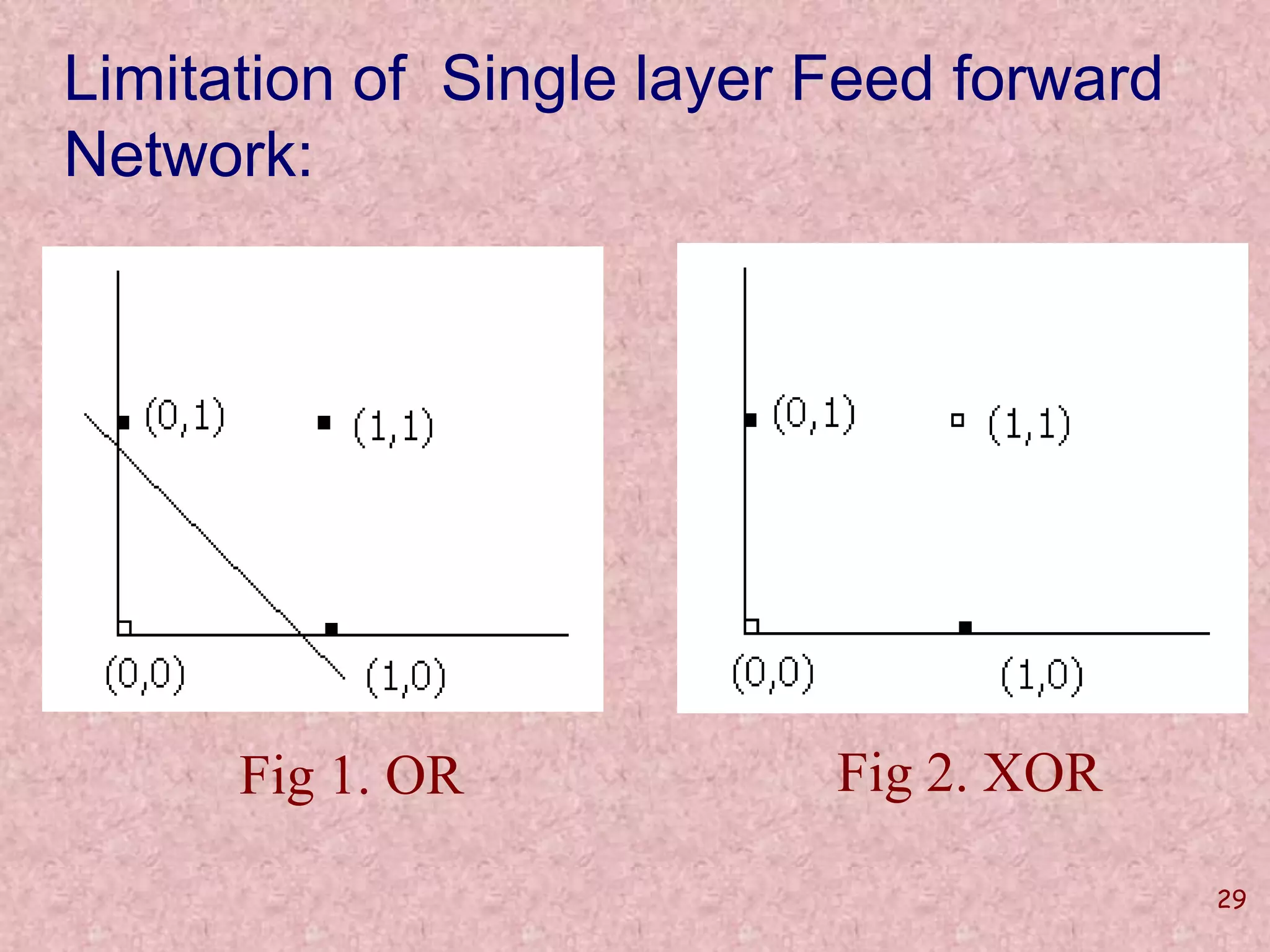
• Single layer perceonptrons cannot represent (learn) 
simple functions such as XOR 
• Multi-layer of non-linear units may have greater 
power but there is no learning rule for such nets 
• Scaling problem: connection weights may grow 
infinitely 
– The first two problems overcame by latter 
effort in 80’s, but the scaling problem persists 
– Death of Rosenblatt (1964) 
– Striving of Von Neumann machine and AI
History of NN 
• Renewed enthusiasm and flourish (80’s – 
present) 
– New techniques 
• Backpropagation learning for multi-layer feed forward nets 
(with non-linear, differentiable node functions) 
• Thermodynamic models (Hopfield net, Boltzmann machine, 
etc.) 
• Unsupervised learning 
– Impressive application (character recognition, 
speech recognition, text-to-speech transformation, 
process control, associative memory, etc.) 
– Traditional approaches face difficult challenges 
– Caution: 
• Don’t underestimate difficulties and limitations 
• Poses more problems than solutions
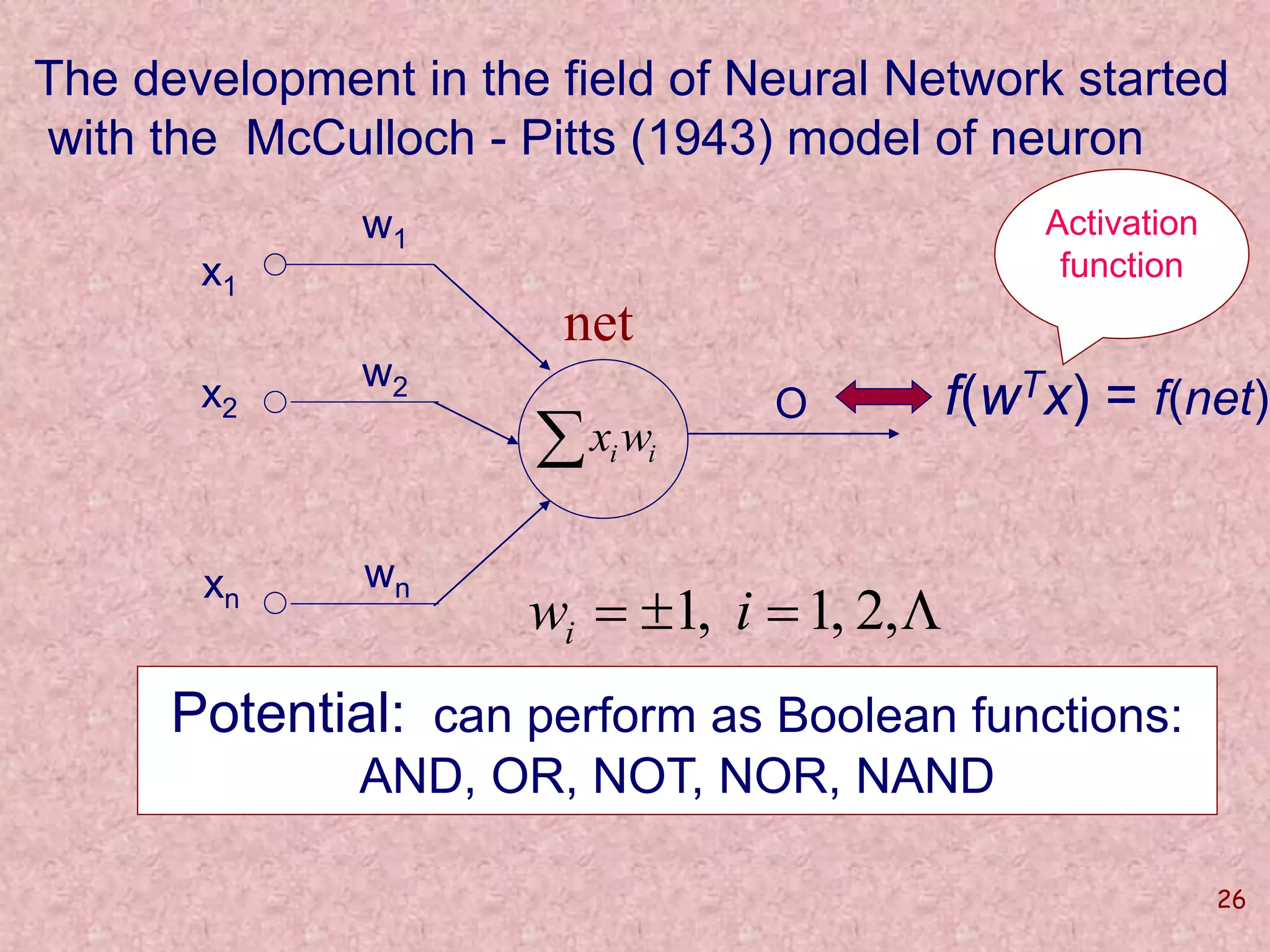
The development in the field of Neural Network started 
with the McCulloch - Pitts (1943) model of neuron 
26 
O 
x1 
x2 
xn 
w1 
w2 
wn 
f(wTx) = f(net) 
net 
w  1, i 1, 2, i 
Potential: can perform as Boolean functions: 
AND, OR, NOT, NOR, NAND 
Activation 
function 
i i w x
27 
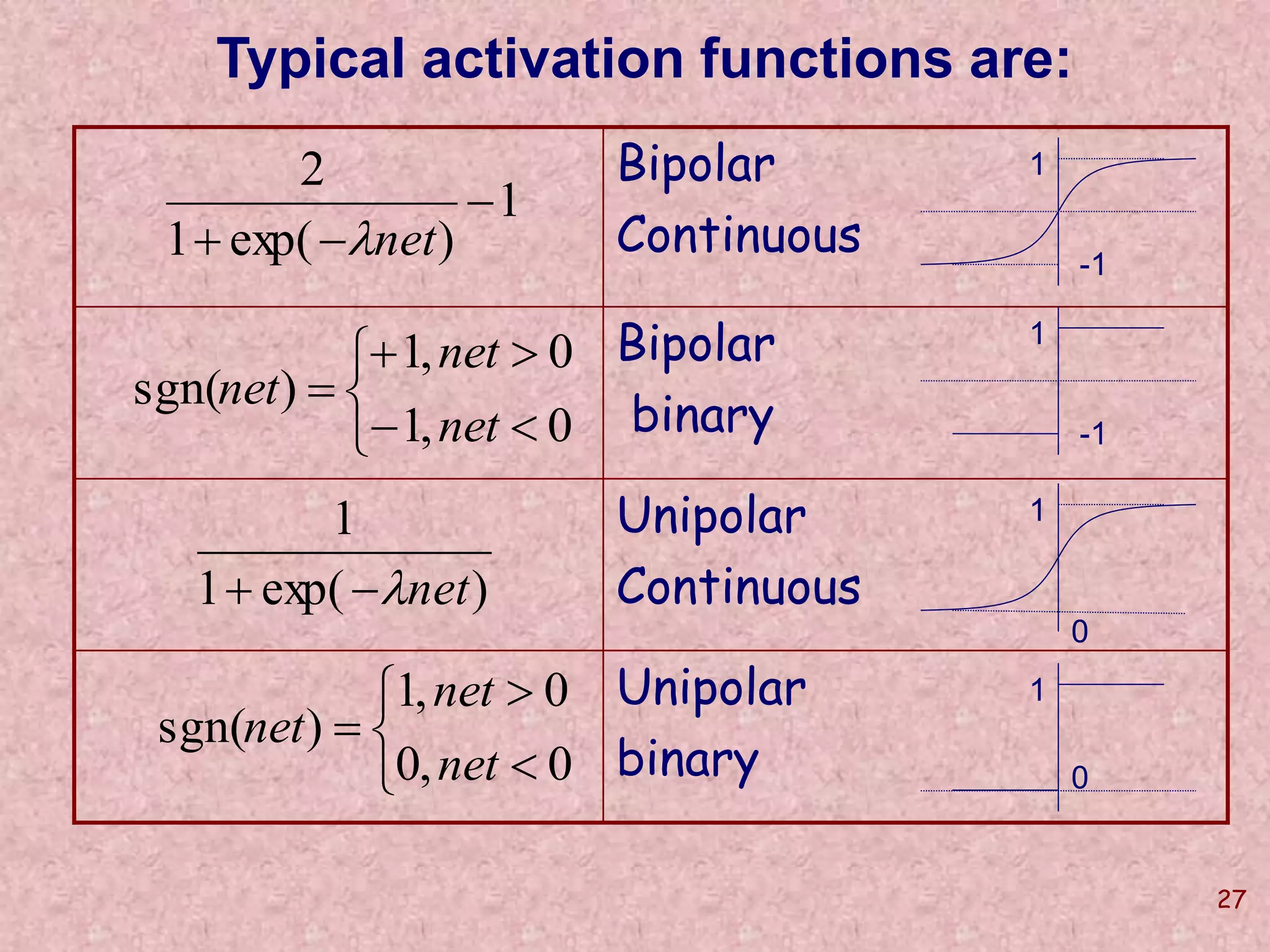
Typical activation functions are: 
Bipolar 
Continuous 
Bipolar 
binary 
Unipolar 
Continuous 
Unipolar 
binary 
1 
2 
1 exp( ) 
 
 net 
net 
  
1, 0 
 
  
 
 
 
1, 0 
sgn( ) 
net 
net 
1 
 net 
1 exp( ) 
net 
1, 0 
 
 
 
 
 
 
0, 0 
sgn( ) 
net 
net 
-1 
1 
-1 
1 
0 
1 
0 
1
28 
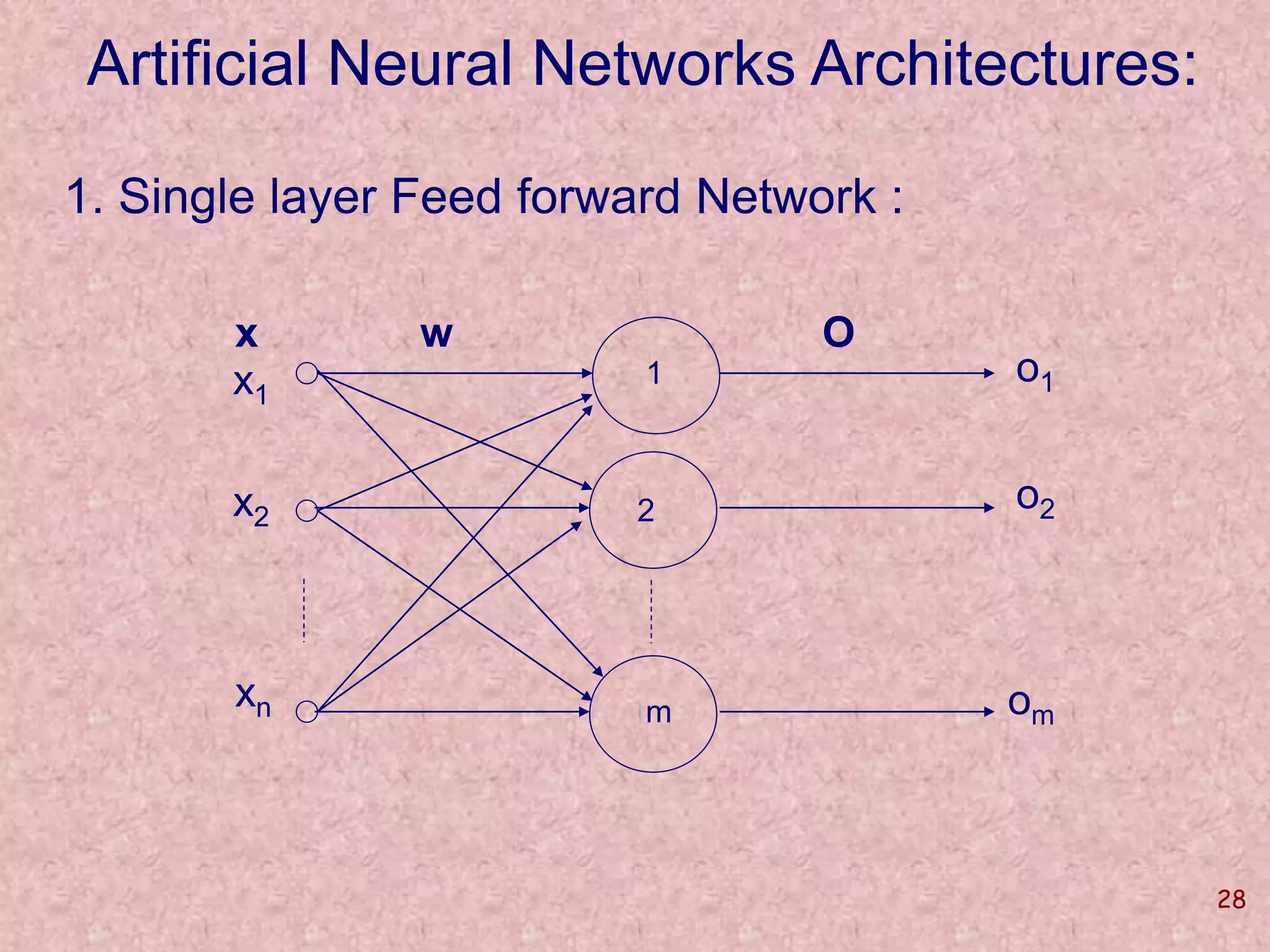
Artificial Neural Networks Architectures: 
1. Single layer Feed forward Network : 
x O 
x1 
x2 
xn 
w 
1 
2 
m 
o1 
o2 
om
29 
Limitation of Single layer Feed forward 
Network: 
Fig 1. OR Fig 2. XOR
30 
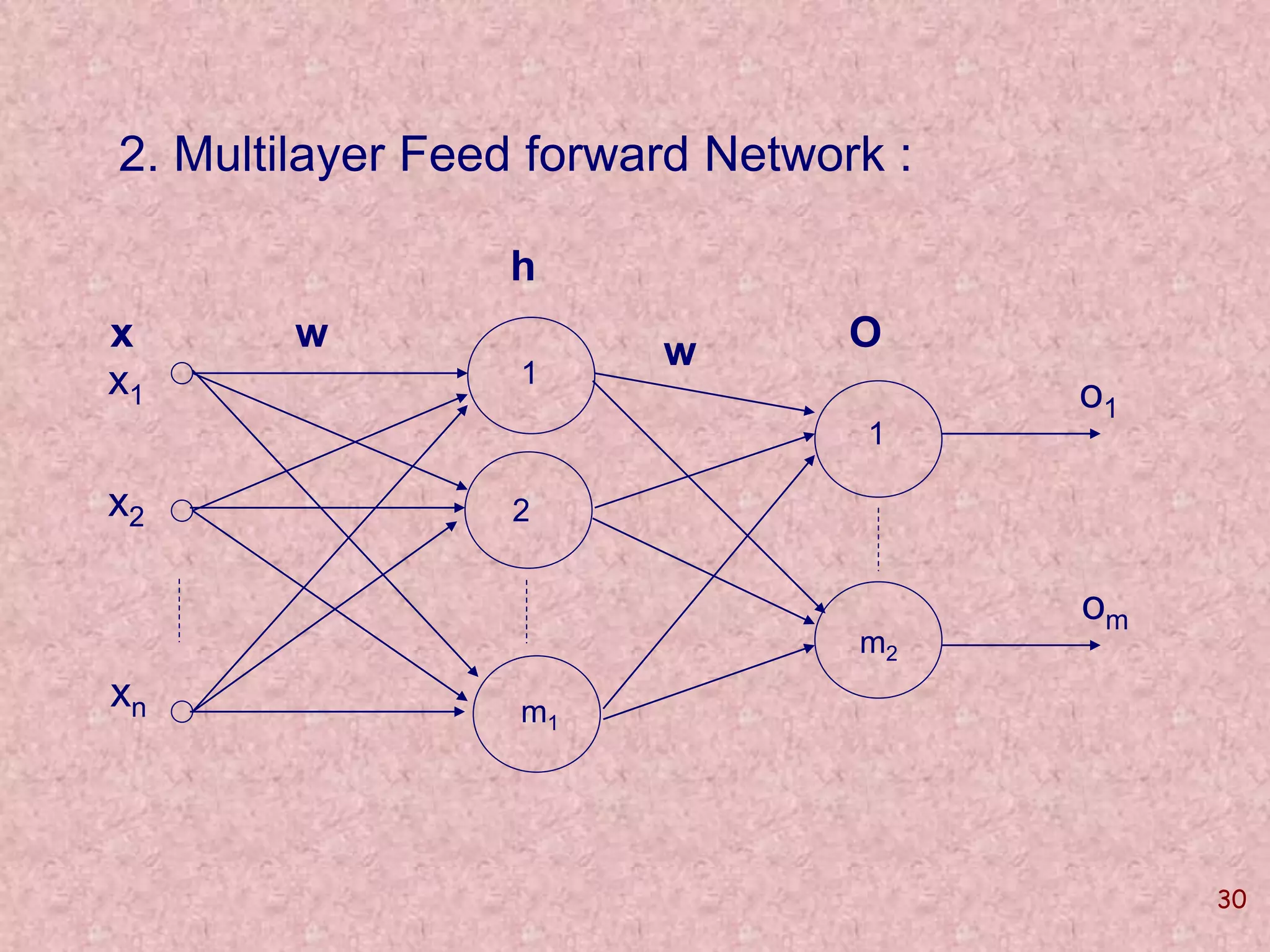
2. Multilayer Feed forward Network : 
x O 
x1 
x2 
xn 
w 
1 
2 
m1 
o1 
om 
1 
m2 
h 
w
31 
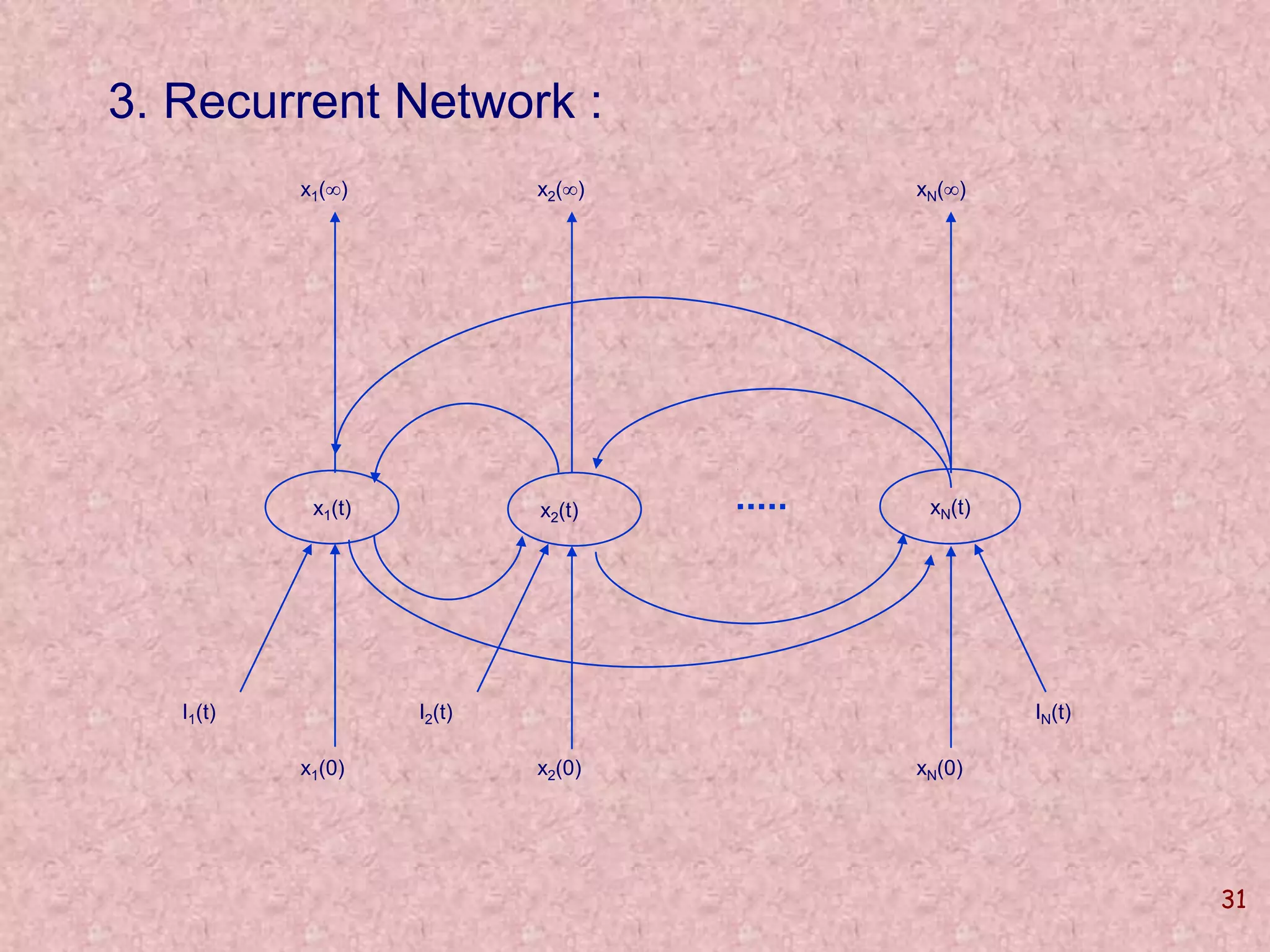
3. Recurrent Network : 
I1(t) 
x xN() 2x () 1() 
x1(t) xNx (t) 2(t) 
x2(0) 
xN(0) 
I2(t) 
IN(t) 
x1(0)
32 
LEARNING : 
Knowledge in Artificial Neural 
Networks lies in the weights. 
Acquiring the knowledge i.e. 
learning in NN means updating the 
weights so that they act as a smart 
Black Box. 
This NN learning process may be 
under supervision or may be 
unsupervised one.
Learning 
• The procedure that consists in estimating the 
parameters of neurons so that the whole network can 
perform a specific task 
• 2 types of learning 
– The supervised learning 
– The unsupervised learning 
• The Learning process (supervised) 
– Present the network a number of inputs and their 
corresponding outputs 
– See how closely the actual outputs match the desired ones 
– Modify the parameters to better approximate the desired 
outputs
Unsupervised learning 
• Idea : group typical input data in function 
of resemblance criteria un-known a priori 
• Data clustering 
• No need of a professor 
– The network finds itself the correlations 
between the data 
– Examples of such networks : 
• Kohonen feature maps
Supervised learning 
• The desired response of the neural 
network in function of particular 
inputs is well known. 
• A “Professor” may provide examples 
and teach the neural network how to 
fulfill a certain task
36 
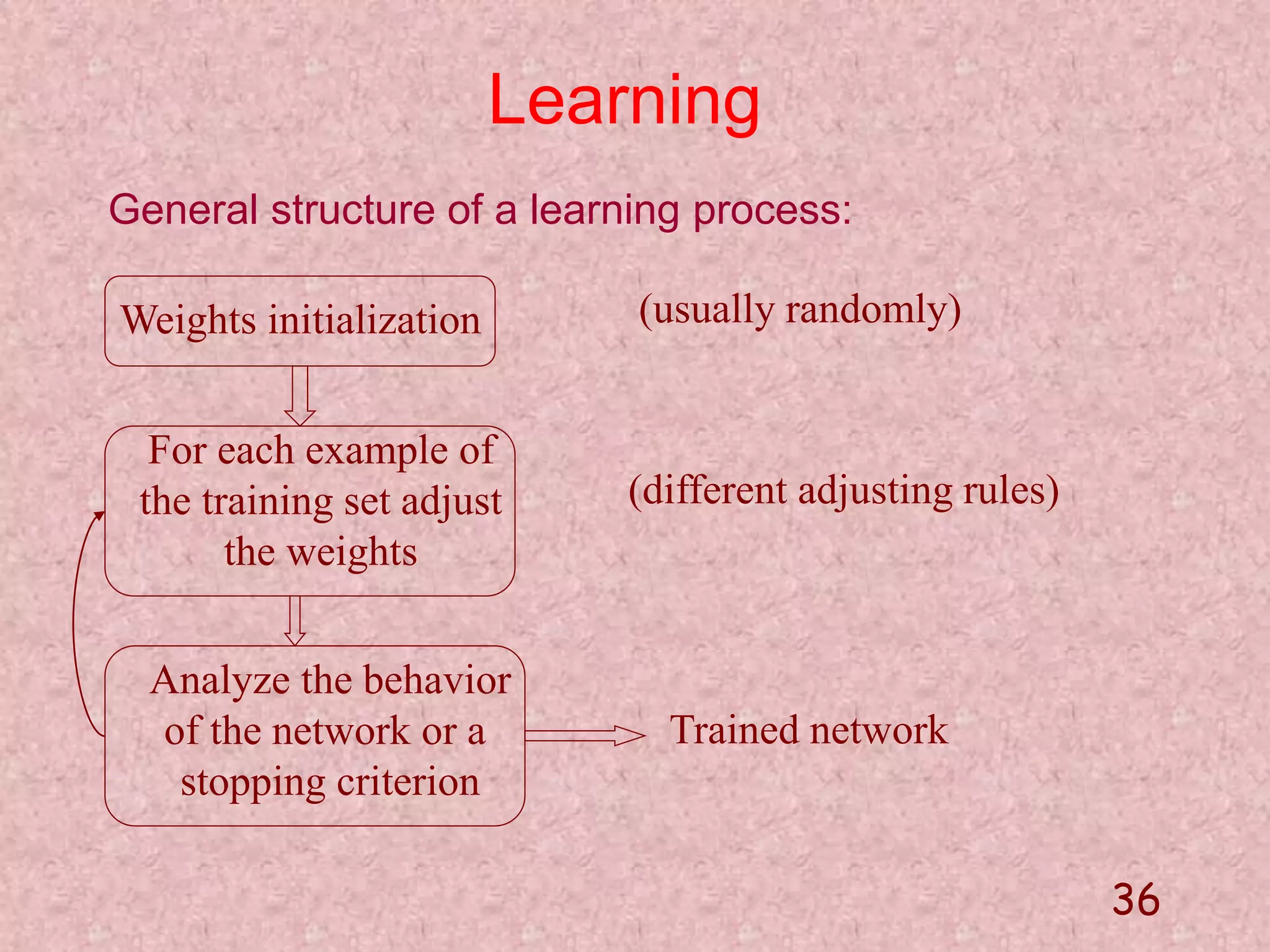
Learning 
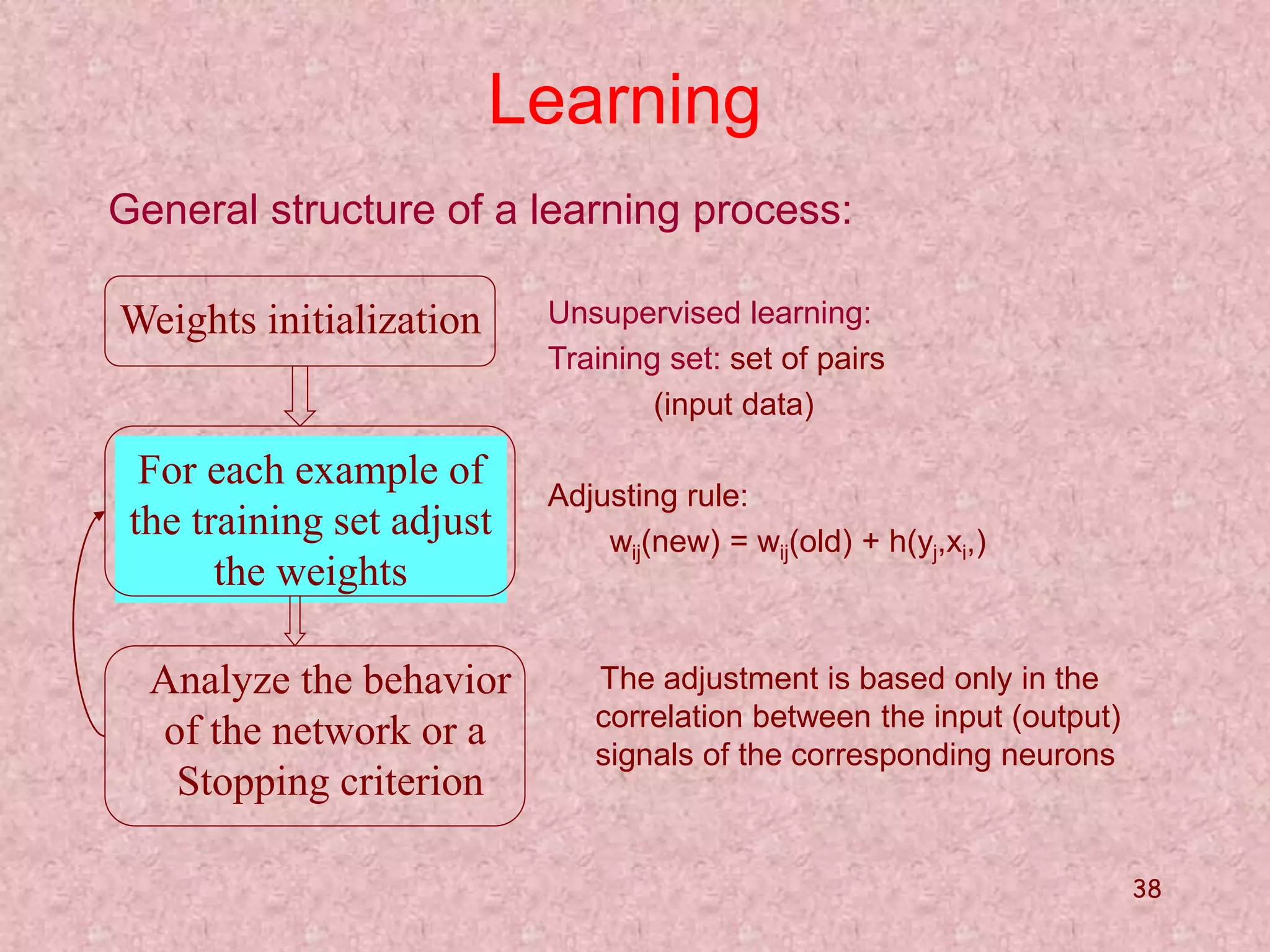
General structure of a learning process: 
Weights initialization 
For each example of 
the training set adjust 
the weights 
Analyze the behavior 
of the network or a 
stopping criterion 
(usually randomly) 
(different adjusting rules) 
Trained network
37 
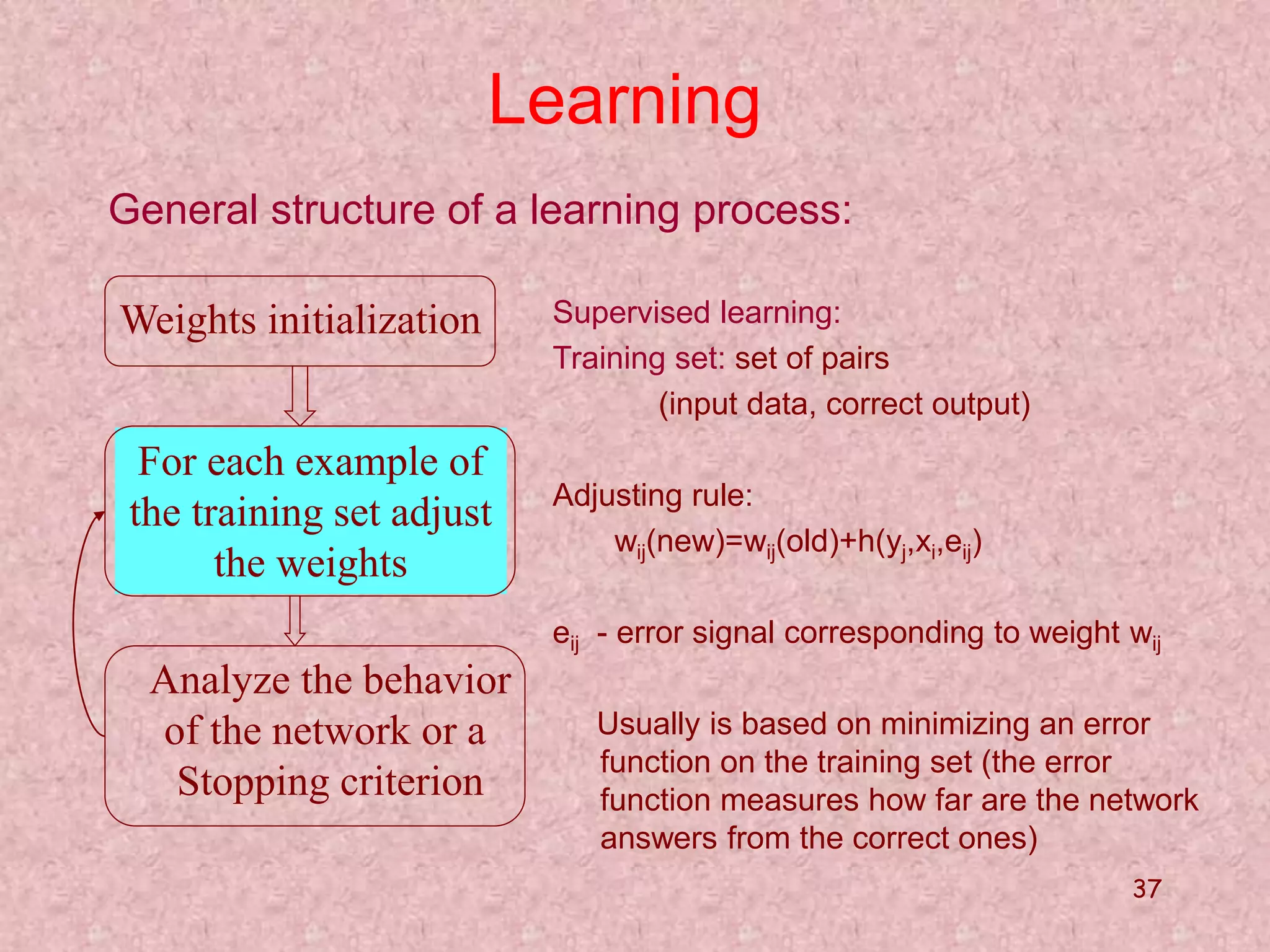
Learning 
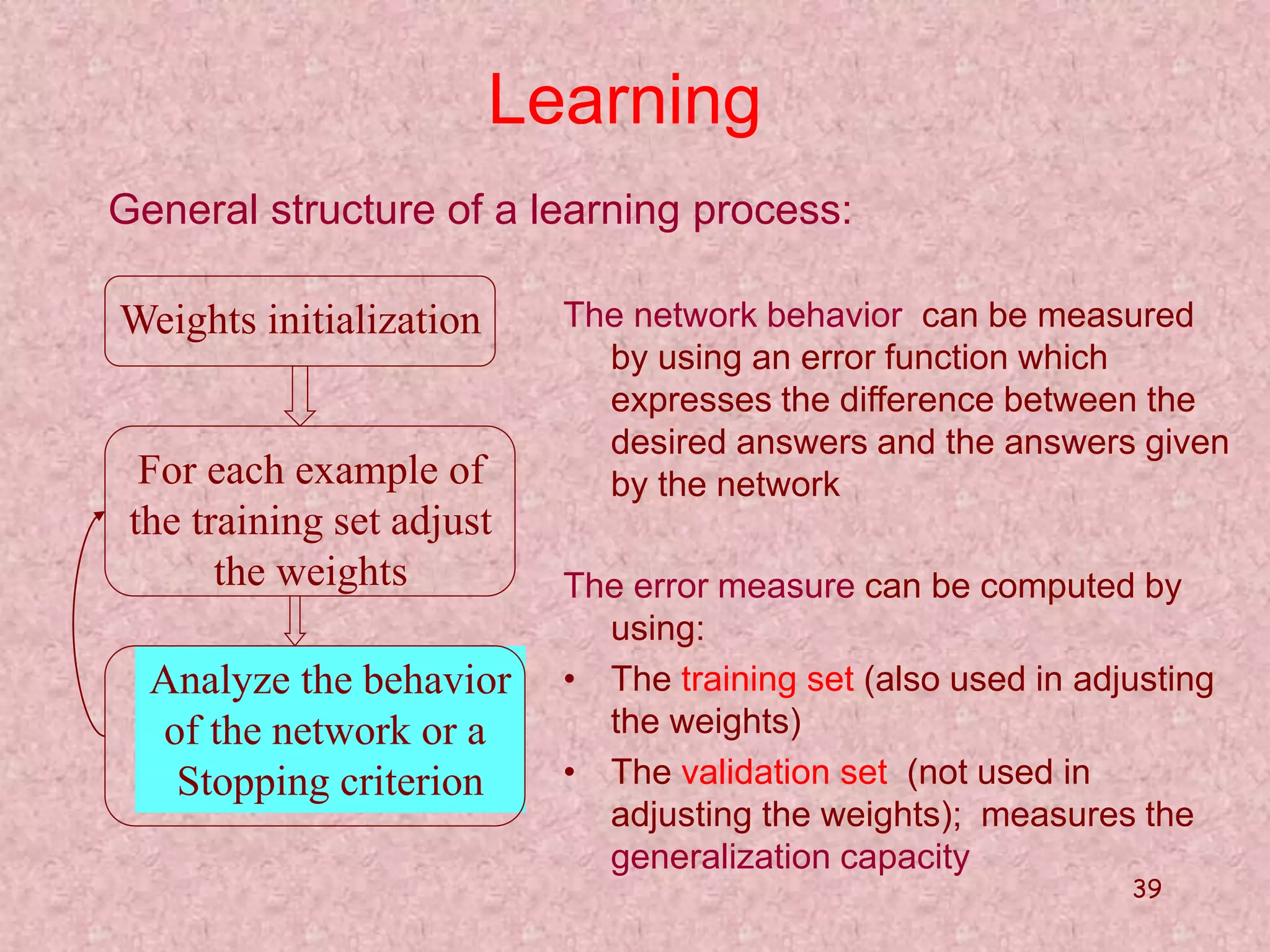
General structure of a learning process: 
Weights initialization 
For each example of 
the training set adjust 
the weights 
Analyze the behavior 
of the network or a 
Stopping criterion 
Supervised learning: 
Training set: set of pairs 
(input data, correct output) 
Adjusting rule: 
wij(new)=wij(old)+h(yj,xi,eij) 
eij - error signal corresponding to weight wij 
Usually is based on minimizing an error 
function on the training set (the error 
function measures how far are the network 
answers from the correct ones)
38 
Learning 
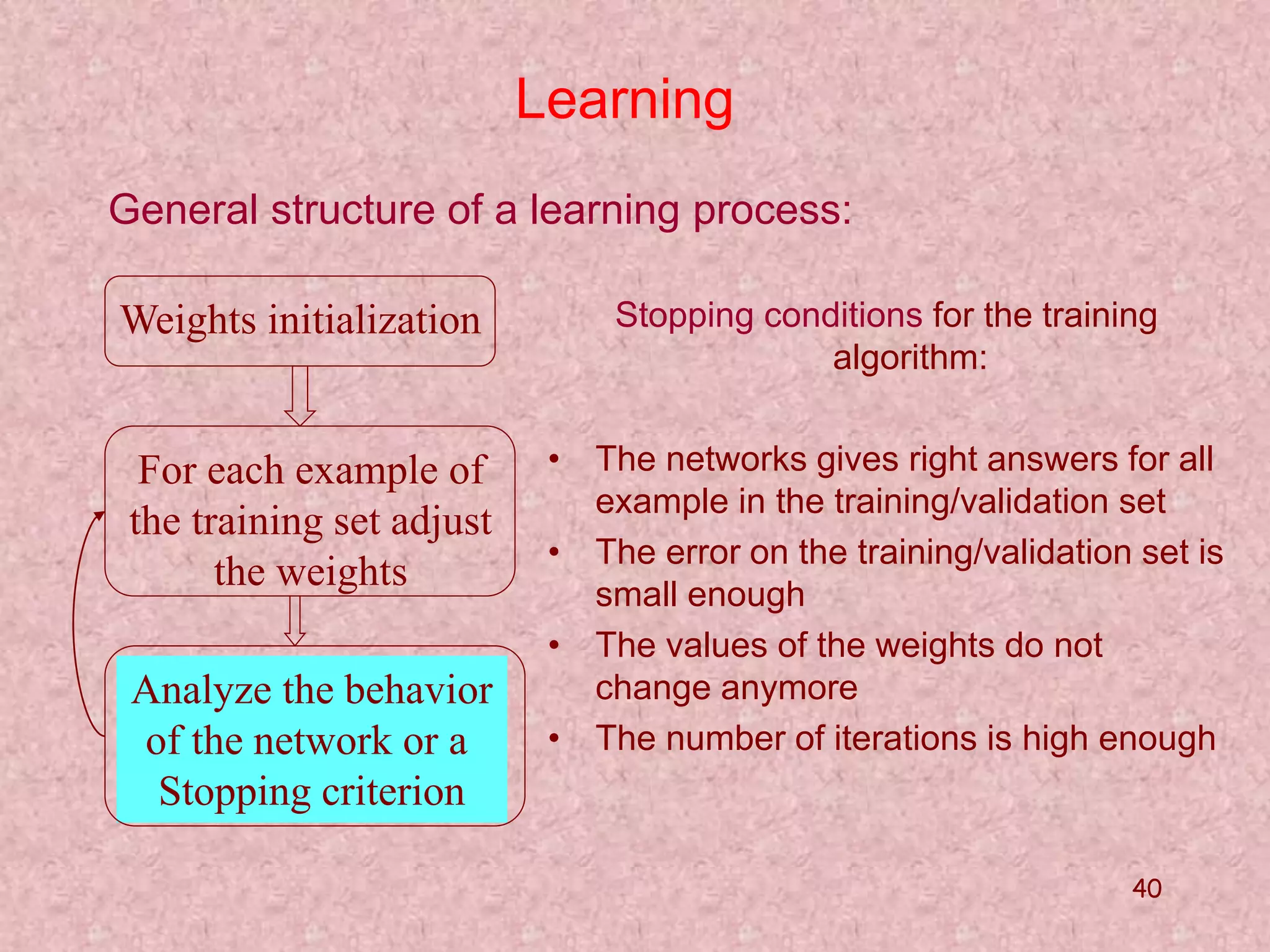
General structure of a learning process: 
Weights initialization 
For each example of 
the training set adjust 
the weights 
Analyze the behavior 
of the network or a 
Stopping criterion 
Unsupervised learning: 
Training set: set of pairs 
(input data) 
Adjusting rule: 
wij(new) = wij(old) + h(yj,xi,) 
The adjustment is based only in the 
correlation between the input (output) 
signals of the corresponding neurons
39 
Learning 
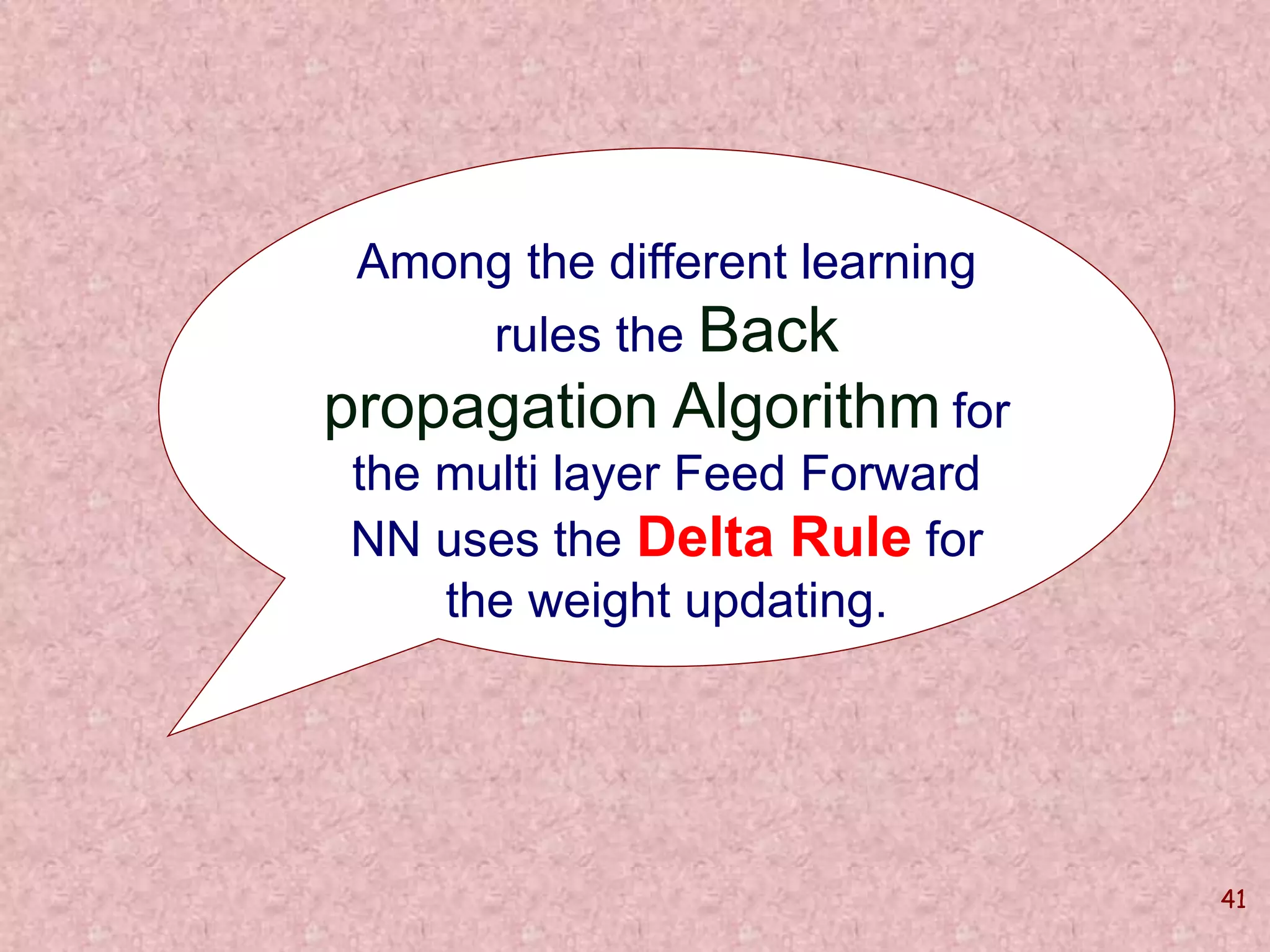
General structure of a learning process: 
Weights initialization 
For each example of 
the training set adjust 
the weights 
Analyze the behavior 
of the network or a 
Stopping criterion 
The network behavior can be measured 
by using an error function which 
expresses the difference between the 
desired answers and the answers given 
by the network 
The error measure can be computed by 
using: 
• The training set (also used in adjusting 
the weights) 
• The validation set (not used in 
adjusting the weights); measures the 
generalization capacity
40 
Learning 
General structure of a learning process: 
Weights initialization 
For each example of 
the training set adjust 
the weights 
Analyze the behavior 
of the network or a 
Stopping criterion 
Stopping conditions for the training 
algorithm: 
• The networks gives right answers for all 
example in the training/validation set 
• The error on the training/validation set is 
small enough 
• The values of the weights do not 
change anymore 
• The number of iterations is high enough
41 
Among the different learning 
rules the Back 
propagation Algorithm for 
the multi layer Feed Forward 
NN uses the Delta Rule for 
the weight updating.
42 
Applications of ANN : 
• Pattern Association 
• Pattern recognition 
• Filtering 
• Memory 
• Function Approximation 
•Parameter Estimation
43 
Neural Networks 
• How do they work? 
– The network is trained with a set of 
known facts that cover the solution 
space (I/O pairs) 
• During the training the weights in the 
network are adjusted until the correct 
answer is given for all the facts in the 
training set 
– After training, the weights are fixed 
and the network answers questions not in 
the training data. 
• These “answers” are consistent with the 
training data
44 
Neural Networks 
• Concurrent NNs accept all inputs at 
once 
• Recurrent or dynamic NNs accept 
input sequentially and may have one or 
more outputs fed back to input 
• We consider only concurrent NNs
45 
MATLAB® NN Toolbox 
• Facilitates easy construction, training 
and use of NNs 
– Concurrent and recurrent networks 
– Linear, tansig, and logsig activation 
functions 
– Variety of training algorithms 
• Backpropagation 
• Descent methods (CG, Steepest Descent…)
46 
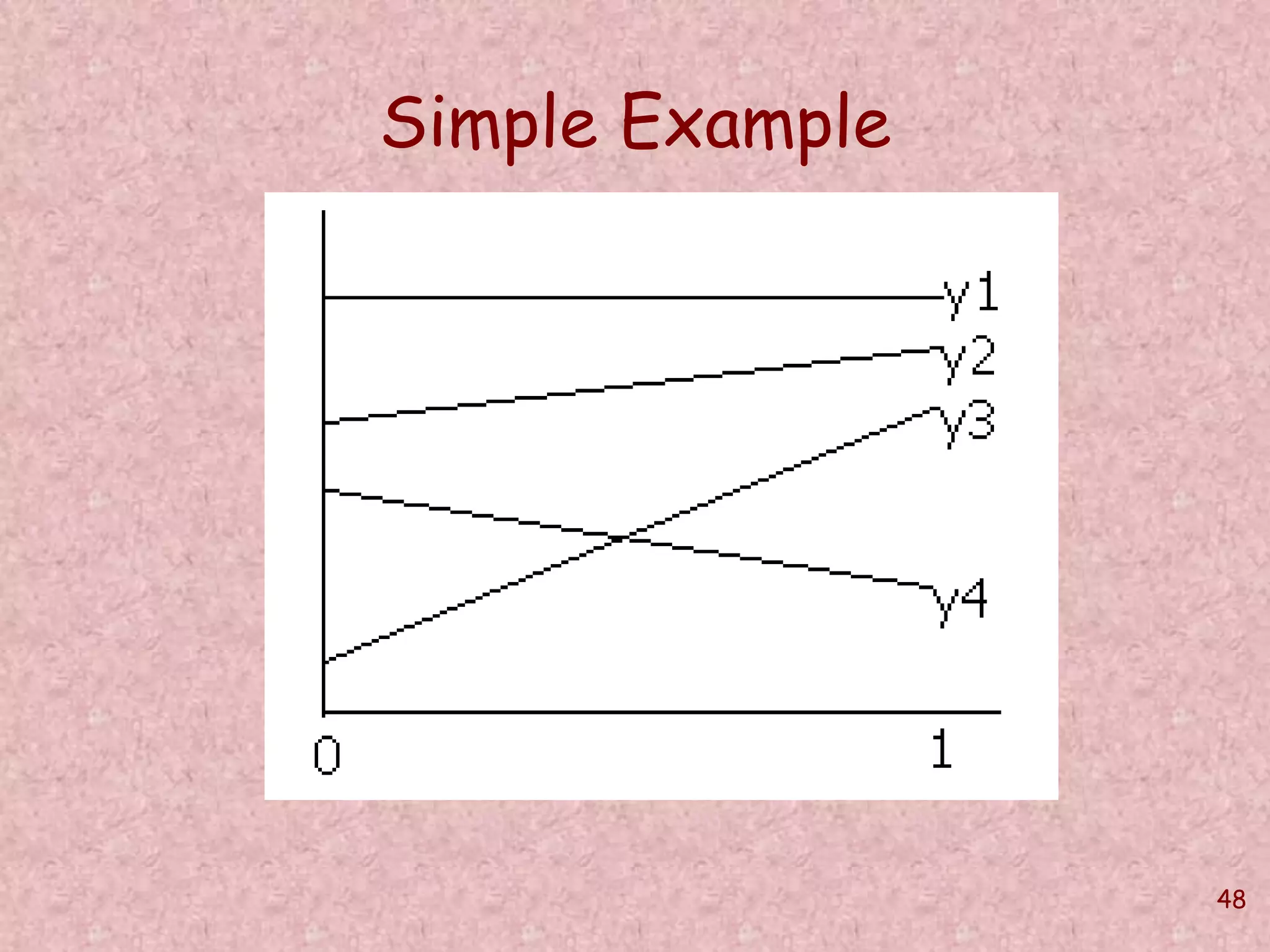
Simple Parameter Estimation 
Y = mx+b 
• Given a number of points on a line, 
determine the slope (m) and intercept 
(b) of the line 
– Fix number of points at 6 
– Restrict domain 0 ≤ x ≤ 1 
– Restrict range of b and m to [ -1, 1 ]
47 
Simple Example 
Approach: 
• let the six values of x be fixed at 0, 
0.2, 0.4, 0.6, 0.8, and 1.0 
• Inputs to the network will be the six 
values of y corresponding to these 
• Outputs of the network will be the 
slope m and intercept b
48 
Simple Example
49 
Simple Example 
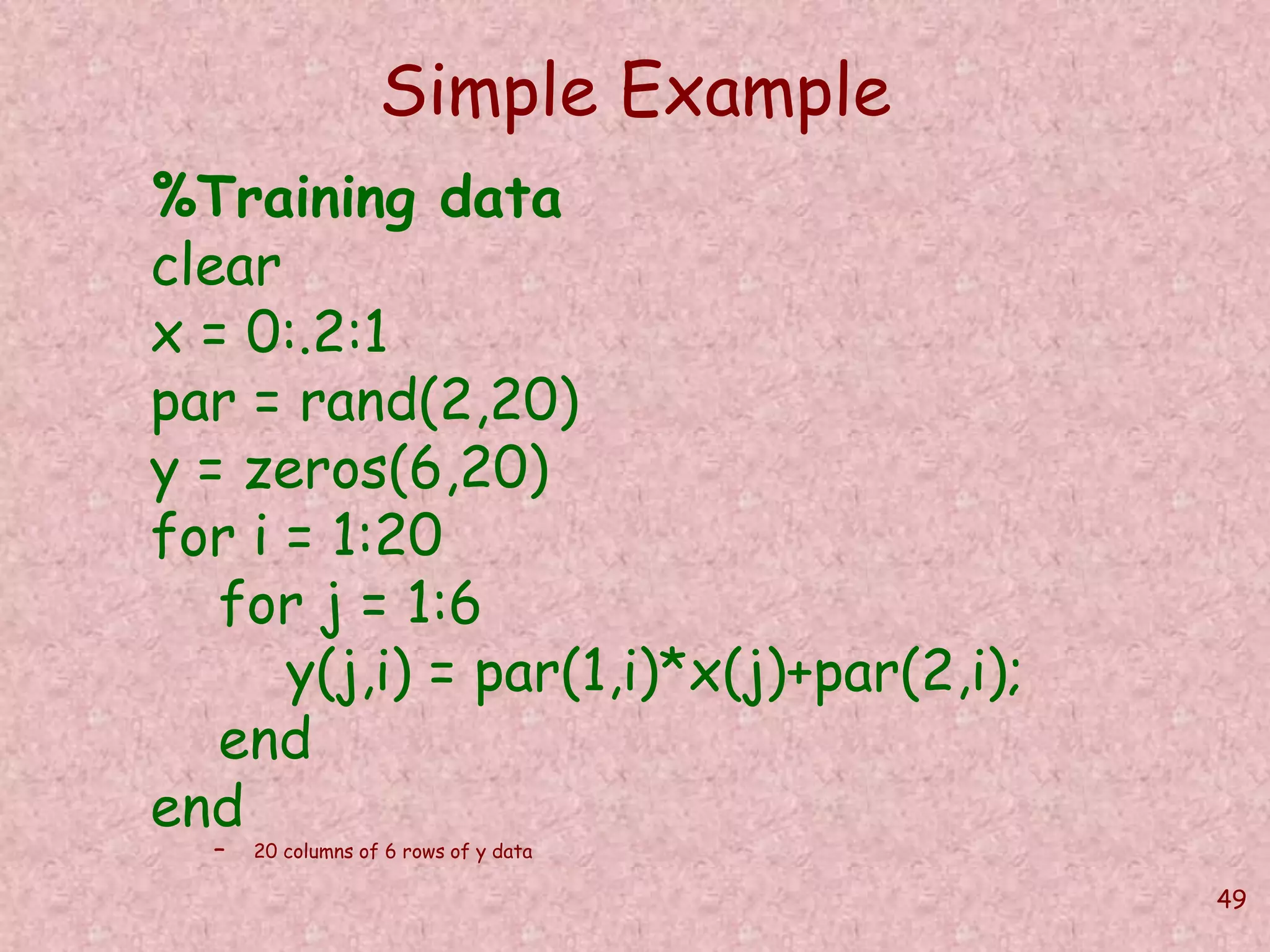
%Training data 
clear 
x = 0:.2:1 
par = rand(2,20) 
y = zeros(6,20) 
for i = 1:20 
for j = 1:6 
y(j,i) = par(1,i)*x(j)+par(2,i); 
end 
end 
– 20 columns of 6 rows of y data
50 
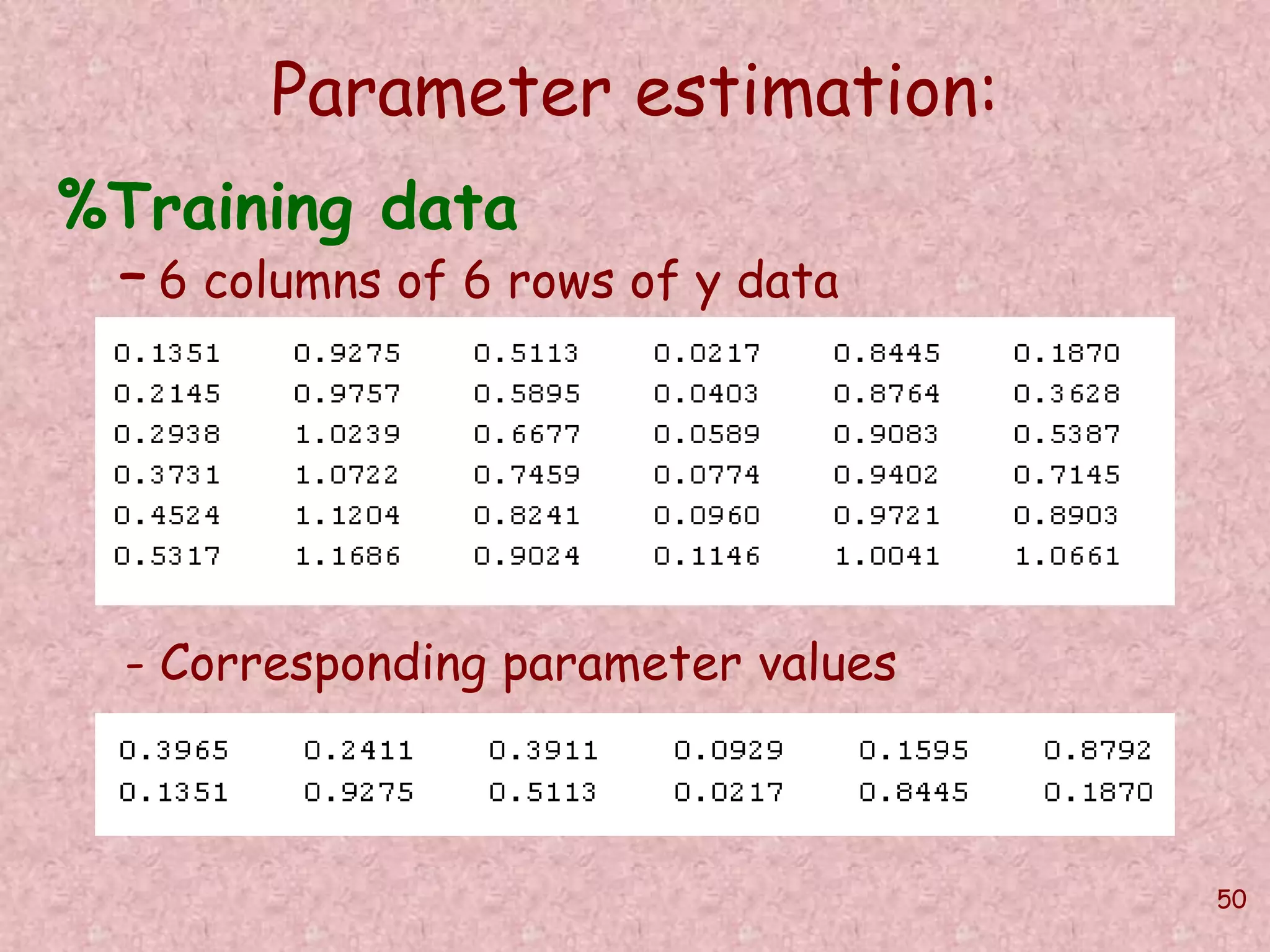
Parameter estimation: 
%Training data 
– 6 columns of 6 rows of y data 
- Corresponding parameter values
51 
Parameter estimation: 
Neural Network 
– 6 inputs – linear activation function 
– 10 neurons in hidden layer 
• Use tansig activation function 
– 2 outputs – tansig activation function 
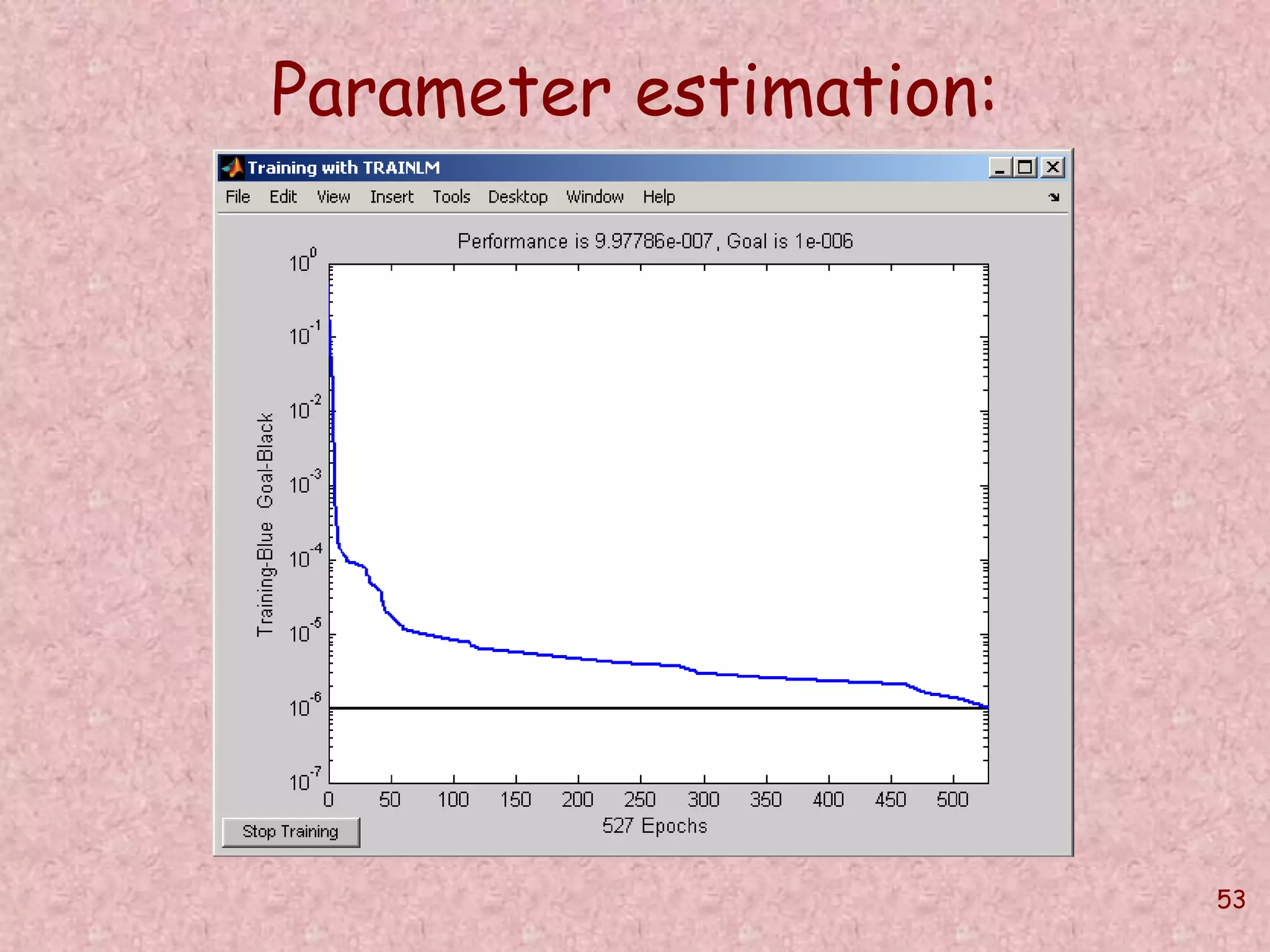
– trained until MSE < 10-6
52 
Parameter estimation: 
netu = newff([0 1;0 1;0 1;0 1;0 1; 0 1],[10, 
2],{'tansig' 'tansig'}, 'trainlm', 'learngdm', 
'mse'); 
netu = init(netu); 
Pu = y; 
Tu = par; 
netu.trainParam.epochs = 100000; 
netu.trainParam.goal = 0.000001; 
netu = train(netu,Pu,Tu); 
yu = sim(netu,Pu)
53 
Parameter estimation:
54 
Parameter estimation: 
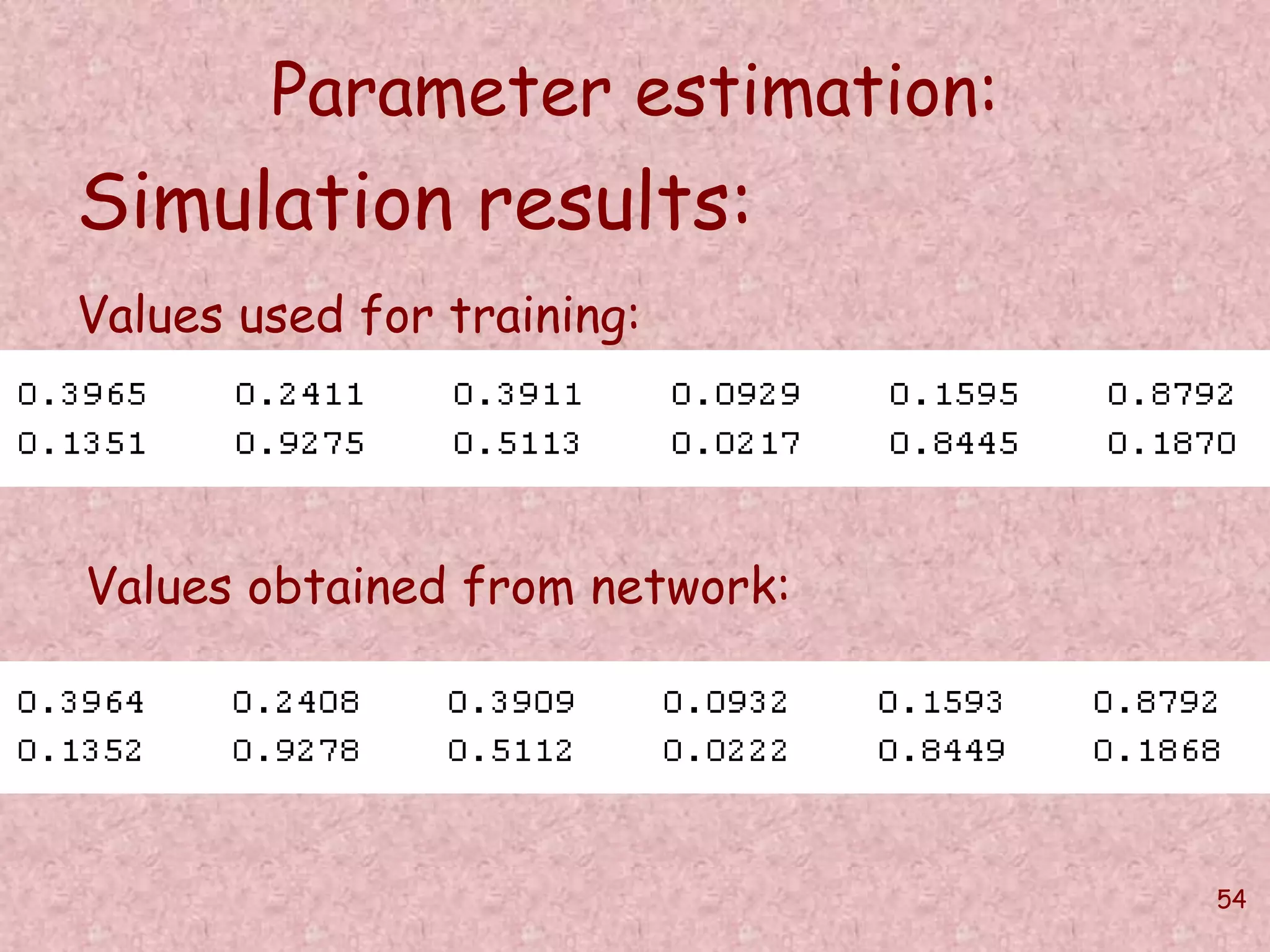
Simulation results: 
Values used for training: 
Values obtained from network:
55 
Parameter estimation: 
Generalization validation: 
Using parameter values 
m = 0.3974 and b = 0.7316 
we generate input vector: 
[ 0.7316 0.8110 0.8905 0.9700 1.0495 1.1290 ]’ 
For this input vector the trained Neural Network 
produces the output as: 
0.3946 
0.7323
56 
Network Design 
• First add more neurons in each 
layer 
• Add more hidden layers if 
necessary
57 
Neural Networks - Conclusions 
• NNs offer possibility of solution of 
parameter estimation 
• Proper design of the network and 
training set is essential for 
successful application
Instructional Worshop on MATLAB 11 - 13 Dec, 2007 
58 
FUZZY Toolbox 
(MATLAB®)
59 
Overview 
• Fuzzy Sets 
• Fuzzy Logic 
• How is Fuzzy Logic used? 
• General Fuzzified Applications 
• Expert Fuzzified Systems 
• An Example 
• MATLAB ® Toolbox
Introduction 
• In 1965* Zadeh published his seminal work 
"Fuzzy Sets" which described the mathematics 
of Fuzzy Set Theory. 
• FST has numbers of applications in various 
fields- artificial intelligence, automata theory, 
computer science, control theory, decision 
making, finance etc. 
• It is being applied on a major scale in 
industries for machine-building (cars, engines, 
ships, etc.) through intelligent robots and 
controls. 
*L. A. ZADEH, Fuzzy Sets, Information Control, 1965, 8, 338-353.
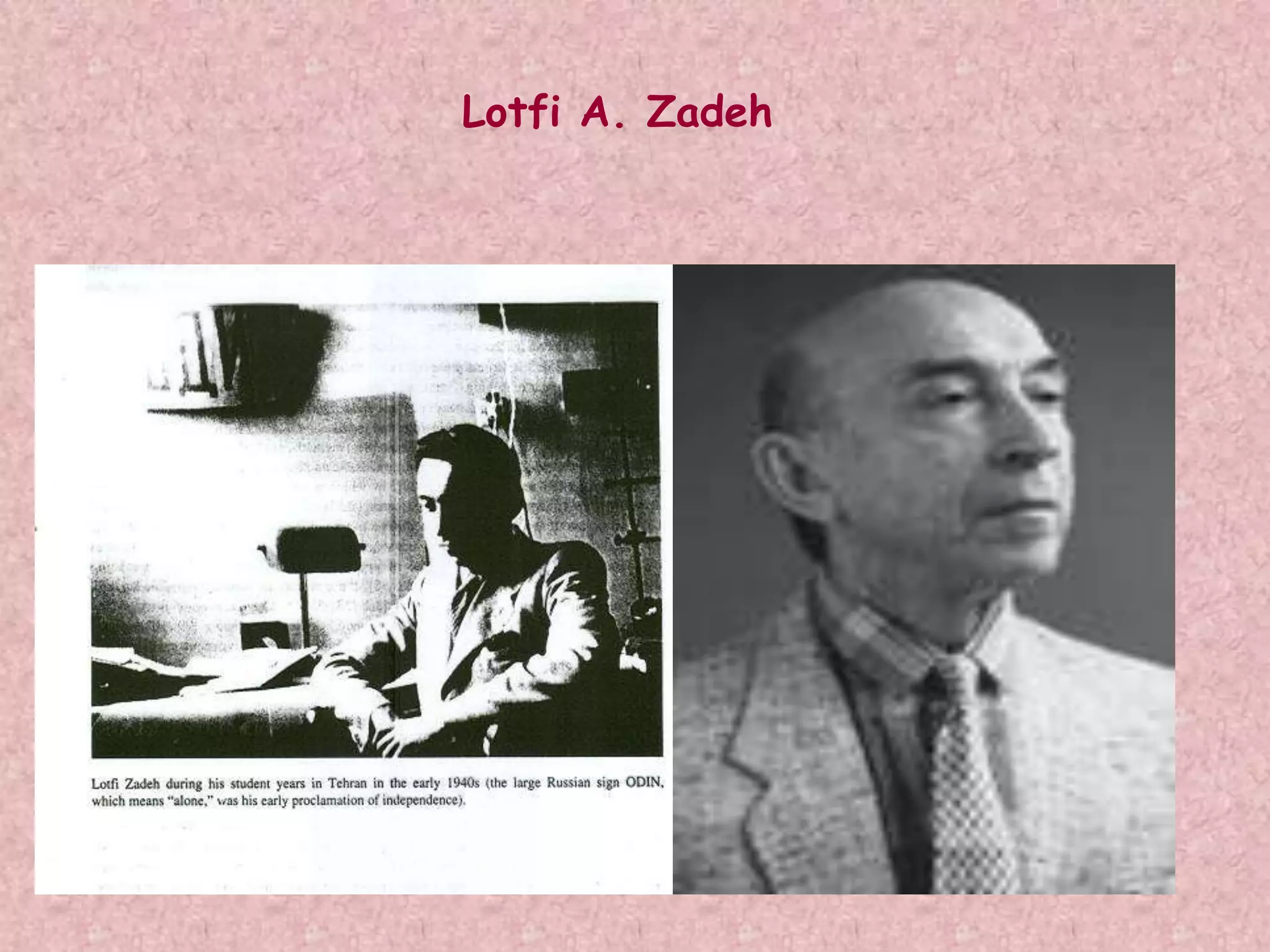
Lotfi A. Zadeh
Fuzzy Set Theory deals with the uncertainty and 
fuzziness arising from interrelated humanistic types of 
phenomena: 
Subjectivity 
Thinking 
Reasoning 
Cognition 
Perception
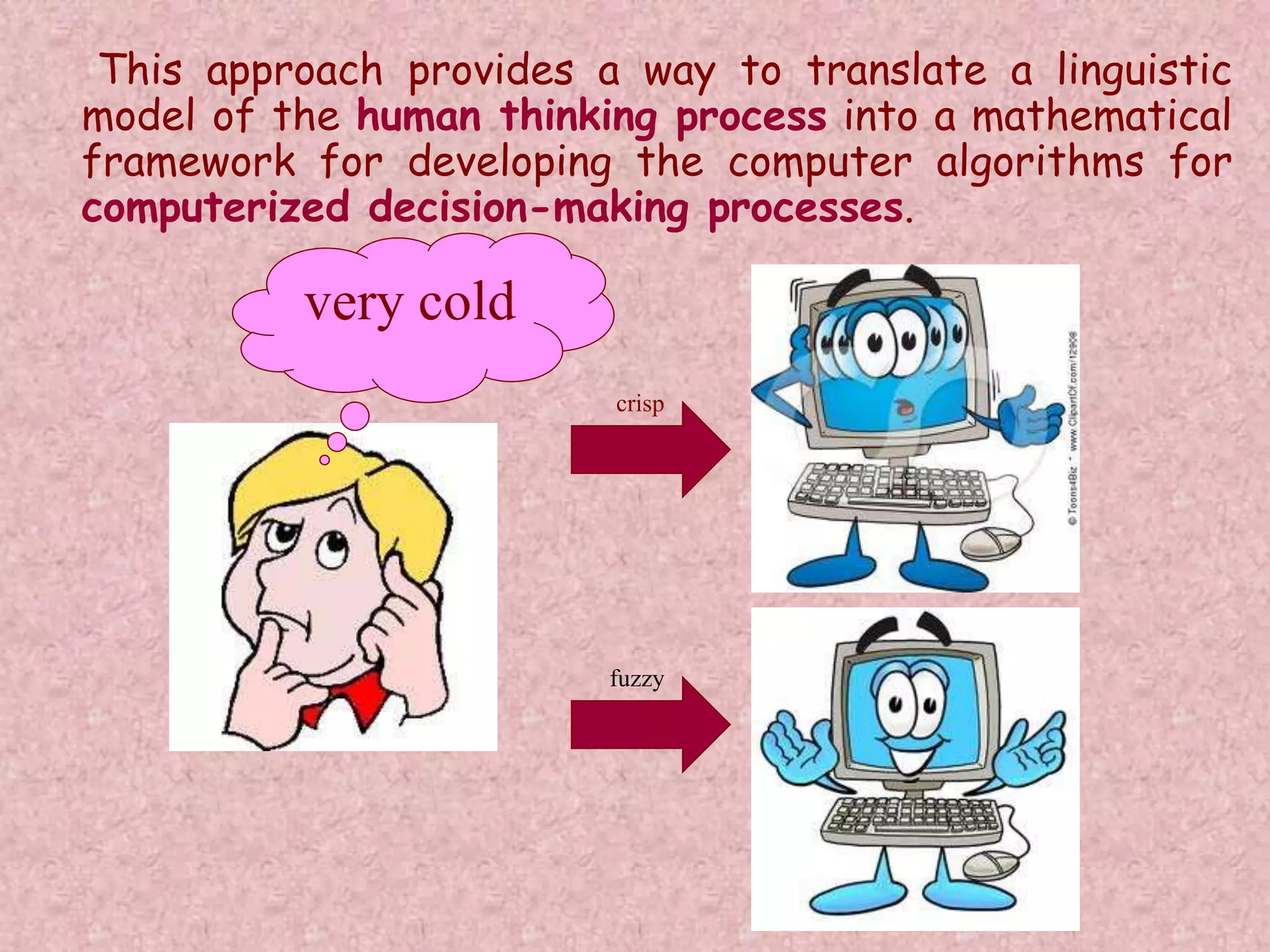
This approach provides a way to translate a linguistic 
model of the human thinking process into a mathematical 
framework for developing the computer algorithms for 
computerized decision-making processes. 
crisp 
fuzzy 
very cold
In general, fuzziness describes 
objects or processes that are not 
acquiescent to precise definition or 
precise measurement. Thus, fuzzy 
processes can be defined as processes 
that are vaguely defined and have some 
uncertainty in their description. The 
data arising from fuzzy systems are in 
general, soft, with no precise 
boundaries.
Fuzziness in Everyday World 
John is tall; 
Temperature is hot; 
The girl next door is pretty; 
The sun is getting relatively hot; 
The people living close to Vadodara; 
My car is slow, your car is fast;
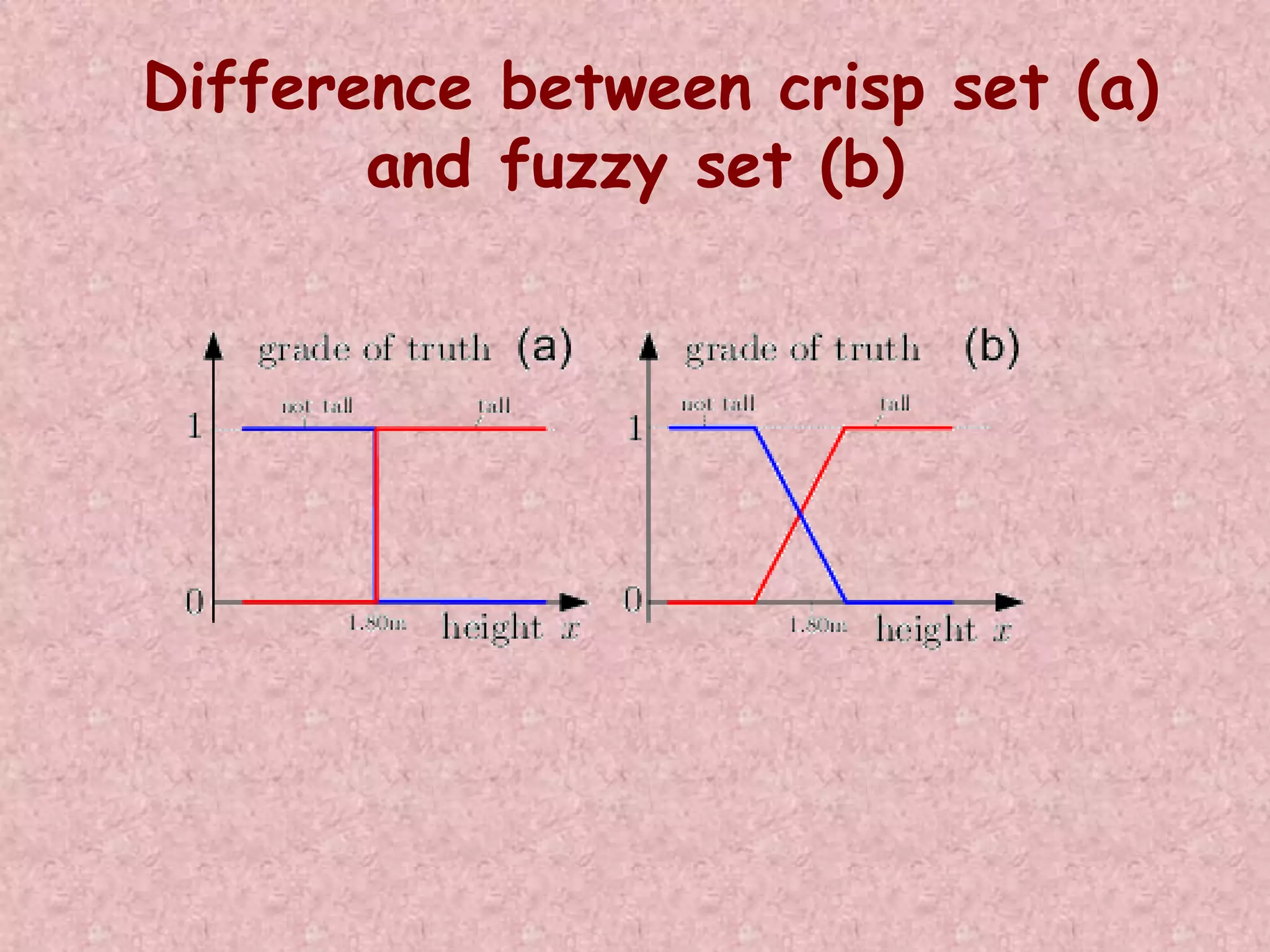
Characteristic Function in the Case 
of Crisp Sets and Fuzzy Sets 
P: X  {0,1} 
P(x) = 
A : X  [0,1] 
A = {X, A(x)} if x  X 
1 if 
 
 
 
x X 
 
x  
X 
0 if 
A Fuzzy Set is a generalized set to which objects can 
belongs with various degrees (grades) of memberships 
over the interval [0,1].
Difference between crisp set (a) 
and fuzzy set (b)
Operations on Fuzzy sets 
• Standard complement :- 
A’(x) = 1 − A(x) 
• Standard intersection:- 
(A ∩ B)(x) = min [A(x), B(x)] 
• Standard union:- 
(A U B)(x) = max [A(x), B(x)]
69 
Fuzzy Logic – A Definition 
Fuzzy logic provides a method to formalize reasoning when 
dealing with vague terms. 
Traditional computing requires finite precision which is not 
always possible in real world scenarios. 
Not every decision is either true or false, or as with 
Boolean logic either 0 or 1. 
Fuzzy logic allows for membership functions, or degrees of 
truthfulness and falsehoods. 
Or as with Boolean logic, not only 0 and 1 but all the 
numbers that fall in between.
70 
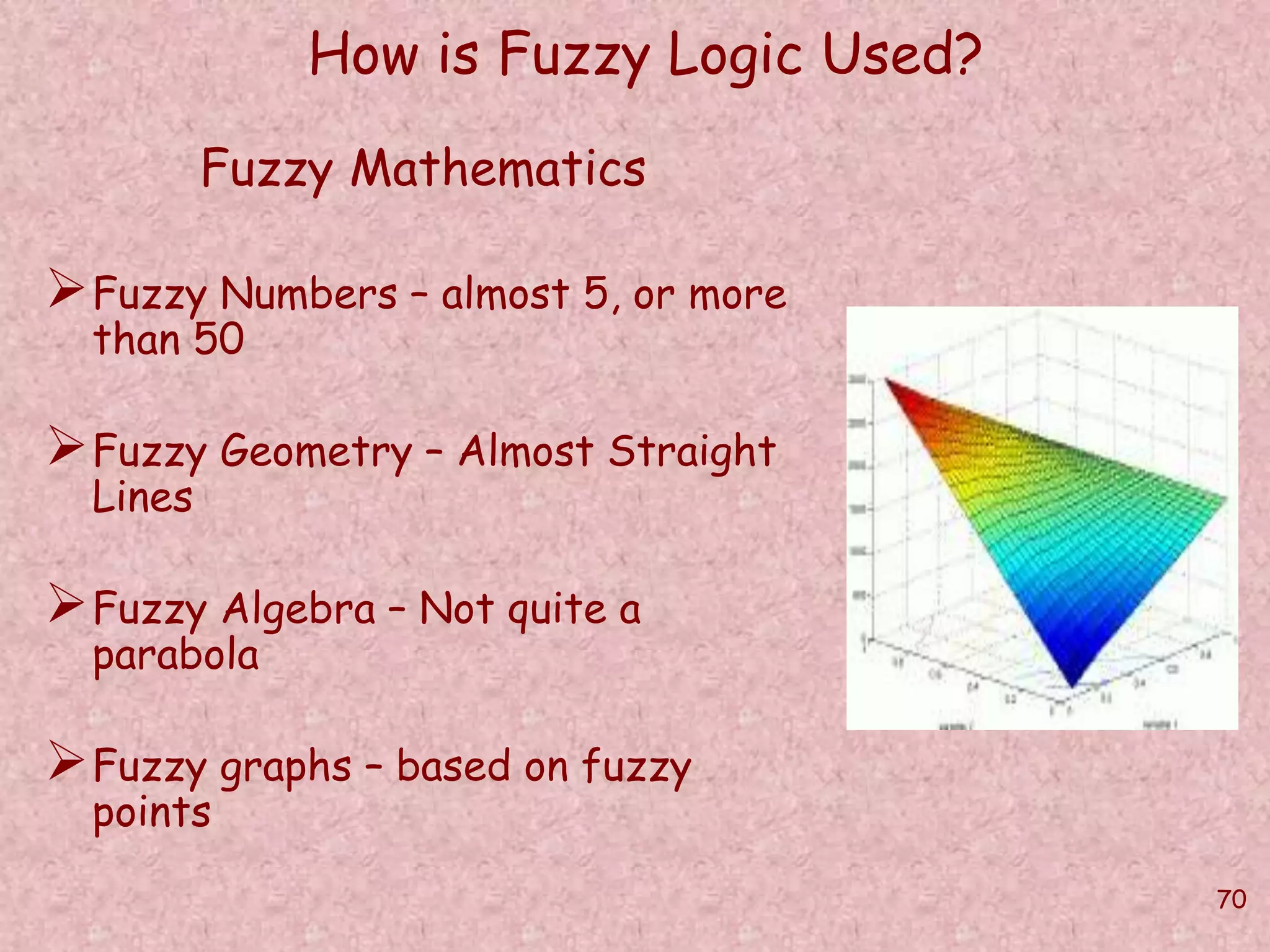
How is Fuzzy Logic Used? 
Fuzzy Mathematics 
Fuzzy Numbers – almost 5, or more 
than 50 
Fuzzy Geometry – Almost Straight 
Lines 
Fuzzy Algebra – Not quite a 
parabola 
Fuzzy graphs – based on fuzzy 
points
71 
General Fuzzified Applications 
• Quality Assurance 
• Error Diagnostics 
• Control Theory 
• Pattern Recognition
72 
Expert Fuzzified Systems 
• Medical Diagnosis 
• Legal 
• Stock Market Analysis 
• Mineral Prospecting 
• Weather Forecasting 
• Economics 
• Politics
73 
MATLAB® Fuzzy Toolbox 
newfis - Create new FIS. 
FIS=NEWFIS(FISNAME) creates a new 
Mamdani-style FIS structure 
FIS=NEWFIS(FISNAME, FISTYPE) creates a 
FIS structure for a Mamdani or Sugeno-style 
system with the name FISNAME.
74 
MATLAB® Fuzzy Toolbox 
Illustration : Fuzzy Washing Machine 
Depending on two fuzzy inputs dirt and 
type of dirt the fuzzy inference system 
calculates the wash time. 
w = newfis('Wash');
75 
MATLAB® Fuzzy Toolbox 
addvar - Add variable to FIS. 
w = addvar(w,varType,varName,varBounds) 
w = addvar(w,'input','dirt',[0,100]); 
addmf - Add membership function to FIS 
w = addmf(w,varType,varIndex,mfName, 
mfType, mfParams) 
w = addmf(w,'input',1,'small','trimf',[-50 0 50]);
76 
MATLAB® Fuzzy Toolbox 
addrule - Add rule to FIS. 
ruleList=[1 1 1 1 1; 
1 2 2 1 1]; 
w = addrule(w,ruleList);
77 
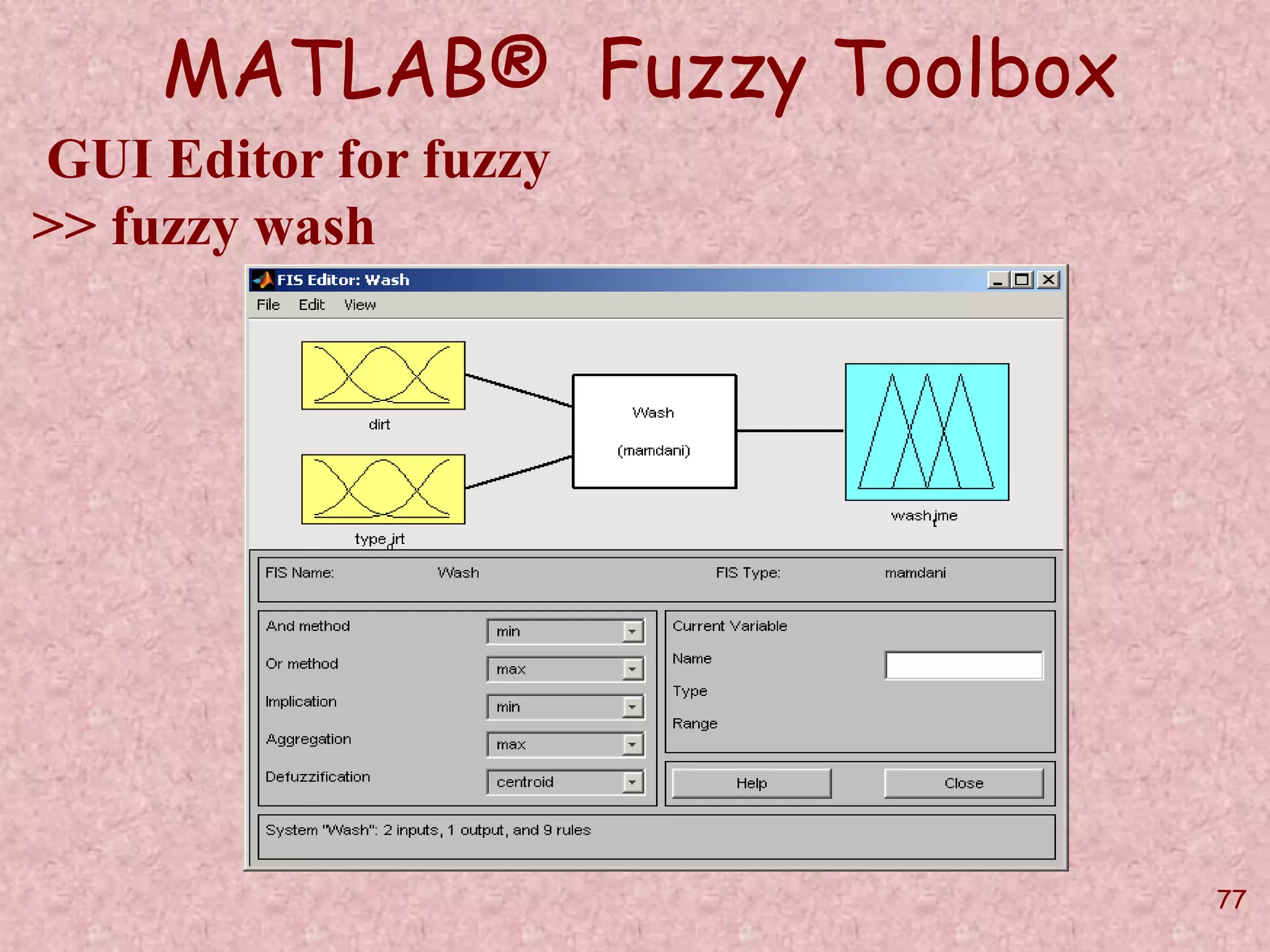
MATLAB® Fuzzy Toolbox 
GUI Editor for fuzzy 
>> fuzzy wash
78 
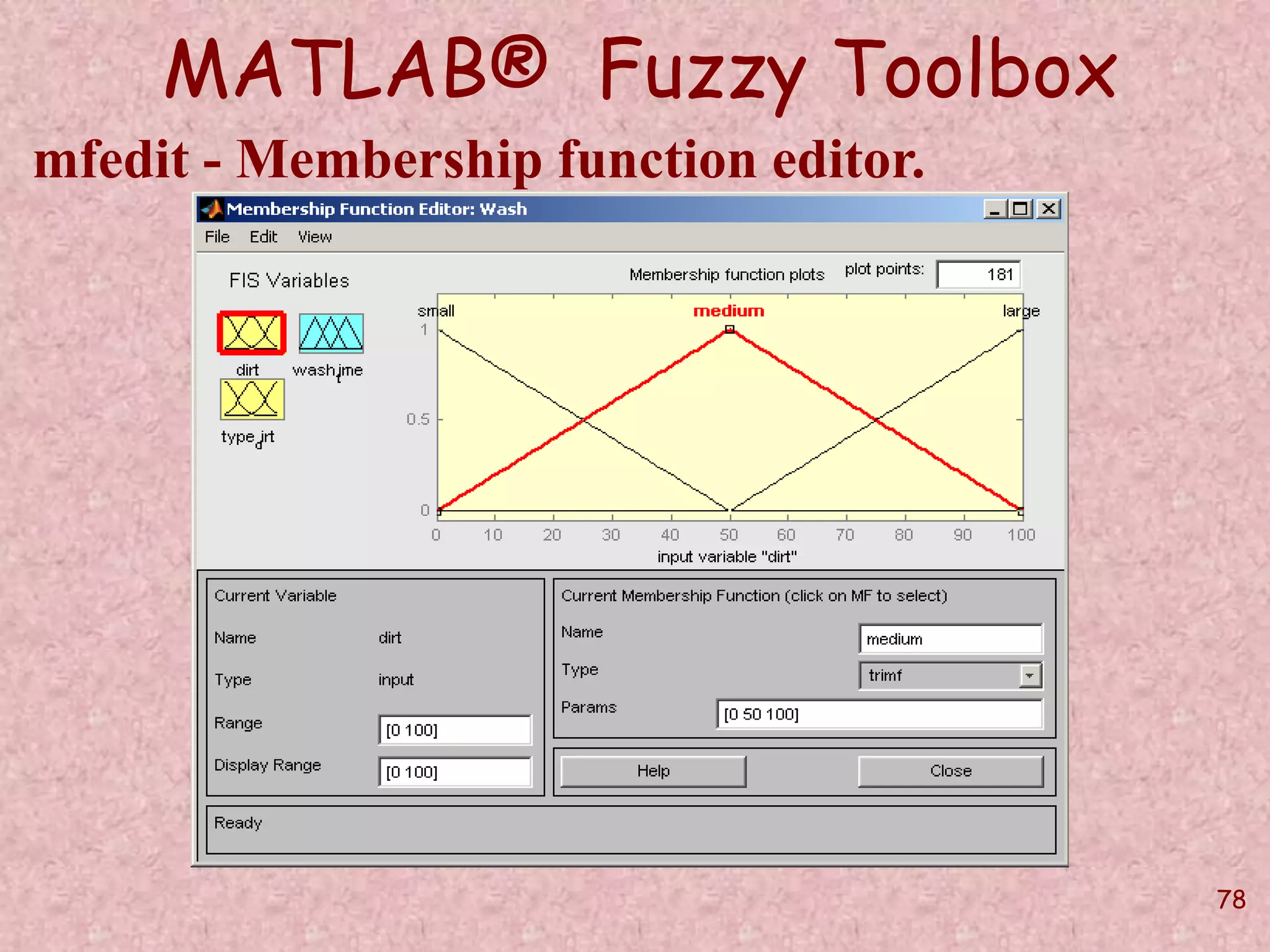
MATLAB® Fuzzy Toolbox 
mfedit - Membership function editor.
79 
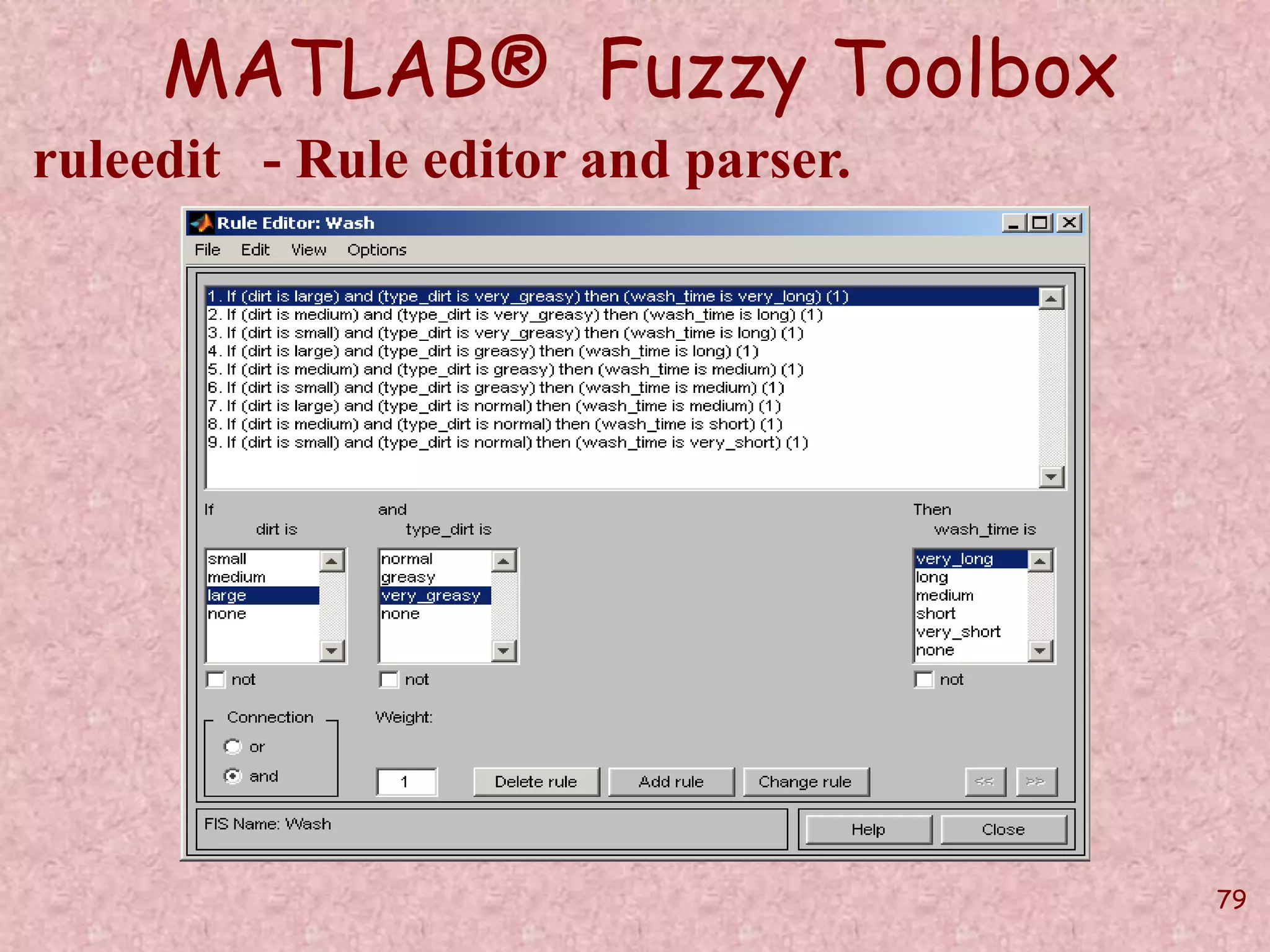
MATLAB® Fuzzy Toolbox 
ruleedit - Rule editor and parser.
80 
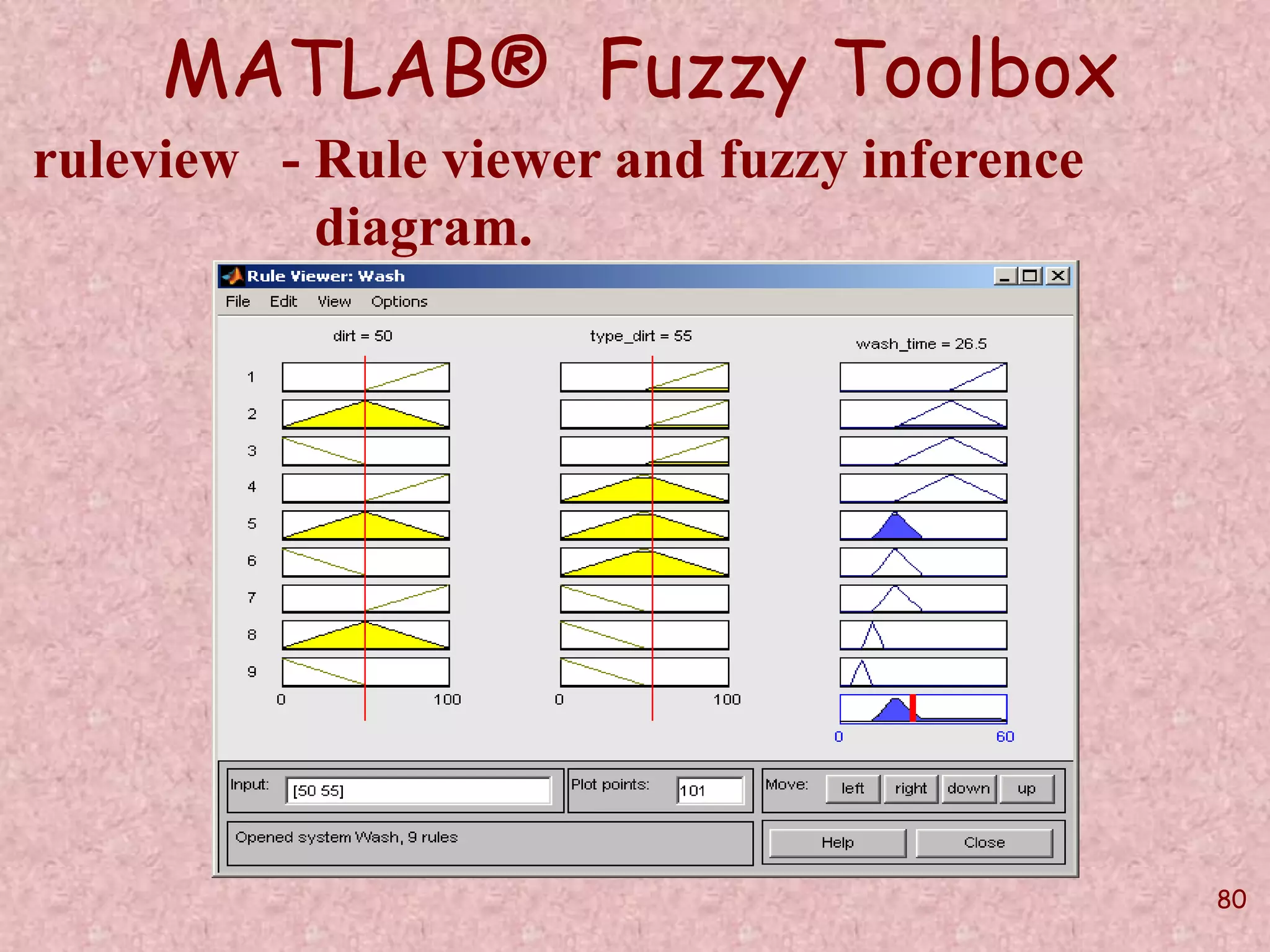
MATLAB® Fuzzy Toolbox 
ruleview - Rule viewer and fuzzy inference 
diagram.
81 
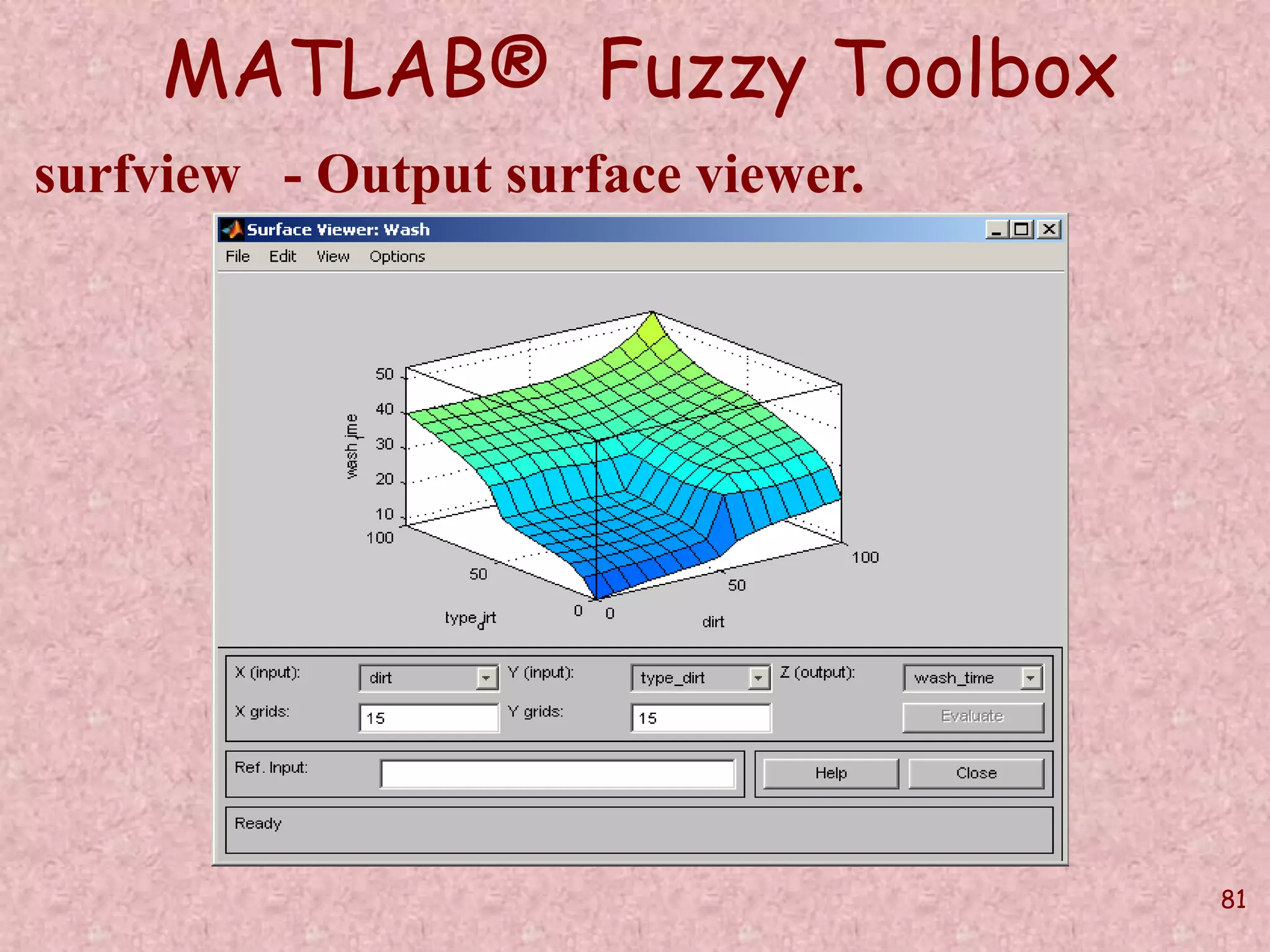
MATLAB® Fuzzy Toolbox 
surfview - Output surface viewer.
82 
MATLAB® Fuzzy Toolbox 
w = newfis('Wash'); 
w = addvar(w,'input','dirt',[0,100]); 
w = addvar(w,'input','type_dirt',[0,100]); 
w = addvar(w,'output','wash_time',[0,60]); 
w = addmf(w,'input',1,'small','trimf',[-50 0 50]); 
w = addmf(w,'input',1,'medium','trimf',[0 50 100]); 
w = addmf(w,'input',1,'large','trimf',[50 100 150]); 
w = addmf(w,'input',2,'normal','trimf',[-50 0 50]); 
w = addmf(w,'input',2,'greasy','trimf',[0 50 100]); 
w = addmf(w,'input',2,'very_greasy','trimf',[50 100 150]); 
w = addmf(w,'output',1,'very_long','trimf',[40 60 80]); 
w = addmf(w,'output',1,'long','trimf',[20 40 60]); 
w = addmf(w,'output',1,'medium','trimf',[12 20 30]); 
w = addmf(w,'output',1,'short','trimf',[8 12 16]); 
w = addmf(w,'output',1,'very_short','trimf',[4 8 12]); 
ruleList = [3 3 1 1 1;2 3 2 1 1; 1 3 2 1 1; 3 2 2 1 1; 2 2 3 1 1; 1 2 3 1 1; 3 1 3 1 1;2 1 4 1 1; 
1 1 5 1 1]; 
w = addrule(w,ruleList); 
gensurf(w,[1 2]); 
surfview(w)
83 
Happy Fuzzyfying 
with MATLAB 
for any of the following: 
• Hair Dryers 
• Cranes 
• Electric Razors 
• Camcorders 
• Television Sets 
• Showers 
• Pen
84 
ALL THE BEST 
HAVE A GREAT 
SUCCESS 
WITH 
Soft Computing ANN, FL 
and MATLAB

Soft computing (ANN and Fuzzy Logic) : Dr. Purnima Pandit

  • 1.
    1 Soft Computing (ANN & Fuzzy Logic) Dr. Purnima Pandit (pkpandit@yahoo.com) Department of Applied Mathematics Faculty of Tech. and Engg. The M.S. University of Baroda
  • 2.
    What is softcomputing ? Techniques used in soft computing?
  • 3.
    What is SoftComputing ? (adapted from L.A. Zadeh) • Soft computing differs from conventional (hard) computing in that, unlike hard computing, it is tolerant of imprecision, uncertainty, partial truth, and approximation. In effect, the role model for soft computing is the human mind.
  • 4.
    What is HardComputing? • Hard computing, i.e., conventional computing, requires a precisely stated analytical model and often a lot of computation time. • Many analytical models are valid for ideal cases. • Real world problems exist in a non-ideal environment.
  • 5.
    Techniques of SoftComputing • The principal constituents, i.e., tools, techniques, of Soft Computing (SC) are – Fuzzy Logic (FL), Neural Networks (NN), Support Vector Machines (SVM), Evolutionary Computation (EC), and – Machine Learning (ML) and Probabilistic Reasoning (PR)
  • 6.
    Premises of SoftComputing • The real world problems are pervasively imprecise and uncertain • Precision and certainty carry a cost
  • 7.
    Guiding Principles ofSoft Computing • The guiding principle of soft computing is: – Exploit the tolerance for imprecision, uncertainty, partial truth, and approximation to achieve tractability, robustness and low solution cost.
  • 8.
    Hard Computing •Premises and guiding principles of Hard Computing are – Precision, Certainty, and rigor. • Many contemporary problems do not lend themselves to precise solutions such as – Recognition problems (handwriting, speech, objects, images) – Mobile robot coordination, forecasting, combinatorial problems etc.
  • 9.
    Implications of SoftComputing • Soft computing employs NN, SVM, FL etc, in a complementary rather than a competitive way. • One example of a particularly effective combination is what has come to be known as "neurofuzzy systems.” • Such systems are becoming increasingly visible as consumer products ranging from air conditioners and washing machines to photocopiers, camcorders and many industrial applications.
  • 10.
    Unique Property ofSoft computing • Learning from experimental data • Soft computing techniques derive their power of generalization from approximating or interpolating to produce outputs from previously unseen inputs by using outputs from previous learned inputs • Generalization is usually done in a high dimensional space.
  • 11.
    Current Applications usingSoft Computing • Application of soft computing to handwriting recognition • Application of soft computing to automotive systems and manufacturing • Application of soft computing to image processing and data compression • Application of soft computing to architecture • Application of soft computing to decision-support systems • Application of soft computing to power systems • Neurofuzzy systems • Fuzzy logic control
  • 12.
    Future of SoftComputing (adapted from L.A. Zadeh) • Soft computing is likely to play an especially important role in science and engineering, but eventually its influence may extend much farther. • Soft computing represents a significant paradigm shift in the aims of computing – a shift which reflects the fact that the human mind, unlike present day computers, possesses a remarkable ability to store and process information which is pervasively imprecise, uncertain and lacking in categorization.
  • 13.
    Techniques in Soft Computing • Neural networks • Support Vector Machines • Fuzzy Logic • Genetic Algorithms in Evolutionary Computation
  • 14.
    14 Artificial NeuralNetworks – What are they? – How do they work? – Different architecture – Learning Algorithms – Application to simple parameter estimation
  • 15.
    15 Fundamentals ofNeural Networks: Basic unit Neuron / Node / processing unit ANN are biologically inspired networks emitting human brain to perform complex tasks
  • 16.
    Introduction • WhyANN – Some tasks can be done easily (effortlessly) by humans but are hard by conventional paradigms on Von Neumann machine with algorithmic approach • Pattern recognition (old friends, hand-written characters) • Content addressable recall • Approximate, common sense reasoning (driving, playing piano, baseball player) – These tasks are often ill-defined, experience based, hard to apply logic
  • 17.
    Introduction Von Neumannmachine --------------------------------------------------------------------------------------------------- ------------------------------------------------------------ • One or a few high speed (ns) processors with considerable computing power • One or a few shared high speed buses for communication • Sequential memory access by address • Problem-solving knowledge is separated from the computing component • Hard to be adaptive Human Brain -------------------------------------------------------------------------------------------------------------------------------------------------------------------------- Large # (1011) of low speed processors (ms) with limited computing power Large # (1015) of low speed connections Content addressable recall (CAM) Problem-solving knowledge resides in the connectivity of neurons Adaptation by changing the connectivity
  • 18.
    18 Neuron inHuman Brain
  • 19.
    Biological neural activity – Each neuron has a body, an axon, and many dendrites • Can be in one of the two states: firing and rest. • Neuron fires if the total incoming stimulus exceeds the threshold – Synapse: thin gap between axon of one neuron and dendrite of another. • Signal exchange • Synaptic strength/efficiency
  • 20.
    An (artificial) neuralnetwork has: – A set of nodes (units, neurons, processing elements) • Each node has input and output • Each node performs a simple computation by its node function – Weighted connections between nodes • Connectivity gives the structure/architecture of the net • What can be computed by a NN is primarily determined by the connections and their weights – A very much simplified version of networks of neurons in animal nerve systems
  • 21.
    ANN ------------------------------------------------------------------------------------- -------------------------------------------------------------------- • Nodes – input – output – node function • Connections – connection strength Bio NN -------------------------------------------------------------------------------------------------------------------------------------------------------------------------- • Cell body – signal firing mechanism – from other neurons – firing frequency • Synapses – synaptic strength • Highly parallel, simple local computation (at neuron level) achieves global results as emerging property of the interaction (at network level) • Pattern directed (meaning of individual nodes only in the context of a pattern) • Fault-tolerant/graceful degrading • Learning/adaptation plays important role.
  • 22.
    History of NN • Pitts & McCulloch (1943) – First mathematical model of biological neurons – All Boolean operations can be implemented by these neuron-like nodes (with different threshold and excitatory/inhibitory connections). – Competitor to Von Neumann model for general purpose computing device – Origin of automata theory. • Hebb (1949) – Hebbian rule of learning: increase the connection strength between neurons i and j whenever both i and j are activated. – Or increase the connection strength between nodes i and j whenever both nodes are simultaneously ON or OFF.
  • 23.
    History of NN • Early booming (50’s – early 60’s) – Rosenblatt (1958) • Perceptron: network of threshold nodes for pattern classification x1 x2 xn Perceptron learning rule • Percenptron convergence theorem: everything that can be represented by a perceptron can be learned – Widow and Hoff (1960, 19062) • Learning rule based on gradient descent (with differentiable unit) – Minsky’s attempt to build a general purpose machine with Pitts/McCullock units
  • 24.
    History of NN • The setback (mid 60’s – late 70’s) – Serious problems with perceptron model (Minsky’s book 1969) • Single layer perceonptrons cannot represent (learn) simple functions such as XOR • Multi-layer of non-linear units may have greater power but there is no learning rule for such nets • Scaling problem: connection weights may grow infinitely – The first two problems overcame by latter effort in 80’s, but the scaling problem persists – Death of Rosenblatt (1964) – Striving of Von Neumann machine and AI
  • 25.
    History of NN • Renewed enthusiasm and flourish (80’s – present) – New techniques • Backpropagation learning for multi-layer feed forward nets (with non-linear, differentiable node functions) • Thermodynamic models (Hopfield net, Boltzmann machine, etc.) • Unsupervised learning – Impressive application (character recognition, speech recognition, text-to-speech transformation, process control, associative memory, etc.) – Traditional approaches face difficult challenges – Caution: • Don’t underestimate difficulties and limitations • Poses more problems than solutions
  • 26.
    The development inthe field of Neural Network started with the McCulloch - Pitts (1943) model of neuron 26 O x1 x2 xn w1 w2 wn f(wTx) = f(net) net w  1, i 1, 2, i Potential: can perform as Boolean functions: AND, OR, NOT, NOR, NAND Activation function i i w x
  • 27.
    27 Typical activationfunctions are: Bipolar Continuous Bipolar binary Unipolar Continuous Unipolar binary 1 2 1 exp( )   net net   1, 0       1, 0 sgn( ) net net 1  net 1 exp( ) net 1, 0       0, 0 sgn( ) net net -1 1 -1 1 0 1 0 1
  • 28.
    28 Artificial NeuralNetworks Architectures: 1. Single layer Feed forward Network : x O x1 x2 xn w 1 2 m o1 o2 om
  • 29.
    29 Limitation ofSingle layer Feed forward Network: Fig 1. OR Fig 2. XOR
  • 30.
    30 2. MultilayerFeed forward Network : x O x1 x2 xn w 1 2 m1 o1 om 1 m2 h w
  • 31.
    31 3. RecurrentNetwork : I1(t) x xN() 2x () 1() x1(t) xNx (t) 2(t) x2(0) xN(0) I2(t) IN(t) x1(0)
  • 32.
    32 LEARNING : Knowledge in Artificial Neural Networks lies in the weights. Acquiring the knowledge i.e. learning in NN means updating the weights so that they act as a smart Black Box. This NN learning process may be under supervision or may be unsupervised one.
  • 33.
    Learning • Theprocedure that consists in estimating the parameters of neurons so that the whole network can perform a specific task • 2 types of learning – The supervised learning – The unsupervised learning • The Learning process (supervised) – Present the network a number of inputs and their corresponding outputs – See how closely the actual outputs match the desired ones – Modify the parameters to better approximate the desired outputs
  • 34.
    Unsupervised learning •Idea : group typical input data in function of resemblance criteria un-known a priori • Data clustering • No need of a professor – The network finds itself the correlations between the data – Examples of such networks : • Kohonen feature maps
  • 35.
    Supervised learning •The desired response of the neural network in function of particular inputs is well known. • A “Professor” may provide examples and teach the neural network how to fulfill a certain task
  • 36.
    36 Learning Generalstructure of a learning process: Weights initialization For each example of the training set adjust the weights Analyze the behavior of the network or a stopping criterion (usually randomly) (different adjusting rules) Trained network
  • 37.
    37 Learning Generalstructure of a learning process: Weights initialization For each example of the training set adjust the weights Analyze the behavior of the network or a Stopping criterion Supervised learning: Training set: set of pairs (input data, correct output) Adjusting rule: wij(new)=wij(old)+h(yj,xi,eij) eij - error signal corresponding to weight wij Usually is based on minimizing an error function on the training set (the error function measures how far are the network answers from the correct ones)
  • 38.
    38 Learning Generalstructure of a learning process: Weights initialization For each example of the training set adjust the weights Analyze the behavior of the network or a Stopping criterion Unsupervised learning: Training set: set of pairs (input data) Adjusting rule: wij(new) = wij(old) + h(yj,xi,) The adjustment is based only in the correlation between the input (output) signals of the corresponding neurons
  • 39.
    39 Learning Generalstructure of a learning process: Weights initialization For each example of the training set adjust the weights Analyze the behavior of the network or a Stopping criterion The network behavior can be measured by using an error function which expresses the difference between the desired answers and the answers given by the network The error measure can be computed by using: • The training set (also used in adjusting the weights) • The validation set (not used in adjusting the weights); measures the generalization capacity
  • 40.
    40 Learning Generalstructure of a learning process: Weights initialization For each example of the training set adjust the weights Analyze the behavior of the network or a Stopping criterion Stopping conditions for the training algorithm: • The networks gives right answers for all example in the training/validation set • The error on the training/validation set is small enough • The values of the weights do not change anymore • The number of iterations is high enough
  • 41.
    41 Among thedifferent learning rules the Back propagation Algorithm for the multi layer Feed Forward NN uses the Delta Rule for the weight updating.
  • 42.
    42 Applications ofANN : • Pattern Association • Pattern recognition • Filtering • Memory • Function Approximation •Parameter Estimation
  • 43.
    43 Neural Networks • How do they work? – The network is trained with a set of known facts that cover the solution space (I/O pairs) • During the training the weights in the network are adjusted until the correct answer is given for all the facts in the training set – After training, the weights are fixed and the network answers questions not in the training data. • These “answers” are consistent with the training data
  • 44.
    44 Neural Networks • Concurrent NNs accept all inputs at once • Recurrent or dynamic NNs accept input sequentially and may have one or more outputs fed back to input • We consider only concurrent NNs
  • 45.
    45 MATLAB® NNToolbox • Facilitates easy construction, training and use of NNs – Concurrent and recurrent networks – Linear, tansig, and logsig activation functions – Variety of training algorithms • Backpropagation • Descent methods (CG, Steepest Descent…)
  • 46.
    46 Simple ParameterEstimation Y = mx+b • Given a number of points on a line, determine the slope (m) and intercept (b) of the line – Fix number of points at 6 – Restrict domain 0 ≤ x ≤ 1 – Restrict range of b and m to [ -1, 1 ]
  • 47.
    47 Simple Example Approach: • let the six values of x be fixed at 0, 0.2, 0.4, 0.6, 0.8, and 1.0 • Inputs to the network will be the six values of y corresponding to these • Outputs of the network will be the slope m and intercept b
  • 48.
  • 49.
    49 Simple Example %Training data clear x = 0:.2:1 par = rand(2,20) y = zeros(6,20) for i = 1:20 for j = 1:6 y(j,i) = par(1,i)*x(j)+par(2,i); end end – 20 columns of 6 rows of y data
  • 50.
    50 Parameter estimation: %Training data – 6 columns of 6 rows of y data - Corresponding parameter values
  • 51.
    51 Parameter estimation: Neural Network – 6 inputs – linear activation function – 10 neurons in hidden layer • Use tansig activation function – 2 outputs – tansig activation function – trained until MSE < 10-6
  • 52.
    52 Parameter estimation: netu = newff([0 1;0 1;0 1;0 1;0 1; 0 1],[10, 2],{'tansig' 'tansig'}, 'trainlm', 'learngdm', 'mse'); netu = init(netu); Pu = y; Tu = par; netu.trainParam.epochs = 100000; netu.trainParam.goal = 0.000001; netu = train(netu,Pu,Tu); yu = sim(netu,Pu)
  • 53.
  • 54.
    54 Parameter estimation: Simulation results: Values used for training: Values obtained from network:
  • 55.
    55 Parameter estimation: Generalization validation: Using parameter values m = 0.3974 and b = 0.7316 we generate input vector: [ 0.7316 0.8110 0.8905 0.9700 1.0495 1.1290 ]’ For this input vector the trained Neural Network produces the output as: 0.3946 0.7323
  • 56.
    56 Network Design • First add more neurons in each layer • Add more hidden layers if necessary
  • 57.
    57 Neural Networks- Conclusions • NNs offer possibility of solution of parameter estimation • Proper design of the network and training set is essential for successful application
  • 58.
    Instructional Worshop onMATLAB 11 - 13 Dec, 2007 58 FUZZY Toolbox (MATLAB®)
  • 59.
    59 Overview •Fuzzy Sets • Fuzzy Logic • How is Fuzzy Logic used? • General Fuzzified Applications • Expert Fuzzified Systems • An Example • MATLAB ® Toolbox
  • 60.
    Introduction • In1965* Zadeh published his seminal work "Fuzzy Sets" which described the mathematics of Fuzzy Set Theory. • FST has numbers of applications in various fields- artificial intelligence, automata theory, computer science, control theory, decision making, finance etc. • It is being applied on a major scale in industries for machine-building (cars, engines, ships, etc.) through intelligent robots and controls. *L. A. ZADEH, Fuzzy Sets, Information Control, 1965, 8, 338-353.
  • 61.
  • 62.
    Fuzzy Set Theorydeals with the uncertainty and fuzziness arising from interrelated humanistic types of phenomena: Subjectivity Thinking Reasoning Cognition Perception
  • 63.
    This approach providesa way to translate a linguistic model of the human thinking process into a mathematical framework for developing the computer algorithms for computerized decision-making processes. crisp fuzzy very cold
  • 64.
    In general, fuzzinessdescribes objects or processes that are not acquiescent to precise definition or precise measurement. Thus, fuzzy processes can be defined as processes that are vaguely defined and have some uncertainty in their description. The data arising from fuzzy systems are in general, soft, with no precise boundaries.
  • 65.
    Fuzziness in EverydayWorld John is tall; Temperature is hot; The girl next door is pretty; The sun is getting relatively hot; The people living close to Vadodara; My car is slow, your car is fast;
  • 66.
    Characteristic Function inthe Case of Crisp Sets and Fuzzy Sets P: X  {0,1} P(x) = A : X  [0,1] A = {X, A(x)} if x  X 1 if    x X  x  X 0 if A Fuzzy Set is a generalized set to which objects can belongs with various degrees (grades) of memberships over the interval [0,1].
  • 67.
    Difference between crispset (a) and fuzzy set (b)
  • 68.
    Operations on Fuzzysets • Standard complement :- A’(x) = 1 − A(x) • Standard intersection:- (A ∩ B)(x) = min [A(x), B(x)] • Standard union:- (A U B)(x) = max [A(x), B(x)]
  • 69.
    69 Fuzzy Logic– A Definition Fuzzy logic provides a method to formalize reasoning when dealing with vague terms. Traditional computing requires finite precision which is not always possible in real world scenarios. Not every decision is either true or false, or as with Boolean logic either 0 or 1. Fuzzy logic allows for membership functions, or degrees of truthfulness and falsehoods. Or as with Boolean logic, not only 0 and 1 but all the numbers that fall in between.
  • 70.
    70 How isFuzzy Logic Used? Fuzzy Mathematics Fuzzy Numbers – almost 5, or more than 50 Fuzzy Geometry – Almost Straight Lines Fuzzy Algebra – Not quite a parabola Fuzzy graphs – based on fuzzy points
  • 71.
    71 General FuzzifiedApplications • Quality Assurance • Error Diagnostics • Control Theory • Pattern Recognition
  • 72.
    72 Expert FuzzifiedSystems • Medical Diagnosis • Legal • Stock Market Analysis • Mineral Prospecting • Weather Forecasting • Economics • Politics
  • 73.
    73 MATLAB® FuzzyToolbox newfis - Create new FIS. FIS=NEWFIS(FISNAME) creates a new Mamdani-style FIS structure FIS=NEWFIS(FISNAME, FISTYPE) creates a FIS structure for a Mamdani or Sugeno-style system with the name FISNAME.
  • 74.
    74 MATLAB® FuzzyToolbox Illustration : Fuzzy Washing Machine Depending on two fuzzy inputs dirt and type of dirt the fuzzy inference system calculates the wash time. w = newfis('Wash');
  • 75.
    75 MATLAB® FuzzyToolbox addvar - Add variable to FIS. w = addvar(w,varType,varName,varBounds) w = addvar(w,'input','dirt',[0,100]); addmf - Add membership function to FIS w = addmf(w,varType,varIndex,mfName, mfType, mfParams) w = addmf(w,'input',1,'small','trimf',[-50 0 50]);
  • 76.
    76 MATLAB® FuzzyToolbox addrule - Add rule to FIS. ruleList=[1 1 1 1 1; 1 2 2 1 1]; w = addrule(w,ruleList);
  • 77.
    77 MATLAB® FuzzyToolbox GUI Editor for fuzzy >> fuzzy wash
  • 78.
    78 MATLAB® FuzzyToolbox mfedit - Membership function editor.
  • 79.
    79 MATLAB® FuzzyToolbox ruleedit - Rule editor and parser.
  • 80.
    80 MATLAB® FuzzyToolbox ruleview - Rule viewer and fuzzy inference diagram.
  • 81.
    81 MATLAB® FuzzyToolbox surfview - Output surface viewer.
  • 82.
    82 MATLAB® FuzzyToolbox w = newfis('Wash'); w = addvar(w,'input','dirt',[0,100]); w = addvar(w,'input','type_dirt',[0,100]); w = addvar(w,'output','wash_time',[0,60]); w = addmf(w,'input',1,'small','trimf',[-50 0 50]); w = addmf(w,'input',1,'medium','trimf',[0 50 100]); w = addmf(w,'input',1,'large','trimf',[50 100 150]); w = addmf(w,'input',2,'normal','trimf',[-50 0 50]); w = addmf(w,'input',2,'greasy','trimf',[0 50 100]); w = addmf(w,'input',2,'very_greasy','trimf',[50 100 150]); w = addmf(w,'output',1,'very_long','trimf',[40 60 80]); w = addmf(w,'output',1,'long','trimf',[20 40 60]); w = addmf(w,'output',1,'medium','trimf',[12 20 30]); w = addmf(w,'output',1,'short','trimf',[8 12 16]); w = addmf(w,'output',1,'very_short','trimf',[4 8 12]); ruleList = [3 3 1 1 1;2 3 2 1 1; 1 3 2 1 1; 3 2 2 1 1; 2 2 3 1 1; 1 2 3 1 1; 3 1 3 1 1;2 1 4 1 1; 1 1 5 1 1]; w = addrule(w,ruleList); gensurf(w,[1 2]); surfview(w)
  • 83.
    83 Happy Fuzzyfying with MATLAB for any of the following: • Hair Dryers • Cranes • Electric Razors • Camcorders • Television Sets • Showers • Pen
  • 84.
    84 ALL THEBEST HAVE A GREAT SUCCESS WITH Soft Computing ANN, FL and MATLAB