Presentation on
Fuzzy Expert Systems
Presented by,
Hsuvas Borkakoty
Roll No.: 02(2 years)
Contents
• Introduction
• Overview of Expert System
• Evolution of Fuzzy Expert System
• Components of Fuzzy Expert System
• Construction of a Fuzzy Expert System
• Pros and cons of Fuzzy Expert Systems
• Applications of Fuzzy Expert System
• Conclusion
• Bibliography and References
“An expert is a man who has made all
the mistakes which can be made in a
very narrow field.”
-Niels Bohr(1885-1962)
Introduction
• According to Merriam Webster, an Expert is
“one with the special skill or knowledge
representing mastery of a particular subject”
• In every domain, there exist someone who has a
certain amount of knowledge about certain parts of
the domain.
• However, it might not be possible for every person to
master every knowledge in that domain.
• Experts are defined as per their capability to solve a
particular task of that domain.
• To combine the ability of problem solving using
knowledge and the speed and accuracy of computers,
Expert systems are created.
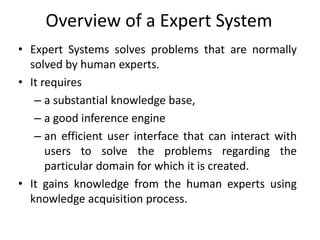
Overview of a Expert System
• Expert Systems solves problems that are normally
solved by human experts.
• It requires
– a substantial knowledge base,
– a good inference engine
– an efficient user interface that can interact with
users to solve the problems regarding the
particular domain for which it is created.
• It gains knowledge from the human experts using
knowledge acquisition process.
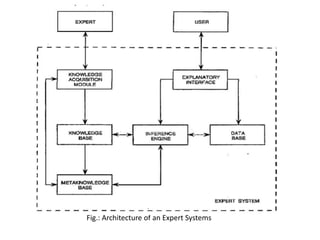
Fig.: Architecture of an Expert Systems
Evolution of Fuzzy Expert Systems
• Why fuzziness became a necessity?
– Because of the imprecision and uncertainty that might
arise in various situations and might impact negatively on
decision making capability.
– To introduce this imprecision and uncertainty, fuzziness is
to be involved in decision making process.
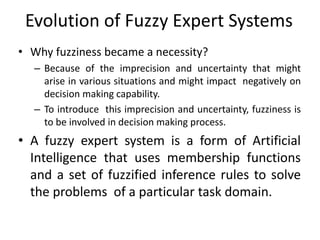
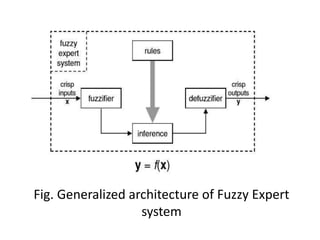
• A fuzzy expert system is a form of Artificial
Intelligence that uses membership functions
and a set of fuzzified inference rules to solve
the problems of a particular task domain.
Fig. Generalized architecture of Fuzzy Expert
system
Components of a Fuzzy Expert System
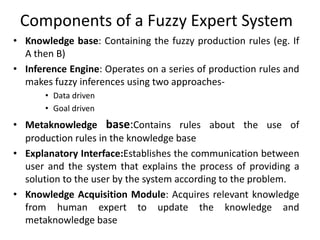
• Knowledge base: Containing the fuzzy production rules (eg. If
A then B)
• Inference Engine: Operates on a series of production rules and
makes fuzzy inferences using two approaches-
• Data driven
• Goal driven
• Metaknowledge base:Contains rules about the use of
production rules in the knowledge base
• Explanatory Interface:Establishes the communication between
user and the system that explains the process of providing a
solution to the user by the system according to the problem.
• Knowledge Acquisition Module: Acquires relevant knowledge
from human expert to update the knowledge and
metaknowledge base
Construction of a Fuzzy Expert System
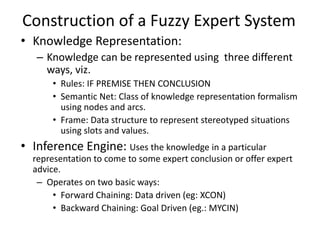
• Knowledge Representation:
– Knowledge can be represented using three different
ways, viz.
• Rules: IF PREMISE THEN CONCLUSION
• Semantic Net: Class of knowledge representation formalism
using nodes and arcs.
• Frame: Data structure to represent stereotyped situations
using slots and values.
• Inference Engine: Uses the knowledge in a particular
representation to come to some expert conclusion or offer expert
advice.
– Operates on two basic ways:
• Forward Chaining: Data driven (eg: XCON)
• Backward Chaining: Goal Driven (eg.: MYCIN)
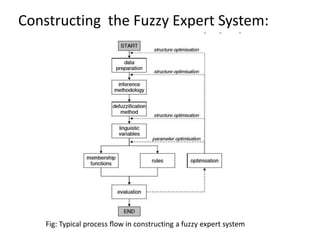
Constructing the Fuzzy Expert System:
Fig: Typical process flow in constructing a fuzzy expert system
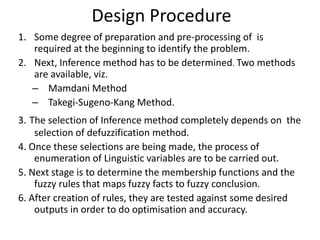
Design Procedure
1. Some degree of preparation and pre-processing of is
required at the beginning to identify the problem.
2. Next, Inference method has to be determined. Two methods
are available, viz.
– Mamdani Method
– Takegi-Sugeno-Kang Method.
3. The selection of Inference method completely depends on the
selection of defuzzification method.
4. Once these selections are being made, the process of
enumeration of Linguistic variables are to be carried out.
5. Next stage is to determine the membership functions and the
fuzzy rules that maps fuzzy facts to fuzzy conclusion.
6. After creation of rules, they are tested against some desired
outputs in order to do optimisation and accuracy.
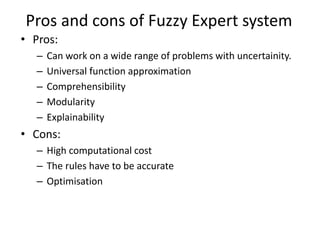
Pros and cons of Fuzzy Expert system
• Pros:
– Can work on a wide range of problems with uncertainity.
– Universal function approximation
– Comprehensibility
– Modularity
– Explainability
• Cons:
– High computational cost
– The rules have to be accurate
– Optimisation
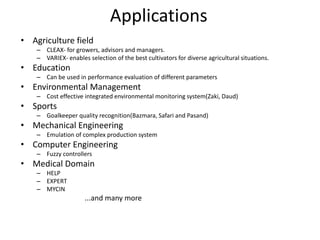
Applications
• Agriculture field
– CLEAX- for growers, advisors and managers.
– VARIEX- enables selection of the best cultivators for diverse agricultural situations.
• Education
– Can be used in performance evaluation of different parameters
• Environmental Management
– Cost effective integrated environmental monitoring system(Zaki, Daud)
• Sports
– Goalkeeper quality recognition(Bazmara, Safari and Pasand)
• Mechanical Engineering
– Emulation of complex production system
• Computer Engineering
– Fuzzy controllers
• Medical Domain
– HELP
– EXPERT
– MYCIN
...and many more
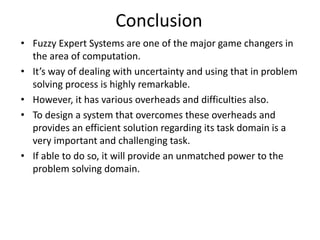
Conclusion
• Fuzzy Expert Systems are one of the major game changers in
the area of computation.
• It’s way of dealing with uncertainty and using that in problem
solving process is highly remarkable.
• However, it has various overheads and difficulties also.
• To design a system that overcomes these overheads and
provides an efficient solution regarding its task domain is a
very important and challenging task.
• If able to do so, it will provide an unmatched power to the
problem solving domain.
Bibliography and Reference
• Bibliography
– Rich, Elain; Knight, Kevin; Artificial Intelligence,Third Edition
– Klir, George J.; Yuan, Bo; Fuzzy Sets and Fuzzy Logic-Theory and
Applications
– Kandel, Abraham; Fuzzy Expert Systems;CRC Press
– Garibaldi, Johnathan M.; Fuzzy Expert Systems
– Siler, William; Buckly, James J; Fuzzy Expert Systems and Fuzzy
Reasoning
– Mishra, Nidhi; Jha, P.; Fuzzy expert system and its utility in various
field; Recent Research in science and technology,2014,6(1):41-45
• Web Reference:
– https://www.netlingo.com/word/fuzzy-expert-system.php
– https://www.cs.cmu.edu/Groups/AI/html/faqs/ai/fuzzy/part1/faq-
doc-4.html
– http://www.austinlinks.com/Fuzzy/expert-systems.html
“As complexity rises , precise statements
lose meaning and meaningful statements
lose precision.”
-Lotfi A. Zadeh(1921-2017)
Fuzzy expert system

Fuzzy expert system

  • 1.
    Presentation on Fuzzy ExpertSystems Presented by, Hsuvas Borkakoty Roll No.: 02(2 years)
  • 2.
    Contents • Introduction • Overviewof Expert System • Evolution of Fuzzy Expert System • Components of Fuzzy Expert System • Construction of a Fuzzy Expert System • Pros and cons of Fuzzy Expert Systems • Applications of Fuzzy Expert System • Conclusion • Bibliography and References
  • 3.
    “An expert isa man who has made all the mistakes which can be made in a very narrow field.” -Niels Bohr(1885-1962)
  • 4.
    Introduction • According toMerriam Webster, an Expert is “one with the special skill or knowledge representing mastery of a particular subject” • In every domain, there exist someone who has a certain amount of knowledge about certain parts of the domain. • However, it might not be possible for every person to master every knowledge in that domain. • Experts are defined as per their capability to solve a particular task of that domain. • To combine the ability of problem solving using knowledge and the speed and accuracy of computers, Expert systems are created.
  • 5.
    Overview of aExpert System • Expert Systems solves problems that are normally solved by human experts. • It requires – a substantial knowledge base, – a good inference engine – an efficient user interface that can interact with users to solve the problems regarding the particular domain for which it is created. • It gains knowledge from the human experts using knowledge acquisition process.
  • 6.
    Fig.: Architecture ofan Expert Systems
  • 7.
    Evolution of FuzzyExpert Systems • Why fuzziness became a necessity? – Because of the imprecision and uncertainty that might arise in various situations and might impact negatively on decision making capability. – To introduce this imprecision and uncertainty, fuzziness is to be involved in decision making process. • A fuzzy expert system is a form of Artificial Intelligence that uses membership functions and a set of fuzzified inference rules to solve the problems of a particular task domain.
  • 8.
    Fig. Generalized architectureof Fuzzy Expert system
  • 9.
    Components of aFuzzy Expert System • Knowledge base: Containing the fuzzy production rules (eg. If A then B) • Inference Engine: Operates on a series of production rules and makes fuzzy inferences using two approaches- • Data driven • Goal driven • Metaknowledge base:Contains rules about the use of production rules in the knowledge base • Explanatory Interface:Establishes the communication between user and the system that explains the process of providing a solution to the user by the system according to the problem. • Knowledge Acquisition Module: Acquires relevant knowledge from human expert to update the knowledge and metaknowledge base
  • 10.
    Construction of aFuzzy Expert System • Knowledge Representation: – Knowledge can be represented using three different ways, viz. • Rules: IF PREMISE THEN CONCLUSION • Semantic Net: Class of knowledge representation formalism using nodes and arcs. • Frame: Data structure to represent stereotyped situations using slots and values. • Inference Engine: Uses the knowledge in a particular representation to come to some expert conclusion or offer expert advice. – Operates on two basic ways: • Forward Chaining: Data driven (eg: XCON) • Backward Chaining: Goal Driven (eg.: MYCIN)
  • 11.
    Constructing the FuzzyExpert System: Fig: Typical process flow in constructing a fuzzy expert system
  • 12.
    Design Procedure 1. Somedegree of preparation and pre-processing of is required at the beginning to identify the problem. 2. Next, Inference method has to be determined. Two methods are available, viz. – Mamdani Method – Takegi-Sugeno-Kang Method. 3. The selection of Inference method completely depends on the selection of defuzzification method. 4. Once these selections are being made, the process of enumeration of Linguistic variables are to be carried out. 5. Next stage is to determine the membership functions and the fuzzy rules that maps fuzzy facts to fuzzy conclusion. 6. After creation of rules, they are tested against some desired outputs in order to do optimisation and accuracy.
  • 13.
    Pros and consof Fuzzy Expert system • Pros: – Can work on a wide range of problems with uncertainity. – Universal function approximation – Comprehensibility – Modularity – Explainability • Cons: – High computational cost – The rules have to be accurate – Optimisation
  • 14.
    Applications • Agriculture field –CLEAX- for growers, advisors and managers. – VARIEX- enables selection of the best cultivators for diverse agricultural situations. • Education – Can be used in performance evaluation of different parameters • Environmental Management – Cost effective integrated environmental monitoring system(Zaki, Daud) • Sports – Goalkeeper quality recognition(Bazmara, Safari and Pasand) • Mechanical Engineering – Emulation of complex production system • Computer Engineering – Fuzzy controllers • Medical Domain – HELP – EXPERT – MYCIN ...and many more
  • 15.
    Conclusion • Fuzzy ExpertSystems are one of the major game changers in the area of computation. • It’s way of dealing with uncertainty and using that in problem solving process is highly remarkable. • However, it has various overheads and difficulties also. • To design a system that overcomes these overheads and provides an efficient solution regarding its task domain is a very important and challenging task. • If able to do so, it will provide an unmatched power to the problem solving domain.
  • 16.
    Bibliography and Reference •Bibliography – Rich, Elain; Knight, Kevin; Artificial Intelligence,Third Edition – Klir, George J.; Yuan, Bo; Fuzzy Sets and Fuzzy Logic-Theory and Applications – Kandel, Abraham; Fuzzy Expert Systems;CRC Press – Garibaldi, Johnathan M.; Fuzzy Expert Systems – Siler, William; Buckly, James J; Fuzzy Expert Systems and Fuzzy Reasoning – Mishra, Nidhi; Jha, P.; Fuzzy expert system and its utility in various field; Recent Research in science and technology,2014,6(1):41-45 • Web Reference: – https://www.netlingo.com/word/fuzzy-expert-system.php – https://www.cs.cmu.edu/Groups/AI/html/faqs/ai/fuzzy/part1/faq- doc-4.html – http://www.austinlinks.com/Fuzzy/expert-systems.html
  • 17.
    “As complexity rises, precise statements lose meaning and meaningful statements lose precision.” -Lotfi A. Zadeh(1921-2017)