1
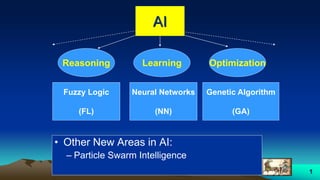
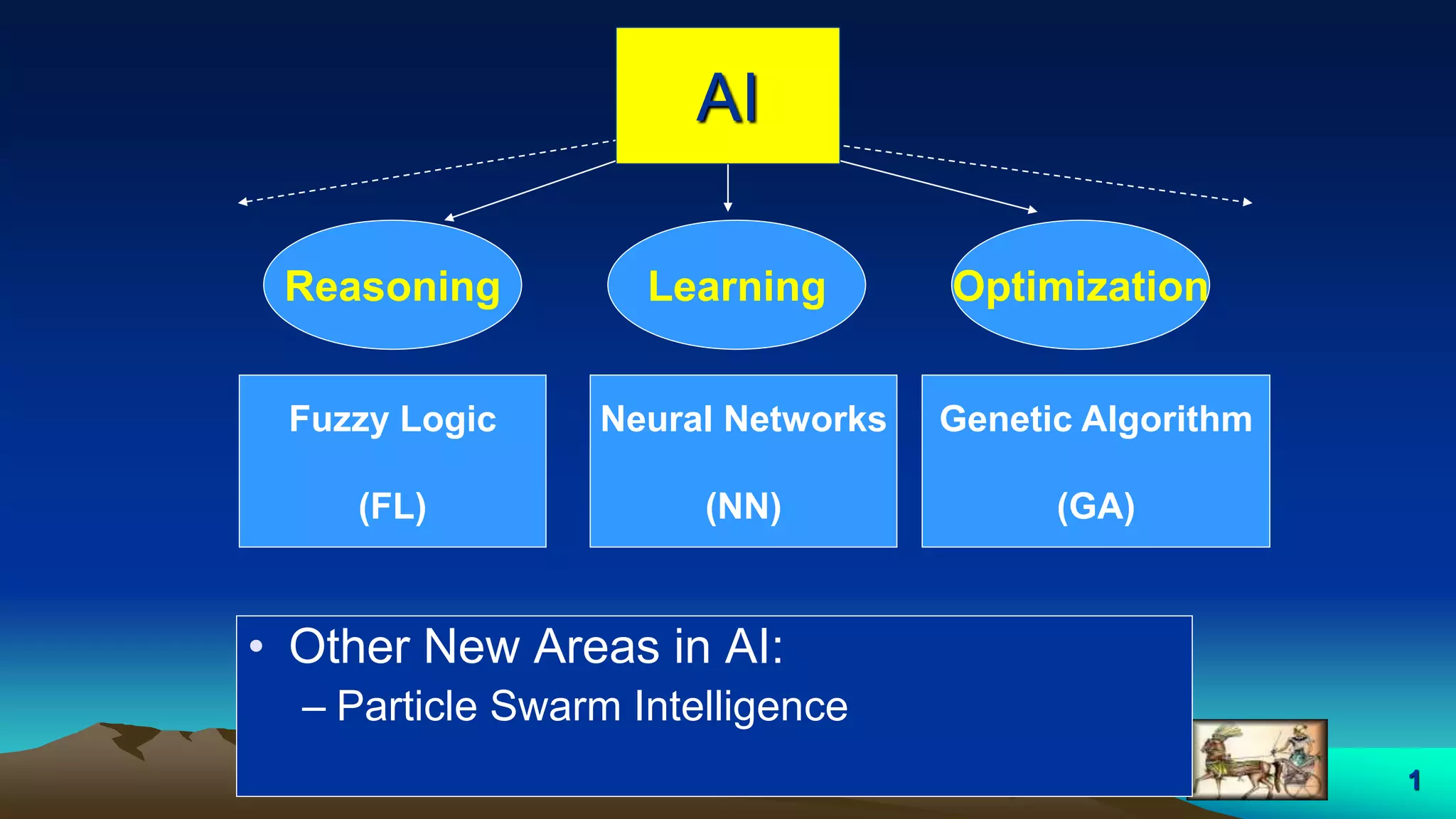
• Other New Areas in AI:
– Particle Swarm Intelligence
Reasoning Learning Optimization
Fuzzy Logic
(FL)
Neural Networks
(NN)
Genetic Algorithm
(GA)
AI
2
Fuzzy Logic
• Fuzzy Logic was initiated in 1965 by Lotfy
Zadeh, professor for computer science at
the University of California in Berkeley.
• Fuzzy stated on the reasoning of facts.
• There is nothing in the world is definite,
there is nothing is absolute. All is a matter
of membership degree to a certain
reference (we must have reference)
3
Fuzzy Logic
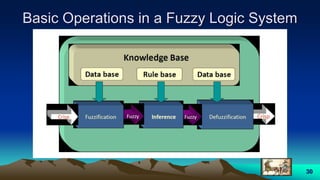
• There are two main characteristics of
fuzzy systems that give them better
performance for specific applications:
– Fuzzy systems are suitable for uncertain or
approximate reasoning, especially for the
system with a mathematical model that is
difficult to derive.
– Fuzzy logic allows decision making with
estimated values under incomplete or
uncertain information.
4
Who is Who in Fuzzy Logic
• Lotfy Zadah:
– Established the concept of Fuzzy Logic.
• Mamdani:
– 1st one used fuzzy logic concepts for reasoning
in control (control of steam turbine).
• Sugeno:
– 1st one used fuzzy logic concepts in plane
control.
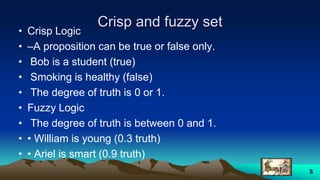
Crisp and fuzzy set
• Crisp Logic
• –A proposition can be true or false only.
• Bob is a student (true)
• Smoking is healthy (false)
• The degree of truth is 0 or 1.
• Fuzzy Logic
• The degree of truth is between 0 and 1.
• • William is young (0.3 truth)
• • Ariel is smart (0.9 truth)
5
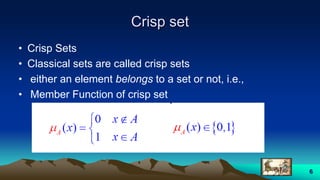
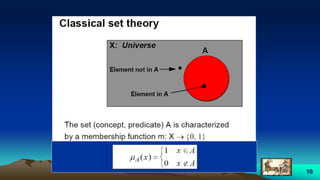
Crisp set
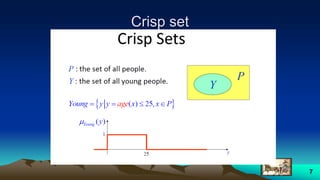
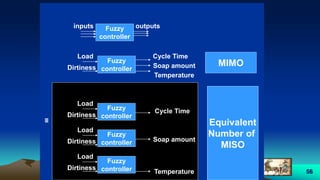
• Crisp Sets
• Classical sets are called crisp sets
• either an element belongs to a set or not, i.e.,
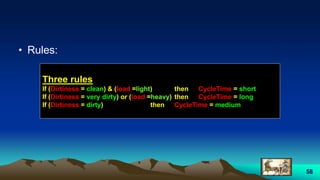
• Member Function of crisp set
6
Crisp set
7
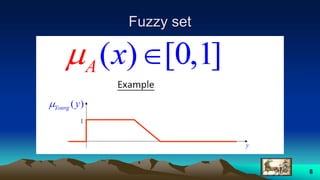
Fuzzy set
8
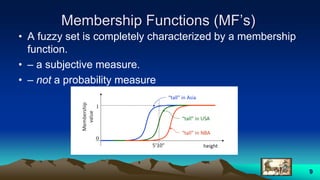
Membership Functions (MF’s)
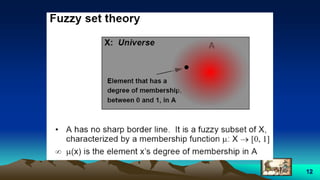
• A fuzzy set is completely characterized by a membership
function.
• – a subjective measure.
• – not a probability measure
9
10
11
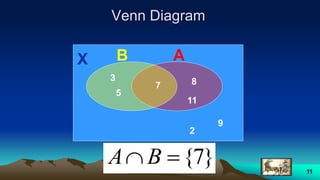
Venn Diagram
7
3
5
8
11
2
9
X AB
}7{ BA
12
13
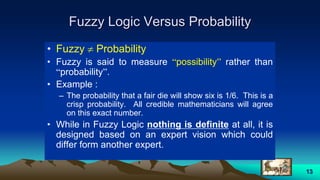
Fuzzy Logic Versus Probability
• Fuzzy  Probability
• Fuzzy is said to measure “possibility” rather than
“probability”.
• Example :
– The probability that a fair die will show six is 1/6. This is a
crisp probability. All credible mathematicians will agree
on this exact number.
• While in Fuzzy Logic nothing is definite at all, it is
designed based on an expert vision which could
differ form another expert.
14
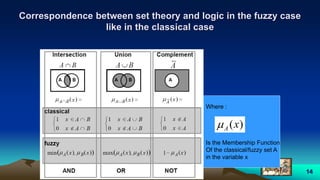
Correspondence between set theory and logic in the fuzzy case
like in the classical case
Where :
Is the Membership Function
Of the classical/fuzzy set A
in the variable x
)(xA
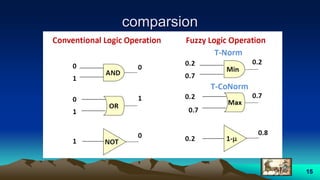
comparsion
15
16
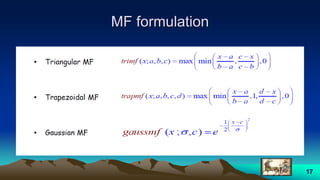
MF formulation
17
18
Example
Good
A
V.G
B
Universe
Of Discourse
1
0
Fuzzy
Membership
Students grades can be classified with FL
))(,)((min)()()( BABABandAC xxxxx   
60% 70% 80% 90%
ExcellentPoor
19
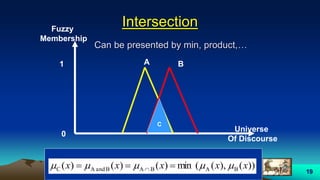
Intersection
A B
Universe
Of Discourse
1
0
Fuzzy
Membership
Can be presented by min, product,…
C
))(,)((min)()()( BABABandAC xxxxx   
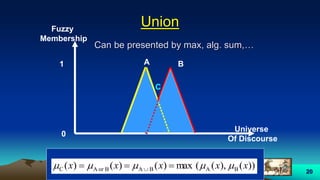
20
Union
A B
Universe
Of Discourse
1
0
Fuzzy
Membership
Can be presented by max, alg. sum,…
))(,)((max)()()( BABABorAC xxxxx   
C
21
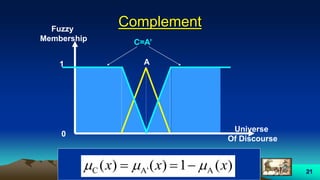
Complement
A
Universe
Of Discourse
1
0
Fuzzy
Membership
)(1)()( AA'C xxx  
C=A’
22
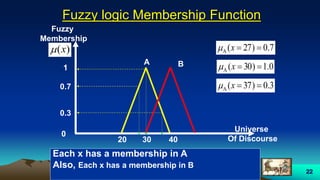
Fuzzy logic Membership Function
A
Universe
Of Discourse
1
0
Fuzzy
Membership
Each x has a membership in A
Also, Each x has a membership in B
7.0)27(A x)(x
0.7
0.3
20 30 40
3.0)37(A x
0.1)30(A xB
23
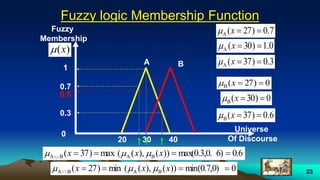
Fuzzy logic Membership Function
0)27(B x
A
Universe
Of Discourse
1
0
Fuzzy
Membership
)(x
0.7
0.3
20 30 40
6.0)37(B x
0)30(B x
B
0.6
7.0)27(A x
3.0)37(A x
0.1)30(A x
0.66)max(0.3,0.))(,)((max)37( BABA  xxx 
0min(0.7,0)))(,)((min)27( BABA  xxx 
24
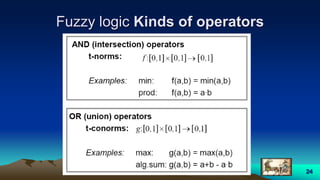
Fuzzy logic Kinds of operators
25
Fuzzy Logic in control
How to
Design
How to
use
? ?
26
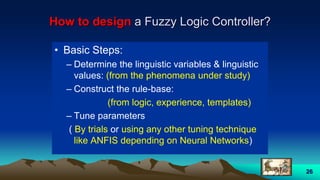
How to design a Fuzzy Logic Controller?
• Basic Steps:
– Determine the linguistic variables & linguistic
values: (from the phenomena under study)
– Construct the rule-base:
(from logic, experience, templates)
– Tune parameters
( By trials or using any other tuning technique
like ANFIS depending on Neural Networks)
27
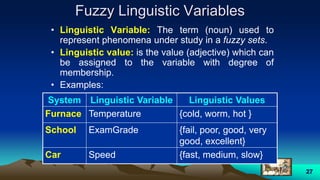
Fuzzy Linguistic Variables
• Linguistic Variable: The term (noun) used to
represent phenomena under study in a fuzzy sets.
• Linguistic value: is the value (adjective) which can
be assigned to the variable with degree of
membership.
• Examples:
System Linguistic Variable Linguistic Values
Furnace Temperature {cold, worm, hot }
School ExamGrade {fail, poor, good, very
good, excellent}
Car Speed {fast, medium, slow}
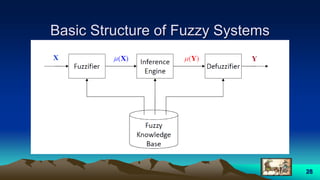
Basic Structure of Fuzzy Systems
28
Basic Structure of Fuzzy Systems
29
• Fuzzifier :Converts the crisp input to a linguistic variable
using the membership functions stored in the fuzzy
knowledge base.
• Defuzzifier : Converts the fuzzy output of the inference
engine to crisp using membership functions analogous to
the ones used by the fuzzifier .
• Fuzzy Knowledge Base that include Information storage for
• 1. Linguistic variables definitions.
• 2. Fuzzy rules.
Basic Operations in a Fuzzy Logic System
30
Types of inference
• 1.Mamadani Fuzzy Model
• 2.Sugeno Fuzzy Model
• 3.Tsukamoto Fuzzy Model
31
Fuzzy inference Mamadani
• One of the most commonly used fuzzy inference
technique is the so-called Mamdani method. In 1975,
Professor Ebrahim Mamdani of London University built
one of the first fuzzy systems to control a steam
engine and boiler combination. He applied a set of
fuzzy rules supplied by experienced human operators.
32
Fuzzy inference Mamadani
• The Mamdani-style fuzzy inference process is performed
in four steps:
• fuzzification of the input variables,
• rule evaluation;
• aggregation of the rule outputs, and finally
• defuzzification.
33
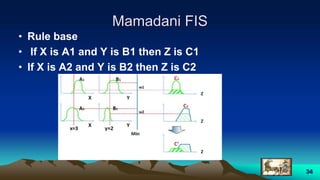
Mamadani FIS
• Rule base
• If X is A1 and Y is B1 then Z is C1
• If X is A2 and Y is B2 then Z is C2
34
Sugeno fuzzy inference
• Mamdani-style inference, as we have just seen, requires
us to find the centroid of a two-dimensional shape by
integrating across a continuously varying function. In
general, this process is not computationally efficient.
• Michio Sugeno suggested to use a single spike, a
singleton, as the membership function of the rule
consequent. A singleton, or more precisely a fuzzy
singleton, is a fuzzy set with a membership function that
is unity at a single particular point on the universe of
discourse and zero everywhere else.
35
Sugeno types
• Zero order type
• First order type
36
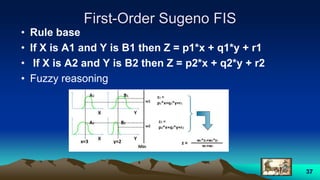
First-Order Sugeno FIS
• Rule base
• If X is A1 and Y is B1 then Z = p1*x + q1*y + r1
• If X is A2 and Y is B2 then Z = p2*x + q2*y + r2
• Fuzzy reasoning
37
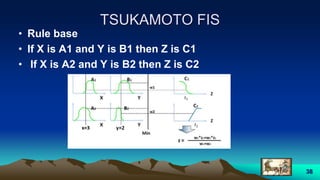
TSUKAMOTO FIS
• Rule base
• If X is A1 and Y is B1 then Z is C1
• If X is A2 and Y is B2 then Z is C2
38
39
Example 1.1: Restaurant
Fuzzy system in Restaurant
Service and Tips.
Service quality: is a matter of degrees.
Also Tips is a matter of degrees.
But there is some relation between this
input (the service) and that output (the
tips).
Represent the system
40
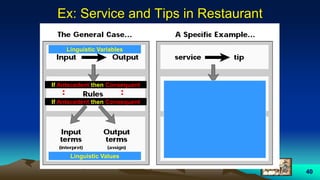
Ex: Service and Tips in Restaurant
If Antecedent then Consequent
Linguistic Variables
Linguistic Values
If Antecedent then Consequent
41
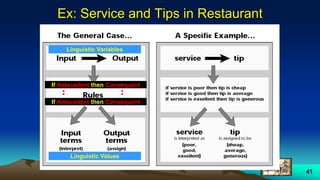
Ex: Service and Tips in Restaurant
If Antecedent then Consequent
Linguistic Variables
Linguistic Values
If Antecedent then Consequent
42
Example 1.2
Air Conditioning
• We have an air conditioned room, we want
to control the temperature of the room in
the range [0:60] degrees.
• Investigate this problem regarding classical
set theory and the fuzzy set theory.
43
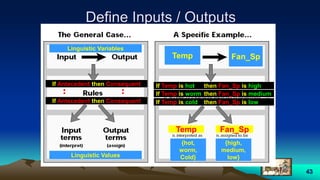
Define Inputs / Outputs
Temp Fan_Sp
Temp
{hot,
worm,
Cold}
Fan_Sp
{high,
medium,
low}
If Temp is hot then Fan_Sp is high
If Antecedent then Consequent
Linguistic Variables
Linguistic Values
If Antecedent then Consequent
If Temp is worm then Fan_Sp is medium
If Temp is cold then Fan_Sp is low
44
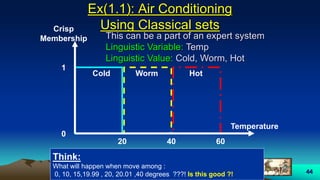
Ex(1.1): Air Conditioning
Using Classical sets
Cold Worm Hot
Temperature
1
0
Crisp
Membership
20 40 60
This can be a part of an expert system
Linguistic Variable: Temp
Linguistic Value: Cold, Worm, Hot
Think:
What will happen when move among :
0, 10, 15,19.99 , 20, 20.01 ,40 degrees ???! Is this good ?!
45
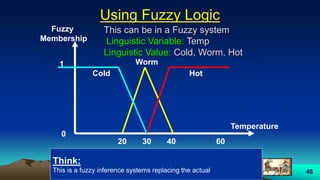
Using Fuzzy Logic
Cold
Worm
Hot
Temperature
1
0
Fuzzy
Membership
20 40 60
This can be in a Fuzzy system
Linguistic Variable: Temp
Linguistic Value: Cold, Worm, Hot
Think:
This is a fuzzy inference systems replacing the actual
30
46
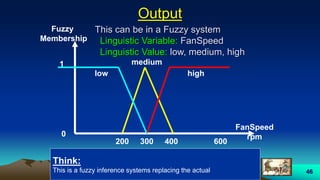
Output
low
medium
high
FanSpeed
rpm
1
0
Fuzzy
Membership
200 400 600
This can be in a Fuzzy system
Linguistic Variable: FanSpeed
Linguistic Value: low, medium, high
Think:
This is a fuzzy inference systems replacing the actual
300
47
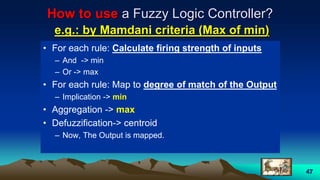
How to use a Fuzzy Logic Controller?
e.g.: by Mamdani criteria (Max of min)
• For each rule: Calculate firing strength of inputs
– And -> min
– Or -> max
• For each rule: Map to degree of match of the Output
– Implication -> min
• Aggregation -> max
• Defuzzification-> centroid
– Now, The Output is mapped.
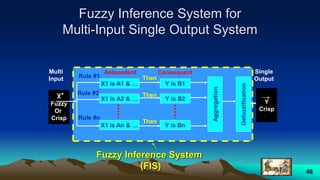
48
Fuzzy Inference System for
Multi-Input Single Output System
X1 is A1 & …
X1 is A2 & …
X1 is An & …
Y is B1
Y is B2
Y is Bn
Rule #1
Rule #2
Rule #n
Then
Then
Then
Antecedent Consequent
Aggregation
X
Fuzzy
Or
Crisp
Multi
Input
Y
Crisp
Defuzzification
Single
Output
Fuzzy Inference System
(FIS)
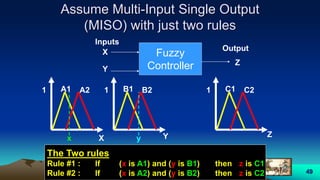
49
Assume Multi-Input Single Output
(MISO) with just two rules
A1 A21
Fuzzy
Controller
X
Y
Z
Output
Inputs
X
B1 B21
Y
C1 C21
Z
The Two rules
Rule #1 : If (x is A1) and (y is B1) then z is C1
Rule #2 : If (x is A2) and (y is B2) then z is C2
x y
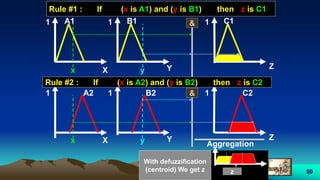
50
A11
X
B11
Y
C11
Rule #1 : If (x is A1) and (y is B1) then z is C1
x y
A21
X
B21
Y
C21
x y
Rule #2 : If (x is A2) and (y is B2) then z is C2
&
&
Aggregation
Z
Z
With defuzzification
(centroid) We get z z
Z
51
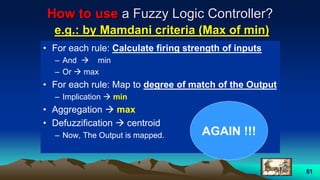
How to use a Fuzzy Logic Controller?
e.g.: by Mamdani criteria (Max of min)
• For each rule: Calculate firing strength of inputs
– And  min
– Or  max
• For each rule: Map to degree of match of the Output
– Implication  min
• Aggregation  max
• Defuzzification  centroid
– Now, The Output is mapped. AGAIN !!!
52
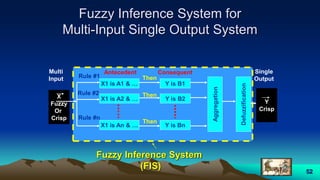
Fuzzy Inference System for
Multi-Input Single Output System
X1 is A1 & …
X1 is A2 & …
X1 is An & …
Y is B1
Y is B2
Y is Bn
Rule #1
Rule #2
Rule #n
Then
Then
Then
Antecedent Consequent
Aggregation
X
Fuzzy
Or
Crisp
Multi
Input
Y
Crisp
Defuzzification
Single
Output
Fuzzy Inference System
(FIS)
53
54
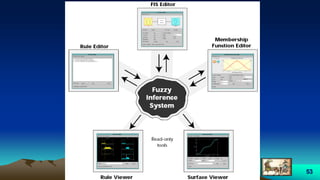
Matlab Demo
55
Example2.1: Multi-Input Multi-Output
MIMO
Washing machine:
Based on clothes Load and Dirtiness the washing program
will set Cycle Time, Soap Amount, and Temperature.
Represent the system using Fuzzy logic
56
Fuzzy
controller
Load Cycle Time
Fuzzy
controller
inputs outputs
Soap amountDirtiness
Temperature
≡
Fuzzy
controller
Load
Soap amountDirtiness
Fuzzy
controller
Load
Dirtiness
Temperature
Fuzzy
controller
Load
Cycle Time
Dirtiness
MIMO
Equivalent
Number of
MISO
57
• MI (Multi-Input) :
1- Dirtiness:
range: [0 1]
MSF: Triangular (clean, dirty, very dirty)
2- load:
range: [0 1]
MSF: Triangular (light, medium, heavy)
• SO (single Output) :
1- Cycle Time:
range: [0 1]
MSF: Trapezoidal (short, medium , long)
58
• Rules:
Three rules
If (Dirtiness = clean) & (load =light) then CycleTime = short
If (Dirtiness = very dirty) or (load =heavy) then CycleTime = long
If (Dirtiness = dirty) then CycleTime = medium
59
Useful commands
readfis
evalfis
60
Matlab Demo
• g=readfis(‘wmachine.fis’);
• g=
• g.andMethod
• g.input
• g.input(1).name
• g.input(2).range
• g.input(1).mf
• g.rule
• Y=evalfis([0.3;0.9],g)
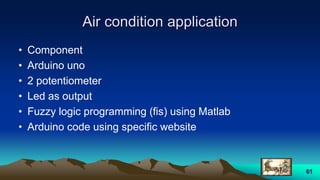
Air condition application
• Component
• Arduino uno
• 2 potentiometer
• Led as output
• Fuzzy logic programming (fis) using Matlab
• Arduino code using specific website
61
62
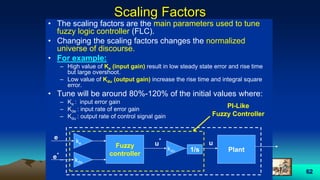
Scaling Factors
• The scaling factors are the main parameters used to tune
fuzzy logic controller (FLC).
• Changing the scaling factors changes the normalized
universe of discourse.
• For example:
– High value of Ke (input gain) result in low steady state error and rise time
but large overshoot.
– Low value of Kdu (output gain) increase the rise time and integral square
error.
• Tune will be around 80%-120% of the initial values where:
– Ke : input error gain
– Kde : input rate of error gain
– Kdu : output rate of control signal gain
– .
u
.e
Fuzzy
controllere
.
ke
kde
Plantkdu 1/s
u
PI-Like
Fuzzy Controller
63
How to design a Fuzzy Logic Controller?
• Basic Steps:
– Determine the linguistic variables & linguistic
values: (from the phenomena under study)
– Construct the rule-base:
(from logic, experience, templates)
– Tune parameters
( By trials or using any other tuning technique
like ANFIS depending on Neural Networks)
64
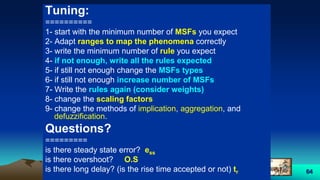
Tuning:
==========
1- start with the minimum number of MSFs you expect
2- Adapt ranges to map the phenomena correctly
3- write the minimum number of rule you expect
4- if not enough, write all the rules expected
5- if still not enough change the MSFs types
6- if still not enough increase number of MSFs
7- Write the rules again (consider weights)
8- change the scaling factors
9- change the methods of implication, aggregation, and
defuzzification.
Questions?
=========
is there steady state error? ess
is there overshoot? O.S
is there long delay? (is the rise time accepted or not) tr
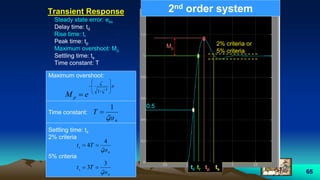
65
Settling time: ts
2% criteria
5% criteria
Transient Response
Steady state error: ess
Delay time: td
Rise time: tr
Peak time: tp
Maximum overshoot: Mp
Settling time: ts
Time constant: T
n
s Tt

4
4 
n
s Tt

3
3  td ts
Mp
0.5
tptr
Maximum overshoot:
2% criteria or
5% criteria














2
1
eM p
Time constant:
n
T

1

2nd order system
66
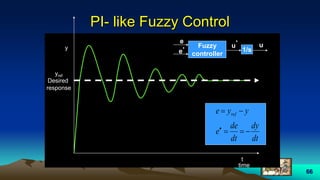
PI- like Fuzzy Control
.
time
yref
Desired
response
dt
dy
dt
de
e
yye ref



y
t
e
Fuzzy
controllere
. u
.
1/s
u
67
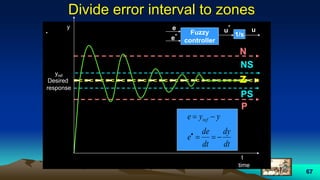
Divide error interval to zones
.
time
yref
Desired
response
N
z
PS
P
NS
y
t
dt
dy
dt
de
e
yye ref



u
.e
Fuzzy
controllere
. 1/s
u
68
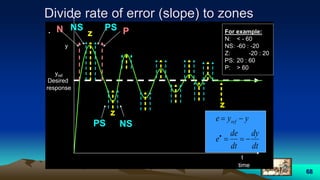
Divide rate of error (slope) to zones
.
time
yref
Desired
response
N z
z
NS PPS
y
t
PS NS
z
dt
dy
dt
de
e
yye ref



For example:
N: < - 60
NS: -60 : -20
Z: -20 : 20
PS: 20 : 60
P: > 60
69
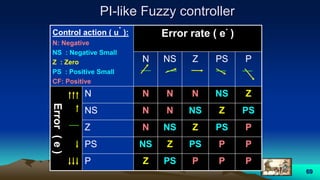
PI-like Fuzzy controller
Control action ( u
.
):
N: Negative
NS : Negative Small
Z : Zero
PS : Positive Small
CF: Positive
Error rate ( e
.
)
N NS Z PS P
Error(e)
N N N N NS Z
NS N N NS Z PS
Z N NS Z PS P
PS NS Z PS P P
P Z PS P P P
70
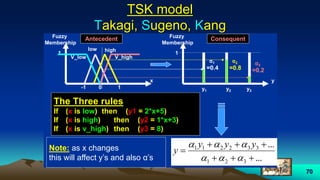
TSK model
Takagi, Sugeno, Kang
. Antecedent Consequent
V_low
low
V_high
x
1
Fuzzy
Membership
-1 10
y
1
Fuzzy
Membership
y1 y3y2
α2
=0.8
α1
=0.4
α3
=0.2
...
...
321
332211




 yyy
y
The Three rules
If (x is low) then (y1 = 2*x+5)
If (x is high) then (y2 = 1*x+3)
If (x is v_high) then (y3 = 8)
Note: as x changes
this will affect y’s and also α’s
high
71
Example:
function approximation
• We want to approximate this
function in the range [1 3] using
fuzzy TSK model with five MSFs.
y = x2
y
x
72
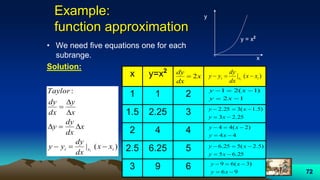
Example:
function approximation
• We need five equations one for each
subrange.
Solution:
y = x2
y
x
)(|
:
ixi xx
dx
dy
yy
x
dx
dy
y
x
y
dx
dy
Taylor
i





x y=x2
1 1 2
1.5 2.25 3
2 4 4
2.5 6.25 5
3 9 6
x
dx
dy
2 )(| ixi xx
dx
dy
yy i

12
)1(21


xy
xy
25.23
)5.1(325.2


xy
xy
44
)2(44


xy
xy
25.65
)5.2(525.6


xy
xy
96
)3(69


xy
xy
73
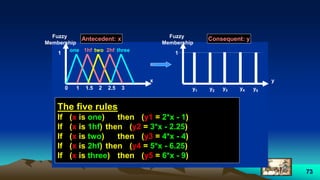
.
Antecedent: x Consequent: y
x
1
Fuzzy
Membership
1 2.50
y
1
Fuzzy
Membership
y1 y5y2
The five rules
If (x is one) then (y1 = 2*x - 1)
If (x is 1hf) then (y2 = 3*x - 2.25)
If (x is two) then (y3 = 4*x - 4)
If (x is 2hf) then (y4 = 5*x - 6.25)
If (x is three) then (y5 = 6*x - 9)
one
1.5 2 3
1hf two 2hf three
y3 y4
74
Matlab Demo
75
References
1. J.-S. Roger Jang, Ned Gulley “Artificial Intelligence -
Fuzzy Logic Toolbox, Matlab”, Mathwotks,1997.
2. R. Full´er “Neural Fuzzy Systems” Abo, 1995.
3. ITI ,“Nine Month Program Training Kit”, 2007.
4. H.Larsen “Fundamentals of fuzzy sets and fuzzy logic”
Aalborg University, 2005.
5. Prof. A. Hambaba” Networked–Intelligent Software
Agents & Agents” San Jose state, 2002.
6. Prof. P. Smyth, “Introduction to Artificial Intelligence”,
UCIrvine, 2007.
7. R. J. Marks “Introduction to Fuzzy Inference”, Baylor
University
8. http://en.wikipedia.org/

Fuzzy logic

  • 1.
    1 • Other NewAreas in AI: – Particle Swarm Intelligence Reasoning Learning Optimization Fuzzy Logic (FL) Neural Networks (NN) Genetic Algorithm (GA) AI
  • 2.
    2 Fuzzy Logic • FuzzyLogic was initiated in 1965 by Lotfy Zadeh, professor for computer science at the University of California in Berkeley. • Fuzzy stated on the reasoning of facts. • There is nothing in the world is definite, there is nothing is absolute. All is a matter of membership degree to a certain reference (we must have reference)
  • 3.
    3 Fuzzy Logic • Thereare two main characteristics of fuzzy systems that give them better performance for specific applications: – Fuzzy systems are suitable for uncertain or approximate reasoning, especially for the system with a mathematical model that is difficult to derive. – Fuzzy logic allows decision making with estimated values under incomplete or uncertain information.
  • 4.
    4 Who is Whoin Fuzzy Logic • Lotfy Zadah: – Established the concept of Fuzzy Logic. • Mamdani: – 1st one used fuzzy logic concepts for reasoning in control (control of steam turbine). • Sugeno: – 1st one used fuzzy logic concepts in plane control.
  • 5.
    Crisp and fuzzyset • Crisp Logic • –A proposition can be true or false only. • Bob is a student (true) • Smoking is healthy (false) • The degree of truth is 0 or 1. • Fuzzy Logic • The degree of truth is between 0 and 1. • • William is young (0.3 truth) • • Ariel is smart (0.9 truth) 5
  • 6.
    Crisp set • CrispSets • Classical sets are called crisp sets • either an element belongs to a set or not, i.e., • Member Function of crisp set 6
  • 7.
  • 8.
  • 9.
    Membership Functions (MF’s) •A fuzzy set is completely characterized by a membership function. • – a subjective measure. • – not a probability measure 9
  • 10.
  • 11.
  • 12.
  • 13.
    13 Fuzzy Logic VersusProbability • Fuzzy  Probability • Fuzzy is said to measure “possibility” rather than “probability”. • Example : – The probability that a fair die will show six is 1/6. This is a crisp probability. All credible mathematicians will agree on this exact number. • While in Fuzzy Logic nothing is definite at all, it is designed based on an expert vision which could differ form another expert.
  • 14.
    14 Correspondence between settheory and logic in the fuzzy case like in the classical case Where : Is the Membership Function Of the classical/fuzzy set A in the variable x )(xA
  • 15.
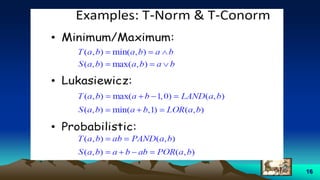
  • 16.
  • 17.
  • 18.
    18 Example Good A V.G B Universe Of Discourse 1 0 Fuzzy Membership Students gradescan be classified with FL ))(,)((min)()()( BABABandAC xxxxx    60% 70% 80% 90% ExcellentPoor
  • 19.
    19 Intersection A B Universe Of Discourse 1 0 Fuzzy Membership Canbe presented by min, product,… C ))(,)((min)()()( BABABandAC xxxxx   
  • 20.
    20 Union A B Universe Of Discourse 1 0 Fuzzy Membership Canbe presented by max, alg. sum,… ))(,)((max)()()( BABABorAC xxxxx    C
  • 21.
  • 22.
    22 Fuzzy logic MembershipFunction A Universe Of Discourse 1 0 Fuzzy Membership Each x has a membership in A Also, Each x has a membership in B 7.0)27(A x)(x 0.7 0.3 20 30 40 3.0)37(A x 0.1)30(A xB
  • 23.
    23 Fuzzy logic MembershipFunction 0)27(B x A Universe Of Discourse 1 0 Fuzzy Membership )(x 0.7 0.3 20 30 40 6.0)37(B x 0)30(B x B 0.6 7.0)27(A x 3.0)37(A x 0.1)30(A x 0.66)max(0.3,0.))(,)((max)37( BABA  xxx  0min(0.7,0)))(,)((min)27( BABA  xxx 
  • 24.
  • 25.
    25 Fuzzy Logic incontrol How to Design How to use ? ?
  • 26.
    26 How to designa Fuzzy Logic Controller? • Basic Steps: – Determine the linguistic variables & linguistic values: (from the phenomena under study) – Construct the rule-base: (from logic, experience, templates) – Tune parameters ( By trials or using any other tuning technique like ANFIS depending on Neural Networks)
  • 27.
    27 Fuzzy Linguistic Variables •Linguistic Variable: The term (noun) used to represent phenomena under study in a fuzzy sets. • Linguistic value: is the value (adjective) which can be assigned to the variable with degree of membership. • Examples: System Linguistic Variable Linguistic Values Furnace Temperature {cold, worm, hot } School ExamGrade {fail, poor, good, very good, excellent} Car Speed {fast, medium, slow}
  • 28.
    Basic Structure ofFuzzy Systems 28
  • 29.
    Basic Structure ofFuzzy Systems 29 • Fuzzifier :Converts the crisp input to a linguistic variable using the membership functions stored in the fuzzy knowledge base. • Defuzzifier : Converts the fuzzy output of the inference engine to crisp using membership functions analogous to the ones used by the fuzzifier . • Fuzzy Knowledge Base that include Information storage for • 1. Linguistic variables definitions. • 2. Fuzzy rules.
  • 30.
    Basic Operations ina Fuzzy Logic System 30
  • 31.
    Types of inference •1.Mamadani Fuzzy Model • 2.Sugeno Fuzzy Model • 3.Tsukamoto Fuzzy Model 31
  • 32.
    Fuzzy inference Mamadani •One of the most commonly used fuzzy inference technique is the so-called Mamdani method. In 1975, Professor Ebrahim Mamdani of London University built one of the first fuzzy systems to control a steam engine and boiler combination. He applied a set of fuzzy rules supplied by experienced human operators. 32
  • 33.
    Fuzzy inference Mamadani •The Mamdani-style fuzzy inference process is performed in four steps: • fuzzification of the input variables, • rule evaluation; • aggregation of the rule outputs, and finally • defuzzification. 33
  • 34.
    Mamadani FIS • Rulebase • If X is A1 and Y is B1 then Z is C1 • If X is A2 and Y is B2 then Z is C2 34
  • 35.
    Sugeno fuzzy inference •Mamdani-style inference, as we have just seen, requires us to find the centroid of a two-dimensional shape by integrating across a continuously varying function. In general, this process is not computationally efficient. • Michio Sugeno suggested to use a single spike, a singleton, as the membership function of the rule consequent. A singleton, or more precisely a fuzzy singleton, is a fuzzy set with a membership function that is unity at a single particular point on the universe of discourse and zero everywhere else. 35
  • 36.
    Sugeno types • Zeroorder type • First order type 36
  • 37.
    First-Order Sugeno FIS •Rule base • If X is A1 and Y is B1 then Z = p1*x + q1*y + r1 • If X is A2 and Y is B2 then Z = p2*x + q2*y + r2 • Fuzzy reasoning 37
  • 38.
    TSUKAMOTO FIS • Rulebase • If X is A1 and Y is B1 then Z is C1 • If X is A2 and Y is B2 then Z is C2 38
  • 39.
    39 Example 1.1: Restaurant Fuzzysystem in Restaurant Service and Tips. Service quality: is a matter of degrees. Also Tips is a matter of degrees. But there is some relation between this input (the service) and that output (the tips). Represent the system
  • 40.
    40 Ex: Service andTips in Restaurant If Antecedent then Consequent Linguistic Variables Linguistic Values If Antecedent then Consequent
  • 41.
    41 Ex: Service andTips in Restaurant If Antecedent then Consequent Linguistic Variables Linguistic Values If Antecedent then Consequent
  • 42.
    42 Example 1.2 Air Conditioning •We have an air conditioned room, we want to control the temperature of the room in the range [0:60] degrees. • Investigate this problem regarding classical set theory and the fuzzy set theory.
  • 43.
    43 Define Inputs /Outputs Temp Fan_Sp Temp {hot, worm, Cold} Fan_Sp {high, medium, low} If Temp is hot then Fan_Sp is high If Antecedent then Consequent Linguistic Variables Linguistic Values If Antecedent then Consequent If Temp is worm then Fan_Sp is medium If Temp is cold then Fan_Sp is low
  • 44.
    44 Ex(1.1): Air Conditioning UsingClassical sets Cold Worm Hot Temperature 1 0 Crisp Membership 20 40 60 This can be a part of an expert system Linguistic Variable: Temp Linguistic Value: Cold, Worm, Hot Think: What will happen when move among : 0, 10, 15,19.99 , 20, 20.01 ,40 degrees ???! Is this good ?!
  • 45.
    45 Using Fuzzy Logic Cold Worm Hot Temperature 1 0 Fuzzy Membership 2040 60 This can be in a Fuzzy system Linguistic Variable: Temp Linguistic Value: Cold, Worm, Hot Think: This is a fuzzy inference systems replacing the actual 30
  • 46.
    46 Output low medium high FanSpeed rpm 1 0 Fuzzy Membership 200 400 600 Thiscan be in a Fuzzy system Linguistic Variable: FanSpeed Linguistic Value: low, medium, high Think: This is a fuzzy inference systems replacing the actual 300
  • 47.
    47 How to usea Fuzzy Logic Controller? e.g.: by Mamdani criteria (Max of min) • For each rule: Calculate firing strength of inputs – And -> min – Or -> max • For each rule: Map to degree of match of the Output – Implication -> min • Aggregation -> max • Defuzzification-> centroid – Now, The Output is mapped.
  • 48.
    48 Fuzzy Inference Systemfor Multi-Input Single Output System X1 is A1 & … X1 is A2 & … X1 is An & … Y is B1 Y is B2 Y is Bn Rule #1 Rule #2 Rule #n Then Then Then Antecedent Consequent Aggregation X Fuzzy Or Crisp Multi Input Y Crisp Defuzzification Single Output Fuzzy Inference System (FIS)
  • 49.
    49 Assume Multi-Input SingleOutput (MISO) with just two rules A1 A21 Fuzzy Controller X Y Z Output Inputs X B1 B21 Y C1 C21 Z The Two rules Rule #1 : If (x is A1) and (y is B1) then z is C1 Rule #2 : If (x is A2) and (y is B2) then z is C2 x y
  • 50.
    50 A11 X B11 Y C11 Rule #1 :If (x is A1) and (y is B1) then z is C1 x y A21 X B21 Y C21 x y Rule #2 : If (x is A2) and (y is B2) then z is C2 & & Aggregation Z Z With defuzzification (centroid) We get z z Z
  • 51.
    51 How to usea Fuzzy Logic Controller? e.g.: by Mamdani criteria (Max of min) • For each rule: Calculate firing strength of inputs – And  min – Or  max • For each rule: Map to degree of match of the Output – Implication  min • Aggregation  max • Defuzzification  centroid – Now, The Output is mapped. AGAIN !!!
  • 52.
    52 Fuzzy Inference Systemfor Multi-Input Single Output System X1 is A1 & … X1 is A2 & … X1 is An & … Y is B1 Y is B2 Y is Bn Rule #1 Rule #2 Rule #n Then Then Then Antecedent Consequent Aggregation X Fuzzy Or Crisp Multi Input Y Crisp Defuzzification Single Output Fuzzy Inference System (FIS)
  • 53.
  • 54.
  • 55.
    55 Example2.1: Multi-Input Multi-Output MIMO Washingmachine: Based on clothes Load and Dirtiness the washing program will set Cycle Time, Soap Amount, and Temperature. Represent the system using Fuzzy logic
  • 56.
    56 Fuzzy controller Load Cycle Time Fuzzy controller inputsoutputs Soap amountDirtiness Temperature ≡ Fuzzy controller Load Soap amountDirtiness Fuzzy controller Load Dirtiness Temperature Fuzzy controller Load Cycle Time Dirtiness MIMO Equivalent Number of MISO
  • 57.
    57 • MI (Multi-Input): 1- Dirtiness: range: [0 1] MSF: Triangular (clean, dirty, very dirty) 2- load: range: [0 1] MSF: Triangular (light, medium, heavy) • SO (single Output) : 1- Cycle Time: range: [0 1] MSF: Trapezoidal (short, medium , long)
  • 58.
    58 • Rules: Three rules If(Dirtiness = clean) & (load =light) then CycleTime = short If (Dirtiness = very dirty) or (load =heavy) then CycleTime = long If (Dirtiness = dirty) then CycleTime = medium
  • 59.
  • 60.
    60 Matlab Demo • g=readfis(‘wmachine.fis’); •g= • g.andMethod • g.input • g.input(1).name • g.input(2).range • g.input(1).mf • g.rule • Y=evalfis([0.3;0.9],g)
  • 61.
    Air condition application •Component • Arduino uno • 2 potentiometer • Led as output • Fuzzy logic programming (fis) using Matlab • Arduino code using specific website 61
  • 62.
    62 Scaling Factors • Thescaling factors are the main parameters used to tune fuzzy logic controller (FLC). • Changing the scaling factors changes the normalized universe of discourse. • For example: – High value of Ke (input gain) result in low steady state error and rise time but large overshoot. – Low value of Kdu (output gain) increase the rise time and integral square error. • Tune will be around 80%-120% of the initial values where: – Ke : input error gain – Kde : input rate of error gain – Kdu : output rate of control signal gain – . u .e Fuzzy controllere . ke kde Plantkdu 1/s u PI-Like Fuzzy Controller
  • 63.
    63 How to designa Fuzzy Logic Controller? • Basic Steps: – Determine the linguistic variables & linguistic values: (from the phenomena under study) – Construct the rule-base: (from logic, experience, templates) – Tune parameters ( By trials or using any other tuning technique like ANFIS depending on Neural Networks)
  • 64.
    64 Tuning: ========== 1- start withthe minimum number of MSFs you expect 2- Adapt ranges to map the phenomena correctly 3- write the minimum number of rule you expect 4- if not enough, write all the rules expected 5- if still not enough change the MSFs types 6- if still not enough increase number of MSFs 7- Write the rules again (consider weights) 8- change the scaling factors 9- change the methods of implication, aggregation, and defuzzification. Questions? ========= is there steady state error? ess is there overshoot? O.S is there long delay? (is the rise time accepted or not) tr
  • 65.
    65 Settling time: ts 2%criteria 5% criteria Transient Response Steady state error: ess Delay time: td Rise time: tr Peak time: tp Maximum overshoot: Mp Settling time: ts Time constant: T n s Tt  4 4  n s Tt  3 3  td ts Mp 0.5 tptr Maximum overshoot: 2% criteria or 5% criteria               2 1 eM p Time constant: n T  1  2nd order system
  • 66.
    66 PI- like FuzzyControl . time yref Desired response dt dy dt de e yye ref    y t e Fuzzy controllere . u . 1/s u
  • 67.
    67 Divide error intervalto zones . time yref Desired response N z PS P NS y t dt dy dt de e yye ref    u .e Fuzzy controllere . 1/s u
  • 68.
    68 Divide rate oferror (slope) to zones . time yref Desired response N z z NS PPS y t PS NS z dt dy dt de e yye ref    For example: N: < - 60 NS: -60 : -20 Z: -20 : 20 PS: 20 : 60 P: > 60
  • 69.
    69 PI-like Fuzzy controller Controlaction ( u . ): N: Negative NS : Negative Small Z : Zero PS : Positive Small CF: Positive Error rate ( e . ) N NS Z PS P Error(e) N N N N NS Z NS N N NS Z PS Z N NS Z PS P PS NS Z PS P P P Z PS P P P
  • 70.
    70 TSK model Takagi, Sugeno,Kang . Antecedent Consequent V_low low V_high x 1 Fuzzy Membership -1 10 y 1 Fuzzy Membership y1 y3y2 α2 =0.8 α1 =0.4 α3 =0.2 ... ... 321 332211      yyy y The Three rules If (x is low) then (y1 = 2*x+5) If (x is high) then (y2 = 1*x+3) If (x is v_high) then (y3 = 8) Note: as x changes this will affect y’s and also α’s high
  • 71.
    71 Example: function approximation • Wewant to approximate this function in the range [1 3] using fuzzy TSK model with five MSFs. y = x2 y x
  • 72.
    72 Example: function approximation • Weneed five equations one for each subrange. Solution: y = x2 y x )(| : ixi xx dx dy yy x dx dy y x y dx dy Taylor i      x y=x2 1 1 2 1.5 2.25 3 2 4 4 2.5 6.25 5 3 9 6 x dx dy 2 )(| ixi xx dx dy yy i  12 )1(21   xy xy 25.23 )5.1(325.2   xy xy 44 )2(44   xy xy 25.65 )5.2(525.6   xy xy 96 )3(69   xy xy
  • 73.
    73 . Antecedent: x Consequent:y x 1 Fuzzy Membership 1 2.50 y 1 Fuzzy Membership y1 y5y2 The five rules If (x is one) then (y1 = 2*x - 1) If (x is 1hf) then (y2 = 3*x - 2.25) If (x is two) then (y3 = 4*x - 4) If (x is 2hf) then (y4 = 5*x - 6.25) If (x is three) then (y5 = 6*x - 9) one 1.5 2 3 1hf two 2hf three y3 y4
  • 74.
  • 75.
    75 References 1. J.-S. RogerJang, Ned Gulley “Artificial Intelligence - Fuzzy Logic Toolbox, Matlab”, Mathwotks,1997. 2. R. Full´er “Neural Fuzzy Systems” Abo, 1995. 3. ITI ,“Nine Month Program Training Kit”, 2007. 4. H.Larsen “Fundamentals of fuzzy sets and fuzzy logic” Aalborg University, 2005. 5. Prof. A. Hambaba” Networked–Intelligent Software Agents & Agents” San Jose state, 2002. 6. Prof. P. Smyth, “Introduction to Artificial Intelligence”, UCIrvine, 2007. 7. R. J. Marks “Introduction to Fuzzy Inference”, Baylor University 8. http://en.wikipedia.org/