FRAME ADJUSTMENTFRAME ADJUSTMENT
AND QUALITYAND QUALITY
CHECKINGCHECKING
OPTOM FASLU MUHAMMEDOPTOM FASLU MUHAMMED
Frame Final AdjustmentsFrame Final Adjustments

Off-Face – 7 AdjustmentsOff-Face – 7 Adjustments

On-Face – 7 AdjustmentsOn-Face – 7 Adjustments
7 Off-Face Adjustments
1.1. X INGX ING
2.2. Temple spreadTemple spread
3.3. Pantoscopic anglePantoscopic angle
4.4. Temple fold angleTemple fold angle
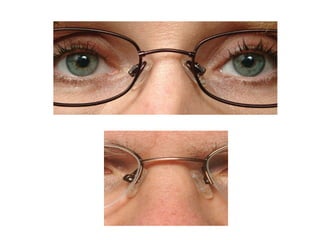
5.5. Pad anglesPad angles
6.6. Face formFace form
7.7. 4 - Point touch4 - Point touch
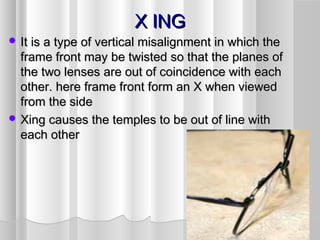
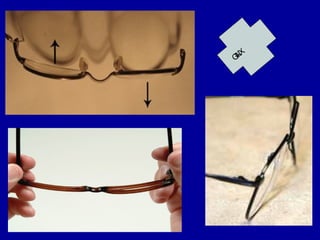
X INGX ING
 It is a type of vertical misalignment in which theIt is a type of vertical misalignment in which the
frame front may be twisted so that the planes offrame front may be twisted so that the planes of
the two lenses are out of coincidence with eachthe two lenses are out of coincidence with each
other. here frame front form an X when viewedother. here frame front form an X when viewed
from the sidefrom the side
 Xing causes the temples to be out of line withXing causes the temples to be out of line with
each othereach other
XING
Xing can be corrected by grasping the eyeXing can be corrected by grasping the eye
wires and rotating the hands in oppositewires and rotating the hands in opposite
direction until the planes of lenses are paralleldirection until the planes of lenses are parallel
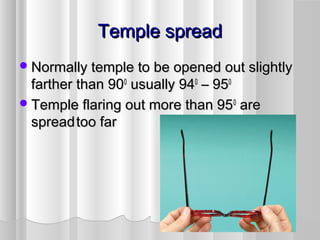
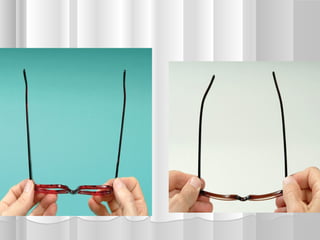
Temple spreadTemple spread
Normally temple to be opened out slightlyNormally temple to be opened out slightly
farther than 90farther than 9000
usually 94usually 9400
– 95– 9500
Temple flaring out more than 95Temple flaring out more than 9500
areare
spreadspread too fartoo far
Can be corrected by heating the end piece andCan be corrected by heating the end piece and
press it back with the thumb or by using halfpress it back with the thumb or by using half
padded plierspadded pliers
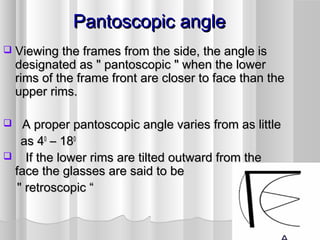
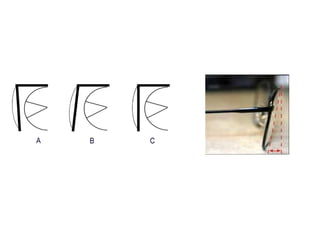
Pantoscopic anglePantoscopic angle
 Viewing the frames from the side, the angle isViewing the frames from the side, the angle is
designated asdesignated as "" pantoscopicpantoscopic "" when the lowerwhen the lower
rims of the frame front are closer to face than therims of the frame front are closer to face than the
upper rims.upper rims.
 A proper pantoscopic angle varies from as littleA proper pantoscopic angle varies from as little
as 4as 400
– 18– 1800
 If the lower rims are tilted outward from theIf the lower rims are tilted outward from the
face the glasses are said to beface the glasses are said to be
"" retroscopic “retroscopic “
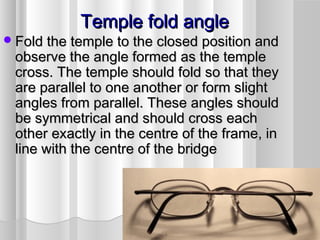
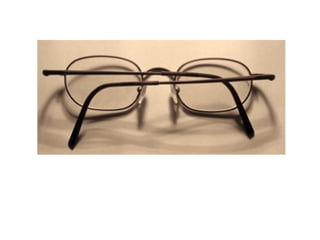
Temple fold angleTemple fold angle
Fold the temple to the closed position andFold the temple to the closed position and
observe the angle formed as the templeobserve the angle formed as the temple
cross. The temple should fold so that theycross. The temple should fold so that they
are parallel to one another or form slightare parallel to one another or form slight
angles from parallel. These angles shouldangles from parallel. These angles should
be symmetrical and should cross eachbe symmetrical and should cross each
other exactly in the centre of the frame, inother exactly in the centre of the frame, in
line with the centre of the bridgeline with the centre of the bridge
Pad anglesPad angles
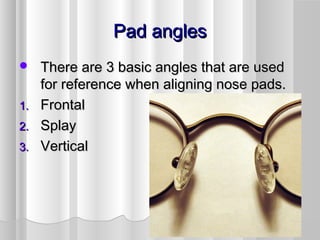
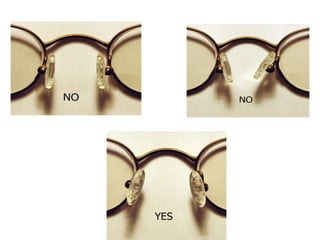
 There are 3 basic angles that are usedThere are 3 basic angles that are used
for reference when aligning nose pads.for reference when aligning nose pads.
1.1. FrontalFrontal
2.2. SplaySplay
3.3. VerticalVertical
Frontal angleFrontal angle
(viewed from the front )(viewed from the front )
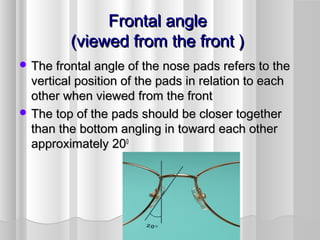
 The frontal angle of the nose pads refers to theThe frontal angle of the nose pads refers to the
vertical position of the pads in relation to eachvertical position of the pads in relation to each
other when viewed from the frontother when viewed from the front
 The top of the pads should be closer togetherThe top of the pads should be closer together
than the bottom angling in toward each otherthan the bottom angling in toward each other
approximately 20approximately 2000
Splay angleSplay angle
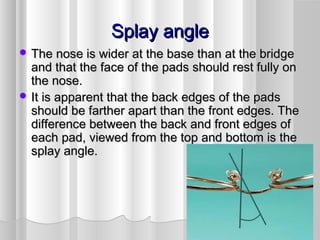
 The nose is wider at the base than at the bridgeThe nose is wider at the base than at the bridge
and that the face of the pads should rest fully onand that the face of the pads should rest fully on
the nose.the nose.
 It is apparent that the back edges of the padsIt is apparent that the back edges of the pads
should be farther apart than the front edges. Theshould be farther apart than the front edges. The
difference between the back and front edges ofdifference between the back and front edges of
each pad, viewed from the top and bottom is theeach pad, viewed from the top and bottom is the
splay angle.splay angle.
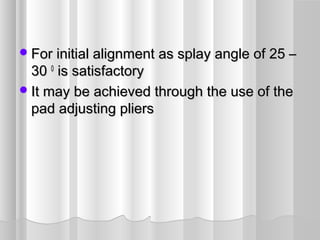
For initial alignment as splay angle of 25 –For initial alignment as splay angle of 25 –
3030 00
is satisfactoryis satisfactory
It may be achieved through the use of theIt may be achieved through the use of the
pad adjusting plierspad adjusting pliers
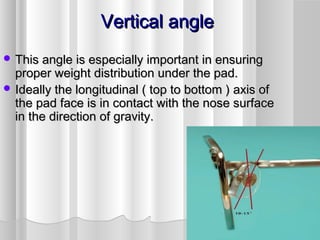
Vertical angleVertical angle
 This angle is especially important in ensuringThis angle is especially important in ensuring
proper weight distribution under the pad.proper weight distribution under the pad.
 Ideally the longitudinal ( top to bottom ) axis ofIdeally the longitudinal ( top to bottom ) axis of
the pad face is in contact with the nose surfacethe pad face is in contact with the nose surface
in the direction of gravity.in the direction of gravity.
For the initial alignment, a verticalFor the initial alignment, a vertical
alignment angle of approximately 15alignment angle of approximately 1500
isis
acceptableacceptable
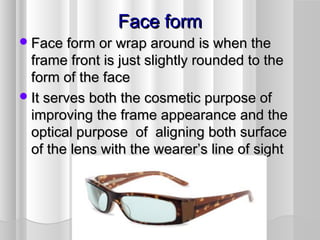
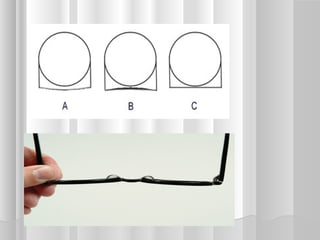
Face formFace form
Face form or wrap around is when theFace form or wrap around is when the
frame front is just slightly rounded to theframe front is just slightly rounded to the
form of the faceform of the face
It serves both the cosmetic purpose ofIt serves both the cosmetic purpose of
improving the frame appearance and theimproving the frame appearance and the
optical purpose of aligning both surfaceoptical purpose of aligning both surface
of the lens with the wearer’s line of sightof the lens with the wearer’s line of sight
Either pliers or hands may be used toEither pliers or hands may be used to
change the degree of faceformchange the degree of faceform
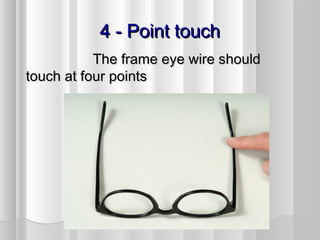
4 - Point touch4 - Point touch
The frame eye wire shouldThe frame eye wire should
touch at four pointstouch at four points
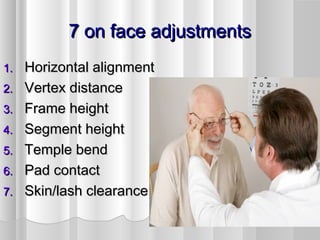
7 on face adjustments7 on face adjustments
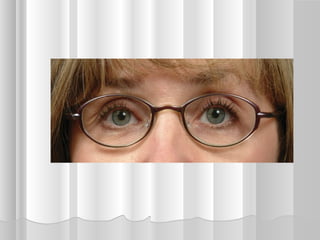
1.1. Horizontal alignmentHorizontal alignment
2.2. Vertex distanceVertex distance
3.3. Frame heightFrame height
4.4. Segment heightSegment height
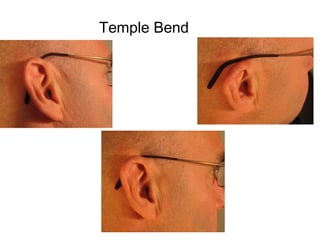
5.5. Temple bendTemple bend
6.6. Pad contactPad contact
7.7. Skin/lash clearanceSkin/lash clearance
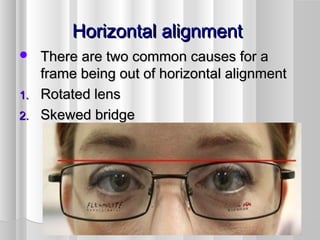
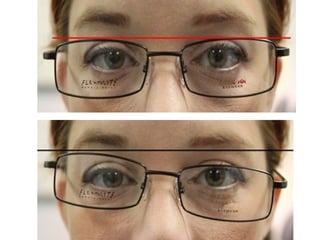
Horizontal alignmentHorizontal alignment
 There are two common causes for aThere are two common causes for a
frame being out of horizontal alignmentframe being out of horizontal alignment
1.1. Rotated lensRotated lens
2.2. Skewed bridgeSkewed bridge
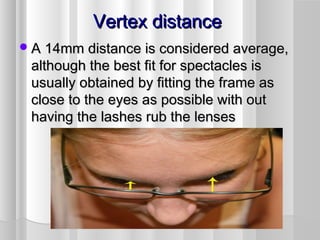
Vertex distanceVertex distance
A 14mm distance is considered average,A 14mm distance is considered average,
although the best fit for spectacles isalthough the best fit for spectacles is
usually obtained by fitting the frame asusually obtained by fitting the frame as
close to the eyes as possible with outclose to the eyes as possible with out
having the lashes rub the lenseshaving the lashes rub the lenses
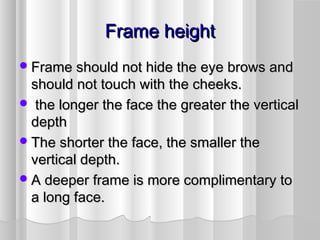
Frame heightFrame height
Frame should not hide the eye brows andFrame should not hide the eye brows and
should not touch with the cheeks.should not touch with the cheeks.
 the longer the face the greater the verticalthe longer the face the greater the vertical
depthdepth
The shorter the face, the smaller theThe shorter the face, the smaller the
vertical depth.vertical depth.
A deeper frame is more complimentary toA deeper frame is more complimentary to
a long face.a long face.
Segment heightSegment height
Bifocal lenses prescribed for generalBifocal lenses prescribed for general
purpose use are usually mounted beforepurpose use are usually mounted before
the eyes, so the the segment top isthe eyes, so the the segment top is
tangential to the lower edge of the iris.tangential to the lower edge of the iris.
In most cases the position of the lowerIn most cases the position of the lower
edge of the iris also corresponds with theedge of the iris also corresponds with the
line of the lower lid when the head is in theline of the lower lid when the head is in the
primaryprimary position.position.
SKIN/LASH CLEARANCESKIN/LASH CLEARANCE
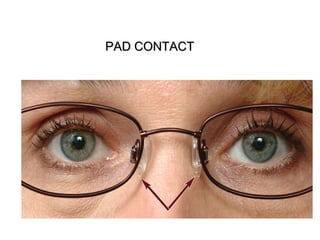
PAD CONTACTPAD CONTACT
Temple Bend
ReferenceReference
System for ophthalmic dispensing (thirdSystem for ophthalmic dispensing (third
edition )edition )
 XING isXING is
a)a) Horizontal misalignmentHorizontal misalignment
b)b) Vertical misalignmentVertical misalignment
c)c) Incorrect pantoscopic angleIncorrect pantoscopic angle
d)d) Skewed bridgeSkewed bridge
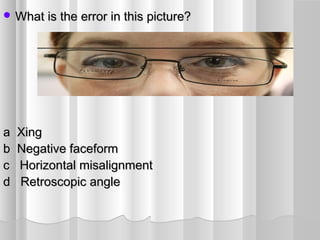
 What is the error in this picture?What is the error in this picture?
a Xinga Xing
b Negative faceformb Negative faceform
c Horizontal misalignmentc Horizontal misalignment
d Retroscopic angled Retroscopic angle
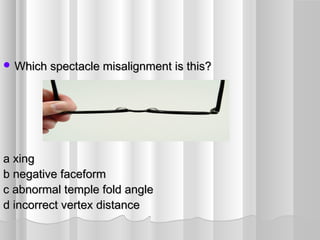
 Which spectacle misalignment is this?Which spectacle misalignment is this?
a xinga xing
b negative faceformb negative faceform
c abnormal temple fold anglec abnormal temple fold angle
d incorrect vertex distanced incorrect vertex distance
Which of the following is not included inWhich of the following is not included in
on- face adjustments?on- face adjustments?
a .skin or lash clearancea .skin or lash clearance
b .vertex distanceb .vertex distance
c .frame heightc .frame height
d .xingd .xing
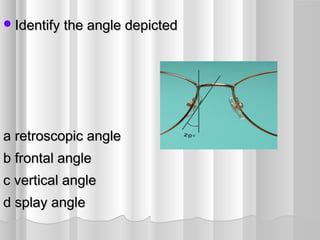
Identify the angle depictedIdentify the angle depicted
a retroscopic anglea retroscopic angle
b frontal angleb frontal angle
c vertical anglec vertical angle
d splay angled splay angle
Frame adjustment and quality checking

Frame adjustment and quality checking

  • 1.
    FRAME ADJUSTMENTFRAME ADJUSTMENT ANDQUALITYAND QUALITY CHECKINGCHECKING OPTOM FASLU MUHAMMEDOPTOM FASLU MUHAMMED
  • 2.
    Frame Final AdjustmentsFrameFinal Adjustments  Off-Face – 7 AdjustmentsOff-Face – 7 Adjustments  On-Face – 7 AdjustmentsOn-Face – 7 Adjustments
  • 3.
    7 Off-Face Adjustments 1.1.X INGX ING 2.2. Temple spreadTemple spread 3.3. Pantoscopic anglePantoscopic angle 4.4. Temple fold angleTemple fold angle 5.5. Pad anglesPad angles 6.6. Face formFace form 7.7. 4 - Point touch4 - Point touch
  • 4.
    X INGX ING It is a type of vertical misalignment in which theIt is a type of vertical misalignment in which the frame front may be twisted so that the planes offrame front may be twisted so that the planes of the two lenses are out of coincidence with eachthe two lenses are out of coincidence with each other. here frame front form an X when viewedother. here frame front form an X when viewed from the sidefrom the side  Xing causes the temples to be out of line withXing causes the temples to be out of line with each othereach other
  • 5.
  • 6.
    Xing can becorrected by grasping the eyeXing can be corrected by grasping the eye wires and rotating the hands in oppositewires and rotating the hands in opposite direction until the planes of lenses are paralleldirection until the planes of lenses are parallel
  • 7.
    Temple spreadTemple spread Normallytemple to be opened out slightlyNormally temple to be opened out slightly farther than 90farther than 9000 usually 94usually 9400 – 95– 9500 Temple flaring out more than 95Temple flaring out more than 9500 areare spreadspread too fartoo far
  • 9.
    Can be correctedby heating the end piece andCan be corrected by heating the end piece and press it back with the thumb or by using halfpress it back with the thumb or by using half padded plierspadded pliers
  • 12.
    Pantoscopic anglePantoscopic angle Viewing the frames from the side, the angle isViewing the frames from the side, the angle is designated asdesignated as "" pantoscopicpantoscopic "" when the lowerwhen the lower rims of the frame front are closer to face than therims of the frame front are closer to face than the upper rims.upper rims.  A proper pantoscopic angle varies from as littleA proper pantoscopic angle varies from as little as 4as 400 – 18– 1800  If the lower rims are tilted outward from theIf the lower rims are tilted outward from the face the glasses are said to beface the glasses are said to be "" retroscopic “retroscopic “
  • 14.
    Temple fold angleTemplefold angle Fold the temple to the closed position andFold the temple to the closed position and observe the angle formed as the templeobserve the angle formed as the temple cross. The temple should fold so that theycross. The temple should fold so that they are parallel to one another or form slightare parallel to one another or form slight angles from parallel. These angles shouldangles from parallel. These angles should be symmetrical and should cross eachbe symmetrical and should cross each other exactly in the centre of the frame, inother exactly in the centre of the frame, in line with the centre of the bridgeline with the centre of the bridge
  • 16.
    Pad anglesPad angles There are 3 basic angles that are usedThere are 3 basic angles that are used for reference when aligning nose pads.for reference when aligning nose pads. 1.1. FrontalFrontal 2.2. SplaySplay 3.3. VerticalVertical
  • 17.
    Frontal angleFrontal angle (viewedfrom the front )(viewed from the front )  The frontal angle of the nose pads refers to theThe frontal angle of the nose pads refers to the vertical position of the pads in relation to eachvertical position of the pads in relation to each other when viewed from the frontother when viewed from the front  The top of the pads should be closer togetherThe top of the pads should be closer together than the bottom angling in toward each otherthan the bottom angling in toward each other approximately 20approximately 2000
  • 18.
    Splay angleSplay angle The nose is wider at the base than at the bridgeThe nose is wider at the base than at the bridge and that the face of the pads should rest fully onand that the face of the pads should rest fully on the nose.the nose.  It is apparent that the back edges of the padsIt is apparent that the back edges of the pads should be farther apart than the front edges. Theshould be farther apart than the front edges. The difference between the back and front edges ofdifference between the back and front edges of each pad, viewed from the top and bottom is theeach pad, viewed from the top and bottom is the splay angle.splay angle.
  • 19.
    For initial alignmentas splay angle of 25 –For initial alignment as splay angle of 25 – 3030 00 is satisfactoryis satisfactory It may be achieved through the use of theIt may be achieved through the use of the pad adjusting plierspad adjusting pliers
  • 20.
    Vertical angleVertical angle This angle is especially important in ensuringThis angle is especially important in ensuring proper weight distribution under the pad.proper weight distribution under the pad.  Ideally the longitudinal ( top to bottom ) axis ofIdeally the longitudinal ( top to bottom ) axis of the pad face is in contact with the nose surfacethe pad face is in contact with the nose surface in the direction of gravity.in the direction of gravity.
  • 21.
    For the initialalignment, a verticalFor the initial alignment, a vertical alignment angle of approximately 15alignment angle of approximately 1500 isis acceptableacceptable
  • 23.
    Face formFace form Faceform or wrap around is when theFace form or wrap around is when the frame front is just slightly rounded to theframe front is just slightly rounded to the form of the faceform of the face It serves both the cosmetic purpose ofIt serves both the cosmetic purpose of improving the frame appearance and theimproving the frame appearance and the optical purpose of aligning both surfaceoptical purpose of aligning both surface of the lens with the wearer’s line of sightof the lens with the wearer’s line of sight
  • 25.
    Either pliers orhands may be used toEither pliers or hands may be used to change the degree of faceformchange the degree of faceform
  • 26.
    4 - Pointtouch4 - Point touch The frame eye wire shouldThe frame eye wire should touch at four pointstouch at four points
  • 27.
    7 on faceadjustments7 on face adjustments 1.1. Horizontal alignmentHorizontal alignment 2.2. Vertex distanceVertex distance 3.3. Frame heightFrame height 4.4. Segment heightSegment height 5.5. Temple bendTemple bend 6.6. Pad contactPad contact 7.7. Skin/lash clearanceSkin/lash clearance
  • 28.
    Horizontal alignmentHorizontal alignment There are two common causes for aThere are two common causes for a frame being out of horizontal alignmentframe being out of horizontal alignment 1.1. Rotated lensRotated lens 2.2. Skewed bridgeSkewed bridge
  • 30.
    Vertex distanceVertex distance A14mm distance is considered average,A 14mm distance is considered average, although the best fit for spectacles isalthough the best fit for spectacles is usually obtained by fitting the frame asusually obtained by fitting the frame as close to the eyes as possible with outclose to the eyes as possible with out having the lashes rub the lenseshaving the lashes rub the lenses
  • 31.
    Frame heightFrame height Frameshould not hide the eye brows andFrame should not hide the eye brows and should not touch with the cheeks.should not touch with the cheeks.  the longer the face the greater the verticalthe longer the face the greater the vertical depthdepth The shorter the face, the smaller theThe shorter the face, the smaller the vertical depth.vertical depth. A deeper frame is more complimentary toA deeper frame is more complimentary to a long face.a long face.
  • 33.
    Segment heightSegment height Bifocallenses prescribed for generalBifocal lenses prescribed for general purpose use are usually mounted beforepurpose use are usually mounted before the eyes, so the the segment top isthe eyes, so the the segment top is tangential to the lower edge of the iris.tangential to the lower edge of the iris. In most cases the position of the lowerIn most cases the position of the lower edge of the iris also corresponds with theedge of the iris also corresponds with the line of the lower lid when the head is in theline of the lower lid when the head is in the primaryprimary position.position.
  • 34.
  • 35.
  • 37.
  • 38.
    ReferenceReference System for ophthalmicdispensing (thirdSystem for ophthalmic dispensing (third edition )edition )
  • 40.
     XING isXINGis a)a) Horizontal misalignmentHorizontal misalignment b)b) Vertical misalignmentVertical misalignment c)c) Incorrect pantoscopic angleIncorrect pantoscopic angle d)d) Skewed bridgeSkewed bridge
  • 41.
     What isthe error in this picture?What is the error in this picture? a Xinga Xing b Negative faceformb Negative faceform c Horizontal misalignmentc Horizontal misalignment d Retroscopic angled Retroscopic angle
  • 42.
     Which spectaclemisalignment is this?Which spectacle misalignment is this? a xinga xing b negative faceformb negative faceform c abnormal temple fold anglec abnormal temple fold angle d incorrect vertex distanced incorrect vertex distance
  • 43.
    Which of thefollowing is not included inWhich of the following is not included in on- face adjustments?on- face adjustments? a .skin or lash clearancea .skin or lash clearance b .vertex distanceb .vertex distance c .frame heightc .frame height d .xingd .xing
  • 44.
    Identify the angledepictedIdentify the angle depicted a retroscopic anglea retroscopic angle b frontal angleb frontal angle c vertical anglec vertical angle d splay angled splay angle