Tinted Contact
lenses
Ananya Chowdhury
(M.OPTOM 2nd year)
BVDUMC , School of Optometry, Pune
History
• In 1969, Professor Otto Wichterle patented the idea of diffusing a
colored dye into a hydrogel (soft material).
• He was awarded two patents describing processes for tinting
hydroxyethyl methacrylate (HEMA) lenses.
• Attempts were made in the 70's to use colored soft contact lenses for
clinical reasons.
• By the 1980’s cosmetic coloured contact lenses arrived in market.
Types
• RGP (corneal) :
Tints are typically used for handling purpose.
Highly mobile on the eye.
• Soft (hydrogel) :
Most commonly prescribed tinted contact lens.
These lenses remain centered and exhibit relatively little movement on the eye.
• Scleral (haptic) :
First contact lenses used for cosmetic enhancement.
Relatively immobile on the eye.
well suited to prosthetic applications.
Tinted lens designs
• Handling tint
• Cosmetic tinted lenses
• Prosthetic tinted lenses
• Therapeutic tinted lenses
• Performance enhancing lenses
• Prophylactic tinted lenses
• Theatric tinted lenses
Handling tint
• SCLs having a light transparent tint as
an aid for handling.
• Easier location when
handling/cleaning.
• Better visibility for low vision patients.
• Luminous transmission factor is about
95%.
Cosmetic tinted contact lenses
• Enhance or alter the appearance of a
normal eye.
• Tints are available as translucent and
opaque colors.
• The light transmission through cosmetic
tinted lenses is usually in the range 75–85%
Circle contact lens
• Contact lens that makes the eye’s iris appear larger.
• It has become a trend throughout east, south and southeast Asia.
• Eg. B & L Lacelle Circle Monthly Disposable Contact Lens, J&J 1-Day circle Acuvue
Define.
Prosthetic tinted Contact-lenses
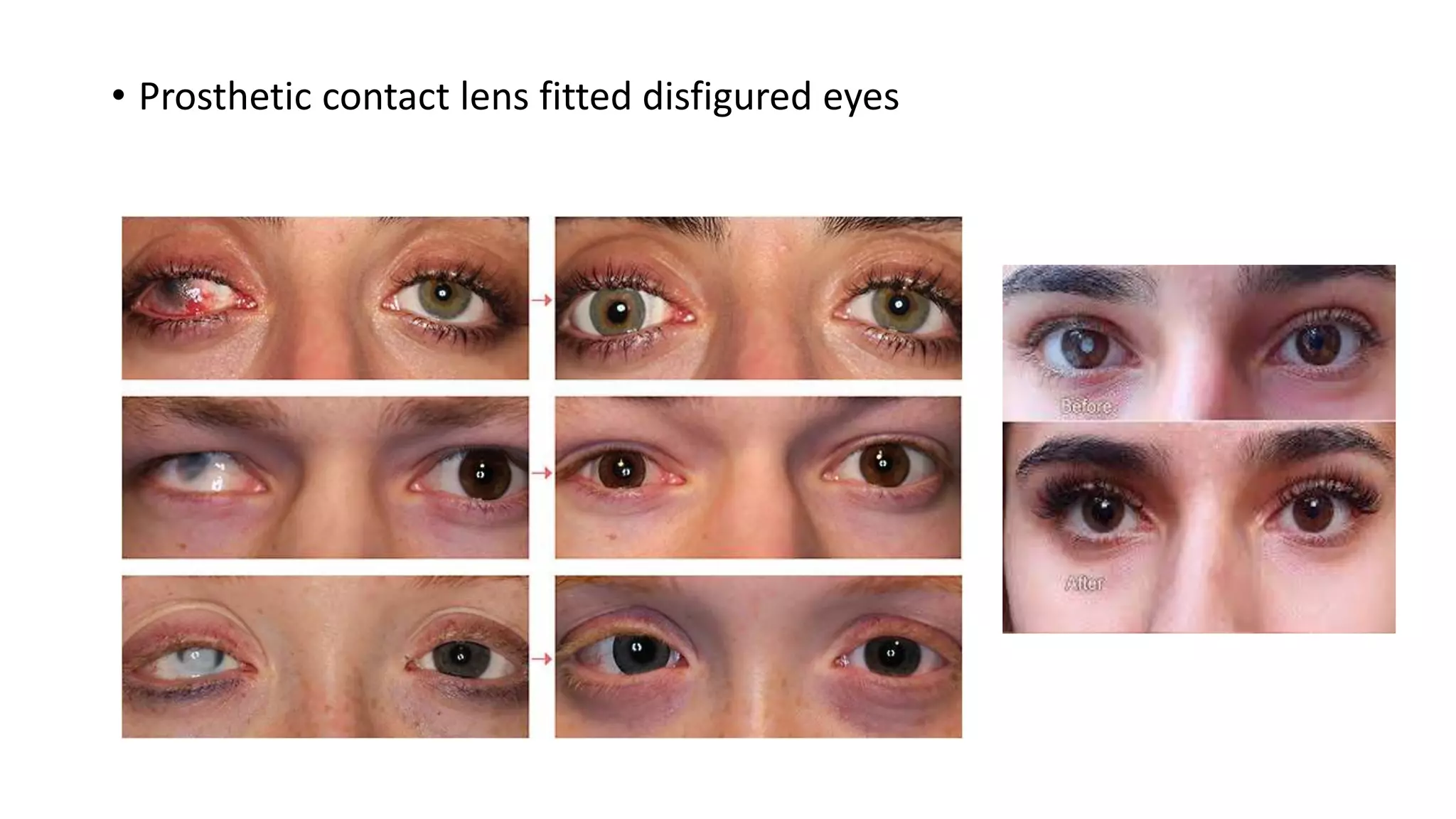
• A prosthetic contact lens is a tinted or painted contact lens used to improve the
appearance of a disfigured eye or to help correct the vision of a poorly
functioning eye.
• Indications:
Any part of the eye may become disfigured due to trauma, ocular disease, systemic
health problems, or congenital defects.
Prosthetic contact lenses may also be used to disguise an enucleated eye.
• Availability
Hand-painted
prosthetic
contact lenses.
computer-generated prosthetic
lenses with a clear iris backing (A)
and black iris backing (B).
• Scleral shell prosthetic CL
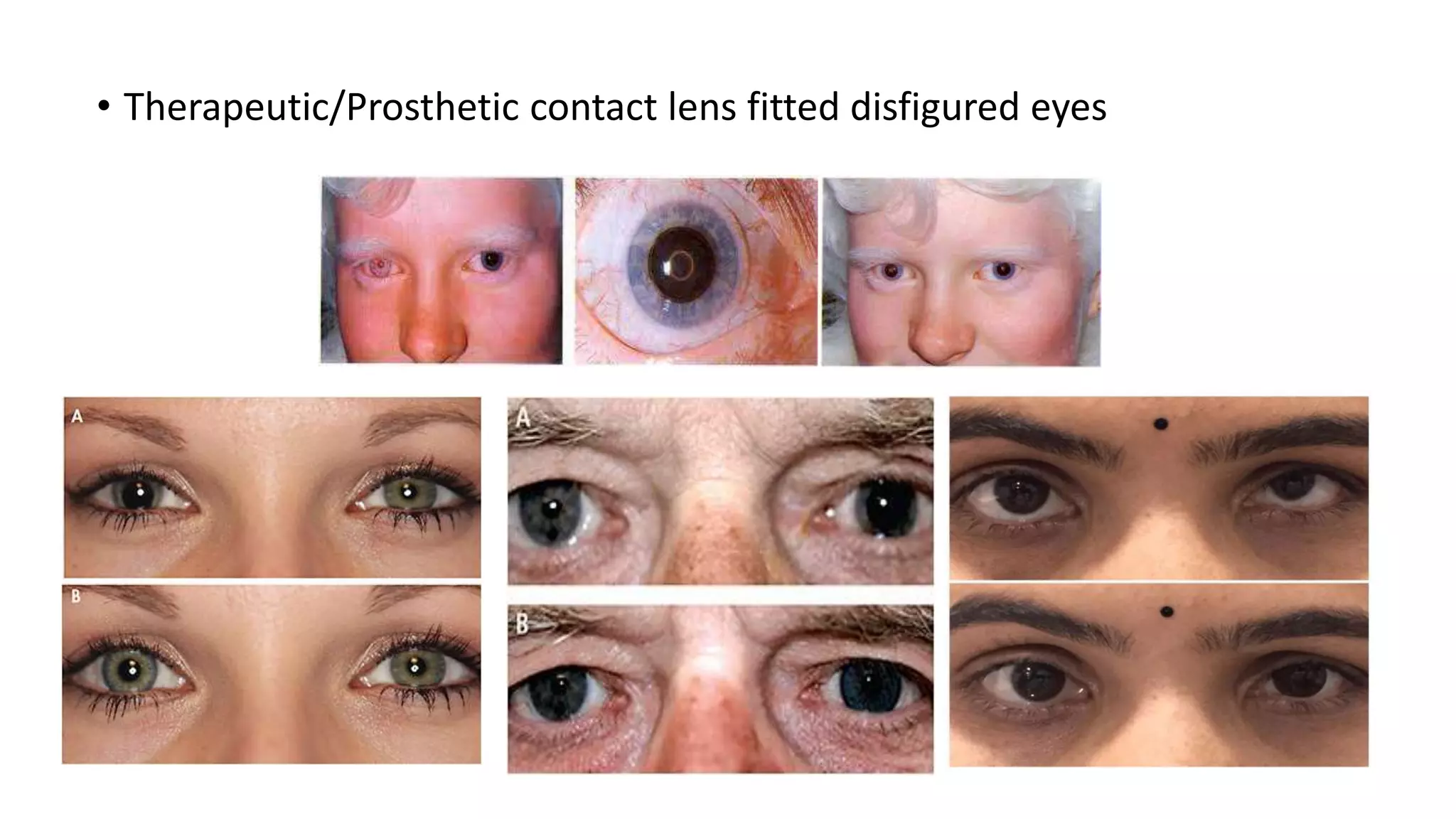
• Prosthetic contact lens fitted disfigured eyes
Therapeutic tinted contact lenses
• A lens that is designed to treat an underlying defect or disease.
• Applications:
Reduce excessive photophobia and glare due to aniridia, Albinism.
Eliminate monocular polyopia due to trauma.
Eliminate binocular diplopia in squint.
Rigid lens with an opaque iris pattern fitted to a distorted cornea in a sighted eye
also having the effect of improving vision by neutralizing corneal optics.
Can be used for occlusion therapy in amblyopia.
• Therapeutic/Prosthetic contact lens fitted disfigured eyes
Performance enhancing tinted contact lenses
• These lenses can be advised to color
deficient, Dyslexic, and sports persons.
1. X-Chrome Contact lenses :
A red tinted contact lens, with peak
transmission of 595 nm.
 worn in nondominant eye.
It attempts to overcome certain red-green
color deficiencies by allowing a comparison of
the different contrasts perceived by the two
eyes.
2. ChromaGen lenses:
ChromaGen contact lenses are a range of soft lenses with tinted pupils of varying
hue and saturation.
It enhances color perception in color defectives.
These lenses are used to ease reading problems for those with specific learning
difficulties (Dyslexia).
• ChromaGen diagnostic system:
It comprises a full range of diagnostic filters and
a 25 contact lens trial set in the same colors as
the filters to ensure optimum performance from
the chosen hue.
Tints used are violet, orange, yellow, green,
amber and magenta
Three intensities of tint and three diameters are
available ranging from 5 to 7 mm.
 In contact lens format the lenses are made from
Benz G-5X, 55% Hioxifilicon 4A, The lenses are
available in 14.50 mm diameter, standard 8.60
mm radius
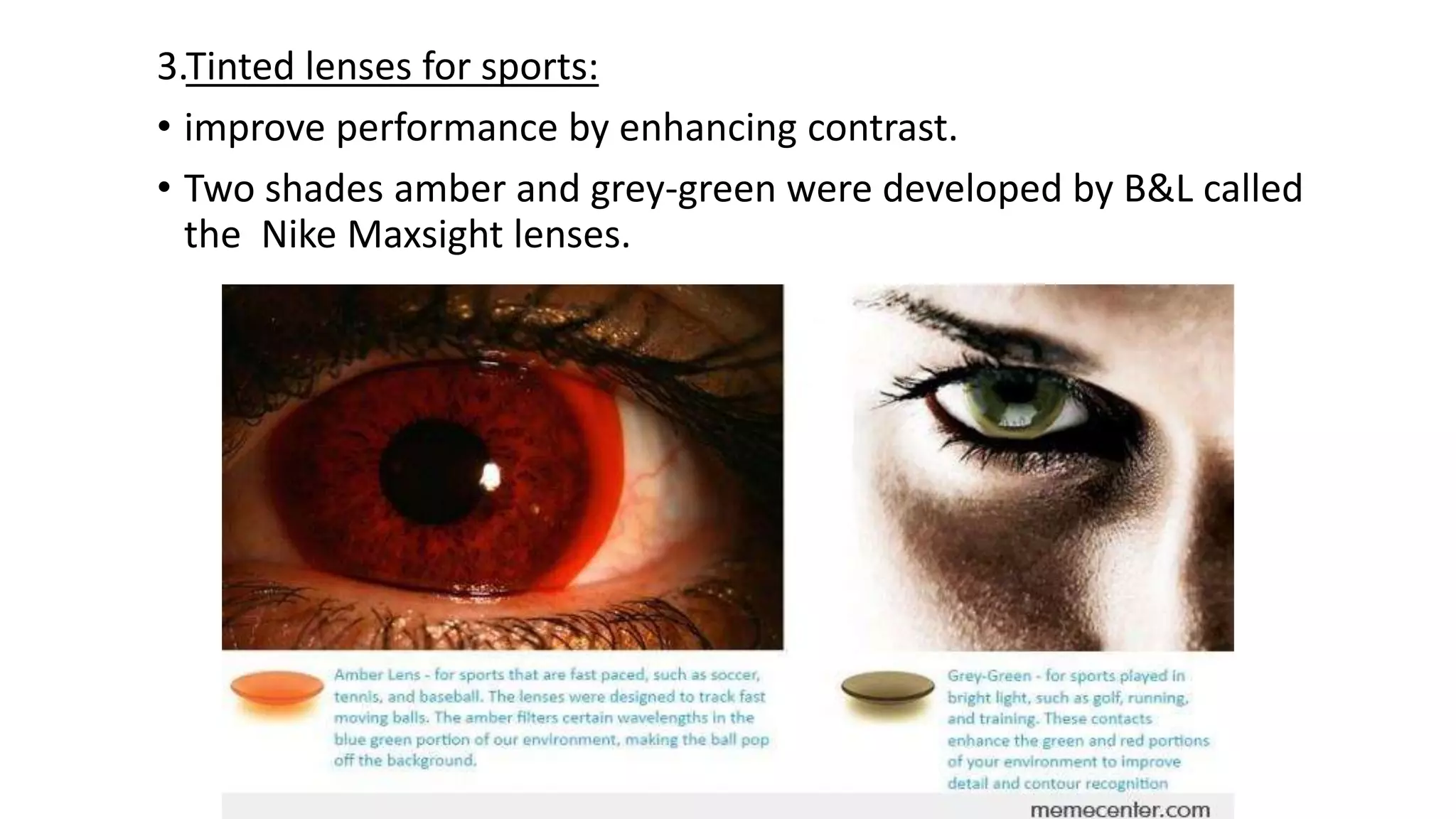
3.Tinted lenses for sports:
• improve performance by enhancing contrast.
• Two shades amber and grey-green were developed by B&L called
the Nike Maxsight lenses.
Prophylactic tints
• protects from excess ultraviolet (UV) light.
• Indicated candidates:
 Individuals having active outdoors lifestyle.
 Use photosensitizing drugs. E.g. Antihistamines, NSAIDs, Oral
contraceptives, and Oestrogens.
 Are often exposed to artificial UV sources during work.
Aphakics.
• contact lenses having Class 1 UV protection
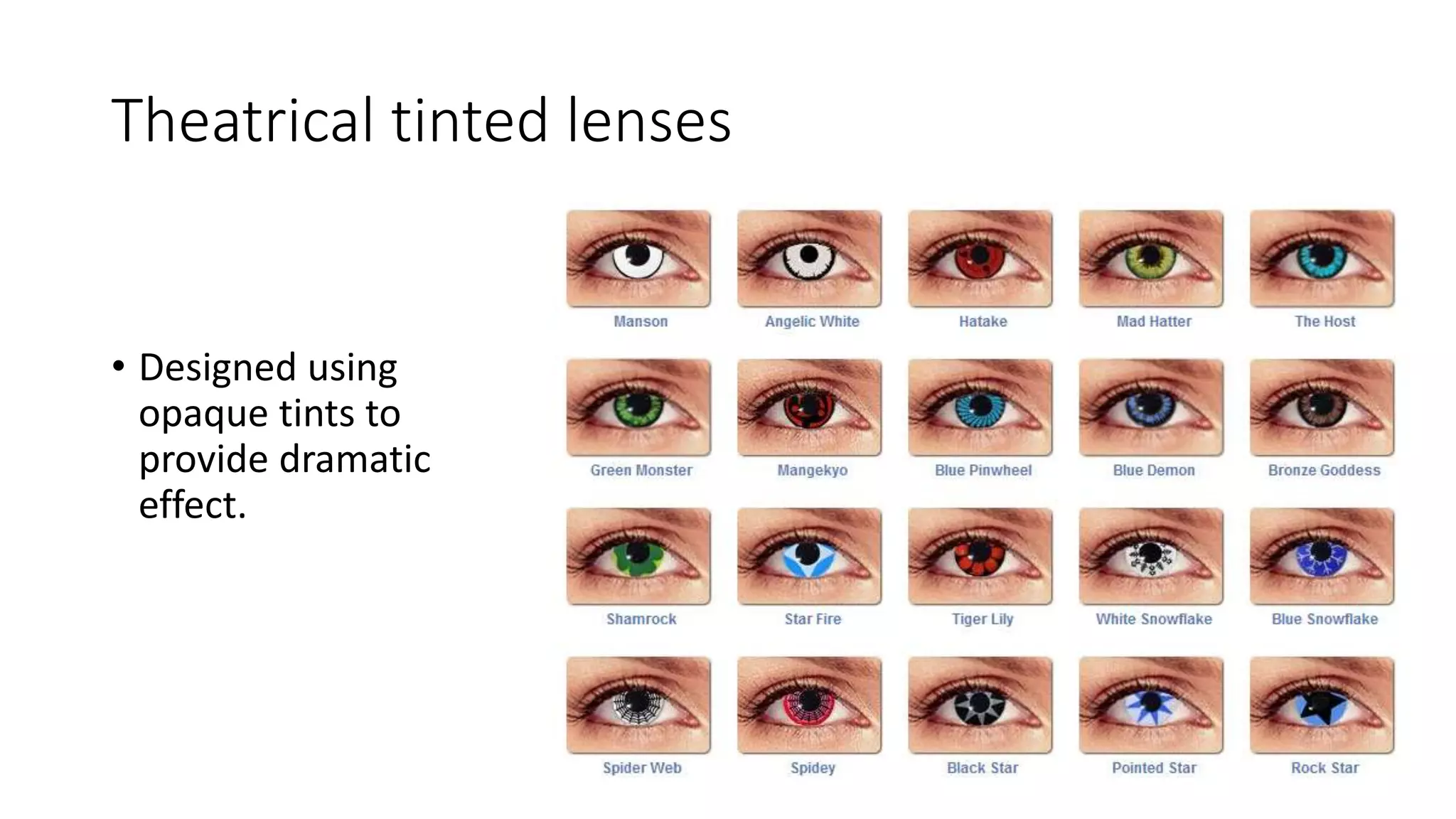
Theatrical tinted lenses
• Designed using
opaque tints to
provide dramatic
effect.
Tinting techniques
• Translucent tinting techniques:
Dye dispersion tinting
VAT tinting
Chemical bond tinting
Printing
• Opaque tinting techniques:
Dot matrix printing
Laminate constructions
Opaque backing
• Dye dispersion tinting:
 Suitable for rigid lenses.
A dye or pigment is mixed to the monomer mixture prior to polymerization, or by adding the dye
to the polymer and then mixing to disperse the color.
• Vat tinting:
This technique can be used for tinting prosthetic silicone hydrogel lenses.
The finished contact lens is soaked in a water-soluble dye for a fixed amount of time and at a
specified temperature. The lens is then exposed to air, making the dye trapped within the lens
matrix.
• Chemical bond tinting:
This involves soaking the lens in a dye solution, in the
presence of a catalyst, for a fixed time at a specified
temperature. The lens then needs to be put through a
series of extraction processes to remove any residual
unreacted agents.
• Printing :
Dye can be placed on the lens surface in a controlled
manner using a printing process similar to that used for
ink printing on paper.
Pad printing process applied now a days. E.g. Air Optix
colors, Fresh look by Alcon
• Dot matrix printing:
an opaque colored dot matrix is applied to the front
surface of a soft lens and chemically fixed to make it
permanent
• Opaque backing:
An opaque white backing of barium sulphate is
precipitated into the matrix of the back surface of the
lens. The iris color is then painted onto the front
surface and bonded.
Or
The matrix of a lens can be tinted with a translucent
dye, and an iris pattern and black pupil are applied to
the back surface of the lens using opaque paints.
• Laminate constructions:
An iris pattern is painted, using opaque dye, on
to the surface of an dehydrate HEMA button
which has been lathed to the curvature of the
intended finished lens.
 A second pouring of HEMA over the top of this
pattern is effected.
 Once set, the laminate button is lathed to
create the finished lens form, which is then
hydrated in the usual way.
Sandwich technology: The top and bottom
layers of clear HEMA are co-polymerized with a
thin middle layer of colored non-toxic pigments,
allowing the composite button to be lathed and
then hydrated into an ultrathin lens design.
Tinted CL fitting considerations
• Fitting procedure for cosmetic Cl is almost as equivalent as clear lenses the only difference is the
counseling approach for suitable color and design of the cosmetic lens.
• For patients already wearing corrective contact lenses and who simply wish to change or highlight their
eye color, fitting a lens from the same company as their current lenses can work well.
• Fit a clear lens first to assess the lens fit and alter it accordingly.
• Measure the iris diameter of the fellow eye and order it the same.
• Tinted rigid lenses need to be of a large diameter so as to cover as much of the cornea as possible and to
minimize lens movement.
• Note the iris color and what type of tint is required.(Photos of fellow can help for customized lenses.)
• Measure the diameter of the pupil of the fellow eye in bright and dim illumination and order it halfway
between the two.
• Specify whether a black or clear tinted pupil is required.
• When re-ordering tinted lenses, keep the lens material the same. otherwise the tint will be different.
• Lens maintenance
Most currently available soft lens solutions can be used safely with disposable cosmetic contact
lenses.
Chlorine-based disinfecting solutions can cause some lens fading.
 Intensive cleaners that employ acids, bases and oxidizing agents could cause tint fading, and so
should not be used on tinted lenses.
For prosthetic lenses and tinted lenses, some solutions (although safe ) may affect the lens color
in particular hydrogen peroxide with long soaking times and alcohol-based cleaners. Conversely
some opaque tints are best stabilized in hydrogen peroxide and advice should always be sought
from individual manufacturers.
References
• IACLE Module
• ‘Contact lenses’ by Speedwell and Phillips.
• ‘Contact lens practice’ by Nathan Efron.
• ‘Contact Lenses in Ophthalmic Practice’ by Mark J Mannis.
• Article: Soft Contact Lenses for Prosthetic Fitting
Prosthetic lenses fulfill a functional and a cosmetic need for damaged or disfigured eyes.
By Dawn Lam, BSc, MSc, OD, FAAO
Thank You.

Tinted Contact lenses.pptx

  • 1.
    Tinted Contact lenses Ananya Chowdhury (M.OPTOM2nd year) BVDUMC , School of Optometry, Pune
  • 2.
    History • In 1969,Professor Otto Wichterle patented the idea of diffusing a colored dye into a hydrogel (soft material). • He was awarded two patents describing processes for tinting hydroxyethyl methacrylate (HEMA) lenses. • Attempts were made in the 70's to use colored soft contact lenses for clinical reasons. • By the 1980’s cosmetic coloured contact lenses arrived in market.
  • 3.
    Types • RGP (corneal): Tints are typically used for handling purpose. Highly mobile on the eye. • Soft (hydrogel) : Most commonly prescribed tinted contact lens. These lenses remain centered and exhibit relatively little movement on the eye. • Scleral (haptic) : First contact lenses used for cosmetic enhancement. Relatively immobile on the eye. well suited to prosthetic applications.
  • 4.
    Tinted lens designs •Handling tint • Cosmetic tinted lenses • Prosthetic tinted lenses • Therapeutic tinted lenses • Performance enhancing lenses • Prophylactic tinted lenses • Theatric tinted lenses
  • 5.
    Handling tint • SCLshaving a light transparent tint as an aid for handling. • Easier location when handling/cleaning. • Better visibility for low vision patients. • Luminous transmission factor is about 95%.
  • 6.
    Cosmetic tinted contactlenses • Enhance or alter the appearance of a normal eye. • Tints are available as translucent and opaque colors. • The light transmission through cosmetic tinted lenses is usually in the range 75–85%
  • 7.
    Circle contact lens •Contact lens that makes the eye’s iris appear larger. • It has become a trend throughout east, south and southeast Asia. • Eg. B & L Lacelle Circle Monthly Disposable Contact Lens, J&J 1-Day circle Acuvue Define.
  • 8.
    Prosthetic tinted Contact-lenses •A prosthetic contact lens is a tinted or painted contact lens used to improve the appearance of a disfigured eye or to help correct the vision of a poorly functioning eye. • Indications: Any part of the eye may become disfigured due to trauma, ocular disease, systemic health problems, or congenital defects. Prosthetic contact lenses may also be used to disguise an enucleated eye.
  • 9.
    • Availability Hand-painted prosthetic contact lenses. computer-generatedprosthetic lenses with a clear iris backing (A) and black iris backing (B).
  • 10.
    • Scleral shellprosthetic CL
  • 11.
    • Prosthetic contactlens fitted disfigured eyes
  • 12.
    Therapeutic tinted contactlenses • A lens that is designed to treat an underlying defect or disease. • Applications: Reduce excessive photophobia and glare due to aniridia, Albinism. Eliminate monocular polyopia due to trauma. Eliminate binocular diplopia in squint. Rigid lens with an opaque iris pattern fitted to a distorted cornea in a sighted eye also having the effect of improving vision by neutralizing corneal optics. Can be used for occlusion therapy in amblyopia.
  • 13.
    • Therapeutic/Prosthetic contactlens fitted disfigured eyes
  • 14.
    Performance enhancing tintedcontact lenses • These lenses can be advised to color deficient, Dyslexic, and sports persons. 1. X-Chrome Contact lenses : A red tinted contact lens, with peak transmission of 595 nm.  worn in nondominant eye. It attempts to overcome certain red-green color deficiencies by allowing a comparison of the different contrasts perceived by the two eyes.
  • 15.
    2. ChromaGen lenses: ChromaGencontact lenses are a range of soft lenses with tinted pupils of varying hue and saturation. It enhances color perception in color defectives. These lenses are used to ease reading problems for those with specific learning difficulties (Dyslexia).
  • 16.
    • ChromaGen diagnosticsystem: It comprises a full range of diagnostic filters and a 25 contact lens trial set in the same colors as the filters to ensure optimum performance from the chosen hue. Tints used are violet, orange, yellow, green, amber and magenta Three intensities of tint and three diameters are available ranging from 5 to 7 mm.  In contact lens format the lenses are made from Benz G-5X, 55% Hioxifilicon 4A, The lenses are available in 14.50 mm diameter, standard 8.60 mm radius
  • 17.
    3.Tinted lenses forsports: • improve performance by enhancing contrast. • Two shades amber and grey-green were developed by B&L called the Nike Maxsight lenses.
  • 18.
    Prophylactic tints • protectsfrom excess ultraviolet (UV) light. • Indicated candidates:  Individuals having active outdoors lifestyle.  Use photosensitizing drugs. E.g. Antihistamines, NSAIDs, Oral contraceptives, and Oestrogens.  Are often exposed to artificial UV sources during work. Aphakics.
  • 19.
    • contact lenseshaving Class 1 UV protection
  • 20.
    Theatrical tinted lenses •Designed using opaque tints to provide dramatic effect.
  • 21.
    Tinting techniques • Translucenttinting techniques: Dye dispersion tinting VAT tinting Chemical bond tinting Printing • Opaque tinting techniques: Dot matrix printing Laminate constructions Opaque backing
  • 22.
    • Dye dispersiontinting:  Suitable for rigid lenses. A dye or pigment is mixed to the monomer mixture prior to polymerization, or by adding the dye to the polymer and then mixing to disperse the color. • Vat tinting: This technique can be used for tinting prosthetic silicone hydrogel lenses. The finished contact lens is soaked in a water-soluble dye for a fixed amount of time and at a specified temperature. The lens is then exposed to air, making the dye trapped within the lens matrix.
  • 23.
    • Chemical bondtinting: This involves soaking the lens in a dye solution, in the presence of a catalyst, for a fixed time at a specified temperature. The lens then needs to be put through a series of extraction processes to remove any residual unreacted agents. • Printing : Dye can be placed on the lens surface in a controlled manner using a printing process similar to that used for ink printing on paper. Pad printing process applied now a days. E.g. Air Optix colors, Fresh look by Alcon
  • 24.
    • Dot matrixprinting: an opaque colored dot matrix is applied to the front surface of a soft lens and chemically fixed to make it permanent • Opaque backing: An opaque white backing of barium sulphate is precipitated into the matrix of the back surface of the lens. The iris color is then painted onto the front surface and bonded. Or The matrix of a lens can be tinted with a translucent dye, and an iris pattern and black pupil are applied to the back surface of the lens using opaque paints.
  • 25.
    • Laminate constructions: Aniris pattern is painted, using opaque dye, on to the surface of an dehydrate HEMA button which has been lathed to the curvature of the intended finished lens.  A second pouring of HEMA over the top of this pattern is effected.  Once set, the laminate button is lathed to create the finished lens form, which is then hydrated in the usual way. Sandwich technology: The top and bottom layers of clear HEMA are co-polymerized with a thin middle layer of colored non-toxic pigments, allowing the composite button to be lathed and then hydrated into an ultrathin lens design.
  • 26.
    Tinted CL fittingconsiderations • Fitting procedure for cosmetic Cl is almost as equivalent as clear lenses the only difference is the counseling approach for suitable color and design of the cosmetic lens. • For patients already wearing corrective contact lenses and who simply wish to change or highlight their eye color, fitting a lens from the same company as their current lenses can work well. • Fit a clear lens first to assess the lens fit and alter it accordingly. • Measure the iris diameter of the fellow eye and order it the same. • Tinted rigid lenses need to be of a large diameter so as to cover as much of the cornea as possible and to minimize lens movement. • Note the iris color and what type of tint is required.(Photos of fellow can help for customized lenses.) • Measure the diameter of the pupil of the fellow eye in bright and dim illumination and order it halfway between the two. • Specify whether a black or clear tinted pupil is required. • When re-ordering tinted lenses, keep the lens material the same. otherwise the tint will be different.
  • 27.
    • Lens maintenance Mostcurrently available soft lens solutions can be used safely with disposable cosmetic contact lenses. Chlorine-based disinfecting solutions can cause some lens fading.  Intensive cleaners that employ acids, bases and oxidizing agents could cause tint fading, and so should not be used on tinted lenses. For prosthetic lenses and tinted lenses, some solutions (although safe ) may affect the lens color in particular hydrogen peroxide with long soaking times and alcohol-based cleaners. Conversely some opaque tints are best stabilized in hydrogen peroxide and advice should always be sought from individual manufacturers.
  • 28.
    References • IACLE Module •‘Contact lenses’ by Speedwell and Phillips. • ‘Contact lens practice’ by Nathan Efron. • ‘Contact Lenses in Ophthalmic Practice’ by Mark J Mannis. • Article: Soft Contact Lenses for Prosthetic Fitting Prosthetic lenses fulfill a functional and a cosmetic need for damaged or disfigured eyes. By Dawn Lam, BSc, MSc, OD, FAAO
  • 29.