Introduction to Rational Use of Drugs
and Role of Pharmacist
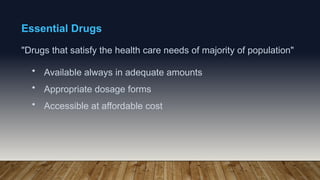
Essential Drugs
"Drugs that satisfy the health care needs of majority of population"
• Available always in adequate amounts
• Appropriate dosage forms
• Accessible at affordable cost
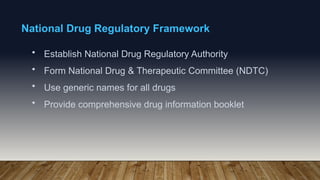
National Drug Regulatory Framework
• Establish National Drug Regulatory Authority
• Form National Drug & Therapeutic Committee (NDTC)
• Use generic names for all drugs
• Provide comprehensive drug information booklet
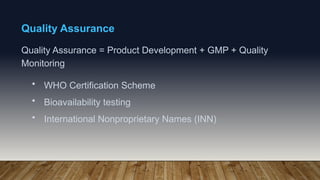
Quality Assurance
Quality Assurance = Product Development + GMP + Quality
Monitoring
• WHO Certification Scheme
• Bioavailability testing
• International Nonproprietary Names (INN)
Rational Use of Drugs - WHO Definition
"Patients receive medications appropriate to their clinical needs, in
doses that meet their individual requirements, for adequate time, at
lowest cost"
Global Problem of Irrational Drug Use
• Over 50% of medicines prescribed inappropriately
• 50% of patients fail to take them correctly
• Results in wastage and health hazards
Examples of Irrational Drug Use
• Polypharmacy (too many drugs per patient)
• Inappropriate use of antimicrobials
• Overuse of injections
• Inappropriate self-medication
Commonly Misused Drugs - Antibiotics
• Penicillins - Prescribed for common cold
• Amoxicillin - Overused in children
• Ciprofloxacin - Without proper indication
• Not completing full course of treatment
Commonly Misused Drugs - Analgesics
• Aspirin - Overdose leads to ulceration
• Ibuprofen - Commonly misused for pain
• Diclofenac - Misused for minor ailments
• Nimesulide - Frequently used inappropriately
WHO 12 Key Interventions (Part 1)
• Multidisciplinary national body
• Use of clinical guidelines
• National Essential Medicines List
• Drug & therapeutics committees
WHO 12 Key Interventions (Part 2)
• Problem-based pharmacotherapy training
• Continuing medical education
• Supervision, audit, and feedback
• Independent information on medicines
WHO 12 Key Interventions (Part 3)
• Public education about medicines
• Avoid perverse financial incentives
• Appropriate and enforced regulation
• Sufficient government expenditure
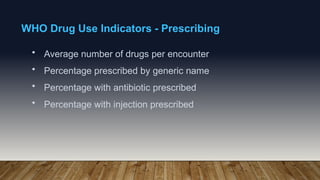
WHO Drug Use Indicators - Prescribing
• Average number of drugs per encounter
• Percentage prescribed by generic name
• Percentage with antibiotic prescribed
• Percentage with injection prescribed
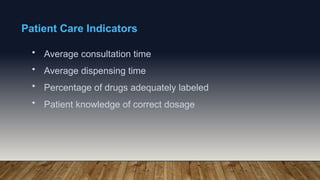
Patient Care Indicators
• Average consultation time
• Average dispensing time
• Percentage of drugs adequately labeled
• Patient knowledge of correct dosage
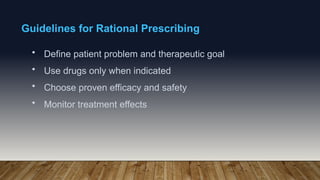
Guidelines for Rational Prescribing
• Define patient problem and therapeutic goal
• Use drugs only when indicated
• Choose proven efficacy and safety
• Monitor treatment effects
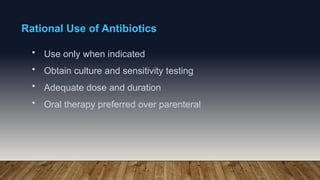
Rational Use of Antibiotics
• Use only when indicated
• Obtain culture and sensitivity testing
• Adequate dose and duration
• Oral therapy preferred over parenteral
Role of Pharmacist in Rational Drug Use
• Member of Drug & Therapeutic Committee
• Drug procurement and storage
• Dispensing and patient education
• Drug information service
Pharmacist Role in Dispensing (Part 1)
• Keep controlled drugs in locked cabinet
• Check prescription validity and patient identity
• Consult prescriber if doubt exists
• Properly label containers
Pharmacist Role in Dispensing (Part 2)
• Provide complete drug information
• Include cautions and warnings
• Give clear directions for use
• Ensure patient understanding
Pharmaceutical Care Services
• Patient medication counseling
• ADR reporting and management
• Drug therapy monitoring
• Drug utilization evaluation
Educational Activities
• Educational workshops for healthcare professionals
• Standard treatment guidelines preparation
• Formulary development
• Public education programs
Thank You!

Unit-5 Introduction To Rational Drug Use

  • 1.
    Introduction to RationalUse of Drugs and Role of Pharmacist
  • 2.
    Essential Drugs "Drugs thatsatisfy the health care needs of majority of population" • Available always in adequate amounts • Appropriate dosage forms • Accessible at affordable cost
  • 3.
    National Drug RegulatoryFramework • Establish National Drug Regulatory Authority • Form National Drug & Therapeutic Committee (NDTC) • Use generic names for all drugs • Provide comprehensive drug information booklet
  • 4.
    Quality Assurance Quality Assurance= Product Development + GMP + Quality Monitoring • WHO Certification Scheme • Bioavailability testing • International Nonproprietary Names (INN)
  • 5.
    Rational Use ofDrugs - WHO Definition "Patients receive medications appropriate to their clinical needs, in doses that meet their individual requirements, for adequate time, at lowest cost"
  • 6.
    Global Problem ofIrrational Drug Use • Over 50% of medicines prescribed inappropriately • 50% of patients fail to take them correctly • Results in wastage and health hazards
  • 7.
    Examples of IrrationalDrug Use • Polypharmacy (too many drugs per patient) • Inappropriate use of antimicrobials • Overuse of injections • Inappropriate self-medication
  • 8.
    Commonly Misused Drugs- Antibiotics • Penicillins - Prescribed for common cold • Amoxicillin - Overused in children • Ciprofloxacin - Without proper indication • Not completing full course of treatment
  • 9.
    Commonly Misused Drugs- Analgesics • Aspirin - Overdose leads to ulceration • Ibuprofen - Commonly misused for pain • Diclofenac - Misused for minor ailments • Nimesulide - Frequently used inappropriately
  • 10.
    WHO 12 KeyInterventions (Part 1) • Multidisciplinary national body • Use of clinical guidelines • National Essential Medicines List • Drug & therapeutics committees
  • 11.
    WHO 12 KeyInterventions (Part 2) • Problem-based pharmacotherapy training • Continuing medical education • Supervision, audit, and feedback • Independent information on medicines
  • 12.
    WHO 12 KeyInterventions (Part 3) • Public education about medicines • Avoid perverse financial incentives • Appropriate and enforced regulation • Sufficient government expenditure
  • 13.
    WHO Drug UseIndicators - Prescribing • Average number of drugs per encounter • Percentage prescribed by generic name • Percentage with antibiotic prescribed • Percentage with injection prescribed
  • 14.
    Patient Care Indicators •Average consultation time • Average dispensing time • Percentage of drugs adequately labeled • Patient knowledge of correct dosage
  • 15.
    Guidelines for RationalPrescribing • Define patient problem and therapeutic goal • Use drugs only when indicated • Choose proven efficacy and safety • Monitor treatment effects
  • 16.
    Rational Use ofAntibiotics • Use only when indicated • Obtain culture and sensitivity testing • Adequate dose and duration • Oral therapy preferred over parenteral
  • 17.
    Role of Pharmacistin Rational Drug Use • Member of Drug & Therapeutic Committee • Drug procurement and storage • Dispensing and patient education • Drug information service
  • 18.
    Pharmacist Role inDispensing (Part 1) • Keep controlled drugs in locked cabinet • Check prescription validity and patient identity • Consult prescriber if doubt exists • Properly label containers
  • 19.
    Pharmacist Role inDispensing (Part 2) • Provide complete drug information • Include cautions and warnings • Give clear directions for use • Ensure patient understanding
  • 20.
    Pharmaceutical Care Services •Patient medication counseling • ADR reporting and management • Drug therapy monitoring • Drug utilization evaluation
  • 21.
    Educational Activities • Educationalworkshops for healthcare professionals • Standard treatment guidelines preparation • Formulary development • Public education programs
  • 22.