Polarizing lenses
kamal thakur
2nd year bsc opto
Polarizing lenses
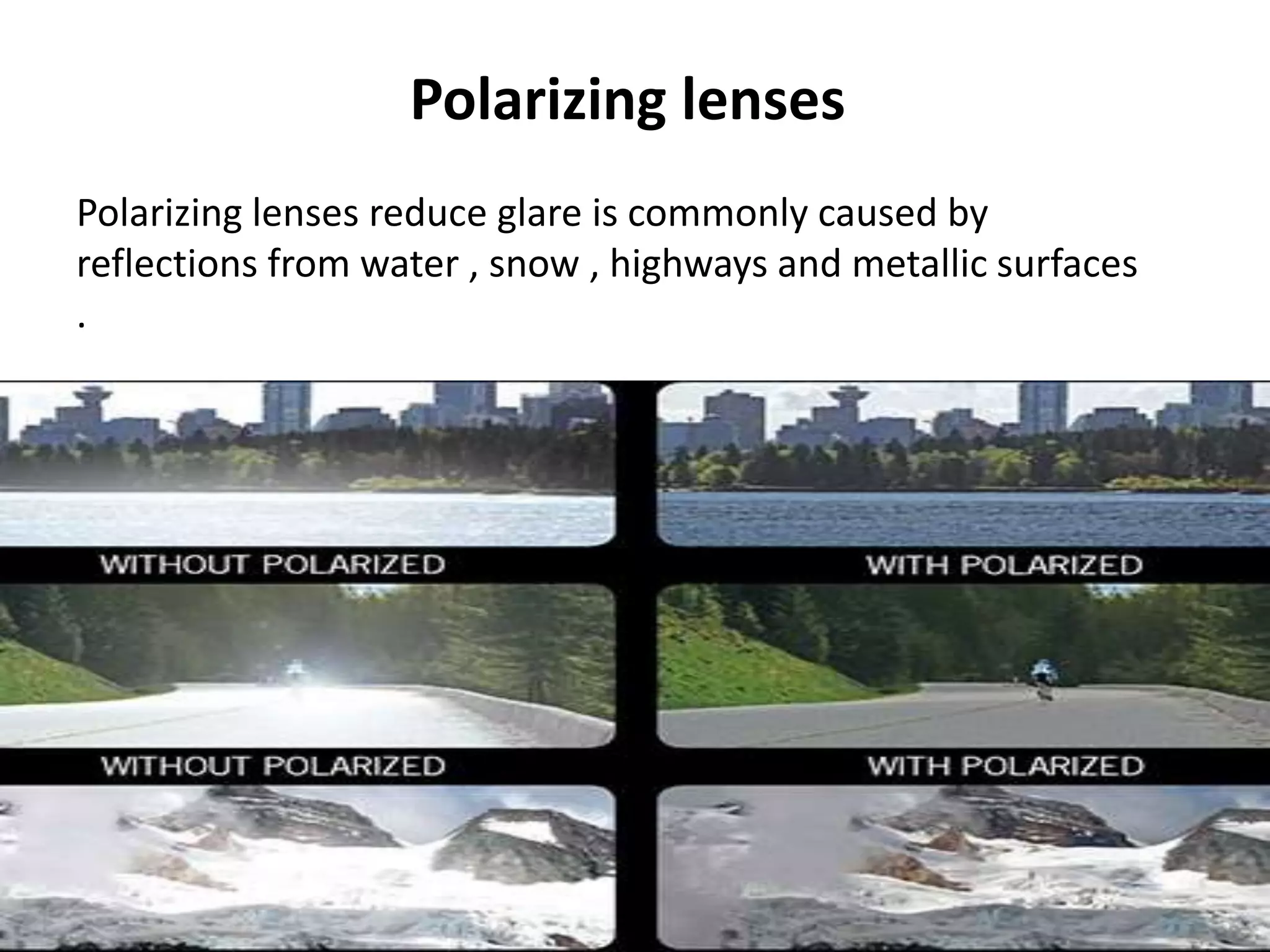
Polarizing lenses reduce glare is commonly caused by
reflections from water , snow , highways and metallic surfaces
.
•They reduce light transmission
•They reduce reflected glare
•They increase contrast sensitivity
How polarizing lenses work
• Light reflected from surfaces such as a flat road or
smooth water generally is horizontally polarized ,
instead of light being scattered in all directions .
Reflected light generally travels in a more
horizontally oriented direction.
Polarized lenses contain a special filter
that blocks this type of intense reflected light ,
reducing glare.
• When light strikes a horizontal reflecting
surface , it becomes partially polarized with
the major direction of vibration being in the
horizontal plane .
• If light strikes the surface of a refracting
material , such as water or glass , most of the
light will be refracted as it strikes the surface
of the water and go on into the water. The rest
of the light will be reflected . There is an angle
of incidence of the light striking a surface
where all of reflected light will be polarized .
This angle is called Brewster,s angle.
Brewster,s angle
When light strikes a refracting surface , most light is refracted into the
media , and some is reflected . The reflected light is partially polarized until
it reaches a certain angle when it is completely polarized . This angle is
where the reflected light and the refracted light are at right angle to one
another. This angle is called brewster,s angle.
Manufacturing of polarized lenses
A filter that absorbs the horizontally vibrating
components of light would be useful . Such a
filter is available for ophthalmic use and is made
from a sheet of PVA (polyvinyl acetate).
The PVA is first stretched to five
times its normal length in one direction . Then
dipped in iodine . The iodine is absorbed into the
chains of molecules in PVA . These darkened lines
create the polarizing filter .
The filter may be “sandwiched” between two
layers of Cellulose Acetate Butyrate (CAB) .
This is how thin , plano polarizing
lenses are made.
For prescription lenses , the
polarizing sheet is mounted between hard
resin or polycarbonate material . Alternately ,
it can be mounted on one layer of cellulose
acetate butyrate material and molded directly
into a plastic lens casting process.
If the polarizing lens is not oriented along 180-
degree meridian , not all horizontally polarized
light will be absorbed . And if a person is
wearing a polarizing filter and tilts his head to
one side , the filter will not absorb as much of
the horizontally polarized light .
Advantages
• Decreased driving fatigue specially during day
time.
• Fisherman can see more with polarizing
lenses because it not only removes reflected
or discomfort glare but enables the wearer to
see below the surface.
• Comfort at the beach is increased because
sand and water are both source of polarized
glare marking these lenses especially
appropriate.
• Color is not bleached.
Bright snowy rays are not blinding when
viewed with polarizing lenses .
• Polarizing lenses are good alternative to
sunglasses because they inhibit U.V radiation.
Application
Polarizing lenses are made in most lens style-
not just single vision lenses , but bifocal ,
trifocals and progressive addition lenses as
well.
they are available in glass , photochromic
glass , plastic , photochromic plastic ,
polycarbonate and HI plastic.
Methods for demonstrating polarizing
lenses
• It is possible to take two Plano polarizing
lenses and by holding one before the other
with their polarizing axis crossed at 900
eliminate all incoming visible light rays .
• Can be demonstrated by showing a glossy
magazine .
Polarized  lenses

Polarized lenses

  • 1.
  • 2.
    Polarizing lenses Polarizing lensesreduce glare is commonly caused by reflections from water , snow , highways and metallic surfaces .
  • 3.
    •They reduce lighttransmission •They reduce reflected glare •They increase contrast sensitivity
  • 4.
    How polarizing lenseswork • Light reflected from surfaces such as a flat road or smooth water generally is horizontally polarized , instead of light being scattered in all directions . Reflected light generally travels in a more horizontally oriented direction. Polarized lenses contain a special filter that blocks this type of intense reflected light , reducing glare.
  • 5.
    • When lightstrikes a horizontal reflecting surface , it becomes partially polarized with the major direction of vibration being in the horizontal plane . • If light strikes the surface of a refracting material , such as water or glass , most of the light will be refracted as it strikes the surface of the water and go on into the water. The rest of the light will be reflected . There is an angle of incidence of the light striking a surface where all of reflected light will be polarized . This angle is called Brewster,s angle.
  • 6.
    Brewster,s angle When lightstrikes a refracting surface , most light is refracted into the media , and some is reflected . The reflected light is partially polarized until it reaches a certain angle when it is completely polarized . This angle is where the reflected light and the refracted light are at right angle to one another. This angle is called brewster,s angle.
  • 7.
    Manufacturing of polarizedlenses A filter that absorbs the horizontally vibrating components of light would be useful . Such a filter is available for ophthalmic use and is made from a sheet of PVA (polyvinyl acetate). The PVA is first stretched to five times its normal length in one direction . Then dipped in iodine . The iodine is absorbed into the chains of molecules in PVA . These darkened lines create the polarizing filter .
  • 8.
    The filter maybe “sandwiched” between two layers of Cellulose Acetate Butyrate (CAB) . This is how thin , plano polarizing lenses are made. For prescription lenses , the polarizing sheet is mounted between hard resin or polycarbonate material . Alternately , it can be mounted on one layer of cellulose acetate butyrate material and molded directly into a plastic lens casting process.
  • 9.
    If the polarizinglens is not oriented along 180- degree meridian , not all horizontally polarized light will be absorbed . And if a person is wearing a polarizing filter and tilts his head to one side , the filter will not absorb as much of the horizontally polarized light .
  • 10.
    Advantages • Decreased drivingfatigue specially during day time. • Fisherman can see more with polarizing lenses because it not only removes reflected or discomfort glare but enables the wearer to see below the surface.
  • 13.
    • Comfort atthe beach is increased because sand and water are both source of polarized glare marking these lenses especially appropriate. • Color is not bleached.
  • 14.
    Bright snowy raysare not blinding when viewed with polarizing lenses .
  • 15.
    • Polarizing lensesare good alternative to sunglasses because they inhibit U.V radiation.
  • 16.
    Application Polarizing lenses aremade in most lens style- not just single vision lenses , but bifocal , trifocals and progressive addition lenses as well. they are available in glass , photochromic glass , plastic , photochromic plastic , polycarbonate and HI plastic.
  • 17.
    Methods for demonstratingpolarizing lenses • It is possible to take two Plano polarizing lenses and by holding one before the other with their polarizing axis crossed at 900 eliminate all incoming visible light rays . • Can be demonstrated by showing a glossy magazine .