5 - 1
CHAPTER 5
Risk and Return: Portfolio Theory and
Asset Pricing Models
 Portfolio Theory
 Capital Asset Pricing Model (CAPM)
Efficient frontier
Capital Market Line (CML)
Security Market Line (SML)
Beta calculation
 Arbitrage pricing theory
 Fama-French 3-factor model
5 - 2
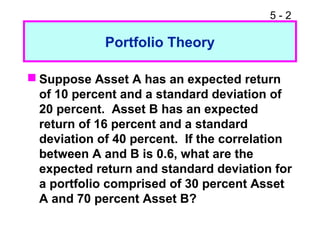
Portfolio Theory
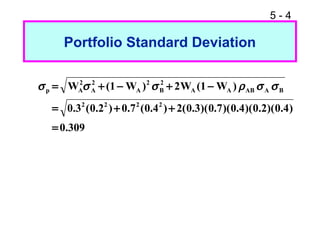
 Suppose Asset A has an expected return
of 10 percent and a standard deviation of
20 percent. Asset B has an expected
return of 16 percent and a standard
deviation of 40 percent. If the correlation
between A and B is 0.6, what are the
expected return and standard deviation for
a portfolio comprised of 30 percent Asset
A and 70 percent Asset B?
5 - 3
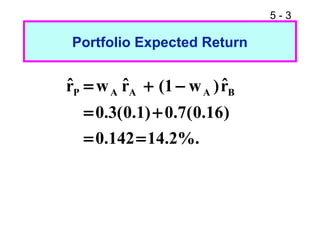
Portfolio Expected Return
%.2.14142.0
)16.0(7.0)1.0(3.0
rˆ)w1(rˆwrˆ BAAAP
==
+=
−+=
5 - 4
Portfolio Standard Deviation
309.0
)4.0)(2.0)(4.0)(7.0)(3.0(2)4.0(7.0)2.0(3.0
)W1(W2)W1(W
2222
BAABAA
2
B
2
A
2
A
2
Ap
=
++=
−+−+= σσρσσσ
5 - 5
Attainable Portfolios: ρAB = 0.4
ρAB = +0.4: Attainable Set of
Risk/Return Combinations
0%
5%
10%
15%
20%
0% 10% 20% 30% 40%
Risk, σp
Expectedreturn
5 - 6
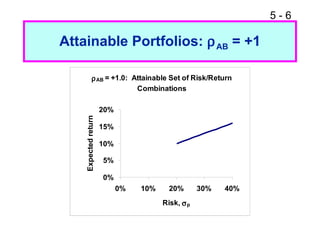
Attainable Portfolios: ρAB = +1
ρAB = +1.0: Attainable Set of Risk/Return
Combinations
0%
5%
10%
15%
20%
0% 10% 20% 30% 40%
Risk, σp
Expectedreturn
5 - 7
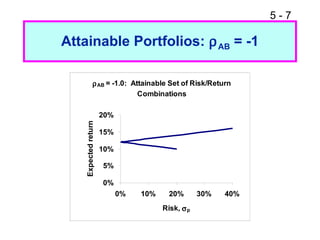
Attainable Portfolios: ρAB = -1
ρAB = -1.0: Attainable Set of Risk/Return
Combinations
0%
5%
10%
15%
20%
0% 10% 20% 30% 40%
Risk, σp
Expectedreturn
5 - 8
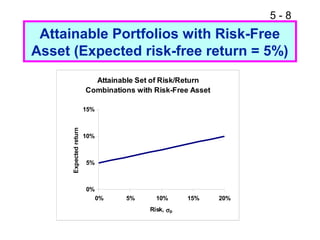
Attainable Portfolios with Risk-Free
Asset (Expected risk-free return = 5%)
Attainable Set of Risk/Return
Combinations with Risk-Free Asset
0%
5%
10%
15%
0% 5% 10% 15% 20%
Risk, σp
Expectedreturn
5 - 9
Expected
Portfolio
Return, rp
Risk, σp
Efficient Set
Feasible Set
Feasible and Efficient Portfolios
5 - 10
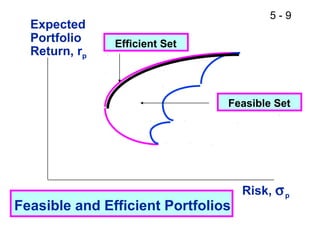
The feasible set of portfolios represents
all portfolios that can be constructed
from a given set of stocks.
An efficient portfolio is one that offers:
the most return for a given amount of risk,
or
the least risk for a give amount of return.
The collection of efficient portfolios is
called the efficient set or efficient
frontier.
5 - 11
IB2 IB1
IA2
IA1
Optimal Portfolio
Investor A
Optimal
Portfolio
Investor B
Risk σp
Expected
Return, rp
Optimal Portfolios
5 - 12
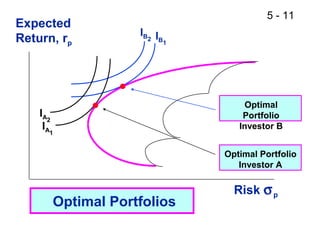
Indifference curves reflect an
investor’s attitude toward risk as
reflected in his or her risk/return
tradeoff function. They differ
among investors because of
differences in risk aversion.
An investor’s optimal portfolio is
defined by the tangency point
between the efficient set and the
investor’s indifference curve.
5 - 13
What is the CAPM?
The CAPM is an equilibrium model
that specifies the relationship
between risk and required rate of
return for assets held in well-
diversified portfolios.
It is based on the premise that only
one factor affects risk.
What is that factor?
5 - 14
 Investors all think in terms of
a single holding period.
 All investors have identical expectations.
 Investors can borrow or lend unlimited
amounts at the risk-free rate.
What are the assumptions
of the CAPM?
(More...)
5 - 15
 All assets are perfectly divisible.
 There are no taxes and no transactions
costs.
 All investors are price takers, that is,
investors’ buying and selling won’t
influence stock prices.
 Quantities of all assets are given and
fixed.
5 - 16
 When a risk-free asset is added to the
feasible set, investors can create
portfolios that combine this asset with a
portfolio of risky assets.
 The straight line connecting rRF with M, the
tangency point between the line and the
old efficient set, becomes the new efficient
frontier.
What impact does rRF have on
the efficient frontier?
5 - 17
M
Z
.A
rRF
σM Risk, σp
Efficient Set with a Risk-Free Asset
The Capital Market
Line (CML):
New Efficient Set
.
.B
rM
^
Expected
Return, rp
5 - 18
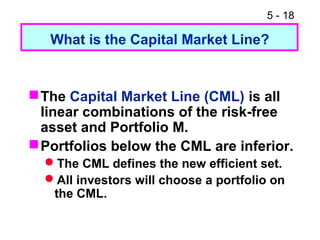
The Capital Market Line (CML) is all
linear combinations of the risk-free
asset and Portfolio M.
Portfolios below the CML are inferior.
The CML defines the new efficient set.
All investors will choose a portfolio on
the CML.
What is the Capital Market Line?
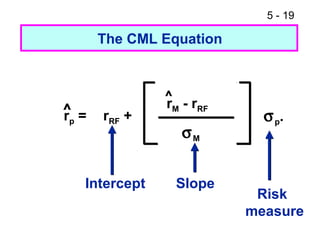
5 - 19
rp = rRF +
SlopeIntercept
^ σp.
The CML Equation
rM - rRF
^
σM
Risk
measure
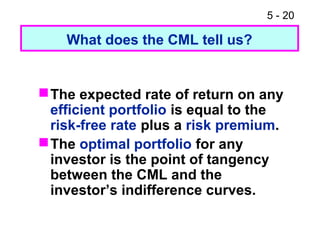
5 - 20
The expected rate of return on any
efficient portfolio is equal to the
risk-free rate plus a risk premium.
The optimal portfolio for any
investor is the point of tangency
between the CML and the
investor’s indifference curves.
What does the CML tell us?
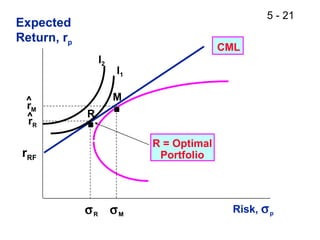
5 - 21
rRF
σM
Risk, σp
I1
I2
CML
R = Optimal
Portfolio
.R
.M
rR
rM
σR
^
^
Expected
Return, rp
5 - 22
The CML gives the risk/return
relationship for efficient portfolios.
The Security Market Line (SML), also
part of the CAPM, gives the risk/return
relationship for individual stocks.
What is the Security Market Line (SML)?
5 - 23
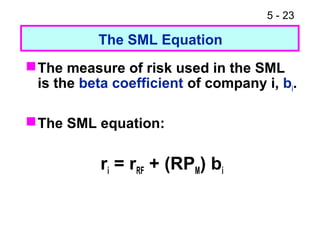
The measure of risk used in the SML
is the beta coefficient of company i, bi.
The SML equation:
ri = rRF + (RPM) bi
The SML Equation
5 - 24
Run a regression line of past
returns on Stock i versus returns
on the market.
The regression line is called the
characteristic line.
The slope coefficient of the
characteristic line is defined as the
beta coefficient.
How are betas calculated?
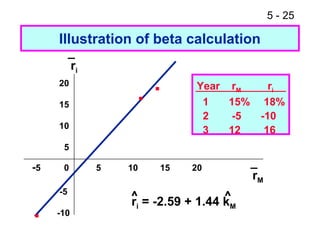
5 - 25
Illustration of beta calculation
Year rM ri
1 15% 18%
2 -5 -10
3 12 16
ri
_
rM
_-5 0 5 10 15 20
20
15
10
5
-5
-10
.
.
.
ri = -2.59 + 1.44 kM
^ ^
5 - 26
(More...)
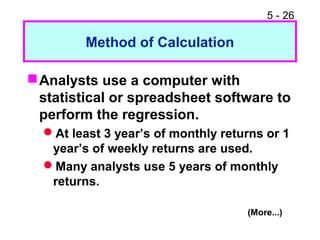
Method of Calculation
Analysts use a computer with
statistical or spreadsheet software to
perform the regression.
At least 3 year’s of monthly returns or 1
year’s of weekly returns are used.
Many analysts use 5 years of monthly
returns.
5 - 27
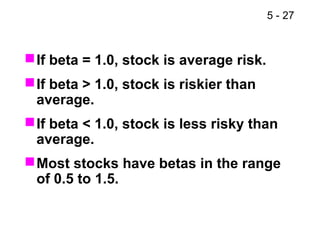
If beta = 1.0, stock is average risk.
If beta > 1.0, stock is riskier than
average.
If beta < 1.0, stock is less risky than
average.
Most stocks have betas in the range
of 0.5 to 1.5.
5 - 28
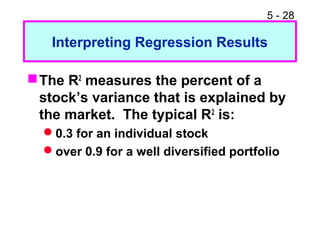
Interpreting Regression Results
The R2
measures the percent of a
stock’s variance that is explained by
the market. The typical R2
is:
0.3 for an individual stock
over 0.9 for a well diversified portfolio
5 - 29
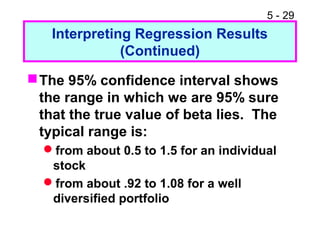
Interpreting Regression Results
(Continued)
The 95% confidence interval shows
the range in which we are 95% sure
that the true value of beta lies. The
typical range is:
from about 0.5 to 1.5 for an individual
stock
from about .92 to 1.08 for a well
diversified portfolio
5 - 30
σ2
= b2
σ2
+ σe
2
.
σ2
= variance
= stand-alone risk of Stock j.
b2
σ2
= market risk of Stock j.
σe
2 = variance of error term
= diversifiable risk of Stock
j.
What is the relationship between stand-
alone, market, and diversifiable risk.
j j M j
j
j
j M
5 - 31
Beta stability tests
Tests based on the slope
of the SML
What are two potential tests that can
be conducted to verify the CAPM?
5 - 32
Tests of the SML indicate:
A more-or-less linear relationship
between realized returns and market
risk.
Slope is less than predicted.
Irrelevance of diversifiable risk
specified in the CAPM model can be
questioned.
(More...)
5 - 33
Betas of individual securities are not
good estimators of future risk.
Betas of portfolios of 10 or more
randomly selected stocks are
reasonably stable.
Past portfolio betas are good
estimates of future portfolio
volatility.
5 - 34
Yes.
Richard Roll questioned whether it
was even conceptually possible to test
the CAPM.
Roll showed that it is virtually
impossible to prove investors behave
in accordance with CAPM theory.
Are there problems with the
CAPM tests?
5 - 35
It is impossible to verify.
Recent studies have questioned its
validity.
Investors seem to be concerned with
both market risk and stand-alone
risk. Therefore, the SML may not
produce a correct estimate of ri.
What are our conclusions
regarding the CAPM?
(More...)
5 - 36
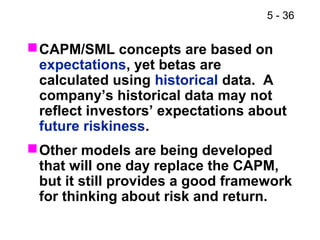
CAPM/SML concepts are based on
expectations, yet betas are
calculated using historical data. A
company’s historical data may not
reflect investors’ expectations about
future riskiness.
Other models are being developed
that will one day replace the CAPM,
but it still provides a good framework
for thinking about risk and return.
5 - 37
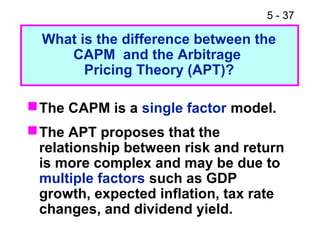
The CAPM is a single factor model.
The APT proposes that the
relationship between risk and return
is more complex and may be due to
multiple factors such as GDP
growth, expected inflation, tax rate
changes, and dividend yield.
What is the difference between the
CAPM and the Arbitrage
Pricing Theory (APT)?
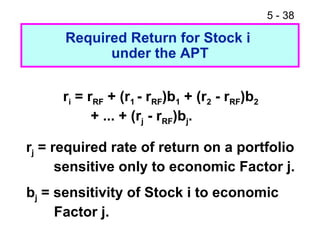
5 - 38
ri = rRF + (r1 - rRF)b1 + (r2 - rRF)b2
+ ... + (rj - rRF)bj.
bj = sensitivity of Stock i to economic
Factor j.
rj = required rate of return on a portfolio
sensitive only to economic Factor j.
Required Return for Stock i
under the APT
5 - 39
The APT is being used for some real
world applications.
Its acceptance has been slow because
the model does not specify what
factors influence stock returns.
More research on risk and return
models is needed to find a model that
is theoretically sound, empirically
verified, and easy to use.
What is the status of the APT?
5 - 40
Fama-French 3-Factor Model
Fama and French propose three
factors:
The excess market return, rM-rRF.
the return on, S, a portfolio of small
firms (where size is based on the market
value of equity) minus the return on B, a
portfolio of big firms. This return is
called rSMB, for S minus B.
5 - 41
Fama-French 3-Factor Model
(Continued)
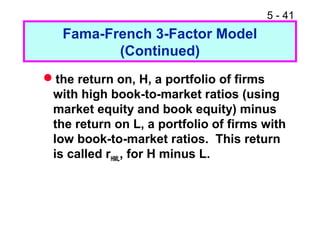
the return on, H, a portfolio of firms
with high book-to-market ratios (using
market equity and book equity) minus
the return on L, a portfolio of firms with
low book-to-market ratios. This return
is called rHML, for H minus L.
5 - 42
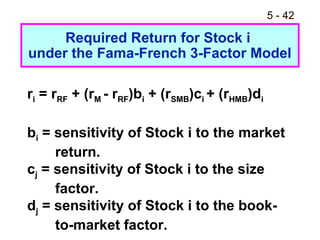
ri = rRF + (rM - rRF)bi + (rSMB)ci + (rHMB)di
bi = sensitivity of Stock i to the market
return.
cj = sensitivity of Stock i to the size
factor.
dj = sensitivity of Stock i to the book-
to-market factor.
Required Return for Stock i
under the Fama-French 3-Factor Model
5 - 43
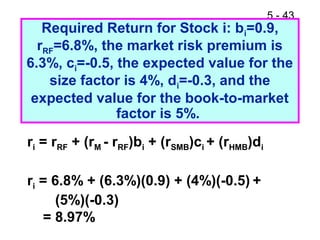
ri = rRF + (rM - rRF)bi + (rSMB)ci + (rHMB)di
ri = 6.8% + (6.3%)(0.9) + (4%)(-0.5) +
(5%)(-0.3)
= 8.97%
Required Return for Stock i: bi=0.9,
rRF=6.8%, the market risk premium is
6.3%, ci=-0.5, the expected value for the
size factor is 4%, di=-0.3, and the
expected value for the book-to-market
factor is 5%.
5 - 44
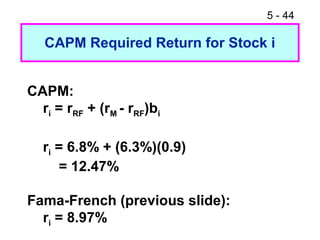
CAPM:
ri = rRF + (rM - rRF)bi
ri = 6.8% + (6.3%)(0.9)
= 12.47%
Fama-French (previous slide):
ri = 8.97%
CAPM Required Return for Stock i

Fm11 ch 05 show

  • 1.
    5 - 1 CHAPTER5 Risk and Return: Portfolio Theory and Asset Pricing Models  Portfolio Theory  Capital Asset Pricing Model (CAPM) Efficient frontier Capital Market Line (CML) Security Market Line (SML) Beta calculation  Arbitrage pricing theory  Fama-French 3-factor model
  • 2.
    5 - 2 PortfolioTheory  Suppose Asset A has an expected return of 10 percent and a standard deviation of 20 percent. Asset B has an expected return of 16 percent and a standard deviation of 40 percent. If the correlation between A and B is 0.6, what are the expected return and standard deviation for a portfolio comprised of 30 percent Asset A and 70 percent Asset B?
  • 3.
    5 - 3 PortfolioExpected Return %.2.14142.0 )16.0(7.0)1.0(3.0 rˆ)w1(rˆwrˆ BAAAP == += −+=
  • 4.
    5 - 4 PortfolioStandard Deviation 309.0 )4.0)(2.0)(4.0)(7.0)(3.0(2)4.0(7.0)2.0(3.0 )W1(W2)W1(W 2222 BAABAA 2 B 2 A 2 A 2 Ap = ++= −+−+= σσρσσσ
  • 5.
    5 - 5 AttainablePortfolios: ρAB = 0.4 ρAB = +0.4: Attainable Set of Risk/Return Combinations 0% 5% 10% 15% 20% 0% 10% 20% 30% 40% Risk, σp Expectedreturn
  • 6.
    5 - 6 AttainablePortfolios: ρAB = +1 ρAB = +1.0: Attainable Set of Risk/Return Combinations 0% 5% 10% 15% 20% 0% 10% 20% 30% 40% Risk, σp Expectedreturn
  • 7.
    5 - 7 AttainablePortfolios: ρAB = -1 ρAB = -1.0: Attainable Set of Risk/Return Combinations 0% 5% 10% 15% 20% 0% 10% 20% 30% 40% Risk, σp Expectedreturn
  • 8.
    5 - 8 AttainablePortfolios with Risk-Free Asset (Expected risk-free return = 5%) Attainable Set of Risk/Return Combinations with Risk-Free Asset 0% 5% 10% 15% 0% 5% 10% 15% 20% Risk, σp Expectedreturn
  • 9.
    5 - 9 Expected Portfolio Return,rp Risk, σp Efficient Set Feasible Set Feasible and Efficient Portfolios
  • 10.
    5 - 10 Thefeasible set of portfolios represents all portfolios that can be constructed from a given set of stocks. An efficient portfolio is one that offers: the most return for a given amount of risk, or the least risk for a give amount of return. The collection of efficient portfolios is called the efficient set or efficient frontier.
  • 11.
    5 - 11 IB2IB1 IA2 IA1 Optimal Portfolio Investor A Optimal Portfolio Investor B Risk σp Expected Return, rp Optimal Portfolios
  • 12.
    5 - 12 Indifferencecurves reflect an investor’s attitude toward risk as reflected in his or her risk/return tradeoff function. They differ among investors because of differences in risk aversion. An investor’s optimal portfolio is defined by the tangency point between the efficient set and the investor’s indifference curve.
  • 13.
    5 - 13 Whatis the CAPM? The CAPM is an equilibrium model that specifies the relationship between risk and required rate of return for assets held in well- diversified portfolios. It is based on the premise that only one factor affects risk. What is that factor?
  • 14.
    5 - 14 Investors all think in terms of a single holding period.  All investors have identical expectations.  Investors can borrow or lend unlimited amounts at the risk-free rate. What are the assumptions of the CAPM? (More...)
  • 15.
    5 - 15 All assets are perfectly divisible.  There are no taxes and no transactions costs.  All investors are price takers, that is, investors’ buying and selling won’t influence stock prices.  Quantities of all assets are given and fixed.
  • 16.
    5 - 16 When a risk-free asset is added to the feasible set, investors can create portfolios that combine this asset with a portfolio of risky assets.  The straight line connecting rRF with M, the tangency point between the line and the old efficient set, becomes the new efficient frontier. What impact does rRF have on the efficient frontier?
  • 17.
    5 - 17 M Z .A rRF σMRisk, σp Efficient Set with a Risk-Free Asset The Capital Market Line (CML): New Efficient Set . .B rM ^ Expected Return, rp
  • 18.
    5 - 18 TheCapital Market Line (CML) is all linear combinations of the risk-free asset and Portfolio M. Portfolios below the CML are inferior. The CML defines the new efficient set. All investors will choose a portfolio on the CML. What is the Capital Market Line?
  • 19.
    5 - 19 rp= rRF + SlopeIntercept ^ σp. The CML Equation rM - rRF ^ σM Risk measure
  • 20.
    5 - 20 Theexpected rate of return on any efficient portfolio is equal to the risk-free rate plus a risk premium. The optimal portfolio for any investor is the point of tangency between the CML and the investor’s indifference curves. What does the CML tell us?
  • 21.
    5 - 21 rRF σM Risk,σp I1 I2 CML R = Optimal Portfolio .R .M rR rM σR ^ ^ Expected Return, rp
  • 22.
    5 - 22 TheCML gives the risk/return relationship for efficient portfolios. The Security Market Line (SML), also part of the CAPM, gives the risk/return relationship for individual stocks. What is the Security Market Line (SML)?
  • 23.
    5 - 23 Themeasure of risk used in the SML is the beta coefficient of company i, bi. The SML equation: ri = rRF + (RPM) bi The SML Equation
  • 24.
    5 - 24 Runa regression line of past returns on Stock i versus returns on the market. The regression line is called the characteristic line. The slope coefficient of the characteristic line is defined as the beta coefficient. How are betas calculated?
  • 25.
    5 - 25 Illustrationof beta calculation Year rM ri 1 15% 18% 2 -5 -10 3 12 16 ri _ rM _-5 0 5 10 15 20 20 15 10 5 -5 -10 . . . ri = -2.59 + 1.44 kM ^ ^
  • 26.
    5 - 26 (More...) Methodof Calculation Analysts use a computer with statistical or spreadsheet software to perform the regression. At least 3 year’s of monthly returns or 1 year’s of weekly returns are used. Many analysts use 5 years of monthly returns.
  • 27.
    5 - 27 Ifbeta = 1.0, stock is average risk. If beta > 1.0, stock is riskier than average. If beta < 1.0, stock is less risky than average. Most stocks have betas in the range of 0.5 to 1.5.
  • 28.
    5 - 28 InterpretingRegression Results The R2 measures the percent of a stock’s variance that is explained by the market. The typical R2 is: 0.3 for an individual stock over 0.9 for a well diversified portfolio
  • 29.
    5 - 29 InterpretingRegression Results (Continued) The 95% confidence interval shows the range in which we are 95% sure that the true value of beta lies. The typical range is: from about 0.5 to 1.5 for an individual stock from about .92 to 1.08 for a well diversified portfolio
  • 30.
    5 - 30 σ2 =b2 σ2 + σe 2 . σ2 = variance = stand-alone risk of Stock j. b2 σ2 = market risk of Stock j. σe 2 = variance of error term = diversifiable risk of Stock j. What is the relationship between stand- alone, market, and diversifiable risk. j j M j j j j M
  • 31.
    5 - 31 Betastability tests Tests based on the slope of the SML What are two potential tests that can be conducted to verify the CAPM?
  • 32.
    5 - 32 Testsof the SML indicate: A more-or-less linear relationship between realized returns and market risk. Slope is less than predicted. Irrelevance of diversifiable risk specified in the CAPM model can be questioned. (More...)
  • 33.
    5 - 33 Betasof individual securities are not good estimators of future risk. Betas of portfolios of 10 or more randomly selected stocks are reasonably stable. Past portfolio betas are good estimates of future portfolio volatility.
  • 34.
    5 - 34 Yes. RichardRoll questioned whether it was even conceptually possible to test the CAPM. Roll showed that it is virtually impossible to prove investors behave in accordance with CAPM theory. Are there problems with the CAPM tests?
  • 35.
    5 - 35 Itis impossible to verify. Recent studies have questioned its validity. Investors seem to be concerned with both market risk and stand-alone risk. Therefore, the SML may not produce a correct estimate of ri. What are our conclusions regarding the CAPM? (More...)
  • 36.
    5 - 36 CAPM/SMLconcepts are based on expectations, yet betas are calculated using historical data. A company’s historical data may not reflect investors’ expectations about future riskiness. Other models are being developed that will one day replace the CAPM, but it still provides a good framework for thinking about risk and return.
  • 37.
    5 - 37 TheCAPM is a single factor model. The APT proposes that the relationship between risk and return is more complex and may be due to multiple factors such as GDP growth, expected inflation, tax rate changes, and dividend yield. What is the difference between the CAPM and the Arbitrage Pricing Theory (APT)?
  • 38.
    5 - 38 ri= rRF + (r1 - rRF)b1 + (r2 - rRF)b2 + ... + (rj - rRF)bj. bj = sensitivity of Stock i to economic Factor j. rj = required rate of return on a portfolio sensitive only to economic Factor j. Required Return for Stock i under the APT
  • 39.
    5 - 39 TheAPT is being used for some real world applications. Its acceptance has been slow because the model does not specify what factors influence stock returns. More research on risk and return models is needed to find a model that is theoretically sound, empirically verified, and easy to use. What is the status of the APT?
  • 40.
    5 - 40 Fama-French3-Factor Model Fama and French propose three factors: The excess market return, rM-rRF. the return on, S, a portfolio of small firms (where size is based on the market value of equity) minus the return on B, a portfolio of big firms. This return is called rSMB, for S minus B.
  • 41.
    5 - 41 Fama-French3-Factor Model (Continued) the return on, H, a portfolio of firms with high book-to-market ratios (using market equity and book equity) minus the return on L, a portfolio of firms with low book-to-market ratios. This return is called rHML, for H minus L.
  • 42.
    5 - 42 ri= rRF + (rM - rRF)bi + (rSMB)ci + (rHMB)di bi = sensitivity of Stock i to the market return. cj = sensitivity of Stock i to the size factor. dj = sensitivity of Stock i to the book- to-market factor. Required Return for Stock i under the Fama-French 3-Factor Model
  • 43.
    5 - 43 ri= rRF + (rM - rRF)bi + (rSMB)ci + (rHMB)di ri = 6.8% + (6.3%)(0.9) + (4%)(-0.5) + (5%)(-0.3) = 8.97% Required Return for Stock i: bi=0.9, rRF=6.8%, the market risk premium is 6.3%, ci=-0.5, the expected value for the size factor is 4%, di=-0.3, and the expected value for the book-to-market factor is 5%.
  • 44.
    5 - 44 CAPM: ri= rRF + (rM - rRF)bi ri = 6.8% + (6.3%)(0.9) = 12.47% Fama-French (previous slide): ri = 8.97% CAPM Required Return for Stock i