Presented by:
Arpit Agarwal
Heena Banka
Pooja Chandak
overview
 About CAPM
 Assumptions of CAPM
 Market Efficiency
 Advantages of CAPM
 Disadvantages of CAPM
 Conclusion
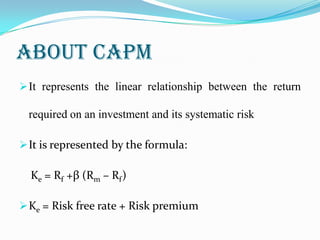
ABOUT CAPM
It represents the linear relationship between the return
required on an investment and its systematic risk
It is represented by the formula:
Ke = Rf +β (Rm – Rf)
Ke = Risk free rate + Risk premium
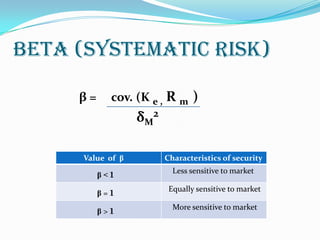
BETA (SYSTEMATIC RISK)
β = cov. (K e , R m )
δM
2
Value of β Characteristics of security
β < 1 Less sensitive to market
β = 1 Equally sensitive to market
β > 1 More sensitive to market
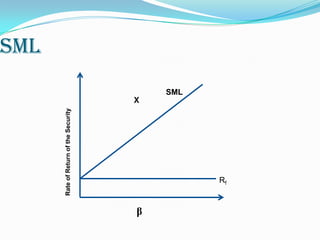
SML
Rf
β
RateofReturnoftheSecurity
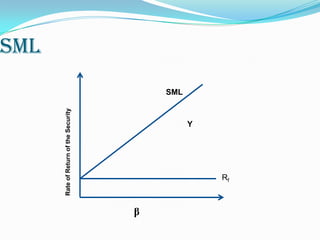
SML
X
SML
Rf
β
RateofReturnoftheSecurity
SML
Y
ASSUMPTIONS OF CAPM
Investors hold diversified portfolios
Single-period transaction horizon
Investors can borrow and lend at the risk-free rate of
return
Perfect capital market
MARKET EFFICIENCY
Market efficiency has varying degrees:
 Weak efficiency
 Semi-strong
 Strong
WEAK EFFICIENCY
No investor can earn excess returns by developing
trading rules based solely on historical price or return
information
SEMI-STRONG EFFICIENCY
No investor can earn excess returns from using trading
rules based on any publicly available information
STRONG EFFICIENCY
No investor can earn excess returns using any
information whether publicly available or not
ADVANTAGES OF CAPM
 It considers only systematic risk, reflecting a reality in
which most investors have diversified portfolios from
which unsystematic risk has been essentially eliminated
 It generates a theoretically-derived relationship between
required return and systematic risk which has been
subject to frequent empirical research and testing
 It is generally seen as a much better method of
calculating the cost of equity than the dividend growth
model (DGM) in that it explicitly takes into account a
company’s level of systematic risk relative to the stock
market as a whole
Disadvantages
 The model assumes that asset returns are (jointly)
normally distributed random variables
 The model assumes that the variance of returns is an
adequate measurement of risk
 The model does not appear to adequately explain the
variation in stock returns
 The model assumes that given a certain expected
return investors will prefer lower risk (lower variance)
to higher risk and conversely given a certain level of
risk will prefer higher returns to lower ones
Contd……
 The model assumes that all investors have access to
the same information and agree about the risk and
expected return of all assets
 The market portfolio should in theory include all
types of assets that are held by anyone as an
investment (including works of art, real estate, human
capital...)
conclusion
Research has shown the CAPM to stand up well to
criticism, although attacks against it have been
increasing in recent years. Many other models have
been developed which are used extensively these days
like Fench and Fama Model. However, the CAPM
remains a very useful item in the financial
management toolkit.
THANK YOU!!!!!!

Financial Mgt. - Capital Asset Pricing Model

  • 1.
  • 2.
    overview  About CAPM Assumptions of CAPM  Market Efficiency  Advantages of CAPM  Disadvantages of CAPM  Conclusion
  • 3.
    ABOUT CAPM It representsthe linear relationship between the return required on an investment and its systematic risk It is represented by the formula: Ke = Rf +β (Rm – Rf) Ke = Risk free rate + Risk premium
  • 4.
    BETA (SYSTEMATIC RISK) β= cov. (K e , R m ) δM 2 Value of β Characteristics of security β < 1 Less sensitive to market β = 1 Equally sensitive to market β > 1 More sensitive to market
  • 5.
  • 6.
  • 7.
    ASSUMPTIONS OF CAPM Investorshold diversified portfolios Single-period transaction horizon Investors can borrow and lend at the risk-free rate of return Perfect capital market
  • 8.
    MARKET EFFICIENCY Market efficiencyhas varying degrees:  Weak efficiency  Semi-strong  Strong
  • 9.
    WEAK EFFICIENCY No investorcan earn excess returns by developing trading rules based solely on historical price or return information
  • 10.
    SEMI-STRONG EFFICIENCY No investorcan earn excess returns from using trading rules based on any publicly available information
  • 11.
    STRONG EFFICIENCY No investorcan earn excess returns using any information whether publicly available or not
  • 12.
    ADVANTAGES OF CAPM It considers only systematic risk, reflecting a reality in which most investors have diversified portfolios from which unsystematic risk has been essentially eliminated  It generates a theoretically-derived relationship between required return and systematic risk which has been subject to frequent empirical research and testing  It is generally seen as a much better method of calculating the cost of equity than the dividend growth model (DGM) in that it explicitly takes into account a company’s level of systematic risk relative to the stock market as a whole
  • 13.
    Disadvantages  The modelassumes that asset returns are (jointly) normally distributed random variables  The model assumes that the variance of returns is an adequate measurement of risk  The model does not appear to adequately explain the variation in stock returns  The model assumes that given a certain expected return investors will prefer lower risk (lower variance) to higher risk and conversely given a certain level of risk will prefer higher returns to lower ones
  • 14.
    Contd……  The modelassumes that all investors have access to the same information and agree about the risk and expected return of all assets  The market portfolio should in theory include all types of assets that are held by anyone as an investment (including works of art, real estate, human capital...)
  • 15.
    conclusion Research has shownthe CAPM to stand up well to criticism, although attacks against it have been increasing in recent years. Many other models have been developed which are used extensively these days like Fench and Fama Model. However, the CAPM remains a very useful item in the financial management toolkit.
  • 16.