Capital Asset Pricing and
Arbitrage Pricing Theory


     Prof. Karim Mimouni
                            1
Capital Asset Pricing Model
          (CAPM)


                              2
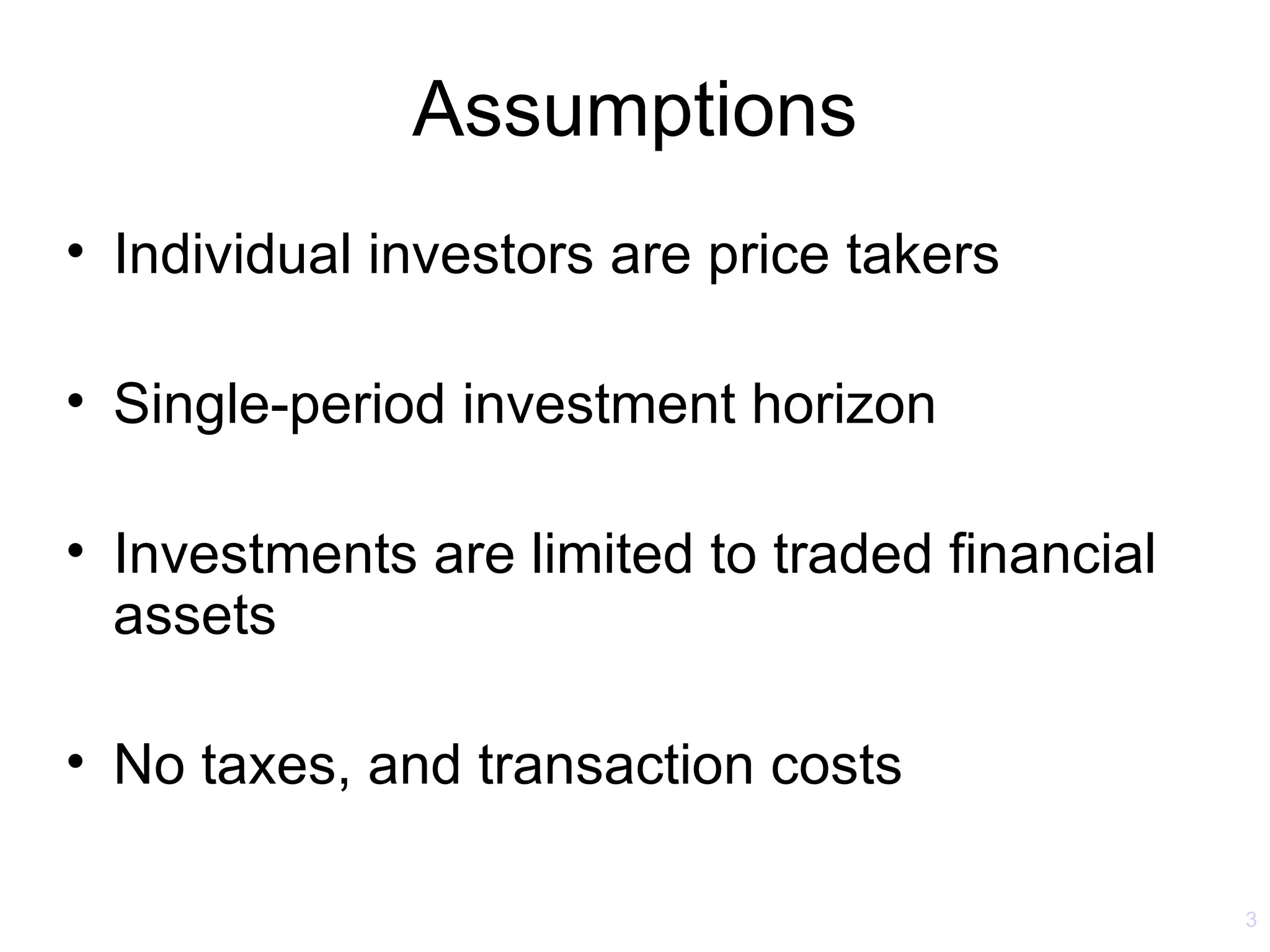
Assumptions
• Individual investors are price takers

• Single-period investment horizon

• Investments are limited to traded financial
  assets

• No taxes, and transaction costs

                                                3
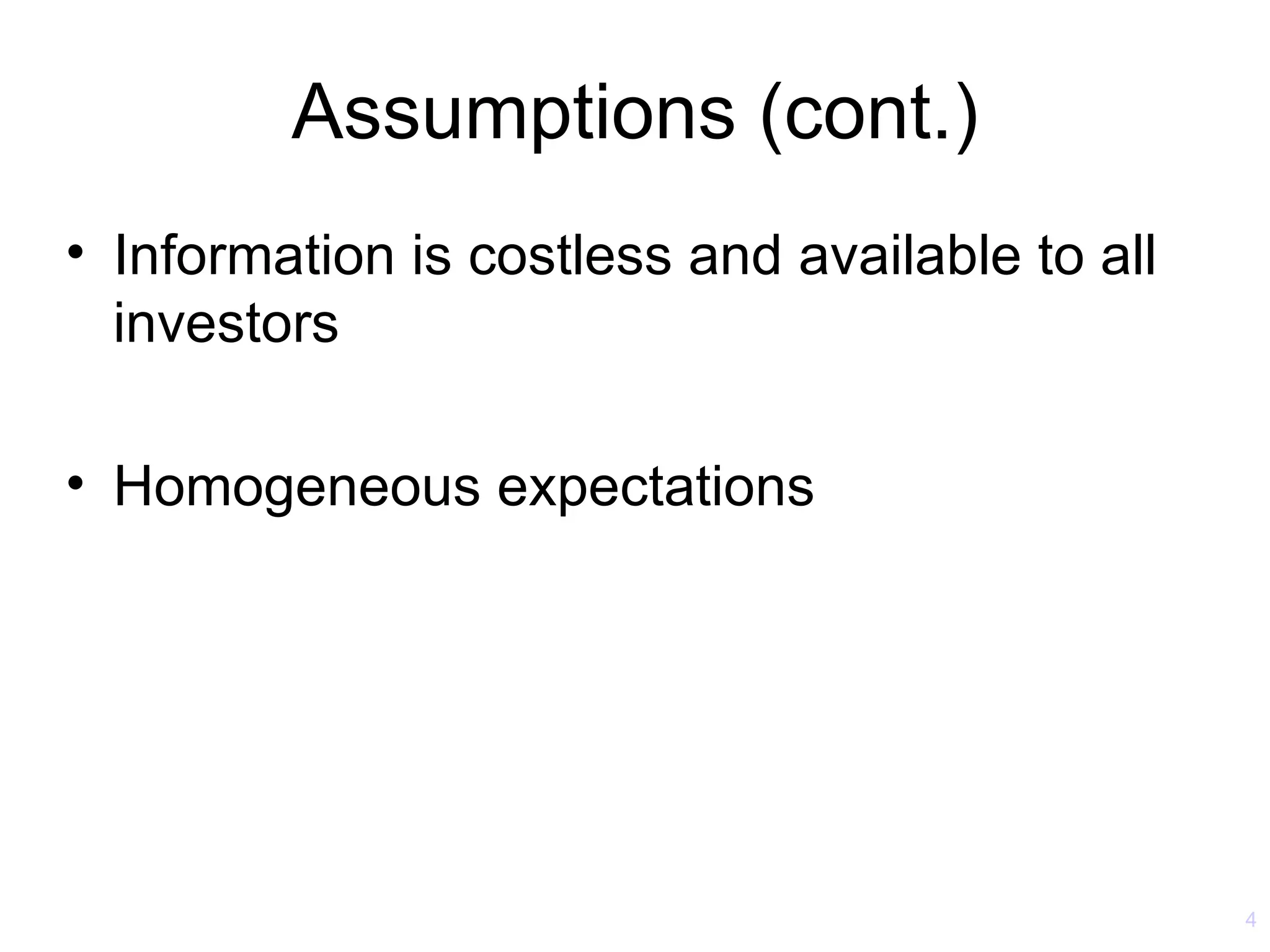
Assumptions (cont.)
• Information is costless and available to all
  investors

• Homogeneous expectations


                                                 4
Resulting Equilibrium
            Conditions
• All investors will hold the same portfolio
  for risky assets – market portfolio

• Market portfolio contains all securities
  and the proportion of each security is its
  market value as a percentage of total
  market value


                                               5
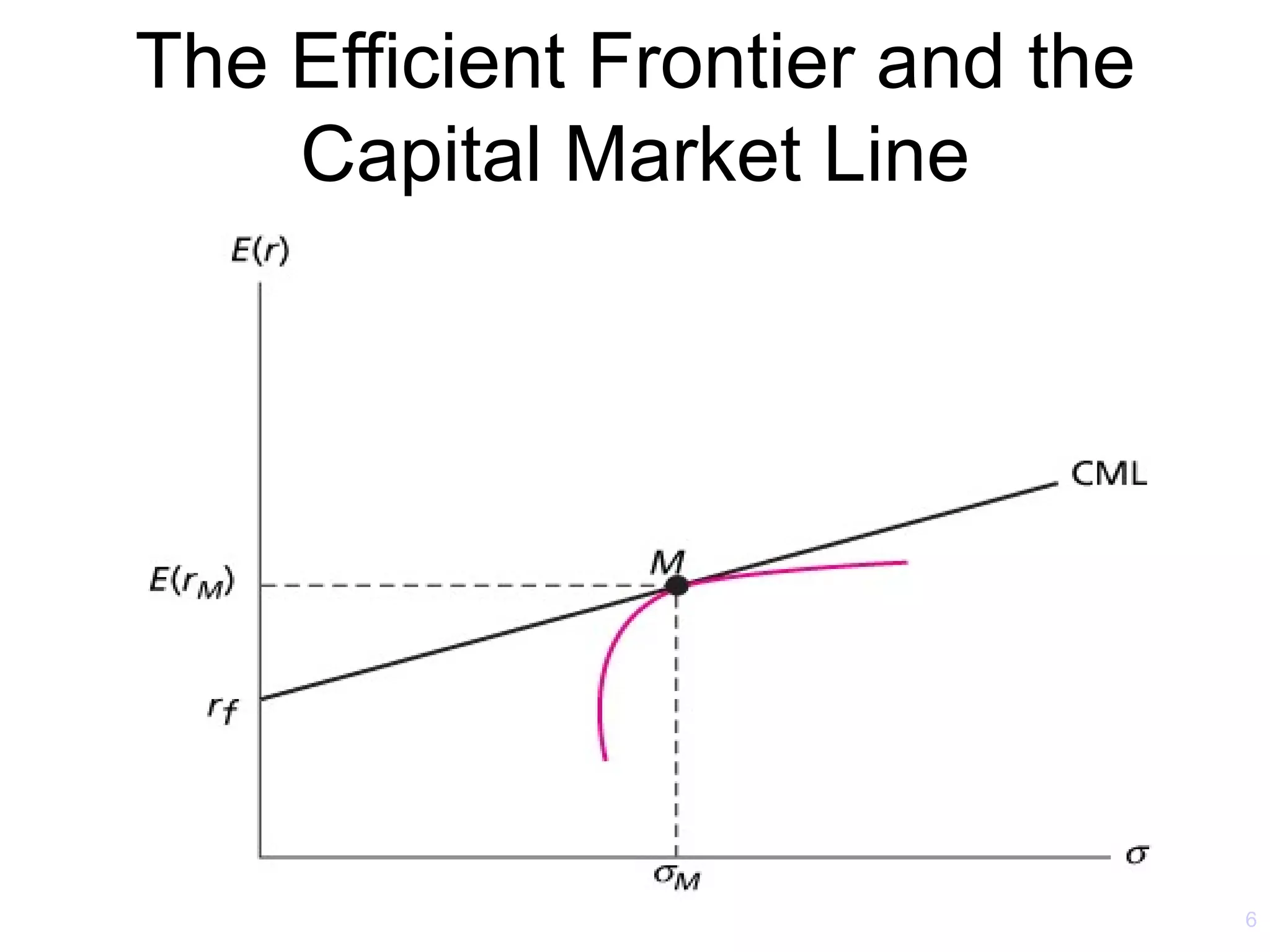
The Efficient Frontier and the
    Capital Market Line


                                 6
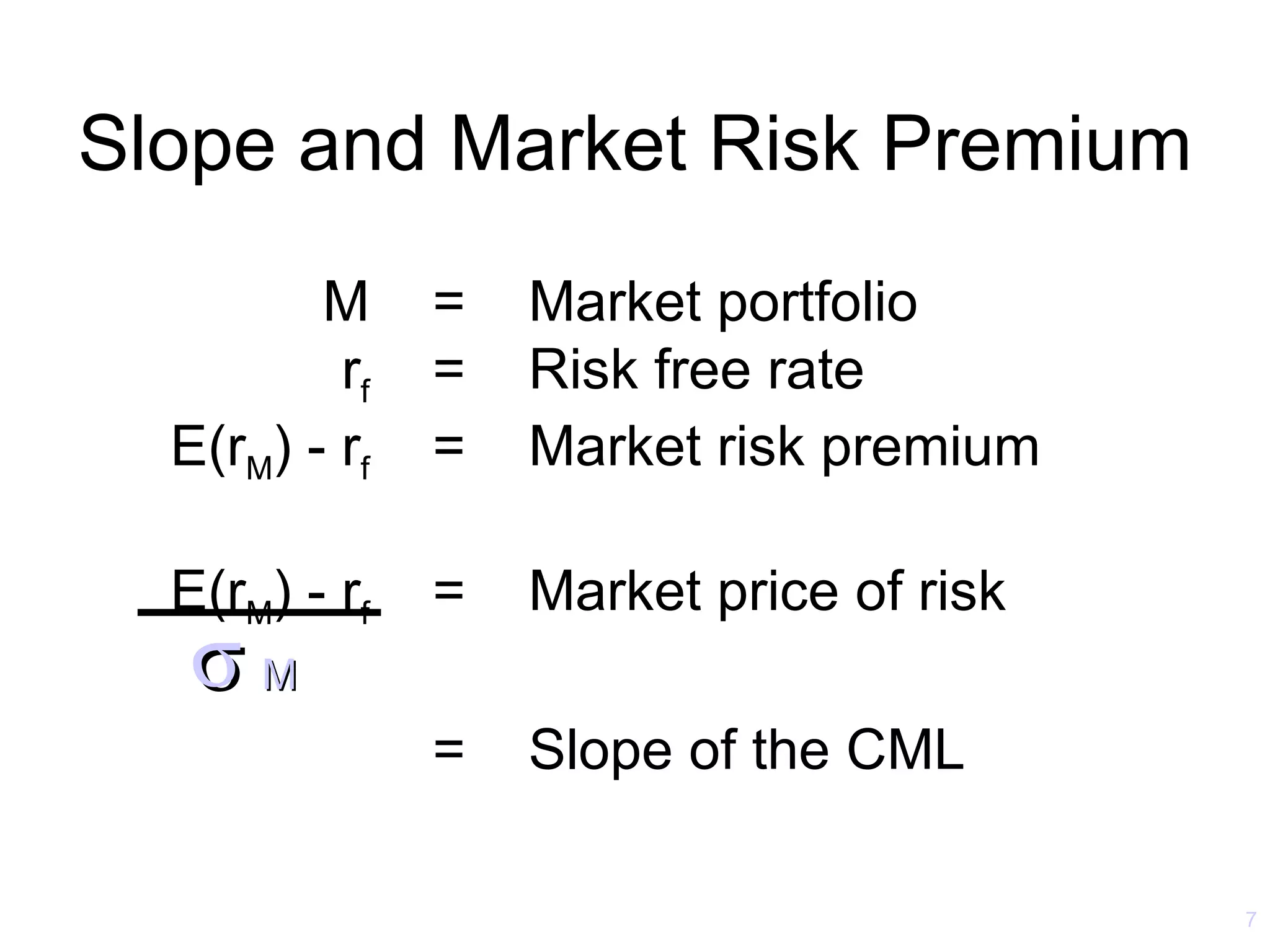
Slope and Market Risk Premium
         M     =   Market portfolio
          rf   =   Risk free rate
  E(rM) - rf   =   Market risk premium

  E(rM) - rf   =   Market price of risk
   σM
               =   Slope of the CML

                                          7
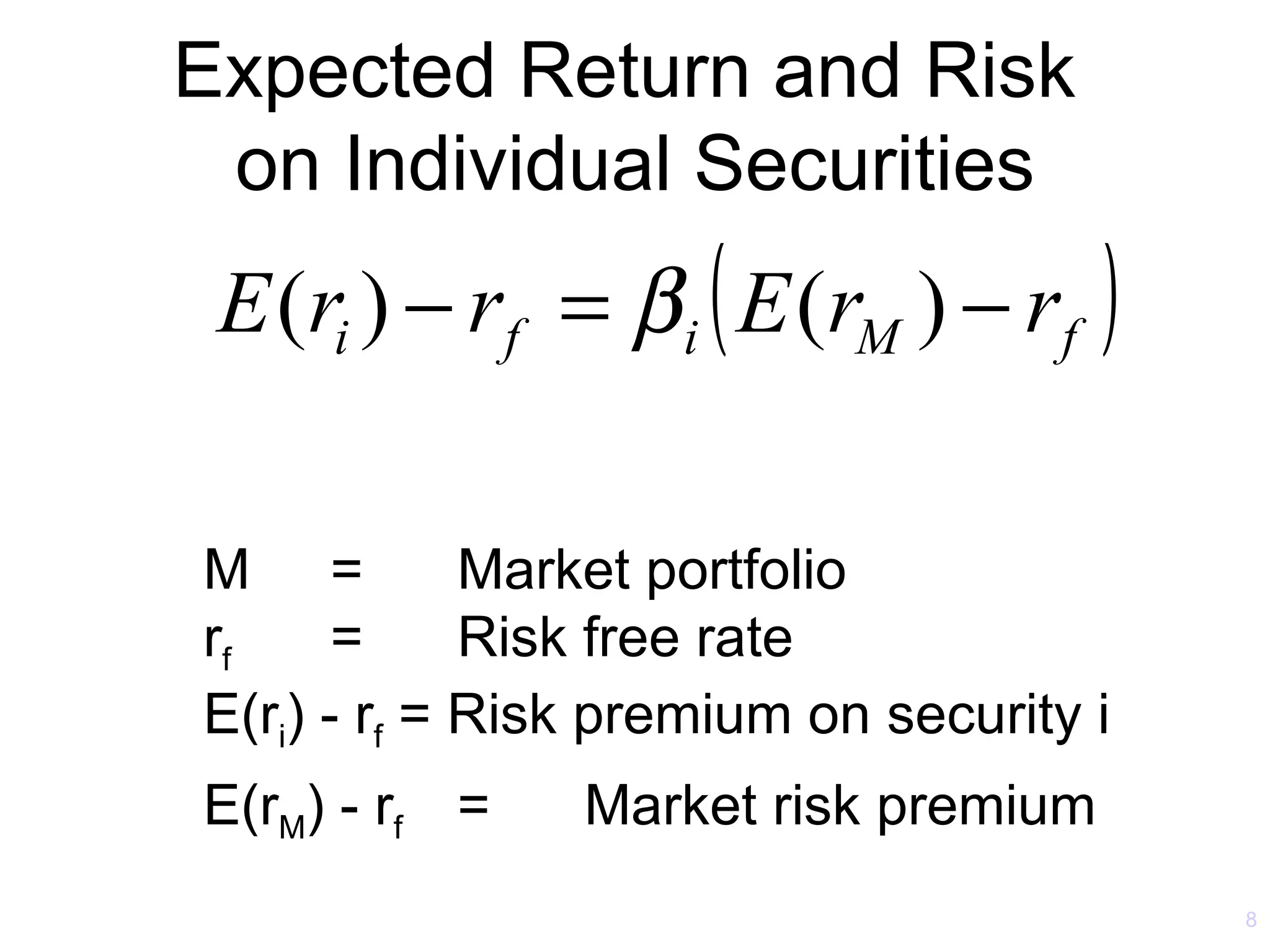
Expected Return and Risk
 on Individual Securities
 E (ri ) − rf = β i ( E (rM ) − rf )

M =          Market portfolio
rf     =     Risk free rate
E(ri) - rf = Risk premium on security i
E(rM) - rf =    Market risk premium
                                          8
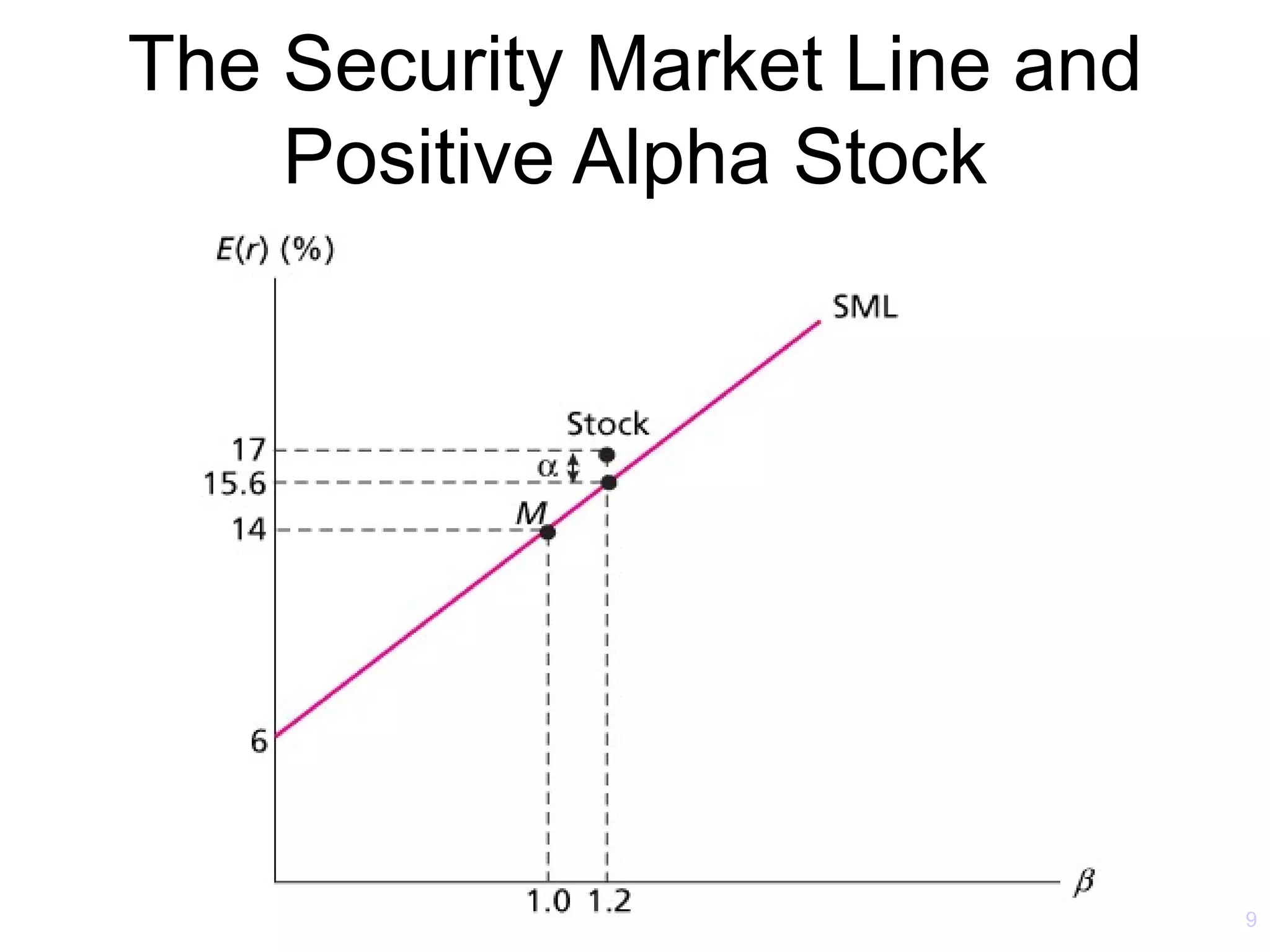
The Security Market Line and
    Positive Alpha Stock


                               9
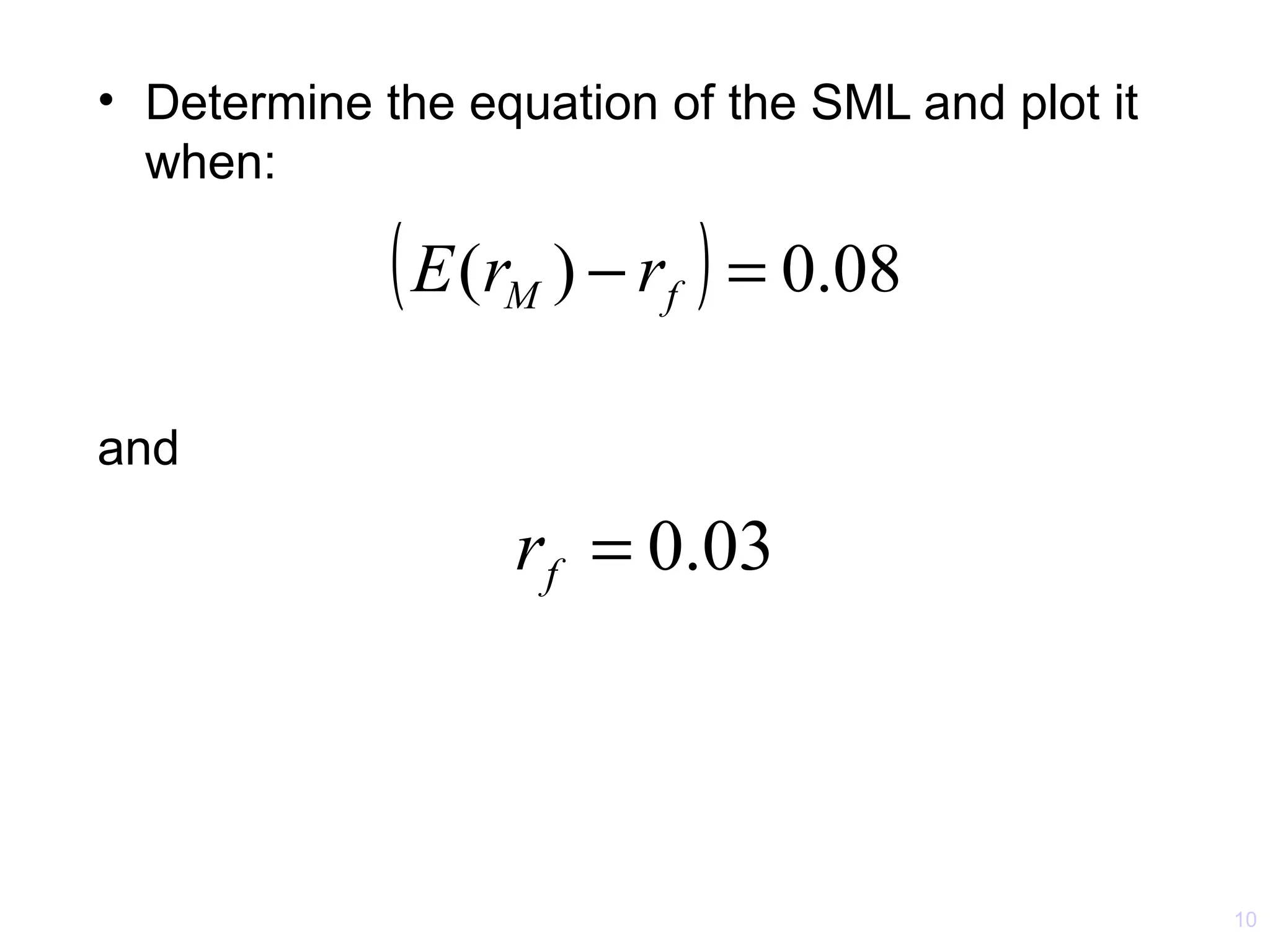
• Determine the equation of the SML and plot it
  when:

             ( E (r
                  M    ) − rf ) = 0.08

and

                      rf = 0.03


                                                  10
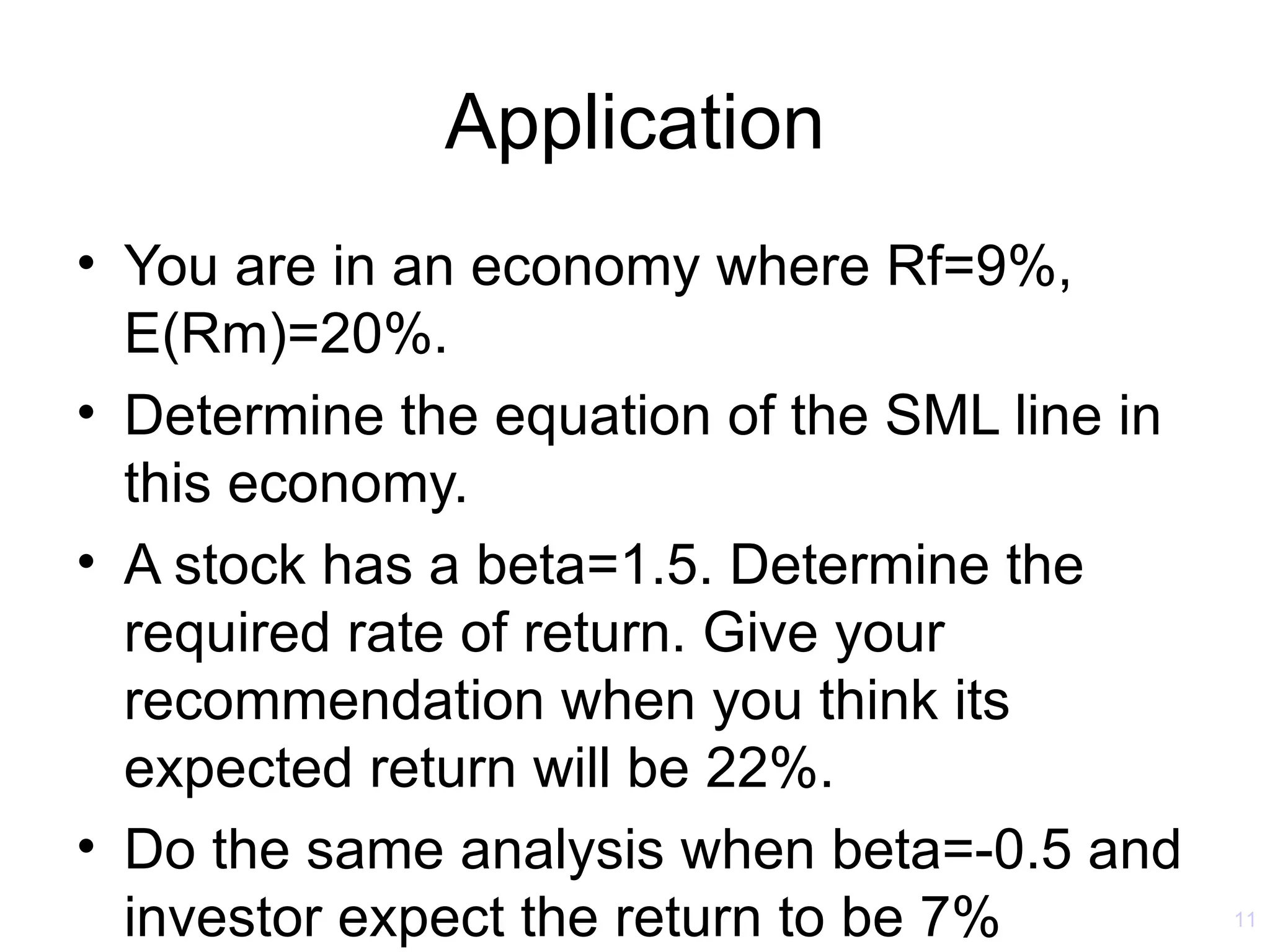
Application
• You are in an economy where Rf=9%,
  E(Rm)=20%.
• Determine the equation of the SML line in
  this economy.
• A stock has a beta=1.5. Determine the
  required rate of return. Give your
  recommendation when you think its
  expected return will be 22%.
• Do the same analysis when beta=-0.5 and
  investor expect the return to be 7%         11
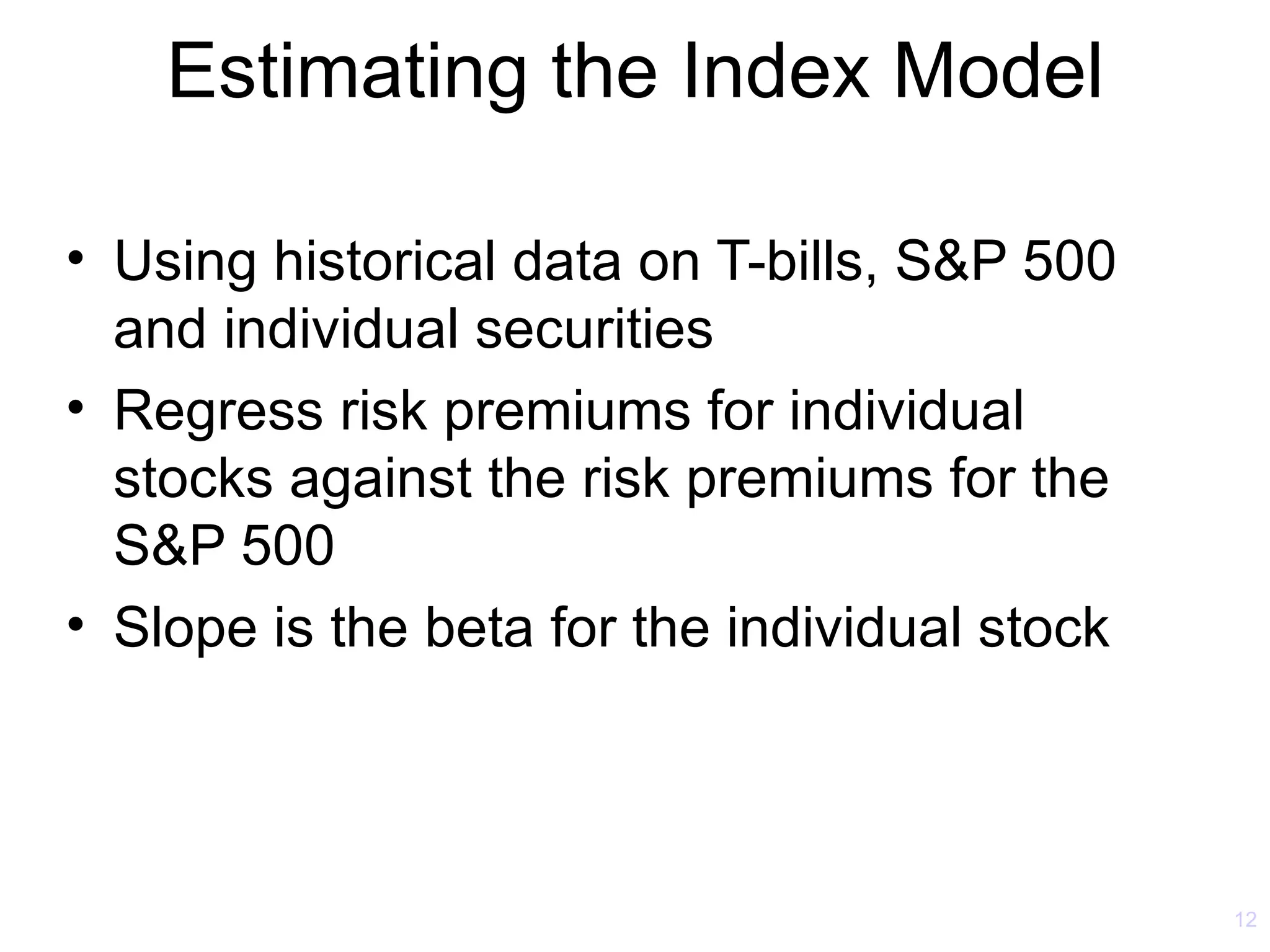
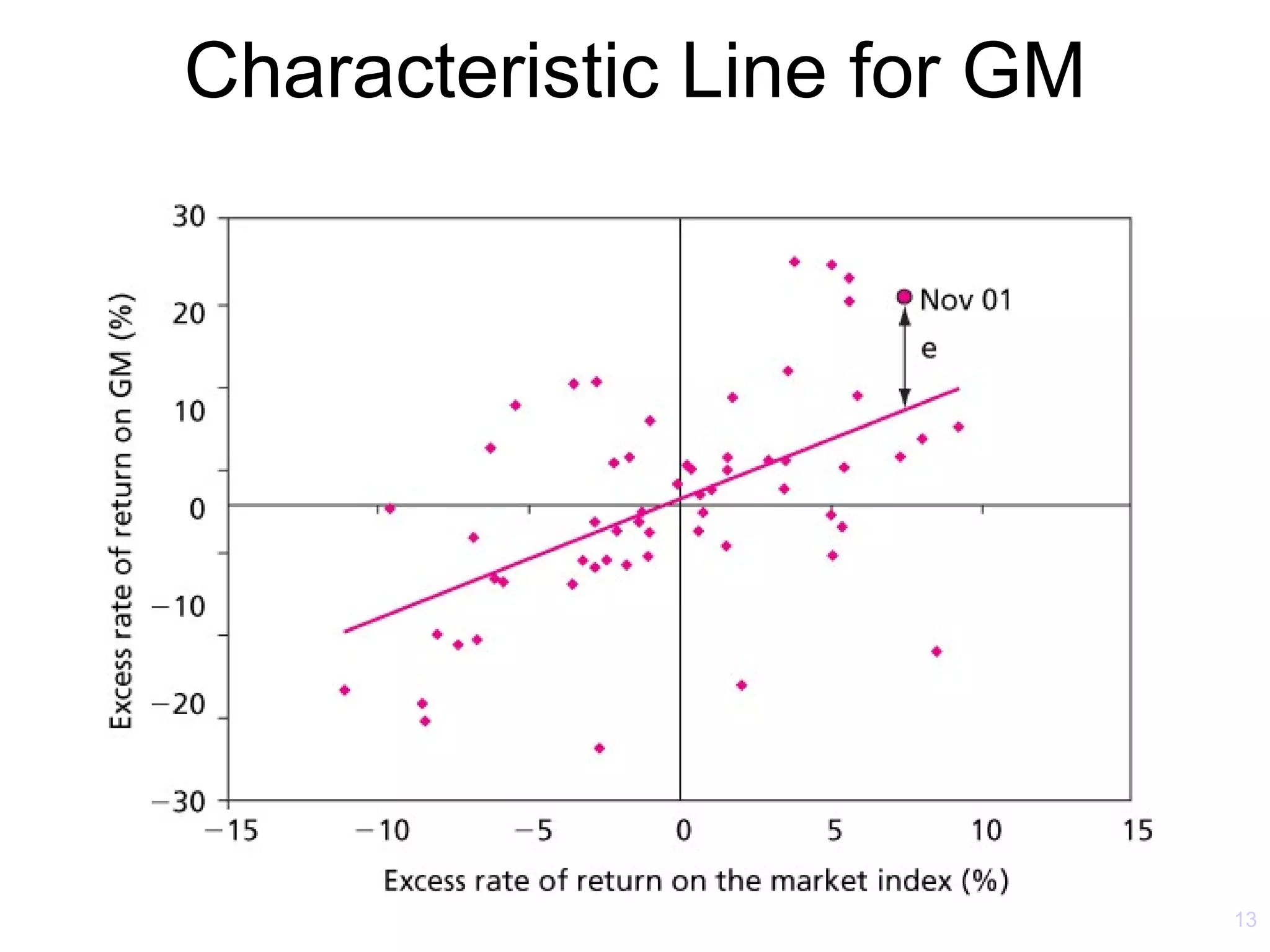
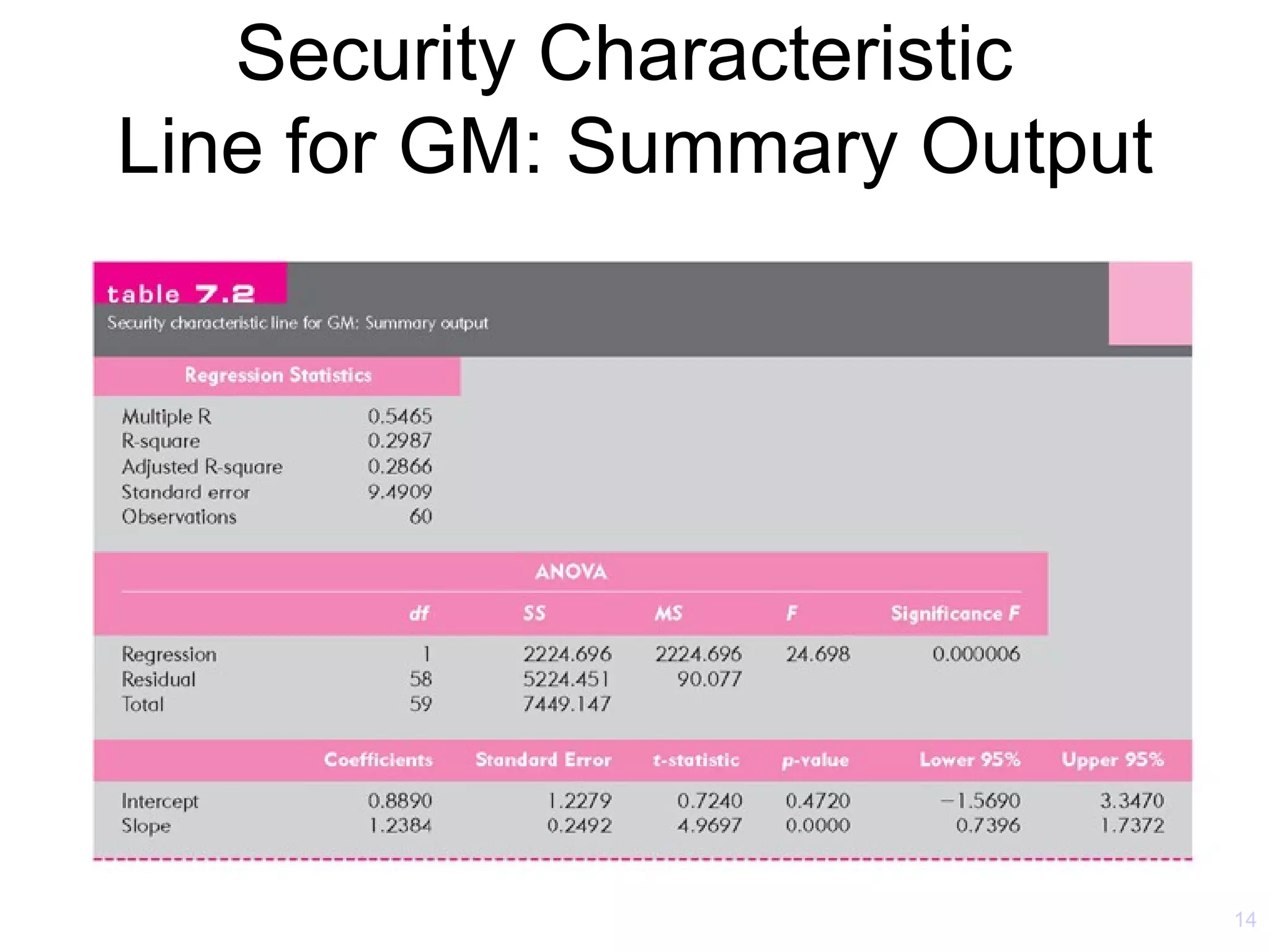
Estimating the Index Model

• Using historical data on T-bills, S&P 500
  and individual securities
• Regress risk premiums for individual
  stocks against the risk premiums for the
  S&P 500
• Slope is the beta for the individual stock


                                               12
Characteristic Line for GM


                             13
Security Characteristic
Line for GM: Summary Output


                              14
Multifactor Models


                     15
• Limitations for CAPM

• Market Portfolio is not directly observable

• Research shows that other factors affect
  returns


                                                16
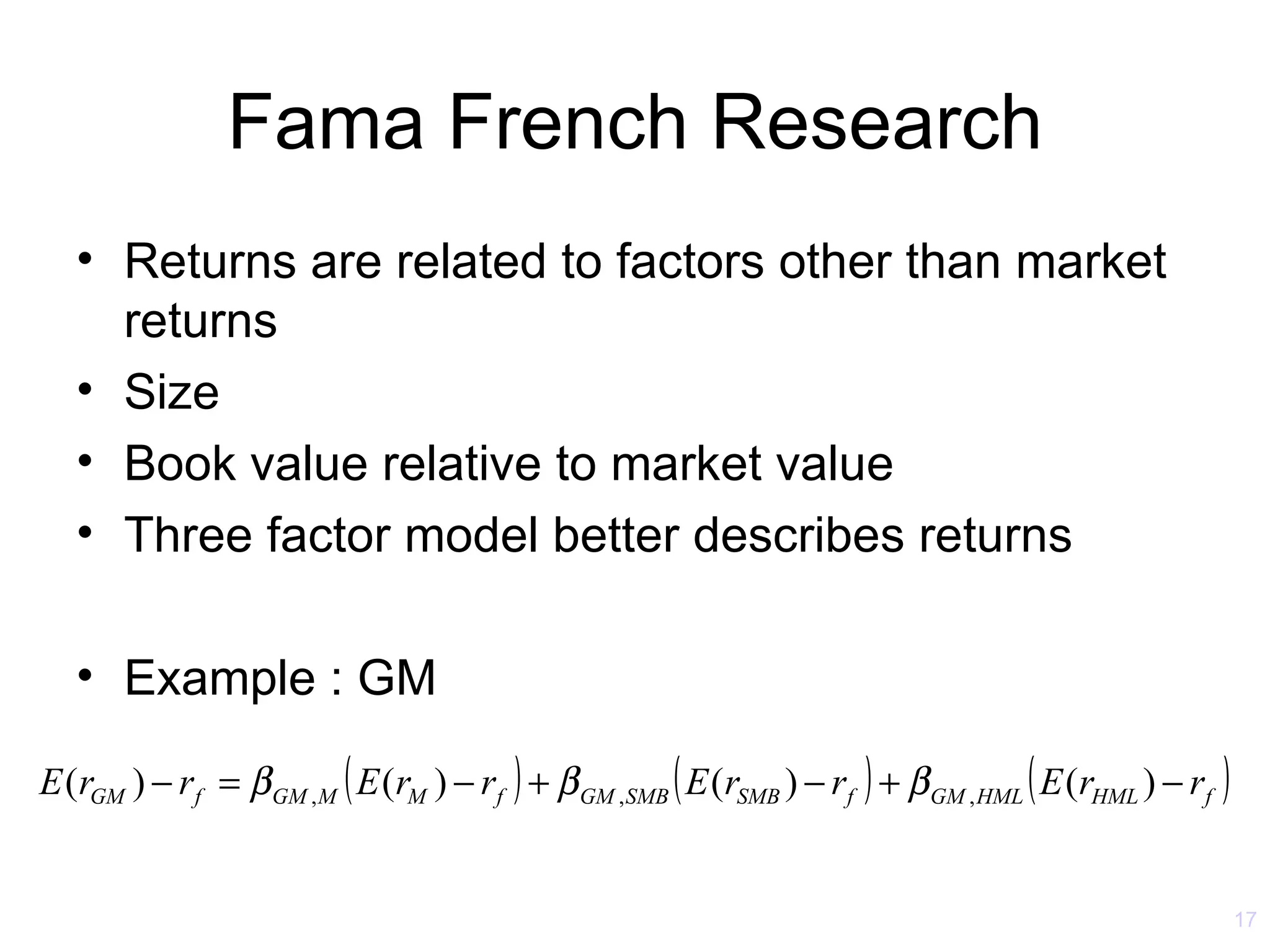
Fama French Research
   • Returns are related to factors other than market
     returns
   • Size
   • Book value relative to market value
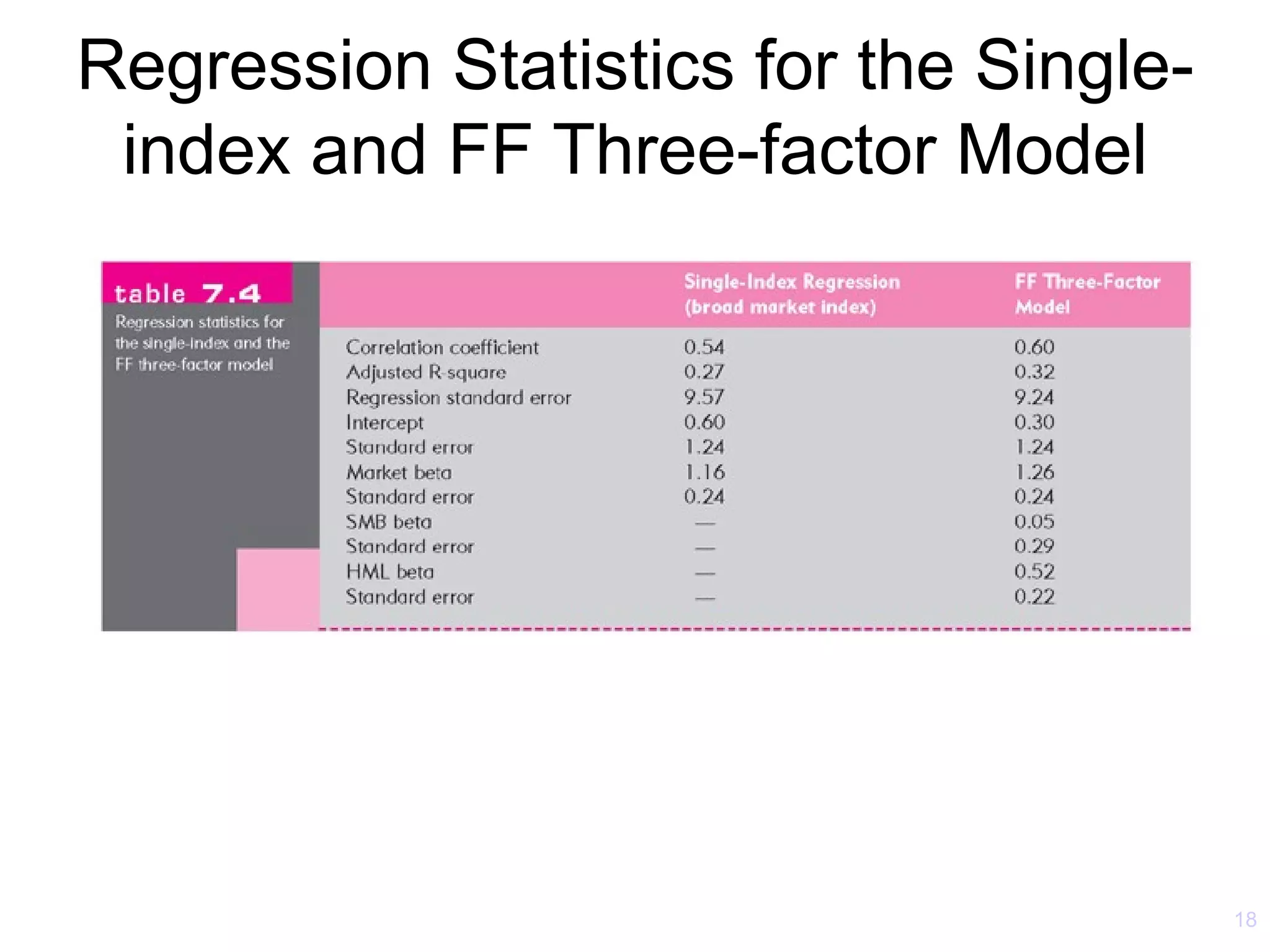
   • Three factor model better describes returns

   • Example : GM

E (rGM ) − r f = β GM , M ( E (rM ) − rf ) + β GM ,SMB ( E (rSMB ) − rf ) + β GM , HML ( E (rHML ) − rf )


                                                                                                            17
Regression Statistics for the Single-
 index and FF Three-factor Model


                                        18
Arbitrage Pricing Theory


                           19
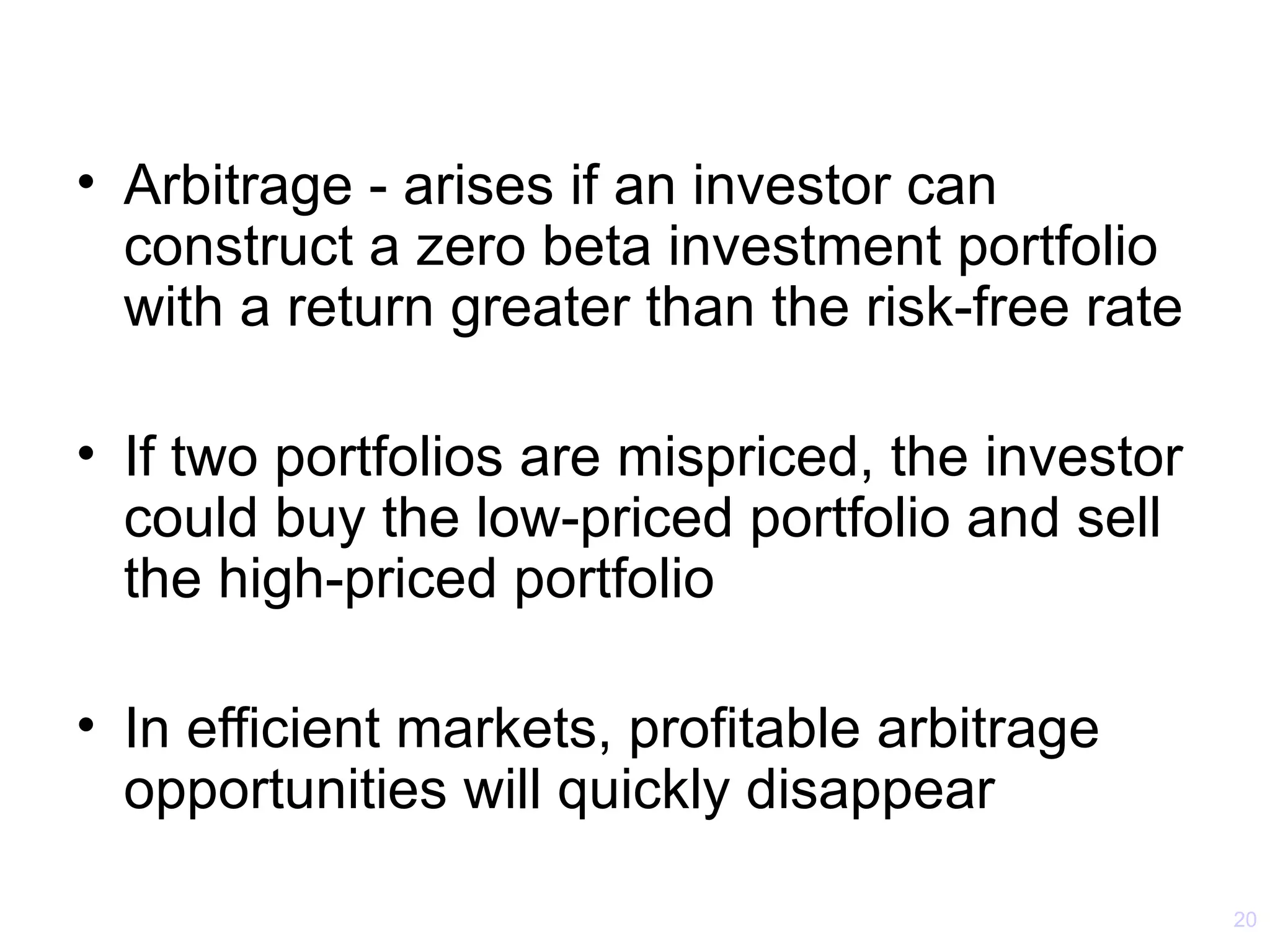
• Arbitrage - arises if an investor can
  construct a zero beta investment portfolio
  with a return greater than the risk-free rate

• If two portfolios are mispriced, the investor
  could buy the low-priced portfolio and sell
  the high-priced portfolio

• In efficient markets, profitable arbitrage
  opportunities will quickly disappear

                                                  20
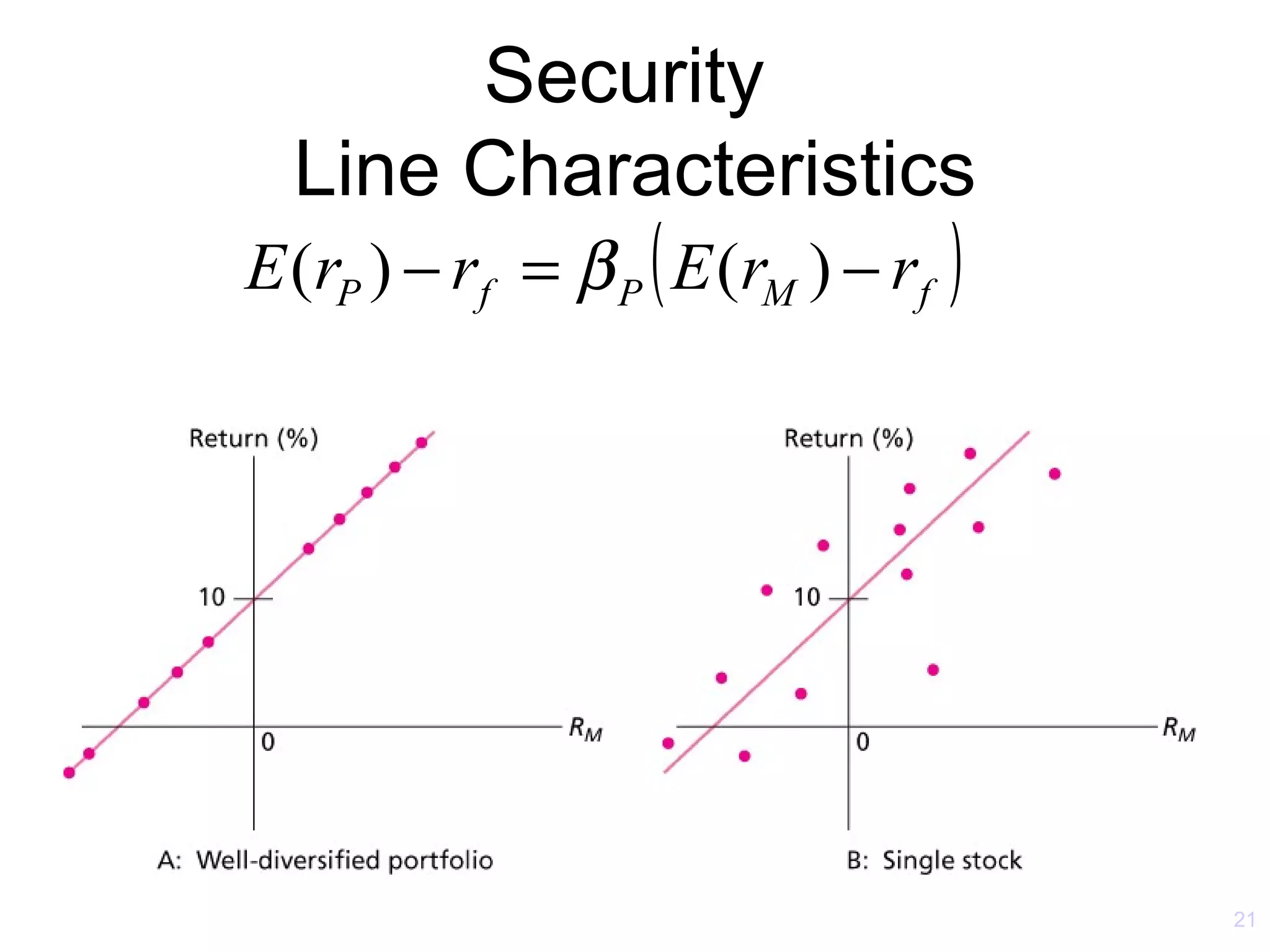
Security
  Line Characteristics
E (rP ) − rf = β P ( E (rM ) − rf )


                                      21
APT and CAPM Compared
• APT applies to well diversified portfolios and not
  necessarily to individual stocks

• With APT it is possible for some individual stocks
  to be mispriced - not lie on the SML

• APT is more general in that it gets to an
  expected return and beta relationship without the
  assumption of the market portfolio

• APT can be extended to multifactor models
                                                       22

Capm and apt

  • 1.
    Capital Asset Pricingand Arbitrage Pricing Theory Prof. Karim Mimouni 1
  • 2.
    Capital Asset PricingModel (CAPM) 2
  • 3.
    Assumptions • Individual investorsare price takers • Single-period investment horizon • Investments are limited to traded financial assets • No taxes, and transaction costs 3
  • 4.
    Assumptions (cont.) • Informationis costless and available to all investors • Homogeneous expectations 4
  • 5.
    Resulting Equilibrium Conditions • All investors will hold the same portfolio for risky assets – market portfolio • Market portfolio contains all securities and the proportion of each security is its market value as a percentage of total market value 5
  • 6.
    The Efficient Frontierand the Capital Market Line 6
  • 7.
    Slope and MarketRisk Premium M = Market portfolio rf = Risk free rate E(rM) - rf = Market risk premium E(rM) - rf = Market price of risk σM = Slope of the CML 7
  • 8.
    Expected Return andRisk on Individual Securities E (ri ) − rf = β i ( E (rM ) − rf ) M = Market portfolio rf = Risk free rate E(ri) - rf = Risk premium on security i E(rM) - rf = Market risk premium 8
  • 9.
    The Security MarketLine and Positive Alpha Stock 9
  • 10.
    • Determine theequation of the SML and plot it when: ( E (r M ) − rf ) = 0.08 and rf = 0.03 10
  • 11.
    Application • You arein an economy where Rf=9%, E(Rm)=20%. • Determine the equation of the SML line in this economy. • A stock has a beta=1.5. Determine the required rate of return. Give your recommendation when you think its expected return will be 22%. • Do the same analysis when beta=-0.5 and investor expect the return to be 7% 11
  • 12.
    Estimating the IndexModel • Using historical data on T-bills, S&P 500 and individual securities • Regress risk premiums for individual stocks against the risk premiums for the S&P 500 • Slope is the beta for the individual stock 12
  • 13.
  • 14.
    Security Characteristic Line forGM: Summary Output 14
  • 15.
  • 16.
    • Limitations forCAPM • Market Portfolio is not directly observable • Research shows that other factors affect returns 16
  • 17.
    Fama French Research • Returns are related to factors other than market returns • Size • Book value relative to market value • Three factor model better describes returns • Example : GM E (rGM ) − r f = β GM , M ( E (rM ) − rf ) + β GM ,SMB ( E (rSMB ) − rf ) + β GM , HML ( E (rHML ) − rf ) 17
  • 18.
    Regression Statistics forthe Single- index and FF Three-factor Model 18
  • 19.
  • 20.
    • Arbitrage -arises if an investor can construct a zero beta investment portfolio with a return greater than the risk-free rate • If two portfolios are mispriced, the investor could buy the low-priced portfolio and sell the high-priced portfolio • In efficient markets, profitable arbitrage opportunities will quickly disappear 20
  • 21.
    Security LineCharacteristics E (rP ) − rf = β P ( E (rM ) − rf ) 21
  • 22.
    APT and CAPMCompared • APT applies to well diversified portfolios and not necessarily to individual stocks • With APT it is possible for some individual stocks to be mispriced - not lie on the SML • APT is more general in that it gets to an expected return and beta relationship without the assumption of the market portfolio • APT can be extended to multifactor models 22