1 - 1
CHAPTER 1
Overview of Financial Management
and the Financial Environment
 Financial management
Forms of business organization
Objective of the firm: Maximize wealth
Determinants of stock pricing
 The financial environment
Financial instruments, markets and
institutions
Interest rates and yield curves
1 - 2
Why is corporate finance important to
all managers?
Corporate finance provides the skills
managers need to:
Identify and select the corporate
strategies and individual projects
that add value to their firm.
Forecast the funding requirements
of their company, and devise
strategies for acquiring those
funds.
1 - 3
Sole proprietorship
Partnership
Corporation
What are some forms of business
organization a company might have as
it evolves from a start-up to a major
corporation?
1 - 4
 Advantages:
Ease of formation
Subject to few regulations
No corporate income taxes
 Disadvantages:
Limited life
Unlimited liability
Difficult to raise capital to support
growth
Starting as a Sole Proprietorship
1 - 5
A partnership has roughly the same
advantages and disadvantages as a
sole proprietorship.
Starting as or Growing into a
Partnership
1 - 6
Becoming a Corporation
A corporation is a legal entity
separate from its owners and
managers.
File papers of incorporation with
state.
Charter
Bylaws
1 - 7
 Advantages:
Unlimited life
Easy transfer of ownership
Limited liability
Ease of raising capital
 Disadvantages:
Double taxation
Cost of set-up and report filing
Advantages and Disadvantages of a
Corporation
1 - 8
Becoming a Public Corporation and
Growing Afterwards
 Initial Public Offering (IPO) of Stock
Raises cash
Allows founders and pre-IPO investors
to “harvest” some of their wealth
 Subsequent issues of debt and equity
 Agency problem: managers may act in
their own interests and not on behalf of
owners (stockholders)
1 - 9
The primary objective should be
shareholder wealth maximization,
which translates to maximizing stock
price.
Should firms behave ethically? YES!
Do firms have any responsibilities to
society at large? YES! Shareholders
are also members of society.
What should management’s primary
objective be?
1 - 10
Is maximizing stock price good for
society, employees, and customers?
Employment growth is higher in firms
that try to maximize stock price. On
average, employment goes up in:
firms that make managers into
owners (such as LBO firms)
firms that were owned by the
government but that have been sold
to private investors
1 - 11
Consumer welfare is higher in
capitalist free market economies
than in communist or socialist
economies.
Fortune lists the most admired firms.
In addition to high stock returns,
these firms have:
high quality from customers’ view
employees who like working there
1 - 12
Amount of expected cash flows
(bigger is better)
Timing of the cash flow stream
(sooner is better)
Risk of the cash flows (less risk is
better)
What three aspects of cash flows
affect an investment’s value?
1 - 13
What are “free cash flows (FCF)”
Free cash flows are the cash flows
that are:
Available (or free) for distribution
To all investors (stockholders and
creditors)
After paying current expenses,
taxes, and making the investments
necessary for growth.
1 - 14
Determinants of Free Cash Flows
Sales revenues
Current level
Short-term growth rate in sales
Long-term sustainable growth rate in
sales
Operating costs (raw materials, labor,
etc.) and taxes
Required investments in operations
(buildings, machines, inventory, etc.)
1 - 15
What is the weighted average cost of
capital (WACC)?
The weighted average cost of capital
(WACC) is the average rate of return
required by all of the company’s
investors (stockholders and
creditors)
1 - 16
What factors affect the weighted
average cost of capital?
Capital structure (the firm’s relative
amounts of debt and equity)
Interest rates
Risk of the firm
Stock market investors’ overall
attitude toward risk
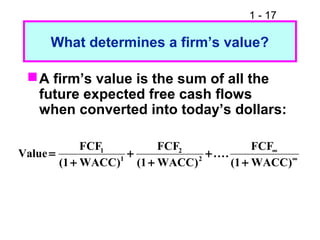
1 - 17
What determines a firm’s value?
A firm’s value is the sum of all the
future expected free cash flows
when converted into today’s dollars:
∞
∞
+
+
+
+
+
=
)WACC1(
FCF
....
)WACC1(
FCF
)WACC1(
FCF
Value 2
2
1
1
1 - 18
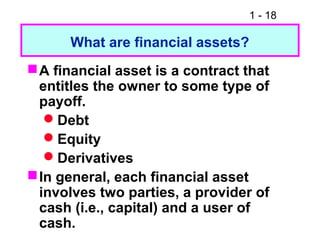
What are financial assets?
A financial asset is a contract that
entitles the owner to some type of
payoff.
Debt
Equity
Derivatives
In general, each financial asset
involves two parties, a provider of
cash (i.e., capital) and a user of
cash.
1 - 19
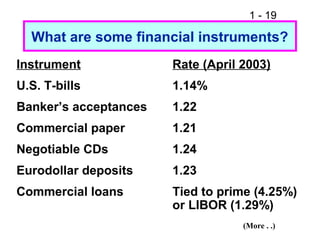
What are some financial instruments?
Instrument Rate (April 2003)
U.S. T-bills 1.14%
Banker’s acceptances 1.22
Commercial paper 1.21
Negotiable CDs 1.24
Eurodollar deposits 1.23
Commercial loans Tied to prime (4.25%)
or LIBOR (1.29%)
(More . .)
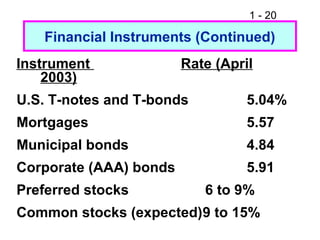
1 - 20
Financial Instruments (Continued)
Instrument Rate (April
2003)
U.S. T-notes and T-bonds 5.04%
Mortgages 5.57
Municipal bonds 4.84
Corporate (AAA) bonds 5.91
Preferred stocks 6 to 9%
Common stocks (expected)9 to 15%
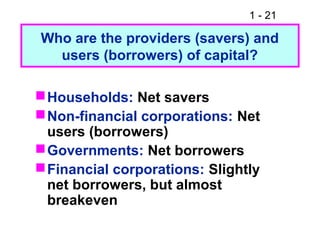
1 - 21
Who are the providers (savers) and
users (borrowers) of capital?
Households: Net savers
Non-financial corporations: Net
users (borrowers)
Governments: Net borrowers
Financial corporations: Slightly
net borrowers, but almost
breakeven
1 - 22
 Direct transfer (e.g., corporation issues
commercial paper to insurance company)
 Through an investment banking house
(e.g., IPO, seasoned equity offering, or
debt placement)
 Through a financial intermediary (e.g.,
individual deposits money in bank, bank
makes commercial loan to a company)
What are three ways that capital is
transferred between savers and
borrowers?
1 - 23
Commercial banks
Savings & Loans, mutual savings
banks, and credit unions
Life insurance companies
Mutual funds
Pension funds
What are some financial intermediaries?
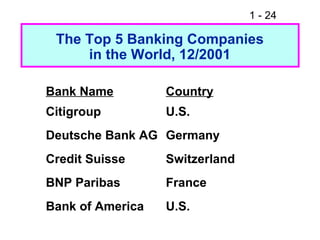
1 - 24
The Top 5 Banking Companies
in the World, 12/2001
Bank Name Country
Citigroup U.S.
Deutsche Bank AG Germany
Credit Suisse Switzerland
BNP Paribas France
Bank of America U.S.
1 - 25
What are some types of markets?
A market is a method of
exchanging one asset (usually
cash) for another asset.
Physical assets vs. financial assets
Spot versus future markets
Money versus capital markets
Primary versus secondary markets
1 - 26
How are secondary markets organized?
By “location”
Physical location exchanges
Computer/telephone networks
By the way that orders from buyers
and sellers are matched
Open outcry auction
Dealers (i.e., market makers)
Electronic communications
networks (ECNs)
1 - 27
Physical Location vs.
Computer/telephone Networks
Physical location exchanges:
e.g., NYSE, AMEX, CBOT, Tokyo
Stock Exchange
Computer/telephone: e.g.,
Nasdaq, government bond
markets, foreign exchange
markets
1 - 28
Auction Markets
NYSE and AMEX are the two largest
auction markets for stocks.
NYSE is a modified auction, with a
“specialist.”
Participants have a seat on the
exchange, meet face-to-face, and place
orders for themselves or for their clients;
e.g., CBOT.
Market orders vs. limit orders
1 - 29
Dealer Markets
 “Dealers” keep an inventory of the stock (or
other financial asset) and place bid and ask
“advertisements,” which are prices at which
they are willing to buy and sell.
 Computerized quotation system keeps track
of bid and ask prices, but does not
automatically match buyers and sellers.
 Examples: Nasdaq National Market, Nasdaq
SmallCap Market, London SEAQ, German
Neuer Markt.
1 - 30
Electronic Communications Networks
(ECNs)
ECNs:
Computerized system matches
orders from buyers and sellers
and automatically executes
transaction.
Examples: Instinet (US, stocks),
Eurex (Swiss-German, futures
contracts), SETS (London,
stocks).
1 - 31
Over the Counter (OTC) Markets
In the old days, securities were kept
in a safe behind the counter, and
passed “over the counter” when they
were sold.
Now the OTC market is the equivalent
of a computer bulletin board, which
allows potential buyers and sellers to
post an offer.
No dealers
Very poor liquidity
1 - 32
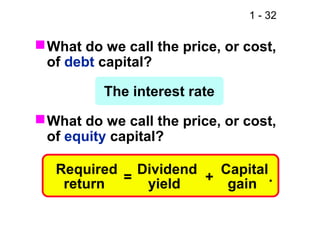
What do we call the price, or cost,
of debt capital?
The interest rate
What do we call the price, or cost,
of equity capital?
Required Dividend Capital
return yield gain= + .
1 - 33
What four factors affect the cost
of money?
Production opportunities
Time preferences for consumption
Risk
Expected inflation
1 - 34
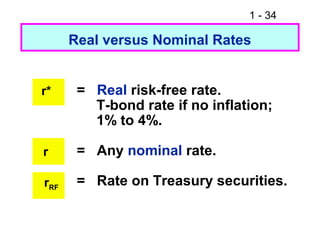
Real versus Nominal Rates
r* = Real risk-free rate.
T-bond rate if no inflation;
1% to 4%.
= Any nominal rate.
= Rate on Treasury securities.
r
rRF
1 - 35
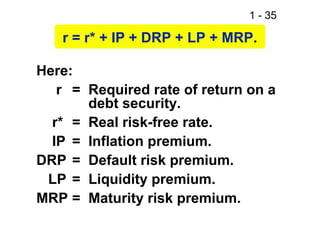
r = r* + IP + DRP + LP + MRP.
Here:
r = Required rate of return on a
debt security.
r* = Real risk-free rate.
IP = Inflation premium.
DRP = Default risk premium.
LP = Liquidity premium.
MRP = Maturity risk premium.
1 - 36
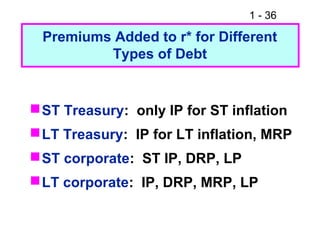
Premiums Added to r* for Different
Types of Debt
ST Treasury: only IP for ST inflation
LT Treasury: IP for LT inflation, MRP
ST corporate: ST IP, DRP, LP
LT corporate: IP, DRP, MRP, LP
1 - 37
What is the “term structure of interest
rates”? What is a “yield curve”?
Term structure: the relationship
between interest rates (or yields)
and maturities.
A graph of the term structure is
called the yield curve.
1 - 38
How can you construct a hypothetical
Treasury yield curve?
Estimate the inflation premium (IP)
for each future year. This is the
estimated average inflation over that
time period.
Step 2: Estimate the maturity risk
premium (MRP) for each future year.
1 - 39
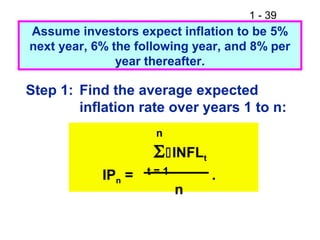
Step 1: Find the average expected
inflation rate over years 1 to n:
n
ΣINFLt
t = 1
n
IPn = .
Assume investors expect inflation to be 5%
next year, 6% the following year, and 8% per
year thereafter.
1 - 40
IP1 = 5%/1.0 = 5.00%.
IP10 = [5 + 6 + 8(8)]/10 = 7.5%.
IP20 = [5 + 6 + 8(18)]/20 = 7.75%.
Must earn these IPs to break even
versus inflation; that is, these IPs
would permit you to earn r* (before
taxes).
1 - 41
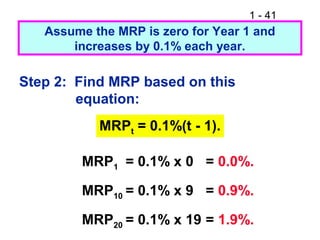
Step 2: Find MRP based on this
equation:
MRPt = 0.1%(t - 1).
MRP1 = 0.1% x 0 = 0.0%.
MRP10 = 0.1% x 9 = 0.9%.
MRP20 = 0.1% x 19 = 1.9%.
Assume the MRP is zero for Year 1 and
increases by 0.1% each year.
1 - 42
Step 3: Add the IPs and MRPs to r*:
rRFt
= r* + IPt + MRPt .
rRF = Quoted market interest
rate on treasury securities.
Assume r* = 3%:
rRF1 = 3% + 5% + 0.0% = 8.0%.
rRF10 = 3% + 7.5% + 0.9% = 11.4%.
rRF20 = 3% + 7.75% + 1.9% = 12.65%.
1 - 43
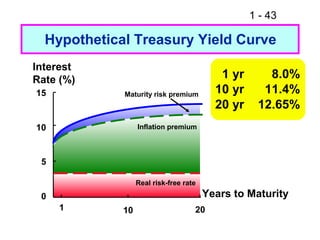
Hypothetical Treasury Yield Curve
0
5
10
15
1 10 20
Years to Maturity
Interest
Rate (%) 1 yr 8.0%
10 yr 11.4%
20 yr 12.65%
Real risk-free rate
Inflation premium
Maturity risk premium
1 - 44
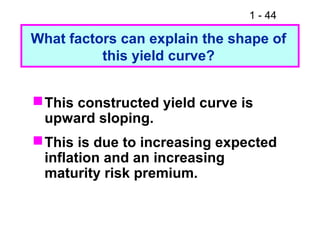
What factors can explain the shape of
this yield curve?
This constructed yield curve is
upward sloping.
This is due to increasing expected
inflation and an increasing
maturity risk premium.
1 - 45
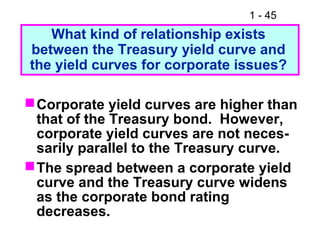
What kind of relationship exists
between the Treasury yield curve and
the yield curves for corporate issues?
Corporate yield curves are higher than
that of the Treasury bond. However,
corporate yield curves are not neces-
sarily parallel to the Treasury curve.
The spread between a corporate yield
curve and the Treasury curve widens
as the corporate bond rating
decreases.
1 - 46
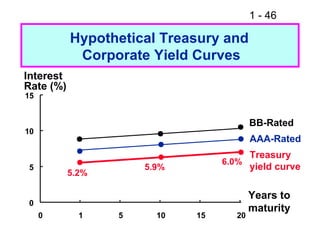
Hypothetical Treasury and
Corporate Yield Curves
0
5
10
15
0 1 5 10 15 20
Years to
maturity
Interest
Rate (%)
5.2%
5.9%
6.0%
Treasury
yield curve
BB-Rated
AAA-Rated
1 - 47
What is the Pure Expectations
Hypothesis (PEH)?
Shape of the yield curve depends on
the investors’ expectations about
future interest rates.
If interest rates are expected to
increase, L-T rates will be higher than
S-T rates and vice versa. Thus, the
yield curve can slope up or down.
PEH assumes that MRP = 0.
1 - 48
What various types of risks arise
when investing overseas?
Country risk: Arises from investing or
doing business in a particular country.
It depends on the country’s economic,
political, and social environment.
Exchange rate risk: If investment is
denominated in a currency other than
the dollar, the investment’s value will
depend on what happens to exchange
rate.
1 - 49
What two factors lead to exchange
rate fluctuations?
 Changes in relative inflation will
lead to changes in exchange rates.
 An increase in country risk will
also cause that country’s currency
to fall.

Fm11 ch 01 show

  • 1.
    1 - 1 CHAPTER1 Overview of Financial Management and the Financial Environment  Financial management Forms of business organization Objective of the firm: Maximize wealth Determinants of stock pricing  The financial environment Financial instruments, markets and institutions Interest rates and yield curves
  • 2.
    1 - 2 Whyis corporate finance important to all managers? Corporate finance provides the skills managers need to: Identify and select the corporate strategies and individual projects that add value to their firm. Forecast the funding requirements of their company, and devise strategies for acquiring those funds.
  • 3.
    1 - 3 Soleproprietorship Partnership Corporation What are some forms of business organization a company might have as it evolves from a start-up to a major corporation?
  • 4.
    1 - 4 Advantages: Ease of formation Subject to few regulations No corporate income taxes  Disadvantages: Limited life Unlimited liability Difficult to raise capital to support growth Starting as a Sole Proprietorship
  • 5.
    1 - 5 Apartnership has roughly the same advantages and disadvantages as a sole proprietorship. Starting as or Growing into a Partnership
  • 6.
    1 - 6 Becominga Corporation A corporation is a legal entity separate from its owners and managers. File papers of incorporation with state. Charter Bylaws
  • 7.
    1 - 7 Advantages: Unlimited life Easy transfer of ownership Limited liability Ease of raising capital  Disadvantages: Double taxation Cost of set-up and report filing Advantages and Disadvantages of a Corporation
  • 8.
    1 - 8 Becominga Public Corporation and Growing Afterwards  Initial Public Offering (IPO) of Stock Raises cash Allows founders and pre-IPO investors to “harvest” some of their wealth  Subsequent issues of debt and equity  Agency problem: managers may act in their own interests and not on behalf of owners (stockholders)
  • 9.
    1 - 9 Theprimary objective should be shareholder wealth maximization, which translates to maximizing stock price. Should firms behave ethically? YES! Do firms have any responsibilities to society at large? YES! Shareholders are also members of society. What should management’s primary objective be?
  • 10.
    1 - 10 Ismaximizing stock price good for society, employees, and customers? Employment growth is higher in firms that try to maximize stock price. On average, employment goes up in: firms that make managers into owners (such as LBO firms) firms that were owned by the government but that have been sold to private investors
  • 11.
    1 - 11 Consumerwelfare is higher in capitalist free market economies than in communist or socialist economies. Fortune lists the most admired firms. In addition to high stock returns, these firms have: high quality from customers’ view employees who like working there
  • 12.
    1 - 12 Amountof expected cash flows (bigger is better) Timing of the cash flow stream (sooner is better) Risk of the cash flows (less risk is better) What three aspects of cash flows affect an investment’s value?
  • 13.
    1 - 13 Whatare “free cash flows (FCF)” Free cash flows are the cash flows that are: Available (or free) for distribution To all investors (stockholders and creditors) After paying current expenses, taxes, and making the investments necessary for growth.
  • 14.
    1 - 14 Determinantsof Free Cash Flows Sales revenues Current level Short-term growth rate in sales Long-term sustainable growth rate in sales Operating costs (raw materials, labor, etc.) and taxes Required investments in operations (buildings, machines, inventory, etc.)
  • 15.
    1 - 15 Whatis the weighted average cost of capital (WACC)? The weighted average cost of capital (WACC) is the average rate of return required by all of the company’s investors (stockholders and creditors)
  • 16.
    1 - 16 Whatfactors affect the weighted average cost of capital? Capital structure (the firm’s relative amounts of debt and equity) Interest rates Risk of the firm Stock market investors’ overall attitude toward risk
  • 17.
    1 - 17 Whatdetermines a firm’s value? A firm’s value is the sum of all the future expected free cash flows when converted into today’s dollars: ∞ ∞ + + + + + = )WACC1( FCF .... )WACC1( FCF )WACC1( FCF Value 2 2 1 1
  • 18.
    1 - 18 Whatare financial assets? A financial asset is a contract that entitles the owner to some type of payoff. Debt Equity Derivatives In general, each financial asset involves two parties, a provider of cash (i.e., capital) and a user of cash.
  • 19.
    1 - 19 Whatare some financial instruments? Instrument Rate (April 2003) U.S. T-bills 1.14% Banker’s acceptances 1.22 Commercial paper 1.21 Negotiable CDs 1.24 Eurodollar deposits 1.23 Commercial loans Tied to prime (4.25%) or LIBOR (1.29%) (More . .)
  • 20.
    1 - 20 FinancialInstruments (Continued) Instrument Rate (April 2003) U.S. T-notes and T-bonds 5.04% Mortgages 5.57 Municipal bonds 4.84 Corporate (AAA) bonds 5.91 Preferred stocks 6 to 9% Common stocks (expected)9 to 15%
  • 21.
    1 - 21 Whoare the providers (savers) and users (borrowers) of capital? Households: Net savers Non-financial corporations: Net users (borrowers) Governments: Net borrowers Financial corporations: Slightly net borrowers, but almost breakeven
  • 22.
    1 - 22 Direct transfer (e.g., corporation issues commercial paper to insurance company)  Through an investment banking house (e.g., IPO, seasoned equity offering, or debt placement)  Through a financial intermediary (e.g., individual deposits money in bank, bank makes commercial loan to a company) What are three ways that capital is transferred between savers and borrowers?
  • 23.
    1 - 23 Commercialbanks Savings & Loans, mutual savings banks, and credit unions Life insurance companies Mutual funds Pension funds What are some financial intermediaries?
  • 24.
    1 - 24 TheTop 5 Banking Companies in the World, 12/2001 Bank Name Country Citigroup U.S. Deutsche Bank AG Germany Credit Suisse Switzerland BNP Paribas France Bank of America U.S.
  • 25.
    1 - 25 Whatare some types of markets? A market is a method of exchanging one asset (usually cash) for another asset. Physical assets vs. financial assets Spot versus future markets Money versus capital markets Primary versus secondary markets
  • 26.
    1 - 26 Howare secondary markets organized? By “location” Physical location exchanges Computer/telephone networks By the way that orders from buyers and sellers are matched Open outcry auction Dealers (i.e., market makers) Electronic communications networks (ECNs)
  • 27.
    1 - 27 PhysicalLocation vs. Computer/telephone Networks Physical location exchanges: e.g., NYSE, AMEX, CBOT, Tokyo Stock Exchange Computer/telephone: e.g., Nasdaq, government bond markets, foreign exchange markets
  • 28.
    1 - 28 AuctionMarkets NYSE and AMEX are the two largest auction markets for stocks. NYSE is a modified auction, with a “specialist.” Participants have a seat on the exchange, meet face-to-face, and place orders for themselves or for their clients; e.g., CBOT. Market orders vs. limit orders
  • 29.
    1 - 29 DealerMarkets  “Dealers” keep an inventory of the stock (or other financial asset) and place bid and ask “advertisements,” which are prices at which they are willing to buy and sell.  Computerized quotation system keeps track of bid and ask prices, but does not automatically match buyers and sellers.  Examples: Nasdaq National Market, Nasdaq SmallCap Market, London SEAQ, German Neuer Markt.
  • 30.
    1 - 30 ElectronicCommunications Networks (ECNs) ECNs: Computerized system matches orders from buyers and sellers and automatically executes transaction. Examples: Instinet (US, stocks), Eurex (Swiss-German, futures contracts), SETS (London, stocks).
  • 31.
    1 - 31 Overthe Counter (OTC) Markets In the old days, securities were kept in a safe behind the counter, and passed “over the counter” when they were sold. Now the OTC market is the equivalent of a computer bulletin board, which allows potential buyers and sellers to post an offer. No dealers Very poor liquidity
  • 32.
    1 - 32 Whatdo we call the price, or cost, of debt capital? The interest rate What do we call the price, or cost, of equity capital? Required Dividend Capital return yield gain= + .
  • 33.
    1 - 33 Whatfour factors affect the cost of money? Production opportunities Time preferences for consumption Risk Expected inflation
  • 34.
    1 - 34 Realversus Nominal Rates r* = Real risk-free rate. T-bond rate if no inflation; 1% to 4%. = Any nominal rate. = Rate on Treasury securities. r rRF
  • 35.
    1 - 35 r= r* + IP + DRP + LP + MRP. Here: r = Required rate of return on a debt security. r* = Real risk-free rate. IP = Inflation premium. DRP = Default risk premium. LP = Liquidity premium. MRP = Maturity risk premium.
  • 36.
    1 - 36 PremiumsAdded to r* for Different Types of Debt ST Treasury: only IP for ST inflation LT Treasury: IP for LT inflation, MRP ST corporate: ST IP, DRP, LP LT corporate: IP, DRP, MRP, LP
  • 37.
    1 - 37 Whatis the “term structure of interest rates”? What is a “yield curve”? Term structure: the relationship between interest rates (or yields) and maturities. A graph of the term structure is called the yield curve.
  • 38.
    1 - 38 Howcan you construct a hypothetical Treasury yield curve? Estimate the inflation premium (IP) for each future year. This is the estimated average inflation over that time period. Step 2: Estimate the maturity risk premium (MRP) for each future year.
  • 39.
    1 - 39 Step1: Find the average expected inflation rate over years 1 to n: n ΣINFLt t = 1 n IPn = . Assume investors expect inflation to be 5% next year, 6% the following year, and 8% per year thereafter.
  • 40.
    1 - 40 IP1= 5%/1.0 = 5.00%. IP10 = [5 + 6 + 8(8)]/10 = 7.5%. IP20 = [5 + 6 + 8(18)]/20 = 7.75%. Must earn these IPs to break even versus inflation; that is, these IPs would permit you to earn r* (before taxes).
  • 41.
    1 - 41 Step2: Find MRP based on this equation: MRPt = 0.1%(t - 1). MRP1 = 0.1% x 0 = 0.0%. MRP10 = 0.1% x 9 = 0.9%. MRP20 = 0.1% x 19 = 1.9%. Assume the MRP is zero for Year 1 and increases by 0.1% each year.
  • 42.
    1 - 42 Step3: Add the IPs and MRPs to r*: rRFt = r* + IPt + MRPt . rRF = Quoted market interest rate on treasury securities. Assume r* = 3%: rRF1 = 3% + 5% + 0.0% = 8.0%. rRF10 = 3% + 7.5% + 0.9% = 11.4%. rRF20 = 3% + 7.75% + 1.9% = 12.65%.
  • 43.
    1 - 43 HypotheticalTreasury Yield Curve 0 5 10 15 1 10 20 Years to Maturity Interest Rate (%) 1 yr 8.0% 10 yr 11.4% 20 yr 12.65% Real risk-free rate Inflation premium Maturity risk premium
  • 44.
    1 - 44 Whatfactors can explain the shape of this yield curve? This constructed yield curve is upward sloping. This is due to increasing expected inflation and an increasing maturity risk premium.
  • 45.
    1 - 45 Whatkind of relationship exists between the Treasury yield curve and the yield curves for corporate issues? Corporate yield curves are higher than that of the Treasury bond. However, corporate yield curves are not neces- sarily parallel to the Treasury curve. The spread between a corporate yield curve and the Treasury curve widens as the corporate bond rating decreases.
  • 46.
    1 - 46 HypotheticalTreasury and Corporate Yield Curves 0 5 10 15 0 1 5 10 15 20 Years to maturity Interest Rate (%) 5.2% 5.9% 6.0% Treasury yield curve BB-Rated AAA-Rated
  • 47.
    1 - 47 Whatis the Pure Expectations Hypothesis (PEH)? Shape of the yield curve depends on the investors’ expectations about future interest rates. If interest rates are expected to increase, L-T rates will be higher than S-T rates and vice versa. Thus, the yield curve can slope up or down. PEH assumes that MRP = 0.
  • 48.
    1 - 48 Whatvarious types of risks arise when investing overseas? Country risk: Arises from investing or doing business in a particular country. It depends on the country’s economic, political, and social environment. Exchange rate risk: If investment is denominated in a currency other than the dollar, the investment’s value will depend on what happens to exchange rate.
  • 49.
    1 - 49 Whattwo factors lead to exchange rate fluctuations?  Changes in relative inflation will lead to changes in exchange rates.  An increase in country risk will also cause that country’s currency to fall.