Presented By
Nilambar Sharma
 Introduction
 Risk
 Beta Coefficient
 CAPM
 Assumptions
 SML
 Problems
A  theory of risk and return for securities on
  a competitive capital market.
 Introduced by Jack Treynor, William Sharpe,
  John Lintner, Jan Mossin
 Sharpe, Markowitz and Merton Miller jointly
  received the Nobel Memorial Prize in
  Economics for this contribution; 1990
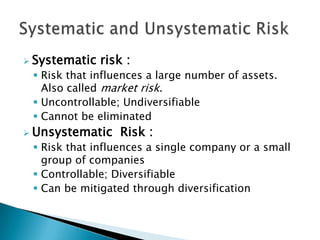
 Systematic   risk :
  Risk that influences a large number of assets.
   Also called market risk.
  Uncontrollable; Undiversifiable
  Cannot be eliminated
 Unsystematic    Risk :
  Risk that influences a single company or a small
   group of companies
  Controllable; Diversifiable
  Can be mitigated through diversification
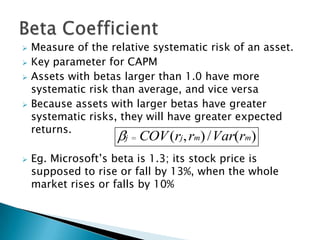
   Measure of the relative systematic risk of an asset.
   Key parameter for CAPM
   Assets with betas larger than 1.0 have more
    systematic risk than average, and vice versa
   Because assets with larger betas have greater
    systematic risks, they will have greater expected
    returns.
                      j   COV (rj, rm) / Var(rm)
   Eg. Microsoft’s beta is 1.3; its stock price is
    supposed to rise or fall by 13%, when the whole
    market rises or falls by 10%
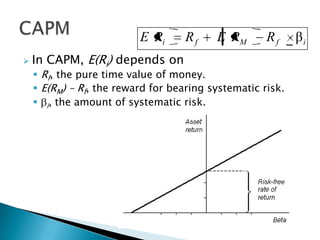
E Ri      Rf    E RM       Rf     βi
   In CAPM, E(Ri) depends on
     Rf, the pure time value of money.
     E(RM) – Rf, the reward for bearing systematic risk.
     i, the amount of systematic risk.
   All investors aim to maximize economic utilities.
   Are rational and risk-averse.
   Are broadly diversified across a range of investments.
   Are price takers, i.e., they cannot influence prices.
   Can lend and borrow unlimited amounts under the
    risk free rate of interest.
   Trade without transaction or taxation costs.
   Deal with securities that are all highly divisible into
    small parcels.
   Assume all information is available at the same time
    to all investors.
   The SML essentially graphs the results from the
    capital asset pricing model (CAPM) formula.
   The x-axis represents the risk (beta), and the y-axis
    represents the expected return.
   The market risk premium is determined from the
    slope of the SML.
   The relationship between β and required return is
    plotted on the securities market line (SML) which
    shows expected return as a function of β.
   assumes that the variance of returns is an adequate
    measurement of risk. This might be justified under
    the assumption of Normally Distributed returns.
   homogeneous expectations
   no taxes or transaction costs
   Assumes rational and risk-averse investors
   Does not adequately explain the variation in stock
    returns. Empirical studies show that low beta
    stocks may offer higher returns than the model
    would predict.
   C-CAPM:
     Consumption Beta
     Proposed by Robert Merton
     Instead of depending upon sensitivity( or Beta coefficient)
      of to overall market risk, it depends on sensitivity to overall
      aggregate consumption
   I-CAPM
     Intertemporal CAPM
     Developed by Douglas Breedon
     It is a linear factor model with wealth and state variable that
      forecast changes in the distribution of future returns or
      income.
   APT : Arbitrage Pricing Theory
     Often viewed as an alternative of CAPM
     more flexible assumption requirements.
     describes the price where a mispriced asset is expected to
      be
     the expected return of a financial asset can be modeled as
      a linear function of various macro-economic factors or
      theoretical market indices, where sensitivity to changes in
      each factor is represented by a factor-specific beta
      coefficient.
Capm

Capm

  • 1.
  • 2.
     Introduction  Risk Beta Coefficient  CAPM  Assumptions  SML  Problems
  • 3.
    A theoryof risk and return for securities on a competitive capital market.  Introduced by Jack Treynor, William Sharpe, John Lintner, Jan Mossin  Sharpe, Markowitz and Merton Miller jointly received the Nobel Memorial Prize in Economics for this contribution; 1990
  • 4.
     Systematic risk :  Risk that influences a large number of assets. Also called market risk.  Uncontrollable; Undiversifiable  Cannot be eliminated  Unsystematic Risk :  Risk that influences a single company or a small group of companies  Controllable; Diversifiable  Can be mitigated through diversification
  • 5.
    Measure of the relative systematic risk of an asset.  Key parameter for CAPM  Assets with betas larger than 1.0 have more systematic risk than average, and vice versa  Because assets with larger betas have greater systematic risks, they will have greater expected returns. j COV (rj, rm) / Var(rm)  Eg. Microsoft’s beta is 1.3; its stock price is supposed to rise or fall by 13%, when the whole market rises or falls by 10%
  • 6.
    E Ri Rf E RM Rf βi  In CAPM, E(Ri) depends on  Rf, the pure time value of money.  E(RM) – Rf, the reward for bearing systematic risk.  i, the amount of systematic risk.
  • 7.
    All investors aim to maximize economic utilities.  Are rational and risk-averse.  Are broadly diversified across a range of investments.  Are price takers, i.e., they cannot influence prices.  Can lend and borrow unlimited amounts under the risk free rate of interest.  Trade without transaction or taxation costs.  Deal with securities that are all highly divisible into small parcels.  Assume all information is available at the same time to all investors.
  • 8.
    The SML essentially graphs the results from the capital asset pricing model (CAPM) formula.  The x-axis represents the risk (beta), and the y-axis represents the expected return.  The market risk premium is determined from the slope of the SML.  The relationship between β and required return is plotted on the securities market line (SML) which shows expected return as a function of β.
  • 10.
    assumes that the variance of returns is an adequate measurement of risk. This might be justified under the assumption of Normally Distributed returns.  homogeneous expectations  no taxes or transaction costs  Assumes rational and risk-averse investors  Does not adequately explain the variation in stock returns. Empirical studies show that low beta stocks may offer higher returns than the model would predict.
  • 11.
    C-CAPM:  Consumption Beta  Proposed by Robert Merton  Instead of depending upon sensitivity( or Beta coefficient) of to overall market risk, it depends on sensitivity to overall aggregate consumption  I-CAPM  Intertemporal CAPM  Developed by Douglas Breedon  It is a linear factor model with wealth and state variable that forecast changes in the distribution of future returns or income.
  • 12.
    APT : Arbitrage Pricing Theory  Often viewed as an alternative of CAPM  more flexible assumption requirements.  describes the price where a mispriced asset is expected to be  the expected return of a financial asset can be modeled as a linear function of various macro-economic factors or theoretical market indices, where sensitivity to changes in each factor is represented by a factor-specific beta coefficient.