CAPITAL ASSET
PRICING MODEL
(CAPM)
PRESENTED BY
SIMRAN KAUR
CAPITAL ALLOCATION LINE
 Capital allocation line shows the reward to variability ratio in
terms of additional beta
 Let us denote a risk-free portfolio by F, a risky portfolio by M,
and a complete portfolio formed by combining them as C.
Further w is the fraction of the overall portfolio invested in M,
and the remaining (= 1-w) in F. The expected return of
complete portfolio may be calculated as
E(𝑟𝑐) = 𝑟𝑓 + w [ E(𝑟 𝑚) − 𝑟𝑓]
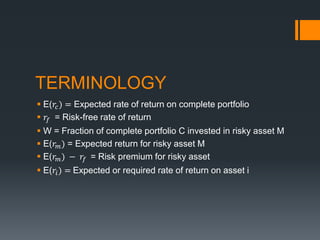
TERMINOLOGY
 E(𝑟𝑐) = Expected rate of return on complete portfolio
 𝑟𝑓 = Risk-free rate of return
 W = Fraction of complete portfolio C invested in risky asset M
 E(𝑟 𝑚) = Expected return for risky asset M
 E(𝑟 𝑚) − 𝑟𝑓 = Risk premium for risky asset
 E(𝑟𝑖) = Expected or required rate of return on asset i
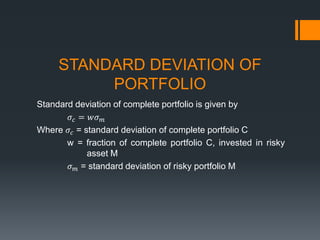
STANDARD DEVIATION OF
PORTFOLIO
Standard deviation of complete portfolio is given by
𝜎𝑐 = 𝑤𝜎 𝑚
Where 𝜎𝑐 = standard deviation of complete portfolio C
w = fraction of complete portfolio C, invested in risky
asset M
𝜎 𝑚 = standard deviation of risky portfolio M
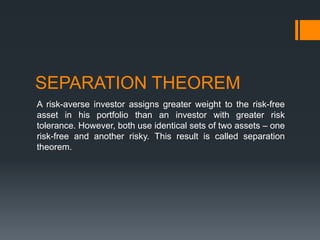
SEPARATION THEOREM
A risk-averse investor assigns greater weight to the risk-free
asset in his portfolio than an investor with greater risk
tolerance. However, both use identical sets of two assets – one
risk-free and another risky. This result is called separation
theorem.
MARKET PORTFOLIO
Market portfolio is a theoretical construct credited to Prof.
Eugene Fama. It is a huge portfolio that includes all traded
assets in exactly the same proportion in which they are
supplied in equilibrium. The return on market portfolio is the
weighted average of return on all capital assets.
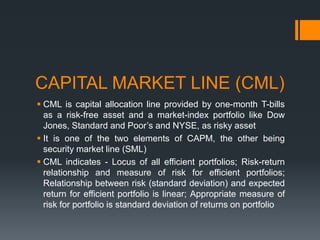
CAPITAL MARKET LINE (CML)
 CML is capital allocation line provided by one-month T-bills
as a risk-free asset and a market-index portfolio like Dow
Jones, Standard and Poor’s and NYSE, as risky asset
 It is one of the two elements of CAPM, the other being
security market line (SML)
 CML indicates - Locus of all efficient portfolios; Risk-return
relationship and measure of risk for efficient portfolios;
Relationship between risk (standard deviation) and expected
return for efficient portfolio is linear; Appropriate measure of
risk for portfolio is standard deviation of returns on portfolio
FUNCTIONS OF CML
 It depicts risk-return relationship for efficient portfolios
available to investors
 It shows the appropriate measure of risk for an efficient
portfolios is the standard deviation of return on portfolio
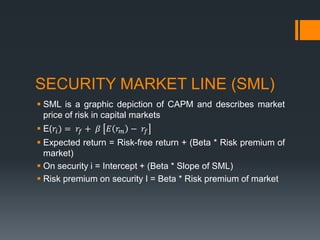
SECURITY MARKET LINE (SML)
 SML is a graphic depiction of CAPM and describes market
price of risk in capital markets
 E(𝑟𝑖) = 𝑟𝑓 + 𝛽 𝐸 𝑟 𝑚 − 𝑟𝑓
 Expected return = Risk-free return + (Beta * Risk premium of
market)
 On security i = Intercept + (Beta * Slope of SML)
 Risk premium on security I = Beta * Risk premium of market
CAPITAL ASSET PRICING
MODEL (CAPM)
 CAPM is an equilibrium model of trade-off between expected
portfolio return and unavoidable (systematic) risk; the basic
theory that links together risk and return of all assets
 It is a logical and major extension of portfolio theory of
Markowitz by William Sharpe, John Linterner and Jan Mossin
 It provides framework for determining the equilibrium
expected return for risky assets
IMPLICATIONS OF CAPM
 Risk-return relationship for an efficient portfolio
 Risk-return relationship for an individual asset/security
 Identification of under- and over-valued assets traded in the
market
 Effect of leverage on cost of equity
 Capital budgeting decisions and cost of capital
 Risk of firm through diversification of project portfolio
ASSUMPTIONS OF CAPM
 All investors are price-takers. Their number is so large that
no single investor can afford prices
 All investors use the mean-variance portfolio selection model
of Markowitz
 Assets/securities are perfectly divisible
 All investors plan for one identical holding period
 Homogeneity of expectation for all investors results in
identical efficient frontier and optimal portfolio
 Investors can lend or borrow at an identical risk-free rate
 There are no transaction costs and income taxes
EXPECTED RETURN IN CAPM
 Risk-free rate plus a premium for systematic risk based on
beta
 The premium of market portfolio, also referred to as reward,
depends on the level of risk-free return and return on market
portfolio
 Information related to the following 3 aspects are needed to
apply CAPM: risk-free rate, risk premium on market portfolio
and beta
RISK-FREE RATE
 Rate of return available on assets like T-bills, money market
funds or bank deposits is taken as proxy for risk-free rate
 The maturity period of T-bills and bank deposits is taken to
be less than one year, usually 364 days
 Such assets have very low or virtually negligible default risk
and interest rate risk
RISK-PREMIUM ON MARKET
PORTFOLIO
 It is the difference between the expected return on market
portfolio and risk-free rate of return
 CAPM holds that in equilibrium, the market portfolio is
unanimously desirable risky portfolio
 It contains all securities in exactly the same proportion in
which they are supplied, that is, each security is held in
proportion to its market value
 It is an efficient portfolio, which entails neither lending nor
borrowing
 It is proportional to its risk (𝜎2
) and degree of risk aversion of
average investor
BETA
 It measures risk(volatility) of an individual asset relative to
market portfolio
 Assets with beta less than one are called defensive assets
 Assets with beta greater than one are called aggressive
assets
 Risk free assets have a beta equal to zero
 Beta is covariance of asset’s return with the market portfolio’s
return, divided by variance of market portfolio
 Beta of a portfolio is the weighted average of betas of assets
included in portfolio
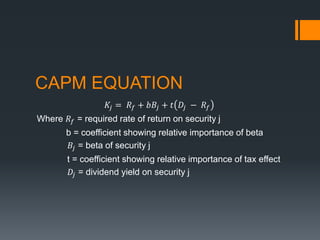
CAPM EQUATION
𝐾𝑗 = 𝑅𝑓 + 𝑏𝐵𝑗 + 𝑡 𝐷𝑗 − 𝑅𝑓
Where 𝑅𝑓 = required rate of return on security j
b = coefficient showing relative importance of beta
𝐵𝑗 = beta of security j
t = coefficient showing relative importance of tax effect
𝐷𝑗 = dividend yield on security j
POPULARITY OF CAPM
 Risk-return trade off – the direct proportional relationship
between the two – has a distinct intuitive appeal
 Transition from Capital Market Line (CML) to Security Market
Line (SML) shows that undiversifiable nature of the
systematic risk makes it the relevant risk for pricing of
securities and portfolios
 Beta, the measure of systematic risk, is easy to compute and
use
 The model shows that investors are content to put their
money in a limited number of portfolios, namely, a risk-free
asset like T-bills and a risky asset like a market-index fund
PROBLEMS WITH CAPM
 One of this relates to the maturity of the risk-free asset,
namely, interest rate on a short term government security like
a T-bill or a long-term rate like that on a treasury bond or an
intermediate term-rate like that on a 3 year treasury
securities
 Whether market premium should be the expected or
historical
 Use of an appropriate market index
 If beta is appropriate risk measure
VARIABLES IN CAPM
 Taxes
 Inflation
 Liquidity
 Market capitalization size
 Price-earnings and market-to-book value ratios
ARBITRAGE PRICING THEORY
(APT)
 APT is based on concept of arbitrage
 It was developed in 1970 by Ross
 In the context of pricing of (return from) securities, arbitrage
implies finding/availability of two securities which are
essentially the same (having different prices/returns)
 APT has markets equilibrating across securities through
arbitrage driving out mispricing
 Arbitrage will ensure that riskless assets(or securities)
provide the same expected return in competitive financial
markets
THANK YOU!!!

Capital asset pricing model (CAPM)

  • 1.
  • 2.
    CAPITAL ALLOCATION LINE Capital allocation line shows the reward to variability ratio in terms of additional beta  Let us denote a risk-free portfolio by F, a risky portfolio by M, and a complete portfolio formed by combining them as C. Further w is the fraction of the overall portfolio invested in M, and the remaining (= 1-w) in F. The expected return of complete portfolio may be calculated as E(𝑟𝑐) = 𝑟𝑓 + w [ E(𝑟 𝑚) − 𝑟𝑓]
  • 3.
    TERMINOLOGY  E(𝑟𝑐) =Expected rate of return on complete portfolio  𝑟𝑓 = Risk-free rate of return  W = Fraction of complete portfolio C invested in risky asset M  E(𝑟 𝑚) = Expected return for risky asset M  E(𝑟 𝑚) − 𝑟𝑓 = Risk premium for risky asset  E(𝑟𝑖) = Expected or required rate of return on asset i
  • 4.
    STANDARD DEVIATION OF PORTFOLIO Standarddeviation of complete portfolio is given by 𝜎𝑐 = 𝑤𝜎 𝑚 Where 𝜎𝑐 = standard deviation of complete portfolio C w = fraction of complete portfolio C, invested in risky asset M 𝜎 𝑚 = standard deviation of risky portfolio M
  • 5.
    SEPARATION THEOREM A risk-averseinvestor assigns greater weight to the risk-free asset in his portfolio than an investor with greater risk tolerance. However, both use identical sets of two assets – one risk-free and another risky. This result is called separation theorem.
  • 6.
    MARKET PORTFOLIO Market portfoliois a theoretical construct credited to Prof. Eugene Fama. It is a huge portfolio that includes all traded assets in exactly the same proportion in which they are supplied in equilibrium. The return on market portfolio is the weighted average of return on all capital assets.
  • 7.
    CAPITAL MARKET LINE(CML)  CML is capital allocation line provided by one-month T-bills as a risk-free asset and a market-index portfolio like Dow Jones, Standard and Poor’s and NYSE, as risky asset  It is one of the two elements of CAPM, the other being security market line (SML)  CML indicates - Locus of all efficient portfolios; Risk-return relationship and measure of risk for efficient portfolios; Relationship between risk (standard deviation) and expected return for efficient portfolio is linear; Appropriate measure of risk for portfolio is standard deviation of returns on portfolio
  • 8.
    FUNCTIONS OF CML It depicts risk-return relationship for efficient portfolios available to investors  It shows the appropriate measure of risk for an efficient portfolios is the standard deviation of return on portfolio
  • 9.
    SECURITY MARKET LINE(SML)  SML is a graphic depiction of CAPM and describes market price of risk in capital markets  E(𝑟𝑖) = 𝑟𝑓 + 𝛽 𝐸 𝑟 𝑚 − 𝑟𝑓  Expected return = Risk-free return + (Beta * Risk premium of market)  On security i = Intercept + (Beta * Slope of SML)  Risk premium on security I = Beta * Risk premium of market
  • 10.
    CAPITAL ASSET PRICING MODEL(CAPM)  CAPM is an equilibrium model of trade-off between expected portfolio return and unavoidable (systematic) risk; the basic theory that links together risk and return of all assets  It is a logical and major extension of portfolio theory of Markowitz by William Sharpe, John Linterner and Jan Mossin  It provides framework for determining the equilibrium expected return for risky assets
  • 11.
    IMPLICATIONS OF CAPM Risk-return relationship for an efficient portfolio  Risk-return relationship for an individual asset/security  Identification of under- and over-valued assets traded in the market  Effect of leverage on cost of equity  Capital budgeting decisions and cost of capital  Risk of firm through diversification of project portfolio
  • 12.
    ASSUMPTIONS OF CAPM All investors are price-takers. Their number is so large that no single investor can afford prices  All investors use the mean-variance portfolio selection model of Markowitz  Assets/securities are perfectly divisible  All investors plan for one identical holding period  Homogeneity of expectation for all investors results in identical efficient frontier and optimal portfolio  Investors can lend or borrow at an identical risk-free rate  There are no transaction costs and income taxes
  • 13.
    EXPECTED RETURN INCAPM  Risk-free rate plus a premium for systematic risk based on beta  The premium of market portfolio, also referred to as reward, depends on the level of risk-free return and return on market portfolio  Information related to the following 3 aspects are needed to apply CAPM: risk-free rate, risk premium on market portfolio and beta
  • 14.
    RISK-FREE RATE  Rateof return available on assets like T-bills, money market funds or bank deposits is taken as proxy for risk-free rate  The maturity period of T-bills and bank deposits is taken to be less than one year, usually 364 days  Such assets have very low or virtually negligible default risk and interest rate risk
  • 15.
    RISK-PREMIUM ON MARKET PORTFOLIO It is the difference between the expected return on market portfolio and risk-free rate of return  CAPM holds that in equilibrium, the market portfolio is unanimously desirable risky portfolio  It contains all securities in exactly the same proportion in which they are supplied, that is, each security is held in proportion to its market value  It is an efficient portfolio, which entails neither lending nor borrowing  It is proportional to its risk (𝜎2 ) and degree of risk aversion of average investor
  • 16.
    BETA  It measuresrisk(volatility) of an individual asset relative to market portfolio  Assets with beta less than one are called defensive assets  Assets with beta greater than one are called aggressive assets  Risk free assets have a beta equal to zero  Beta is covariance of asset’s return with the market portfolio’s return, divided by variance of market portfolio  Beta of a portfolio is the weighted average of betas of assets included in portfolio
  • 17.
    CAPM EQUATION 𝐾𝑗 =𝑅𝑓 + 𝑏𝐵𝑗 + 𝑡 𝐷𝑗 − 𝑅𝑓 Where 𝑅𝑓 = required rate of return on security j b = coefficient showing relative importance of beta 𝐵𝑗 = beta of security j t = coefficient showing relative importance of tax effect 𝐷𝑗 = dividend yield on security j
  • 18.
    POPULARITY OF CAPM Risk-return trade off – the direct proportional relationship between the two – has a distinct intuitive appeal  Transition from Capital Market Line (CML) to Security Market Line (SML) shows that undiversifiable nature of the systematic risk makes it the relevant risk for pricing of securities and portfolios  Beta, the measure of systematic risk, is easy to compute and use  The model shows that investors are content to put their money in a limited number of portfolios, namely, a risk-free asset like T-bills and a risky asset like a market-index fund
  • 19.
    PROBLEMS WITH CAPM One of this relates to the maturity of the risk-free asset, namely, interest rate on a short term government security like a T-bill or a long-term rate like that on a treasury bond or an intermediate term-rate like that on a 3 year treasury securities  Whether market premium should be the expected or historical  Use of an appropriate market index  If beta is appropriate risk measure
  • 20.
    VARIABLES IN CAPM Taxes  Inflation  Liquidity  Market capitalization size  Price-earnings and market-to-book value ratios
  • 21.
    ARBITRAGE PRICING THEORY (APT) APT is based on concept of arbitrage  It was developed in 1970 by Ross  In the context of pricing of (return from) securities, arbitrage implies finding/availability of two securities which are essentially the same (having different prices/returns)  APT has markets equilibrating across securities through arbitrage driving out mispricing  Arbitrage will ensure that riskless assets(or securities) provide the same expected return in competitive financial markets
  • 22.