Portfolio construction:
Risk and return

Calculating portfolio standard
deviation and CV
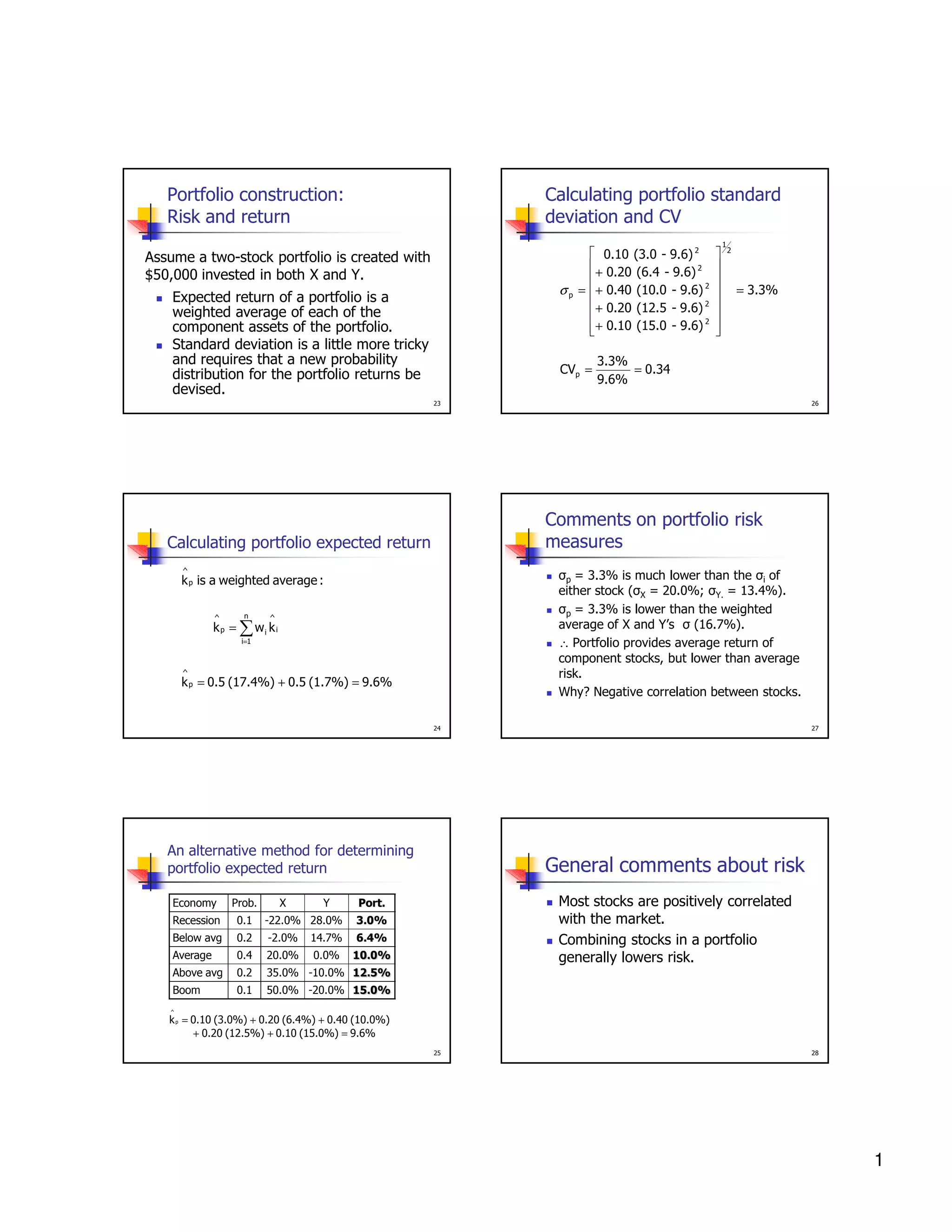
 0.10 (3.0 - 9.6) 2
 + 0.20 (6.4 - 9.6) 2

σ p =  + 0.40 (10.0 - 9.6) 2
 + 0.20 (12.5 - 9.6) 2

2
 + 0.10 (15.0 - 9.6)


Assume a two-stock portfolio is created with
$50,000 invested in both X and Y.
Expected return of a portfolio is a
weighted average of each of the
component assets of the portfolio.
Standard deviation is a little more tricky
and requires that a new probability
distribution for the portfolio returns be
devised.

CVp =










1

2

= 3.3%

3.3%
= 0.34
9.6%

23

Comments on portfolio risk
measures

Calculating portfolio expected return
^

σp = 3.3% is much lower than the σi of
either stock (σX = 20.0%; σY. = 13.4%).
σp = 3.3% is lower than the weighted
average of X and Y’s σ (16.7%).
∴ Portfolio provides average return of
component stocks, but lower than average
risk.
Why? Negative correlation between stocks.

k p is a weighted average :
^

n

26

^

k p = ∑ wi k i
i=1

^

k p = 0.5 (17.4%) + 0.5 (1.7%) = 9.6%

24

An alternative method for determining
portfolio expected return
Economy

Prob.

Recession

0.1

X

Y

-22.0% 28.0%

General comments about risk
Most stocks are positively correlated
with the market.
Combining stocks in a portfolio
generally lowers risk.

Port.
3.0%

Below avg

0.2

-2.0%

14.7%

6.4%

Average

0.4

20.0%

0.0%

10.0%

Above avg

0.2

35.0% -10.0% 12.5%

Boom

0.1

27

50.0% -20.0% 15.0%

^

k p = 0.10 (3.0%) + 0.20 (6.4%) + 0.40 (10.0%)
+ 0.20 (12.5%) + 0.10 (15.0%) = 9.6%
25

28

1
Returns distribution for two perfectly
negatively correlated stocks (ρ = -1.0)

Covx,y & Corr x,y ?
A

Stock W

Stock M

Economy

25

25

25

15

15

15

0

0

0

-10

-10

Prob.

RX

0.1
0.2
0.4
0.2
0.1

-22%
-2%
20%
35%
50%

28%
15%
0%
-10%
-20%

17.4%
20.00%

C

1.7%
13.40%

Ex. Return
Std.dev
Covariance (x,Y)

-10

B

Ry

Recession
Below avg
Average
Above avg
Boom

Portfolio WM

A*B
RX -E(Rx) RY-E(RY)
-39.4% 26.3%
-19.4% 13.0%
2.6% -1.7%
17.6% -11.7%
32.6% -21.7%

-10.36%
-2.52%
-0.04%
-2.06%
-7.07%

C* Prob
-1.04%
-0.50%
-0.02%
-0.41%
-0.71%

-2.68%

Corr (x,Y)

-1.00

29

Incorporating correlation to
portfolio risk calculation

Returns distribution for two perfectly
positively correlated stocks (ρ = 1.0)
Stock M’

Stock M

2
σ p = Wx 2 *σ 2 + W y2 * σ y + 2WxW y Corrxyσ xσ y
x

Portfolio MM’

25

25
15

15

0

0

0

-10

-10

OR, using covariance

25

15

32

-10

2
σ p = Wx 2 *σ 2 + W y2 *σ y + 2WxW y Cov xy
x

Previous Example,

σ p = 0.5 2 * 20 2 + 0.5 2 *13.4 2 + 2 * 0.5 * 0.5 * −1* 20 *13.4
2

30

Co var iance ( X , Y )
σ x *σ y

Cov ( x , y ) = Corr ( x , y ) * σ

x

*σ

33

Calculate the portfolio risk and return
for the example 2 given above if 60%
of investment is made on stock P

,

Therefore

σ p = 0.5 * 20 2 + 0.52 *13.4 2 + 2 * 0.5 * 0.5 * −2.68
σ p = 3. 3

Portfolio risk and return using
historical data

How to find correlation ?
Corr ( x , y ) =

OR, using covariance

σ p = 3. 3

y

Covariance for forecast data with probabilities
n

Cov ( x , y ) =

∑ [r

x

− E ( r x )] [ r y − E ( r y )] Pi

i =1

Covariance for historical data

∑ ( x − x)( y
i

Cov( x, y ) =

i

− y)

i =1

n −1

31

34

2
Creating a portfolio:
Beginning with one stock and adding
randomly selected stocks to portfolio

Failure to diversify

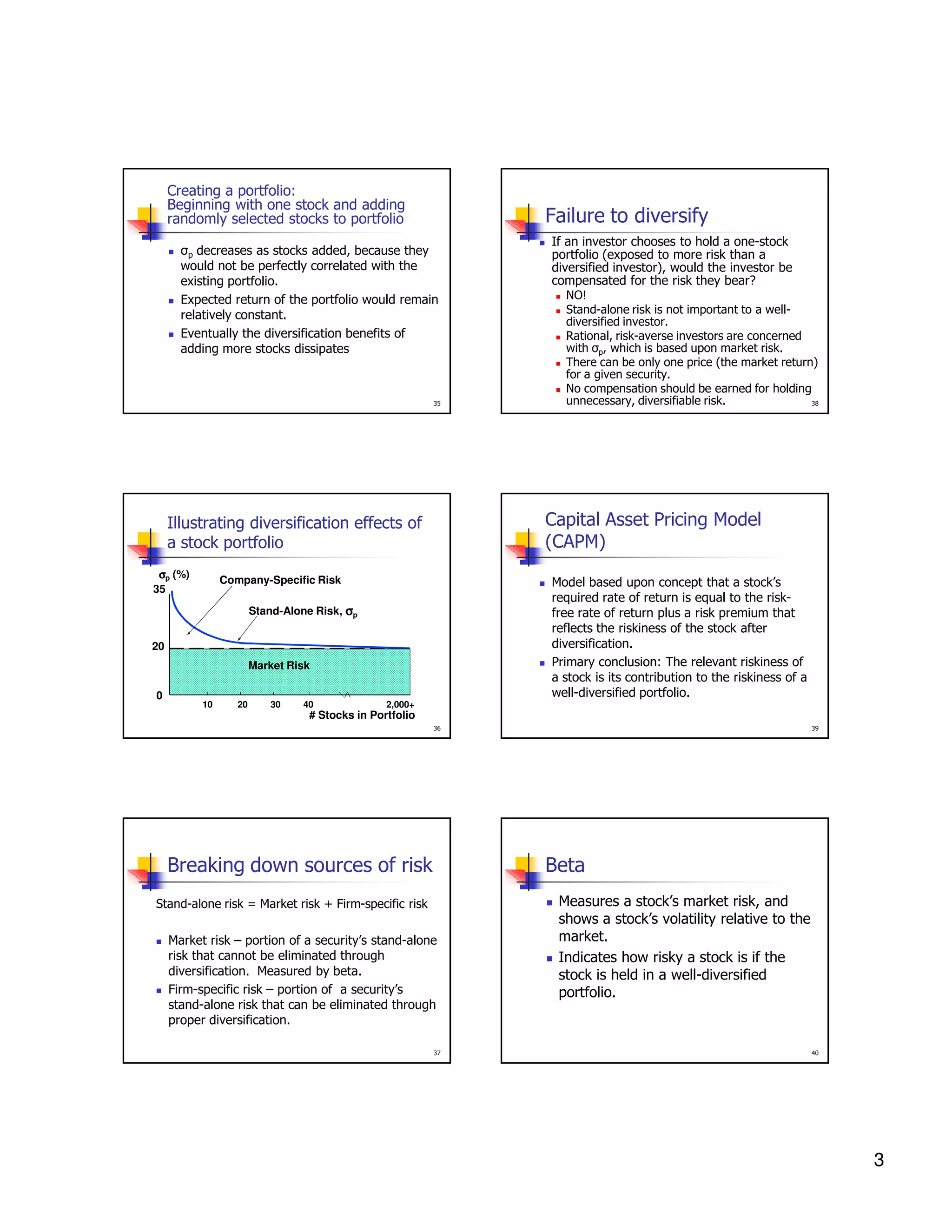
σp decreases as stocks added, because they
would not be perfectly correlated with the
existing portfolio.
Expected return of the portfolio would remain
relatively constant.
Eventually the diversification benefits of
adding more stocks dissipates

35

Company-Specific Risk

Model based upon concept that a stock’s
required rate of return is equal to the riskfree rate of return plus a risk premium that
reflects the riskiness of the stock after
diversification.
Primary conclusion: The relevant riskiness of
a stock is its contribution to the riskiness of a
well-diversified portfolio.

Stand-Alone Risk, σp
20
Market Risk
0

10

20

30

40

NO!
Stand-alone risk is not important to a welldiversified investor.
Rational, risk-averse investors are concerned
with σp, which is based upon market risk.
There can be only one price (the market return)
for a given security.
No compensation should be earned for holding
unnecessary, diversifiable risk.
38

Capital Asset Pricing Model
(CAPM)

Illustrating diversification effects of
a stock portfolio
σp (%)
35

If an investor chooses to hold a one-stock
portfolio (exposed to more risk than a
diversified investor), would the investor be
compensated for the risk they bear?

2,000+

# Stocks in Portfolio
36

Breaking down sources of risk

39

Beta

Stand-alone risk = Market risk + Firm-specific risk

Market risk – portion of a security’s stand-alone
risk that cannot be eliminated through
diversification. Measured by beta.
Firm-specific risk – portion of a security’s
stand-alone risk that can be eliminated through
proper diversification.
37

Measures a stock’s market risk, and
shows a stock’s volatility relative to the
market.
Indicates how risky a stock is if the
stock is held in a well-diversified
portfolio.

40

3
Can the beta of a security be
negative?

Calculating betas

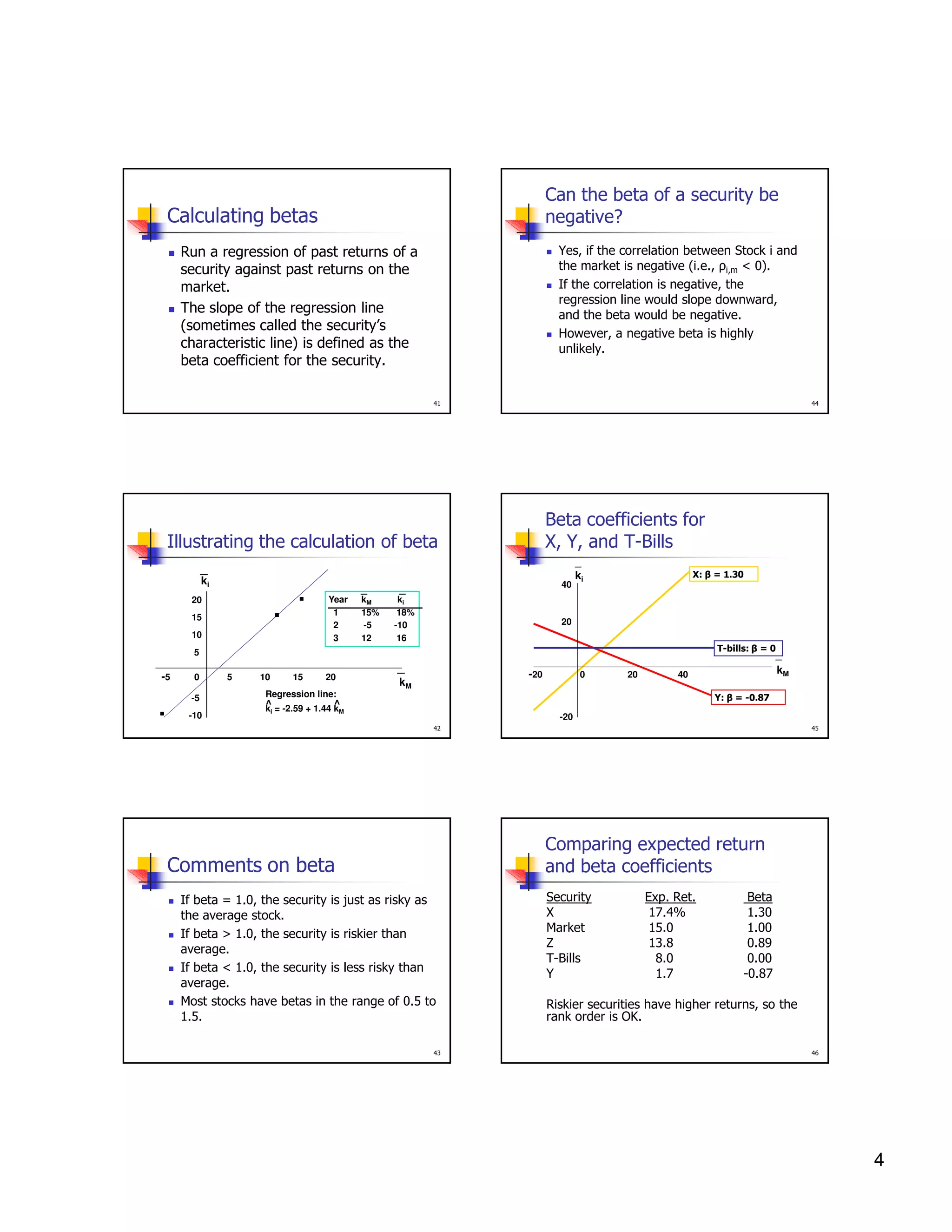
Yes, if the correlation between Stock i and
the market is negative (i.e., ρi,m < 0).
If the correlation is negative, the
regression line would slope downward,
and the beta would be negative.
However, a negative beta is highly
unlikely.

Run a regression of past returns of a
security against past returns on the
market.
The slope of the regression line
(sometimes called the security’s
characteristic line) is defined as the
beta coefficient for the security.
41

44

Beta coefficients for
X, Y, and T-Bills

Illustrating the calculation of beta
_
ki
20

.

15

.

10

40
Year
1
2
3

kM
15%
-5
12

ki
18%
-10
16

_
ki

X: β = 1.30

20
T-bills: β = 0

5

-5

.

0
-5
-10

5

10

15

_

20

-20

kM

0

20

Regression line:

Y: β = -0.87

^ = -2.59 + 1.44 k
^
k
i

_
kM

40

M

-20
42

45

Comparing expected return
and beta coefficients

Comments on beta
If beta = 1.0, the security is just as risky as
the average stock.
If beta > 1.0, the security is riskier than
average.
If beta < 1.0, the security is less risky than
average.
Most stocks have betas in the range of 0.5 to
1.5.
43

Security
X
Market
Z
T-Bills
Y

Exp. Ret.
17.4%
15.0
13.8
8.0
1.7

Beta
1.30
1.00
0.89
0.00
-0.87

Riskier securities have higher returns, so the
rank order is OK.
46

4
The Security Market Line (SML):
Calculating required rates of return

Expected vs. Required returns
^

k

k
^

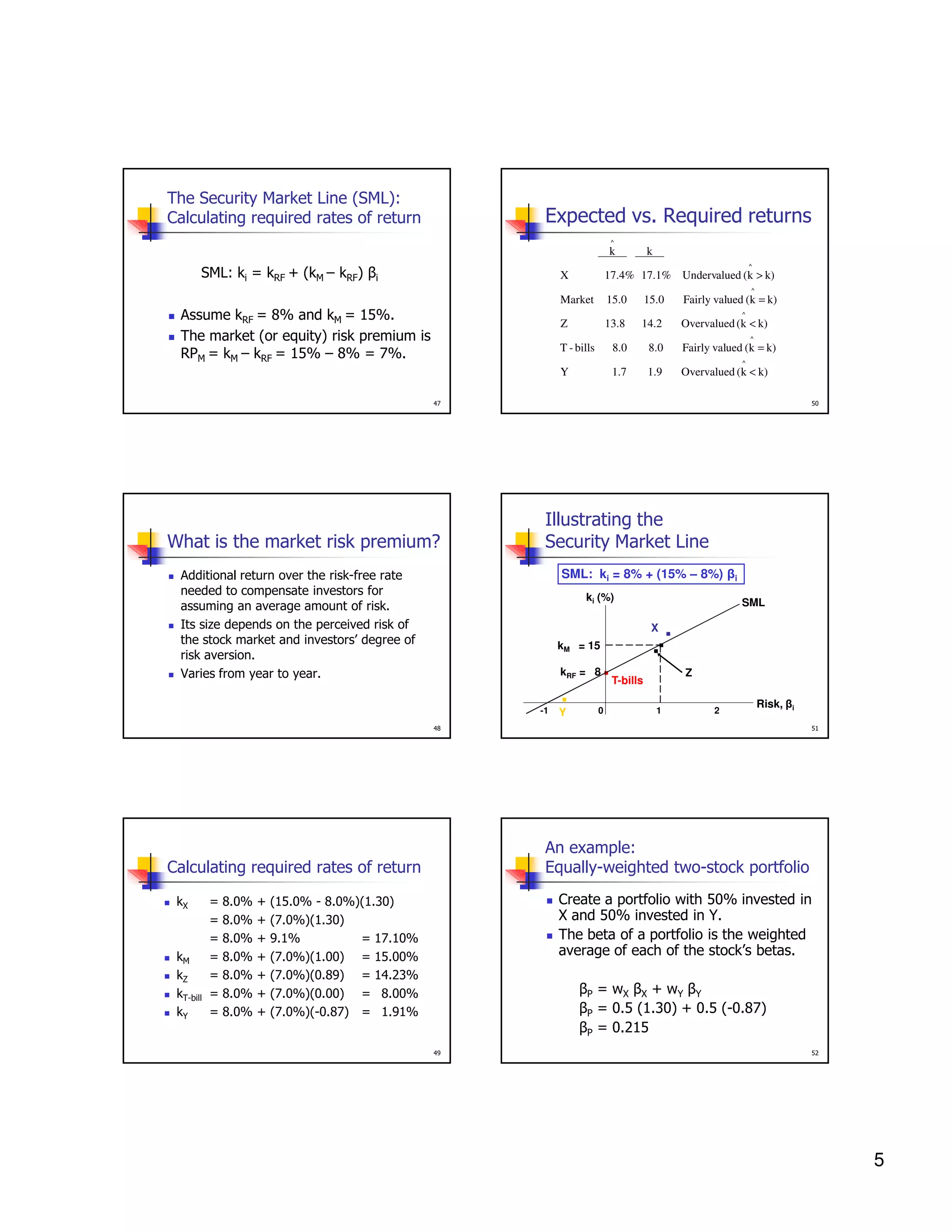
SML: ki = kRF + (kM – kRF) βi

X

17.4% 17.1% Undervalued (k > k)

Market

15.0

^

Assume kRF = 8% and kM = 15%.
The market (or equity) risk premium is
RPM = kM – kRF = 15% – 8% = 7%.

15.0

Fairly valued (k = k)
^

Z

13.8

14.2

Overvalued (k < k)

T - bills

8.0

8.0

Fairly valued (k = k)

Y

1.7

1.9

Overvalued (k < k)

^

^

47

What is the market risk premium?

50

Illustrating the
Security Market Line
SML: ki = 8% + (15% – 8%) βi

Additional return over the risk-free rate
needed to compensate investors for
assuming an average amount of risk.
Its size depends on the perceived risk of
the stock market and investors’ degree of
risk aversion.
Varies from year to year.

ki (%)

SML

.
..

X
kM = 15
kRF = 8
-1

.
Y

. T-bills

0

Z

1

2

Risk, βi

48

An example:
Equally-weighted two-stock portfolio

Calculating required rates of return
kX

kM
kZ
kT-bill
kY

=
=
=
=
=
=
=

8.0%
8.0%
8.0%
8.0%
8.0%
8.0%
8.0%

+
+
+
+
+
+
+

51

Create a portfolio with 50% invested in
X and 50% invested in Y.
The beta of a portfolio is the weighted
average of each of the stock’s betas.

(15.0% - 8.0%)(1.30)
(7.0%)(1.30)
9.1%
= 17.10%
(7.0%)(1.00) = 15.00%
(7.0%)(0.89) = 14.23%
(7.0%)(0.00) = 8.00%
(7.0%)(-0.87) = 1.91%

βP = wX βX + wY βY
βP = 0.5 (1.30) + 0.5 (-0.87)
βP = 0.215
49

52

5
Calculating portfolio required returns

Verifying the CAPM empirically

The required return of a portfolio is the weighted
average of each of the stock’s required returns.

The CAPM has not been verified
completely.
Statistical tests have problems that
make verification almost impossible.
Some argue that there are additional
risk factors, other than the market risk
premium, that must be considered.

kP = wX kX + wY kY
kP = 0.5 (17.1%) + 0.5 (1.9%)
kP = 9.5%
Or, using the portfolio’s beta, CAPM can be used
to solve for expected return.
kP = kRF + (kM – kRF) βP
kP = 8.0% + (15.0% – 8.0%) (0.215)
kP = 9.5%

53

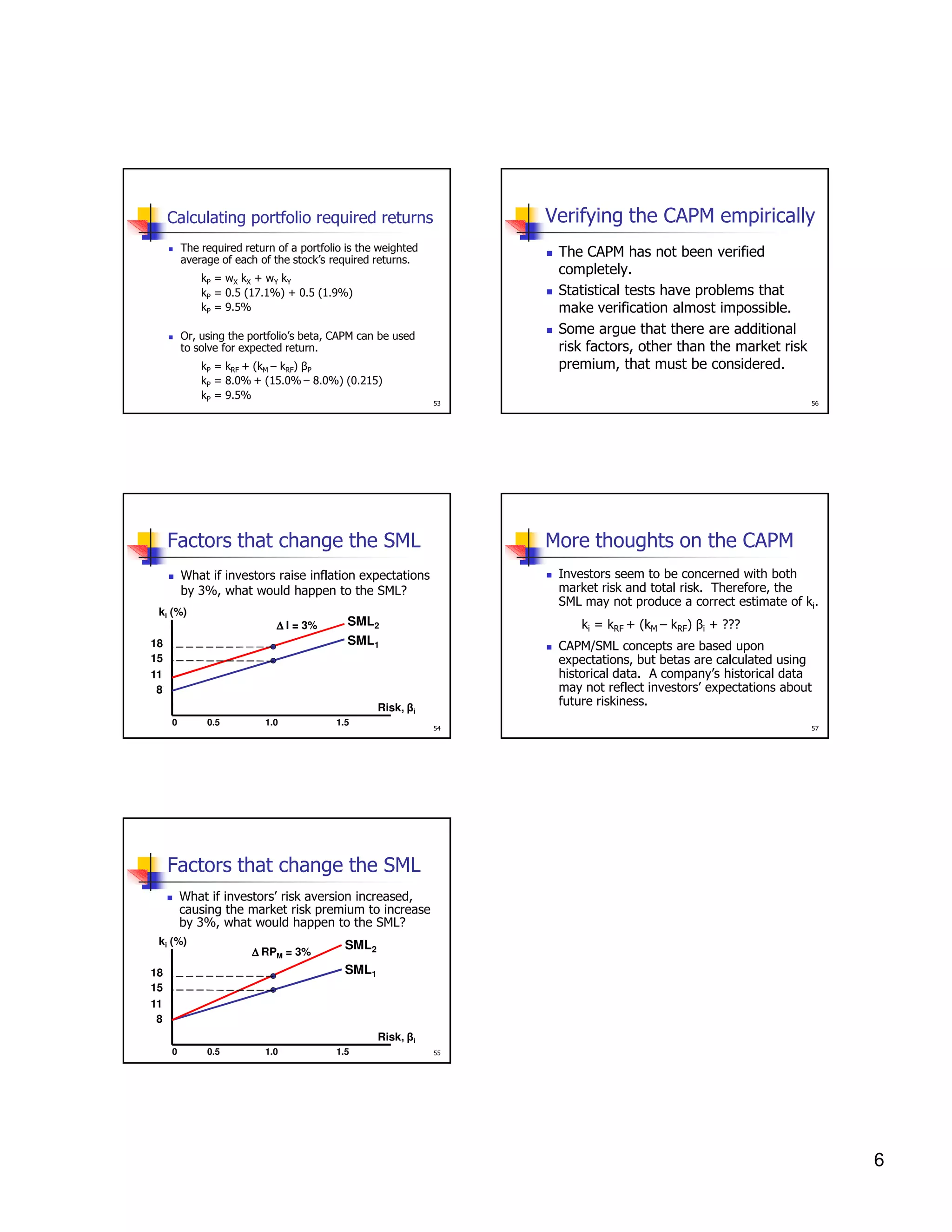
Factors that change the SML

More thoughts on the CAPM
Investors seem to be concerned with both
market risk and total risk. Therefore, the
SML may not produce a correct estimate of ki.

What if investors raise inflation expectations
by 3%, what would happen to the SML?
ki (%)
∆ I = 3%

SML2

ki = kRF + (kM – kRF) βi + ???

SML1

18
15
11
8

CAPM/SML concepts are based upon
expectations, but betas are calculated using
historical data. A company’s historical data
may not reflect investors’ expectations about
future riskiness.

Risk, βi
0

0.5

1.0

1.5

56

54

57

Factors that change the SML
What if investors’ risk aversion increased,
causing the market risk premium to increase
by 3%, what would happen to the SML?
ki (%)

∆ RPM = 3%

SML2
SML1

18
15
11
8

Risk, βi
0

0.5

1.0

1.5

55

6

S9 10 risk return contd (1)

  • 1.
    Portfolio construction: Risk andreturn Calculating portfolio standard deviation and CV  0.10 (3.0 - 9.6) 2  + 0.20 (6.4 - 9.6) 2  σ p =  + 0.40 (10.0 - 9.6) 2  + 0.20 (12.5 - 9.6) 2  2  + 0.10 (15.0 - 9.6)  Assume a two-stock portfolio is created with $50,000 invested in both X and Y. Expected return of a portfolio is a weighted average of each of the component assets of the portfolio. Standard deviation is a little more tricky and requires that a new probability distribution for the portfolio returns be devised. CVp =         1 2 = 3.3% 3.3% = 0.34 9.6% 23 Comments on portfolio risk measures Calculating portfolio expected return ^ σp = 3.3% is much lower than the σi of either stock (σX = 20.0%; σY. = 13.4%). σp = 3.3% is lower than the weighted average of X and Y’s σ (16.7%). ∴ Portfolio provides average return of component stocks, but lower than average risk. Why? Negative correlation between stocks. k p is a weighted average : ^ n 26 ^ k p = ∑ wi k i i=1 ^ k p = 0.5 (17.4%) + 0.5 (1.7%) = 9.6% 24 An alternative method for determining portfolio expected return Economy Prob. Recession 0.1 X Y -22.0% 28.0% General comments about risk Most stocks are positively correlated with the market. Combining stocks in a portfolio generally lowers risk. Port. 3.0% Below avg 0.2 -2.0% 14.7% 6.4% Average 0.4 20.0% 0.0% 10.0% Above avg 0.2 35.0% -10.0% 12.5% Boom 0.1 27 50.0% -20.0% 15.0% ^ k p = 0.10 (3.0%) + 0.20 (6.4%) + 0.40 (10.0%) + 0.20 (12.5%) + 0.10 (15.0%) = 9.6% 25 28 1
  • 2.
    Returns distribution fortwo perfectly negatively correlated stocks (ρ = -1.0) Covx,y & Corr x,y ? A Stock W Stock M Economy 25 25 25 15 15 15 0 0 0 -10 -10 Prob. RX 0.1 0.2 0.4 0.2 0.1 -22% -2% 20% 35% 50% 28% 15% 0% -10% -20% 17.4% 20.00% C 1.7% 13.40% Ex. Return Std.dev Covariance (x,Y) -10 B Ry Recession Below avg Average Above avg Boom Portfolio WM A*B RX -E(Rx) RY-E(RY) -39.4% 26.3% -19.4% 13.0% 2.6% -1.7% 17.6% -11.7% 32.6% -21.7% -10.36% -2.52% -0.04% -2.06% -7.07% C* Prob -1.04% -0.50% -0.02% -0.41% -0.71% -2.68% Corr (x,Y) -1.00 29 Incorporating correlation to portfolio risk calculation Returns distribution for two perfectly positively correlated stocks (ρ = 1.0) Stock M’ Stock M 2 σ p = Wx 2 *σ 2 + W y2 * σ y + 2WxW y Corrxyσ xσ y x Portfolio MM’ 25 25 15 15 0 0 0 -10 -10 OR, using covariance 25 15 32 -10 2 σ p = Wx 2 *σ 2 + W y2 *σ y + 2WxW y Cov xy x Previous Example, σ p = 0.5 2 * 20 2 + 0.5 2 *13.4 2 + 2 * 0.5 * 0.5 * −1* 20 *13.4 2 30 Co var iance ( X , Y ) σ x *σ y Cov ( x , y ) = Corr ( x , y ) * σ x *σ 33 Calculate the portfolio risk and return for the example 2 given above if 60% of investment is made on stock P , Therefore σ p = 0.5 * 20 2 + 0.52 *13.4 2 + 2 * 0.5 * 0.5 * −2.68 σ p = 3. 3 Portfolio risk and return using historical data How to find correlation ? Corr ( x , y ) = OR, using covariance σ p = 3. 3 y Covariance for forecast data with probabilities n Cov ( x , y ) = ∑ [r x − E ( r x )] [ r y − E ( r y )] Pi i =1 Covariance for historical data ∑ ( x − x)( y i Cov( x, y ) = i − y) i =1 n −1 31 34 2
  • 3.
    Creating a portfolio: Beginningwith one stock and adding randomly selected stocks to portfolio Failure to diversify σp decreases as stocks added, because they would not be perfectly correlated with the existing portfolio. Expected return of the portfolio would remain relatively constant. Eventually the diversification benefits of adding more stocks dissipates 35 Company-Specific Risk Model based upon concept that a stock’s required rate of return is equal to the riskfree rate of return plus a risk premium that reflects the riskiness of the stock after diversification. Primary conclusion: The relevant riskiness of a stock is its contribution to the riskiness of a well-diversified portfolio. Stand-Alone Risk, σp 20 Market Risk 0 10 20 30 40 NO! Stand-alone risk is not important to a welldiversified investor. Rational, risk-averse investors are concerned with σp, which is based upon market risk. There can be only one price (the market return) for a given security. No compensation should be earned for holding unnecessary, diversifiable risk. 38 Capital Asset Pricing Model (CAPM) Illustrating diversification effects of a stock portfolio σp (%) 35 If an investor chooses to hold a one-stock portfolio (exposed to more risk than a diversified investor), would the investor be compensated for the risk they bear? 2,000+ # Stocks in Portfolio 36 Breaking down sources of risk 39 Beta Stand-alone risk = Market risk + Firm-specific risk Market risk – portion of a security’s stand-alone risk that cannot be eliminated through diversification. Measured by beta. Firm-specific risk – portion of a security’s stand-alone risk that can be eliminated through proper diversification. 37 Measures a stock’s market risk, and shows a stock’s volatility relative to the market. Indicates how risky a stock is if the stock is held in a well-diversified portfolio. 40 3
  • 4.
    Can the betaof a security be negative? Calculating betas Yes, if the correlation between Stock i and the market is negative (i.e., ρi,m < 0). If the correlation is negative, the regression line would slope downward, and the beta would be negative. However, a negative beta is highly unlikely. Run a regression of past returns of a security against past returns on the market. The slope of the regression line (sometimes called the security’s characteristic line) is defined as the beta coefficient for the security. 41 44 Beta coefficients for X, Y, and T-Bills Illustrating the calculation of beta _ ki 20 . 15 . 10 40 Year 1 2 3 kM 15% -5 12 ki 18% -10 16 _ ki X: β = 1.30 20 T-bills: β = 0 5 -5 . 0 -5 -10 5 10 15 _ 20 -20 kM 0 20 Regression line: Y: β = -0.87 ^ = -2.59 + 1.44 k ^ k i _ kM 40 M -20 42 45 Comparing expected return and beta coefficients Comments on beta If beta = 1.0, the security is just as risky as the average stock. If beta > 1.0, the security is riskier than average. If beta < 1.0, the security is less risky than average. Most stocks have betas in the range of 0.5 to 1.5. 43 Security X Market Z T-Bills Y Exp. Ret. 17.4% 15.0 13.8 8.0 1.7 Beta 1.30 1.00 0.89 0.00 -0.87 Riskier securities have higher returns, so the rank order is OK. 46 4
  • 5.
    The Security MarketLine (SML): Calculating required rates of return Expected vs. Required returns ^ k k ^ SML: ki = kRF + (kM – kRF) βi X 17.4% 17.1% Undervalued (k > k) Market 15.0 ^ Assume kRF = 8% and kM = 15%. The market (or equity) risk premium is RPM = kM – kRF = 15% – 8% = 7%. 15.0 Fairly valued (k = k) ^ Z 13.8 14.2 Overvalued (k < k) T - bills 8.0 8.0 Fairly valued (k = k) Y 1.7 1.9 Overvalued (k < k) ^ ^ 47 What is the market risk premium? 50 Illustrating the Security Market Line SML: ki = 8% + (15% – 8%) βi Additional return over the risk-free rate needed to compensate investors for assuming an average amount of risk. Its size depends on the perceived risk of the stock market and investors’ degree of risk aversion. Varies from year to year. ki (%) SML . .. X kM = 15 kRF = 8 -1 . Y . T-bills 0 Z 1 2 Risk, βi 48 An example: Equally-weighted two-stock portfolio Calculating required rates of return kX kM kZ kT-bill kY = = = = = = = 8.0% 8.0% 8.0% 8.0% 8.0% 8.0% 8.0% + + + + + + + 51 Create a portfolio with 50% invested in X and 50% invested in Y. The beta of a portfolio is the weighted average of each of the stock’s betas. (15.0% - 8.0%)(1.30) (7.0%)(1.30) 9.1% = 17.10% (7.0%)(1.00) = 15.00% (7.0%)(0.89) = 14.23% (7.0%)(0.00) = 8.00% (7.0%)(-0.87) = 1.91% βP = wX βX + wY βY βP = 0.5 (1.30) + 0.5 (-0.87) βP = 0.215 49 52 5
  • 6.
    Calculating portfolio requiredreturns Verifying the CAPM empirically The required return of a portfolio is the weighted average of each of the stock’s required returns. The CAPM has not been verified completely. Statistical tests have problems that make verification almost impossible. Some argue that there are additional risk factors, other than the market risk premium, that must be considered. kP = wX kX + wY kY kP = 0.5 (17.1%) + 0.5 (1.9%) kP = 9.5% Or, using the portfolio’s beta, CAPM can be used to solve for expected return. kP = kRF + (kM – kRF) βP kP = 8.0% + (15.0% – 8.0%) (0.215) kP = 9.5% 53 Factors that change the SML More thoughts on the CAPM Investors seem to be concerned with both market risk and total risk. Therefore, the SML may not produce a correct estimate of ki. What if investors raise inflation expectations by 3%, what would happen to the SML? ki (%) ∆ I = 3% SML2 ki = kRF + (kM – kRF) βi + ??? SML1 18 15 11 8 CAPM/SML concepts are based upon expectations, but betas are calculated using historical data. A company’s historical data may not reflect investors’ expectations about future riskiness. Risk, βi 0 0.5 1.0 1.5 56 54 57 Factors that change the SML What if investors’ risk aversion increased, causing the market risk premium to increase by 3%, what would happen to the SML? ki (%) ∆ RPM = 3% SML2 SML1 18 15 11 8 Risk, βi 0 0.5 1.0 1.5 55 6