Phyllotaxis
Morphology Of Leaf
What is Phyllotaxis? Explain
with diagrams
• The arrangement of the leaf on the stem
is called phyllotaxis. The object of the
phyllotaxis is to avoid over crowding. So
that all leaves get maximum light for
photosynthesis.
• There are two types of phyllotaxis:
• a) Spiral
• b) Cyclic
Two types of phyllotaxis:
a) Spiral phyllotaxis: When the leaves are
present singly on each node, such an
arrangement of leaves is called spiral. And the
leaves are said to be alternate as in mustard,
sunflower etc.
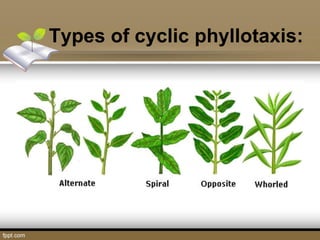
b) Cyclic phyllotaxis: If two or more leaves are
present at each node such an arrangement of
leaves is called cyclic.
Types of cyclic phyllotaxis:
• Opposite : If only two leaves arise at each
node , they are described as opposite.
• Opposite and superposed; If the
opposite leaves borne at any one node,
are parallel to those of the upper node,
they are said to be opposite and
superposed. E.g. Jaman.
Types of cyclic phyllotaxis:
• Opposite and Decussate: If opposite leaves
at any one node are at right angles to those
at the upper or lower node, they are
described as Opposite and decussate . e.g.
Mint, Niazbo, Calotropis.
• Whorled or Verticillate : If more than two
leaves are present at each node and are
arranged in a circle around it , they are said
to be whorled or verticillate as in Oleander
Types of cyclic phyllotaxis:

Phylotaxis

  • 1.
  • 2.
    What is Phyllotaxis?Explain with diagrams • The arrangement of the leaf on the stem is called phyllotaxis. The object of the phyllotaxis is to avoid over crowding. So that all leaves get maximum light for photosynthesis. • There are two types of phyllotaxis: • a) Spiral • b) Cyclic
  • 3.
    Two types ofphyllotaxis: a) Spiral phyllotaxis: When the leaves are present singly on each node, such an arrangement of leaves is called spiral. And the leaves are said to be alternate as in mustard, sunflower etc. b) Cyclic phyllotaxis: If two or more leaves are present at each node such an arrangement of leaves is called cyclic.
  • 4.
    Types of cyclicphyllotaxis: • Opposite : If only two leaves arise at each node , they are described as opposite. • Opposite and superposed; If the opposite leaves borne at any one node, are parallel to those of the upper node, they are said to be opposite and superposed. E.g. Jaman.
  • 5.
    Types of cyclicphyllotaxis: • Opposite and Decussate: If opposite leaves at any one node are at right angles to those at the upper or lower node, they are described as Opposite and decussate . e.g. Mint, Niazbo, Calotropis. • Whorled or Verticillate : If more than two leaves are present at each node and are arranged in a circle around it , they are said to be whorled or verticillate as in Oleander
  • 6.
    Types of cyclicphyllotaxis: