Flowering is a critical stage in the life cycle of a plant, marking the transition from vegetative growth to reproduction. This process is controlled by both internal (endogenous) and external (environmental) factors.
Factors Affecting Floweringin Plants
Submitted to : The Department of Botany
University of Lucknow
Submitted By : Naushad Ahamad
University of Lucknow
2.
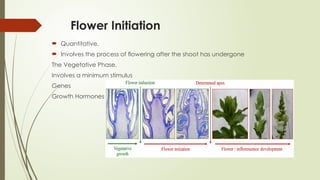
Flower Initiation
Quantitative.
Involves the process of flowering after the shoot has undergone
The Vegetative Phase.
Involves a minimum stimulus
Genes
Growth Hormones
3.
Flower and Flowering
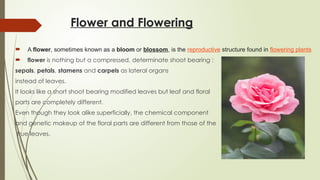
A flower, sometimes known as a bloom or blossom, is the reproductive structure found in flowering plants
flower is nothing but a compressed, determinate shoot bearing :
sepals, petals, stamens and carpels as lateral organs
instead of leaves.
It looks like a short shoot bearing modified leaves but leaf and floral
parts are completely different.
Even though they look alike superficially, the chemical component
and genetic makeup of the floral parts are different from those of the
true leaves.
4.
1. Photoperoidism
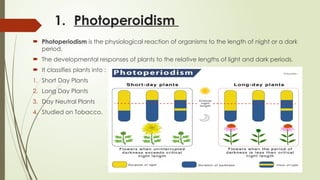
Photoperiodismis the physiological reaction of organisms to the length of night or a dark
period.
The developmental responses of plants to the relative lengths of light and dark periods.
It classifies plants into :
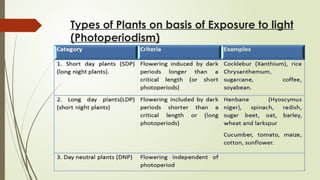
1. Short Day Plants
2. Long Day Plants
3. Day Neutral Plants
4. Studied on Tobacco.
5.
Phytochromes
Phytochromes areleaf pigments which are used by the plant to detect periods of light
and darkness. They work in a range of 600-750 nm.
Phytochromes exist in two forms – an active form and an inactive form.
6.
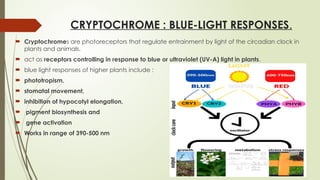
CRYPTOCHROME : BLUE-LIGHTRESPONSES.
Cryptochromes are photoreceptors that regulate entrainment by light of the circadian clock in
plants and animals.
act as receptors controlling in response to blue or ultraviolet (UV-A) light in plants.
blue light responses of higher plants include :
phototropism,
stomatal movement,
inhibition of hypocotyl elongation,
pigment biosynthesis and
gene activation
Works in range of 390-500 nm
7.
Types of Plantson basis of Exposure to light
(Photoperiodism)
8.
2. Vernalisation
Itis the “induction of a plant's flowering process by exposure to the prolonged cold of
winter, or by an artificial equivalent”
Many plants grown in temperate climates require vernalization and must experience a
period of low winter temperature to initiate or accelerate the flowering process.
Thus, the action of chilling is inductive, hence it is named "thermoinduction”
“Devernalisation”
It means that the
Process of vernalisation
gets reversed along
With its effects.
9.
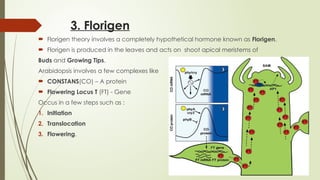
3. Florigen
Florigentheory involves a completely hypothetical hormone known as Florigen.
Florigen is produced in the leaves and acts on shoot apical meristems of
Buds and Growing Tips.
Arabidopsis involves a few complexes like
CONSTANS(CO) – A protein
Flowering Locus T (FT) - Gene
Occus in a few steps such as :
1. Initiation
2. Translocation
3. Flowering.
10.
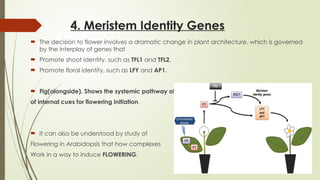
4. Meristem IdentityGenes
The decision to flower involves a dramatic change in plant architecture, which is governed
by the interplay of genes that
Promote shoot identity, such as TFL1 and TFL2,
Promote floral identity, such as LFY and AP1.
Fig(alongside). Shows the systemic pathway of induction
of internal cues for flowering initiation.
It can also be understood by study of
Flowering in Arabidopsis that how complexes
Work in a way to induce FLOWERING.
11.
Other Factors AffectingFlowering
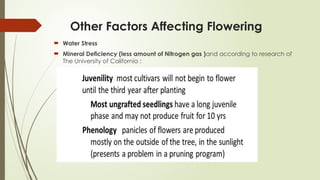
Water Stress
Mineral Deficiency (less amount of Nitrogen gas )and according to research of
The University of California :
12.
Conclusion :
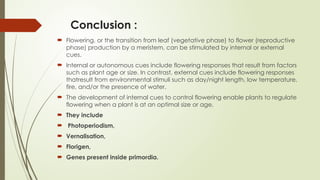
Flowering,or the transition from leaf (vegetative phase) to flower (reproductive
phase) production by a meristem, can be stimulated by internal or external
cues.
Internal or autonomous cues include flowering responses that result from factors
such as plant age or size. In contrast, external cues include flowering responses
thatresult from environmental stimuli such as day/night length, low temperature,
fire, and/or the presence of water.
The development of internal cues to control flowering enable plants to regulate
flowering when a plant is at an optimal size or age.
They include
Photoperiodism,
Vernalisation,
Florigen,
Genes present inside primordia.





![ANIMAL_CELL_,_TISSUE_AND_ORGAN_CULTURE[1].pptx](https://cdn.slidesharecdn.com/ss_thumbnails/animalcelltissueandorganculture1-260204172026-4462b440-thumbnail.jpg?width=640&height=640&fit=bounds)


