POLLEN PISTIL
INTERACTION
DEPARTMENT OF BOTANY
PREPARED BY
DR. P. B. CHOLKE
(ASSISTANT PROFESSOR IN BOTANY)
Pune District Education Association’s
Anantrao Pawar College ,Pirangut,
Tal-Mulshi, Dist-Pune- 412115
POLLEN PISTIL INTERACTION
 After pollination, the pollen grain gets deposited
on the stigma.
 It is two-celled having a larger tube cell and
smaller generative cell.
 The sugary secretions produced on the stigma
stimulate the germination of the pollen grain.
 The inner covering intine produces a pollen tube
which comes out through a germ pore.
 The tube nucleus enters the pollen tube first,
followed by generative nucleus.
 Soon, the tube cell disintegrates, while the generative
nucleus divides by mitosis to produce two haploid
male gametes.
 The pollen tube with its contents, i.e. tube nucleus,
cytoplasm and two male gametes is called male
gametophyte.
 The pollen tube bores its way through the stigma
and passes down though the style towards the
ovary
 After reaching the ovary, the pollen tube enters the ovule
through the micropyle (Porogamy) and then enters
one of the synergids through the filiform apparatus.
 The extensive infoldings of the wall in the synergids
at the micropylar end is called the filiform apparatus.
It plays an important role in attracting the pollen tube.
 All the sequence of events from the deposition of pollen
on the stigma till the entry of pollen tube in the ovule
together is referred to as ‘Pollen Pistil interaction’.
ENDOSPERM DEVELOPMENT IN
ANGIOSPERMS
 Endosperm develops from the triploid primary endospermic
nucleus (PEN).
 The PEN divides and redivides by mitosis to form a tissue called
endosperm.
 Endosperm grows faster than the embryo and gets surrounded
around the embryo.
 In some plants, endosperm is complety utilized by the developing
embryo and as a result there is no endosperm in the mature seeds.
This type of seed without endosperm is called non endospermic
(exalbuminous). Example: Ground nut, Pea.
 In some plants, endosperm is partially utilized by the developing
embryo and as a result there is endosperm in the mature seeds. This
type of seed with endosperm is called endospermic
(albuminous). Example: Maize, Castor.
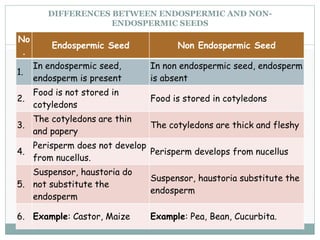
DIFFERENCES BETWEEN ENDOSPERMIC AND NON-
ENDOSPERMIC SEEDS
No
.
Endospermic Seed Non Endospermic Seed
1.
In endospermic seed,
endosperm is present
In non endospermic seed, endosperm
is absent
2.
Food is not stored in
cotyledons
Food is stored in cotyledons
3.
The cotyledons are thin
and papery
The cotyledons are thick and fleshy
4.
Perisperm does not develop
from nucellus.
Perisperm develops from nucellus
5.
Suspensor, haustoria do
not substitute the
endosperm
Suspensor, haustoria substitute the
endosperm
6. Example: Castor, Maize Example: Pea, Bean, Cucurbita.
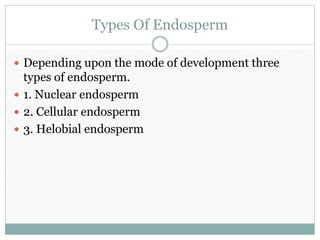
Types Of Endosperm
 Depending upon the mode of development three
types of endosperm.
 1. Nuclear endosperm
 2. Cellular endosperm
 3. Helobial endosperm
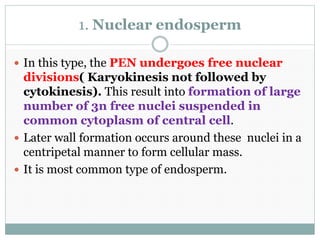
1. Nuclear endosperm
 In this type, the PEN undergoes free nuclear
divisions( Karyokinesis not followed by
cytokinesis). This result into formation of large
number of 3n free nuclei suspended in
common cytoplasm of central cell.
 Later wall formation occurs around these nuclei in a
centripetal manner to form cellular mass.
 It is most common type of endosperm.
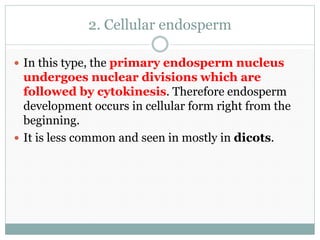
2. Cellular endosperm
 In this type, the primary endosperm nucleus
undergoes nuclear divisions which are
followed by cytokinesis. Therefore endosperm
development occurs in cellular form right from the
beginning.
 It is less common and seen in mostly in dicots.
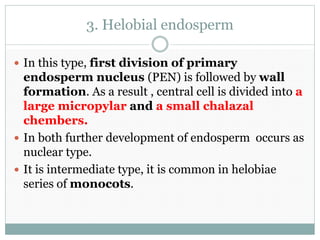
3. Helobial endosperm
 In this type, first division of primary
endosperm nucleus (PEN) is followed by wall
formation. As a result , central cell is divided into a
large micropylar and a small chalazal
chembers.
 In both further development of endosperm occurs as
nuclear type.
 It is intermediate type, it is common in helobiae
series of monocots.
A-Free nuclear B-Cellular C-Helobial
Fig. Types of endosperm
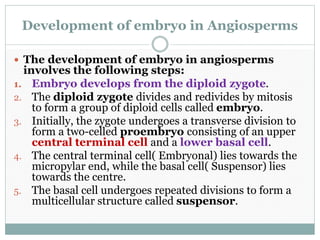
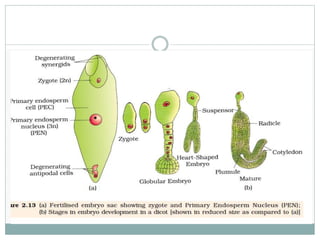
Development of embryo in Angiosperms
 The development of embryo in angiosperms
involves the following steps:
1. Embryo develops from the diploid zygote.
2. The diploid zygote divides and redivides by mitosis
to form a group of diploid cells called embryo.
3. Initially, the zygote undergoes a transverse division to
form a two-celled proembryo consisting of an upper
central terminal cell and a lower basal cell.
4. The central terminal cell( Embryonal) lies towards the
micropylar end, while the basal cell( Suspensor) lies
towards the centre.
5. The basal cell undergoes repeated divisions to form a
multicellular structure called suspensor.
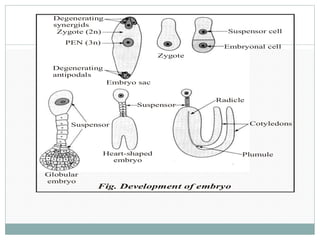
Suspensor
Radicle
Cotyledons
PlumuleHeart-shaped
embryo
Globular
embryo
Suspensor
Degenerating
synergids
Zygote (2n)
PEN (3n)
Degenerating
antipodals
Embryo sac
Zygote
Suspensor cell
Embryonal cell
Fig. Development of embryo
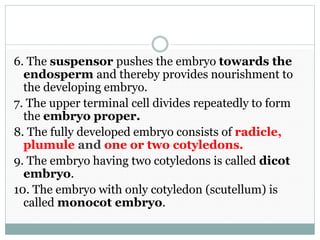
6. The suspensor pushes the embryo towards the
endosperm and thereby provides nourishment to
the developing embryo.
7. The upper terminal cell divides repeatedly to form
the embryo proper.
8. The fully developed embryo consists of radicle,
plumule and one or two cotyledons.
9. The embryo having two cotyledons is called dicot
embryo.
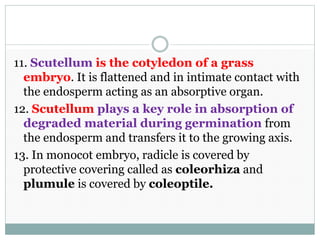
10. The embryo with only cotyledon (scutellum) is
called monocot embryo.
11. Scutellum is the cotyledon of a grass
embryo. It is flattened and in intimate contact with
the endosperm acting as an absorptive organ.
12. Scutellum plays a key role in absorption of
degraded material during germination from
the endosperm and transfers it to the growing axis.
13. In monocot embryo, radicle is covered by
protective covering called as coleorhiza and
plumule is covered by coleoptile.
Formation of fruit and seed.
After fertilization sepals, petals, stamens and style
are wither away and fall off.
 Ovary after fertilization undergoes changes to form
fruit.
A fruit which is developed only from the ovary is
called true fruit.
Some times thalamus is also involved in the fruit
formation such fruits are called false fruits, e.g. Apple,
Strawberry etc.
* The wall of ovary is transformed into the wall of
fruit, called Pericarp
 In most of cases the pericarp consist of three parts.
 i Epicarp : Outer layer .
 ii) Mesocarp : Middle layer
 iii) Endocarp : Inner layer
 * Fruit gives protection to the seed in immature condition
and also involved in dispersal of the seed.
 * After fertilization ovule get transformed into
seed. The integuments of the ovule dry up.
 * The outer integument becomes hard and forms
testa. Whereas inner integument forms the tegmen.
 * In some cases nucellus remains as a thin layer
called perisperm.
 * The micropyle remains in the form of a fine pore
on the surface of seed,
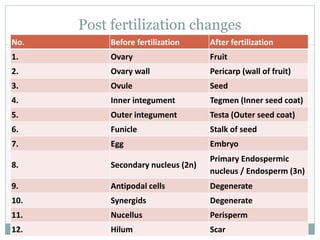
Post fertilization changes
No. Before fertilization After fertilization
1. Ovary Fruit
2. Ovary wall Pericarp (wall of fruit)
3. Ovule Seed
4. Inner integument Tegmen (Inner seed coat)
5. Outer integument Testa (Outer seed coat)
6. Funicle Stalk of seed
7. Egg Embryo
8. Secondary nucleus (2n)
Primary Endospermic
nucleus / Endosperm (3n)
9. Antipodal cells Degenerate
10. Synergids Degenerate
11. Nucellus Perisperm
12. Hilum Scar
Parthenocarpy
 (Parthenos = virgin, carpos = fruit)
 * Formation of fruit without fertilization is called
parthenocarpy, These fruits are called Parthenocarpic fruits.
 * Parthenocarpic fruits are without seeds.
 * Parthenocarpy is of great commercial value. Most
commonly cultivated varieties of Banana are parthenocarp
 * Even in those plants which normally bear seeded fruits,
the parthenocarpy could be induced by the application of
growth hormones like gibberellins.
 * Some common examples of parthenocarpy are Citrus,
Pineapple, Grapes, Orchid, Cherries etc
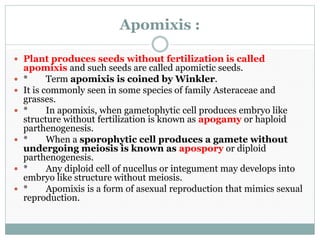
Apomixis :
 Plant produces seeds without fertilization is called
apomixis and such seeds are called apomictic seeds.
 * Term apomixis is coined by Winkler.
 It is commonly seen in some species of family Asteraceae and
grasses.
 * In apomixis, when gametophytic cell produces embryo like
structure without fertilization is known as apogamy or haploid
parthenogenesis.
 * When a sporophytic cell produces a gamete without
undergoing meiosis is known as apospory or diploid
parthenogenesis.
 * Any diploid cell of nucellus or integument may develops into
embryo like structure without meiosis.
 * Apomixis is a form of asexual reproduction that mimics sexual
reproduction.
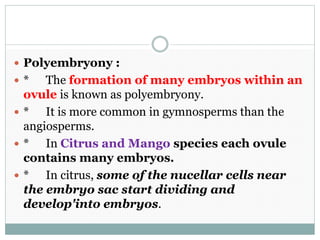
 Polyembryony :
 * The formation of many embryos within an
ovule is known as polyembryony.
 * It is more common in gymnosperms than the
angiosperms.
 * In Citrus and Mango species each ovule
contains many embryos.
 * In citrus, some of the nucellar cells near
the embryo sac start dividing and
develop'into embryos.
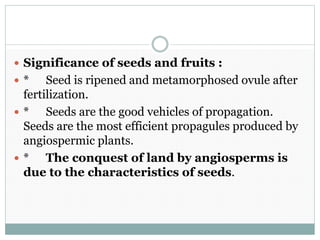
 Significance of seeds and fruits :
 * Seed is ripened and metamorphosed ovule after
fertilization.
 * Seeds are the good vehicles of propagation.
Seeds are the most efficient propagules produced by
angiospermic plants.
 * The conquest of land by angiosperms is
due to the characteristics of seeds.
 Some of the common characteristics of seeds are.
 1. Seed dormancy :
 * Resting period of seed called seed dormancy. It is a
temporary suspension of growth. It is a due to some
internal factors of seed, and some external
environmental factors.
 2. Viability :
 * The functional ability of seed to germinate after
considerable dormancy period is called seed viability.
 * Seeds are more viable due to triploid
endosperm.
 3. Reserve food :
 * It is in the form of starch. Reserve food is stored either in
endosperm or cotyledons, it is essential for growth and
development of embryo.
 4. Protective coat :
 * The outer protective covering of seed is called testa. It
gives protection to embryo.
 * It gives protection from mechanical shocks, dry
conditions or very high temperature.
 5. Edible fruits :
 * Edible fruit are consumed by different organisms. The
seed of these fruits are thrown. These seeds undergoes
germination and produces new plantlet and plant body.

Pollen pistil interaction

  • 1.
    POLLEN PISTIL INTERACTION DEPARTMENT OFBOTANY PREPARED BY DR. P. B. CHOLKE (ASSISTANT PROFESSOR IN BOTANY) Pune District Education Association’s Anantrao Pawar College ,Pirangut, Tal-Mulshi, Dist-Pune- 412115
  • 2.
    POLLEN PISTIL INTERACTION After pollination, the pollen grain gets deposited on the stigma.  It is two-celled having a larger tube cell and smaller generative cell.  The sugary secretions produced on the stigma stimulate the germination of the pollen grain.  The inner covering intine produces a pollen tube which comes out through a germ pore.  The tube nucleus enters the pollen tube first, followed by generative nucleus.
  • 3.
     Soon, thetube cell disintegrates, while the generative nucleus divides by mitosis to produce two haploid male gametes.  The pollen tube with its contents, i.e. tube nucleus, cytoplasm and two male gametes is called male gametophyte.  The pollen tube bores its way through the stigma and passes down though the style towards the ovary
  • 4.
     After reachingthe ovary, the pollen tube enters the ovule through the micropyle (Porogamy) and then enters one of the synergids through the filiform apparatus.  The extensive infoldings of the wall in the synergids at the micropylar end is called the filiform apparatus. It plays an important role in attracting the pollen tube.  All the sequence of events from the deposition of pollen on the stigma till the entry of pollen tube in the ovule together is referred to as ‘Pollen Pistil interaction’.
  • 5.
    ENDOSPERM DEVELOPMENT IN ANGIOSPERMS Endosperm develops from the triploid primary endospermic nucleus (PEN).  The PEN divides and redivides by mitosis to form a tissue called endosperm.  Endosperm grows faster than the embryo and gets surrounded around the embryo.  In some plants, endosperm is complety utilized by the developing embryo and as a result there is no endosperm in the mature seeds. This type of seed without endosperm is called non endospermic (exalbuminous). Example: Ground nut, Pea.  In some plants, endosperm is partially utilized by the developing embryo and as a result there is endosperm in the mature seeds. This type of seed with endosperm is called endospermic (albuminous). Example: Maize, Castor.
  • 6.
    DIFFERENCES BETWEEN ENDOSPERMICAND NON- ENDOSPERMIC SEEDS No . Endospermic Seed Non Endospermic Seed 1. In endospermic seed, endosperm is present In non endospermic seed, endosperm is absent 2. Food is not stored in cotyledons Food is stored in cotyledons 3. The cotyledons are thin and papery The cotyledons are thick and fleshy 4. Perisperm does not develop from nucellus. Perisperm develops from nucellus 5. Suspensor, haustoria do not substitute the endosperm Suspensor, haustoria substitute the endosperm 6. Example: Castor, Maize Example: Pea, Bean, Cucurbita.
  • 7.
    Types Of Endosperm Depending upon the mode of development three types of endosperm.  1. Nuclear endosperm  2. Cellular endosperm  3. Helobial endosperm
  • 8.
    1. Nuclear endosperm In this type, the PEN undergoes free nuclear divisions( Karyokinesis not followed by cytokinesis). This result into formation of large number of 3n free nuclei suspended in common cytoplasm of central cell.  Later wall formation occurs around these nuclei in a centripetal manner to form cellular mass.  It is most common type of endosperm.
  • 9.
    2. Cellular endosperm In this type, the primary endosperm nucleus undergoes nuclear divisions which are followed by cytokinesis. Therefore endosperm development occurs in cellular form right from the beginning.  It is less common and seen in mostly in dicots.
  • 10.
    3. Helobial endosperm In this type, first division of primary endosperm nucleus (PEN) is followed by wall formation. As a result , central cell is divided into a large micropylar and a small chalazal chembers.  In both further development of endosperm occurs as nuclear type.  It is intermediate type, it is common in helobiae series of monocots.
  • 11.
    A-Free nuclear B-CellularC-Helobial Fig. Types of endosperm
  • 12.
    Development of embryoin Angiosperms  The development of embryo in angiosperms involves the following steps: 1. Embryo develops from the diploid zygote. 2. The diploid zygote divides and redivides by mitosis to form a group of diploid cells called embryo. 3. Initially, the zygote undergoes a transverse division to form a two-celled proembryo consisting of an upper central terminal cell and a lower basal cell. 4. The central terminal cell( Embryonal) lies towards the micropylar end, while the basal cell( Suspensor) lies towards the centre. 5. The basal cell undergoes repeated divisions to form a multicellular structure called suspensor.
  • 13.
  • 14.
    6. The suspensorpushes the embryo towards the endosperm and thereby provides nourishment to the developing embryo. 7. The upper terminal cell divides repeatedly to form the embryo proper. 8. The fully developed embryo consists of radicle, plumule and one or two cotyledons. 9. The embryo having two cotyledons is called dicot embryo. 10. The embryo with only cotyledon (scutellum) is called monocot embryo.
  • 16.
    11. Scutellum isthe cotyledon of a grass embryo. It is flattened and in intimate contact with the endosperm acting as an absorptive organ. 12. Scutellum plays a key role in absorption of degraded material during germination from the endosperm and transfers it to the growing axis. 13. In monocot embryo, radicle is covered by protective covering called as coleorhiza and plumule is covered by coleoptile.
  • 18.
    Formation of fruitand seed. After fertilization sepals, petals, stamens and style are wither away and fall off.  Ovary after fertilization undergoes changes to form fruit. A fruit which is developed only from the ovary is called true fruit. Some times thalamus is also involved in the fruit formation such fruits are called false fruits, e.g. Apple, Strawberry etc. * The wall of ovary is transformed into the wall of fruit, called Pericarp
  • 19.
     In mostof cases the pericarp consist of three parts.  i Epicarp : Outer layer .  ii) Mesocarp : Middle layer  iii) Endocarp : Inner layer  * Fruit gives protection to the seed in immature condition and also involved in dispersal of the seed.  * After fertilization ovule get transformed into seed. The integuments of the ovule dry up.  * The outer integument becomes hard and forms testa. Whereas inner integument forms the tegmen.  * In some cases nucellus remains as a thin layer called perisperm.  * The micropyle remains in the form of a fine pore on the surface of seed,
  • 20.
    Post fertilization changes No.Before fertilization After fertilization 1. Ovary Fruit 2. Ovary wall Pericarp (wall of fruit) 3. Ovule Seed 4. Inner integument Tegmen (Inner seed coat) 5. Outer integument Testa (Outer seed coat) 6. Funicle Stalk of seed 7. Egg Embryo 8. Secondary nucleus (2n) Primary Endospermic nucleus / Endosperm (3n) 9. Antipodal cells Degenerate 10. Synergids Degenerate 11. Nucellus Perisperm 12. Hilum Scar
  • 21.
    Parthenocarpy  (Parthenos =virgin, carpos = fruit)  * Formation of fruit without fertilization is called parthenocarpy, These fruits are called Parthenocarpic fruits.  * Parthenocarpic fruits are without seeds.  * Parthenocarpy is of great commercial value. Most commonly cultivated varieties of Banana are parthenocarp  * Even in those plants which normally bear seeded fruits, the parthenocarpy could be induced by the application of growth hormones like gibberellins.  * Some common examples of parthenocarpy are Citrus, Pineapple, Grapes, Orchid, Cherries etc
  • 22.
    Apomixis :  Plantproduces seeds without fertilization is called apomixis and such seeds are called apomictic seeds.  * Term apomixis is coined by Winkler.  It is commonly seen in some species of family Asteraceae and grasses.  * In apomixis, when gametophytic cell produces embryo like structure without fertilization is known as apogamy or haploid parthenogenesis.  * When a sporophytic cell produces a gamete without undergoing meiosis is known as apospory or diploid parthenogenesis.  * Any diploid cell of nucellus or integument may develops into embryo like structure without meiosis.  * Apomixis is a form of asexual reproduction that mimics sexual reproduction.
  • 23.
     Polyembryony : * The formation of many embryos within an ovule is known as polyembryony.  * It is more common in gymnosperms than the angiosperms.  * In Citrus and Mango species each ovule contains many embryos.  * In citrus, some of the nucellar cells near the embryo sac start dividing and develop'into embryos.
  • 24.
     Significance ofseeds and fruits :  * Seed is ripened and metamorphosed ovule after fertilization.  * Seeds are the good vehicles of propagation. Seeds are the most efficient propagules produced by angiospermic plants.  * The conquest of land by angiosperms is due to the characteristics of seeds.
  • 25.
     Some ofthe common characteristics of seeds are.  1. Seed dormancy :  * Resting period of seed called seed dormancy. It is a temporary suspension of growth. It is a due to some internal factors of seed, and some external environmental factors.  2. Viability :  * The functional ability of seed to germinate after considerable dormancy period is called seed viability.  * Seeds are more viable due to triploid endosperm.
  • 26.
     3. Reservefood :  * It is in the form of starch. Reserve food is stored either in endosperm or cotyledons, it is essential for growth and development of embryo.  4. Protective coat :  * The outer protective covering of seed is called testa. It gives protection to embryo.  * It gives protection from mechanical shocks, dry conditions or very high temperature.  5. Edible fruits :  * Edible fruit are consumed by different organisms. The seed of these fruits are thrown. These seeds undergoes germination and produces new plantlet and plant body.