1
PRESENTED BY:
Shalini Sharma
SUBMITTED TO :
P. G. DEPARTMENT OF BOTANY
Sanmati Govt. College of Science Education and Research,
Jagraon (Ludhiana)
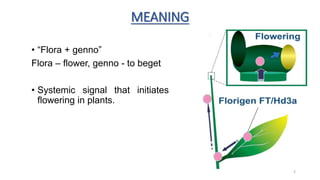
MEANING
• “Flora + genno”
Flora – flower, genno - to beget
• Systemic signal that initiates
flowering in plants.
2
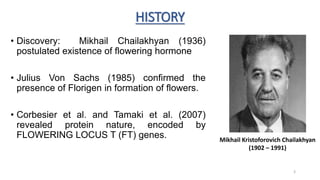
HISTORY
• Discovery: Mikhail Chailakhyan (1936)
postulated existence of flowering hormone
• Julius Von Sachs (1985) confirmed the
presence of Florigen in formation of flowers.
• Corbesier et al. and Tamaki et al. (2007)
revealed protein nature, encoded by
FLOWERING LOCUS T (FT) genes.
3
Mikhail Kristoforovich Chailakhyan
(1902 – 1991)
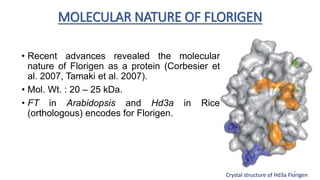
MOLECULAR NATURE OF FLORIGEN
• Recent advances revealed the molecular
nature of Florigen as a protein (Corbesier et
al. 2007, Tamaki et al. 2007).
• Mol. Wt. : 20 – 25 kDa.
• FT in Arabidopsis and Hd3a in Rice
(orthologous) encodes for Florigen.
Crystal structure of Hd3a Florigen
4
CHARACTERISTICS OF FLORIGEN
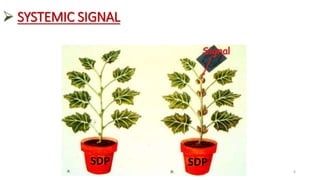
SYSTEMIC SIGNAL
TRANSPORT THROUGH PHLOEM
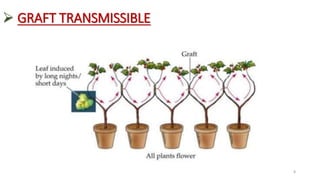
GRAFT TRANSMISSIBLE
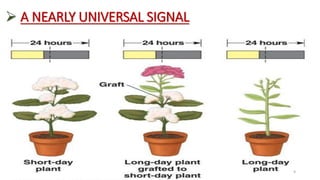
A NEARLY UNIVERSAL SIGNAL
QUANTITATIVE
5
 SYSTEMIC SIGNAL
6
SDP SDP
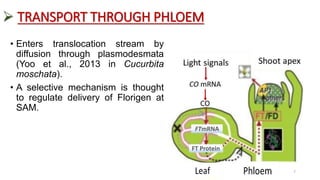
 TRANSPORT THROUGH PHLOEM
• Enters translocation stream by
diffusion through plasmodesmata
(Yoo et al., 2013 in Cucurbita
moschata).
• A selective mechanism is thought
to regulate delivery of Florigen at
SAM.
7
FTmRNA
FT Protein
 GRAFT TRANSMISSIBLE
8
 A NEARLY UNIVERSAL SIGNAL
9
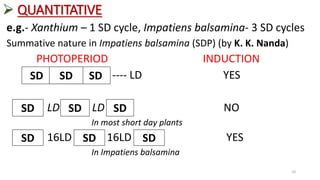
 QUANTITATIVE
e.g.- Xanthium – 1 SD cycle, Impatiens balsamina- 3 SD cycles
Summative nature in Impatiens balsamina (SDP) (by K. K. Nanda)
PHOTOPERIOD INDUCTION
---- LD YES
LD LD NO
In most short day plants
16LD 16LD YES
In Impatiens balsamina
SD SD SD
SD SD SD
SD SD SD
10
MECHANISM OF ACTION
The mechanism can be broken down into three steps:
1. PHOTOPERIOD - REGULATED PRODUCTION
2. SIGNAL TRANSLOCATION
3. INITIATION OF FLOWERING AT SHOOT APICAL
MERISTEM
11
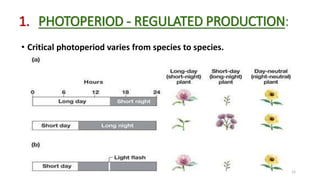
1. PHOTOPERIOD - REGULATED PRODUCTION:
• Critical photoperiod varies from species to species.
12
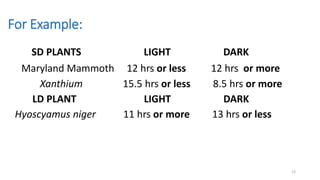
For Example:
SD PLANTS LIGHT DARK
Maryland Mammoth 12 hrs or less 12 hrs or more
Xanthium 15.5 hrs or less 8.5 hrs or more
LD PLANT LIGHT DARK
Hyoscyamus niger 11 hrs or more 13 hrs or less
13
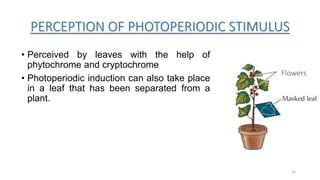
PERCEPTION OF PHOTOPERIODIC STIMULUS
• Perceived by leaves with the help of
phytochrome and cryptochrome
• Photoperiodic induction can also take place
in a leaf that has been separated from a
plant.
Flowers
14
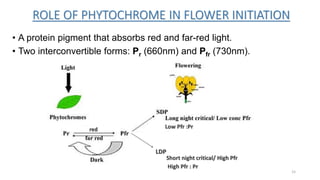
ROLE OF PHYTOCHROME IN FLOWER INITIATION
• A protein pigment that absorbs red and far-red light.
• Two interconvertible forms: Pr (660nm) and Pfr (730nm).
LDP
Short night critical/ High Pfr
15
Low Pfr :Pr
High Pfr : Pr
red
ROLE OF CRYPTOCHROME IN FLOWER INITIATION
• A protein pigment that absorbs blue light.
• In Arabidopsis mutation in one of the cryptochrome gene,
CRY2, caused a delay in flowering and an inability to
perceive inductive photoperiods ( Guo et al. 1998).
16
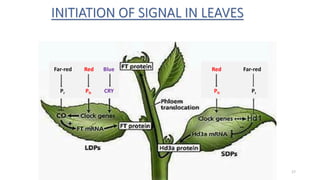
INITIATION OF SIGNAL IN LEAVES
17
Red Far-red
Pfr Pr
Far-red Red Blue
Pr Pfr CRY
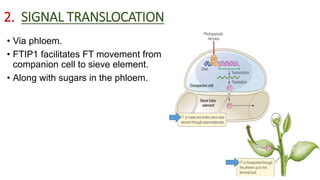
2. SIGNAL TRANSLOCATION
• Via phloem.
• FTIP1 facilitates FT movement from
companion cell to sieve element.
• Along with sugars in the phloem.
18
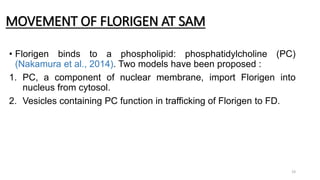
MOVEMENT OF FLORIGEN AT SAM
• Florigen binds to a phospholipid: phosphatidylcholine (PC)
(Nakamura et al., 2014). Two models have been proposed :
1. PC, a component of nuclear membrane, import Florigen into
nucleus from cytosol.
2. Vesicles containing PC function in trafficking of Florigen to FD.
19
3. INITIATION OF FLOWERING AT SAM
At SAM, two processes leads to floral transition:
I. Formation of Florigen Activation Complex
II. Downstream gene expression
20
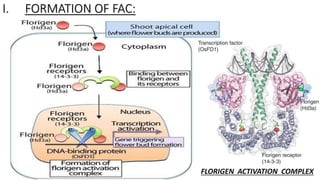
I. FORMATION OF FAC:
FLORIGEN ACTIVATION COMPLEX21
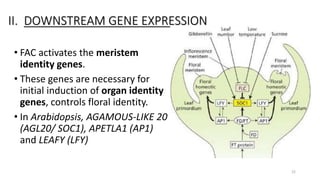
II. DOWNSTREAM GENE EXPRESSION
• FAC activates the meristem
identity genes.
• These genes are necessary for
initial induction of organ identity
genes, controls floral identity.
• In Arabidopsis, AGAMOUS-LIKE 20
(AGL20/ SOC1), APETLA1 (AP1)
and LEAFY (LFY)
22
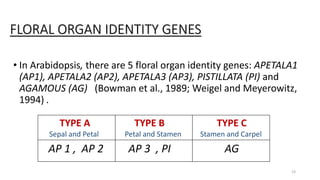
FLORAL ORGAN IDENTITY GENES
• In Arabidopsis, there are 5 floral organ identity genes: APETALA1
(AP1), APETALA2 (AP2), APETALA3 (AP3), PISTILLATA (PI) and
AGAMOUS (AG) (Bowman et al., 1989; Weigel and Meyerowitz,
1994) .
TYPE A
Sepal and Petal
TYPE B
Petal and Stamen
TYPE C
Stamen and Carpel
AP 1 , AP 2 AP 3 , PI AG
23
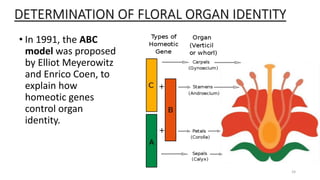
DETERMINATION OF FLORAL ORGAN IDENTITY
• In 1991, the ABC
model was proposed
by Elliot Meyerowitz
and Enrico Coen, to
explain how
homeotic genes
control organ
identity.
24
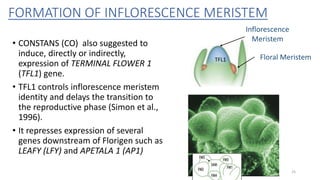
FORMATION OF INFLORESCENCE MERISTEM
• CONSTANS (CO) also suggested to
induce, directly or indirectly,
expression of TERMINAL FLOWER 1
(TFL1) gene.
• TFL1 controls inflorescence meristem
identity and delays the transition to
the reproductive phase (Simon et al.,
1996).
• It represses expression of several
genes downstream of Florigen such as
LEAFY (LFY) and APETALA 1 (AP1)
Inflorescence
Meristem
TFL1 Floral Meristem
25
OTHER FUNCTIONS OF FLORIGEN
Formation of storage organs
e.g., Tuber formation in Potato (Navarro et al. 2011)
Bulb formation in Onion (Lee et al. 2013)
Fruit development in Pineapple (Lv et al. 2012)
Timing of reproduction
Plant Architecture
e.g., Leaf development in Rice (Tsuji et al. 2013)
Promotes lateral branching in the axillary meristem in Rice ( Tsuji et al.
2015).
26
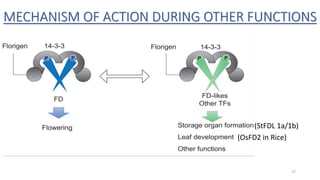
MECHANISM OF ACTION DURING OTHER FUNCTIONS
(StFDL 1a/1b)
(OsFD2 in Rice)
27
ANTIFLORIGEN
• Transmissible inhibitors of flowering.
• Produced in leaves of LDPs during non-inductive photoperiod.
• Graft transmissible.
Experiment : by Lang et al. 1977
Grafting of uninduced LDP Nicotiana sylvestris onto a DNP
Nicotiana tabacum cultivar Trapezond
During short days ---------- No flowering in DNP
During long days ---------- Flowering
28
CONCLUSION
When discovered Florigen was considered as a
flowering hormone. Recent studies show its nature as a
globular protein. But its exact molecular nature is still a
mystery as all attempts to isolate and identify Florigen
have been largely unsuccessful.
29
REFERENCES
Malik, C. P. and Shrivastava, A. K. (2005). Textbook of Plant Physiology.
Kalyani Publishers, New Delhi-Ludhiana
Salisbury, F.B. and Ross, C. (1995). Plant Physiology ed 1st. CBS
Publishers and Distributors, Shahdara, Delhi
Taiz, L. and Zeiger, E. (2003). Plant Physiology ed 3rd. Panima Publishing
Corporation, New Delhi-110002
https://www.researchgate.net/publication/318667245_Molecular_f
unction_of_florigen
https://www.cell.com/molecular-plant/pdf/S1674-2052(15)00094-
5.pdf
30
31THANK YOU

Florigen concept

  • 1.
    1 PRESENTED BY: Shalini Sharma SUBMITTEDTO : P. G. DEPARTMENT OF BOTANY Sanmati Govt. College of Science Education and Research, Jagraon (Ludhiana)
  • 2.
    MEANING • “Flora +genno” Flora – flower, genno - to beget • Systemic signal that initiates flowering in plants. 2
  • 3.
    HISTORY • Discovery: MikhailChailakhyan (1936) postulated existence of flowering hormone • Julius Von Sachs (1985) confirmed the presence of Florigen in formation of flowers. • Corbesier et al. and Tamaki et al. (2007) revealed protein nature, encoded by FLOWERING LOCUS T (FT) genes. 3 Mikhail Kristoforovich Chailakhyan (1902 – 1991)
  • 4.
    MOLECULAR NATURE OFFLORIGEN • Recent advances revealed the molecular nature of Florigen as a protein (Corbesier et al. 2007, Tamaki et al. 2007). • Mol. Wt. : 20 – 25 kDa. • FT in Arabidopsis and Hd3a in Rice (orthologous) encodes for Florigen. Crystal structure of Hd3a Florigen 4
  • 5.
    CHARACTERISTICS OF FLORIGEN SYSTEMICSIGNAL TRANSPORT THROUGH PHLOEM GRAFT TRANSMISSIBLE A NEARLY UNIVERSAL SIGNAL QUANTITATIVE 5
  • 6.
  • 7.
     TRANSPORT THROUGHPHLOEM • Enters translocation stream by diffusion through plasmodesmata (Yoo et al., 2013 in Cucurbita moschata). • A selective mechanism is thought to regulate delivery of Florigen at SAM. 7 FTmRNA FT Protein
  • 8.
  • 9.
     A NEARLYUNIVERSAL SIGNAL 9
  • 10.
     QUANTITATIVE e.g.- Xanthium– 1 SD cycle, Impatiens balsamina- 3 SD cycles Summative nature in Impatiens balsamina (SDP) (by K. K. Nanda) PHOTOPERIOD INDUCTION ---- LD YES LD LD NO In most short day plants 16LD 16LD YES In Impatiens balsamina SD SD SD SD SD SD SD SD SD 10
  • 11.
    MECHANISM OF ACTION Themechanism can be broken down into three steps: 1. PHOTOPERIOD - REGULATED PRODUCTION 2. SIGNAL TRANSLOCATION 3. INITIATION OF FLOWERING AT SHOOT APICAL MERISTEM 11
  • 12.
    1. PHOTOPERIOD -REGULATED PRODUCTION: • Critical photoperiod varies from species to species. 12
  • 13.
    For Example: SD PLANTSLIGHT DARK Maryland Mammoth 12 hrs or less 12 hrs or more Xanthium 15.5 hrs or less 8.5 hrs or more LD PLANT LIGHT DARK Hyoscyamus niger 11 hrs or more 13 hrs or less 13
  • 14.
    PERCEPTION OF PHOTOPERIODICSTIMULUS • Perceived by leaves with the help of phytochrome and cryptochrome • Photoperiodic induction can also take place in a leaf that has been separated from a plant. Flowers 14
  • 15.
    ROLE OF PHYTOCHROMEIN FLOWER INITIATION • A protein pigment that absorbs red and far-red light. • Two interconvertible forms: Pr (660nm) and Pfr (730nm). LDP Short night critical/ High Pfr 15 Low Pfr :Pr High Pfr : Pr red
  • 16.
    ROLE OF CRYPTOCHROMEIN FLOWER INITIATION • A protein pigment that absorbs blue light. • In Arabidopsis mutation in one of the cryptochrome gene, CRY2, caused a delay in flowering and an inability to perceive inductive photoperiods ( Guo et al. 1998). 16
  • 17.
    INITIATION OF SIGNALIN LEAVES 17 Red Far-red Pfr Pr Far-red Red Blue Pr Pfr CRY
  • 18.
    2. SIGNAL TRANSLOCATION •Via phloem. • FTIP1 facilitates FT movement from companion cell to sieve element. • Along with sugars in the phloem. 18
  • 19.
    MOVEMENT OF FLORIGENAT SAM • Florigen binds to a phospholipid: phosphatidylcholine (PC) (Nakamura et al., 2014). Two models have been proposed : 1. PC, a component of nuclear membrane, import Florigen into nucleus from cytosol. 2. Vesicles containing PC function in trafficking of Florigen to FD. 19
  • 20.
    3. INITIATION OFFLOWERING AT SAM At SAM, two processes leads to floral transition: I. Formation of Florigen Activation Complex II. Downstream gene expression 20
  • 21.
    I. FORMATION OFFAC: FLORIGEN ACTIVATION COMPLEX21
  • 22.
    II. DOWNSTREAM GENEEXPRESSION • FAC activates the meristem identity genes. • These genes are necessary for initial induction of organ identity genes, controls floral identity. • In Arabidopsis, AGAMOUS-LIKE 20 (AGL20/ SOC1), APETLA1 (AP1) and LEAFY (LFY) 22
  • 23.
    FLORAL ORGAN IDENTITYGENES • In Arabidopsis, there are 5 floral organ identity genes: APETALA1 (AP1), APETALA2 (AP2), APETALA3 (AP3), PISTILLATA (PI) and AGAMOUS (AG) (Bowman et al., 1989; Weigel and Meyerowitz, 1994) . TYPE A Sepal and Petal TYPE B Petal and Stamen TYPE C Stamen and Carpel AP 1 , AP 2 AP 3 , PI AG 23
  • 24.
    DETERMINATION OF FLORALORGAN IDENTITY • In 1991, the ABC model was proposed by Elliot Meyerowitz and Enrico Coen, to explain how homeotic genes control organ identity. 24
  • 25.
    FORMATION OF INFLORESCENCEMERISTEM • CONSTANS (CO) also suggested to induce, directly or indirectly, expression of TERMINAL FLOWER 1 (TFL1) gene. • TFL1 controls inflorescence meristem identity and delays the transition to the reproductive phase (Simon et al., 1996). • It represses expression of several genes downstream of Florigen such as LEAFY (LFY) and APETALA 1 (AP1) Inflorescence Meristem TFL1 Floral Meristem 25
  • 26.
    OTHER FUNCTIONS OFFLORIGEN Formation of storage organs e.g., Tuber formation in Potato (Navarro et al. 2011) Bulb formation in Onion (Lee et al. 2013) Fruit development in Pineapple (Lv et al. 2012) Timing of reproduction Plant Architecture e.g., Leaf development in Rice (Tsuji et al. 2013) Promotes lateral branching in the axillary meristem in Rice ( Tsuji et al. 2015). 26
  • 27.
    MECHANISM OF ACTIONDURING OTHER FUNCTIONS (StFDL 1a/1b) (OsFD2 in Rice) 27
  • 28.
    ANTIFLORIGEN • Transmissible inhibitorsof flowering. • Produced in leaves of LDPs during non-inductive photoperiod. • Graft transmissible. Experiment : by Lang et al. 1977 Grafting of uninduced LDP Nicotiana sylvestris onto a DNP Nicotiana tabacum cultivar Trapezond During short days ---------- No flowering in DNP During long days ---------- Flowering 28
  • 29.
    CONCLUSION When discovered Florigenwas considered as a flowering hormone. Recent studies show its nature as a globular protein. But its exact molecular nature is still a mystery as all attempts to isolate and identify Florigen have been largely unsuccessful. 29
  • 30.
    REFERENCES Malik, C. P.and Shrivastava, A. K. (2005). Textbook of Plant Physiology. Kalyani Publishers, New Delhi-Ludhiana Salisbury, F.B. and Ross, C. (1995). Plant Physiology ed 1st. CBS Publishers and Distributors, Shahdara, Delhi Taiz, L. and Zeiger, E. (2003). Plant Physiology ed 3rd. Panima Publishing Corporation, New Delhi-110002 https://www.researchgate.net/publication/318667245_Molecular_f unction_of_florigen https://www.cell.com/molecular-plant/pdf/S1674-2052(15)00094- 5.pdf 30
  • 31.