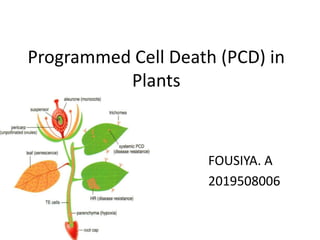
Programmed Cell Death (PCD) in
Plants
FOUSIYA. A
2019508006
Programmed cell death
• Physiological cell death process involved in selective elimination of unwanted
tissues (Ellis et al., 1991)
• Programmed cell death (PCD) has been defined as a sequence of (potentially
interruptible) events that lead to the controlled and organized destruction of
the cell. (Lockshin and Zakeri, 2004) .
• The term apoptosis –A Greek word originally means that ‘’fall of the leaf or leaf
falling’’ . (John et al., 1972)
• Synonyms = Chromatolysis, Karyolysis, Karyohexis, Shrinkage necrosis,
Programmed cell death, Cell suicide, Self destruction and Apoptosis
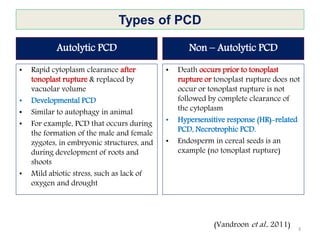
Types of PCD
Autolytic PCD
• Rapid cytoplasm clearance after
tonoplast rupture & replaced by
vacuolar volume
• Developmental PCD
• Similar to autophagy in animal
• For example, PCD that occurs during
the formation of the male and female
zygotes, in embryonic structures, and
during development of roots and
shoots
• Mild abiotic stress, such as lack of
oxygen and drought
Non – Autolytic PCD
• Death occurs prior to tonoplast
rupture or tonoplast rupture does not
occur or tonoplast rupture is not
followed by complete clearance of
the cytoplasm
• Hypersensitive response (HR)-related
PCD, Necrotrophic PCD.
• Endosperm in cereal seeds is an
example (no tonoplast rupture)
(Vandroon et al., 2011) 3
What is the purpose of this PCD ?
• Developmental PCD
Essential for successful development & growth
of complex multicellular organisms.
Regulates the rate of cell division.
Shaping of cells, tissues & organs.
• Defensive PCD
Control of cell populations & defense against
invading microbes.
Steps in apoptosis:
1. The decision to activate the pathway;
2. The actual "suicide" of the cell;
3. Engulfment of the cell remains by specialized immune
cells called phagocytes;
4. Degradation of engulfed cell.
The actual steps in cell death require:
1. condensing of the cell nucleus and breaking it into
pieces
2. condensing and fragmenting of cytoplasm into
membrane bound apoptotic bodies;
3. breaking chromosomes into fragments containing
multiple number of nucleosomes (a nucleosome
ladder)
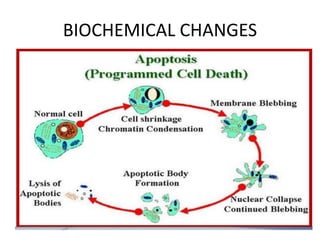
BIOCHEMICAL CHANGES
Regulation of PCD in Plants
• Plant Proteases
– Metacaspases: A family of cysteine proteases in plants
that are most similar to animal caspases.
– Metacaspases divided into Type 1 Metacaspases (AtMC
1, AtMC 2) , Type 2 Metacaspases (AtMC 4, AtMC 9)
• Subtilisin-like serine proteases.
• VPE family of protease : vacuolar processing
enzyme (VPE) family of cysteine proteases.
Localization of Protease in Plant Cell
• Proteolytic enzymes that are involved in PCD
are localized in different compartments of
plant cells:
– The cytoplasm (metacaspases),
– The vacuoles (VPE),
– The intercellular fluid (phytaspases)
Role of Vacuoles in PCD
• During viral infection, the tonoplast is lysed with the
release of lytic enzymes of vacuoles into the cytosol.
• The vacuole tonoplast fuse with the plasmalemma to
release vacuolar contents extracellularly, or it disintegrate
to release its contents to the cytosol.
• Induction of rapid cell death pathways may be an effective
way of cleansing cytoplasm from viral growth.
• Sudden release of vacuolar contents into the cytoplasm
causes rapid cell death as was also noted for the HR
response to TMV in tobacco.
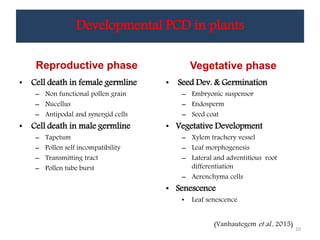
Developmental PCD in plants
Reproductive phase
• Cell death in female germline
– Non functional pollen grain
– Nucellus
– Antipodal and synergid cells
• Cell death in male germline
– Tapetum
– Pollen self incompatibility
– Transmitting tract
– Pollen tube burst
Vegetative phase
• Seed Dev. & Germination
– Embryonic suspensor
– Endosperm
– Seed coat
• Vegetative Development
– Xylem trachery vessel
– Leaf morphogenesis
– Lateral and adventitious root
differentiation
– Aerenchyma cells
• Senescence
• Leaf senescence
(Vanhautegem et al., 2015)
10
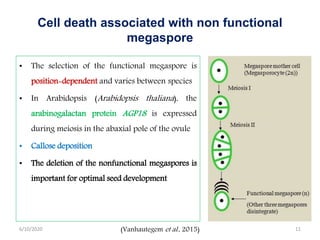
Cell death associated with non functional
megaspore
• The selection of the functional megaspore is
position-dependent and varies between species
• In Arabidopsis (Arabidopsis thaliana), the
arabinogalactan protein AGP18 is expressed
during meiosis in the abaxial pole of the ovule
• Callose deposition
• The deletion of the nonfunctional megaspores is
important for optimal seed development
(Vanhautegem et al., 2015)6/10/2020 11
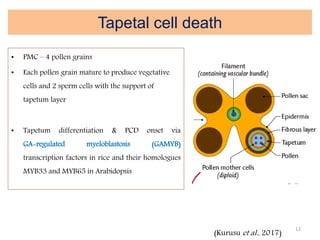
Tapetal cell death
• PMC – 4 pollen grains
• Each pollen grain mature to produce vegetative
cells and 2 sperm cells with the support of
tapetum layer
• Tapetum differentiation & PCD onset via
GA-regulated myeloblastosis (GAMYB)
transcription factors in rice and their homologues
MYB33 and MYB65 in Arabidopsis
(Kurusu et al., 2017)
12
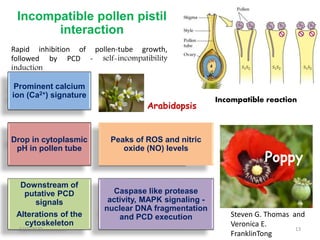
Prominent calcium
ion (Ca2+) signature
Drop in cytoplasmic
pH in pollen tube
Downstream of
putative PCD
signals
Alterations of the
cytoskeleton
Caspase like protease
activity, MAPK signaling -
nuclear DNA fragmentation
and PCD execution
Peaks of ROS and nitric
oxide (NO) levels
Incompatible pollen pistil
interaction
Rapid inhibition of pollen-tube growth,
followed by PCD - self-incompatibility
induction
Arabidopsis
Poppy
Incompatible reaction
6/10/2020 13
Steven G. Thomas and
Veronica E.
FranklinTong
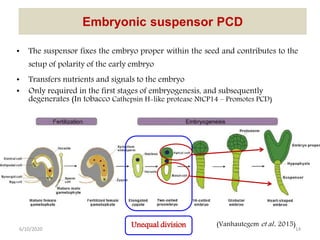
• The suspensor fixes the embryo proper within the seed and contributes to the
setup of polarity of the early embryo
• Transfers nutrients and signals to the embryo
• Only required in the first stages of embryogenesis, and subsequently
degenerates (In tobacco Cathepsin H-like protease NtCP14 – Promotes PCD)
Unequal division
Embryonic suspensor PCD
(Vanhautegem et al., 2015)
6/10/2020 14
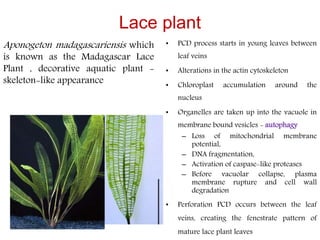
Lace plant
Aponogeton madagascariensis which
is known as the Madagascar Lace
Plant , decorative aquatic plant -
skeleton-like appearance
• PCD process starts in young leaves between
leaf veins
• Alterations in the actin cytoskeleton
• Chloroplast accumulation around the
nucleus
• Organelles are taken up into the vacuole in
membrane bound vesicles - autophagy
– Loss of mitochondrial membrane
potential,
– DNA fragmentation,
– Activation of caspase-like proteases
– Before vacuolar collapse, plasma
membrane rupture and cell wall
degradation
• Perforation PCD occurs between the leaf
veins, creating the fenestrate pattern of
mature lace plant leaves
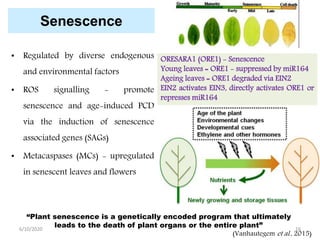
Senescence
• Regulated by diverse endogenous
and environmental factors
• ROS signalling - promote
senescence and age-induced PCD
via the induction of senescence
associated genes (SAGs)
• Metacaspases (MCs) - upregulated
in senescent leaves and flowers
ORESARA1 (ORE1) - Senescence
Young leaves = ORE1 - suppressed by miR164
Ageing leaves = ORE1 degraded via EIN2
EIN2 activates EIN3, directly activates ORE1 or
represses miR164
“Plant senescence is a genetically encoded program that ultimately
leads to the death of plant organs or the entire plant”
(Vanhautegem et al., 2015)
6/10/2020 16
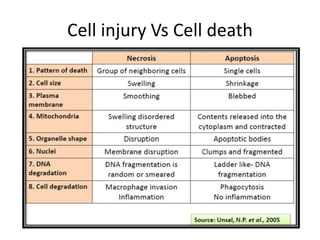
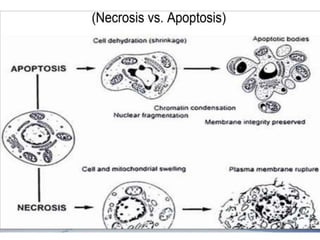
Cell injury Vs Cell death
REFERENCES
• Kabbage M. et. al. (2017): The Life and Death of a
Plant Cell. Annual Review of Plant Biology. 2017.
68:375–404.
• Martin B. et. al. (2013): Centrality of Host Cell
Death in Plant-Microbe Interactions. Annual
Review of Phytopathology. 2013. 51:543–70
• John M. et. al. (2003) Plant disease resistance
genes: recent insights and Potential applications.
Trends in Biotechnology Vol. 21 No.4 April 2013.
178-183.
• Agrios G N; Plant Pathology. Elsevier Academic
Press, Burlington, MA, 2005.