TILAK. I S 
PG14AGR6074
2 
Introduction 
Meristem 
SAM 
contents 
RAM 
Conclusions 
Molecular Analysis 
Of SAM & RAM
INTRODUCTION 
• Plant Tissues fall into two 
large categories: 
Meristematic. 
Permanent (Non- 
Meristematic) 
Term”meristem” was first used in 
1858 by Carl Wilh. V. Nagell
meristem 
 Greek word ”merizein ” to 
divide. 
Contains undifferentiated 
cells (meristematic cells). 
 Found in zones of the plant 
where growth can take 
place. 
Epidermal (L1) 
Subepidermal (L2) Tunica. 
(L3) Inner most layer corpus 
Tunica determine the physical 
characteristics of the leaf edge and 
margin.
Positional information (auxin 
accumulation) precedes leaf initiation 
Auxin accumulation 
precedes leaf initiation 
Indole-3-acetic acid (IAA) a 
naturally occurring auxin
A boundary forms by the action of 
mutually antagonistic genes 
ARP 
KNOX1 
KNOX1 genes, expressed in the 
meristem, 
ARP genes, expressed in the leaf 
primordia, are mutually repressive, 
and help establish a separate identity 
for the emerging leaf primordium
Apical meristems 
(Growing tip) 
• Found in the buds and growing tips 
of roots in plants. 
1) Growth of new cells in young 
seedlings at the tips of roots and 
shoots . 
2) An active apical meristem lays 
down a 
growing root or shoot behind itself.
Apical Meristems 
• In plants belonging to the MONOCOT , apical 
meristems are located ONLY in the root tips. 
• REVOLUTA gene is necessary for Apical meristem 
development
STM and CUC1 Expression (Apical Meristem) 
• CUC1 redundantly required for embryonic apical meristem 
formation, cotyledon separation and expression of STM.. 
Cup shaped cotyledon
Intercalary Meristems 
• Plants in the MONOCOT class have special 
meristems called intercalary meristems. 
• Lateral meristems 
• Cause SECONDARY GROWTH. 
• meristems located in the shoot and root tips, 
plants in the DICOT class have lateral 
meristems.
11
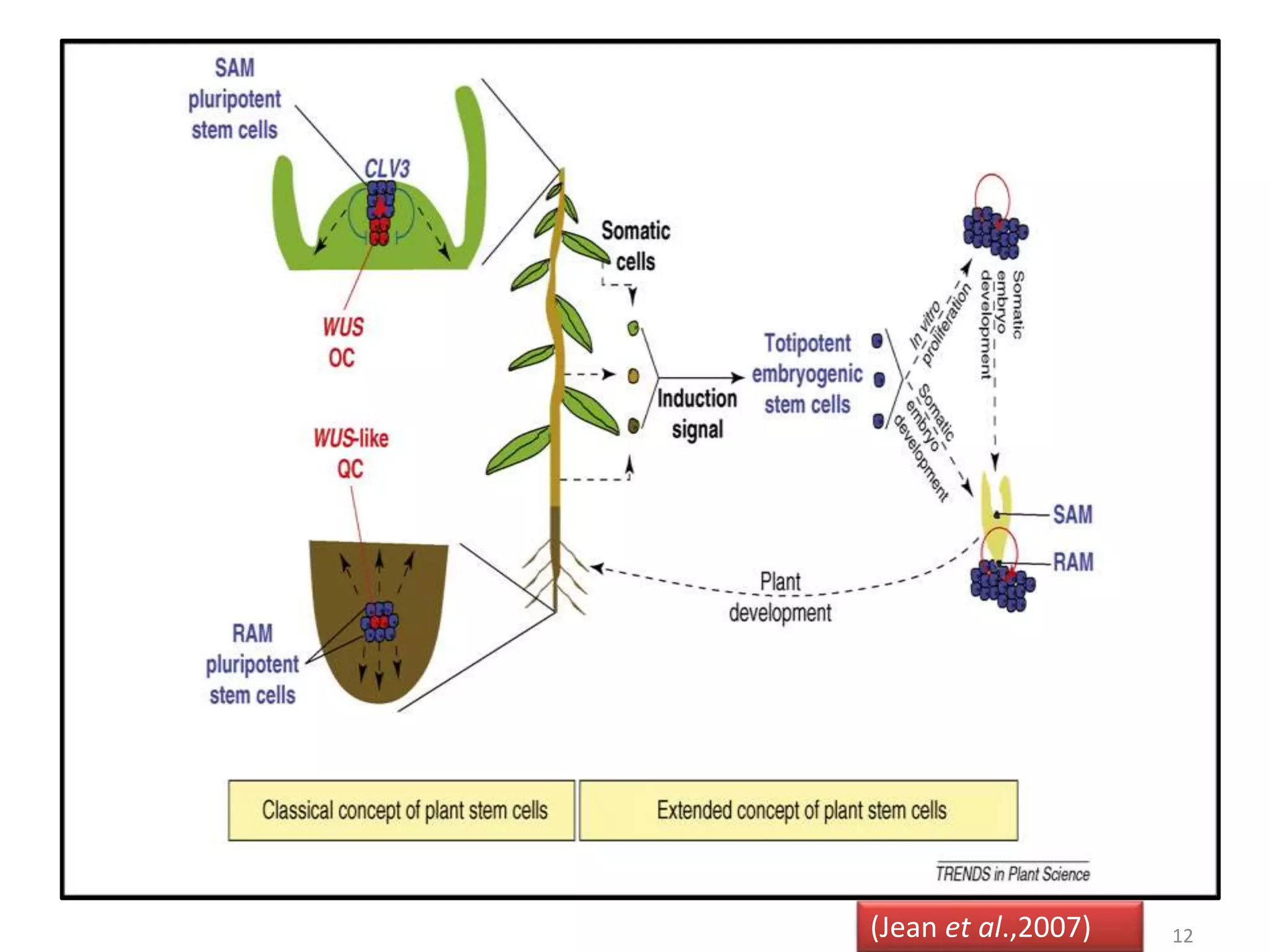
(Jean et al.,2007) 12
Shoot apical meristems 
• 14 days later, leaves have developed (right).
Shoot apical meristem - Importance 
• Center of postembryonic growth & 
development 
• Source of all primary meristems 
– Protoderm, ground meristem & 
procambium 
• Source of 
– Leaves 
– Branches 
– Tendrils 
– Thorns 
• Self-renewing mass of cells  stem cells 
• Balance cell division and cell 
differentiation 
14
The shoot apical meristem consists of 4 distinct cell 
groups: 
 Stem cells. 
The immediate daughter cells of the stem cells. 
A subjacent organising centre. 
Founder cells for organ initiation in surrounding 
regions. 
are maintained by a complex signalling pathway
Shoot apical meristem organization 
Stem Cells 
Central Zone 
L1 = tunica 
L2 = tunica 
Peripheral Zone 
Pith or Rib 
Meristem 
Organizing Center 
L3 = corpus 
16
Development involves positional 
information 
Auxin gradients are regulated by auxin 
transporters) 
Movement of a signal away 
from a source 
… selective destruction 
of a signal by miRNA 
cleavage of mRNAs) 
REVOLUTA gene is necessary for Apical meristem development
Development involves boundaries 
Boundaries form between the shoot 
apical meristem and leaf primordia, 
and between the upper and lower 
surfaces of the leaf 
Shoot apical 
meristem 
Patterning of cells in 
the epidermis also 
involves production of 
inhibitory signals
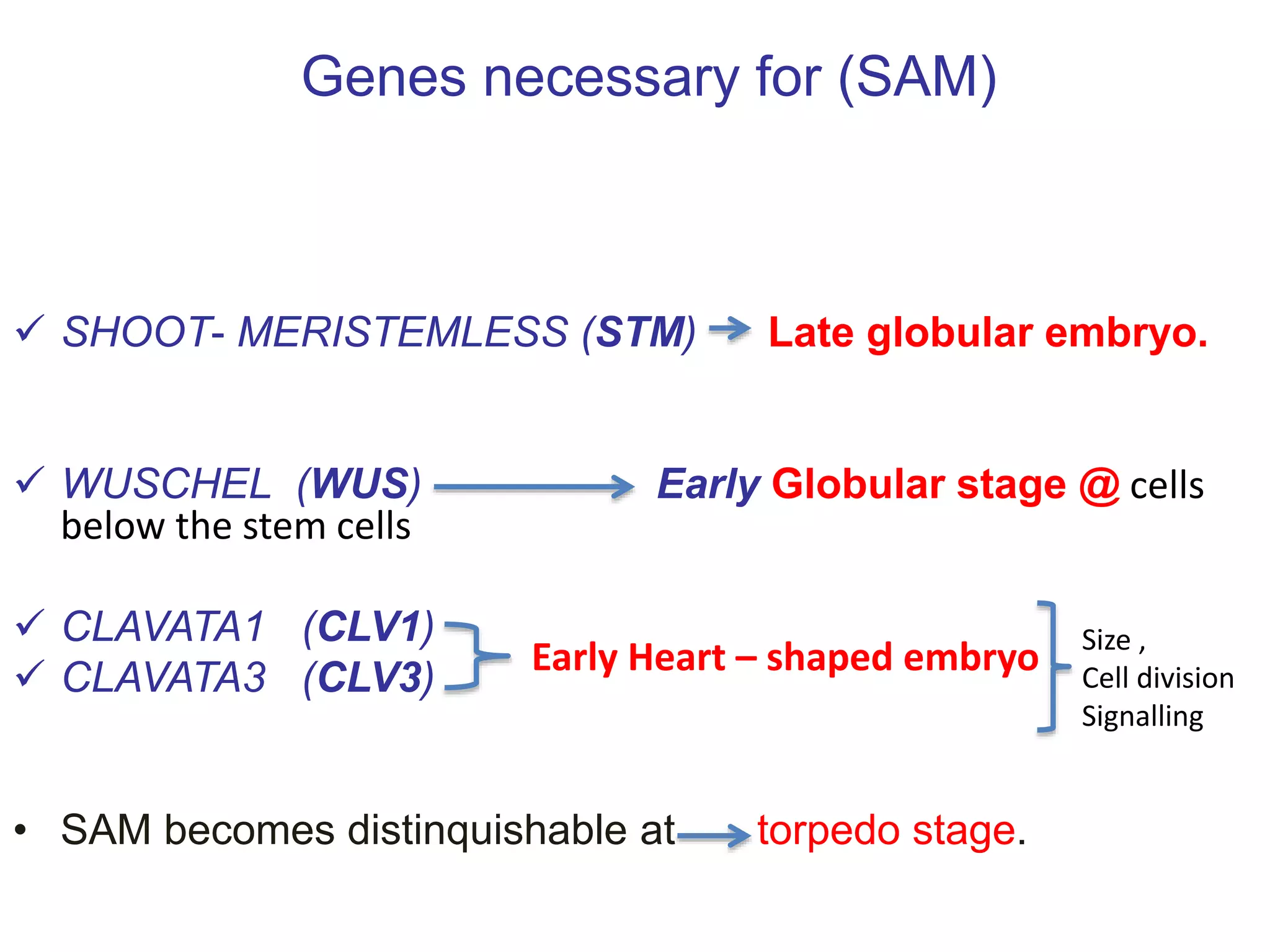
Genes necessary for (SAM) 
 SHOOT- MERISTEMLESS (STM) Late globular embryo. 
 WUSCHEL (WUS) Early Globular stage @ cells 
below the stem cells 
 CLAVATA1 (CLV1) 
 CLAVATA3 (CLV3) 
Early Heart – shaped embryo Size , 
• SAM becomes distinquishable at torpedo stage. 
Cell division 
Signalling
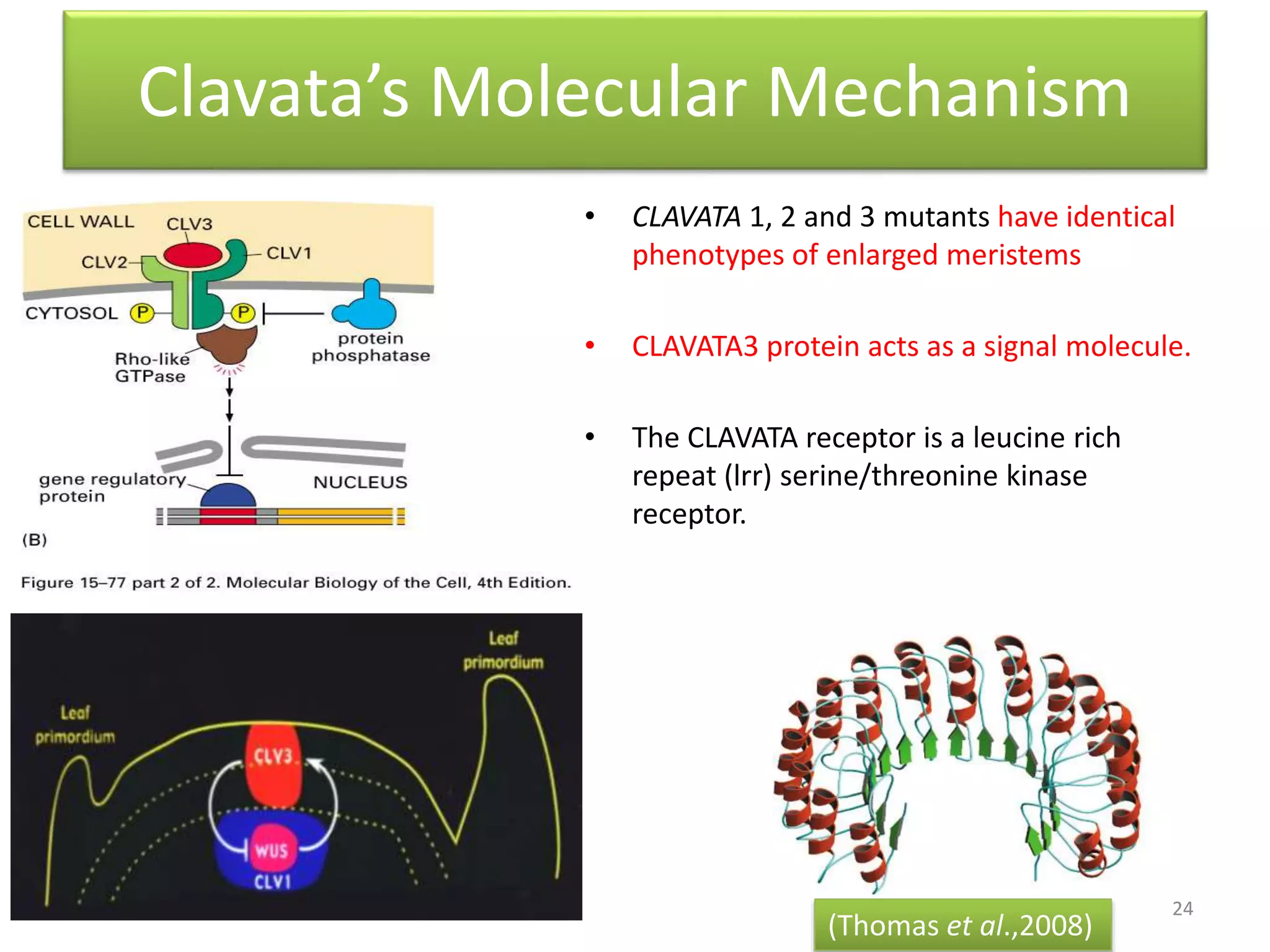
Clavata’s Molecular Mechanism 
• CLAVATA 1, 2 and 3 mutants have identical 
phenotypes of enlarged meristems 
• CLAVATA3 protein acts as a signal molecule. 
• The CLAVATA receptor is a leucine rich 
repeat (lrr) serine/threonine kinase 
receptor. 
24 
(Thomas et al.,2008)
Shoot Development : Genetics 
CLAVATA gene mechanism 
Protein-binding 
motif 
CLAVATA GENE Characteristics 
CLV1 – Extracellular polypeptide: 96 amino acids 
Restricted to L1, L2 of SAM Central Zone 
CLV2 – Membrane-bound protein receptor with a protein-binding motif 
CLV3 – Membrane-bound protein receptor with a protein-binding motif and 
Restricted to L1, L2 of SAM Central Zone 
Kinase activity… signaling… Kinase cascade 
Inhibitory to WUS expression 
Signal transduction pathway
WUSCHEL(WUS) molecular mechanism 
WUS function: 
1. WUS Protein product is a homeodomain 
transcription factor 
2. Gene regulation 
3. Positional influence of once cell type by 
another 
• wus mutants result in 
1. Early termination of SAM 
 wus defective in maintaining SAM 
2. Aberrant SAM organization 
 wus defective in maintaining SAM 
integrity 
L1 
L2 
L3 
Localization of WUS gene 
product in organizing 
center (OC) of shoot 
26
Shoot Development : Genetics 
WUSCHEL gene phenotype 
Wild Type 
wus mutant 
Wild type SAM 
wus SAM 
mutants but it fails to develop
Gene Interaction: WUSCHEL and CLAVATA 
Initiation of an Organizing Center in the shoot apical meristem 
CLV3 expression 
( Cell division ) 
WUS expression ( Gene Regulation ) 
1. OC precursor lineage established in 4 subepidermal cells of 16 cell 
proembryo as indicated by expression of WUS (red) 
2. Stem cells of Central Zone induced by heart stage as indicated by 
expression of CLV3 gene (blue)
mRNA Expression Domains and gene interaction 
for CLV1 CLV3 and WUS 
Wild type 
clv mutant 
wus 
mutant 
Overexpressed 
WUS mutant 
Wild-type mRNA expression domains illustrate location of gene expression. 
1. WUS – under stem cells of Central Zone 
2. CLV3 – stem cells of Central Zone above OC (produces extracellular protein) 
3. CLV1 – Organizing Center (OC) & vicinity (produces membrane-bound protein)
A feedback look between WUS and CLV exists because: 
1. Expansion of the WUS expression domain in a clv 
mutant suggests a feedback loop between the two 
genes. 
2. wus mutants have downregulated (smaller) CLV3 
expression domain. 
3. WUS overexpressed mutants have a broader CLV3 
expression domain.
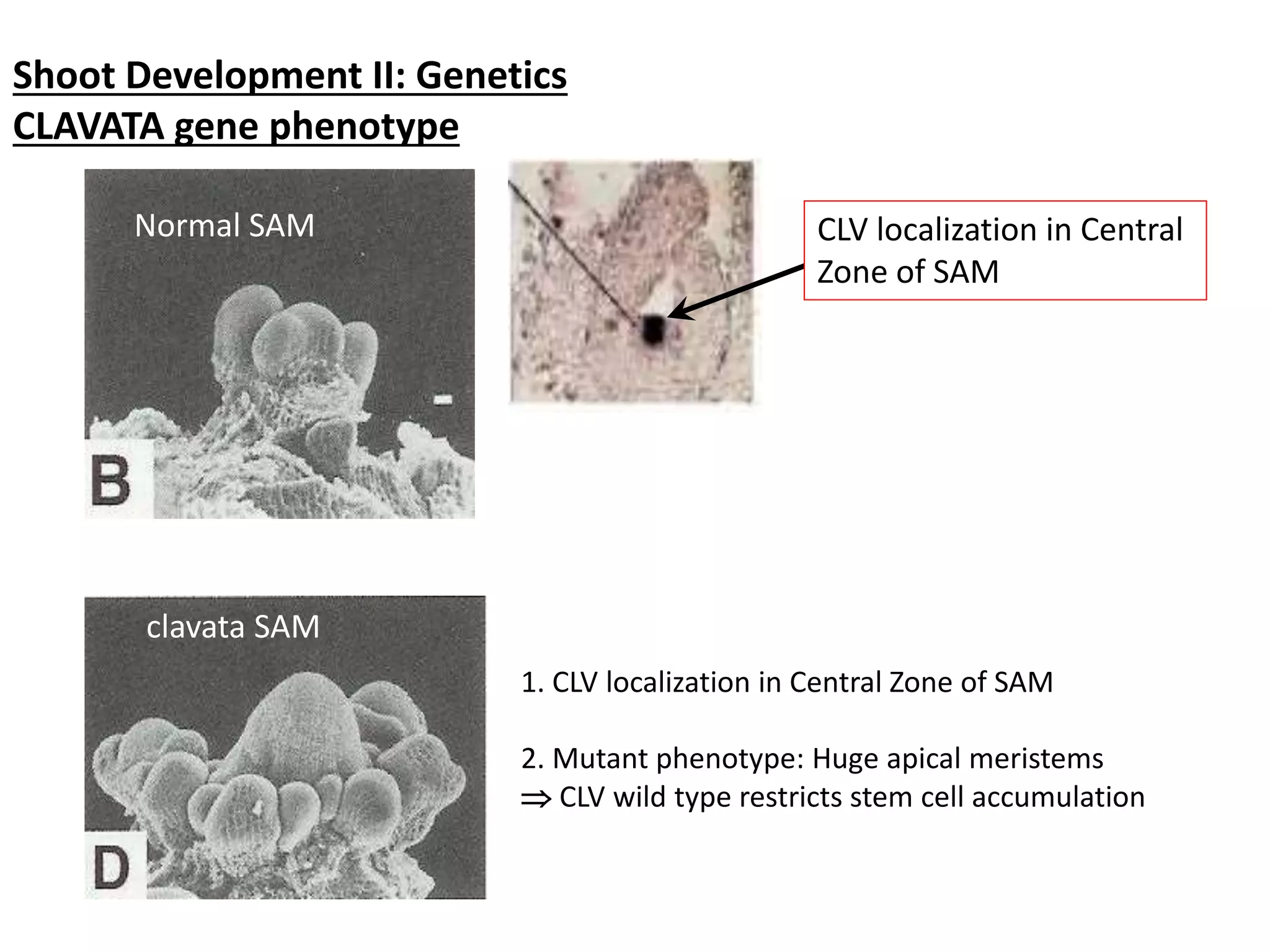
Shoot Development II: Genetics 
CLAVATA gene phenotype 
Normal SAM 
clavata SAM 
CLV localization in Central 
Zone of SAM 
1. CLV localization in Central Zone of SAM 
2. Mutant phenotype: Huge apical meristems 
 CLV wild type restricts stem cell accumulation
STM molecular mechanism 
– Stem cells of Central Zone and 
peripheral Zone. 
– Encodes homeodomain protein 
KNOTTED Class 
– Transcription factor 
– Prevents premature 
differentiation of cells from 
Peripheral Zone. 
Wild type Stm mutant 
32
-STM encodes a 
transcription factor 
with homeobox region Cotyledons not mature leaves 
33 
Some Genes Involved in Root-Shoot 
Formation 
Both shoot and root meristems are apical 
meristems, but are independently controlled 
-Shootmeristemless 
(STM) is necessary for 
stm mutant 
shoot formation, but 
not root development 
STM wild type 
are shown
Gene Expression in the Apical Embryo Domain 
WUSCHEL (WUS), CLAVATA (CLV) AND SHOOT MERISTEMLESS (STM) 
Laux, T., et al. Plant Cell 2004;16:S190-S202
Root apical meristem 
1 - Quiescent center 
2 - Calyptrogen (live rootcap cells) 
3 – Rootcap 
4 - Rootcap cells 
5 - Procambium
• The root apical meristem produces cells in two 
dimensions. 
• It harbors two pools of stem cells around an 
organizing center called the quiescent center 
(QC) cells and together produce most of the 
cells in an adult root. 
• QC : low mitotic activity. 
Act as a reservoir of stem cells 
• Root cap: protects and guide its growth
RAM
Root Cells 
• Root structure 
Root cap 
• composed of inner columella cells and lateral root cap 
cells 
• New root cap produced when existing cap is removed
• Zone of maturation 
– cells differentiate into specific cell types 
• root surface cells mature into epidermal hairs, each 
with root hair 
• cortex produced by parenchyma cells 
– inner boundary differentiates into endodermis 
» surrounded by Casparian strips composed of suberin
Some Genes Involved in Root-Shoot 
Formation 
The HOBBIT gene is required for root meristem, but not 
shoot meristem formation 
42 
Hobbit is a protein that inhibits another protein that stops 
the gene expression of the genes that Auxin causes to be 
made!!!!
43 
Two Internal Proteins Responsible for the 
Development of a Structure Cause Similar 
Phenotypes if their corresponding genes are 
mutated 
Abnormal cell Has a basal peg not a root 
division create stub 
rather than a root
44 
Auxin and Monopteros Promote Root 
Development 
One way that auxin induces 
gene expression is 
by activating the 
MONOPTEROS 
(MP) protein 
-Auxin releases the 
repressor from MP 
-MP then activates the 
transcription of a 
root development gene
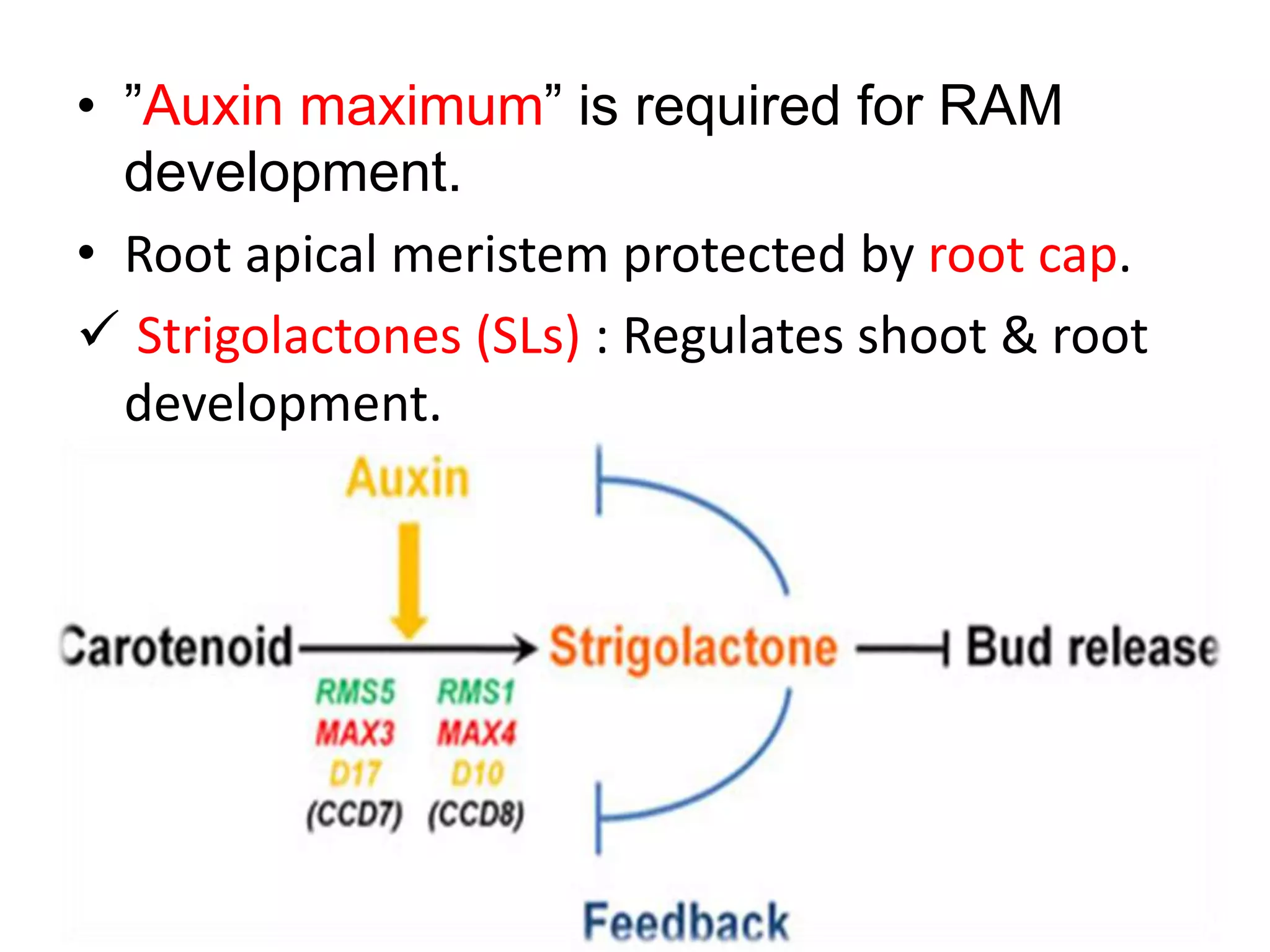
• ”Auxin maximum” is required for RAM 
development. 
• Root apical meristem protected by root cap. 
 Strigolactones (SLs) : Regulates shoot & root 
development.
• RAM size is controlled by DA1-Related 
Protein2 in Arabidopsis. 
• ERECTA genes regulate auxin transport in 
SAM. 
• SCARECROW function reveals a radial 
patterning in root & shoot. 
• MADS box genes : Helps in development of 
Roots, Leaf, Flower, Ovule & fruit.
Conclusion 
• SAM 
SHOOT- 
MERISTEMLESS (STM), 
 WUSCHEL (WUS), 
 CLAVATA1 (CLV1) 
 CLAVATA3 (CLV3). 
 ERECTA genes 
• RAM 
 DA1-Related Protein2 
MONOPTEROS 
(MP)protein 
 HOBBIT gene 
 MADS box genes 
 SCR Mutants 
47
References 
Plant roots – Amaram Eshel. 
Plant physiology – A.S.Gontia. 
www.wikipedia.com 
www.DocStock.com 
www.ncbi.nlm.nih.gov 
www.researchgate.net 
www.sciencedirect.com 
Reviews & Research articles.
THANK YOU

Molecular Analysis Of SAM & RAM

  • 1.
    TILAK. I S PG14AGR6074
  • 2.
    2 Introduction Meristem SAM contents RAM Conclusions Molecular Analysis Of SAM & RAM
  • 3.
    INTRODUCTION • PlantTissues fall into two large categories: Meristematic. Permanent (Non- Meristematic) Term”meristem” was first used in 1858 by Carl Wilh. V. Nagell
  • 4.
    meristem  Greekword ”merizein ” to divide. Contains undifferentiated cells (meristematic cells).  Found in zones of the plant where growth can take place. Epidermal (L1) Subepidermal (L2) Tunica. (L3) Inner most layer corpus Tunica determine the physical characteristics of the leaf edge and margin.
  • 5.
    Positional information (auxin accumulation) precedes leaf initiation Auxin accumulation precedes leaf initiation Indole-3-acetic acid (IAA) a naturally occurring auxin
  • 6.
    A boundary formsby the action of mutually antagonistic genes ARP KNOX1 KNOX1 genes, expressed in the meristem, ARP genes, expressed in the leaf primordia, are mutually repressive, and help establish a separate identity for the emerging leaf primordium
  • 7.
    Apical meristems (Growingtip) • Found in the buds and growing tips of roots in plants. 1) Growth of new cells in young seedlings at the tips of roots and shoots . 2) An active apical meristem lays down a growing root or shoot behind itself.
  • 8.
    Apical Meristems •In plants belonging to the MONOCOT , apical meristems are located ONLY in the root tips. • REVOLUTA gene is necessary for Apical meristem development
  • 9.
    STM and CUC1Expression (Apical Meristem) • CUC1 redundantly required for embryonic apical meristem formation, cotyledon separation and expression of STM.. Cup shaped cotyledon
  • 10.
    Intercalary Meristems •Plants in the MONOCOT class have special meristems called intercalary meristems. • Lateral meristems • Cause SECONDARY GROWTH. • meristems located in the shoot and root tips, plants in the DICOT class have lateral meristems.
  • 11.
  • 12.
  • 13.
    Shoot apical meristems • 14 days later, leaves have developed (right).
  • 14.
    Shoot apical meristem- Importance • Center of postembryonic growth & development • Source of all primary meristems – Protoderm, ground meristem & procambium • Source of – Leaves – Branches – Tendrils – Thorns • Self-renewing mass of cells  stem cells • Balance cell division and cell differentiation 14
  • 15.
    The shoot apicalmeristem consists of 4 distinct cell groups:  Stem cells. The immediate daughter cells of the stem cells. A subjacent organising centre. Founder cells for organ initiation in surrounding regions. are maintained by a complex signalling pathway
  • 16.
    Shoot apical meristemorganization Stem Cells Central Zone L1 = tunica L2 = tunica Peripheral Zone Pith or Rib Meristem Organizing Center L3 = corpus 16
  • 17.
    Development involves positional information Auxin gradients are regulated by auxin transporters) Movement of a signal away from a source … selective destruction of a signal by miRNA cleavage of mRNAs) REVOLUTA gene is necessary for Apical meristem development
  • 18.
    Development involves boundaries Boundaries form between the shoot apical meristem and leaf primordia, and between the upper and lower surfaces of the leaf Shoot apical meristem Patterning of cells in the epidermis also involves production of inhibitory signals
  • 19.
    Genes necessary for(SAM)  SHOOT- MERISTEMLESS (STM) Late globular embryo.  WUSCHEL (WUS) Early Globular stage @ cells below the stem cells  CLAVATA1 (CLV1)  CLAVATA3 (CLV3) Early Heart – shaped embryo Size , • SAM becomes distinquishable at torpedo stage. Cell division Signalling
  • 24.
    Clavata’s Molecular Mechanism • CLAVATA 1, 2 and 3 mutants have identical phenotypes of enlarged meristems • CLAVATA3 protein acts as a signal molecule. • The CLAVATA receptor is a leucine rich repeat (lrr) serine/threonine kinase receptor. 24 (Thomas et al.,2008)
  • 25.
    Shoot Development :Genetics CLAVATA gene mechanism Protein-binding motif CLAVATA GENE Characteristics CLV1 – Extracellular polypeptide: 96 amino acids Restricted to L1, L2 of SAM Central Zone CLV2 – Membrane-bound protein receptor with a protein-binding motif CLV3 – Membrane-bound protein receptor with a protein-binding motif and Restricted to L1, L2 of SAM Central Zone Kinase activity… signaling… Kinase cascade Inhibitory to WUS expression Signal transduction pathway
  • 26.
    WUSCHEL(WUS) molecular mechanism WUS function: 1. WUS Protein product is a homeodomain transcription factor 2. Gene regulation 3. Positional influence of once cell type by another • wus mutants result in 1. Early termination of SAM  wus defective in maintaining SAM 2. Aberrant SAM organization  wus defective in maintaining SAM integrity L1 L2 L3 Localization of WUS gene product in organizing center (OC) of shoot 26
  • 27.
    Shoot Development :Genetics WUSCHEL gene phenotype Wild Type wus mutant Wild type SAM wus SAM mutants but it fails to develop
  • 28.
    Gene Interaction: WUSCHELand CLAVATA Initiation of an Organizing Center in the shoot apical meristem CLV3 expression ( Cell division ) WUS expression ( Gene Regulation ) 1. OC precursor lineage established in 4 subepidermal cells of 16 cell proembryo as indicated by expression of WUS (red) 2. Stem cells of Central Zone induced by heart stage as indicated by expression of CLV3 gene (blue)
  • 29.
    mRNA Expression Domainsand gene interaction for CLV1 CLV3 and WUS Wild type clv mutant wus mutant Overexpressed WUS mutant Wild-type mRNA expression domains illustrate location of gene expression. 1. WUS – under stem cells of Central Zone 2. CLV3 – stem cells of Central Zone above OC (produces extracellular protein) 3. CLV1 – Organizing Center (OC) & vicinity (produces membrane-bound protein)
  • 30.
    A feedback lookbetween WUS and CLV exists because: 1. Expansion of the WUS expression domain in a clv mutant suggests a feedback loop between the two genes. 2. wus mutants have downregulated (smaller) CLV3 expression domain. 3. WUS overexpressed mutants have a broader CLV3 expression domain.
  • 31.
    Shoot Development II:Genetics CLAVATA gene phenotype Normal SAM clavata SAM CLV localization in Central Zone of SAM 1. CLV localization in Central Zone of SAM 2. Mutant phenotype: Huge apical meristems  CLV wild type restricts stem cell accumulation
  • 32.
    STM molecular mechanism – Stem cells of Central Zone and peripheral Zone. – Encodes homeodomain protein KNOTTED Class – Transcription factor – Prevents premature differentiation of cells from Peripheral Zone. Wild type Stm mutant 32
  • 33.
    -STM encodes a transcription factor with homeobox region Cotyledons not mature leaves 33 Some Genes Involved in Root-Shoot Formation Both shoot and root meristems are apical meristems, but are independently controlled -Shootmeristemless (STM) is necessary for stm mutant shoot formation, but not root development STM wild type are shown
  • 34.
    Gene Expression inthe Apical Embryo Domain WUSCHEL (WUS), CLAVATA (CLV) AND SHOOT MERISTEMLESS (STM) Laux, T., et al. Plant Cell 2004;16:S190-S202
  • 35.
    Root apical meristem 1 - Quiescent center 2 - Calyptrogen (live rootcap cells) 3 – Rootcap 4 - Rootcap cells 5 - Procambium
  • 38.
    • The rootapical meristem produces cells in two dimensions. • It harbors two pools of stem cells around an organizing center called the quiescent center (QC) cells and together produce most of the cells in an adult root. • QC : low mitotic activity. Act as a reservoir of stem cells • Root cap: protects and guide its growth
  • 39.
  • 40.
    Root Cells •Root structure Root cap • composed of inner columella cells and lateral root cap cells • New root cap produced when existing cap is removed
  • 41.
    • Zone ofmaturation – cells differentiate into specific cell types • root surface cells mature into epidermal hairs, each with root hair • cortex produced by parenchyma cells – inner boundary differentiates into endodermis » surrounded by Casparian strips composed of suberin
  • 42.
    Some Genes Involvedin Root-Shoot Formation The HOBBIT gene is required for root meristem, but not shoot meristem formation 42 Hobbit is a protein that inhibits another protein that stops the gene expression of the genes that Auxin causes to be made!!!!
  • 43.
    43 Two InternalProteins Responsible for the Development of a Structure Cause Similar Phenotypes if their corresponding genes are mutated Abnormal cell Has a basal peg not a root division create stub rather than a root
  • 44.
    44 Auxin andMonopteros Promote Root Development One way that auxin induces gene expression is by activating the MONOPTEROS (MP) protein -Auxin releases the repressor from MP -MP then activates the transcription of a root development gene
  • 45.
    • ”Auxin maximum”is required for RAM development. • Root apical meristem protected by root cap.  Strigolactones (SLs) : Regulates shoot & root development.
  • 46.
    • RAM sizeis controlled by DA1-Related Protein2 in Arabidopsis. • ERECTA genes regulate auxin transport in SAM. • SCARECROW function reveals a radial patterning in root & shoot. • MADS box genes : Helps in development of Roots, Leaf, Flower, Ovule & fruit.
  • 47.
    Conclusion • SAM SHOOT- MERISTEMLESS (STM),  WUSCHEL (WUS),  CLAVATA1 (CLV1)  CLAVATA3 (CLV3).  ERECTA genes • RAM  DA1-Related Protein2 MONOPTEROS (MP)protein  HOBBIT gene  MADS box genes  SCR Mutants 47
  • 48.
    References Plant roots– Amaram Eshel. Plant physiology – A.S.Gontia. www.wikipedia.com www.DocStock.com www.ncbi.nlm.nih.gov www.researchgate.net www.sciencedirect.com Reviews & Research articles.
  • 49.