FLEXIBLE 
MANUFACTURING 
SYSTEMS (FMS) 
BY - SHIVAM JOSHI 
[0131ME114]
What is FMS ? 
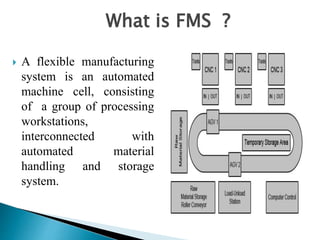
 A flexible manufacturing 
system is an automated 
machine cell, consisting 
of a group of processing 
workstations, 
interconnected with 
automated material 
handling and storage 
system.
The issues such as reduction of inventories and market-response 
time to meet customer demands, flexibility to adapt to changes in the 
market, reducing the cost of products and services to grab more 
market shares, etc have made it almost obligatory to many firms to 
switch over to flexible manufacturing systems (FMSs) as a viable means 
to accomplish the above requirements while producing consistently 
good quality and cost effective products. FMS is actually an automated 
set of numerically controlled machine tools and material handling 
systems, capable of performing a wide range manufacturing operations 
with quick tooling and instruction changeovers.
HOW FMS WORKS 
• A flexible manufacturing system (FMS) is a highly automated GT 
machine cell, consisting of a group or processing workstations (usually 
CNC machine tools), interconnected by an automated material 
handling and storage system, and controlled by a distributed computer 
system. 
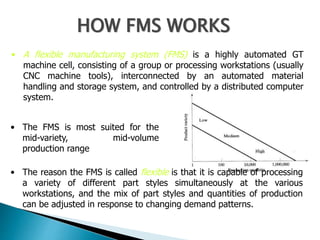
• The FMS is most suited for the 
mid-variety, mid-volume 
production range 
• The reason the FMS is called flexible is that it is capable of processing 
a variety of different part styles simultaneously at the various 
workstations, and the mix of part styles and quantities of production 
can be adjusted in response to changing demand patterns.
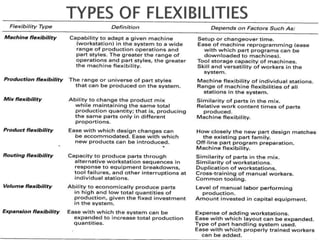
Flexibility is an attribute that allows a mixed model manufacturing 
system to cope up with a certain level of variations in part or 
product style, without having any interruption in production due to 
changeovers between models. Flexibility measures the ability to 
adapt “to a wide range of possible environment”. To be flexible, a 
manufacturing system must posses the following capabilities 
• Identification of the different production units to perform the 
correct operation 
• Quick changeover of operating instructions to the computer 
controlled production machines 
• Quick changeover of physical setups of fixtures, tools and other 
working units
The first FMS was patented in 1965 by Theo Williamson who 
made numerically controlled equipment. Examples of 
numerically controlled equipment are like a CNC lathes or mills 
which is called varying types of FMS. 
During the 1970s, with the ever-growing developments in the 
field of technology, manufacturers started facing difficulties and 
hence, FM systems became main-stream in manufacturing to 
accommodate new changes whenever required. During the 
1980s for the first time manufacturers had to take in 
consideration efficiency, quality, and flexibility to stay in 
business.
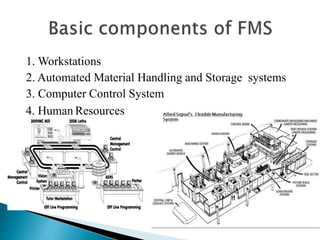
1.Workstations 
2. Automated Material Handling and Storage systems 
3. Computer Control System 
4. Human Resources
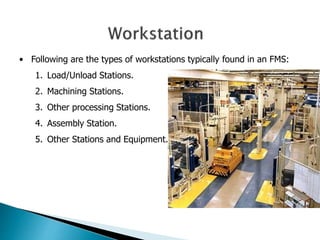
• Following are the types of workstations typically found in an FMS: 
1. Load/Unload Stations. 
2. Machining Stations. 
3. Other processing Stations. 
4. Assembly Station. 
5. Other Stations and Equipment.
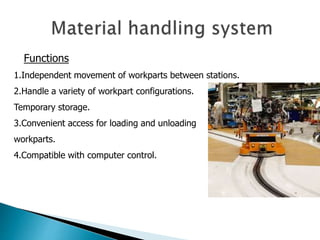
Functions 
1.Independent movement of workparts between stations. 
2.Handle a variety of workpart configurations. 
Temporary storage. 
3.Convenient access for loading and unloading 
workparts. 
4.Compatible with computer control.
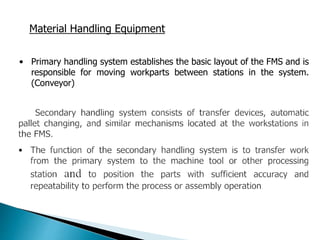
Material Handling Equipment 
• Primary handling system establishes the basic layout of the FMS and is 
responsible for moving workparts between stations in the system. 
(Conveyor)
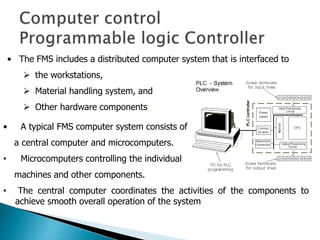
• The FMS includes a distributed computer system that is interfaced to 
 the workstations, 
 Material handling system, and 
 Other hardware components. 
• A typical FMS computer system consists of 
a central computer and microcomputers. 
• Microcomputers controlling the individual 
machines and other components. 
• The central computer coordinates the activities of the components to 
achieve smooth overall operation of the system
• Human are needed to manage the operations of the FMS. Functions 
typically performed by human includes: 
 Loading raw workparts into the system, 
 Unloading finished parts (or assemblies) from the system, 
 Changing and setting tools, 
 Equipment maintenance and repair, 
 NC part programming in a machining system, and 
 Programming and operation the computer system.
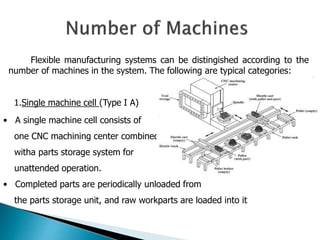
Flexible manufacturing systems can be distingished according to the 
number of machines in the system. The following are typical categories: 
1.Single machine cell (Type I A) 
• A single machine cell consists of 
one CNC machining center combined 
witha parts storage system for 
unattended operation. 
• Completed parts are periodically unloaded from 
the parts storage unit, and raw workparts are loaded into it
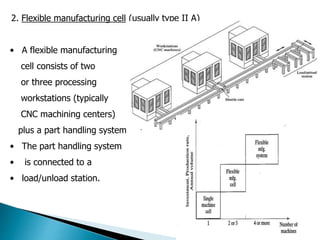
2. Flexible manufacturing cell (usually type II A) 
• A flexible manufacturing 
cell consists of two 
or three processing 
workstations (typically 
CNC machining centers) 
plus a part handling system. 
• The part handling system 
• is connected to a 
• load/unload station.
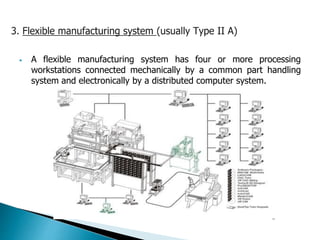
• A flexible manufacturing system has four or more processing 
workstations connected mechanically by a common part handling 
system and electronically by a distributed computer system.
 Sequential FMS 
 Random FMS 
 Dedicated FMS 
 Engineered FMS 
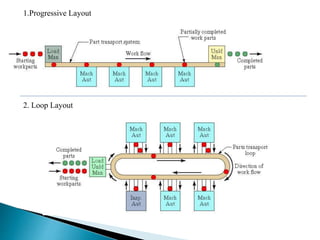
 Progressive or Line 
Type 
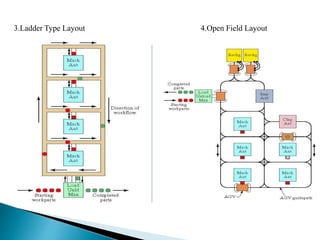
 Loop Type 
 Ladder Type 
 Open field type 
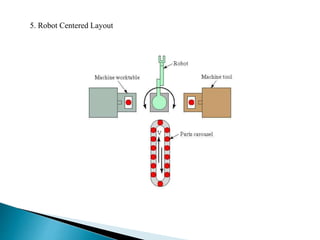
 Robot centered type
1.Progressive Layout 
2. Loop Layout
3.Ladder Type Layout 4.Open Field Layout
5. Robot Centered Layout
1.External changes such as change in product design and 
production system. 
2.Optimizing the manufacturing cycle time 
3.Reduced production costs 
4.Overcoming internal changes like breakdowns etc. 
5.Lower cost per unit produced 
6.Greater labour productivity 
7.Greater machine efficiency 
8.Improved quality 
9.Increased system reliability 
10.Reduced parts inventories
11.To reduce set up and queue times 
12.Improve efficiency 
13.Reduce time for product completion 
14.Utilize human workers better 
15.Improve product routing 
16.Produce a variety of Items under one roof 
17.Improve product quality 
18.Serve a variety of vendors simultaneously 
19.Produce more product more quickly 
20.Adaptability to CAD/CAM operations 
21.Shorter lead times
1.Expensive. 
2.Substantial pre-planning activity. 
3.Cost to implement, 
4.Substantial pre-planning 
5.Requirement of skilled labour 
6.Complicated system 
CHALLENGES 
1.Determining if FMS the best production system for 
your company 
2.Possible expansion costs associated with implementing 
FMS
 Metal-cutting machining 
 Metal forming 
 Assembly 
 Joining-welding (arc , spot), glueing 
 Surface treatment 
 Inspection 
 Testing
 FMS is a revolution in the field of Manufacturing 
Technology. 
 FMS can be designed to meet the specific demand of 
each company 
 FMS is used for multitask operation. 
 FMS requires substantial investment of time and 
resources.
T.Y

flexible manufacturing systems

  • 1.
    FLEXIBLE MANUFACTURING SYSTEMS(FMS) BY - SHIVAM JOSHI [0131ME114]
  • 2.
    What is FMS?  A flexible manufacturing system is an automated machine cell, consisting of a group of processing workstations, interconnected with automated material handling and storage system.
  • 3.
    The issues suchas reduction of inventories and market-response time to meet customer demands, flexibility to adapt to changes in the market, reducing the cost of products and services to grab more market shares, etc have made it almost obligatory to many firms to switch over to flexible manufacturing systems (FMSs) as a viable means to accomplish the above requirements while producing consistently good quality and cost effective products. FMS is actually an automated set of numerically controlled machine tools and material handling systems, capable of performing a wide range manufacturing operations with quick tooling and instruction changeovers.
  • 4.
    HOW FMS WORKS • A flexible manufacturing system (FMS) is a highly automated GT machine cell, consisting of a group or processing workstations (usually CNC machine tools), interconnected by an automated material handling and storage system, and controlled by a distributed computer system. • The FMS is most suited for the mid-variety, mid-volume production range • The reason the FMS is called flexible is that it is capable of processing a variety of different part styles simultaneously at the various workstations, and the mix of part styles and quantities of production can be adjusted in response to changing demand patterns.
  • 5.
    Flexibility is anattribute that allows a mixed model manufacturing system to cope up with a certain level of variations in part or product style, without having any interruption in production due to changeovers between models. Flexibility measures the ability to adapt “to a wide range of possible environment”. To be flexible, a manufacturing system must posses the following capabilities • Identification of the different production units to perform the correct operation • Quick changeover of operating instructions to the computer controlled production machines • Quick changeover of physical setups of fixtures, tools and other working units
  • 7.
    The first FMSwas patented in 1965 by Theo Williamson who made numerically controlled equipment. Examples of numerically controlled equipment are like a CNC lathes or mills which is called varying types of FMS. During the 1970s, with the ever-growing developments in the field of technology, manufacturers started facing difficulties and hence, FM systems became main-stream in manufacturing to accommodate new changes whenever required. During the 1980s for the first time manufacturers had to take in consideration efficiency, quality, and flexibility to stay in business.
  • 8.
    1.Workstations 2. AutomatedMaterial Handling and Storage systems 3. Computer Control System 4. Human Resources
  • 9.
    • Following arethe types of workstations typically found in an FMS: 1. Load/Unload Stations. 2. Machining Stations. 3. Other processing Stations. 4. Assembly Station. 5. Other Stations and Equipment.
  • 10.
    Functions 1.Independent movementof workparts between stations. 2.Handle a variety of workpart configurations. Temporary storage. 3.Convenient access for loading and unloading workparts. 4.Compatible with computer control.
  • 11.
    Material Handling Equipment • Primary handling system establishes the basic layout of the FMS and is responsible for moving workparts between stations in the system. (Conveyor)
  • 12.
    • The FMSincludes a distributed computer system that is interfaced to  the workstations,  Material handling system, and  Other hardware components. • A typical FMS computer system consists of a central computer and microcomputers. • Microcomputers controlling the individual machines and other components. • The central computer coordinates the activities of the components to achieve smooth overall operation of the system
  • 13.
    • Human areneeded to manage the operations of the FMS. Functions typically performed by human includes:  Loading raw workparts into the system,  Unloading finished parts (or assemblies) from the system,  Changing and setting tools,  Equipment maintenance and repair,  NC part programming in a machining system, and  Programming and operation the computer system.
  • 14.
    Flexible manufacturing systemscan be distingished according to the number of machines in the system. The following are typical categories: 1.Single machine cell (Type I A) • A single machine cell consists of one CNC machining center combined witha parts storage system for unattended operation. • Completed parts are periodically unloaded from the parts storage unit, and raw workparts are loaded into it
  • 15.
    2. Flexible manufacturingcell (usually type II A) • A flexible manufacturing cell consists of two or three processing workstations (typically CNC machining centers) plus a part handling system. • The part handling system • is connected to a • load/unload station.
  • 16.
    • A flexiblemanufacturing system has four or more processing workstations connected mechanically by a common part handling system and electronically by a distributed computer system.
  • 17.
     Sequential FMS  Random FMS  Dedicated FMS  Engineered FMS  Progressive or Line Type  Loop Type  Ladder Type  Open field type  Robot centered type
  • 18.
  • 19.
    3.Ladder Type Layout4.Open Field Layout
  • 20.
  • 21.
    1.External changes suchas change in product design and production system. 2.Optimizing the manufacturing cycle time 3.Reduced production costs 4.Overcoming internal changes like breakdowns etc. 5.Lower cost per unit produced 6.Greater labour productivity 7.Greater machine efficiency 8.Improved quality 9.Increased system reliability 10.Reduced parts inventories
  • 22.
    11.To reduce setup and queue times 12.Improve efficiency 13.Reduce time for product completion 14.Utilize human workers better 15.Improve product routing 16.Produce a variety of Items under one roof 17.Improve product quality 18.Serve a variety of vendors simultaneously 19.Produce more product more quickly 20.Adaptability to CAD/CAM operations 21.Shorter lead times
  • 23.
    1.Expensive. 2.Substantial pre-planningactivity. 3.Cost to implement, 4.Substantial pre-planning 5.Requirement of skilled labour 6.Complicated system CHALLENGES 1.Determining if FMS the best production system for your company 2.Possible expansion costs associated with implementing FMS
  • 25.
     Metal-cutting machining  Metal forming  Assembly  Joining-welding (arc , spot), glueing  Surface treatment  Inspection  Testing
  • 26.
     FMS isa revolution in the field of Manufacturing Technology.  FMS can be designed to meet the specific demand of each company  FMS is used for multitask operation.  FMS requires substantial investment of time and resources.
  • 27.