IMB 513 
MANUFACTURING 
SYSTEMS PROJECT 
ID NO: 201101574 
PROJECT ON 
AUTOMATED 
PROCESSES-FMS 
FLEXIBLE MANUFACTURING 
SYSTEMS 
Mr Dingalo A Dingalo
TABLE OF CONTENTS 
Contents 
TABLE OF CONTENTS .................................................................................................................... 1 
INTRODUCTION ............................................................................................................................ 2 
Definition- ................................................................................................................................ 2 
AUTOMATED MANUFACTURING CELL ............................................................................................ 3 
MANUFACTURING FLEXIBILITY....................................................................................................... 4 
EQUIPMENT OF FMS ..................................................................................................................... 5 
PRIMARY EQUIPMENT............................................................................................................... 5 
SECONDARY EQUIPMENT .......................................................................................................... 6 
BASIC COMPONENTS OF A FMS ..................................................................................................... 6 
MACHINING STATIONS .............................................................................................................. 7 
CNC MACHINING CENTER .......................................................................................................... 7 
LOAD/UNLOAD STATIONS ......................................................................................................... 7 
MATERIAL HANDLING SYSTEM................................................................................................... 8 
OBJETIVES OF FMS........................................................................................................................ 8 
TYPES OF FMS-.......................................................................................................................... 9 
APPLICATION OF FMS-............................................................................................................... 9 
ADVANTAGES OF FMS................................................................................................................. 10 
DISADVANTAGES OF FMS ............................................................................................................ 10 
REFERENCES ............................................................................................................................... 12
INTRODUCTION 
A flexible manufacturing system (FMS) is a group of numerically-controlled machine tools, 
interconnected by a central control system. The various machining cells are interconnected, 
via loading and unloading stations, by an automated transport system. Operational 
flexibility is enhanced by the ability to execute all manufacturing tasks on numerous product 
designs in small quantities and with faster delivery. It has been described as an automated 
job shop and as a miniature automated factory. Simply stated, it is an automated production 
system that produces one or more families of parts in a flexible manner. Today, this 
prospect of automation and flexibility presents the possibility of producing nonstandard 
parts to create a competitive advantage. 
Definition- 
“A Flexible Manufacturing System (FMS) is a production system consisting of a set of 
identical and/or complementary numerically controlled machine which are connected 
through an automated transportation system”. 
Each process in FMS is controlled by a dedicated computer (FMS cell computer). 
The concept of flexible manufacturing systems evolved during the 1960s when robots, 
programmable controllers, and computerized numerical controls brought a controlled 
environment to the factory floor in the form of numerically-controlled and direct-numerically- 
controlled machines. 
For the most part, FMS is limited to firms involved in batch production or job shop 
environments. Normally, batch producers have two kinds of equipment from which to 
choose: dedicated machinery or automated, general-purpose tools. Dedicated machinery 
results in cost savings but lacks flexibility. General purpose machines such as lathes, milling 
machines, or drill presses are all costly, and may not reach full capacity. Flexible 
manufacturing systems provide the batch manufacturer with another option—one that can 
make batch manufacturing just as efficient and productive as mass production. 
The first FMS was patent in 1965 by Theo Williamson who made numerically controlled 
equipment.
The word “automated” would distinguish this technology from other manufacturing systems 
that are flexible but not automated, such as a manned GT machine cell. 
The word “flexible” would distinguish it from other manufacturing systems that are highly 
automated but not flexible, such as a conventional transfer line. 
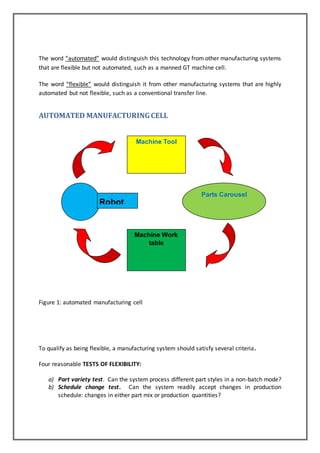
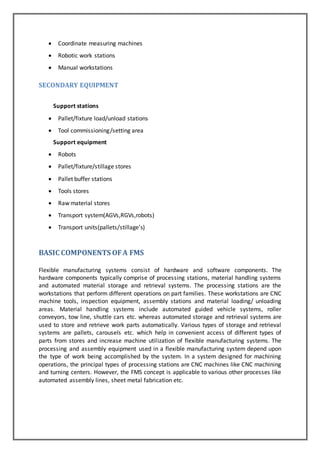
AUTOMATED MANUFACTURING CELL 
Machine Tool 
Machine Work 
Robot 
Figure 1: automated manufacturing cell 
table 
Parts Carousel 
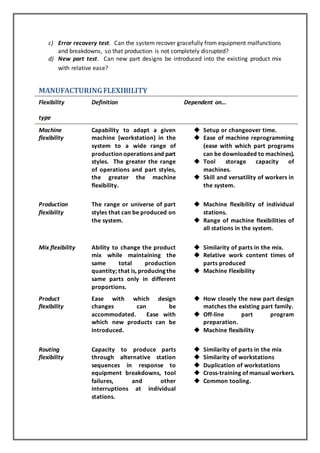
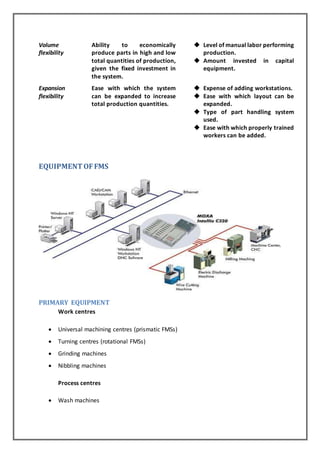
To qualify as being flexible, a manufacturing system should satisfy several criteria. 
Four reasonable TESTS OF FLEXIBILITY: 
a) Part variety test. Can the system process different part styles in a non-batch mode? 
b) Schedule change test. Can the system readily accept changes in production 
schedule: changes in either part mix or production quantities?
c) Error recovery test. Can the system recover gracefully from equipment malfunctions 
and breakdowns, so that production is not completely disrupted? 
d) New part test. Can new part designs be introduced into the existing product mix 
with relative ease? 
MANUFACTURING FLEXIBILITY 
Flexibility 
type 
Definition Dependent on... 
Machine 
flexibility 
Capability to adapt a given 
machine (workstation) in the 
system to a wide range of 
production operations and part 
styles. The greater the range 
of operations and part styles, 
the greater the machine 
flexibility. 
 Setup or changeover time. 
 Ease of machine reprogramming 
(ease with which part programs 
can be downloaded to machines). 
 Tool storage capacity of 
machines. 
 Skill and versatility of workers in 
the system. 
Production 
flexibility 
The range or universe of part 
styles that can be produced on 
the system. 
 Machine flexibility of individual 
stations. 
 Range of machine flexibilities of 
all stations in the system. 
Mix flexibility Ability to change the product 
mix while maintaining the 
same total production 
quantity; that is, producing the 
same parts only in different 
proportions. 
 Similarity of parts in the mix. 
 Relative work content times of 
parts produced 
 Machine Flexibility 
Product 
flexibility 
Ease with which design 
changes can be 
accommodated. Ease with 
which new products can be 
introduced. 
 How closely the new part design 
matches the existing part family. 
 Off-line part program 
preparation. 
 Machine flexibility 
Routing 
flexibility 
Capacity to produce parts 
through alternative station 
sequences in response to 
equipment breakdowns, tool 
failures, and other 
interruptions at individual 
stations. 
 Similarity of parts in the mix 
 Similarity of workstations 
 Duplication of workstations 
 Cross-training of manual workers. 
 Common tooling.
Volume 
flexibility 
Ability to economically 
produce parts in high and low 
total quantities of production, 
given the fixed investment in 
the system. 
 Level of manual labor performing 
production. 
 Amount invested in capital 
equipment. 
Expansion 
flexibility 
Ease with which the system 
can be expanded to increase 
total production quantities. 
 Expense of adding workstations. 
 Ease with which layout can be 
expanded. 
 Type of part handling system 
used. 
 Ease with which properly trained 
workers can be added. 
EQUIPMENT OF FMS 
PRIMARY EQUIPMENT 
Work centres 
 Universal machining centres (prismatic FMSs) 
 Turning centres (rotational FMSs) 
 Grinding machines 
 Nibbling machines 
Process centres 
 Wash machines
 Coordinate measuring machines 
 Robotic work stations 
 Manual workstations 
SECONDARY EQUIPMENT 
Support stations 
 Pallet/fixture load/unload stations 
 Tool commissioning /setting area 
Support equipment 
 Robots 
 Pallet/fixture/stillage stores 
 Pallet buffer stations 
 Tools stores 
 Raw material stores 
 Transport system(AGVs,RGVs,robots) 
 Transport units(pallets/stillage’s) 
BASIC COMPONENTS OF A FMS 
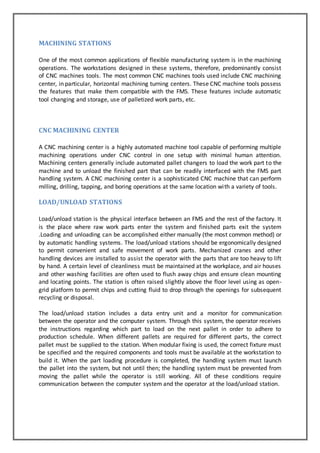
Flexible manufacturing systems consist of hardware and software components. The 
hardware components typically comprise of processing stations, material handling systems 
and automated material storage and retrieval systems. The processing stations are the 
workstations that perform different operations on part families. These workstations are CNC 
machine tools, inspection equipment, assembly stations and material loading/ unloading 
areas. Material handling systems include automated guided vehicle systems, roller 
conveyors, tow line, shuttle cars etc. whereas automated storage and retrieval systems are 
used to store and retrieve work parts automatically. Various types of storage and retrieval 
systems are pallets, carousels etc. which help in convenient access of different types of 
parts from stores and increase machine utilization of flexible manufacturing systems. The 
processing and assembly equipment used in a flexible manufacturing system depend upon 
the type of work being accomplished by the system. In a system designed for machining 
operations, the principal types of processing stations are CNC machines like CNC machining 
and turning centers. However, the FMS concept is applicable to various other processes like 
automated assembly lines, sheet metal fabrication etc.
MACHINING STATIONS 
One of the most common applications of flexible manufacturing system is in the machining 
operations. The workstations designed in these systems, therefore, predominantly consist 
of CNC machines tools. The most common CNC machines tools used include CNC machining 
center, in particular, horizontal machining turning centers. These CNC machine tools possess 
the features that make them compatible with the FMS. These features include automatic 
tool changing and storage, use of palletized work parts, etc. 
CNC MACHINING CENTER 
A CNC machining center is a highly automated machine tool capable of performing multiple 
machining operations under CNC control in one setup with minimal human attention. 
Machining centers generally include automated pallet changers to load the work part to the 
machine and to unload the finished part that can be readily interfaced with the FMS part 
handling system. A CNC machining center is a sophisticated CNC machine that can perform 
milling, drilling, tapping, and boring operations at the same location wi th a variety of tools. 
LOAD/UNLOAD STATIONS 
Load/unload station is the physical interface between an FMS and the rest of the factory. It 
is the place where raw work parts enter the system and finished parts exit the system 
.Loading and unloading can be accomplished either manually (the most common method) or 
by automatic handling systems. The load/unload stations should be ergonomically designed 
to permit convenient and safe movement of work parts. Mechanized cranes and other 
handling devices are installed to assist the operator with the parts that are too heavy to lift 
by hand. A certain level of cleanliness must be maintained at the workplace, and air houses 
and other washing facilities are often used to flush away chips and ensure clean mounting 
and locating points. The station is often raised slightly above the floor level using as open-grid 
platform to permit chips and cutting fluid to drop through the openings for subsequent 
recycling or disposal. 
The load/unload station includes a data entry unit and a monitor for communication 
between the operator and the computer system. Through this system, the operator receives 
the instructions regarding which part to load on the next pallet in order to adhere to 
production schedule. When different pallets are required for different parts, the correct 
pallet must be supplied to the station. When modular fixing is used, the correct fixture must 
be specified and the required components and tools must be available at the workstation to 
build it. When the part loading procedure is completed, the handling system must launch 
the pallet into the system, but not until then; the handling system must be prevented from 
moving the pallet while the operator is still working. All of these conditions require 
communication between the computer system and the operator at the load/unload station.
MATERIAL HANDLING SYSTEM 
There are two types of material handling systems which are: 
 Primary handling system establishes the basic layout of the FMS and is responsible 
for moving work parts between stations in the system 
 Secondary handling system consists of transfer devices, automatic pallet changing, 
and similar mechanisms located at the workstations 
Functions of the Handling System 
 Random, independent movement of work pieces between stations. 
 Handle a variety of work piece configurations. 
 Temporary storage. 
 Convenient access for loading and unloading work pieces. 
 Compatible with computer control. 
The material-handling equipment used in flexible manufacturing systems include robots, 
conveyers, automated guided vehicle systems, monorails and other rail guided vehicles, and 
other specially designed vehicles. There important features are that they are integrated with 
the machine centres and the storage and retrieval systems .For prismatic part material 
handling systems are accompanied with modular pallet fixtures .For rotational parts 
industrial robots are used to load/unload the turning machine and to move parts between 
stations. 
OBJETIVES OF FMS 
Stated formally, the general objectives of an FMS are to approach the efficiencies and 
economies of scale normally associated with mass production, and to maintain the flexibility 
required for small- and medium-lot-size production of a variety of parts. 
Two kinds of manufacturing systems fall within the FMS spectrum. These are assembly 
systems, which assemble components into final products and forming systems, which 
actually form components or final products. A generic FMS is said to consist of the following 
components: 
1. A set of work stations containing machine tools that do not require significant set-up 
time or change-over between successive jobs. Typically, these machines perform 
milling, boring, drilling, tapping, reaming, turning, and grooving operations. 
2. A material-handling system that is automated and flexible in that it permits jobs to 
move between any pair of machines so that any job routing can be followed.
3. A network of supervisory computers and microprocessors that perform some or all 
of the following tasks: (a) directs the routing of jobs through the system; (b) tracks 
the status of all jobs in progress so it is known where each job is to go next; (c) 
passes the instructions for the processing of each operation to each station and 
ensures that the right tools are available for the job; and (d) provides essential 
monitoring of the correct performance of operations and signals problems requiring 
attention. 
4. Storage, locally at the work stations, and/or centrally at the system level. 
The jobs to be processed by the system. In operating an FMS, the worker enters the job to 
be run at the supervisory computer, which then downloads the part programs to the cell 
control or NC controller. 
TYPES OF FMS- 
 Sequential FMS 
 Random FMS 
 Dedicated FMS 
 Engineered FMS 
 Modular FMS 
APPLICATION OF FMS- 
 Metal-cutting machining 
 Metal forming 
 Assembly 
 Joining-welding (arc , spot), gluing 
 Surface treatment 
 Inspection 
 Testing
ADVANTAGES OF FMS 
The potential benefits from the implementation and utilization of a flexible manufacturing 
system have been detailed by numerous researchers on the subject. A review of the 
literature reveals many tangible and intangible benefits that FMS users extol. Thes e benefits 
include: 
 achieving a highly automated manufacturing process with rigorous computerized 
monitoring and management of quality and productivity 
 making manufacturing operations readily scalable for different levels of output 
 allowing customization and reconfiguration of manufacturing processes with 
minimal downtime and cost 
 providing management with detailed and timely information about the 
manufacturing process 
 enabling manufacturers to coordinate their work processes with those of their 
suppliers and customers to maximize efficiency and minimize costs 
 Increased machine utilization 
 Fewer machines required 
 Reduction in factory floor space required 
 Greater responsiveness to change. 
 Reduced inventory requirements 
 Lower manufacturing lead times 
 Reduced direct labor requirements and higher labor productivity 
 Opportunity for unattended production 
DISADVANTAGES OF FMS 
Despite these benefits, FMS does have certain limitations. In particular, this type of system 
can only handle a relatively-narrow range of part varieties, so it must be used for similar 
parts (family of parts) that require similar processing. Due to increased complexity and cost, 
an FMS also requires a longer planning and development period than traditional 
manufacturing equipment. 
Equipment utilization for the FMS sometimes is not as high as one would expect. Japanese 
firms tend to have a much higher equipment utilization rate than U.S. manufacturers 
utilizing FMS. This is probably a result of U.S. users' attempt to utilize FMS for high-volume 
production of a few parts rather than for a high-variety production of many parts at a low 
cost per unit. U.S. firms average ten types of parts per machine, compared to ninety-three 
types of parts per machine in Japan.
Other problems can result from a lack of technical literacy, management incompetence, and 
poor implementation of the FMS process. If the firm misidentifies its objectives and 
manufacturing mission, and does not maintain a manufacturing strategy that is consistent 
with the firm's overall strategy, problems are inevitable. It is crucial that a firm's technology 
acquisition decisions be consistent with its manufacturing strategy. 
If a firm chooses to compete on the basis of flexibility rather than cost or quality, it may be a 
candidate for flexible manufacturing, especially if it is suited for low- to mid-volume 
production. This is particularly true if the firm is in an industry where products change 
rapidly, and the ability to introduce new products may be more important than minimizing 
cost. In this scenario, scale is no longer the main concern and size is no longer a barrier to 
entry. 
However, an FMS may not be appropriate for some firms. Since new technology is costly 
and requires several years to install and become productive, it requires a supportive 
infrastructure and the allocation of scarce resources for implementation. Frankly, many 
firms do not possess the necessary resources. Economically justifying an FMS can be a 
difficult task—especially since cost accounting tends to be designed for mass production of 
a mature product, with known characteristics, and a stable technology. Therefore, it is 
difficult to give an accurate indication of whether flexible manufacturing is justified. The 
question remains of how to quantify the benefits of flexibility. In addition, rapidly-changing 
technology and shortened product life cycles can cause capital equipment to quickly 
become obsolete. 
For other firms, their products may not require processes at the technological level of an 
FMS. IBM found that a redesigned printer was simple enough for high-quality manual 
assembly and that the manual assembly could be achieved at a lower cost than automated 
assembly. Potential FMS users should also consider that some of the costs traditionally 
incurred in manufacturing may actually be higher in a flexible automated system than in 
conventional manufacturing.
REFERENCES 
1) J. A. Buzacott,'The Fundamental Principles of Flexibility in Manufacturing Systems', 
Proceedings of the 1st International Conference on Flexible Manufacturing Systems. 
2) ASKIN R. G., and STANDRIDGE C. R., 1993 “Modelling and Analysis of Manufacturing Syste ms”. 
John Wiley and Sons, Inc. 
3) Mikell P. Groover, Automation, Production Systems, and Computer-Aided Manufacturing. 
Prentice-Hall, Englewood Cliffs NJ (1980). 
4) Tauseef Aized (2010). Flexible Manufacturing System: Hardware Requirements, Future 
Manufacturing Systems, Tauseef Aized (Ed.), ISBN: 978-953-307-128-2, 
5)http://www.intechopen.com/books/future-manufacturing-systems/flexible-manufacturing-system- 
hardwarerequirements

Flexible manufacturing systems

  • 1.
    IMB 513 MANUFACTURING SYSTEMS PROJECT ID NO: 201101574 PROJECT ON AUTOMATED PROCESSES-FMS FLEXIBLE MANUFACTURING SYSTEMS Mr Dingalo A Dingalo
  • 2.
    TABLE OF CONTENTS Contents TABLE OF CONTENTS .................................................................................................................... 1 INTRODUCTION ............................................................................................................................ 2 Definition- ................................................................................................................................ 2 AUTOMATED MANUFACTURING CELL ............................................................................................ 3 MANUFACTURING FLEXIBILITY....................................................................................................... 4 EQUIPMENT OF FMS ..................................................................................................................... 5 PRIMARY EQUIPMENT............................................................................................................... 5 SECONDARY EQUIPMENT .......................................................................................................... 6 BASIC COMPONENTS OF A FMS ..................................................................................................... 6 MACHINING STATIONS .............................................................................................................. 7 CNC MACHINING CENTER .......................................................................................................... 7 LOAD/UNLOAD STATIONS ......................................................................................................... 7 MATERIAL HANDLING SYSTEM................................................................................................... 8 OBJETIVES OF FMS........................................................................................................................ 8 TYPES OF FMS-.......................................................................................................................... 9 APPLICATION OF FMS-............................................................................................................... 9 ADVANTAGES OF FMS................................................................................................................. 10 DISADVANTAGES OF FMS ............................................................................................................ 10 REFERENCES ............................................................................................................................... 12
  • 3.
    INTRODUCTION A flexiblemanufacturing system (FMS) is a group of numerically-controlled machine tools, interconnected by a central control system. The various machining cells are interconnected, via loading and unloading stations, by an automated transport system. Operational flexibility is enhanced by the ability to execute all manufacturing tasks on numerous product designs in small quantities and with faster delivery. It has been described as an automated job shop and as a miniature automated factory. Simply stated, it is an automated production system that produces one or more families of parts in a flexible manner. Today, this prospect of automation and flexibility presents the possibility of producing nonstandard parts to create a competitive advantage. Definition- “A Flexible Manufacturing System (FMS) is a production system consisting of a set of identical and/or complementary numerically controlled machine which are connected through an automated transportation system”. Each process in FMS is controlled by a dedicated computer (FMS cell computer). The concept of flexible manufacturing systems evolved during the 1960s when robots, programmable controllers, and computerized numerical controls brought a controlled environment to the factory floor in the form of numerically-controlled and direct-numerically- controlled machines. For the most part, FMS is limited to firms involved in batch production or job shop environments. Normally, batch producers have two kinds of equipment from which to choose: dedicated machinery or automated, general-purpose tools. Dedicated machinery results in cost savings but lacks flexibility. General purpose machines such as lathes, milling machines, or drill presses are all costly, and may not reach full capacity. Flexible manufacturing systems provide the batch manufacturer with another option—one that can make batch manufacturing just as efficient and productive as mass production. The first FMS was patent in 1965 by Theo Williamson who made numerically controlled equipment.
  • 4.
    The word “automated”would distinguish this technology from other manufacturing systems that are flexible but not automated, such as a manned GT machine cell. The word “flexible” would distinguish it from other manufacturing systems that are highly automated but not flexible, such as a conventional transfer line. AUTOMATED MANUFACTURING CELL Machine Tool Machine Work Robot Figure 1: automated manufacturing cell table Parts Carousel To qualify as being flexible, a manufacturing system should satisfy several criteria. Four reasonable TESTS OF FLEXIBILITY: a) Part variety test. Can the system process different part styles in a non-batch mode? b) Schedule change test. Can the system readily accept changes in production schedule: changes in either part mix or production quantities?
  • 5.
    c) Error recoverytest. Can the system recover gracefully from equipment malfunctions and breakdowns, so that production is not completely disrupted? d) New part test. Can new part designs be introduced into the existing product mix with relative ease? MANUFACTURING FLEXIBILITY Flexibility type Definition Dependent on... Machine flexibility Capability to adapt a given machine (workstation) in the system to a wide range of production operations and part styles. The greater the range of operations and part styles, the greater the machine flexibility.  Setup or changeover time.  Ease of machine reprogramming (ease with which part programs can be downloaded to machines).  Tool storage capacity of machines.  Skill and versatility of workers in the system. Production flexibility The range or universe of part styles that can be produced on the system.  Machine flexibility of individual stations.  Range of machine flexibilities of all stations in the system. Mix flexibility Ability to change the product mix while maintaining the same total production quantity; that is, producing the same parts only in different proportions.  Similarity of parts in the mix.  Relative work content times of parts produced  Machine Flexibility Product flexibility Ease with which design changes can be accommodated. Ease with which new products can be introduced.  How closely the new part design matches the existing part family.  Off-line part program preparation.  Machine flexibility Routing flexibility Capacity to produce parts through alternative station sequences in response to equipment breakdowns, tool failures, and other interruptions at individual stations.  Similarity of parts in the mix  Similarity of workstations  Duplication of workstations  Cross-training of manual workers.  Common tooling.
  • 6.
    Volume flexibility Abilityto economically produce parts in high and low total quantities of production, given the fixed investment in the system.  Level of manual labor performing production.  Amount invested in capital equipment. Expansion flexibility Ease with which the system can be expanded to increase total production quantities.  Expense of adding workstations.  Ease with which layout can be expanded.  Type of part handling system used.  Ease with which properly trained workers can be added. EQUIPMENT OF FMS PRIMARY EQUIPMENT Work centres  Universal machining centres (prismatic FMSs)  Turning centres (rotational FMSs)  Grinding machines  Nibbling machines Process centres  Wash machines
  • 7.
     Coordinate measuringmachines  Robotic work stations  Manual workstations SECONDARY EQUIPMENT Support stations  Pallet/fixture load/unload stations  Tool commissioning /setting area Support equipment  Robots  Pallet/fixture/stillage stores  Pallet buffer stations  Tools stores  Raw material stores  Transport system(AGVs,RGVs,robots)  Transport units(pallets/stillage’s) BASIC COMPONENTS OF A FMS Flexible manufacturing systems consist of hardware and software components. The hardware components typically comprise of processing stations, material handling systems and automated material storage and retrieval systems. The processing stations are the workstations that perform different operations on part families. These workstations are CNC machine tools, inspection equipment, assembly stations and material loading/ unloading areas. Material handling systems include automated guided vehicle systems, roller conveyors, tow line, shuttle cars etc. whereas automated storage and retrieval systems are used to store and retrieve work parts automatically. Various types of storage and retrieval systems are pallets, carousels etc. which help in convenient access of different types of parts from stores and increase machine utilization of flexible manufacturing systems. The processing and assembly equipment used in a flexible manufacturing system depend upon the type of work being accomplished by the system. In a system designed for machining operations, the principal types of processing stations are CNC machines like CNC machining and turning centers. However, the FMS concept is applicable to various other processes like automated assembly lines, sheet metal fabrication etc.
  • 8.
    MACHINING STATIONS Oneof the most common applications of flexible manufacturing system is in the machining operations. The workstations designed in these systems, therefore, predominantly consist of CNC machines tools. The most common CNC machines tools used include CNC machining center, in particular, horizontal machining turning centers. These CNC machine tools possess the features that make them compatible with the FMS. These features include automatic tool changing and storage, use of palletized work parts, etc. CNC MACHINING CENTER A CNC machining center is a highly automated machine tool capable of performing multiple machining operations under CNC control in one setup with minimal human attention. Machining centers generally include automated pallet changers to load the work part to the machine and to unload the finished part that can be readily interfaced with the FMS part handling system. A CNC machining center is a sophisticated CNC machine that can perform milling, drilling, tapping, and boring operations at the same location wi th a variety of tools. LOAD/UNLOAD STATIONS Load/unload station is the physical interface between an FMS and the rest of the factory. It is the place where raw work parts enter the system and finished parts exit the system .Loading and unloading can be accomplished either manually (the most common method) or by automatic handling systems. The load/unload stations should be ergonomically designed to permit convenient and safe movement of work parts. Mechanized cranes and other handling devices are installed to assist the operator with the parts that are too heavy to lift by hand. A certain level of cleanliness must be maintained at the workplace, and air houses and other washing facilities are often used to flush away chips and ensure clean mounting and locating points. The station is often raised slightly above the floor level using as open-grid platform to permit chips and cutting fluid to drop through the openings for subsequent recycling or disposal. The load/unload station includes a data entry unit and a monitor for communication between the operator and the computer system. Through this system, the operator receives the instructions regarding which part to load on the next pallet in order to adhere to production schedule. When different pallets are required for different parts, the correct pallet must be supplied to the station. When modular fixing is used, the correct fixture must be specified and the required components and tools must be available at the workstation to build it. When the part loading procedure is completed, the handling system must launch the pallet into the system, but not until then; the handling system must be prevented from moving the pallet while the operator is still working. All of these conditions require communication between the computer system and the operator at the load/unload station.
  • 9.
    MATERIAL HANDLING SYSTEM There are two types of material handling systems which are:  Primary handling system establishes the basic layout of the FMS and is responsible for moving work parts between stations in the system  Secondary handling system consists of transfer devices, automatic pallet changing, and similar mechanisms located at the workstations Functions of the Handling System  Random, independent movement of work pieces between stations.  Handle a variety of work piece configurations.  Temporary storage.  Convenient access for loading and unloading work pieces.  Compatible with computer control. The material-handling equipment used in flexible manufacturing systems include robots, conveyers, automated guided vehicle systems, monorails and other rail guided vehicles, and other specially designed vehicles. There important features are that they are integrated with the machine centres and the storage and retrieval systems .For prismatic part material handling systems are accompanied with modular pallet fixtures .For rotational parts industrial robots are used to load/unload the turning machine and to move parts between stations. OBJETIVES OF FMS Stated formally, the general objectives of an FMS are to approach the efficiencies and economies of scale normally associated with mass production, and to maintain the flexibility required for small- and medium-lot-size production of a variety of parts. Two kinds of manufacturing systems fall within the FMS spectrum. These are assembly systems, which assemble components into final products and forming systems, which actually form components or final products. A generic FMS is said to consist of the following components: 1. A set of work stations containing machine tools that do not require significant set-up time or change-over between successive jobs. Typically, these machines perform milling, boring, drilling, tapping, reaming, turning, and grooving operations. 2. A material-handling system that is automated and flexible in that it permits jobs to move between any pair of machines so that any job routing can be followed.
  • 10.
    3. A networkof supervisory computers and microprocessors that perform some or all of the following tasks: (a) directs the routing of jobs through the system; (b) tracks the status of all jobs in progress so it is known where each job is to go next; (c) passes the instructions for the processing of each operation to each station and ensures that the right tools are available for the job; and (d) provides essential monitoring of the correct performance of operations and signals problems requiring attention. 4. Storage, locally at the work stations, and/or centrally at the system level. The jobs to be processed by the system. In operating an FMS, the worker enters the job to be run at the supervisory computer, which then downloads the part programs to the cell control or NC controller. TYPES OF FMS-  Sequential FMS  Random FMS  Dedicated FMS  Engineered FMS  Modular FMS APPLICATION OF FMS-  Metal-cutting machining  Metal forming  Assembly  Joining-welding (arc , spot), gluing  Surface treatment  Inspection  Testing
  • 11.
    ADVANTAGES OF FMS The potential benefits from the implementation and utilization of a flexible manufacturing system have been detailed by numerous researchers on the subject. A review of the literature reveals many tangible and intangible benefits that FMS users extol. Thes e benefits include:  achieving a highly automated manufacturing process with rigorous computerized monitoring and management of quality and productivity  making manufacturing operations readily scalable for different levels of output  allowing customization and reconfiguration of manufacturing processes with minimal downtime and cost  providing management with detailed and timely information about the manufacturing process  enabling manufacturers to coordinate their work processes with those of their suppliers and customers to maximize efficiency and minimize costs  Increased machine utilization  Fewer machines required  Reduction in factory floor space required  Greater responsiveness to change.  Reduced inventory requirements  Lower manufacturing lead times  Reduced direct labor requirements and higher labor productivity  Opportunity for unattended production DISADVANTAGES OF FMS Despite these benefits, FMS does have certain limitations. In particular, this type of system can only handle a relatively-narrow range of part varieties, so it must be used for similar parts (family of parts) that require similar processing. Due to increased complexity and cost, an FMS also requires a longer planning and development period than traditional manufacturing equipment. Equipment utilization for the FMS sometimes is not as high as one would expect. Japanese firms tend to have a much higher equipment utilization rate than U.S. manufacturers utilizing FMS. This is probably a result of U.S. users' attempt to utilize FMS for high-volume production of a few parts rather than for a high-variety production of many parts at a low cost per unit. U.S. firms average ten types of parts per machine, compared to ninety-three types of parts per machine in Japan.
  • 12.
    Other problems canresult from a lack of technical literacy, management incompetence, and poor implementation of the FMS process. If the firm misidentifies its objectives and manufacturing mission, and does not maintain a manufacturing strategy that is consistent with the firm's overall strategy, problems are inevitable. It is crucial that a firm's technology acquisition decisions be consistent with its manufacturing strategy. If a firm chooses to compete on the basis of flexibility rather than cost or quality, it may be a candidate for flexible manufacturing, especially if it is suited for low- to mid-volume production. This is particularly true if the firm is in an industry where products change rapidly, and the ability to introduce new products may be more important than minimizing cost. In this scenario, scale is no longer the main concern and size is no longer a barrier to entry. However, an FMS may not be appropriate for some firms. Since new technology is costly and requires several years to install and become productive, it requires a supportive infrastructure and the allocation of scarce resources for implementation. Frankly, many firms do not possess the necessary resources. Economically justifying an FMS can be a difficult task—especially since cost accounting tends to be designed for mass production of a mature product, with known characteristics, and a stable technology. Therefore, it is difficult to give an accurate indication of whether flexible manufacturing is justified. The question remains of how to quantify the benefits of flexibility. In addition, rapidly-changing technology and shortened product life cycles can cause capital equipment to quickly become obsolete. For other firms, their products may not require processes at the technological level of an FMS. IBM found that a redesigned printer was simple enough for high-quality manual assembly and that the manual assembly could be achieved at a lower cost than automated assembly. Potential FMS users should also consider that some of the costs traditionally incurred in manufacturing may actually be higher in a flexible automated system than in conventional manufacturing.
  • 13.
    REFERENCES 1) J.A. Buzacott,'The Fundamental Principles of Flexibility in Manufacturing Systems', Proceedings of the 1st International Conference on Flexible Manufacturing Systems. 2) ASKIN R. G., and STANDRIDGE C. R., 1993 “Modelling and Analysis of Manufacturing Syste ms”. John Wiley and Sons, Inc. 3) Mikell P. Groover, Automation, Production Systems, and Computer-Aided Manufacturing. Prentice-Hall, Englewood Cliffs NJ (1980). 4) Tauseef Aized (2010). Flexible Manufacturing System: Hardware Requirements, Future Manufacturing Systems, Tauseef Aized (Ed.), ISBN: 978-953-307-128-2, 5)http://www.intechopen.com/books/future-manufacturing-systems/flexible-manufacturing-system- hardwarerequirements