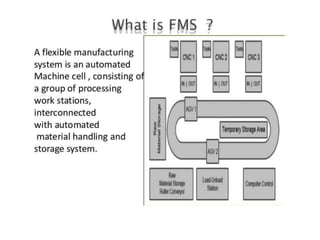
1152ME136 - FLEXIBLE MANUFACTURING SYSTEMS
UNIT I PRODUCTION SYSTEMS
Types of production-Job Shop, Batch and Mass production - Functions in manufacturing -
Organization and information processing in manufacturing - Plant layout - Batch production –
Work in progress inventory - Scheduling, problems.
UNIT II GROUP TECHNOLOGY
Formation of part families - Part classification - Coding system optiz, Multi Class - Production flow
analysis – Machine cells design - Clustering methods - Modern algorithms - Benefits of GT - System
planning - Objective, guide line, system definition and sizing - Human resources - Objective,
staffing, supervisor role.
UNIT III FLEXIBLE MANUFACTURING SYSTEMS
Introduction – Evolution – Definition - Need for FMS - Need for Flexibility - Economic Justification of
FMS-Application Criteria - Machine tool Selection and Layout - Computer control system - Data files –
Reports - Planning the FMS - Analysis Methods for FMS - Benefits and limitations.
UNIT IV FLEXIBLE MANUFACTURING CELLS
Introduction - Cell description and classifications - Unattended machining – Component handling
and storage system - Cellular versus FMS – System - Simulation, Hardware configuration –
Controllers - Communication networks - Lean production and agile manufacturing.
UNIT V FMS SOFTWARE
Introduction - General Structure and requirements - Functional descriptions - Operational overview
- Computer simulation - FMS installation – Objective - Acceptance testing - Performance goals –
Expectations - Continued support.
B.Tech. Mechanical Engineering With Specialization in Mechatronics
https://rekadayaupaya.wordpress.com/buku-cim/buku-manufaktur/
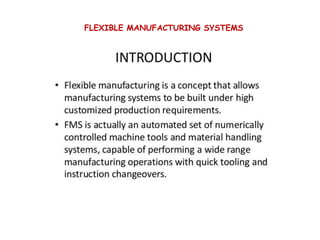
FLEXIBLE MANUFACTURING SYSTEMS
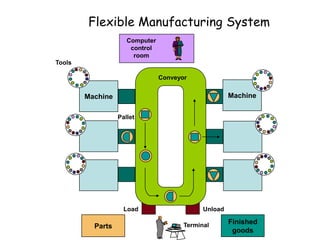
Flexible Manufacturing System
Parts
Finished
goods
Load Unload
Computer
control
room
Terminal
Machine Machine
Tools
Conveyor
Pallet
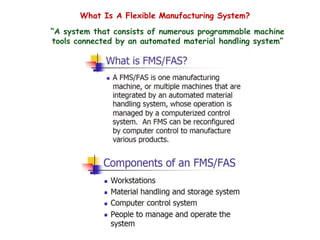
What Is A Flexible Manufacturing System?
“A system that consists of numerous programmable machine
tools connected by an automated material handling system”
Basic Components of FMS
History of FMS
 The FMS was patented in 1965 by Theo Williamson
who made numerically controlled equipment.
Examples of numerically controlled equipments are
like CNC lathes or mills which is called varying types
of FMS
• In the middle of the 1960s, market competition became more
intense.
• During 1960 to 1970 cost was the primary concern.
Later quality became a priority.
• As the market became more and more complex, speed of
delivery became something customer also needed.
• A new strategy was formulated: Customizability.
• The companies have to adapt to the environment in which they
operate, to be more flexible in their operations and to satisfy
different market segments (customizability).
• Thus the innovation of FMS became related to the effort of gaining
competitive advantage.
FLEXIBLE MANUFACTURING SYSTEMS – HISTORY
Why FMS ?
• External changes such as change in product design
and production system.
• Optimizing the manufacturing cycle time.
• Reduced production costs.
• Overcoming internal changes like breakdown etc
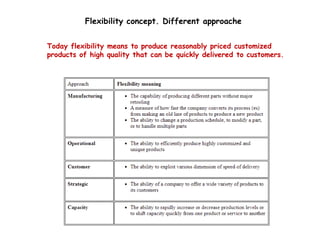
Flexibility concept. Different approache
Today flexibility means to produce reasonably priced customized
products of high quality that can be quickly delivered to customers.
FLEXIBLE MANUFACTURING SYSTEM
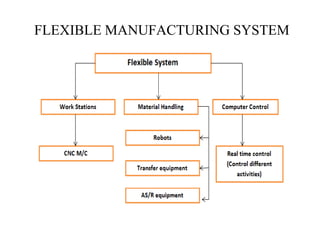
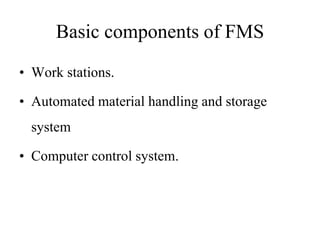
Basic components of FMS
• Work stations.
• Automated material handling and storage
system
• Computer control system.
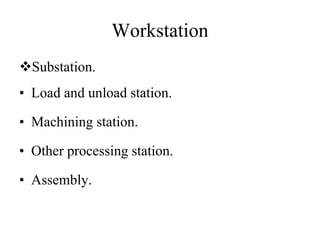
Workstation
Substation.
• Load and unload station.
• Machining station.
• Other processing station.
• Assembly.
1
2
3
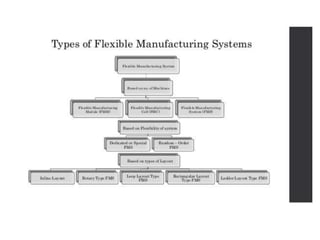
2.Types of FMS
• Sequential FMS.
• Random FMS.
• Dedicated FMS.
• Engineered FMS.
• Sequential FMS: It manufactures one piece part
batch type and planning and preparation is carried out
for the next piece part batch type to be manufactured.
• Random FMS :It manufactures any random mix of
piece part types at any one time.
• Dedicated FMS : It continually manufactures , for
extended period , the same but limited mix of piece
part batch types.
• Engineered FMS : It manufactures the same mix of
part types throughout its lifetime
3. Layouts of FMS
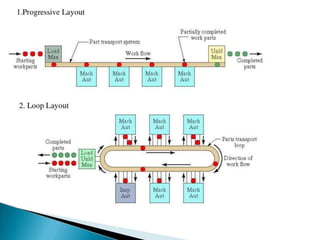
• Progressive or Line type.
• Loop type:
• Ladder type.
• Open field type.
• Robot cantered type.
Progressive or Line type
• The machines and handling system are arranged in a
line.
• In this system part progress from one workstation to
the next in a well defined sequence with no back flow
• Work always flows in unidirectional path.
Loop type
• In this , parts usually move in one direction around
the loop, with capability to stop and be transferred to
any station.
• The loading and unloading stations are typically
located at one end of the loop.
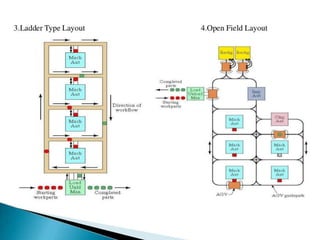
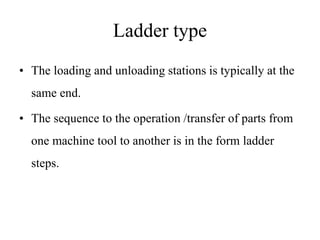
Ladder type
• The loading and unloading stations is typically at the
same end.
• The sequence to the operation /transfer of parts from
one machine tool to another is in the form ladder
steps.
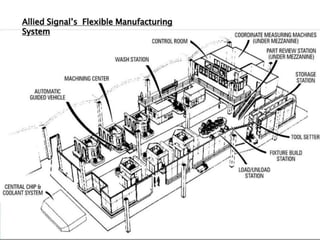
Open field type
• The loading and unloading stations is typically at the
same end.
• The parts will go through all the substations such as
CNC machine , coordinate measuring machines and
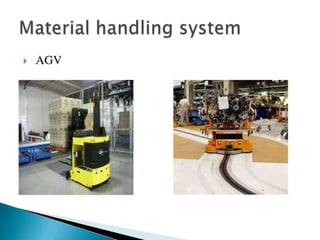
wash station by the help of AGV’S from one
substation to another.
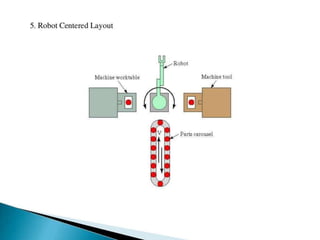
Robot centered type
• Robot cantered cell is a relatively new form of
flexible system.
• One or more robots are used as the material handling
system.
• Industrial robots can be equipped with grippers that
make well suited for handling of rotational parts
FMS.ppt
FMS.ppt

FMS.ppt

  • 1.
    1152ME136 - FLEXIBLEMANUFACTURING SYSTEMS UNIT I PRODUCTION SYSTEMS Types of production-Job Shop, Batch and Mass production - Functions in manufacturing - Organization and information processing in manufacturing - Plant layout - Batch production – Work in progress inventory - Scheduling, problems. UNIT II GROUP TECHNOLOGY Formation of part families - Part classification - Coding system optiz, Multi Class - Production flow analysis – Machine cells design - Clustering methods - Modern algorithms - Benefits of GT - System planning - Objective, guide line, system definition and sizing - Human resources - Objective, staffing, supervisor role. UNIT III FLEXIBLE MANUFACTURING SYSTEMS Introduction – Evolution – Definition - Need for FMS - Need for Flexibility - Economic Justification of FMS-Application Criteria - Machine tool Selection and Layout - Computer control system - Data files – Reports - Planning the FMS - Analysis Methods for FMS - Benefits and limitations. UNIT IV FLEXIBLE MANUFACTURING CELLS Introduction - Cell description and classifications - Unattended machining – Component handling and storage system - Cellular versus FMS – System - Simulation, Hardware configuration – Controllers - Communication networks - Lean production and agile manufacturing. UNIT V FMS SOFTWARE Introduction - General Structure and requirements - Functional descriptions - Operational overview - Computer simulation - FMS installation – Objective - Acceptance testing - Performance goals – Expectations - Continued support. B.Tech. Mechanical Engineering With Specialization in Mechatronics https://rekadayaupaya.wordpress.com/buku-cim/buku-manufaktur/
  • 3.
  • 5.
    Flexible Manufacturing System Parts Finished goods LoadUnload Computer control room Terminal Machine Machine Tools Conveyor Pallet
  • 6.
    What Is AFlexible Manufacturing System? “A system that consists of numerous programmable machine tools connected by an automated material handling system” Basic Components of FMS
  • 7.
    History of FMS The FMS was patented in 1965 by Theo Williamson who made numerically controlled equipment. Examples of numerically controlled equipments are like CNC lathes or mills which is called varying types of FMS
  • 9.
    • In themiddle of the 1960s, market competition became more intense. • During 1960 to 1970 cost was the primary concern. Later quality became a priority. • As the market became more and more complex, speed of delivery became something customer also needed. • A new strategy was formulated: Customizability. • The companies have to adapt to the environment in which they operate, to be more flexible in their operations and to satisfy different market segments (customizability). • Thus the innovation of FMS became related to the effort of gaining competitive advantage. FLEXIBLE MANUFACTURING SYSTEMS – HISTORY
  • 10.
    Why FMS ? •External changes such as change in product design and production system. • Optimizing the manufacturing cycle time. • Reduced production costs. • Overcoming internal changes like breakdown etc
  • 12.
    Flexibility concept. Differentapproache Today flexibility means to produce reasonably priced customized products of high quality that can be quickly delivered to customers.
  • 16.
  • 17.
    Basic components ofFMS • Work stations. • Automated material handling and storage system • Computer control system.
  • 18.
    Workstation Substation. • Load andunload station. • Machining station. • Other processing station. • Assembly.
  • 31.
  • 32.
    2.Types of FMS •Sequential FMS. • Random FMS. • Dedicated FMS. • Engineered FMS.
  • 33.
    • Sequential FMS:It manufactures one piece part batch type and planning and preparation is carried out for the next piece part batch type to be manufactured. • Random FMS :It manufactures any random mix of piece part types at any one time. • Dedicated FMS : It continually manufactures , for extended period , the same but limited mix of piece part batch types. • Engineered FMS : It manufactures the same mix of part types throughout its lifetime
  • 34.
    3. Layouts ofFMS • Progressive or Line type. • Loop type: • Ladder type. • Open field type. • Robot cantered type.
  • 35.
    Progressive or Linetype • The machines and handling system are arranged in a line. • In this system part progress from one workstation to the next in a well defined sequence with no back flow • Work always flows in unidirectional path.
  • 36.
    Loop type • Inthis , parts usually move in one direction around the loop, with capability to stop and be transferred to any station. • The loading and unloading stations are typically located at one end of the loop.
  • 38.
    Ladder type • Theloading and unloading stations is typically at the same end. • The sequence to the operation /transfer of parts from one machine tool to another is in the form ladder steps.
  • 39.
    Open field type •The loading and unloading stations is typically at the same end. • The parts will go through all the substations such as CNC machine , coordinate measuring machines and wash station by the help of AGV’S from one substation to another.
  • 41.
    Robot centered type •Robot cantered cell is a relatively new form of flexible system. • One or more robots are used as the material handling system. • Industrial robots can be equipped with grippers that make well suited for handling of rotational parts

Editor's Notes