SUBJECT CODE: 2171903
BE Semester VII
Flexible
Manufacturing
System.
History.
• The FMS was first conceptualized for
machining, and it
required the prior development of NC.
• This concept is credited to DavidWilliamson,
a British engineer during mid-1960s.
• In late 1960s the first FMS machining system
was installed at Ingersoll company inVirginia.
• Germany implemented its first FMS in 1969,
in cooperation with the university of
Stuttgart.
What is FMS ???
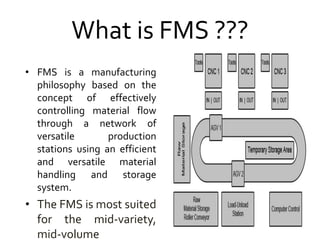
• FMS is a manufacturing
philosophy based on the
concept of effectively
controlling material flow
through a network of
versatile production
stations using an efficient
and versatile material
handling and storage
system.
• The FMS is most suited
for the mid-variety,
mid-volume
Why FMS ?
• External changes such as change in product
design and production system.
• Optimizing the manufacturing cycle time
• Reduced production costs
• Overcoming internal changes like
breakdowns etc.
What makes it flexible???
• Three capabilities that a manufacturing
system must possess to be a flexible.
1.The ability to identify and distinguish
among the different part styles
processed by the system.
2.Quick changeover of operating
instructions, and
3.Quick changeover of physical setup.
Classification of FMS…
• Flexible manufacturing systems can be
distinguished according to the number of
machines in the system. The following are
typical categories:
Single machine cell
Flexible manufacturing cell
Flexible manufacturing system
Flexible manufacturing line
Single Machine Cell (SMC)
• A single machine cell consists of one CNC
machining center combined with a parts storage
system for unattended operation.
• Completed parts are periodically unloaded from
the parts storage unit, and raw work parts are
loaded into it
Flexible Manufacturing Cell
(FMC)
• A flexible manufacturing cell consists
of two or three processing
workstations (typically CNC machining
centers) plus a part handling system.
• The part handling system is connected
to a load/unload station.
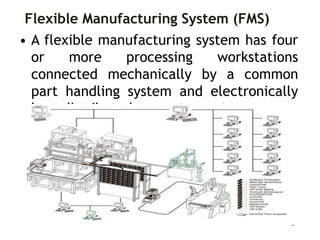
Flexible Manufacturing System (FMS)
• A flexible manufacturing system has four
or more processing workstations
connected mechanically by a common
part handling system and electronically
by a distributed computer system.
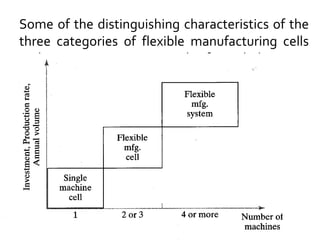
Some of the distinguishing characteristics of the
three categories of flexible manufacturing cells
and systems are summarized in figure below
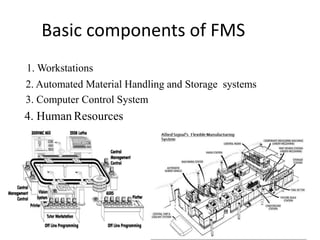
1. Workstations
2. Automated Material Handling and Storage systems
3. Computer Control System
Basic components of FMS
4. Human Resources
Workstation
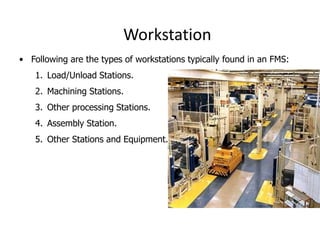
• Following are the types of workstations typically found in an FMS:
1. Load/Unload Stations.
2. Machining Stations.
3. Other processing Stations.
4. Assembly Station.
5. Other Stations and Equipment.
Material handling system
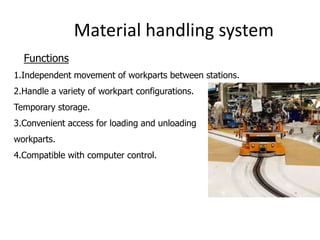
Functions
1.Independent movement of workparts between stations.
2.Handle a variety of workpart configurations.
Temporary storage.
3.Convenient access for loading and unloading
workparts.
4.Compatible with computer control.
Material handling system
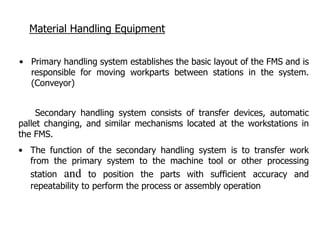
Secondary handling system consists of transfer devices, automatic
pallet changing, and similar mechanisms located at the workstations in
the FMS.
• The function of the secondary handling system is to transfer work
from the primary system to the machine tool or other processing
station and to position the parts with sufficient accuracy and
repeatability to perform the process or assembly operation.
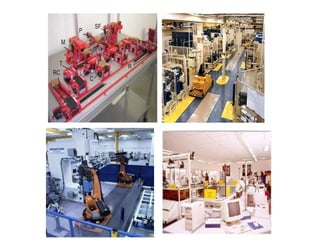
Material Handling Equipment
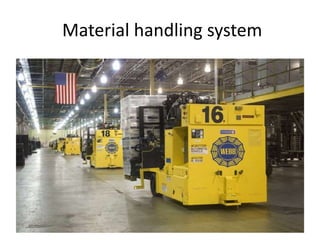
• Primary handling system establishes the basic layout of the FMS and is
responsible for moving workparts between stations in the system.
(Conveyor)
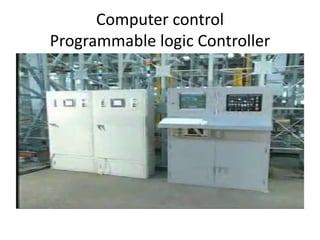
Computer control
Programmable logic Controller
• The FMS includes a distributed computer system that is interfaced to
 the workstations,
 Material handling system, and
 Other hardware components.
• A typical FMS computer system consists of
a central computer and microcomputers.
• Microcomputers controlling the individual
machines and other components.
• The central computer coordinates the activities of the components to
achieve smooth overall operation of the system
Computer control
Programmable logic Controller
Human Resources
• Human are needed to manage the operations of the FMS. Functions
typically performed by human includes:
 Loading raw workparts into the system,
 Unloading finished parts (or assemblies) from the system,
 Changing and setting tools,
 Equipment maintenance and repair, and
 Programming and operation the computer system.
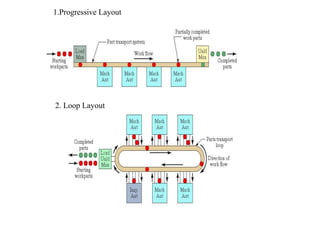
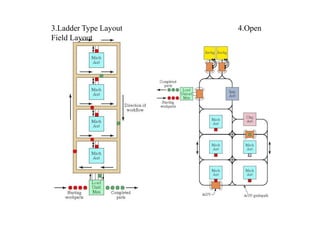
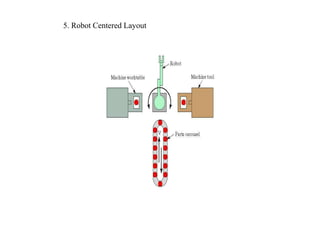
Layouts of FMS
• Progressive or LineType
• LoopType
• LadderType
• Open field type
• Robot centered type
1.Progressive Layout
2. Loop Layout
3.Ladder Type Layout 4.Open
Field Layout
5. Robot Centered Layout
Application of FMS
• Metal-cutting machining
• Metal forming
• Assembly
• Joining-welding (arc , spot), gluing
• Surface treatment
• Inspection
• Testing
Advantages of FMS
• To reduce set up and queue times
• Improve efficiency
• Reduce time for product completion
• Utilize human workers better
• Improve product routing
• Produce a variety of Items under one roof
• Improve product quality
• Serve a variety of vendors simultaneously
• Produce more product more quickly
Disadvantages of
FMS
• Expensive.
• Substantial pre-planning activity.
Challenges with
FMS
• Determining if FMS the best production
system for your company
• Possible expansion costs associated with
implementing FMS
Conclusion
• FMS is a revolution in the field of
ManufacturingTechnology.
• FMS can be designed to meet the
specific demand of each company
• FMS is used for multitask operation.
• FMS requires substantial investment of
time and resources.
Thank
you…

Flexible manufacturing system

  • 1.
  • 2.
  • 3.
    History. • The FMSwas first conceptualized for machining, and it required the prior development of NC. • This concept is credited to DavidWilliamson, a British engineer during mid-1960s. • In late 1960s the first FMS machining system was installed at Ingersoll company inVirginia. • Germany implemented its first FMS in 1969, in cooperation with the university of Stuttgart.
  • 4.
    What is FMS??? • FMS is a manufacturing philosophy based on the concept of effectively controlling material flow through a network of versatile production stations using an efficient and versatile material handling and storage system. • The FMS is most suited for the mid-variety, mid-volume
  • 5.
    Why FMS ? •External changes such as change in product design and production system. • Optimizing the manufacturing cycle time • Reduced production costs • Overcoming internal changes like breakdowns etc.
  • 6.
    What makes itflexible??? • Three capabilities that a manufacturing system must possess to be a flexible. 1.The ability to identify and distinguish among the different part styles processed by the system. 2.Quick changeover of operating instructions, and 3.Quick changeover of physical setup.
  • 7.
    Classification of FMS… •Flexible manufacturing systems can be distinguished according to the number of machines in the system. The following are typical categories: Single machine cell Flexible manufacturing cell Flexible manufacturing system Flexible manufacturing line
  • 8.
    Single Machine Cell(SMC) • A single machine cell consists of one CNC machining center combined with a parts storage system for unattended operation. • Completed parts are periodically unloaded from the parts storage unit, and raw work parts are loaded into it
  • 9.
    Flexible Manufacturing Cell (FMC) •A flexible manufacturing cell consists of two or three processing workstations (typically CNC machining centers) plus a part handling system. • The part handling system is connected to a load/unload station.
  • 10.
    Flexible Manufacturing System(FMS) • A flexible manufacturing system has four or more processing workstations connected mechanically by a common part handling system and electronically by a distributed computer system.
  • 11.
    Some of thedistinguishing characteristics of the three categories of flexible manufacturing cells and systems are summarized in figure below
  • 12.
    1. Workstations 2. AutomatedMaterial Handling and Storage systems 3. Computer Control System Basic components of FMS 4. Human Resources
  • 13.
    Workstation • Following arethe types of workstations typically found in an FMS: 1. Load/Unload Stations. 2. Machining Stations. 3. Other processing Stations. 4. Assembly Station. 5. Other Stations and Equipment.
  • 14.
    Material handling system Functions 1.Independentmovement of workparts between stations. 2.Handle a variety of workpart configurations. Temporary storage. 3.Convenient access for loading and unloading workparts. 4.Compatible with computer control.
  • 15.
  • 16.
    Secondary handling systemconsists of transfer devices, automatic pallet changing, and similar mechanisms located at the workstations in the FMS. • The function of the secondary handling system is to transfer work from the primary system to the machine tool or other processing station and to position the parts with sufficient accuracy and repeatability to perform the process or assembly operation. Material Handling Equipment • Primary handling system establishes the basic layout of the FMS and is responsible for moving workparts between stations in the system. (Conveyor)
  • 17.
    Computer control Programmable logicController • The FMS includes a distributed computer system that is interfaced to  the workstations,  Material handling system, and  Other hardware components. • A typical FMS computer system consists of a central computer and microcomputers. • Microcomputers controlling the individual machines and other components. • The central computer coordinates the activities of the components to achieve smooth overall operation of the system
  • 18.
  • 19.
    Human Resources • Humanare needed to manage the operations of the FMS. Functions typically performed by human includes:  Loading raw workparts into the system,  Unloading finished parts (or assemblies) from the system,  Changing and setting tools,  Equipment maintenance and repair, and  Programming and operation the computer system.
  • 20.
    Layouts of FMS •Progressive or LineType • LoopType • LadderType • Open field type • Robot centered type
  • 21.
  • 22.
    3.Ladder Type Layout4.Open Field Layout
  • 23.
  • 25.
    Application of FMS •Metal-cutting machining • Metal forming • Assembly • Joining-welding (arc , spot), gluing • Surface treatment • Inspection • Testing
  • 26.
    Advantages of FMS •To reduce set up and queue times • Improve efficiency • Reduce time for product completion • Utilize human workers better • Improve product routing • Produce a variety of Items under one roof • Improve product quality • Serve a variety of vendors simultaneously • Produce more product more quickly
  • 27.
    Disadvantages of FMS • Expensive. •Substantial pre-planning activity.
  • 28.
    Challenges with FMS • Determiningif FMS the best production system for your company • Possible expansion costs associated with implementing FMS
  • 29.
    Conclusion • FMS isa revolution in the field of ManufacturingTechnology. • FMS can be designed to meet the specific demand of each company • FMS is used for multitask operation. • FMS requires substantial investment of time and resources.
  • 30.