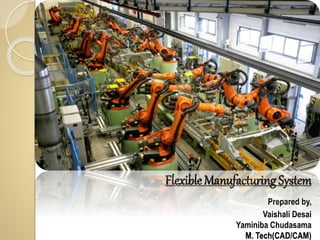
Flexible Manufacturing System
Prepared by,
Vaishali Desai
Yaminiba Chudasama
M. Tech(CAD/CAM)
 Introduction:-
 Globalization, flicking market requirements and modern lifestyle
trends have put up tremendous challenge to manufacturing industries.
 In the current business scenario the competitiveness of any manufacturing
industry is determined by its ability to respond quick change in market and
to produce high quality products at low costs.
 In the middle of the 1960s, market competition became more intense.
 During 1960 to 1970 cost was the primary concern. Later quality became a
priority. As the market became more and more complex, speed of delivery
became something customer also needed.
 FMS:-
 First of all, FMS is a manufacturing technology.
 Secondly, FMS is a philosophy. "System" is the key word.
FMS incorporates a system view of manufacturing. The
buzz word for today’s manufacturer is "agility". An agile
manufacturer is one who is the fastest to the market,
operates with the lowest total cost and has the greatest
ability to "delight" its customers. FMS is simply one way
that manufacturers are able to achieve this agility.
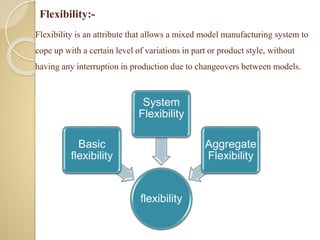
Flexibility:-
Flexibility is an attribute that allows a mixed model manufacturing system to
cope up with a certain level of variations in part or product style, without
having any interruption in production due to changeovers between models.
flexibility
Basic
flexibility
System
Flexibility
Aggregate
Flexibility
Basic flexibilities:-
 Machine flexibility - the ease with which a machine can
process various operations
 Material handling flexibility - a measure of the ease with
which different part types can be transported and properly
positioned at the various machine tools in a system
 Operation flexibility - a measure of the ease with which
alternative operation sequences can be used for processing a
part type
System flexibilities
 Volume flexibility - a measure of a system’s capability to be
operated profitably at different volumes of the existing part types
 Routing flexibility - a measure of the alternative paths that a part
can effectively follow through a system for a given process plan
 Process flexibility - a measure of the volume of the set of part types
that a system can produce without incurring any setup
 Product flexibility - the volume of the set of part types that can be
manufactured in a system with minor setup.
Aggregate flexibilities
 Program flexibility - the ability of a system to run for
reasonably long periods without external intervention
 Production flexibility - the volume of the set of part types
that a system can produce without major investment in
capital equipment
 Market flexibility - the ability of a system to efficiently
adapt to changing market conditions.
Types of FMS:-
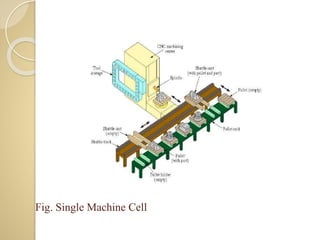
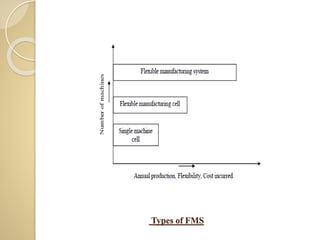
 1. Single machine cell—
 It contains one machine (often a CNC machining centre) connected to a
parts storage system, which can load and unload parts to and from the
storage system (Figure).
 It is designed to operate in batch mode, flexible mode, or a combination of
the two. When in batch mode, the system processes parts of a single style in
specific lot sizes before physical and programmed changeover to the next
batch specifications;
 In flexible mode the system satisfies three of the four tests for flexibility—
the exception being error recovery, since, if the CNC machine centre breaks
down, the system stops.
Fig. Single Machine Cell
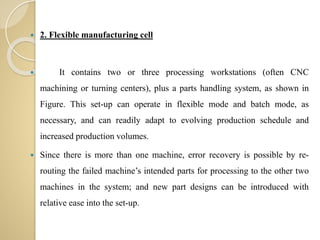
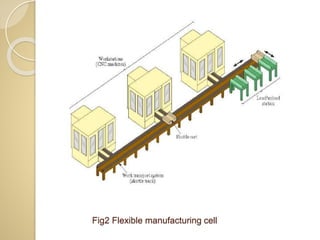
 2. Flexible manufacturing cell
 It contains two or three processing workstations (often CNC
machining or turning centers), plus a parts handling system, as shown in
Figure. This set-up can operate in flexible mode and batch mode, as
necessary, and can readily adapt to evolving production schedule and
increased production volumes.
 Since there is more than one machine, error recovery is possible by re-
routing the failed machine’s intended parts for processing to the other two
machines in the system; and new part designs can be introduced with
relative ease into the set-up.
Fig2 Flexible manufacturing cell
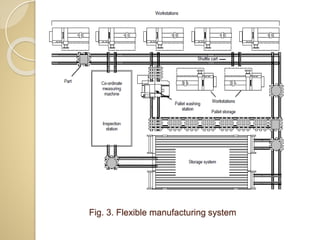
 3. Flexible Manufacturing System (FMS)—
 It consists of four or more processing stations connected
mechanically by a common parts handling system and electronically
by a distributed computer system (as shown in figure). FMS is
larger than the flexible manufacturing cell, not only in the number
of workstations it may contain, but also in the number of supporting
stations in the system, such as part/pallet washing stations, co-
ordinate measuring machines, storage stations and so on. Computer
control is also more sophisticated; it includes functions not found in
the flexible manufacturing cell such as tool monitoring.
Fig. 3. Flexible manufacturing system
Types of FMS
FMS Layouts:-
 FMS line layout
 FMS loop layout
 FMS Rectangular layout
 FMS ladder layout
 Open field layout
 1) FMS in line layout:-
 The machines and handling system are arranged in a straight line. As
shown In Figure. parts progress from one workstation to the next in a well-
defined sequence with work always moving in one direction and with no
back-flow. Similar operation to a transfer line, except the system holds a
greater variety of parts. Here a secondary handling system is provided at
each workstation to separate most of the parts from the primary line.
 Material handling equipment used: in-line transfer system; conveyor
system; or rail-guided vehicle system.
In line layout
 2) FMS loop layout:-
 Workstations are organized in a loop that is served by a looped parts
handling system. In Figure parts usually flow in one direction around the
loop with the capability to stop and be transferred to any station. Each
station has secondary handling equipment so that part can be brought to
and transferred-from the station work head to the material handling loop.
 Load/unload stations are usually located at one end of the loop. This
arrangement allows for the return of pallets to the starting position in a
straight line arrangement.
Loop layout
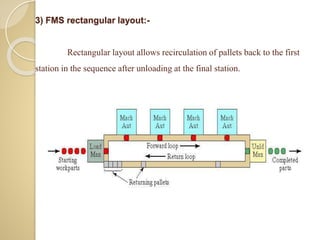
3) FMS rectangular layout:-
Rectangular layout allows recirculation of pallets back to the first
station in the sequence after unloading at the final station.
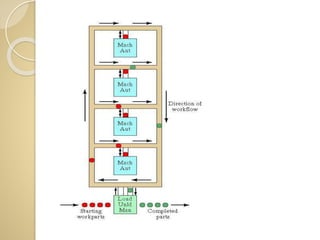
4) FMS ladder layout:-
 This consists of a loop with rungs upon which workstations
are located. The rungs increase the number of possible ways of
getting from one machine to the next. This consists of a loop
with rungs upon which workstations are located. The rungs
increase the number of possible ways of getting from one
machine to the next, and obviates the need for a secondary
material handling system. It reduces average travel distance and
minimizes congestion in the handling system, thereby reducing
transport time between stations.
5) Open field layout:-
 Consists of multiple loops and ladders, and may include sidings also.
This layout is generally used to process a large family of parts, although
the number of different machine types may be limited, and parts are usually
routed to different workstations—depending on which one becomes
available first. See Figure..
 Advantages of FMS:-
 Produce a variety of items under one roof
 Produce more product more quickly
 Improve efficiency
 Improve product routing
 Improve product quality
 To reduce setup and queue times
 Reduce time for product completion
 Utilize human workers better
 Serve a variety of vendors simultaneously
 Disadvantages of FMS:-
 Limited ability to adapt to changes in product or product mix(ex: machines
are of limited capacity and the tooling necessary for products, even of the
same family, is not always feasible in a given FMS) .
 Substantial pre-planning activity .
 Expensive, costing millions of dollars .
 Technological problems of exact component positioning and precise timing
necessary to process a component .
 Sophisticated manufacturing systems .
 Application of FMS:-
 Metal-cutting machining
 Metal forming
 Assembly
 Joining-welding (arc , spot), gluing
 Surface treatment
 Inspection
 Testing
Thank
uhh…!!!

Flexible Manufacturing System

  • 1.
    Flexible Manufacturing System Preparedby, Vaishali Desai Yaminiba Chudasama M. Tech(CAD/CAM)
  • 2.
     Introduction:-  Globalization,flicking market requirements and modern lifestyle trends have put up tremendous challenge to manufacturing industries.  In the current business scenario the competitiveness of any manufacturing industry is determined by its ability to respond quick change in market and to produce high quality products at low costs.  In the middle of the 1960s, market competition became more intense.  During 1960 to 1970 cost was the primary concern. Later quality became a priority. As the market became more and more complex, speed of delivery became something customer also needed.
  • 3.
     FMS:-  Firstof all, FMS is a manufacturing technology.  Secondly, FMS is a philosophy. "System" is the key word. FMS incorporates a system view of manufacturing. The buzz word for today’s manufacturer is "agility". An agile manufacturer is one who is the fastest to the market, operates with the lowest total cost and has the greatest ability to "delight" its customers. FMS is simply one way that manufacturers are able to achieve this agility.
  • 4.
    Flexibility:- Flexibility is anattribute that allows a mixed model manufacturing system to cope up with a certain level of variations in part or product style, without having any interruption in production due to changeovers between models. flexibility Basic flexibility System Flexibility Aggregate Flexibility
  • 5.
    Basic flexibilities:-  Machineflexibility - the ease with which a machine can process various operations  Material handling flexibility - a measure of the ease with which different part types can be transported and properly positioned at the various machine tools in a system  Operation flexibility - a measure of the ease with which alternative operation sequences can be used for processing a part type
  • 6.
    System flexibilities  Volumeflexibility - a measure of a system’s capability to be operated profitably at different volumes of the existing part types  Routing flexibility - a measure of the alternative paths that a part can effectively follow through a system for a given process plan  Process flexibility - a measure of the volume of the set of part types that a system can produce without incurring any setup  Product flexibility - the volume of the set of part types that can be manufactured in a system with minor setup.
  • 7.
    Aggregate flexibilities  Programflexibility - the ability of a system to run for reasonably long periods without external intervention  Production flexibility - the volume of the set of part types that a system can produce without major investment in capital equipment  Market flexibility - the ability of a system to efficiently adapt to changing market conditions.
  • 8.
    Types of FMS:- 1. Single machine cell—  It contains one machine (often a CNC machining centre) connected to a parts storage system, which can load and unload parts to and from the storage system (Figure).  It is designed to operate in batch mode, flexible mode, or a combination of the two. When in batch mode, the system processes parts of a single style in specific lot sizes before physical and programmed changeover to the next batch specifications;  In flexible mode the system satisfies three of the four tests for flexibility— the exception being error recovery, since, if the CNC machine centre breaks down, the system stops.
  • 9.
  • 10.
     2. Flexiblemanufacturing cell  It contains two or three processing workstations (often CNC machining or turning centers), plus a parts handling system, as shown in Figure. This set-up can operate in flexible mode and batch mode, as necessary, and can readily adapt to evolving production schedule and increased production volumes.  Since there is more than one machine, error recovery is possible by re- routing the failed machine’s intended parts for processing to the other two machines in the system; and new part designs can be introduced with relative ease into the set-up.
  • 11.
  • 12.
     3. FlexibleManufacturing System (FMS)—  It consists of four or more processing stations connected mechanically by a common parts handling system and electronically by a distributed computer system (as shown in figure). FMS is larger than the flexible manufacturing cell, not only in the number of workstations it may contain, but also in the number of supporting stations in the system, such as part/pallet washing stations, co- ordinate measuring machines, storage stations and so on. Computer control is also more sophisticated; it includes functions not found in the flexible manufacturing cell such as tool monitoring.
  • 13.
    Fig. 3. Flexiblemanufacturing system
  • 14.
  • 15.
    FMS Layouts:-  FMSline layout  FMS loop layout  FMS Rectangular layout  FMS ladder layout  Open field layout
  • 16.
     1) FMSin line layout:-  The machines and handling system are arranged in a straight line. As shown In Figure. parts progress from one workstation to the next in a well- defined sequence with work always moving in one direction and with no back-flow. Similar operation to a transfer line, except the system holds a greater variety of parts. Here a secondary handling system is provided at each workstation to separate most of the parts from the primary line.  Material handling equipment used: in-line transfer system; conveyor system; or rail-guided vehicle system.
  • 17.
  • 18.
     2) FMSloop layout:-  Workstations are organized in a loop that is served by a looped parts handling system. In Figure parts usually flow in one direction around the loop with the capability to stop and be transferred to any station. Each station has secondary handling equipment so that part can be brought to and transferred-from the station work head to the material handling loop.  Load/unload stations are usually located at one end of the loop. This arrangement allows for the return of pallets to the starting position in a straight line arrangement.
  • 19.
  • 20.
    3) FMS rectangularlayout:- Rectangular layout allows recirculation of pallets back to the first station in the sequence after unloading at the final station.
  • 21.
    4) FMS ladderlayout:-  This consists of a loop with rungs upon which workstations are located. The rungs increase the number of possible ways of getting from one machine to the next. This consists of a loop with rungs upon which workstations are located. The rungs increase the number of possible ways of getting from one machine to the next, and obviates the need for a secondary material handling system. It reduces average travel distance and minimizes congestion in the handling system, thereby reducing transport time between stations.
  • 23.
    5) Open fieldlayout:-  Consists of multiple loops and ladders, and may include sidings also. This layout is generally used to process a large family of parts, although the number of different machine types may be limited, and parts are usually routed to different workstations—depending on which one becomes available first. See Figure..
  • 25.
     Advantages ofFMS:-  Produce a variety of items under one roof  Produce more product more quickly  Improve efficiency  Improve product routing  Improve product quality  To reduce setup and queue times  Reduce time for product completion  Utilize human workers better  Serve a variety of vendors simultaneously
  • 26.
     Disadvantages ofFMS:-  Limited ability to adapt to changes in product or product mix(ex: machines are of limited capacity and the tooling necessary for products, even of the same family, is not always feasible in a given FMS) .  Substantial pre-planning activity .  Expensive, costing millions of dollars .  Technological problems of exact component positioning and precise timing necessary to process a component .  Sophisticated manufacturing systems .
  • 27.
     Application ofFMS:-  Metal-cutting machining  Metal forming  Assembly  Joining-welding (arc , spot), gluing  Surface treatment  Inspection  Testing
  • 28.