Flexible
Manufacturing
System.
PRASANNA DAE.,BE(Auto).,ME (Manufacturing Engg)
TamilNadu Madurai
INDIA
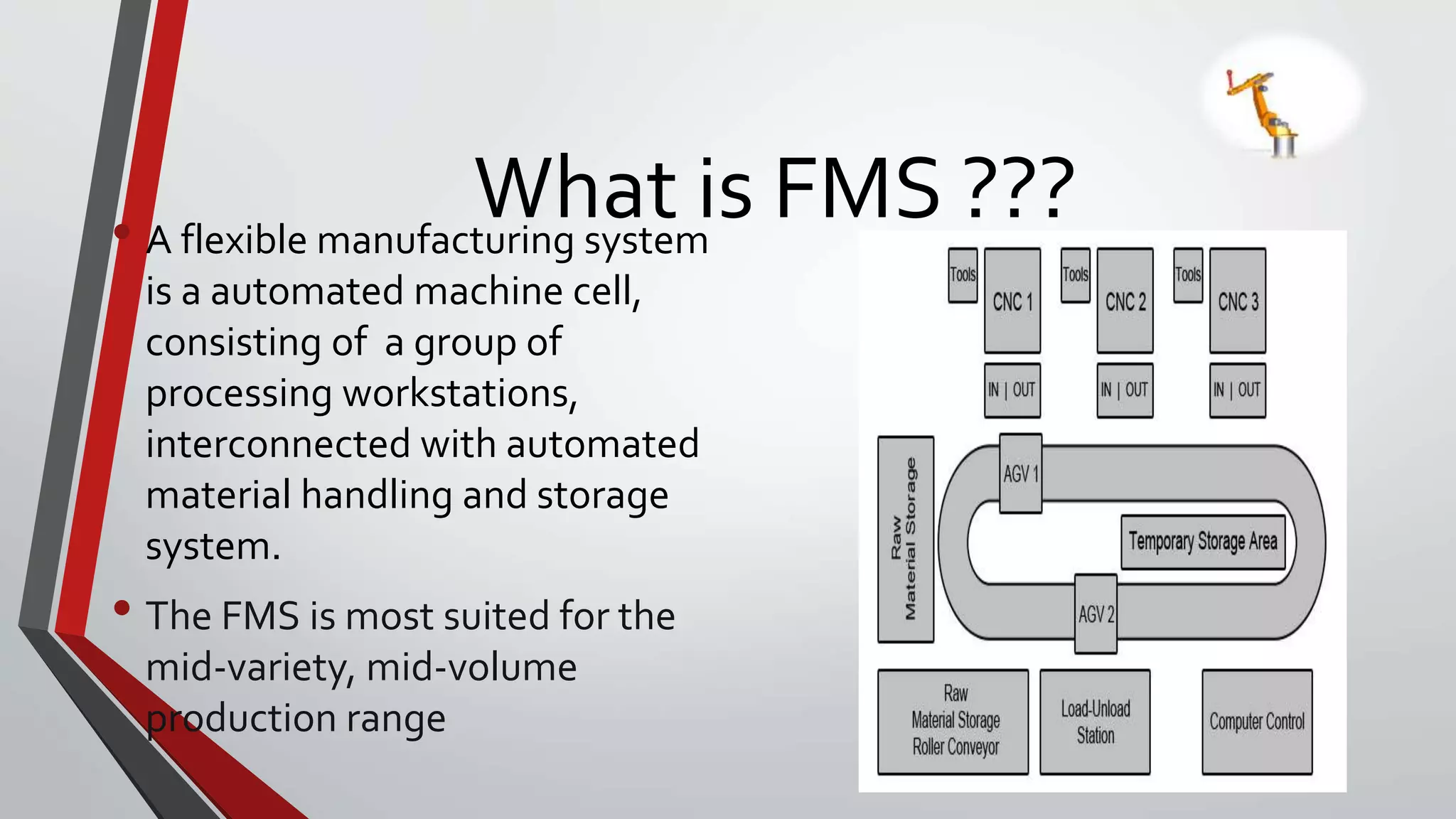
What is FMS ???• A flexible manufacturing system
is a automated machine cell,
consisting of a group of
processing workstations,
interconnected with automated
material handling and storage
system.
• The FMS is most suited for the
mid-variety, mid-volume
production range
Why FMS ?
•External changes such as change in product design and
production system.
•Optimizing the manufacturing cycle time
•Reduced production costs
•Overcoming internal changes like breakdowns etc.
What makes it flexible???
•Three capabilities that a manufacturing system must
possess to be a flexible.
1.The ability to identify and distinguish among the
different part styles processed by the system.
2.Quick changeover of operating instructions, and
3.Quick changeover of physical setup.
Tests of Flexibility….
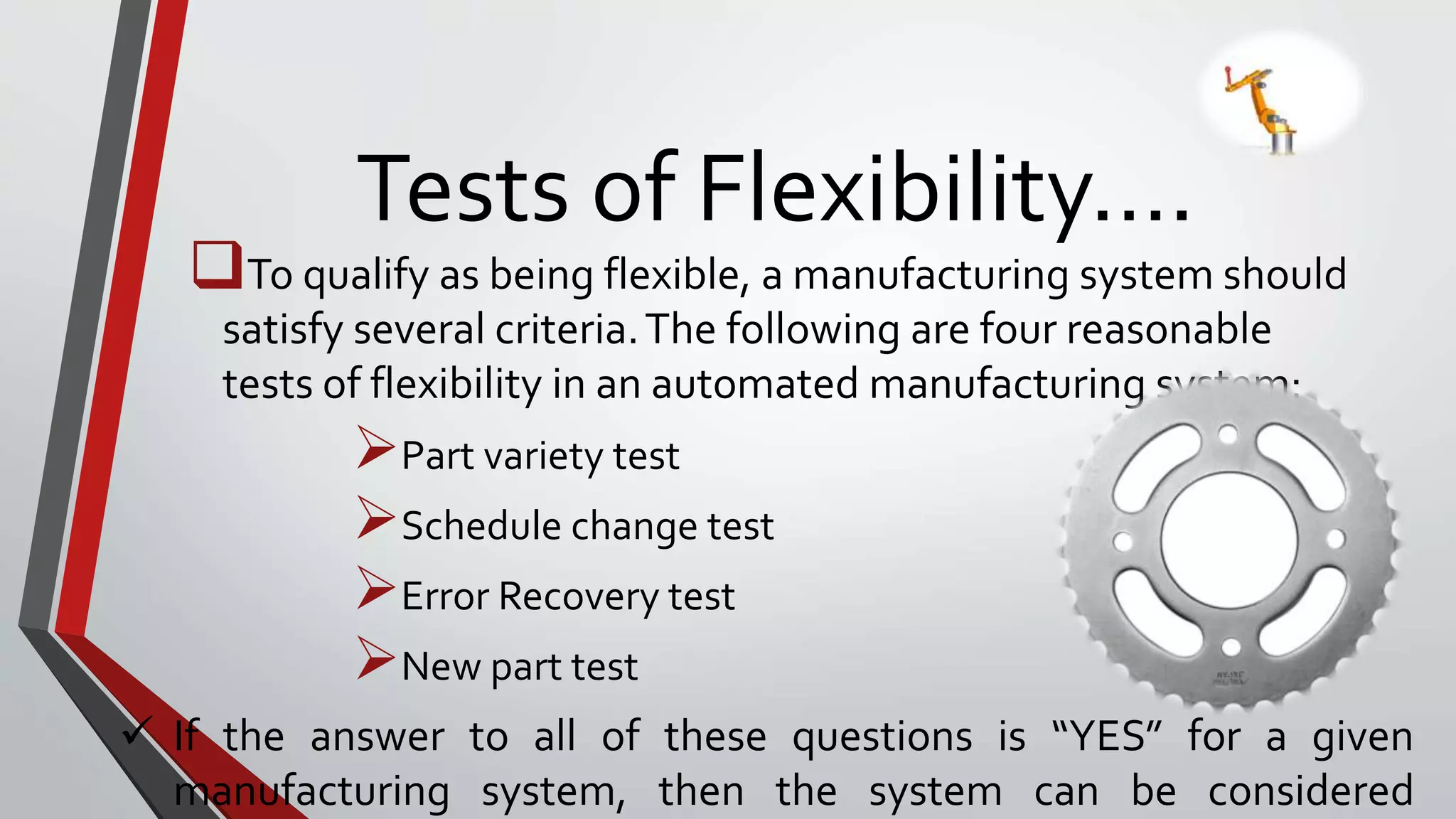
To qualify as being flexible, a manufacturing system should
satisfy several criteria.The following are four reasonable
tests of flexibility in an automated manufacturing system:
Part variety test
Schedule change test
Error Recovery test
New part test
 If the answer to all of these questions is “YES” for a given
manufacturing system, then the system can be considered
Basic components of FMS
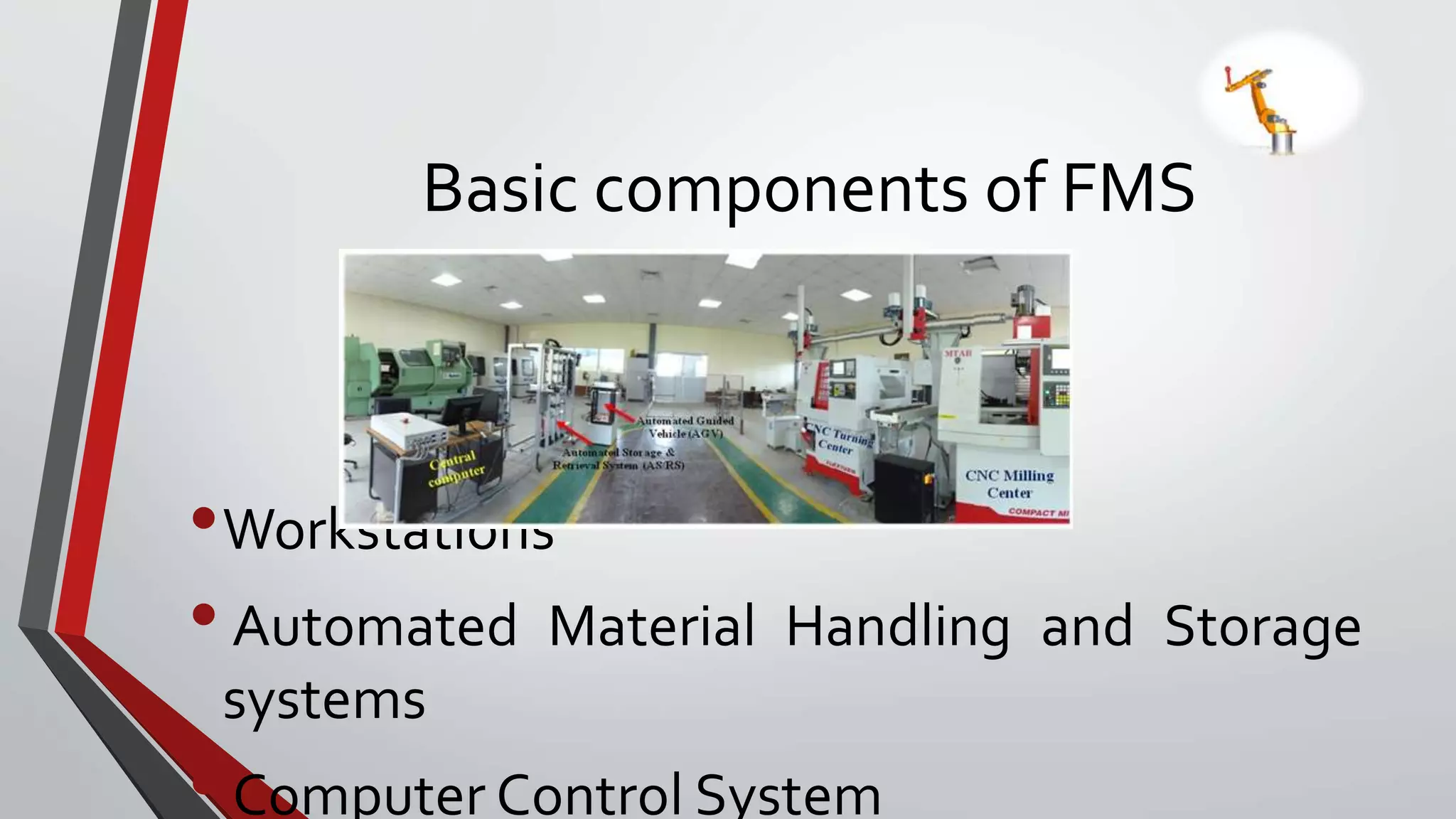
•Workstations
•Automated Material Handling and Storage
systems
• Computer Control System
Workstation
•Substations
1. Load/Unload Stations
2. Machining Stations (Milling Machines ,Turning
Machines ,etc.,)
3. Other processing stations
(Punching,shearing,welding,Bending,Forming)
4. Assembly Stations (Robots)
5. Other stations and equipments(Inspection,Vision,
etc.,)
Material handling system
Substations
1. Independent movement of workparts
between stations.
2. Handle variety of parts
3. Temporary storage
4. Convenient for loading and unloading
workparts
Material handling system
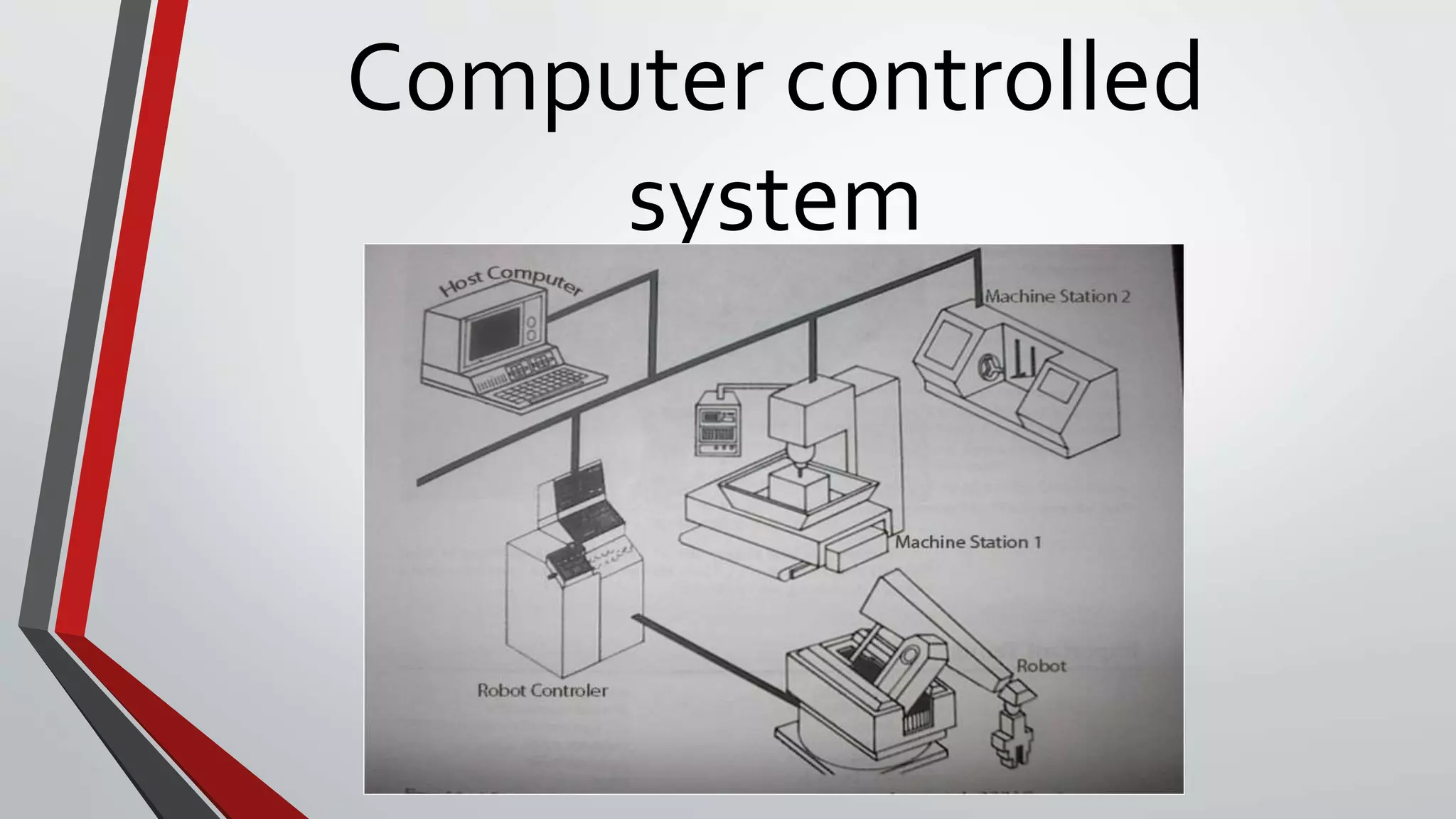
Computer controlled
system
Computer controlled
system• FMS includes a distributed computer system that is interfaced to
1.Workstations
2.Material handling system
3.Other Hardware components.
 A typical computer system consists of central computer and Micro
computers
1.Microcomputers controling the individual machines and other
components
2.The central computer coordinates the activities of the components to
achieve smooth overall operation of the system.
Number of Machines
•Flexible manufacturing systems can be distinguished
according to the number of machines in the system. The
following are typical categories:
Single machine cell
Flexible manufacturing cell
Flexible manufacturing system
Number of Machines
Single Machine cell
(SMC)
Flexible
ManufacturingCell
Flexible Manufacturing System (FMS)
• A flexible manufacturing system has four or
more processing workstations connected
mechanically by a common part handling
system and electronically by a distributed
computer system.
Allied Signal’s Flexible Manufacturing System
Application of FMS
• Metal-cutting machining
• Metal forming
• Assembly
• Joining-welding (arc , spot), gluing
• Surface treatment
• Inspection
• Testing
Advantages of FMS
• To reduce set up and queue times
• Improve efficiency
• Reduce time for product completion
• Utilize human workers better
• Improve product routing
• Produce a variety of Items under one roof
• Improve product quality
• Serve a variety of vendors simultaneously
• Produce more product more quickly
Disadvantages of FMS
•Expensive.
•Substantial pre-planning activity.
Challenges with FMS
•Determining if FMS the best production system
for your company
•Possible expansion costs associated with
implementing FMS
Conclusion
•FMS is a revolution in the field of Manufacturing
Technology.
•FMS can be designed to meet the specific demand
of each company
•FMS is used for multitask operation.
•FMS requires substantial investment of time and
resources.
Thank you…

Flexible Manufacturing System (FMS)

  • 1.
  • 2.
    What is FMS???• A flexible manufacturing system is a automated machine cell, consisting of a group of processing workstations, interconnected with automated material handling and storage system. • The FMS is most suited for the mid-variety, mid-volume production range
  • 3.
    Why FMS ? •Externalchanges such as change in product design and production system. •Optimizing the manufacturing cycle time •Reduced production costs •Overcoming internal changes like breakdowns etc.
  • 4.
    What makes itflexible??? •Three capabilities that a manufacturing system must possess to be a flexible. 1.The ability to identify and distinguish among the different part styles processed by the system. 2.Quick changeover of operating instructions, and 3.Quick changeover of physical setup.
  • 5.
    Tests of Flexibility…. Toqualify as being flexible, a manufacturing system should satisfy several criteria.The following are four reasonable tests of flexibility in an automated manufacturing system: Part variety test Schedule change test Error Recovery test New part test  If the answer to all of these questions is “YES” for a given manufacturing system, then the system can be considered
  • 6.
    Basic components ofFMS •Workstations •Automated Material Handling and Storage systems • Computer Control System
  • 7.
    Workstation •Substations 1. Load/Unload Stations 2.Machining Stations (Milling Machines ,Turning Machines ,etc.,) 3. Other processing stations (Punching,shearing,welding,Bending,Forming) 4. Assembly Stations (Robots) 5. Other stations and equipments(Inspection,Vision, etc.,)
  • 8.
    Material handling system Substations 1.Independent movement of workparts between stations. 2. Handle variety of parts 3. Temporary storage 4. Convenient for loading and unloading workparts
  • 9.
  • 10.
  • 11.
    Computer controlled system• FMSincludes a distributed computer system that is interfaced to 1.Workstations 2.Material handling system 3.Other Hardware components.  A typical computer system consists of central computer and Micro computers 1.Microcomputers controling the individual machines and other components 2.The central computer coordinates the activities of the components to achieve smooth overall operation of the system.
  • 13.
    Number of Machines •Flexiblemanufacturing systems can be distinguished according to the number of machines in the system. The following are typical categories: Single machine cell Flexible manufacturing cell Flexible manufacturing system
  • 14.
    Number of Machines SingleMachine cell (SMC) Flexible ManufacturingCell
  • 15.
    Flexible Manufacturing System(FMS) • A flexible manufacturing system has four or more processing workstations connected mechanically by a common part handling system and electronically by a distributed computer system.
  • 16.
    Allied Signal’s FlexibleManufacturing System
  • 17.
    Application of FMS •Metal-cutting machining • Metal forming • Assembly • Joining-welding (arc , spot), gluing • Surface treatment • Inspection • Testing
  • 18.
    Advantages of FMS •To reduce set up and queue times • Improve efficiency • Reduce time for product completion • Utilize human workers better • Improve product routing • Produce a variety of Items under one roof • Improve product quality • Serve a variety of vendors simultaneously • Produce more product more quickly
  • 19.
  • 20.
    Challenges with FMS •Determiningif FMS the best production system for your company •Possible expansion costs associated with implementing FMS
  • 21.
    Conclusion •FMS is arevolution in the field of Manufacturing Technology. •FMS can be designed to meet the specific demand of each company •FMS is used for multitask operation. •FMS requires substantial investment of time and resources.
  • 22.