FLEXIBLE
MANUFACTURING
SYSTEMS
DEFINITION
A FLEXIBLE MANUFACTURING SYSTEM (FMS) IS
A SET OF NUMERICALLY CONTROLLED MACHINE
TOOLS AND SUPPORTING WORKSTATIONS
CONNECTED BY AN AUTOMATED MATERIAL
HANDLING SYSTEM AND CONTROLLED BY A
CENTRAL COMPUTER
ELEMENTS OF FMS
• AUTOMATICALLY
REPROGRAMMABLE MACHINES.
• AUTOMATED TOOL DELIVERY AND
CHANGING
• AUTOMATED MATERIAL HANDLING
• COORDINATED CONTROL
FMS FEATURES
• MANY PART TYPES CAN BE LOADED
• PARTS CAN ARRIVE AT MACHINES IN
ANY SEQUENCE
• PARTS IDENTIFIED BY CODES
• MANY MACHINES CAN BE INCLUDED
• SMALL FMS LEAD TO FLEXIBLE
CELLS
FMS FEATURES
• EXPENSIVE TO IMPLEMENT BUT
SAVINGS CAN BE SIGNIFICANT
• FLOOR SPACE REDUCIBLE BY 1/3
• EQUIPMENT UTILIZATION UP TO 85%
OR MORE
• DETAILED PRODUCTION SEQUENCE
NOT NEEDED WELL IN ADVANCE
FMS FEATURES
• REDUCED VARIABLE COSTS AND
THROUGHPUT TIME LEAD TO
ENHANCED MANUFACTURING
COMPETITIVENESS
• ELIMINATION OF STARTUP CYCLES
LEAD TO STANDARIZED
PERFORMANCE
• MODULAR DESIGN
FMS FEATURES
• REDUCED DIRECT LABOR COSTS
• THREE SHIFTS READILY FEASIBLE
• IDEAL FOR JIT
• CAN EASILY BE TURNED OVER TO
NEW SET OF PRODUCTS IF THE NEED
ARISES
MANUFACTURING
FLEXIBILITY
• BASIC
– MACHINE (VARIETY OF OPERATIONS)
– MATERIAL HANDLING (PART
MOBILITY AND PLACEMENT)
– OPERATION (VARIETY OF OPERATIONS
PRODUCING SAME PART FEATURES)
MANUFACTURING
FLEXIBILITY
• SYSTEM
– PROCESS (VARIETY OF PARTS
PRODUCIBLE WITH SAME SETUP)
– ROUTING (ABILITY TO USE DIFFERENT
MACHINES UNDER SAME SETUP)
– PRODUCT (CHANGEOVER)
– VOLUME (PRODUCTION LEVEL)
– EXPANSION (ADDED CAPACITY)
MANUFACTURING
FLEXIBILITY
• AGGREGATED
– PROGRAM (UNATTENDED RUNNING)
– PRODUCTION (RANGES OF PARTS,
PRODUCTS, PROCESSES, VOLUME,
EXPANSION)
– MARKET (COMBINATION OF PRODUCT,
PROCESS, VOLUME AND EXPANSION)
ORIGINS OF FMS
• LINK LINES (1960’S)
• NC MACHINES AND
CONVEYORS
• BATCH PROCESSING
ACRONYMS
• FMS
• NC
• DNC
• CNC
• AGV
• JIT
FMS PRIORITIES
• MEETING DUE DATES
• MAXIMIZING MACHINE
UTILIZATION
• MINIMIZE THROUGHPUT
TIMES
• MINIMIZE WIP LEVELS
FMS COMPONENTS
• MACHINES
• PART MOVEMENT SYSTEMS
• SUPPORTING
WORKSTATIONS
• SYSTEM CONTROLLER
MACHINES
• PRISMATIC VS ROTATIONAL
PARTS
• HORIZONTAL MACHINING
CENTERS (HMC) AND HEAD
INDEXERS (HI)
• TOOL MAGAZINES AND
AUTOMATIC TOOL CHANGERS
PART MOVEMENT
• CONVEYORS
• TOW CARTS
• RAIL CARTS
• AGV’S
SUPPORTING
WORKSTATIONS
• LOAD/UNLOAD STATIONS
• AUTOMATIC PART WASHERS
• COORDINATE MEASURING
MACHINES
CONTROLLER
• COMPUTER
• WORKER (ATTENDANT)
• TRACKING SYSTEM FOR
–PARTS
–MACHINES
• Definition
• History of FMS
• FMS equipment
• Types of FMS
• Applications of FMS
• FSM different
approaches
• Advantages
• Disadvantage
• Development of
FMS
• Nuts and Bolts
• How FMS works
• A real world
example
• Summary
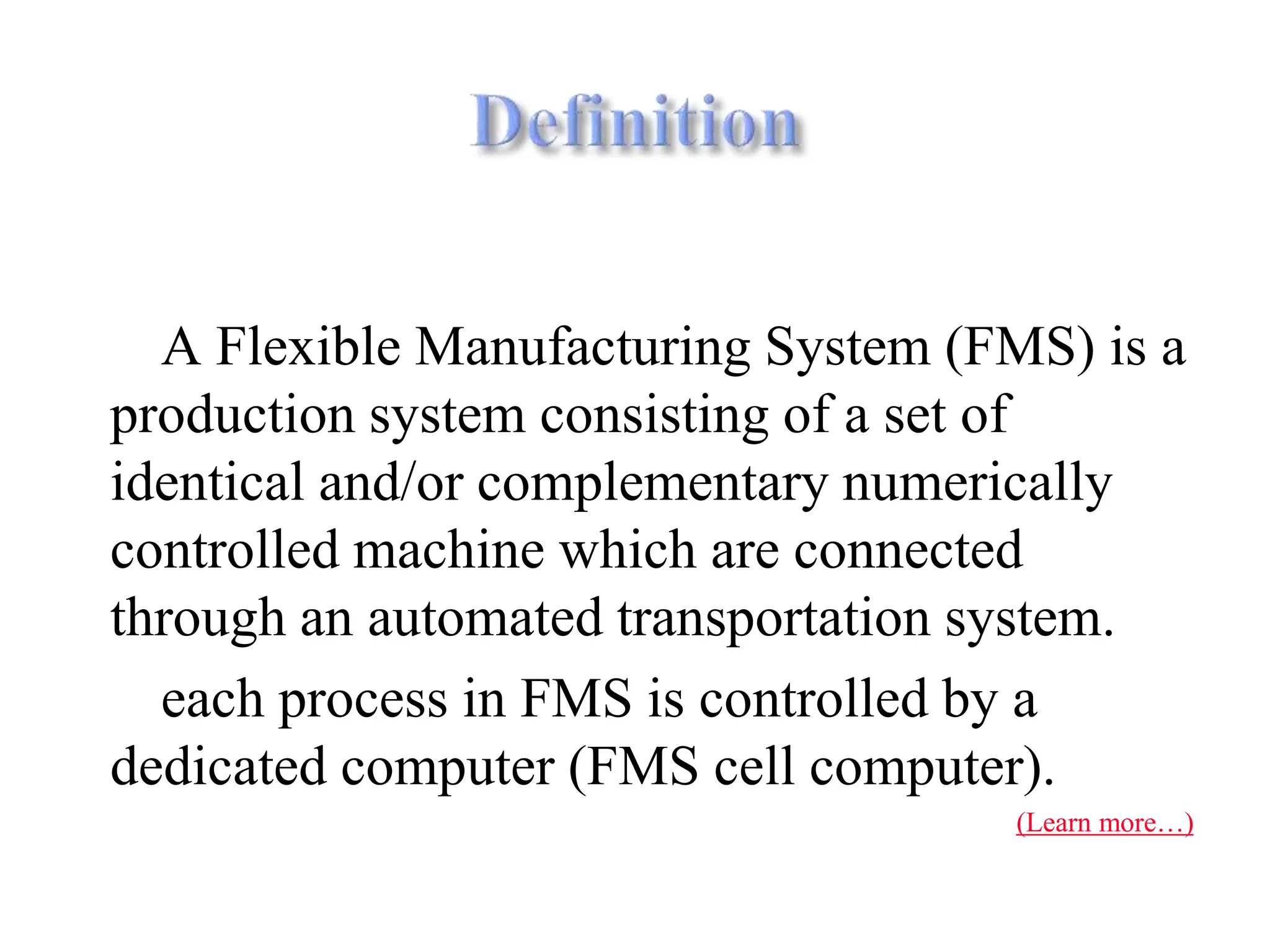
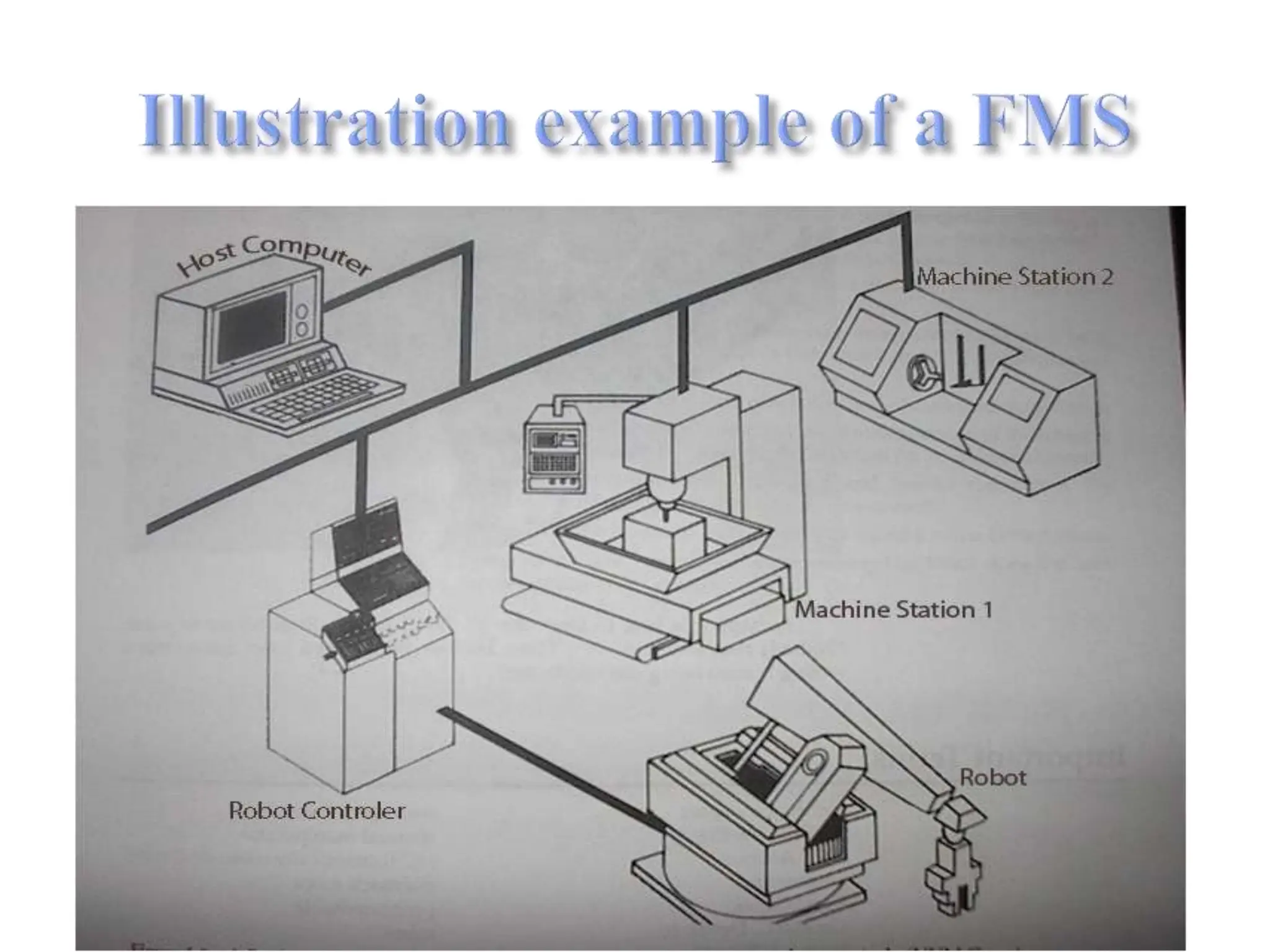
A Flexible Manufacturing System (FMS) is a
production system consisting of a set of
identical and/or complementary numerically
controlled machine which are connected
through an automated transportation system.
each process in FMS is controlled by a
dedicated computer (FMS cell computer).
(Learn more…)
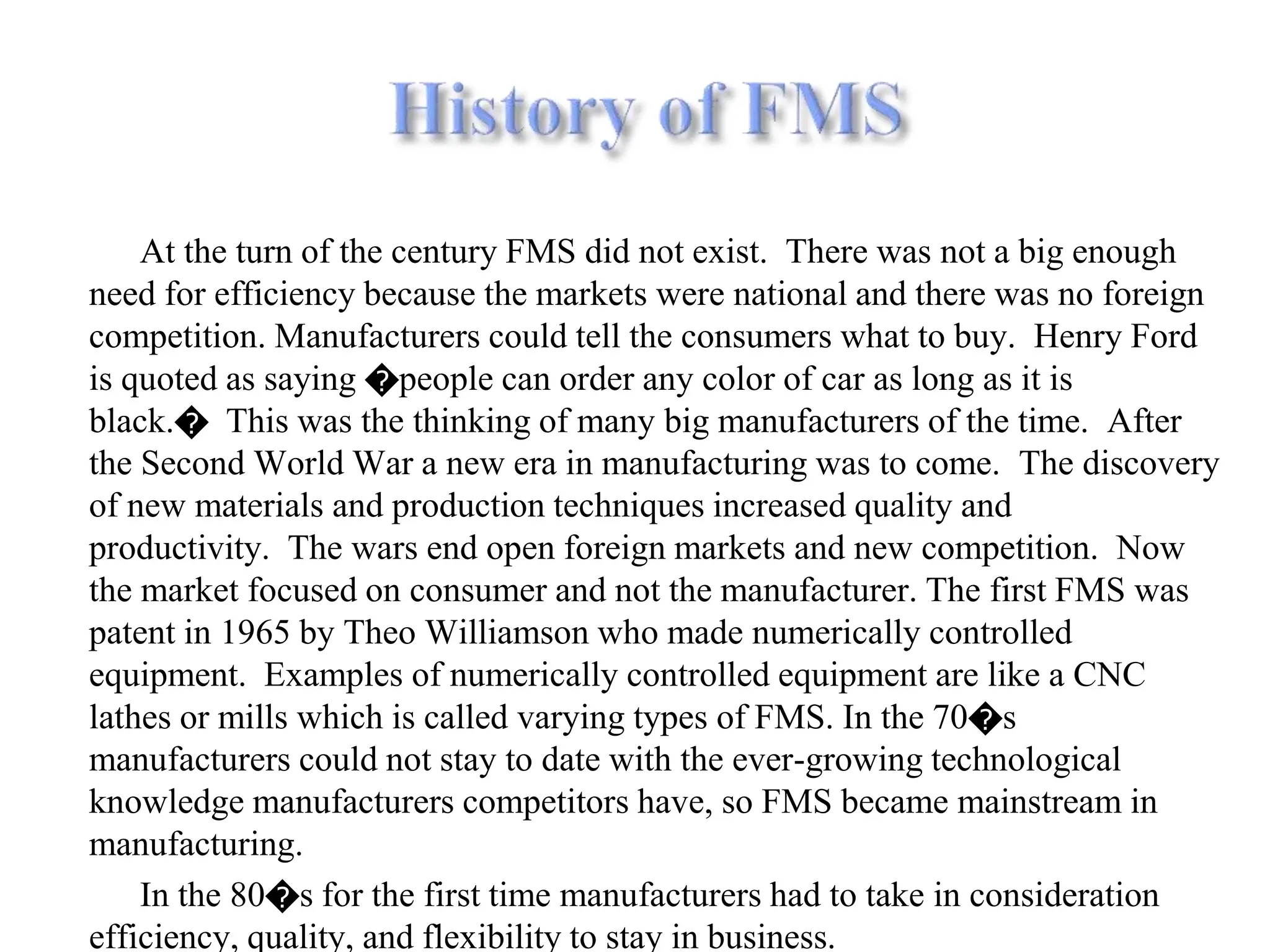
At the turn of the century FMS did not exist. There was not a big enough
need for efficiency because the markets were national and there was no foreign
competition. Manufacturers could tell the consumers what to buy. Henry Ford
is quoted as saying �people can order any color of car as long as it is
black.� This was the thinking of many big manufacturers of the time. After
the Second World War a new era in manufacturing was to come. The discovery
of new materials and production techniques increased quality and
productivity. The wars end open foreign markets and new competition. Now
the market focused on consumer and not the manufacturer. The first FMS was
patent in 1965 by Theo Williamson who made numerically controlled
equipment. Examples of numerically controlled equipment are like a CNC
lathes or mills which is called varying types of FMS. In the 70�s
manufacturers could not stay to date with the ever-growing technological
knowledge manufacturers competitors have, so FMS became mainstream in
manufacturing.
In the 80�s for the first time manufacturers had to take in consideration
efficiency, quality, and flexibility to stay in business.
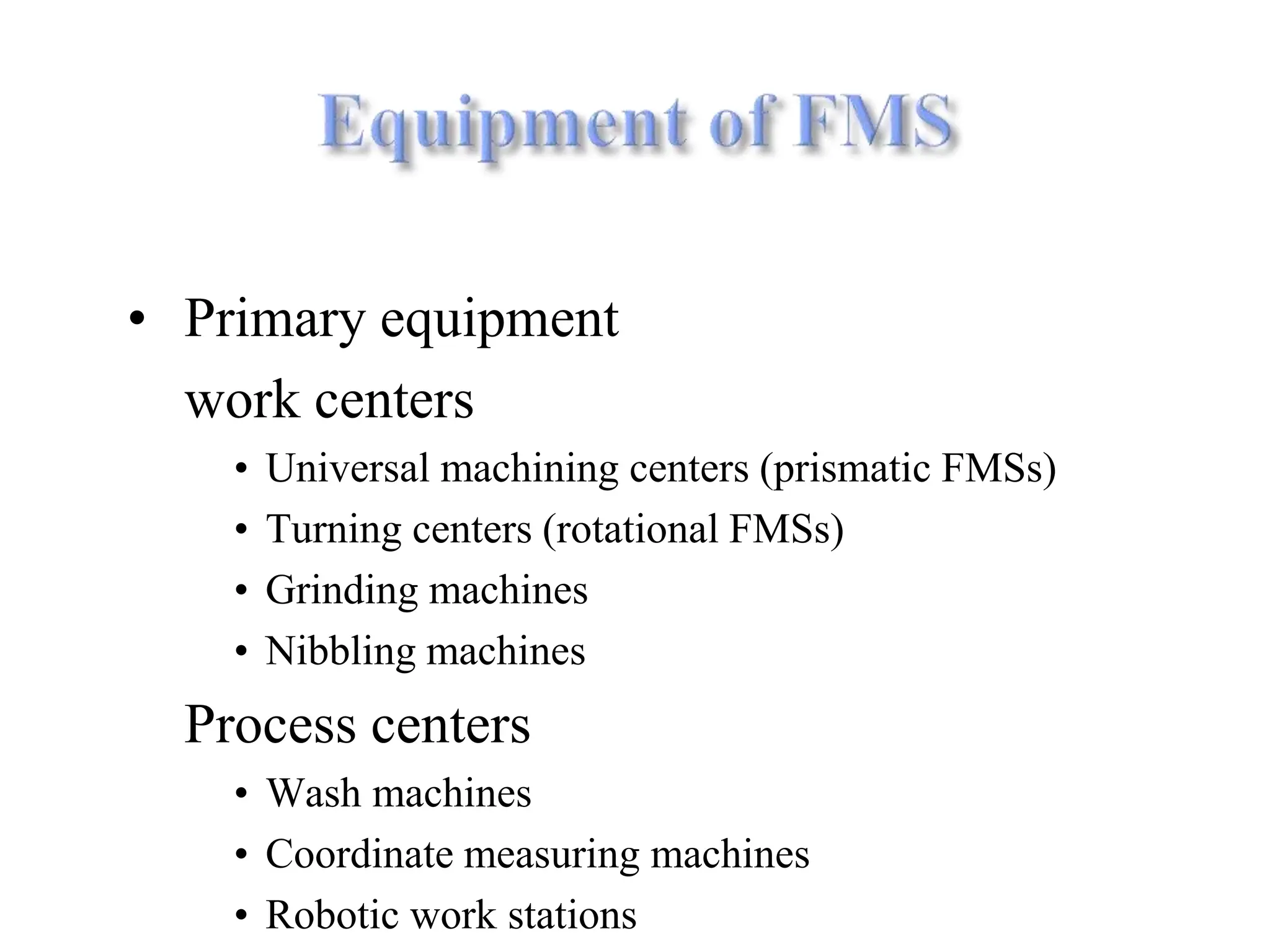
• Primary equipment
work centers
• Universal machining centers (prismatic FMSs)
• Turning centers (rotational FMSs)
• Grinding machines
• Nibbling machines
Process centers
• Wash machines
• Coordinate measuring machines
• Robotic work stations
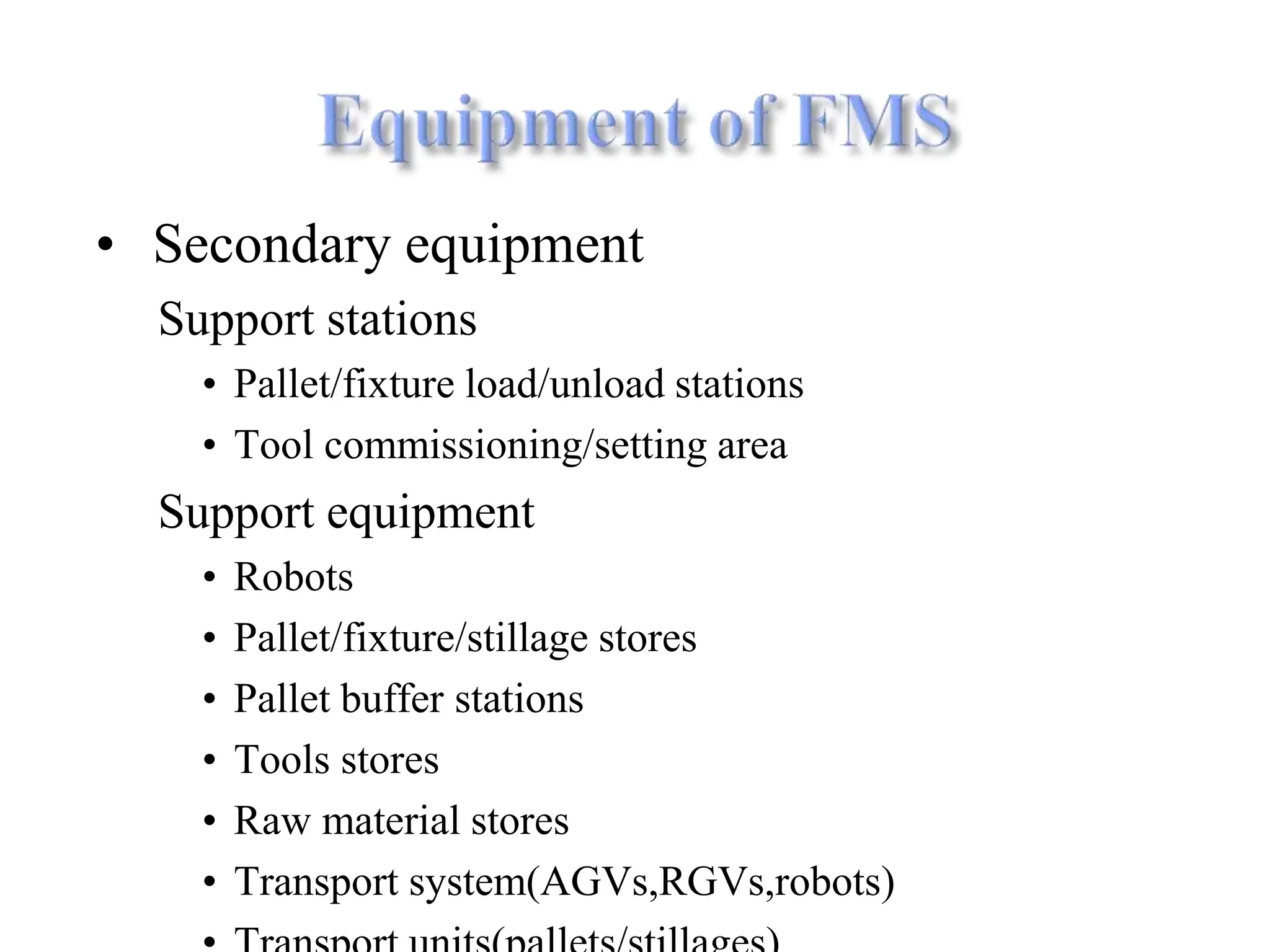
• Secondary equipment
Support stations
• Pallet/fixture load/unload stations
• Tool commissioning/setting area
Support equipment
• Robots
• Pallet/fixture/stillage stores
• Pallet buffer stations
• Tools stores
• Raw material stores
• Transport system(AGVs,RGVs,robots)
• Sequential FMS
• Random FMS
• Dedicated FMS
• Engineered FMS
• Modular FMS
• Metal-cutting machining
• Metal forming
• Assembly
• Joining-welding (arc , spot), glueing
• Surface treatment
• Inspection
• Testing
• The capability of producing different parts
without major retooling
• A measure of how fast the company
converts its process/es from making an old
line of products to produce a new product
• The ability to change a production
schedule, to modify a part, or to handle
multiple parts
• To reduce set up and queue times
• Improve efficiency
• Reduce time for product completion
• Utilize human workers better
• Improve product routing
• Produce a variety of Items under one roof
• Improve product quality
• Serve a variety of vendors simultaneously
• Produce more product more quickly
• Limited ability to adapt to changes in
product or product mix (ex:machines are of limited capacity
and the tooling necessary for products, even of the same family, is not always
feasible in a given FMS)
• Substantial pre-planning activity
• Expensive, costing millions of dollars
• Technological problems of exact
component positioning and precise timing
necessary to process a component
• Sophisticated manufacturing systems
Several actions must be decided on before you can
have a FMS. These actions include.
• Selecting operations needed to make the product.
• Putting the operations in a logical order.
• Selecting equipment to make the product.
• Arranging the equipment for efficient use.
• Designing special devices to help build the product.
• Developing ways to control product quality.
• Testing the manufacturing system.
FMS Layouts
• Progressive Layout:
– Best for producing a variety of parts
• Closed Loop Layout:
– Parts can skip stations for flexibility
– Used for large part sizes
– Best for long process times
• Ladder Layout:
― Parts can be sent to any machine in any sequence
― Parts not limited to particular part families
• Open Field Layout:
― Most complex FMS layout
― Includes several support stations
• Ability to adapt to
engineering changes
in parts
• Increase in number
of similar parts
produced on the
system
• Ability to
accommodate
routing changes
• Ability to rapidly
change production
set up
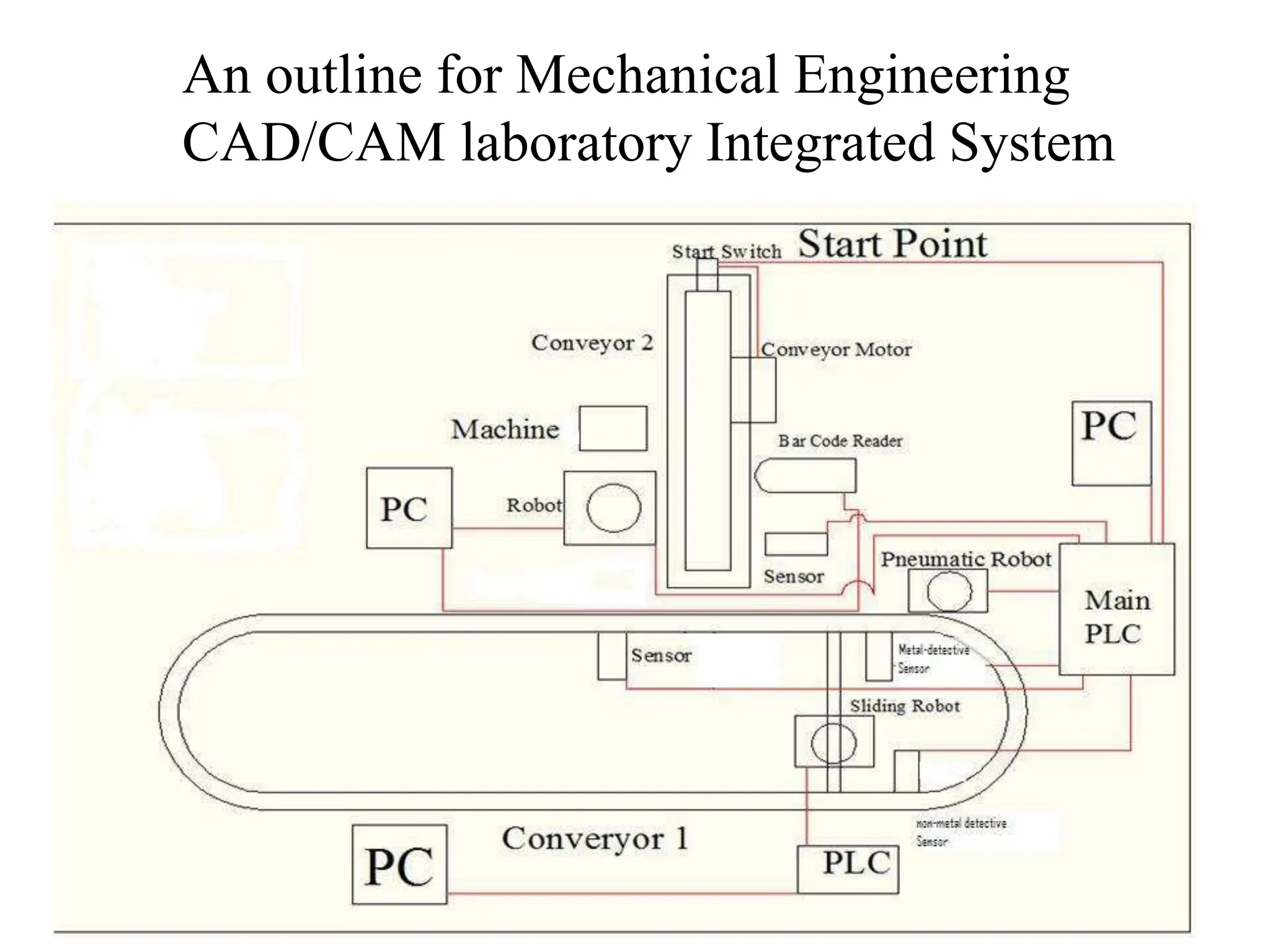
An outline for Mechanical Engineering
CAD/CAM laboratory Integrated System

Flexible Manufacturing System, Advantages and DIsadvantages of FMS

  • 1.
  • 2.
    DEFINITION A FLEXIBLE MANUFACTURINGSYSTEM (FMS) IS A SET OF NUMERICALLY CONTROLLED MACHINE TOOLS AND SUPPORTING WORKSTATIONS CONNECTED BY AN AUTOMATED MATERIAL HANDLING SYSTEM AND CONTROLLED BY A CENTRAL COMPUTER
  • 3.
    ELEMENTS OF FMS •AUTOMATICALLY REPROGRAMMABLE MACHINES. • AUTOMATED TOOL DELIVERY AND CHANGING • AUTOMATED MATERIAL HANDLING • COORDINATED CONTROL
  • 4.
    FMS FEATURES • MANYPART TYPES CAN BE LOADED • PARTS CAN ARRIVE AT MACHINES IN ANY SEQUENCE • PARTS IDENTIFIED BY CODES • MANY MACHINES CAN BE INCLUDED • SMALL FMS LEAD TO FLEXIBLE CELLS
  • 5.
    FMS FEATURES • EXPENSIVETO IMPLEMENT BUT SAVINGS CAN BE SIGNIFICANT • FLOOR SPACE REDUCIBLE BY 1/3 • EQUIPMENT UTILIZATION UP TO 85% OR MORE • DETAILED PRODUCTION SEQUENCE NOT NEEDED WELL IN ADVANCE
  • 6.
    FMS FEATURES • REDUCEDVARIABLE COSTS AND THROUGHPUT TIME LEAD TO ENHANCED MANUFACTURING COMPETITIVENESS • ELIMINATION OF STARTUP CYCLES LEAD TO STANDARIZED PERFORMANCE • MODULAR DESIGN
  • 7.
    FMS FEATURES • REDUCEDDIRECT LABOR COSTS • THREE SHIFTS READILY FEASIBLE • IDEAL FOR JIT • CAN EASILY BE TURNED OVER TO NEW SET OF PRODUCTS IF THE NEED ARISES
  • 8.
    MANUFACTURING FLEXIBILITY • BASIC – MACHINE(VARIETY OF OPERATIONS) – MATERIAL HANDLING (PART MOBILITY AND PLACEMENT) – OPERATION (VARIETY OF OPERATIONS PRODUCING SAME PART FEATURES)
  • 9.
    MANUFACTURING FLEXIBILITY • SYSTEM – PROCESS(VARIETY OF PARTS PRODUCIBLE WITH SAME SETUP) – ROUTING (ABILITY TO USE DIFFERENT MACHINES UNDER SAME SETUP) – PRODUCT (CHANGEOVER) – VOLUME (PRODUCTION LEVEL) – EXPANSION (ADDED CAPACITY)
  • 10.
    MANUFACTURING FLEXIBILITY • AGGREGATED – PROGRAM(UNATTENDED RUNNING) – PRODUCTION (RANGES OF PARTS, PRODUCTS, PROCESSES, VOLUME, EXPANSION) – MARKET (COMBINATION OF PRODUCT, PROCESS, VOLUME AND EXPANSION)
  • 11.
    ORIGINS OF FMS •LINK LINES (1960’S) • NC MACHINES AND CONVEYORS • BATCH PROCESSING
  • 12.
    ACRONYMS • FMS • NC •DNC • CNC • AGV • JIT
  • 13.
    FMS PRIORITIES • MEETINGDUE DATES • MAXIMIZING MACHINE UTILIZATION • MINIMIZE THROUGHPUT TIMES • MINIMIZE WIP LEVELS
  • 14.
    FMS COMPONENTS • MACHINES •PART MOVEMENT SYSTEMS • SUPPORTING WORKSTATIONS • SYSTEM CONTROLLER
  • 15.
    MACHINES • PRISMATIC VSROTATIONAL PARTS • HORIZONTAL MACHINING CENTERS (HMC) AND HEAD INDEXERS (HI) • TOOL MAGAZINES AND AUTOMATIC TOOL CHANGERS
  • 16.
    PART MOVEMENT • CONVEYORS •TOW CARTS • RAIL CARTS • AGV’S
  • 17.
    SUPPORTING WORKSTATIONS • LOAD/UNLOAD STATIONS •AUTOMATIC PART WASHERS • COORDINATE MEASURING MACHINES
  • 18.
    CONTROLLER • COMPUTER • WORKER(ATTENDANT) • TRACKING SYSTEM FOR –PARTS –MACHINES
  • 20.
    • Definition • Historyof FMS • FMS equipment • Types of FMS • Applications of FMS • FSM different approaches • Advantages • Disadvantage • Development of FMS • Nuts and Bolts • How FMS works • A real world example • Summary
  • 21.
    A Flexible ManufacturingSystem (FMS) is a production system consisting of a set of identical and/or complementary numerically controlled machine which are connected through an automated transportation system. each process in FMS is controlled by a dedicated computer (FMS cell computer). (Learn more…)
  • 22.
    At the turnof the century FMS did not exist. There was not a big enough need for efficiency because the markets were national and there was no foreign competition. Manufacturers could tell the consumers what to buy. Henry Ford is quoted as saying �people can order any color of car as long as it is black.� This was the thinking of many big manufacturers of the time. After the Second World War a new era in manufacturing was to come. The discovery of new materials and production techniques increased quality and productivity. The wars end open foreign markets and new competition. Now the market focused on consumer and not the manufacturer. The first FMS was patent in 1965 by Theo Williamson who made numerically controlled equipment. Examples of numerically controlled equipment are like a CNC lathes or mills which is called varying types of FMS. In the 70�s manufacturers could not stay to date with the ever-growing technological knowledge manufacturers competitors have, so FMS became mainstream in manufacturing. In the 80�s for the first time manufacturers had to take in consideration efficiency, quality, and flexibility to stay in business.
  • 23.
    • Primary equipment workcenters • Universal machining centers (prismatic FMSs) • Turning centers (rotational FMSs) • Grinding machines • Nibbling machines Process centers • Wash machines • Coordinate measuring machines • Robotic work stations
  • 24.
    • Secondary equipment Supportstations • Pallet/fixture load/unload stations • Tool commissioning/setting area Support equipment • Robots • Pallet/fixture/stillage stores • Pallet buffer stations • Tools stores • Raw material stores • Transport system(AGVs,RGVs,robots)
  • 25.
    • Sequential FMS •Random FMS • Dedicated FMS • Engineered FMS • Modular FMS
  • 26.
    • Metal-cutting machining •Metal forming • Assembly • Joining-welding (arc , spot), glueing • Surface treatment • Inspection • Testing
  • 27.
    • The capabilityof producing different parts without major retooling • A measure of how fast the company converts its process/es from making an old line of products to produce a new product • The ability to change a production schedule, to modify a part, or to handle multiple parts
  • 28.
    • To reduceset up and queue times • Improve efficiency • Reduce time for product completion • Utilize human workers better • Improve product routing • Produce a variety of Items under one roof • Improve product quality • Serve a variety of vendors simultaneously • Produce more product more quickly
  • 29.
    • Limited abilityto adapt to changes in product or product mix (ex:machines are of limited capacity and the tooling necessary for products, even of the same family, is not always feasible in a given FMS) • Substantial pre-planning activity • Expensive, costing millions of dollars • Technological problems of exact component positioning and precise timing necessary to process a component • Sophisticated manufacturing systems
  • 30.
    Several actions mustbe decided on before you can have a FMS. These actions include. • Selecting operations needed to make the product. • Putting the operations in a logical order. • Selecting equipment to make the product. • Arranging the equipment for efficient use. • Designing special devices to help build the product. • Developing ways to control product quality. • Testing the manufacturing system.
  • 32.
    FMS Layouts • ProgressiveLayout: – Best for producing a variety of parts • Closed Loop Layout: – Parts can skip stations for flexibility – Used for large part sizes – Best for long process times
  • 33.
    • Ladder Layout: ―Parts can be sent to any machine in any sequence ― Parts not limited to particular part families • Open Field Layout: ― Most complex FMS layout ― Includes several support stations
  • 34.
    • Ability toadapt to engineering changes in parts • Increase in number of similar parts produced on the system • Ability to accommodate routing changes • Ability to rapidly change production set up
  • 36.
    An outline forMechanical Engineering CAD/CAM laboratory Integrated System