Flexible Manufacturing
Systems (FMS)
Introduction
1. A FMS consists of a group of programmable
production machines interconnected by means
of an automated material handling and storage
system and controlled by an integrated
computer system to produce a variety of parts
at non- uniform product rates, batch sizes and
quantities .
2. A FMS is characterised by the following:
Variety of products ,small volume of products,
Less manufacturing lead time ,high quality ,
Low cost.
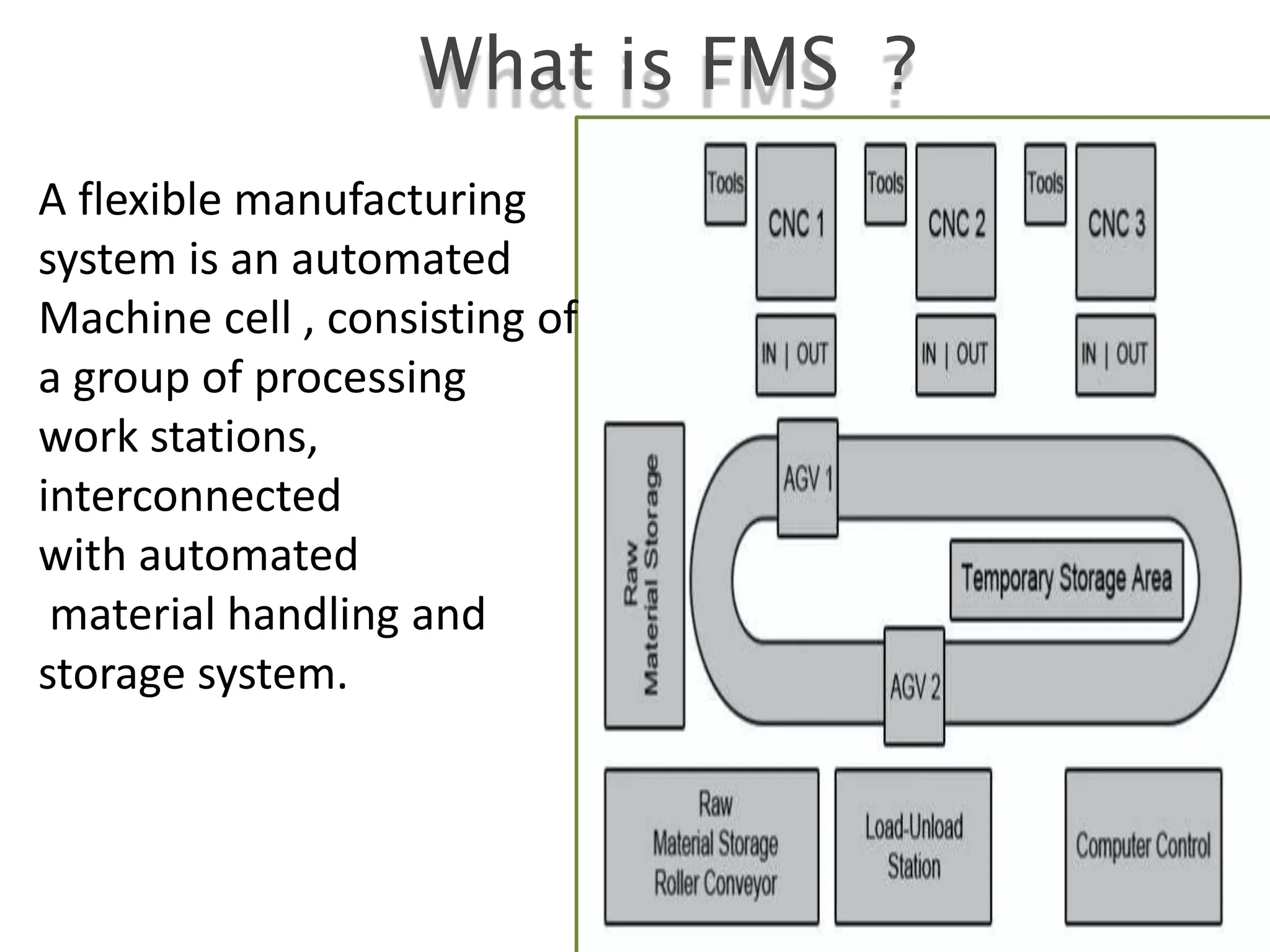
What is FMS ?
A flexible manufacturing
system is an automated
Machine cell , consisting of
a group of processing
work stations,
interconnected
with automated
material handling and
storage system.
FMS Equipment
1. In general FMS equipments consists of the
following components:
1.Manufacturing system.
2.Tool handling and storage.
3.Material handling and storage.
4.Computer control system.
1.Manufacturing System
1. The machining system consists of CNC Machine
tools (including Horizontal centre, Vertical centre ,
Turning centre) that can perform machining operations
on part families.
2. However FMS also include ASSEMBLY STATIONS,
SHEET METAL PRESSES , INSPECTION STATIONS
3. Manufacturing system capable of performing several
operations on the work piece automatically
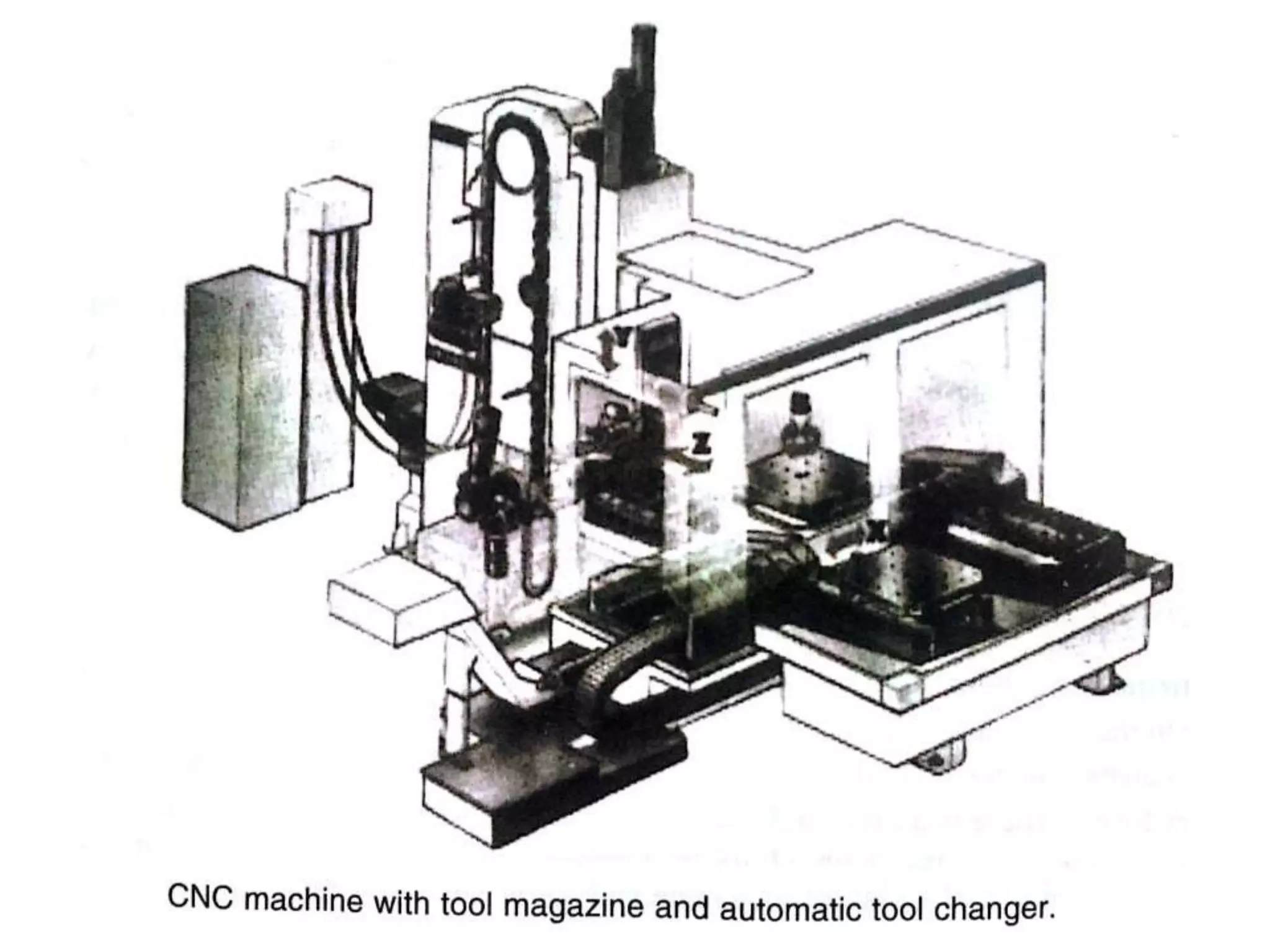
• Machining centres consist of an automatic tool
changing and tool storage , pallet changer, CNC
Control and DNC control.
• Assembly workstations are used for assembly
products typically made in batches
• Industrial robots are usually considered to be the
most appropriate as automated workstations
• INSPECTION STATIONS are incorporated into
FMS by including an inspection operation at a given
work station or by designating a specific station for
inspection.
• SHEET METAL PROCESSING MACHINES consist
of press working operations such as punching ,
shearing and bending and forming processes
1.Manufacturing system.
2. Material Handling and Storage
1. This system facilitates the timely supply of un machined work
pieces from the storage to the machining centres and transport of
the machined parts from machining centres to the desired
locations.
2. Functions of material handling and storage system are
a) Random , Independent movement of work pieces between
work stations
b) Accommodation of different part configurations:
• Example : For prismatic parts , the fixture is located on the top of
pallet and is designed to accommodate different part configurations
• For rotational parts, industrial robots are used to load and unload
the machine tools and to transfer parts between workstations.
c) Compatibility with computer control: The handling system is
allowed to control directly by the computer to direct to
workstation, load and unload workstation.
The material handling equipments consists of
1.load/unload stations(palletising)
2.Robotics
3.AGV (AUTOMATICALLY GUIDED VECHICLE)
4.AS/RS (Automatic storage and Retrieval system)
• Prismatic components are set up on pallets.
• Fixture are used to locate the parts precisely on the
pallets
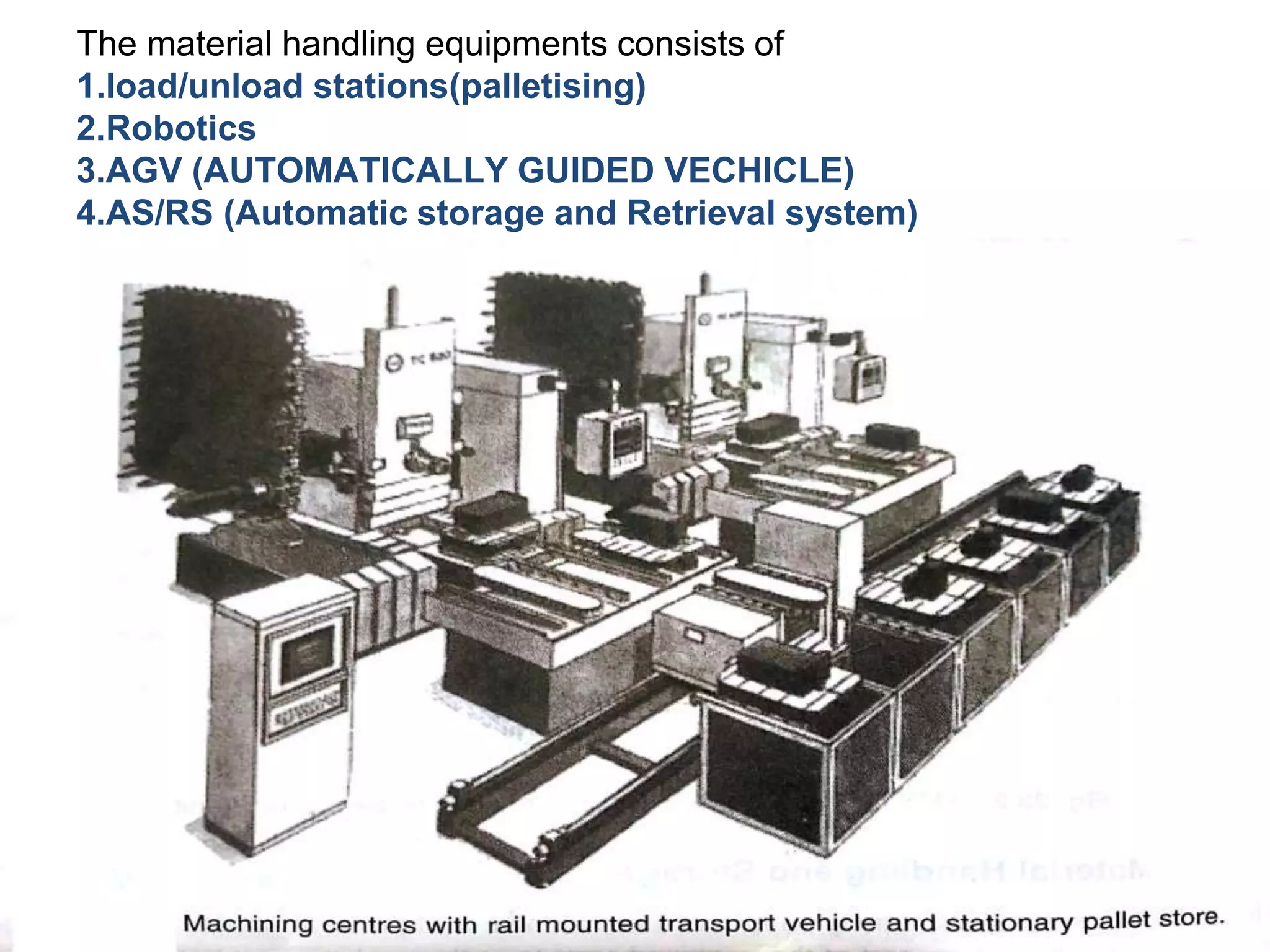
• Figure show FMS with a rail – mounted transport vehicle
and stationary pallets.
• FMS fixtures can accommodate part families and
minimise changeover times.
Modular fixturing
• A typical AS/RS is shown
• Work piece storage and retrieval can be automated by
using an automatic storage retrieval system (As/Rs).
• AS/RS consists of storage racks , a PLC based or
computer-controlled stacker crane.
• Servomotors used in the cranes can achieve
positioning accuracy and reliability.
• Elevating speeds of the stacker could be as high as
180 m/min.
AGV
• An automatically guided vehicle (AGV) is a material handling
system which uses independently operated , self – propelled
vehicles that are guided along defined pathways in the floor.
• This vehicles are power by means of on- board batteries.
• A typical AGVS unit load carrier is shown.
• It is equipped for automatic loading and unloading by means
of Powered rollers , Moving belts , Mechanised lift platforms
or other devices.
3.Tool Handling storage
1. In a FMS , various cutting tools are loaded onto the machine at
intervals depending upon their utilisation.
2. The cutting tools are stored in auxiliary tool storage from where the
required tools can be transferred to the main tool magazine.
3. Such storage units include drums ,chains, discs and other forms.
4. There is limit to the maximum number of tools available at the machine
tool (20-120).
4.FMS Control System
• All the elements in an FMS , Machine tools , Material
handling units and cutting tools are to be controlled in real
– time.
• A computer is used to control the operation of FMS
• Functions performed by the FMS computer control are:
1.Control of workstations
2.Production control.
3.Traffic control.
4.Shuttle control. (secondary part handling system)
5.Tool control. (Tool location Accounting and Tool life
Monitoring)
6.Scheduling.
7.System performance and Monitoring
FMS Layouts
• The FMS layouts are Broadly Classified into
the Following Five categories:
1.IN – Line.
2.Loop.
3.Ladder.
4.Open – field.
5.Robot – centred cell.
1.In – line or progressive FMS layout
• It is most appropriate for systems in which
the work parts progress from one
workstation (WS) to the next in a well –
defined sequence with no back flow.
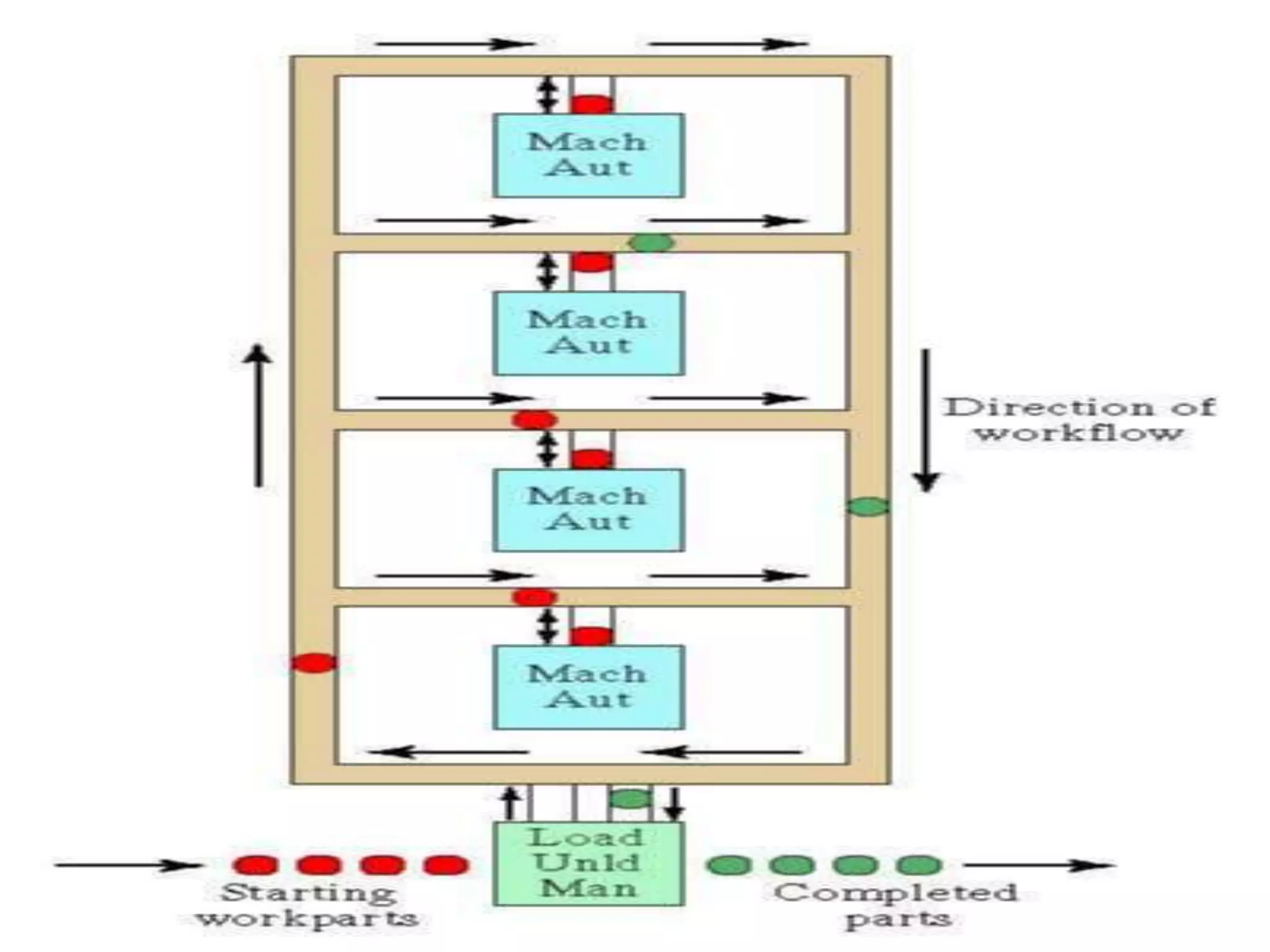
2.LOOP FMS Layout:
• In this layout work part usually flow in one direction
along the loop with the capability at any
workstation
• The load/unload stations are located at one end of
the loop.
3.Ladder FMS Layout :
1. This type of layout contains rungs on which
workstations are located
2. This layout reduces the average distance travelled to
transfer work parts between stations.
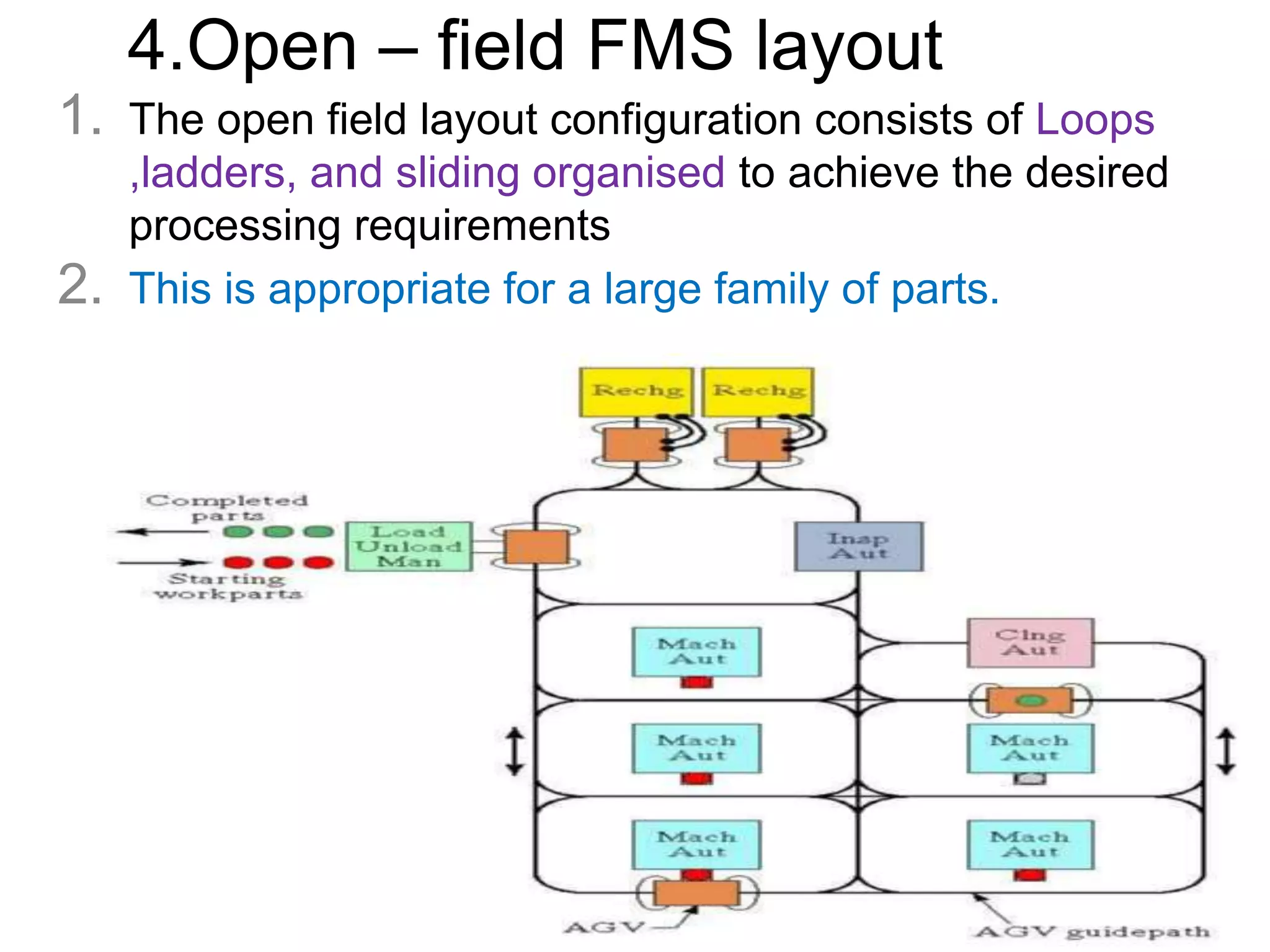
4.Open – field FMS layout
1. The open field layout configuration consists of Loops
,ladders, and sliding organised to achieve the desired
processing requirements
2. This is appropriate for a large family of parts.
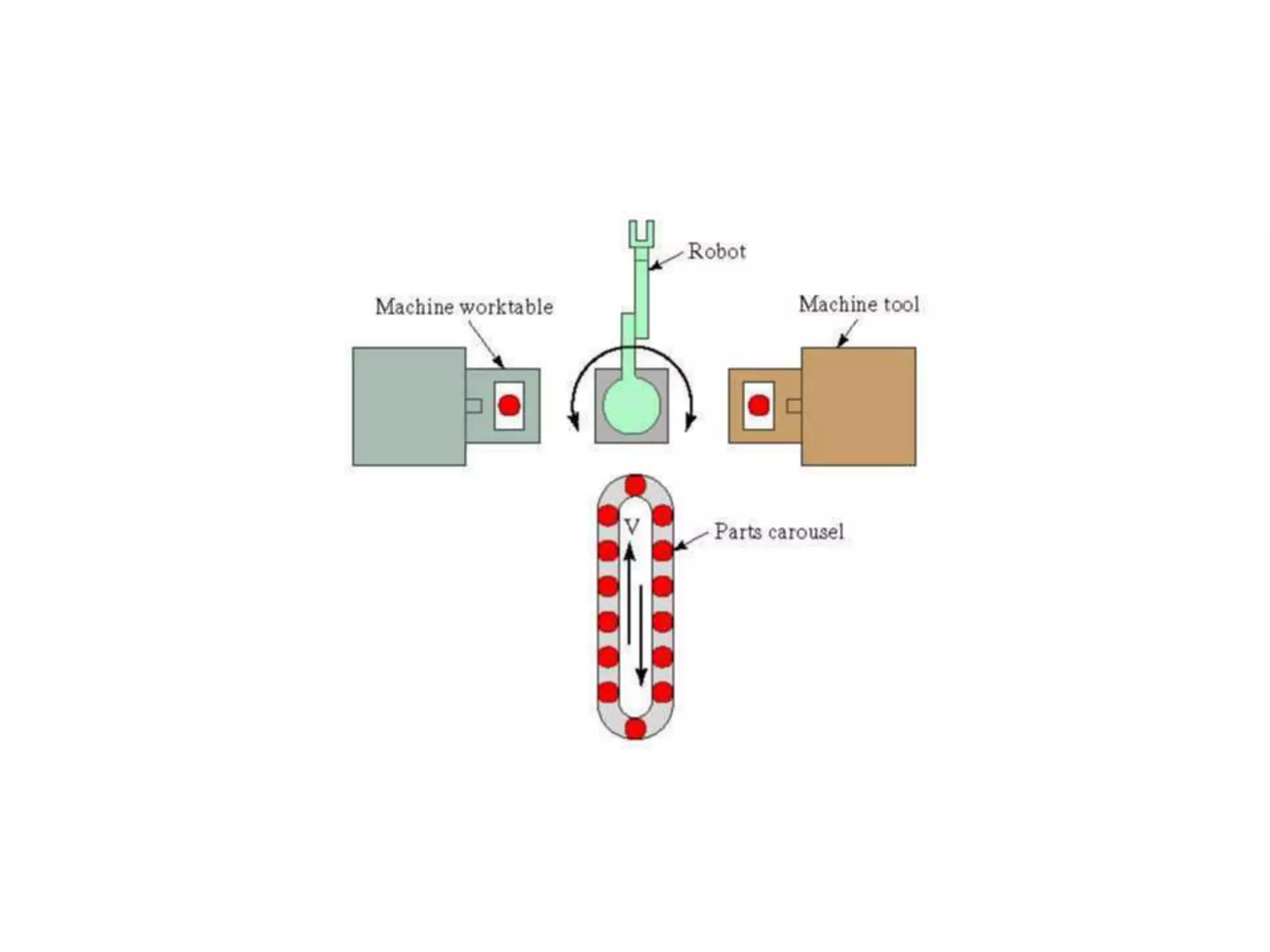
5.Robot – centred FMS layout
• In this the robot is located at the approximate centre of the
layout and the other workstations are arranged around it
• Industrial robot equipped with grippers may be used for
the handling of rotational parts.
• The type of layout is well – suited for handling of cylindrical
or disk shaped parts.
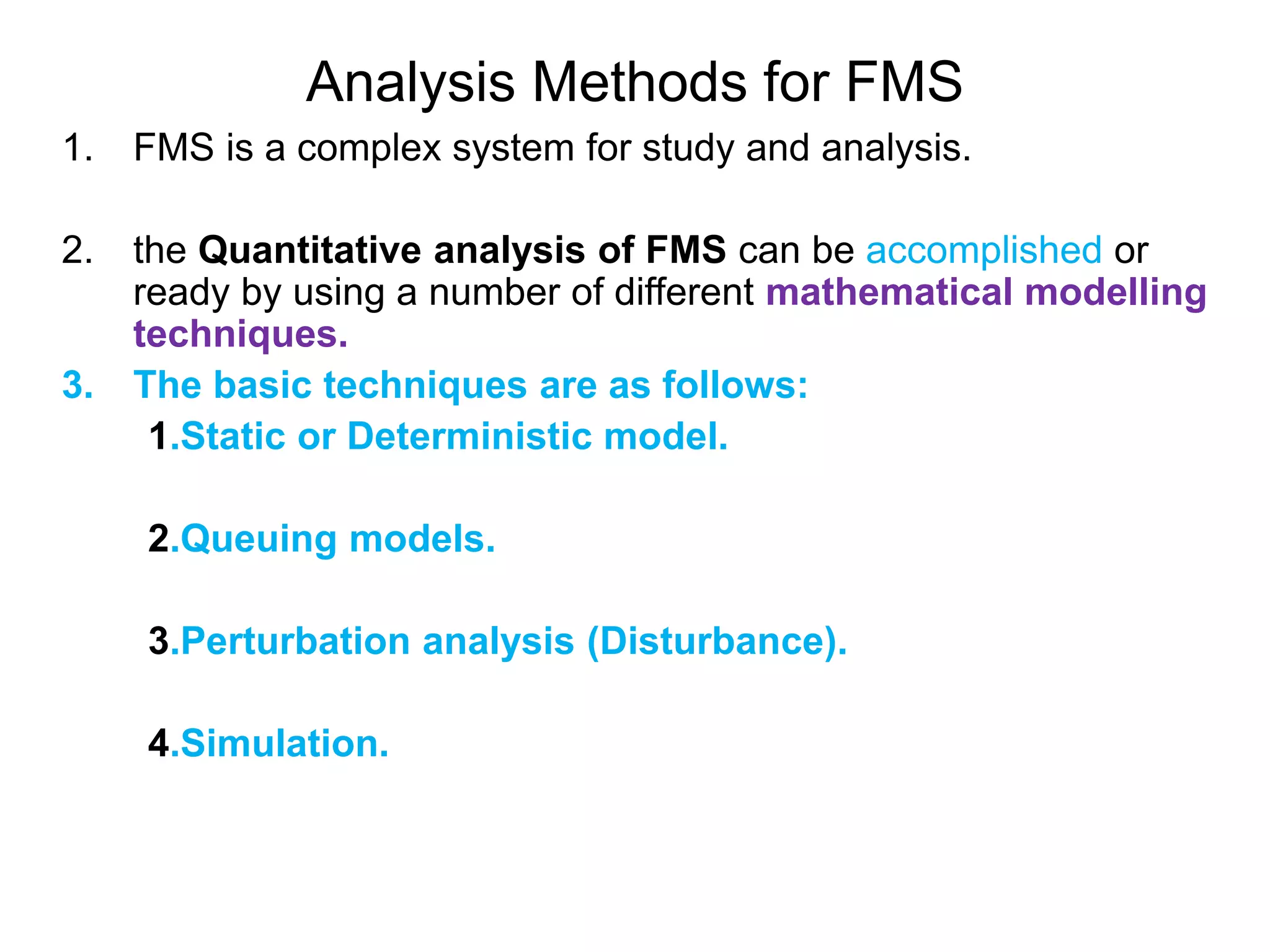
Analysis Methods for FMS
1. FMS is a complex system for study and analysis.
2. the Quantitative analysis of FMS can be accomplished or
ready by using a number of different mathematical modelling
techniques.
3. The basic techniques are as follows:
1.Static or Deterministic model.
2.Queuing models.
3.Perturbation analysis (Disturbance).
4.Simulation.
1.Static or Deterministic models:
1. These models are used to estimate production throughout
, capacity and utilisation.
2. Operating characteristics of the production cannot be
evaluated by using this models.
3. A) The manufacturing lead time (MLT) is the total time
Required to process a given product throughout the plant
4. The mathematical expression is given by
where
T s i = Set –up time.
T o i = Time per operation at a given workstation.
T n i = Non-operation time Associated with the same workstation.
I= is operation sequence in the processing i=1,2,3,4,m
2.The production capacity (PC) for the Group of work Centres is
given: PC= WS w HRP where
where W is the number of work centres
1. S w = Number of shift per week
2. H = Operating time in hours of each work centre.
3. RP = Production rate , units per hour.
3. Utilisation (U) is the amount of a production facility relative
to its capacity U = Output / Capacity.
4.work-in- progress is the amount of product currently
located in the plant that is either being processed or between
processing operations.
The work-in-progress is given by WIP = (PC) U (MLT)/ S w H
2. Queuing Models:
1. This model is based on mathematics of
queues.
2. Queuing models are useful in the
preliminary design of manufacturing
systems but are not accurate enough at
the detailed design/operation stage.
3.Perturbation Analysis
1. This model enables parameter sensitivities to be
computed in real-time
2. Perturbation Analysis works by observing nominal
experiment, which could be on the actual system or
based on the simulation
3. By performing simple computations, solutions can be
obtained questions such as:
4. What will be the performance index if the machines are
faster ?
4.Simulation
1. Discrete event simulation on a computer offers the most flexible approach
for modelling the FMS.
2. There are three approaches to simulation modelling of FMS
I. a)Network or graphical models : In these model objects are represented
by graphical symbols placed in the same physical relationship to each
other as the corresponding machines are in the real world
b) SLAM and SIMAN are two widely used networking tools for FMS.
II. Data – Driven models : It consists of only numerical data
example: The numerical data may be a) A simple count of machines in a
system or
b) A table of operation times for each process on the route for a given
product.
III. Programming language models: These provides activity cycles ,
queues and an optimum cycle.
1.Activity cycle diagram (ACD) Is widely used for FMS simulation
2.It is equivalent to a flow chart of a general purpose computer
program
3.The ACD shows the cycles for every activity in the model.
1.External changes such as change in product design and
production system.
2.Optimizing the manufacturing cycle time
3.Reduced production costs
4.Overcoming internal changes like breakdowns etc.
5.Lower cost per unit produced
6.Greater labour productivity
7.Greater machine efficiency
8.Improved quality
9.Increased system reliability
10.Reduced parts inventories
11.To reduce set up and queue times
12.Improve efficiency
13.Reduce time for product completion
14.Utilize human workers better
15.Improve product routing
16.Produce a variety of Items under one roof
17.Improve product quality
18.Serve a variety of vendors simultaneously
19.Produce more product more quickly
20.Adaptability to CAD/CAM operations
21.Shorter lead times
1.Expensive.
2.Substantial pre-planning activity.
3.Cost to implement,
4.Substantial pre-planning
5.Requirement of skilled labour
6.Complicated system
CHALLENGES
1.Determining if FMS the best production system for
your company
2.Possible expansion costs associated with implementing
FMS
Benefits of FMS
1. Greater flexibility
2. Higher machine utilisation
3. Reduced work-in- progress
4. Lower manufacturing lead times
5. Higher labour productivity
Metal-cutting machining
Metal forming
Assembly
Joining-welding (Arc , Spot)
Surface treatment
Inspection
Testing
Thank U Boshalla

Flexible manufacturing systems (FMS)

  • 1.
  • 2.
    Introduction 1. A FMSconsists of a group of programmable production machines interconnected by means of an automated material handling and storage system and controlled by an integrated computer system to produce a variety of parts at non- uniform product rates, batch sizes and quantities . 2. A FMS is characterised by the following: Variety of products ,small volume of products, Less manufacturing lead time ,high quality , Low cost.

  • 3.
    What is FMS? A flexible manufacturing system is an automated Machine cell , consisting of a group of processing work stations, interconnected with automated material handling and storage system.
  • 4.
    FMS Equipment 1. Ingeneral FMS equipments consists of the following components: 1.Manufacturing system. 2.Tool handling and storage. 3.Material handling and storage. 4.Computer control system.
  • 5.
    1.Manufacturing System 1. Themachining system consists of CNC Machine tools (including Horizontal centre, Vertical centre , Turning centre) that can perform machining operations on part families. 2. However FMS also include ASSEMBLY STATIONS, SHEET METAL PRESSES , INSPECTION STATIONS 3. Manufacturing system capable of performing several operations on the work piece automatically
  • 6.
    • Machining centresconsist of an automatic tool changing and tool storage , pallet changer, CNC Control and DNC control. • Assembly workstations are used for assembly products typically made in batches • Industrial robots are usually considered to be the most appropriate as automated workstations • INSPECTION STATIONS are incorporated into FMS by including an inspection operation at a given work station or by designating a specific station for inspection. • SHEET METAL PROCESSING MACHINES consist of press working operations such as punching , shearing and bending and forming processes
  • 7.
  • 8.
    2. Material Handlingand Storage 1. This system facilitates the timely supply of un machined work pieces from the storage to the machining centres and transport of the machined parts from machining centres to the desired locations. 2. Functions of material handling and storage system are a) Random , Independent movement of work pieces between work stations b) Accommodation of different part configurations: • Example : For prismatic parts , the fixture is located on the top of pallet and is designed to accommodate different part configurations • For rotational parts, industrial robots are used to load and unload the machine tools and to transfer parts between workstations. c) Compatibility with computer control: The handling system is allowed to control directly by the computer to direct to workstation, load and unload workstation.
  • 9.
    The material handlingequipments consists of 1.load/unload stations(palletising) 2.Robotics 3.AGV (AUTOMATICALLY GUIDED VECHICLE) 4.AS/RS (Automatic storage and Retrieval system)
  • 10.
    • Prismatic componentsare set up on pallets. • Fixture are used to locate the parts precisely on the pallets • Figure show FMS with a rail – mounted transport vehicle and stationary pallets. • FMS fixtures can accommodate part families and minimise changeover times.
  • 11.
  • 12.
    • A typicalAS/RS is shown • Work piece storage and retrieval can be automated by using an automatic storage retrieval system (As/Rs). • AS/RS consists of storage racks , a PLC based or computer-controlled stacker crane. • Servomotors used in the cranes can achieve positioning accuracy and reliability. • Elevating speeds of the stacker could be as high as 180 m/min.
  • 14.
    AGV • An automaticallyguided vehicle (AGV) is a material handling system which uses independently operated , self – propelled vehicles that are guided along defined pathways in the floor. • This vehicles are power by means of on- board batteries. • A typical AGVS unit load carrier is shown. • It is equipped for automatic loading and unloading by means of Powered rollers , Moving belts , Mechanised lift platforms or other devices.
  • 15.
    3.Tool Handling storage 1.In a FMS , various cutting tools are loaded onto the machine at intervals depending upon their utilisation. 2. The cutting tools are stored in auxiliary tool storage from where the required tools can be transferred to the main tool magazine. 3. Such storage units include drums ,chains, discs and other forms. 4. There is limit to the maximum number of tools available at the machine tool (20-120).
  • 17.
    4.FMS Control System •All the elements in an FMS , Machine tools , Material handling units and cutting tools are to be controlled in real – time. • A computer is used to control the operation of FMS • Functions performed by the FMS computer control are: 1.Control of workstations 2.Production control. 3.Traffic control. 4.Shuttle control. (secondary part handling system) 5.Tool control. (Tool location Accounting and Tool life Monitoring) 6.Scheduling. 7.System performance and Monitoring
  • 18.
    FMS Layouts • TheFMS layouts are Broadly Classified into the Following Five categories: 1.IN – Line. 2.Loop. 3.Ladder. 4.Open – field. 5.Robot – centred cell.
  • 19.
    1.In – lineor progressive FMS layout • It is most appropriate for systems in which the work parts progress from one workstation (WS) to the next in a well – defined sequence with no back flow.
  • 20.
    2.LOOP FMS Layout: •In this layout work part usually flow in one direction along the loop with the capability at any workstation • The load/unload stations are located at one end of the loop.
  • 22.
    3.Ladder FMS Layout: 1. This type of layout contains rungs on which workstations are located 2. This layout reduces the average distance travelled to transfer work parts between stations.
  • 24.
    4.Open – fieldFMS layout 1. The open field layout configuration consists of Loops ,ladders, and sliding organised to achieve the desired processing requirements 2. This is appropriate for a large family of parts.
  • 25.
    5.Robot – centredFMS layout • In this the robot is located at the approximate centre of the layout and the other workstations are arranged around it • Industrial robot equipped with grippers may be used for the handling of rotational parts. • The type of layout is well – suited for handling of cylindrical or disk shaped parts.
  • 27.
    Analysis Methods forFMS 1. FMS is a complex system for study and analysis. 2. the Quantitative analysis of FMS can be accomplished or ready by using a number of different mathematical modelling techniques. 3. The basic techniques are as follows: 1.Static or Deterministic model. 2.Queuing models. 3.Perturbation analysis (Disturbance). 4.Simulation.
  • 28.
    1.Static or Deterministicmodels: 1. These models are used to estimate production throughout , capacity and utilisation. 2. Operating characteristics of the production cannot be evaluated by using this models. 3. A) The manufacturing lead time (MLT) is the total time Required to process a given product throughout the plant 4. The mathematical expression is given by where T s i = Set –up time. T o i = Time per operation at a given workstation. T n i = Non-operation time Associated with the same workstation. I= is operation sequence in the processing i=1,2,3,4,m
  • 29.
    2.The production capacity(PC) for the Group of work Centres is given: PC= WS w HRP where where W is the number of work centres 1. S w = Number of shift per week 2. H = Operating time in hours of each work centre. 3. RP = Production rate , units per hour. 3. Utilisation (U) is the amount of a production facility relative to its capacity U = Output / Capacity. 4.work-in- progress is the amount of product currently located in the plant that is either being processed or between processing operations. The work-in-progress is given by WIP = (PC) U (MLT)/ S w H
  • 30.
    2. Queuing Models: 1.This model is based on mathematics of queues. 2. Queuing models are useful in the preliminary design of manufacturing systems but are not accurate enough at the detailed design/operation stage.
  • 31.
    3.Perturbation Analysis 1. Thismodel enables parameter sensitivities to be computed in real-time 2. Perturbation Analysis works by observing nominal experiment, which could be on the actual system or based on the simulation 3. By performing simple computations, solutions can be obtained questions such as: 4. What will be the performance index if the machines are faster ?
  • 32.
    4.Simulation 1. Discrete eventsimulation on a computer offers the most flexible approach for modelling the FMS. 2. There are three approaches to simulation modelling of FMS I. a)Network or graphical models : In these model objects are represented by graphical symbols placed in the same physical relationship to each other as the corresponding machines are in the real world b) SLAM and SIMAN are two widely used networking tools for FMS. II. Data – Driven models : It consists of only numerical data example: The numerical data may be a) A simple count of machines in a system or b) A table of operation times for each process on the route for a given product. III. Programming language models: These provides activity cycles , queues and an optimum cycle. 1.Activity cycle diagram (ACD) Is widely used for FMS simulation 2.It is equivalent to a flow chart of a general purpose computer program 3.The ACD shows the cycles for every activity in the model.
  • 33.
    1.External changes suchas change in product design and production system. 2.Optimizing the manufacturing cycle time 3.Reduced production costs 4.Overcoming internal changes like breakdowns etc. 5.Lower cost per unit produced 6.Greater labour productivity 7.Greater machine efficiency 8.Improved quality 9.Increased system reliability 10.Reduced parts inventories
  • 34.
    11.To reduce setup and queue times 12.Improve efficiency 13.Reduce time for product completion 14.Utilize human workers better 15.Improve product routing 16.Produce a variety of Items under one roof 17.Improve product quality 18.Serve a variety of vendors simultaneously 19.Produce more product more quickly 20.Adaptability to CAD/CAM operations 21.Shorter lead times
  • 35.
    1.Expensive. 2.Substantial pre-planning activity. 3.Costto implement, 4.Substantial pre-planning 5.Requirement of skilled labour 6.Complicated system CHALLENGES 1.Determining if FMS the best production system for your company 2.Possible expansion costs associated with implementing FMS
  • 37.
    Benefits of FMS 1.Greater flexibility 2. Higher machine utilisation 3. Reduced work-in- progress 4. Lower manufacturing lead times 5. Higher labour productivity
  • 38.
    Metal-cutting machining Metal forming Assembly Joining-welding(Arc , Spot) Surface treatment Inspection Testing
  • 39.