Automated assembly systems
• Assembly involves the joining together of two
or more separate parts to form new entity
which may be assembly or subassembly.
• Automated assembly refers to the use of
mechanized and automated devices to
perform the various functions in an assembly
line or cell.
• Automated assembly system performs a
sequence of automated operations to
combine multiple components in to a single
entity which can be a final product or sub
assembly.
Need for an automated assembly
system
• High product demand.
• Stable product design.
• The assembly consists of no more than a
limited number of components.
• The product is designed for automated
assembly.
Automated assembly v/s Transfer lines
• Work part produced are smaller in size
compared to transfer lines.
• Assembly operations do not have the large
mechanical forces and power requirement.
• Size is very less compared to transfer lines.
Design for Automated assembly
Some principles that can be applied in product design
to facilitate automated assembly are:
• Reduce the amount of assembly required.
• Use modular design.
• Reduce the number of fasteners required.
• Reduce the need for multiple components to lie handled
at once.
• Limit the required directions of access.
• Require high quality in components.
• Implement hopperability.
Types of automated assembly systems
• Dial-type assembly machine
• In-line assembly machine
• Carousel assembly system
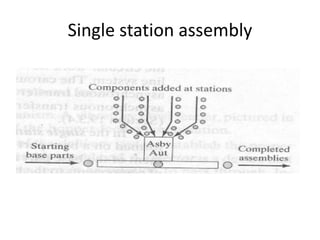
• Single-station assembly machine
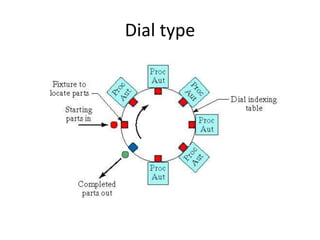
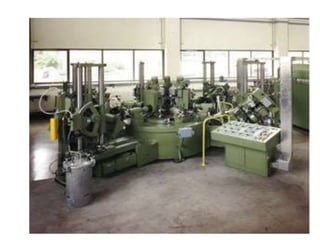
Dial type
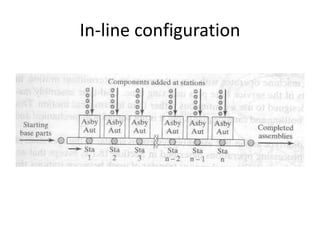
In-line configuration
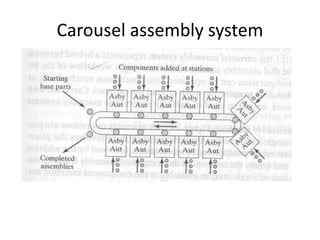
Carousel assembly system
Single station assembly
Part feeding devices
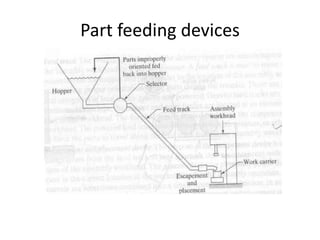
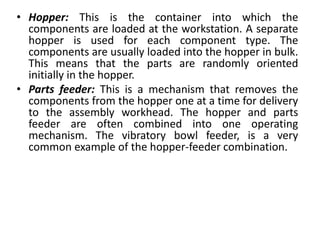
• Hopper: This is the container into which the
components are loaded at the workstation. A separate
hopper is used for each component type. The
components are usually loaded into the hopper in bulk.
This means that the parts are randomly oriented
initially in the hopper.
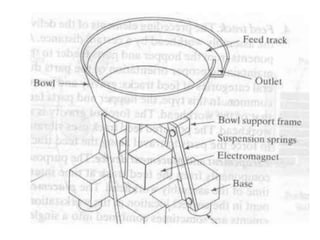
• Parts feeder: This is a mechanism that removes the
components from the hopper one at a time for delivery
to the assembly workhead. The hopper and parts
feeder are often combined into one operating
mechanism. The vibratory bowl feeder, is a very
common example of the hopper-feeder combination.
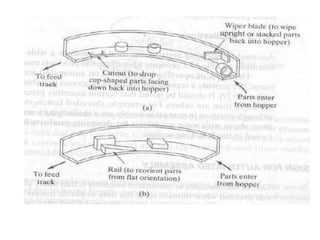
• Selector and/or orienteer: These elements of the delivery system establish the
proper orientation of the components for the assembly workhead. A selector is a
device that acts as a filter, permitting only parts that are in the correct orientation
to pass through. Components that are not properly oriented are rejected back into
the hopper. An orientor is a device that allows properly oriented pans to pass
through but provides a reorientation of components that are not properly oriented
initially. Selector and orientor devices are often combined and incorporated into
one hopper-feeder system.
• Feed track: The preceding elements of the delivery system are usually located
some distance from the assembly workhead. A feed track is used to transfer the
components from the hopper and parts feeder to the location of the assembly
workhead, maintaining proper orientation of the parts during the transfer. There
are two general categories of feed tracks: gravity and powered. The gravity feed
track is most common. In this type the hopper and parts feeder are located at an
elevation that is above the elevation of the workhead. The force of gravity is used
to deliver the components to the workhead. The powered feed track uses
vibratory action, air pressure, or other means to force the parts to travel along the
feed track toward the assembly workhead.
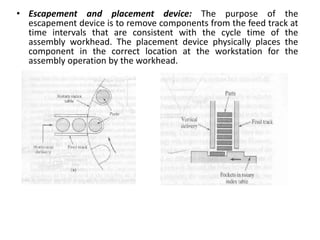
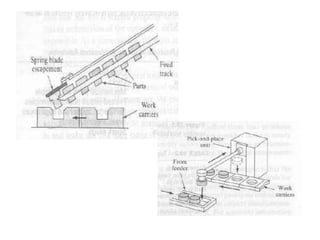
• Escapement and placement device: The purpose of the
escapement device is to remove components from the feed track at
time intervals that are consistent with the cycle time of the
assembly workhead. The placement device physically places the
component in the correct location at the workstation for the
assembly operation by the workhead.
Automated assembly systems

Automated assembly systems

  • 1.
  • 2.
    • Assembly involvesthe joining together of two or more separate parts to form new entity which may be assembly or subassembly. • Automated assembly refers to the use of mechanized and automated devices to perform the various functions in an assembly line or cell. • Automated assembly system performs a sequence of automated operations to combine multiple components in to a single entity which can be a final product or sub assembly.
  • 3.
    Need for anautomated assembly system • High product demand. • Stable product design. • The assembly consists of no more than a limited number of components. • The product is designed for automated assembly.
  • 4.
    Automated assembly v/sTransfer lines • Work part produced are smaller in size compared to transfer lines. • Assembly operations do not have the large mechanical forces and power requirement. • Size is very less compared to transfer lines.
  • 5.
    Design for Automatedassembly Some principles that can be applied in product design to facilitate automated assembly are: • Reduce the amount of assembly required. • Use modular design. • Reduce the number of fasteners required. • Reduce the need for multiple components to lie handled at once. • Limit the required directions of access. • Require high quality in components. • Implement hopperability.
  • 6.
    Types of automatedassembly systems • Dial-type assembly machine • In-line assembly machine • Carousel assembly system • Single-station assembly machine
  • 7.
  • 9.
  • 11.
  • 13.
  • 14.
  • 15.
    • Hopper: Thisis the container into which the components are loaded at the workstation. A separate hopper is used for each component type. The components are usually loaded into the hopper in bulk. This means that the parts are randomly oriented initially in the hopper. • Parts feeder: This is a mechanism that removes the components from the hopper one at a time for delivery to the assembly workhead. The hopper and parts feeder are often combined into one operating mechanism. The vibratory bowl feeder, is a very common example of the hopper-feeder combination.
  • 17.
    • Selector and/ororienteer: These elements of the delivery system establish the proper orientation of the components for the assembly workhead. A selector is a device that acts as a filter, permitting only parts that are in the correct orientation to pass through. Components that are not properly oriented are rejected back into the hopper. An orientor is a device that allows properly oriented pans to pass through but provides a reorientation of components that are not properly oriented initially. Selector and orientor devices are often combined and incorporated into one hopper-feeder system. • Feed track: The preceding elements of the delivery system are usually located some distance from the assembly workhead. A feed track is used to transfer the components from the hopper and parts feeder to the location of the assembly workhead, maintaining proper orientation of the parts during the transfer. There are two general categories of feed tracks: gravity and powered. The gravity feed track is most common. In this type the hopper and parts feeder are located at an elevation that is above the elevation of the workhead. The force of gravity is used to deliver the components to the workhead. The powered feed track uses vibratory action, air pressure, or other means to force the parts to travel along the feed track toward the assembly workhead.
  • 19.
    • Escapement andplacement device: The purpose of the escapement device is to remove components from the feed track at time intervals that are consistent with the cycle time of the assembly workhead. The placement device physically places the component in the correct location at the workstation for the assembly operation by the workhead.