

Shri S'ad Vidya Mandal Institute Of Technology
Branch : Mechanical Engineering
Semester : 7th Sem
Year : 2016-2017
Subject : Computer Aided Manufacturing (2171903)
Presentation Topic : Introduction to Flexible Manufacturing System
Presentation By : Nilrajsinh Vasandia
Enrollment No : 130454119006
Content List :-
1. Introduction to Flexible Manufacturing System (FMS).
2. Components of FMS.
3. Objectives of FMS.
4. Flexibilities in FMS.
5. Classification of FMS.
6. Advantages, Limitations & Applications of FMS.
References :-
1. Content from Computer Aided Manufacturing by R. B. Patil (Tech-Max) edition (2016-2017).
2. Images – Self prepared by power point tools & from Google Images.
• Flexible manufacturing system (FMS) is a highly automated
group technology machine cell :
1. Consist group of workstations (CNC machines or CNC machining centres)
2. Interconnected by an automated material handling and storage system
3. Controlled be a computer system.
• Basic features of Flexible Manufacturing system (FMS):
1. Ability to manufacture variety of products;
2. Setup & processes are programmable as per requirement of part;
3. Less manufacturing lead time;
4. High quality
5. Low cost
Introduction to Flexible Manufacturing System (FMS)
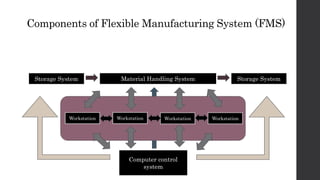
Components of Flexible Manufacturing System (FMS)
Storage System Material Handling System Storage System
Workstation Workstation Workstation Workstation
Computer control
system
Any flexible manufacturing system consists of four
basic components:
1. Workstations
2. Material Handling & Storage system
3. Computer control system
4. Human Resource
1. Workstation :-
• It is the main element of FMS
• May contain one or more workstations : CNC machine, CNC press, Industrial robots etc.
2. Material Handling & Storage system :-
• The second major element of flexible manufacturing system is material handling and storage
system
• Functions, performed by material handling system : Movement of work piece between stations,
locating the work piece, temporary storage of work piece, Loading and unloading of work piece.
• Functions performed by storage system : Storage of raw material and finish products.
3. Computer control system :-
• It is the Brain of FMS.
• It is interfaced with workstations, Material handling system & Storage system.
4. Human Resource :-
• It is needed to manage the operations of FMS.
• Functions performed : Loading of raw material into the system, Unloading of finished parts,
Changing and setting of tools, Programming and operating the system, Maintenance of system
and overall management of the system.
Objectives of Flexible Manufacturing Systems :
1. Flexibility
2. Automation & Integration
3. Reduction in manufacturing lead time
4. High Productivity
5. Reduction in Manpower
6. Reduction in Material Handling
1. Flexibility :-
• The basic objective of the FMS is it must give fair degree of flexibility in terms of ability to manufacture variety of
products.
• It should be able to incorporate the product changes at short notice
2. Automation :-
• The FMS must give programmable automation to the manufacturing system.
• FMS should integrate all the manufacturing and allied functions such as machine tools, tooling, material handling,
storage system, etc.
3. Reduction in manufacturing lead time :- The FMS should reduce the manufacturing time
for the product.
4. High productivity :- FMS should improve the productivity of the system.
5. Reduction in Man power :- Reduction in manpower requirement is the prime objective of
automation, and hence FMS.
6. Reduction in Material handling :- FMS should minimize the manual material handling.
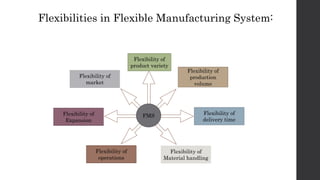
Flexibilities in Flexible Manufacturing System:
FMS
Flexibility of
product variety
Flexibility of
production
volume
Flexibility of
delivery time
Flexibility of
Expansion
Flexibility of
operations
Flexibility of
Material handling
Flexibility of
market
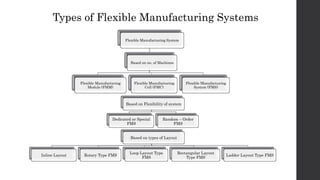
Flexible Manufacturing System
Based on no. of Machines
Flexible Manufacturing
Module (FMM)
Flexible Manufacturing
Cell (FMC)
Flexible Manufacturing
System (FMS)
Types of Flexible Manufacturing Systems
Based on Flexibility of system
Dedicated or Special
FMS
Random – Order
FMS
Based on types of Layout
Inline Layout Rotary Type FMS
Loop Layout Type
FMS
Rectangular Layout
Type FMS
Ladder Layout Type FMS
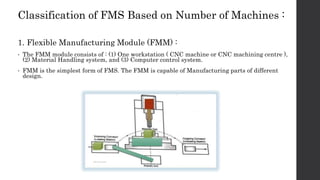
Classification of FMS Based on Number of Machines :
1. Flexible Manufacturing Module (FMM) :
• The FMM module consists of : (1) One workstation ( CNC machine or CNC machining centre ),
(2) Material Handling system, and (3) Computer control system.
• FMM is the simplest form of FMS. The FMM is capable of Manufacturing parts of different
design.
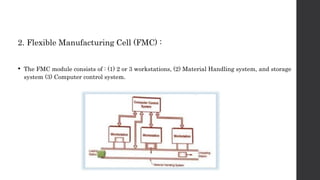
2. Flexible Manufacturing Cell (FMC) :
• The FMC module consists of : (1) 2 or 3 workstations, (2) Material Handling system, and storage
system (3) Computer control system.
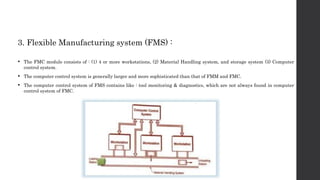
3. Flexible Manufacturing system (FMS) :
• The FMC module consists of : (1) 4 or more workstations, (2) Material Handling system, and storage system (3) Computer
control system.
• The computer control system is generally larger and more sophisticated than that of FMM and FMC.
• The computer control system of FMS contains like : tool monitoring & diagnostics, which are not always found in computer
control system of FMC.
Classification of FMS Based on Flexibility of system:
1. Dedicated or Special FMS :
• Dedicated or special FMS is one which is designed to produce a limited varity of
configurations.
• The designed parts to be manufactured is known in advance. Therefore, the system can be
designed with a certain amount of process specialization to make machining operation more
efficient.
2. Random – Order FMS :
• Random order FMS is used when the part family is large and there are substantial variation in
part configuration. It is a flexible manufacturing system with unlimited flexibility.
Classification of FMS Based on Type of Layout :
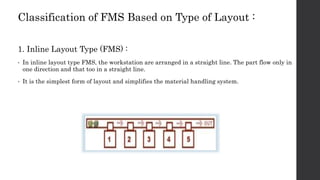
1. Inline Layout Type (FMS) :
• In inline layout type FMS, the workstation are arranged in a straight line. The part flow only in
one direction and that too in a straight line.
• It is the simplest form of layout and simplifies the material handling system.
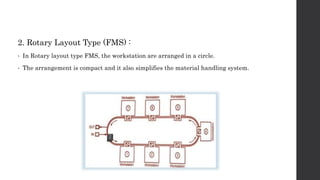
2. Rotary Layout Type (FMS) :
• In Rotary layout type FMS, the workstation are arranged in a circle.
• The arrangement is compact and it also simplifies the material handling system.
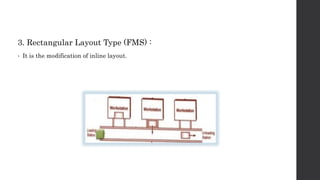
3. Rectangular Layout Type (FMS) :
• It is the modification of inline layout.
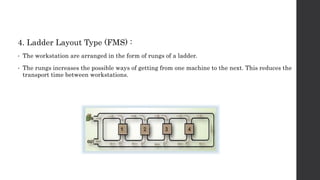
4. Ladder Layout Type (FMS) :
• The workstation are arranged in the form of rungs of a ladder.
• The rungs increases the possible ways of getting from one machine to the next. This reduces the
transport time between workstations.
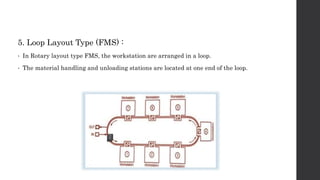
5. Loop Layout Type (FMS) :
• In Rotary layout type FMS, the workstation are arranged in a loop.
• The material handling and unloading stations are located at one end of the loop.
Advantages & Limitations & Applications of FMS :
Advantages
• Increased machine utilization.
• Lesser no. of machines required.
• Reduction in floor space requirement.
• Greater Flexibility.
• Reduction in inventory.
• Lower manufacturing lead time.
• Reduced labour requirement.
Limitations
• High initial cost.
• High maintenance cost.
• Worker unemployment.
Applications : The flexible Manufacturing system is used for the products of medium
quantity and medium variety
Introduction to flexible manufacturing system (fms)

Introduction to flexible manufacturing system (fms)

  • 1.
    Shri S'ad VidyaMandal Institute Of Technology Branch : Mechanical Engineering Semester : 7th Sem Year : 2016-2017 Subject : Computer Aided Manufacturing (2171903) Presentation Topic : Introduction to Flexible Manufacturing System Presentation By : Nilrajsinh Vasandia Enrollment No : 130454119006
  • 2.
    Content List :- 1.Introduction to Flexible Manufacturing System (FMS). 2. Components of FMS. 3. Objectives of FMS. 4. Flexibilities in FMS. 5. Classification of FMS. 6. Advantages, Limitations & Applications of FMS. References :- 1. Content from Computer Aided Manufacturing by R. B. Patil (Tech-Max) edition (2016-2017). 2. Images – Self prepared by power point tools & from Google Images.
  • 3.
    • Flexible manufacturingsystem (FMS) is a highly automated group technology machine cell : 1. Consist group of workstations (CNC machines or CNC machining centres) 2. Interconnected by an automated material handling and storage system 3. Controlled be a computer system. • Basic features of Flexible Manufacturing system (FMS): 1. Ability to manufacture variety of products; 2. Setup & processes are programmable as per requirement of part; 3. Less manufacturing lead time; 4. High quality 5. Low cost Introduction to Flexible Manufacturing System (FMS)
  • 4.
    Components of FlexibleManufacturing System (FMS) Storage System Material Handling System Storage System Workstation Workstation Workstation Workstation Computer control system
  • 5.
    Any flexible manufacturingsystem consists of four basic components: 1. Workstations 2. Material Handling & Storage system 3. Computer control system 4. Human Resource
  • 6.
    1. Workstation :- •It is the main element of FMS • May contain one or more workstations : CNC machine, CNC press, Industrial robots etc. 2. Material Handling & Storage system :- • The second major element of flexible manufacturing system is material handling and storage system • Functions, performed by material handling system : Movement of work piece between stations, locating the work piece, temporary storage of work piece, Loading and unloading of work piece. • Functions performed by storage system : Storage of raw material and finish products.
  • 7.
    3. Computer controlsystem :- • It is the Brain of FMS. • It is interfaced with workstations, Material handling system & Storage system. 4. Human Resource :- • It is needed to manage the operations of FMS. • Functions performed : Loading of raw material into the system, Unloading of finished parts, Changing and setting of tools, Programming and operating the system, Maintenance of system and overall management of the system.
  • 8.
    Objectives of FlexibleManufacturing Systems : 1. Flexibility 2. Automation & Integration 3. Reduction in manufacturing lead time 4. High Productivity 5. Reduction in Manpower 6. Reduction in Material Handling
  • 9.
    1. Flexibility :- •The basic objective of the FMS is it must give fair degree of flexibility in terms of ability to manufacture variety of products. • It should be able to incorporate the product changes at short notice 2. Automation :- • The FMS must give programmable automation to the manufacturing system. • FMS should integrate all the manufacturing and allied functions such as machine tools, tooling, material handling, storage system, etc. 3. Reduction in manufacturing lead time :- The FMS should reduce the manufacturing time for the product. 4. High productivity :- FMS should improve the productivity of the system. 5. Reduction in Man power :- Reduction in manpower requirement is the prime objective of automation, and hence FMS. 6. Reduction in Material handling :- FMS should minimize the manual material handling.
  • 10.
    Flexibilities in FlexibleManufacturing System: FMS Flexibility of product variety Flexibility of production volume Flexibility of delivery time Flexibility of Expansion Flexibility of operations Flexibility of Material handling Flexibility of market
  • 11.
    Flexible Manufacturing System Basedon no. of Machines Flexible Manufacturing Module (FMM) Flexible Manufacturing Cell (FMC) Flexible Manufacturing System (FMS) Types of Flexible Manufacturing Systems Based on Flexibility of system Dedicated or Special FMS Random – Order FMS Based on types of Layout Inline Layout Rotary Type FMS Loop Layout Type FMS Rectangular Layout Type FMS Ladder Layout Type FMS
  • 12.
    Classification of FMSBased on Number of Machines : 1. Flexible Manufacturing Module (FMM) : • The FMM module consists of : (1) One workstation ( CNC machine or CNC machining centre ), (2) Material Handling system, and (3) Computer control system. • FMM is the simplest form of FMS. The FMM is capable of Manufacturing parts of different design.
  • 13.
    2. Flexible ManufacturingCell (FMC) : • The FMC module consists of : (1) 2 or 3 workstations, (2) Material Handling system, and storage system (3) Computer control system.
  • 14.
    3. Flexible Manufacturingsystem (FMS) : • The FMC module consists of : (1) 4 or more workstations, (2) Material Handling system, and storage system (3) Computer control system. • The computer control system is generally larger and more sophisticated than that of FMM and FMC. • The computer control system of FMS contains like : tool monitoring & diagnostics, which are not always found in computer control system of FMC.
  • 15.
    Classification of FMSBased on Flexibility of system: 1. Dedicated or Special FMS : • Dedicated or special FMS is one which is designed to produce a limited varity of configurations. • The designed parts to be manufactured is known in advance. Therefore, the system can be designed with a certain amount of process specialization to make machining operation more efficient. 2. Random – Order FMS : • Random order FMS is used when the part family is large and there are substantial variation in part configuration. It is a flexible manufacturing system with unlimited flexibility.
  • 16.
    Classification of FMSBased on Type of Layout : 1. Inline Layout Type (FMS) : • In inline layout type FMS, the workstation are arranged in a straight line. The part flow only in one direction and that too in a straight line. • It is the simplest form of layout and simplifies the material handling system.
  • 17.
    2. Rotary LayoutType (FMS) : • In Rotary layout type FMS, the workstation are arranged in a circle. • The arrangement is compact and it also simplifies the material handling system.
  • 18.
    3. Rectangular LayoutType (FMS) : • It is the modification of inline layout.
  • 19.
    4. Ladder LayoutType (FMS) : • The workstation are arranged in the form of rungs of a ladder. • The rungs increases the possible ways of getting from one machine to the next. This reduces the transport time between workstations.
  • 20.
    5. Loop LayoutType (FMS) : • In Rotary layout type FMS, the workstation are arranged in a loop. • The material handling and unloading stations are located at one end of the loop.
  • 21.
    Advantages & Limitations& Applications of FMS : Advantages • Increased machine utilization. • Lesser no. of machines required. • Reduction in floor space requirement. • Greater Flexibility. • Reduction in inventory. • Lower manufacturing lead time. • Reduced labour requirement. Limitations • High initial cost. • High maintenance cost. • Worker unemployment. Applications : The flexible Manufacturing system is used for the products of medium quantity and medium variety