Group Technology (GT)
GT is a manufacturing philosophy in
which components are grouped
together to form families on the basis
of geometrical similarity or
manufacturing process.
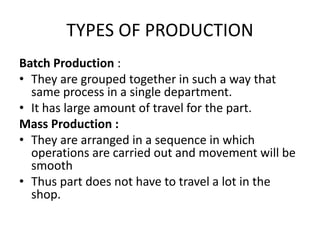
TYPES OF PRODUCTION
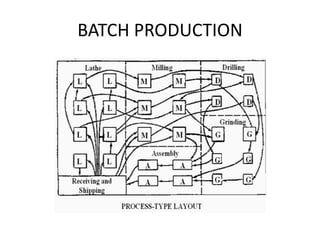
Batch Production :
• They are grouped together in such a way that
same process in a single department.
• It has large amount of travel for the part.
Mass Production :
• They are arranged in a sequence in which
operations are carried out and movement will be
smooth
• Thus part does not have to travel a lot in the
shop.
BATCH PRODUCTION
ADVANTAGES OF GT
• Maximizes the output
• Less lead time
• Less setting time
• Reduced scrap
• Reduced material handling
FLEXIBLE MANUFACTURING SYSTEMS
(FMS)
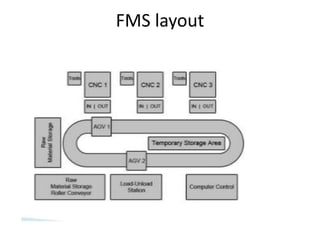
• It is a production system consisting of sets of
CNC machine tool, inter-connected by an
automated material handling and storage
system & controlled by a central computer
system.
COMPONENTS OF FMS
• Workstations
• Material Handling & Storage Systems
• Computer Control Systems
• Human Resources
FMS layout
BENEFITS OF FMS
• It has higher avg. utilization than machines in
a conventional batch production shop.
• Because of a higher m/c utilization, fewer m/c
are required.
•It requires lesser floor area.
•Lower manufacturing lead times
•Reduced direct labour requirements.
SUPPLY CHAIN MANAGEMENT
(SCM)
• SCM deals with management of materials,
information & financial flows in a network
consisting of suppliers, manufacturers,
distributors and consumers.
• The objective is to produced & distribute
the product in right quantities at right
location and at a right time.
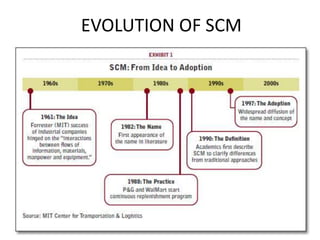
EVOLUTION OF SCM
WHY FOCUS ON SCM ???
1. Customer expectations are moving in the direction of
• Increased value addition & cost consciousness.
• Response time & information sensitivity.
• need of reliability.
2. Increased competition forcing industries towards
• Reducing lead times.
• Reduce cost.
3. Change of attitude forcing industry managers
• Need of integration & partnerships.
• Continuous improvement of processes.
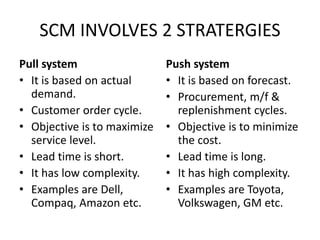
SCM INVOLVES 2 STRATERGIES
Pull system
• It is based on actual
demand.
• Customer order cycle.
• Objective is to maximize
service level.
• Lead time is short.
• It has low complexity.
• Examples are Dell,
Compaq, Amazon etc.
Push system
• It is based on forecast.
• Procurement, m/f &
replenishment cycles.
• Objective is to minimize
the cost.
• Lead time is long.
• It has high complexity.
• Examples are Toyota,
Volkswagen, GM etc.
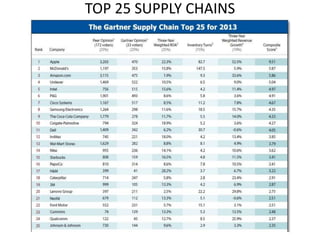
TOP 25 SUPPLY CHAINS
SUPPLY CHAIN FOR BREAD
STAGE OF PRODUCTION VALUE ADDED VALUE OF PRODUCT
Farmer produces &
harvests wheat
2.33 2.33
Wheat transported to mill 1.24 3.57
Mill produces floor 2.33 5.90
Floor transported to baker 1.25 7.15
Baker produces bread 8.35 15.50
Bread transported to
grocery store
1.25 16.75
Grocery store displays and
sells bread
3.25 20.00
Total value-added 20.00
BENEFITS OF SCM
• Inventory reduction
• Productivity improvement
• Cost reduction
• High customer satisfaction
• Increased profit
• On-time delivery fulfillment
• Better cash management
• Better order management

Group technology _ flexible manufacturing system_supply chain management

  • 1.
    Group Technology (GT) GTis a manufacturing philosophy in which components are grouped together to form families on the basis of geometrical similarity or manufacturing process.
  • 2.
    TYPES OF PRODUCTION BatchProduction : • They are grouped together in such a way that same process in a single department. • It has large amount of travel for the part. Mass Production : • They are arranged in a sequence in which operations are carried out and movement will be smooth • Thus part does not have to travel a lot in the shop.
  • 3.
  • 4.
    ADVANTAGES OF GT •Maximizes the output • Less lead time • Less setting time • Reduced scrap • Reduced material handling
  • 5.
    FLEXIBLE MANUFACTURING SYSTEMS (FMS) •It is a production system consisting of sets of CNC machine tool, inter-connected by an automated material handling and storage system & controlled by a central computer system.
  • 6.
    COMPONENTS OF FMS •Workstations • Material Handling & Storage Systems • Computer Control Systems • Human Resources
  • 7.
  • 8.
    BENEFITS OF FMS •It has higher avg. utilization than machines in a conventional batch production shop. • Because of a higher m/c utilization, fewer m/c are required. •It requires lesser floor area. •Lower manufacturing lead times •Reduced direct labour requirements.
  • 9.
    SUPPLY CHAIN MANAGEMENT (SCM) •SCM deals with management of materials, information & financial flows in a network consisting of suppliers, manufacturers, distributors and consumers. • The objective is to produced & distribute the product in right quantities at right location and at a right time.
  • 10.
  • 11.
    WHY FOCUS ONSCM ??? 1. Customer expectations are moving in the direction of • Increased value addition & cost consciousness. • Response time & information sensitivity. • need of reliability. 2. Increased competition forcing industries towards • Reducing lead times. • Reduce cost. 3. Change of attitude forcing industry managers • Need of integration & partnerships. • Continuous improvement of processes.
  • 12.
    SCM INVOLVES 2STRATERGIES Pull system • It is based on actual demand. • Customer order cycle. • Objective is to maximize service level. • Lead time is short. • It has low complexity. • Examples are Dell, Compaq, Amazon etc. Push system • It is based on forecast. • Procurement, m/f & replenishment cycles. • Objective is to minimize the cost. • Lead time is long. • It has high complexity. • Examples are Toyota, Volkswagen, GM etc.
  • 13.
  • 14.
    SUPPLY CHAIN FORBREAD STAGE OF PRODUCTION VALUE ADDED VALUE OF PRODUCT Farmer produces & harvests wheat 2.33 2.33 Wheat transported to mill 1.24 3.57 Mill produces floor 2.33 5.90 Floor transported to baker 1.25 7.15 Baker produces bread 8.35 15.50 Bread transported to grocery store 1.25 16.75 Grocery store displays and sells bread 3.25 20.00 Total value-added 20.00
  • 15.
    BENEFITS OF SCM •Inventory reduction • Productivity improvement • Cost reduction • High customer satisfaction • Increased profit • On-time delivery fulfillment • Better cash management • Better order management