Business Process Re-engineering 03 – Process Re-Design &  Process Improvement
Beginning Process Re-Design
Process Re-design Two approaches to BPR: Systematic re-design identify / understand the existing process It is reviewing current processes and then making the relevant improvements Clean sheet approach Rethinking the way the product / service is delivered and design a new process from the start It is like demolishing an old building and rebuilding instead of patching it up.
Defining processes A simple way to begin defining processes: Identify a set of processes -  executives work back from their own responsibilities  (they know their work processes best) Rationale to establish main processes -  identify major and minor processes -  categorise processes as innovation, delivery and  infrastructure -  group related processes together Define process boundaries -  what is the process owner’s control? -  where is the process customer’s involvement?
Guidelines for selecting processes Processes selected for re-engineering should be: Major contributors to core competencies  (key processes for e.g. marketing & sales) Ready for change – at an acceptable level of risk  (some processes may take a very long time for change) Able to produce early successes  (early hits) Interrelated with other processes  (across functions or departments)
Definition of Visualisation To enable radical changes and dramatic improvements to processes: Visualisation is: moving a process from an ‘As-is’ state to  a ‘To-be’ state the creative  process of developing achievable visions of the ‘To-be’ state Visualisation involves: understanding what others do well deciding attainable but tough improvement targets (“stretch goals”) thinking ahead of the competition to achieve the competitive “edge” a high level design to pragmatic solutions for the current business state
Process Redesign  Issues Some of the issues related to redesign include: Motivation – lack of motivation to enable redesign to processes Attitude – there may be resistance Knowledge – not all may have information on the processes Creativity – lack of creative ideas Innovation – not easy and challenging; thinking ‘out of the box’
BPR Project Structure & Methodology
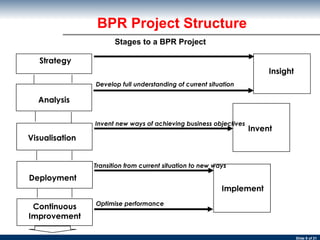
BPR Project Structure Strategy Analysis Visualisation Deployment Continuous Improvement Insight Invent Implement Develop full understanding of current situation Invent new ways of achieving business objectives Transition from current situation to new ways Optimise performance Stages to a BPR Project
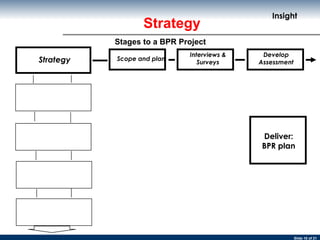
Strategy Strategy Deliver: BPR plan Scope and plan Interviews & Surveys Develop Assessment Insight Stages to a BPR Project
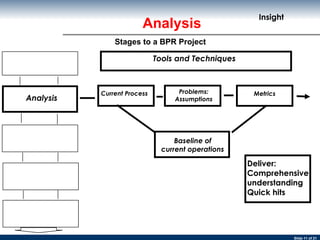
Analysis Analysis Deliver: Comprehensive understanding Quick hits Current Process Problems: Assumptions Metrics Tools and Techniques Baseline of current operations Insight Stages to a BPR Project
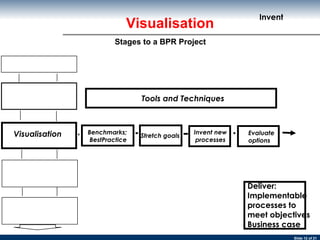
Visualisation  Visualisation Deliver: Implementable processes to meet objectives Business case Benchmarks; BestPractice Stretch goals Invent new processes Tools and Techniques Evaluate options Invent Stages to a BPR Project
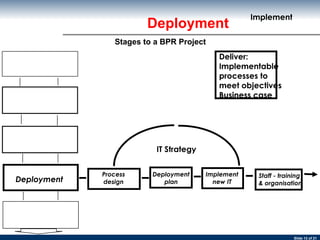
Deployment Deployment Deliver: Implementable processes to meet objectives Business case Process design Deployment plan Implement new IT Staff - training  & organisation IT Strategy Implement Stages to a BPR Project
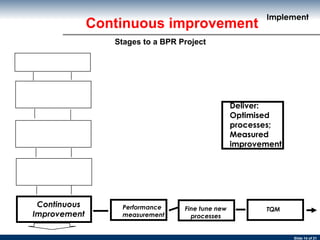
Continuous improvement Implement Continuous Improvement Performance measurement Fine tune new processes TQM Deliver: Optimised processes; Measured improvement Stages to a BPR Project
BPR Methodology Generic Methodology 1. Create a Reengineering Framework  to build a comprehensive foundation and framework for the entire process reengineering change effort that will create the required focus, direction, and motivation necessary to sustain itself.  2. Identify Customers and Determine Needs   to develop a concrete and comprehensive understanding of the customers of the targeted process, and their needs and wants, that will result in a redesigned business process that clearly provides added value to the customer.
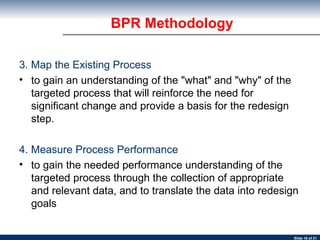
3. Map the Existing Process  to gain an understanding of the "what" and "why" of the targeted process that will reinforce the need for significant change and provide a basis for the redesign step.  4. Measure Process Performance  to gain the needed performance understanding of the targeted process through the collection of appropriate and relevant data, and to translate the data into redesign goals  BPR Methodology
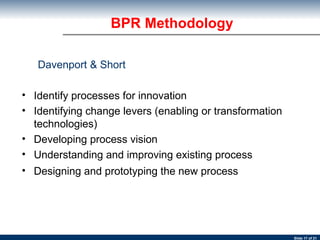
BPR Methodology Davenport & Short Identify processes for innovation  Identifying change levers (enabling or transformation technologies)  Developing process vision  Understanding and improving existing process  Designing and prototyping the new process
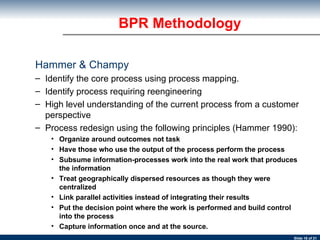
BPR Methodology Hammer & Champy Identify the core process using process mapping.  Identify process requiring reengineering  High level understanding of the current process from a customer perspective  Process redesign using the following principles (Hammer 1990):  Organize around outcomes not task  Have those who use the output of the process perform the process  Subsume information-processes work into the real work that produces the information  Treat geographically dispersed resources as though they were centralized  Link parallel activities instead of integrating their results  Put the decision point where the work is performed and build control into the process  Capture information once and at the source.
Barriers to BPR
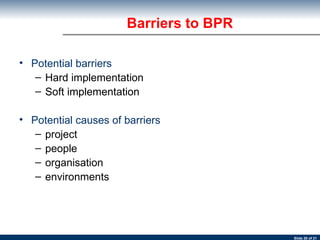
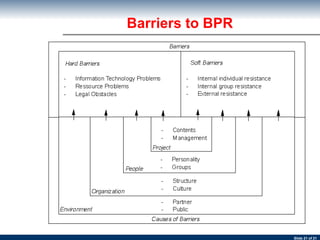
Potential barriers   Hard implementation Soft implementation Potential causes of barriers project people organisation  environments Barriers to BPR
Barriers to BPR

Bpr 03 Process Re Design

  • 1.
    Business Process Re-engineering03 – Process Re-Design & Process Improvement
  • 2.
  • 3.
    Process Re-design Twoapproaches to BPR: Systematic re-design identify / understand the existing process It is reviewing current processes and then making the relevant improvements Clean sheet approach Rethinking the way the product / service is delivered and design a new process from the start It is like demolishing an old building and rebuilding instead of patching it up.
  • 4.
    Defining processes Asimple way to begin defining processes: Identify a set of processes - executives work back from their own responsibilities (they know their work processes best) Rationale to establish main processes - identify major and minor processes - categorise processes as innovation, delivery and infrastructure - group related processes together Define process boundaries - what is the process owner’s control? - where is the process customer’s involvement?
  • 5.
    Guidelines for selectingprocesses Processes selected for re-engineering should be: Major contributors to core competencies (key processes for e.g. marketing & sales) Ready for change – at an acceptable level of risk (some processes may take a very long time for change) Able to produce early successes (early hits) Interrelated with other processes (across functions or departments)
  • 6.
    Definition of VisualisationTo enable radical changes and dramatic improvements to processes: Visualisation is: moving a process from an ‘As-is’ state to a ‘To-be’ state the creative process of developing achievable visions of the ‘To-be’ state Visualisation involves: understanding what others do well deciding attainable but tough improvement targets (“stretch goals”) thinking ahead of the competition to achieve the competitive “edge” a high level design to pragmatic solutions for the current business state
  • 7.
    Process Redesign Issues Some of the issues related to redesign include: Motivation – lack of motivation to enable redesign to processes Attitude – there may be resistance Knowledge – not all may have information on the processes Creativity – lack of creative ideas Innovation – not easy and challenging; thinking ‘out of the box’
  • 8.
    BPR Project Structure& Methodology
  • 9.
    BPR Project StructureStrategy Analysis Visualisation Deployment Continuous Improvement Insight Invent Implement Develop full understanding of current situation Invent new ways of achieving business objectives Transition from current situation to new ways Optimise performance Stages to a BPR Project
  • 10.
    Strategy Strategy Deliver:BPR plan Scope and plan Interviews & Surveys Develop Assessment Insight Stages to a BPR Project
  • 11.
    Analysis Analysis Deliver:Comprehensive understanding Quick hits Current Process Problems: Assumptions Metrics Tools and Techniques Baseline of current operations Insight Stages to a BPR Project
  • 12.
    Visualisation VisualisationDeliver: Implementable processes to meet objectives Business case Benchmarks; BestPractice Stretch goals Invent new processes Tools and Techniques Evaluate options Invent Stages to a BPR Project
  • 13.
    Deployment Deployment Deliver:Implementable processes to meet objectives Business case Process design Deployment plan Implement new IT Staff - training & organisation IT Strategy Implement Stages to a BPR Project
  • 14.
    Continuous improvement ImplementContinuous Improvement Performance measurement Fine tune new processes TQM Deliver: Optimised processes; Measured improvement Stages to a BPR Project
  • 15.
    BPR Methodology GenericMethodology 1. Create a Reengineering Framework to build a comprehensive foundation and framework for the entire process reengineering change effort that will create the required focus, direction, and motivation necessary to sustain itself. 2. Identify Customers and Determine Needs to develop a concrete and comprehensive understanding of the customers of the targeted process, and their needs and wants, that will result in a redesigned business process that clearly provides added value to the customer.
  • 16.
    3. Map theExisting Process to gain an understanding of the "what" and "why" of the targeted process that will reinforce the need for significant change and provide a basis for the redesign step. 4. Measure Process Performance to gain the needed performance understanding of the targeted process through the collection of appropriate and relevant data, and to translate the data into redesign goals BPR Methodology
  • 17.
    BPR Methodology Davenport& Short Identify processes for innovation Identifying change levers (enabling or transformation technologies) Developing process vision Understanding and improving existing process Designing and prototyping the new process
  • 18.
    BPR Methodology Hammer& Champy Identify the core process using process mapping. Identify process requiring reengineering High level understanding of the current process from a customer perspective Process redesign using the following principles (Hammer 1990): Organize around outcomes not task Have those who use the output of the process perform the process Subsume information-processes work into the real work that produces the information Treat geographically dispersed resources as though they were centralized Link parallel activities instead of integrating their results Put the decision point where the work is performed and build control into the process Capture information once and at the source.
  • 19.
  • 20.
    Potential barriers Hard implementation Soft implementation Potential causes of barriers project people organisation environments Barriers to BPR
  • 21.