Supply Chain Management Chapter 8
What are the basics of SCM? Supply Chain consists of all parties involved, directly or indirectly, in the procurement of a product or raw material SCM : involves the management of information flows between and among stages in a supply chain to maximize total supply chain effectiveness & profitability
Take Dell for Example! Dell assembles nearly 80,000 computers every 24 hours! Roughly 10 years ago (like many competitors)  Had warehouses with 20-25 days worth of inventory Today, Dell doesn’t have a single warehouse and carries only 2 hours worth of inventory in its factories and a maximum of just 72 hours across its entire operation How’d they do it?
Dell-like Supply Chain Plan Supply Chain starts with the customer: by cutting out retailers and selling directly to its customers, Dell is in a far better position to forecast real customer demand 2.  Replace Inventory with Information!: to operate with close to zero inventory, Dell communicates constantly with its suppliers.  It sends out status updates 3 times per day from its assembly plants; every week it updates its quarterly demand forecasts.  By making communication its highest priority, Dell ensures the lowest possible inventory 3.  If you cannot measure it, you cannot manage it: Dell knows what works because it  measures  everything from days in inventory to the time it takes to build a PC.  As Dell slashed those numbers it got more efficient 4.  Complexity slows you down: Dell cut the # of its core suppliers from several hundred to about 25.  It standardizes critical PC components, which streamlined its manufacturing. Dell got faster by making things simpler 5.  Create a watershed mind-set: Dell is not content with incremental improvement; it demands massive change.  Each year, it wants its Austin-based PC assembly plant—already very fast—to improve production by 30%.  “you don’t get big results if you don’t challenge people with big goals”
What has changed in terms of business focus? In the past, companies focused primarily on manufacturing and quality improvements within their own 4 walls. Now companies extend their effort to influence the entire SCM to include  CUSTOMERS and SUPPLIERS!
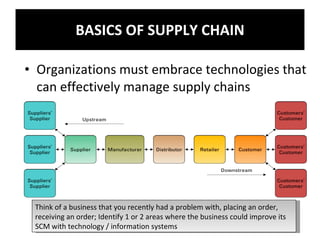
BASICS OF SUPPLY CHAIN The supply chain has three main links : Materials flow from suppliers and their “upstream” suppliers at all levels Transformation of materials into semi-finished and finished products through the organization’s own production process Distribution of products to customers and their “downstream” customers at all levels
BASICS OF SUPPLY CHAIN Organizations must embrace technologies that can effectively manage supply chains Think of a business that you recently had a problem with, placing an order, receiving an order; Identify 1 or 2 areas where the business could improve its SCM with technology / information systems
Information technology’s role in the Supply Chain At this point, the notion of virtually seamless information links within and between organizations is an essential element of integrated supply chains Despite this however, remember: Privacy and security of customer information and intellectual capital remain a major concern and should be built into the system
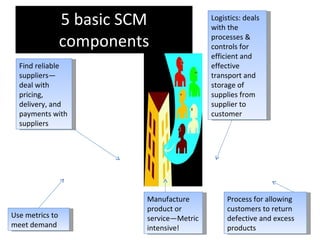
5 basic SCM components Use metrics to meet demand Find reliable suppliers—deal with pricing, delivery, and payments with suppliers Manufacture product or service—Metric intensive! Logistics: deals with the processes & controls for efficient and effective transport and storage of supplies from supplier to customer Process for allowing customers to return defective and excess products
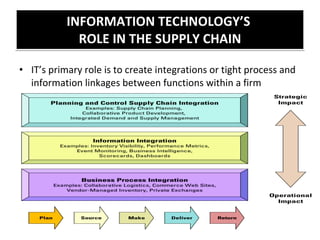
INFORMATION TECHNOLOGY’S  ROLE IN THE SUPPLY CHAIN IT’s primary role is to create integrations or tight process and information linkages between functions within a firm
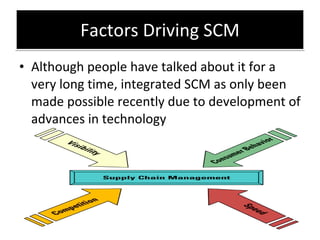
Factors Driving SCM Although people have talked about it for a very long time, integrated SCM as only been made possible recently due to development of advances in technology
Visibility Supply chain visibility  – the ability to view all areas up and down the supply chain
Consumer Behavior Companies can respond faster and more effectively to consumer demands through supply chain enhances  Demand planning software  – generates demand forecasts using statistical tools and forecasting techniques Consumers are demanding more today Why?
Competition Supply chain planning (SCP)   software – uses advanced mathematical algorithms to improve the flow and efficiency of the supply chain Supply chain execution (SCE) software –  automates the different steps and stages of the supply chain Having a efficient & effective SCM means having a competitive advantage over competitors
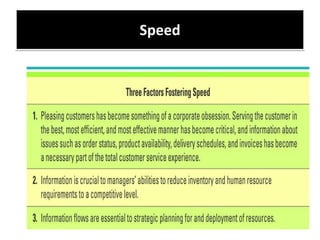
Speed
Benefits of SCM Many are obvious; Cost control/ savings Productivity improvements Inventory reductions / improvements Improved visibility into demand/supply Quality improvements Maintain/gain competitive advantage Perfect example:  NEC & Epson Deliver Global SCM Reform for Printer Supplies;
Drivers of SCM Facilities Inventory Transportation Information SCM like we have said provides metrics by which we can measure efficiency IT metrics and effectiveness IT metric These metrics are driven by the 4 drivers;
Facilities :  addresses the process or transformation of inventory into another products or stores inventory before it moves to the next facility Factors to consider are Location Capacity Operational design
Inventory : addresses the strategy employed to maintain low inventories but also maintain a rapid turnover time to meet demand! Management & Control software helps address this   Transportation: a major cost in the SCM strategy Software again is providing solutions for organizations through  Global inventory management systems  Transportation planning software &  Distribution management software
Information Driver An organization must decide what information is most valuable in efficiently reducing costs or improving effectiveness SCM strategies then consider; Information Sharing Push  vs . Pull information strategy In a push technology environment, organizations send information. In a pull technology environment, organizations receive or request information
Customer Relationship Management (CRM) Basics & Business Benefits of CRM
Most Valuable Customers Organizations can use the RFM formula to determine who is its MVC’s! Recency : how recently a customer purchased items Frequency : how frequently a customer purchases items Monetary value : how much a customer spends on each purchase
Customer Relationship Management CRM: involves managing all aspects of a customers relationship with an organization to increase customer loyalty, retention, and an organization’s profitability. CRM acknowledges industries that they are migrating from the traditional product-focused organization toward customer-driven organizations.  Why?
 
Brief History: the 80’s 1980 Business Processes  - In the case of larger, key clients it was a valuable tool for keeping the lines of communication open and tailoring service to the client’s needs. In the case of smaller clients, however, it tended to provide repetitive, survey-like information that cluttered databases and didn’t provide much insight.
1990 Resource Planning  - In the 1990’s companies began to improve on Customer Relationship Management by making it more of a two-way street.  Instead of simply gathering data for their own use, they began giving back to their customers not only in terms of the obvious goal of improved customer service, but in incentives, gifts and other perks for customer loyalty.  2000 Customer Relationship Management  - Life blood of most sales and service based business.
CRM-Supporting  technologies self-service 24x7 support AVR’s  (automated voice response phone systems) Password Resets Via Email
CRM Solutions Web Based Applets Intra/Extranet   Share Point    Office Online Business Contact Manager Shared Calendars Open Source Dynamics Oracle SQL Intuit (QuickBooks, Peachtree)
Customer Satisfaction Because businesses recognize that customers have more choices and often already come with a considerable amount of product knowledge Businesses need to do everything they can to acknowledge customer demand, preferences, demographic info, etc.. To ensure that customers are satisfied!
BUSINESS BENEFITS OF CRM CRM enables an organization to : Provide better customer service Make call centers more efficient Cross sell products more effectively Help sales staff close deals faster Simplify marketing and sales processes Discover new customers Increase customer revenues
Benefits Explained CRM is a business philosophy based on the premise that those organizations that understand the needs of the individual customers are best positioned to achieve sustainable competitive advantage in the future CRM in many cases is about sifting through information to reveal trends,  explain outcomes,  and predict results so that businesses can increase response rates& identify profitable customers
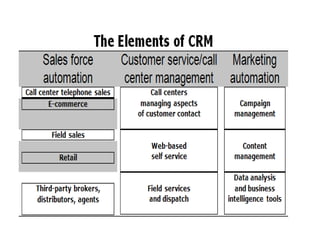
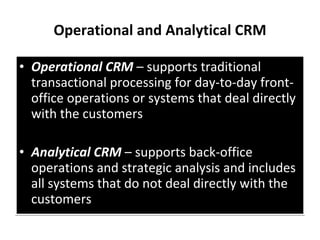
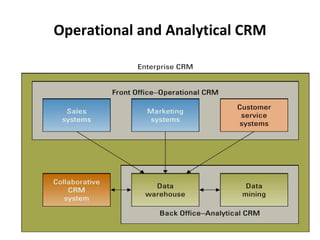
Operational and Analytical CRM Operational CRM  – supports traditional transactional processing for day-to-day front-office operations or systems that deal directly with the customers Analytical CRM  – supports back-office operations and strategic analysis and includes all systems that do not deal directly with the customers
Operational and Analytical CRM
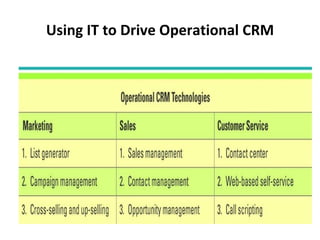
Using IT to Drive Operational CRM
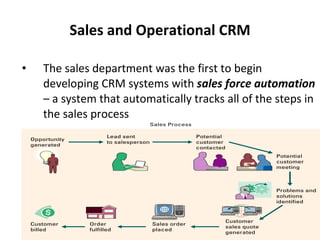
Sales and Operational CRM The sales department was the first to begin developing CRM systems with  sales force automation  – a system that automatically tracks all of the steps in the sales process
Sales and Operational CRM technologies Sales management CRM system  – automates each phase of the sales process, helping individual sales representatives coordinate and organize all of their accounts Contact management CRM system  – maintains customer contact information and identifies prospective customers for future sales  Opportunity management CRM system  – targets sales opportunities by finding new customers or companies for future sales
Sales and Operational CRM CRM Pointers for Gaining Prospective Customer Get their attention Value their time Overdeliver Contact frequently Generate a trustworthy mailing list Follow up
USING IT TO DRIVE  ANALYTICAL CRM Personalization  – when a Web site knows enough about a persons likes and dislikes that it can fashion offers that are more likely to appeal to that person Analytical CRM relies heavily on  data warehousing technologies  and  business intelligence  to glean insights into customer behavior These systems quickly aggregate, analyze, and disseminate customer information throughout an organization Analytical CRM has the ability to provide an organization with information about their customers that was previously impossible to locate, and the resulting payback can be tremendous.
CUSTOMER RELATIONSHIP MANAGEMENT’S EXPLOSIVE GROWTH CRM Business Drivers
CURRENT TRENDS: SRM, PRM, AND ERM Current trends include: Supplier relationship management (SRM)   – focuses on keeping suppliers satisfied by evaluating and categorizing suppliers for different projects, which optimizes supplier selection Partner relationship management (PRM)  – focuses on keeping vendors satisfied by managing alliance partner and reseller relationship that provide customers with the optimal sales channel Employee relationship management (ERM)  – provides employees with a subset of CRM applications available through a Web browser
The End of the line: ERP Enterprise Resource Planning & Collaboration Systems
ERP Integrates all departments and functions throughout an organization into a single IT system (or integrated set of IT systems so that employees can make decisions by viewing enterprise wide information on all business operations Really? What about access control & authentication?  Remember Information Security!!!
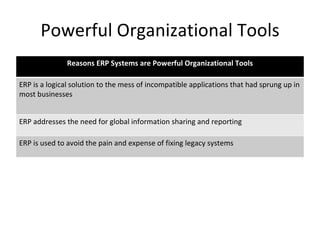
Powerful Organizational Tools Reasons ERP Systems are Powerful Organizational Tools ERP is a logical solution to the mess of incompatible applications that had sprung up in most businesses ERP addresses the need for global information sharing and reporting ERP is used to avoid the pain and expense of fixing legacy systems
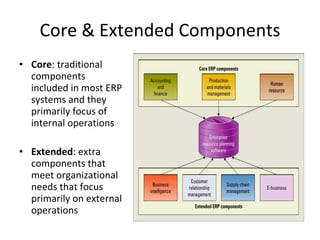
Core & Extended Components Core : traditional components included in most ERP systems and they primarily focus of internal operations Extended : extra components that meet organizational needs that focus primarily on external operations
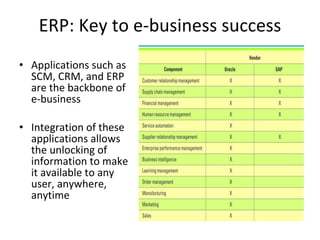
ERP: Key to e-business success Applications such as SCM, CRM, and ERP are the backbone of e-business Integration of these applications allows the unlocking of information to make it available to any user, anywhere, anytime
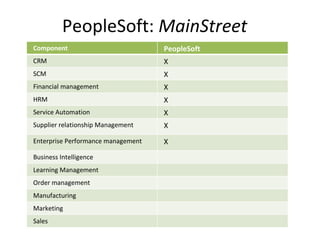
PeopleSoft:  MainStreet Component PeopleSoft CRM X SCM X Financial management X HRM X Service Automation X Supplier relationship Management X Enterprise Performance management X Business Intelligence Learning Management Order management Manufacturing Marketing Sales
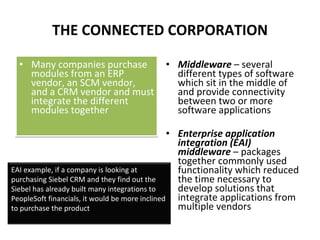
THE CONNECTED CORPORATION Many companies purchase modules from an ERP vendor, an SCM vendor, and a CRM vendor and must integrate the different modules together Middleware  – several different types of software which sit in the middle of and provide connectivity between two or more software applications  Enterprise application integration (EAI) middleware  – packages together commonly used functionality which reduced the time necessary to develop solutions that integrate applications from multiple vendors EAI example, if a company is looking at purchasing Siebel CRM and they find out the Siebel has already built many integrations to PeopleSoft financials, it would be more inclined to purchase the product
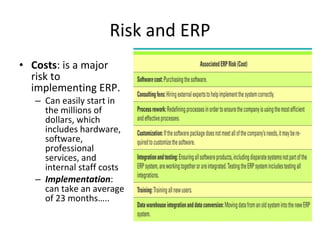
Risk and ERP Costs : is a major risk to implementing ERP.  Can easily start in the millions of dollars, which includes hardware, software, professional services, and internal staff costs Implementation : can take an average of 23 months…..
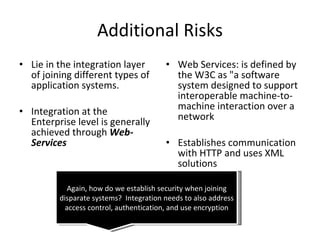
Additional Risks Lie in the integration layer of joining different types of application systems. Integration at the Enterprise level is generally achieved through  Web-Services Web Services: is defined by the W3C as "a software system designed to support interoperable machine-to-machine interaction over a network Establishes communication with HTTP and uses XML solutions Again, how do we establish security when joining disparate systems?  Integration needs to also address access control, authentication, and use encryption

Enterprise Systems: SCM, CRM, & ERP

  • 1.
  • 2.
    What are thebasics of SCM? Supply Chain consists of all parties involved, directly or indirectly, in the procurement of a product or raw material SCM : involves the management of information flows between and among stages in a supply chain to maximize total supply chain effectiveness & profitability
  • 3.
    Take Dell forExample! Dell assembles nearly 80,000 computers every 24 hours! Roughly 10 years ago (like many competitors) Had warehouses with 20-25 days worth of inventory Today, Dell doesn’t have a single warehouse and carries only 2 hours worth of inventory in its factories and a maximum of just 72 hours across its entire operation How’d they do it?
  • 4.
    Dell-like Supply ChainPlan Supply Chain starts with the customer: by cutting out retailers and selling directly to its customers, Dell is in a far better position to forecast real customer demand 2. Replace Inventory with Information!: to operate with close to zero inventory, Dell communicates constantly with its suppliers. It sends out status updates 3 times per day from its assembly plants; every week it updates its quarterly demand forecasts. By making communication its highest priority, Dell ensures the lowest possible inventory 3. If you cannot measure it, you cannot manage it: Dell knows what works because it measures everything from days in inventory to the time it takes to build a PC. As Dell slashed those numbers it got more efficient 4. Complexity slows you down: Dell cut the # of its core suppliers from several hundred to about 25. It standardizes critical PC components, which streamlined its manufacturing. Dell got faster by making things simpler 5. Create a watershed mind-set: Dell is not content with incremental improvement; it demands massive change. Each year, it wants its Austin-based PC assembly plant—already very fast—to improve production by 30%. “you don’t get big results if you don’t challenge people with big goals”
  • 5.
    What has changedin terms of business focus? In the past, companies focused primarily on manufacturing and quality improvements within their own 4 walls. Now companies extend their effort to influence the entire SCM to include CUSTOMERS and SUPPLIERS!
  • 6.
    BASICS OF SUPPLYCHAIN The supply chain has three main links : Materials flow from suppliers and their “upstream” suppliers at all levels Transformation of materials into semi-finished and finished products through the organization’s own production process Distribution of products to customers and their “downstream” customers at all levels
  • 7.
    BASICS OF SUPPLYCHAIN Organizations must embrace technologies that can effectively manage supply chains Think of a business that you recently had a problem with, placing an order, receiving an order; Identify 1 or 2 areas where the business could improve its SCM with technology / information systems
  • 8.
    Information technology’s rolein the Supply Chain At this point, the notion of virtually seamless information links within and between organizations is an essential element of integrated supply chains Despite this however, remember: Privacy and security of customer information and intellectual capital remain a major concern and should be built into the system
  • 9.
    5 basic SCMcomponents Use metrics to meet demand Find reliable suppliers—deal with pricing, delivery, and payments with suppliers Manufacture product or service—Metric intensive! Logistics: deals with the processes & controls for efficient and effective transport and storage of supplies from supplier to customer Process for allowing customers to return defective and excess products
  • 10.
    INFORMATION TECHNOLOGY’S ROLE IN THE SUPPLY CHAIN IT’s primary role is to create integrations or tight process and information linkages between functions within a firm
  • 11.
    Factors Driving SCMAlthough people have talked about it for a very long time, integrated SCM as only been made possible recently due to development of advances in technology
  • 12.
    Visibility Supply chainvisibility – the ability to view all areas up and down the supply chain
  • 13.
    Consumer Behavior Companiescan respond faster and more effectively to consumer demands through supply chain enhances Demand planning software – generates demand forecasts using statistical tools and forecasting techniques Consumers are demanding more today Why?
  • 14.
    Competition Supply chainplanning (SCP) software – uses advanced mathematical algorithms to improve the flow and efficiency of the supply chain Supply chain execution (SCE) software – automates the different steps and stages of the supply chain Having a efficient & effective SCM means having a competitive advantage over competitors
  • 15.
  • 16.
    Benefits of SCMMany are obvious; Cost control/ savings Productivity improvements Inventory reductions / improvements Improved visibility into demand/supply Quality improvements Maintain/gain competitive advantage Perfect example: NEC & Epson Deliver Global SCM Reform for Printer Supplies;
  • 17.
    Drivers of SCMFacilities Inventory Transportation Information SCM like we have said provides metrics by which we can measure efficiency IT metrics and effectiveness IT metric These metrics are driven by the 4 drivers;
  • 18.
    Facilities : addresses the process or transformation of inventory into another products or stores inventory before it moves to the next facility Factors to consider are Location Capacity Operational design
  • 19.
    Inventory : addressesthe strategy employed to maintain low inventories but also maintain a rapid turnover time to meet demand! Management & Control software helps address this Transportation: a major cost in the SCM strategy Software again is providing solutions for organizations through Global inventory management systems Transportation planning software & Distribution management software
  • 20.
    Information Driver Anorganization must decide what information is most valuable in efficiently reducing costs or improving effectiveness SCM strategies then consider; Information Sharing Push vs . Pull information strategy In a push technology environment, organizations send information. In a pull technology environment, organizations receive or request information
  • 21.
    Customer Relationship Management(CRM) Basics & Business Benefits of CRM
  • 22.
    Most Valuable CustomersOrganizations can use the RFM formula to determine who is its MVC’s! Recency : how recently a customer purchased items Frequency : how frequently a customer purchases items Monetary value : how much a customer spends on each purchase
  • 23.
    Customer Relationship ManagementCRM: involves managing all aspects of a customers relationship with an organization to increase customer loyalty, retention, and an organization’s profitability. CRM acknowledges industries that they are migrating from the traditional product-focused organization toward customer-driven organizations. Why?
  • 24.
  • 25.
    Brief History: the80’s 1980 Business Processes - In the case of larger, key clients it was a valuable tool for keeping the lines of communication open and tailoring service to the client’s needs. In the case of smaller clients, however, it tended to provide repetitive, survey-like information that cluttered databases and didn’t provide much insight.
  • 26.
    1990 Resource Planning - In the 1990’s companies began to improve on Customer Relationship Management by making it more of a two-way street. Instead of simply gathering data for their own use, they began giving back to their customers not only in terms of the obvious goal of improved customer service, but in incentives, gifts and other perks for customer loyalty. 2000 Customer Relationship Management - Life blood of most sales and service based business.
  • 27.
    CRM-Supporting technologiesself-service 24x7 support AVR’s (automated voice response phone systems) Password Resets Via Email
  • 28.
    CRM Solutions WebBased Applets Intra/Extranet Share Point Office Online Business Contact Manager Shared Calendars Open Source Dynamics Oracle SQL Intuit (QuickBooks, Peachtree)
  • 29.
    Customer Satisfaction Becausebusinesses recognize that customers have more choices and often already come with a considerable amount of product knowledge Businesses need to do everything they can to acknowledge customer demand, preferences, demographic info, etc.. To ensure that customers are satisfied!
  • 30.
    BUSINESS BENEFITS OFCRM CRM enables an organization to : Provide better customer service Make call centers more efficient Cross sell products more effectively Help sales staff close deals faster Simplify marketing and sales processes Discover new customers Increase customer revenues
  • 31.
    Benefits Explained CRMis a business philosophy based on the premise that those organizations that understand the needs of the individual customers are best positioned to achieve sustainable competitive advantage in the future CRM in many cases is about sifting through information to reveal trends, explain outcomes, and predict results so that businesses can increase response rates& identify profitable customers
  • 32.
    Operational and AnalyticalCRM Operational CRM – supports traditional transactional processing for day-to-day front-office operations or systems that deal directly with the customers Analytical CRM – supports back-office operations and strategic analysis and includes all systems that do not deal directly with the customers
  • 33.
  • 34.
    Using IT toDrive Operational CRM
  • 35.
    Sales and OperationalCRM The sales department was the first to begin developing CRM systems with sales force automation – a system that automatically tracks all of the steps in the sales process
  • 36.
    Sales and OperationalCRM technologies Sales management CRM system – automates each phase of the sales process, helping individual sales representatives coordinate and organize all of their accounts Contact management CRM system – maintains customer contact information and identifies prospective customers for future sales Opportunity management CRM system – targets sales opportunities by finding new customers or companies for future sales
  • 37.
    Sales and OperationalCRM CRM Pointers for Gaining Prospective Customer Get their attention Value their time Overdeliver Contact frequently Generate a trustworthy mailing list Follow up
  • 38.
    USING IT TODRIVE ANALYTICAL CRM Personalization – when a Web site knows enough about a persons likes and dislikes that it can fashion offers that are more likely to appeal to that person Analytical CRM relies heavily on data warehousing technologies and business intelligence to glean insights into customer behavior These systems quickly aggregate, analyze, and disseminate customer information throughout an organization Analytical CRM has the ability to provide an organization with information about their customers that was previously impossible to locate, and the resulting payback can be tremendous.
  • 39.
    CUSTOMER RELATIONSHIP MANAGEMENT’SEXPLOSIVE GROWTH CRM Business Drivers
  • 40.
    CURRENT TRENDS: SRM,PRM, AND ERM Current trends include: Supplier relationship management (SRM) – focuses on keeping suppliers satisfied by evaluating and categorizing suppliers for different projects, which optimizes supplier selection Partner relationship management (PRM) – focuses on keeping vendors satisfied by managing alliance partner and reseller relationship that provide customers with the optimal sales channel Employee relationship management (ERM) – provides employees with a subset of CRM applications available through a Web browser
  • 41.
    The End ofthe line: ERP Enterprise Resource Planning & Collaboration Systems
  • 42.
    ERP Integrates alldepartments and functions throughout an organization into a single IT system (or integrated set of IT systems so that employees can make decisions by viewing enterprise wide information on all business operations Really? What about access control & authentication? Remember Information Security!!!
  • 43.
    Powerful Organizational ToolsReasons ERP Systems are Powerful Organizational Tools ERP is a logical solution to the mess of incompatible applications that had sprung up in most businesses ERP addresses the need for global information sharing and reporting ERP is used to avoid the pain and expense of fixing legacy systems
  • 44.
    Core & ExtendedComponents Core : traditional components included in most ERP systems and they primarily focus of internal operations Extended : extra components that meet organizational needs that focus primarily on external operations
  • 45.
    ERP: Key toe-business success Applications such as SCM, CRM, and ERP are the backbone of e-business Integration of these applications allows the unlocking of information to make it available to any user, anywhere, anytime
  • 46.
    PeopleSoft: MainStreetComponent PeopleSoft CRM X SCM X Financial management X HRM X Service Automation X Supplier relationship Management X Enterprise Performance management X Business Intelligence Learning Management Order management Manufacturing Marketing Sales
  • 47.
    THE CONNECTED CORPORATIONMany companies purchase modules from an ERP vendor, an SCM vendor, and a CRM vendor and must integrate the different modules together Middleware – several different types of software which sit in the middle of and provide connectivity between two or more software applications Enterprise application integration (EAI) middleware – packages together commonly used functionality which reduced the time necessary to develop solutions that integrate applications from multiple vendors EAI example, if a company is looking at purchasing Siebel CRM and they find out the Siebel has already built many integrations to PeopleSoft financials, it would be more inclined to purchase the product
  • 48.
    Risk and ERPCosts : is a major risk to implementing ERP. Can easily start in the millions of dollars, which includes hardware, software, professional services, and internal staff costs Implementation : can take an average of 23 months…..
  • 49.
    Additional Risks Liein the integration layer of joining different types of application systems. Integration at the Enterprise level is generally achieved through Web-Services Web Services: is defined by the W3C as "a software system designed to support interoperable machine-to-machine interaction over a network Establishes communication with HTTP and uses XML solutions Again, how do we establish security when joining disparate systems? Integration needs to also address access control, authentication, and use encryption

Editor's Notes

  • #7 Collecting, analyzing, and distributing transactional information to all relevant parties, SCM systems help all the different entities in the supply chain work together more effectively SCM has significantly improved companies’ forecasting abilities over the last few years Businesses today have access to modeling and simulation tools, algorithms, and applications that can combine information from multiple sources to build forecasts for days, weeks, and months in advance
  • #8 CLASSROOM EXERCISE Supply Chaining Ask your students to try to choose an organization that is currently experiencing supply chain issues, perhaps an organization where the student has had recent issues, such as not receiving an order, receiving an incorrect order, or receiving someone else's order Be sure to have them list the names of the suppliers, manufacturers, distributors, retailers, and customers Ask the students to identify one or two areas where the organization can improve its supply chain Have each group present their supply chains to the class along with their recommendations for improvement
  • #11 Considerable evidence shows that this type of supply chain integration results in superior supply chain capabilities and profits. CLASSROOM EXERCISE Near Beer Supply Chain Game This is an excellent exercise for students who are just learning about the supply chain. http://www.forio.com/nearbeer.htm
  • #15 SCP and SCE both increase a company’s ability to compete SCP depends entirely on information for its accuracy SCE can be as simple as electronically routing orders from a manufacturer to a supplier
  • #16 Why is information speed critical in a supply chain? If the information arrives three dates late, chances are high that managers have already made decisions based on current information that might have been inaccurate Information timeliness is critical IT is an enabler of information timeliness CLASSROOM EXERCISE Designing a Digital Dashboard for an SCM System Digital dashboards offer an effective and efficient way to view enterprisewide information at near real-time. According to Nucleus Research, there is a direct correlation between use of digital dashboards and a company’s return on investment (ROI), hence all executives should be using or pushing the development of digital dashboards to monitor and analyze organizational operations. Break your students into groups and ask them to develop a digital dashboard for the CEO of a transportation company. Be sure your students have addressed all of the following in their digital dashboard: Inventory Materials Demand/Supply Sales Supplier’s supplier Supplier Manufacturer Distributor Retailer Customer Customer’s Customer
  • #31 As the business world increasingly shifts from product-focus to customer-focus, most organizations recognize that treating existing customers well is the best source of profitable and sustainable revenue growth Ask your students why, in the age of e-business, an organization is challenged more than ever before to truly satisfy its customers Business 2.0 ranked "You - the customer" as one of the 50 people who matter now for 2006.  http://money.cnn.com/magazines/business2/peoplewhomatter/ These Web sites show the power people have in the consumer market today http://www.ihatedell.net/ http://www.donotbuydodge.ca/