Introduction
to Business
Lecture-1
1
Topics
 CONCEPT OF BUSINESS
 THE DIFFERENCE BETWEEN BUSINESS AND NON BUSINESS
ACTIVITIES
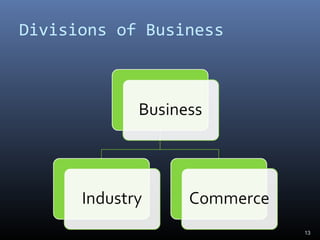
 DIVISIONS OF BUSINESS
COMMERCE AND INDUSTRY
• OBJECTIVES OF A MODERN BUSINESS
• PROBLEMS BEFORE ESTABLISHING A NEW BUSINESS
• BUSINESS ORGANIZATION AND ITS SCOPE
• QUALITIES OF A SUCCESSFUL BUSINESSMEN
2
First Definition of Business
All the commercial and industrial
activities that provide goods and
services to the people and with the
aim to earn profit.
for example: a manufacturer who converts
raw material into finished goods ( cotton to
cloth, and wood into furniture.
3
 Commercial Occupations
1. Buying and selling
2. The exchange of commodities
3. And distribution of goods
4
Second Definition
Business is the sum of total activities which are connected with
the production or purchase and sale of goods and services with
the object to earn profit.
The persons who are engaged in business are named as
businessmen or entrepreneurs. An organization formed for
carrying on business activities is called business organization.
5
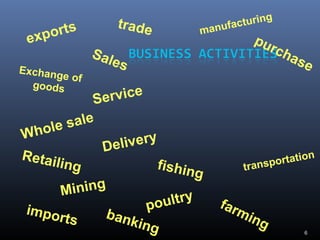
exports
Sales
manufacturing
Exchange of
goods
fishing
Mining
Retailing
poultry
trade
banking
Whole sale
transportation
imports
Delivery
Service
farming
purchase
6
The difference between Business
Activities and Non Business
Activities
Business Activities: The business combines human, material,
technological and financial resources carried on for profit. For example
buying and selling
Non Business Activities: Those Activities which are not for the sake
of profit, but to provide social services to the society. For example setting
up free hospitals, free educational institutions etc.
1. Social Service Activities
2. Personal consumption activities
3. Religious and other activities
4. Illegal activities
7
Objectives of Business
 Objective of a business means the purpose for which business is established.
It is generally believed that the main objective of business is to make profit
and avoid loss, but it is not the sole objective of any business.
1. Economic Objectives
2. Social Objectives
3. Human Objectives
4. National Objectives
8
1. Economic Objectives
Economic objectives are those
objectives, where a business earn
profit, create customers, improve
technologies and use resources in a
best possible way.
9
2. Social Objectives
 Social objectives are those which are for the
betterment of the society
 The main social objectives are
1. Supply of standard quality of goods
2. Avoidance(the act of keeping away something) of anti-social practices (smuggling, overcharging) etc.
3. More employment & Equal employment Opportunities
4. Cooperation with the government
5. Welfare of employees : somebody's state or condition with respect to whether he or she is healthy,
safe, happy, or prospering
10
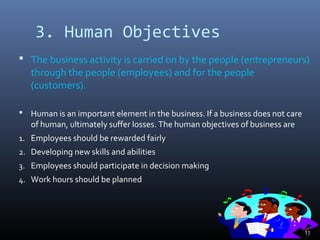
3. Human Objectives
 The business activity is carried on by the people (entrepreneurs)
through the people (employees) and for the people
(customers).
 Human is an important element in the business. If a business does not care
of human, ultimately suffer losses. The human objectives of business are
1. Employees should be rewarded fairly
2. Developing new skills and abilities
3. Employees should participate in decision making
4. Work hours should be planned
11
4. National Objectives
 Every business whether operating on small scale or
large must have an obligation towards nation. It
should help in promoting social justice, quality goods
for exports, finding out better and cheaper
substitutes for imports, producing goods according to
national priorities.
12
Divisions of Business
13
Meaning of Industry
 The term “industry” refers that part of business
activity which is concerned with extraction,
production, or fabrication of products.
14
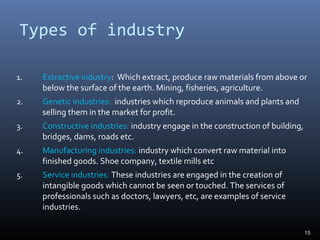
Types of industry
1. Extractive industry: Which extract, produce raw materials from above or
below the surface of the earth. Mining, fisheries, agriculture.
2. Genetic industries: industries which reproduce animals and plants and
selling them in the market for profit.
3. Constructive industries: industry engage in the construction of building,
bridges, dams, roads etc.
4. Manufacturing industries: industry which convert raw material into
finished goods. Shoe company, textile mills etc
5. Service industries: These industries are engaged in the creation of
intangible goods which cannot be seen or touched. The services of
professionals such as doctors, lawyers, etc, are examples of service
industries.
15
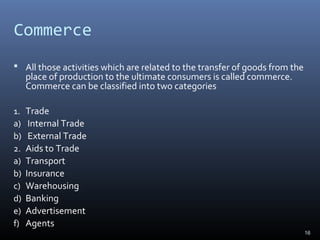
Commerce
 All those activities which are related to the transfer of goods from the
place of production to the ultimate consumers is called commerce.
Commerce can be classified into two categories
1. Trade
a) Internal Trade
b) External Trade
2. Aids to Trade
a) Transport
b) Insurance
c) Warehousing
d) Banking
e) Advertisement
f) Agents
16
Trade
 Trade: Trade means buying and selling of
goods or it is the exchange of goods and
services among buyers and sellers in which
both parties ( sellers and buyers) are
benefited.
17
Trade
 Trade involves the transfer of
the ownership of goods or services from
one person or entity to another in
exchange for other goods or services or for
money. Possible synonyms of "trade"
include "commerce" and "financial
transaction". A network that allows trade
is called a market.
18
Aids to Trade
1. Transport
The different means of
transport e.g., railways, ships,
airlines etc. help in carrying
goods from the places of
production to centers of
consumption.
19
2. Insurance
Financial protection against loss or harm: An
arrangement by which a company gives
customers financial protection against loss or
harm such as theft or illness in return for payment
premium.
The risk of damage of goods due to fire, flood,
earthquake
20
3. Warehousing
 Warehousing is a kind of storage.
Goods are stored in safe places and
are released as and when demanded
in the market. Warehousing helps
overcoming the barrier of time.
21
4. Banking
 Banks help traders by providing loans
whenever they need. They also assist
the buyers and sellers of goods in
receiving and making payments, both
at national and international level.
22
5. Advertisement
 Selling of goods is the most important
and difficult problem for the
manufacturer. Advertising helps in
increasing the sale of goods.
 A public announcement in a newspaper or on the radio,
television, or Internet advertising something such as a product
for sale or an event.
23
6. Middlemen
 There is a long chain of middlemen
(wholesalers, retailers, agents) who
act as agents between the producers
and the consumers. These people
bring together producer and
consumer.
24
Important points before starting a new
business
 Before the industrial revolution,
the goods were generally
produced for local markets. It was
easy to establish a new business.
Now the goods are produced by
machines, the rate of production
has gone up.The main factors or
problems which are to be
examined before establishing a
new business are as follows.
25
1. Selection of business
 The most important decision before
engaging one-self in any business is
the selection of business. Care should
be taken while selecting a business.
Because it is very difficult to change
that business again.
26
2. Demand for the product
A business should not be taken up on the basis of
current demand. Future trend (direction) in
demand should be carefully examined. If the
demand for the product is irregular, seasonal,
and the margin of profit earned by existing firms
is very low, it is no use in starting such a
business.
27
3. Size of business unit
 Determination of the size of business is an
important factor to be considered before
establishing a business.
28
4. Provision of Capital
Capital is the life blood of
business. Before starting a
business, the capital needs of a
business is to be considered and
analyzed.
29
5. Location
 The selection of a suitable place for the
establishment of a business is very important.
30
6. Selection of physical
facilities
 The selection of physical facilities
depends upon the nature of a new
business. In case of manufacturing
business, land, building, machinery,
store, etc are purchased or on rent
basis will be carefully undertaken.
31
7. Plan Layout
 Business depends upon plan layout.
Plan lay out is the setting up of
machines and equipments of the
factory in manufacturing business.
(Five M’s Money, Machines, Material,
Methods, Men) should be properly
utilized.
32
8. Selection of staff
A new business needs enough staff both skilled and
unskilled for the operation of a business. Here care
should be taken that right persons are selected for
the right job.
33
9. Office equipments
 Tables, chairs, computers, air conditioners,
machines etc are important for a business. These
equipments improve the working of the staff.
34
10. Fulfillment of Legal
requirements
 An entrepreneur before starting a
business has to fulfill the conditions
and rules imposed by the state, if any.
The non fulfillment of legal
requirements may send him to jail.
35

Introduction to business

  • 1.
  • 2.
    Topics  CONCEPT OFBUSINESS  THE DIFFERENCE BETWEEN BUSINESS AND NON BUSINESS ACTIVITIES  DIVISIONS OF BUSINESS COMMERCE AND INDUSTRY • OBJECTIVES OF A MODERN BUSINESS • PROBLEMS BEFORE ESTABLISHING A NEW BUSINESS • BUSINESS ORGANIZATION AND ITS SCOPE • QUALITIES OF A SUCCESSFUL BUSINESSMEN 2
  • 3.
    First Definition ofBusiness All the commercial and industrial activities that provide goods and services to the people and with the aim to earn profit. for example: a manufacturer who converts raw material into finished goods ( cotton to cloth, and wood into furniture. 3
  • 4.
     Commercial Occupations 1.Buying and selling 2. The exchange of commodities 3. And distribution of goods 4
  • 5.
    Second Definition Business isthe sum of total activities which are connected with the production or purchase and sale of goods and services with the object to earn profit. The persons who are engaged in business are named as businessmen or entrepreneurs. An organization formed for carrying on business activities is called business organization. 5
  • 6.
  • 7.
    The difference betweenBusiness Activities and Non Business Activities Business Activities: The business combines human, material, technological and financial resources carried on for profit. For example buying and selling Non Business Activities: Those Activities which are not for the sake of profit, but to provide social services to the society. For example setting up free hospitals, free educational institutions etc. 1. Social Service Activities 2. Personal consumption activities 3. Religious and other activities 4. Illegal activities 7
  • 8.
    Objectives of Business Objective of a business means the purpose for which business is established. It is generally believed that the main objective of business is to make profit and avoid loss, but it is not the sole objective of any business. 1. Economic Objectives 2. Social Objectives 3. Human Objectives 4. National Objectives 8
  • 9.
    1. Economic Objectives Economicobjectives are those objectives, where a business earn profit, create customers, improve technologies and use resources in a best possible way. 9
  • 10.
    2. Social Objectives Social objectives are those which are for the betterment of the society  The main social objectives are 1. Supply of standard quality of goods 2. Avoidance(the act of keeping away something) of anti-social practices (smuggling, overcharging) etc. 3. More employment & Equal employment Opportunities 4. Cooperation with the government 5. Welfare of employees : somebody's state or condition with respect to whether he or she is healthy, safe, happy, or prospering 10
  • 11.
    3. Human Objectives The business activity is carried on by the people (entrepreneurs) through the people (employees) and for the people (customers).  Human is an important element in the business. If a business does not care of human, ultimately suffer losses. The human objectives of business are 1. Employees should be rewarded fairly 2. Developing new skills and abilities 3. Employees should participate in decision making 4. Work hours should be planned 11
  • 12.
    4. National Objectives Every business whether operating on small scale or large must have an obligation towards nation. It should help in promoting social justice, quality goods for exports, finding out better and cheaper substitutes for imports, producing goods according to national priorities. 12
  • 13.
  • 14.
    Meaning of Industry The term “industry” refers that part of business activity which is concerned with extraction, production, or fabrication of products. 14
  • 15.
    Types of industry 1.Extractive industry: Which extract, produce raw materials from above or below the surface of the earth. Mining, fisheries, agriculture. 2. Genetic industries: industries which reproduce animals and plants and selling them in the market for profit. 3. Constructive industries: industry engage in the construction of building, bridges, dams, roads etc. 4. Manufacturing industries: industry which convert raw material into finished goods. Shoe company, textile mills etc 5. Service industries: These industries are engaged in the creation of intangible goods which cannot be seen or touched. The services of professionals such as doctors, lawyers, etc, are examples of service industries. 15
  • 16.
    Commerce  All thoseactivities which are related to the transfer of goods from the place of production to the ultimate consumers is called commerce. Commerce can be classified into two categories 1. Trade a) Internal Trade b) External Trade 2. Aids to Trade a) Transport b) Insurance c) Warehousing d) Banking e) Advertisement f) Agents 16
  • 17.
    Trade  Trade: Trademeans buying and selling of goods or it is the exchange of goods and services among buyers and sellers in which both parties ( sellers and buyers) are benefited. 17
  • 18.
    Trade  Trade involvesthe transfer of the ownership of goods or services from one person or entity to another in exchange for other goods or services or for money. Possible synonyms of "trade" include "commerce" and "financial transaction". A network that allows trade is called a market. 18
  • 19.
    Aids to Trade 1.Transport The different means of transport e.g., railways, ships, airlines etc. help in carrying goods from the places of production to centers of consumption. 19
  • 20.
    2. Insurance Financial protectionagainst loss or harm: An arrangement by which a company gives customers financial protection against loss or harm such as theft or illness in return for payment premium. The risk of damage of goods due to fire, flood, earthquake 20
  • 21.
    3. Warehousing  Warehousingis a kind of storage. Goods are stored in safe places and are released as and when demanded in the market. Warehousing helps overcoming the barrier of time. 21
  • 22.
    4. Banking  Bankshelp traders by providing loans whenever they need. They also assist the buyers and sellers of goods in receiving and making payments, both at national and international level. 22
  • 23.
    5. Advertisement  Sellingof goods is the most important and difficult problem for the manufacturer. Advertising helps in increasing the sale of goods.  A public announcement in a newspaper or on the radio, television, or Internet advertising something such as a product for sale or an event. 23
  • 24.
    6. Middlemen  Thereis a long chain of middlemen (wholesalers, retailers, agents) who act as agents between the producers and the consumers. These people bring together producer and consumer. 24
  • 25.
    Important points beforestarting a new business  Before the industrial revolution, the goods were generally produced for local markets. It was easy to establish a new business. Now the goods are produced by machines, the rate of production has gone up.The main factors or problems which are to be examined before establishing a new business are as follows. 25
  • 26.
    1. Selection ofbusiness  The most important decision before engaging one-self in any business is the selection of business. Care should be taken while selecting a business. Because it is very difficult to change that business again. 26
  • 27.
    2. Demand forthe product A business should not be taken up on the basis of current demand. Future trend (direction) in demand should be carefully examined. If the demand for the product is irregular, seasonal, and the margin of profit earned by existing firms is very low, it is no use in starting such a business. 27
  • 28.
    3. Size ofbusiness unit  Determination of the size of business is an important factor to be considered before establishing a business. 28
  • 29.
    4. Provision ofCapital Capital is the life blood of business. Before starting a business, the capital needs of a business is to be considered and analyzed. 29
  • 30.
    5. Location  Theselection of a suitable place for the establishment of a business is very important. 30
  • 31.
    6. Selection ofphysical facilities  The selection of physical facilities depends upon the nature of a new business. In case of manufacturing business, land, building, machinery, store, etc are purchased or on rent basis will be carefully undertaken. 31
  • 32.
    7. Plan Layout Business depends upon plan layout. Plan lay out is the setting up of machines and equipments of the factory in manufacturing business. (Five M’s Money, Machines, Material, Methods, Men) should be properly utilized. 32
  • 33.
    8. Selection ofstaff A new business needs enough staff both skilled and unskilled for the operation of a business. Here care should be taken that right persons are selected for the right job. 33
  • 34.
    9. Office equipments Tables, chairs, computers, air conditioners, machines etc are important for a business. These equipments improve the working of the staff. 34
  • 35.
    10. Fulfillment ofLegal requirements  An entrepreneur before starting a business has to fulfill the conditions and rules imposed by the state, if any. The non fulfillment of legal requirements may send him to jail. 35