Business Process Re-engineering  & Government Process Re-engineering J Satyanarayana As part of the Capacity Building Workshop under the Joint Economic Research Program (JERP)
Agenda What is BPR? Why BPR? Principles & Methodologies of BPR Issues & Challenges in BPR Critical Success/ Failure Factors in BPR An example of BPR Conclusion
What is BPR?
What is BPR? Business Process Re-engineering or BPR is  the  analysis  and  redesign  of  workflow  and  processes   within  and  between   Organizations - Michael Hammer & James Champy, 1993
A Definition of BPR  BPR is the  Fundamental  rethinking and  Radical  redesign of  Business Processes  to achieve  Dramatic  improvements in  critical measures of  performance   .. such as Cost, Quality, Service and Speed.
What is a Business Process (BP)? BP is a collection of activities that takes one or more kinds of input and creates an output that is of value to customers Examples of BP, in the context of e-Government, are: Issuance of a Driving License or Passport Registration of a Company Audit of a Tax Return Release of a Grant
Reengineering is not ……. Automation of existing ineffective processes Sophisticated computerization of obsolete processes Playing with organization structures Downsizing – doing less with less
Effectiveness Vs Automation Automation  : use technology to automate the “AS IS” process to make it happen faster -  often wrongly perceived as eGovernment. Effectiveness : To improve service and  satisfy customer needs, while lowering costs.
Automation & BPR Automation is using technological tools to perform OLD processes, in a NEW way. Like putting OLD Wine in a NEW bottle. BPR is about  Innovation Making NEW Wine and putting it in a NEW bottle
BPR & Quality Initiatives Quality Initiatives attempt continuous improvement Six Sigma TQM (Total Quality Management) BPR attempts a radical redesign or transformation Big Bang approach Quantum Leap
Why BPR?
Problem Statement The Problem is that  we are governing in the 21 st  century  with Processes and Organizations  designed in the 19 th  Century to work well in the 20 th  Century!  We need entirely different  PROCESSES & ORGANIZATIONS  for Governance in the 21 st  Century
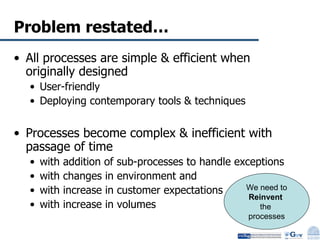
Problem restated… All processes are simple & efficient when originally designed User-friendly Deploying contemporary tools & techniques Processes become complex & inefficient with passage of time with addition of sub-processes to handle exceptions with changes in environment and with increase in customer expectations  with increase in volumes We need to Reinvent   the  processes
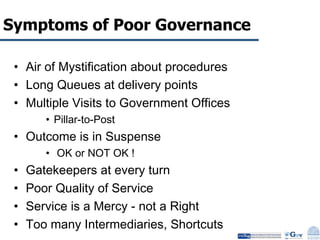
Symptoms of Poor Governance Air of Mystification about procedures Long Queues at delivery points Multiple Visits to Government Offices Pillar-to-Post Outcome is in Suspense  OK or NOT OK ! Gatekeepers at every turn Poor Quality of Service Service is a Mercy - not a Right Too many Intermediaries, Shortcuts
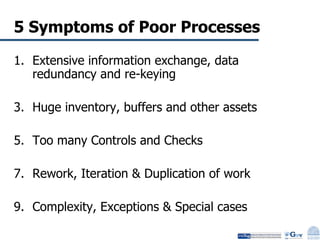
5 Symptoms of Poor Processes Extensive information exchange, data redundancy and re-keying Huge inventory, buffers and other assets Too many Controls and Checks Rework, Iteration & Duplication of work Complexity, Exceptions & Special cases
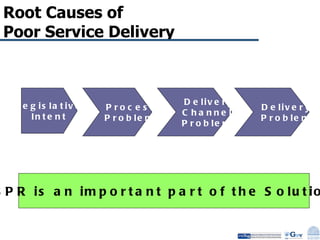
Root Causes of  Poor Service Delivery Legislative Intent Process Problems Delivery Channel Problems Delivery Problems BPR is an important part of the Solution
3 Goals of BPR Customer Friendliness Meeting customer requirements closely Providing convenience Effectiveness Outcome-based approach Gaining loyalty of customers Image and branding  Efficiency Cost Time Effort
12 Attributes of  Customer-friendly Services Simple  Need-based Certainty Speed Convenience Place Time Channel Equitable Responsive Customer-centric Quality of Service Cost-effective Accessible Assisted
Principles &  Methodologies of BPR
7 Basic Principles of BPR Organize around outcomes, not tasks. Identify all the processes in an organization and prioritize them in order of redesign urgency. Integrate information processing work into the real work that produces the information. Treat geographically dispersed resources as though they were centralized. Link parallel activities in the workflow instead of just integrating their results. Put the decision point where the work is performed, and build control into the process. Capture information once and at the source.
The essence of BPR is  Transformation
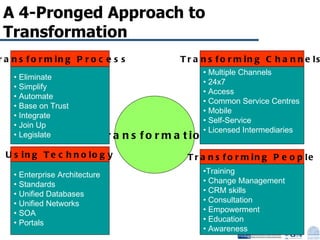
A 4-Pronged Approach to Transformation Transformation Eliminate  Simplify Automate Base on Trust Integrate Join Up Legislate Transforming Process Multiple Channels 24x7 Access Common Service Centres Mobile  Self-Service Licensed Intermediaries Transforming Channels Enterprise Architecture Standards Unified Databases Unified Networks SOA Portals Using Technology Training Change Management  CRM skills Consultation Empowerment Education Awareness  Transforming People
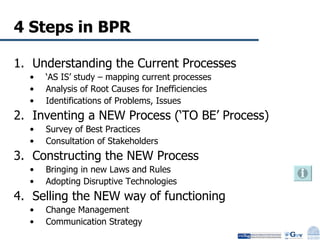
4 Steps in BPR Understanding the Current Processes ‘ AS IS’ study – mapping current processes Analysis of Root Causes for Inefficiencies Identifications of Problems, Issues Inventing a NEW Process (‘TO BE’ Process) Survey of Best Practices  Consultation of Stakeholders Constructing the NEW Process Bringing in new Laws and Rules Adopting Disruptive Technologies Selling the NEW way of functioning Change Management Communication Strategy
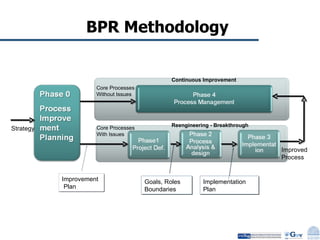
BPR Methodology Improved  Process Core Processes  Without Issues Core   Processes With   Issues Improvement Plan Goals, Roles Boundaries Implementation Plan Strategy Continuous Improvement Reengineering - Breakthrough
Challenges, Critical Success Factors & Critical Failure Factors … in BPR
Challenges in a BPR Exercise Identifying Customer Needs & Performance Problems in the current Processes Reassessing the Strategic Goals of the Organization Defining the opportunities for Re-engineering Managing the BPR initiative Controlling Risks  Maximizing the Benefits Managing Organizational Changes Implementing the re-engineered Processes
9 Changes occasioned by BPR Work Units change from functional departments to process teams Jobs change from simple tasks to multi-dimensional work People’s roles change from controlled to empowered Job preparation changes from training to education Measures of Performance & compensation change from activity to results Criteria for career advancement change from performance to ability Values change from protective to productive Organizational Structures change from hierarchical to flat Executives change from scorekeepers to leaders
Critical Success Factors in BPR Clear Vision for Transformation Top management commitment Identification of Core Processes for BPR Ambitious BPR team Knowledge of Reengineering techniques Engaging external consultants Tolerance of  “genuine failures" Change Management
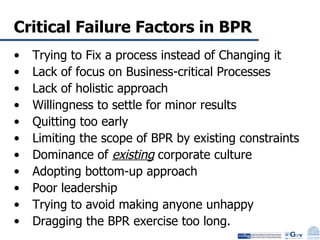
Critical Failure Factors in BPR Trying to Fix a process instead of Changing it Lack of focus on Business-critical Processes Lack of holistic approach Willingness to settle for minor results Quitting too early Limiting the scope of BPR by existing constraints Dominance of  existing  corporate culture Adopting bottom-up approach Poor leadership Trying to avoid making anyone unhappy Dragging the BPR exercise too long.
An Example of BPR
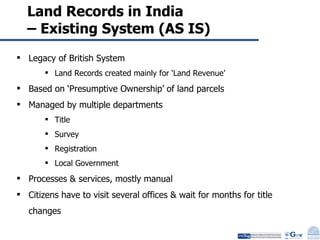
Land Records in India  – Existing System (AS IS)  Legacy of British System Land Records created mainly for ‘Land Revenue’  Based on ‘Presumptive Ownership’ of land parcels Managed by multiple departments Title Survey Registration Local Government Processes & services, mostly manual Citizens have to visit several offices & wait for months for title changes
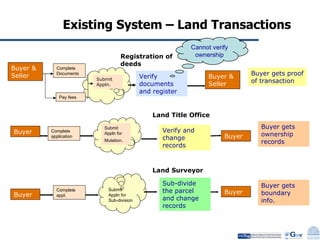
Existing System – Land Transactions Buyer & Seller Complete Documents Pay fees Submit  Appln. Registration of deeds Verify and change records Buyer & Seller Buyer Complete application Submit  Appln for Mutation . Verify documents and register Buyer Submit  Appln for  Sub-division Complete appl. Land Title Office Sub-divide the parcel and change records Land Surveyor Buyer Buyer Buyer gets proof of transaction Buyer gets ownership records  Buyer gets boundary info. Cannot verify ownership
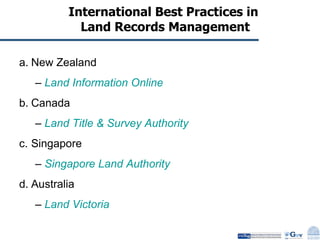
International Best Practices in  Land Records Management New Zealand  –  Land Information Online Canada  –  Land Title & Survey Authority Singapore  –  Singapore Land Authority Australia  –  Land Victoria
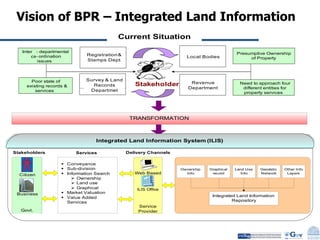
Vision of BPR – Integrated Land Information
Conclusion BPR is about Radical Redesign of business processes BPR brings Efficiency, Effectiveness & Customer-friendliness BPR needs adoption of a structured methodology Top management commitment & Change Management are critical to success
Thank You [email_address]
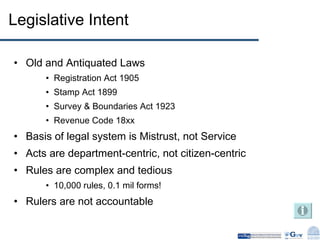
Legislative Intent Old and Antiquated Laws Registration Act 1905 Stamp Act 1899 Survey & Boundaries Act 1923 Revenue Code 18xx Basis of legal system is Mistrust, not Service Acts are department-centric, not citizen-centric Rules are complex and tedious 10,000 rules, 0.1 mil forms! Rulers are not accountable
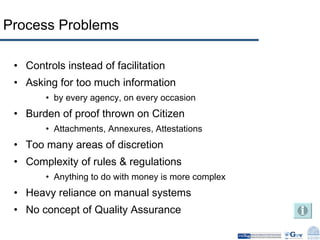
Process Problems Controls instead of facilitation Asking for too much information by every agency, on every occasion Burden of proof thrown on Citizen Attachments, Annexures, Attestations  Too many areas of discretion Complexity of rules & regulations Anything to do with money is more complex Heavy reliance on manual systems No concept of Quality Assurance
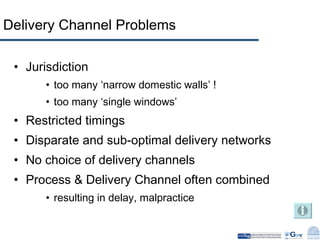
Delivery Channel Problems Jurisdiction too many ‘narrow domestic walls’ ! too many ‘single windows’ Restricted timings Disparate and sub-optimal delivery networks No choice of delivery channels Process & Delivery Channel often combined resulting in delay, malpractice
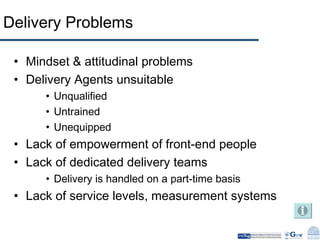
Delivery Problems Mindset & attitudinal problems Delivery Agents unsuitable Unqualified Untrained Unequipped  Lack of empowerment of front-end people Lack of dedicated delivery teams Delivery is handled on a part-time basis Lack of service levels, measurement systems
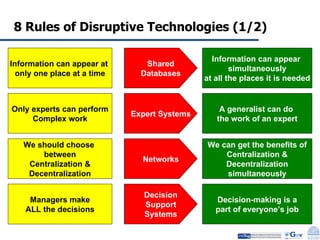
8 Rules of Disruptive Technologies (1/2) Information can appear at  only one place at a time Shared Databases Information can appear  simultaneously at all the places it is needed Only experts can perform Complex work Expert Systems A generalist can do  the work of an expert We should choose  between Centralization & Decentralization Networks We can get the benefits of Centralization & Decentralization simultaneously Managers make ALL the decisions Decision Support Systems Decision-making is a part of everyone’s job
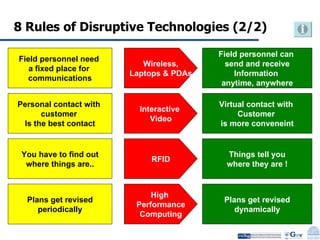
8 Rules of Disruptive Technologies (2/2) Field personnel need  a fixed place for  communications Wireless, Laptops & PDAs Field personnel can  send and receive Information  anytime, anywhere Personal contact with  customer  Is the best contact Interactive  Video Virtual contact with  Customer  is more conveneint You have to find out where things are.. RFID Things tell you where they are ! Plans get revised periodically High  Performance Computing Plans get revised dynamically

Business Process Reengineering

  • 1.
    Business Process Re-engineering & Government Process Re-engineering J Satyanarayana As part of the Capacity Building Workshop under the Joint Economic Research Program (JERP)
  • 2.
    Agenda What isBPR? Why BPR? Principles & Methodologies of BPR Issues & Challenges in BPR Critical Success/ Failure Factors in BPR An example of BPR Conclusion
  • 3.
  • 4.
    What is BPR?Business Process Re-engineering or BPR is the analysis and redesign of workflow and processes within and between Organizations - Michael Hammer & James Champy, 1993
  • 5.
    A Definition ofBPR BPR is the Fundamental rethinking and Radical redesign of Business Processes to achieve Dramatic improvements in critical measures of performance .. such as Cost, Quality, Service and Speed.
  • 6.
    What is aBusiness Process (BP)? BP is a collection of activities that takes one or more kinds of input and creates an output that is of value to customers Examples of BP, in the context of e-Government, are: Issuance of a Driving License or Passport Registration of a Company Audit of a Tax Return Release of a Grant
  • 7.
    Reengineering is not……. Automation of existing ineffective processes Sophisticated computerization of obsolete processes Playing with organization structures Downsizing – doing less with less
  • 8.
    Effectiveness Vs AutomationAutomation : use technology to automate the “AS IS” process to make it happen faster - often wrongly perceived as eGovernment. Effectiveness : To improve service and satisfy customer needs, while lowering costs.
  • 9.
    Automation & BPRAutomation is using technological tools to perform OLD processes, in a NEW way. Like putting OLD Wine in a NEW bottle. BPR is about Innovation Making NEW Wine and putting it in a NEW bottle
  • 10.
    BPR & QualityInitiatives Quality Initiatives attempt continuous improvement Six Sigma TQM (Total Quality Management) BPR attempts a radical redesign or transformation Big Bang approach Quantum Leap
  • 11.
  • 12.
    Problem Statement TheProblem is that we are governing in the 21 st century with Processes and Organizations designed in the 19 th Century to work well in the 20 th Century! We need entirely different PROCESSES & ORGANIZATIONS for Governance in the 21 st Century
  • 13.
    Problem restated… Allprocesses are simple & efficient when originally designed User-friendly Deploying contemporary tools & techniques Processes become complex & inefficient with passage of time with addition of sub-processes to handle exceptions with changes in environment and with increase in customer expectations with increase in volumes We need to Reinvent the processes
  • 14.
    Symptoms of PoorGovernance Air of Mystification about procedures Long Queues at delivery points Multiple Visits to Government Offices Pillar-to-Post Outcome is in Suspense OK or NOT OK ! Gatekeepers at every turn Poor Quality of Service Service is a Mercy - not a Right Too many Intermediaries, Shortcuts
  • 15.
    5 Symptoms ofPoor Processes Extensive information exchange, data redundancy and re-keying Huge inventory, buffers and other assets Too many Controls and Checks Rework, Iteration & Duplication of work Complexity, Exceptions & Special cases
  • 16.
    Root Causes of Poor Service Delivery Legislative Intent Process Problems Delivery Channel Problems Delivery Problems BPR is an important part of the Solution
  • 17.
    3 Goals ofBPR Customer Friendliness Meeting customer requirements closely Providing convenience Effectiveness Outcome-based approach Gaining loyalty of customers Image and branding Efficiency Cost Time Effort
  • 18.
    12 Attributes of Customer-friendly Services Simple Need-based Certainty Speed Convenience Place Time Channel Equitable Responsive Customer-centric Quality of Service Cost-effective Accessible Assisted
  • 19.
    Principles & Methodologies of BPR
  • 20.
    7 Basic Principlesof BPR Organize around outcomes, not tasks. Identify all the processes in an organization and prioritize them in order of redesign urgency. Integrate information processing work into the real work that produces the information. Treat geographically dispersed resources as though they were centralized. Link parallel activities in the workflow instead of just integrating their results. Put the decision point where the work is performed, and build control into the process. Capture information once and at the source.
  • 21.
    The essence ofBPR is Transformation
  • 22.
    A 4-Pronged Approachto Transformation Transformation Eliminate Simplify Automate Base on Trust Integrate Join Up Legislate Transforming Process Multiple Channels 24x7 Access Common Service Centres Mobile Self-Service Licensed Intermediaries Transforming Channels Enterprise Architecture Standards Unified Databases Unified Networks SOA Portals Using Technology Training Change Management CRM skills Consultation Empowerment Education Awareness Transforming People
  • 23.
    4 Steps inBPR Understanding the Current Processes ‘ AS IS’ study – mapping current processes Analysis of Root Causes for Inefficiencies Identifications of Problems, Issues Inventing a NEW Process (‘TO BE’ Process) Survey of Best Practices Consultation of Stakeholders Constructing the NEW Process Bringing in new Laws and Rules Adopting Disruptive Technologies Selling the NEW way of functioning Change Management Communication Strategy
  • 24.
    BPR Methodology Improved Process Core Processes Without Issues Core Processes With Issues Improvement Plan Goals, Roles Boundaries Implementation Plan Strategy Continuous Improvement Reengineering - Breakthrough
  • 25.
    Challenges, Critical SuccessFactors & Critical Failure Factors … in BPR
  • 26.
    Challenges in aBPR Exercise Identifying Customer Needs & Performance Problems in the current Processes Reassessing the Strategic Goals of the Organization Defining the opportunities for Re-engineering Managing the BPR initiative Controlling Risks Maximizing the Benefits Managing Organizational Changes Implementing the re-engineered Processes
  • 27.
    9 Changes occasionedby BPR Work Units change from functional departments to process teams Jobs change from simple tasks to multi-dimensional work People’s roles change from controlled to empowered Job preparation changes from training to education Measures of Performance & compensation change from activity to results Criteria for career advancement change from performance to ability Values change from protective to productive Organizational Structures change from hierarchical to flat Executives change from scorekeepers to leaders
  • 28.
    Critical Success Factorsin BPR Clear Vision for Transformation Top management commitment Identification of Core Processes for BPR Ambitious BPR team Knowledge of Reengineering techniques Engaging external consultants Tolerance of “genuine failures" Change Management
  • 29.
    Critical Failure Factorsin BPR Trying to Fix a process instead of Changing it Lack of focus on Business-critical Processes Lack of holistic approach Willingness to settle for minor results Quitting too early Limiting the scope of BPR by existing constraints Dominance of existing corporate culture Adopting bottom-up approach Poor leadership Trying to avoid making anyone unhappy Dragging the BPR exercise too long.
  • 30.
  • 31.
    Land Records inIndia – Existing System (AS IS) Legacy of British System Land Records created mainly for ‘Land Revenue’ Based on ‘Presumptive Ownership’ of land parcels Managed by multiple departments Title Survey Registration Local Government Processes & services, mostly manual Citizens have to visit several offices & wait for months for title changes
  • 32.
    Existing System –Land Transactions Buyer & Seller Complete Documents Pay fees Submit Appln. Registration of deeds Verify and change records Buyer & Seller Buyer Complete application Submit Appln for Mutation . Verify documents and register Buyer Submit Appln for Sub-division Complete appl. Land Title Office Sub-divide the parcel and change records Land Surveyor Buyer Buyer Buyer gets proof of transaction Buyer gets ownership records Buyer gets boundary info. Cannot verify ownership
  • 33.
    International Best Practicesin Land Records Management New Zealand – Land Information Online Canada – Land Title & Survey Authority Singapore – Singapore Land Authority Australia – Land Victoria
  • 34.
    Vision of BPR– Integrated Land Information
  • 35.
    Conclusion BPR isabout Radical Redesign of business processes BPR brings Efficiency, Effectiveness & Customer-friendliness BPR needs adoption of a structured methodology Top management commitment & Change Management are critical to success
  • 36.
  • 37.
    Legislative Intent Oldand Antiquated Laws Registration Act 1905 Stamp Act 1899 Survey & Boundaries Act 1923 Revenue Code 18xx Basis of legal system is Mistrust, not Service Acts are department-centric, not citizen-centric Rules are complex and tedious 10,000 rules, 0.1 mil forms! Rulers are not accountable
  • 38.
    Process Problems Controlsinstead of facilitation Asking for too much information by every agency, on every occasion Burden of proof thrown on Citizen Attachments, Annexures, Attestations Too many areas of discretion Complexity of rules & regulations Anything to do with money is more complex Heavy reliance on manual systems No concept of Quality Assurance
  • 39.
    Delivery Channel ProblemsJurisdiction too many ‘narrow domestic walls’ ! too many ‘single windows’ Restricted timings Disparate and sub-optimal delivery networks No choice of delivery channels Process & Delivery Channel often combined resulting in delay, malpractice
  • 40.
    Delivery Problems Mindset& attitudinal problems Delivery Agents unsuitable Unqualified Untrained Unequipped Lack of empowerment of front-end people Lack of dedicated delivery teams Delivery is handled on a part-time basis Lack of service levels, measurement systems
  • 41.
    8 Rules ofDisruptive Technologies (1/2) Information can appear at only one place at a time Shared Databases Information can appear simultaneously at all the places it is needed Only experts can perform Complex work Expert Systems A generalist can do the work of an expert We should choose between Centralization & Decentralization Networks We can get the benefits of Centralization & Decentralization simultaneously Managers make ALL the decisions Decision Support Systems Decision-making is a part of everyone’s job
  • 42.
    8 Rules ofDisruptive Technologies (2/2) Field personnel need a fixed place for communications Wireless, Laptops & PDAs Field personnel can send and receive Information anytime, anywhere Personal contact with customer Is the best contact Interactive Video Virtual contact with Customer is more conveneint You have to find out where things are.. RFID Things tell you where they are ! Plans get revised periodically High Performance Computing Plans get revised dynamically

Editor's Notes

  • #9 So the challenge is to improve service – options, access, speed – in all imaginable ways and at the same time reduce costs And one option is to throw technology at the problem and automate. This was what the private sector did initially; soon realised that RoI was the victim; corrected by tryinjg to align IT strategy with Business strategy continuously. As we discussed yesterday that is not eGov