BUSINESS PROCESS REENGINEERING By: Garip Önder Özen
DEFINITION Hammer and Champy (1993) define BPR as   "... the fundamental rethinking and radical redesign of business processes to achieve dramatic improvements in critical contemporary measures of performance, such as cost, quality, service, and speed."
DEFINITION Thomas Davenport  (1993), another well-known BPR theorist, uses the term process innovation, which he says   ”encompasses the envisioning of new work strategies, the actual process design activity, and the implementation of the change in all its complex technological, human, and organizational dimensions”.
DEFINITION Finally, Johansson  et al.  (1993) provide a description of BPR relative to other process-oriented views, such as  Total Quality Management  (TQM) and  Just-in-time  (JIT), and state:   "Business Process Reengineering, although a close relative, seeks radical rather than merely continuous improvement. It escalates the efforts of JIT and TQM to make process orientation a strategic tool and a core competence of the organization. BPR concentrates on core business processes, and uses the specific techniques within the JIT and TQM ”toolboxes” as enablers, while broadening the process vision."
DEFINITION BPR derives its existence from different disciplines, and four major areas can be identified as being subjected to change in BPR organization  technology  strategy  people
WHY REENGINEERING? Customers Demanding Sophistication Changing Needs Competition Local Global
WHY REENGINEERING? Change Technology Customer Preferences
WHY REENGINEERING? Complacency Resistance New Developments Fear of Failure
WHAT DOES IT SEEK? BPR seeks  Cost Quality Service Speed , improvements
The role of information technology Information technology (IT) plays an important role in the reengineering concept  It is considered as a major enabler for new forms of working and collaborating within an organization and across organizational borders.
The role of information technology Shared databases, making information available at many places  Expert systems, allowing generalists to perform specialist tasks  Telecommunication networks, allowing organizations to be centralized and decentralized at the same time  Decision-support tools, allowing decision-making to be a part of everybody's job  Wirelss data communication  and  portable computers , allowing field personnel to work office independent  Interactive videodisk, to get in immediate contact with potential buyers  Automatic identification and tracking, allowing things to tell where they are, instead of requiring to be found  High performance computing, allowing on-the-fly planning and revisioning
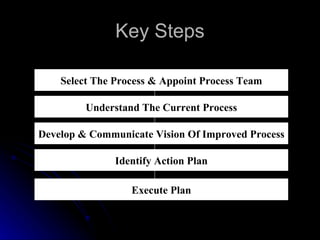
Key Steps Select The Process & Appoint Process Team Understand The Current Process Develop & Communicate Vision Of Improved Process Identify Action Plan Execute Plan
Select the Process & Appoint  Team Two  Important  Tasks Select  t he  p rocess to be  r eengineered Appoint  a   p rocess  t eam
Select the Process Review  b usiness  s trategy and  c ustomer  r equirements Select  c ore  p rocesses Understand  c ustomer  n eeds No assumption
Select the Process Select  c orrect  p ath for  c hange Ask -  q uestionnaires,  m eetings,  f ocus
Appoint the Process Team Identify  p rocess  o wners Develop   e xecutive  i mprovement  t eam Provide  t raining to  e xecutive  t eam
Core Skills Required Capacity to view the organization as a whole Ability to focus on end-customers Ability to challenge fundamental assumptions Courage to deliver into unknown areas
Core Skills Required Ability to assume individual and collective responsibility
Understand the Current Process Develop a  p rocess  o verview Clearly define the process  Mission Scope Boundaries Set business and customer measurements  Understand customers expectations from the process
Understand the Current Process Identify Improvement Opportunities Quality Rework Document the Process Cost Time  Value Data
Develop & Communicate Vision of Improved Process Communicate with all employees so that they are aware of the vision of the future Always provide information on the progress of the BPR initiative - good and bad. Demonstrate assurance that the BPR initiative is both necessary and properly managed
Develop & Communicate Vision of Improved Process Promote individual development by indicating options that are available Indicate actions required and those responsible
Identify Action Plan Develop an  i mprovement  p lan Appoint  p rocess  o wners Simplify the  p rocess to  r educe  p rocess  t ime
Identify Action Plan Remove no-value-added activities Standardize  p rocess and  a utomate  w here  p ossible Up-grade  e quipment Plan/schedule the changes
Execute Plan Qualify/certify the process Perform periodic qualification reviews Define and eliminate process problems Evaluate the change impact on the business and on customers Benchmark the process Provide advanced team training
Benefits From IT Assists the Implementation of Business Processes Enables Product & Service Innovations Improve Operational Efficiency Coordinate Vendors & Customers in the Process Chain
Common Problems Process  s implification is  c ommon -  t rue BPR is  n ot Desire to  c hange  n ot  s trong Commitment to  e xisting  p rocesses  t oo  s trong
Common Problems with BPR Process under review too big or too small Reliance on existing process too strong The Costs of the  c hange  s eem  l arge Allocation of  r esources Poor  t iming and  p lanning Keeping the  t eam and  o rganization on  t arget
THANK YOU...

Business process reengineering

  • 1.
    BUSINESS PROCESS REENGINEERINGBy: Garip Önder Özen
  • 2.
    DEFINITION Hammer andChampy (1993) define BPR as "... the fundamental rethinking and radical redesign of business processes to achieve dramatic improvements in critical contemporary measures of performance, such as cost, quality, service, and speed."
  • 3.
    DEFINITION Thomas Davenport (1993), another well-known BPR theorist, uses the term process innovation, which he says ”encompasses the envisioning of new work strategies, the actual process design activity, and the implementation of the change in all its complex technological, human, and organizational dimensions”.
  • 4.
    DEFINITION Finally, Johansson et al. (1993) provide a description of BPR relative to other process-oriented views, such as Total Quality Management (TQM) and Just-in-time (JIT), and state: "Business Process Reengineering, although a close relative, seeks radical rather than merely continuous improvement. It escalates the efforts of JIT and TQM to make process orientation a strategic tool and a core competence of the organization. BPR concentrates on core business processes, and uses the specific techniques within the JIT and TQM ”toolboxes” as enablers, while broadening the process vision."
  • 5.
    DEFINITION BPR derivesits existence from different disciplines, and four major areas can be identified as being subjected to change in BPR organization technology strategy people
  • 6.
    WHY REENGINEERING? CustomersDemanding Sophistication Changing Needs Competition Local Global
  • 7.
    WHY REENGINEERING? ChangeTechnology Customer Preferences
  • 8.
    WHY REENGINEERING? ComplacencyResistance New Developments Fear of Failure
  • 9.
    WHAT DOES ITSEEK? BPR seeks Cost Quality Service Speed , improvements
  • 10.
    The role ofinformation technology Information technology (IT) plays an important role in the reengineering concept It is considered as a major enabler for new forms of working and collaborating within an organization and across organizational borders.
  • 11.
    The role ofinformation technology Shared databases, making information available at many places Expert systems, allowing generalists to perform specialist tasks Telecommunication networks, allowing organizations to be centralized and decentralized at the same time Decision-support tools, allowing decision-making to be a part of everybody's job Wirelss data communication and portable computers , allowing field personnel to work office independent Interactive videodisk, to get in immediate contact with potential buyers Automatic identification and tracking, allowing things to tell where they are, instead of requiring to be found High performance computing, allowing on-the-fly planning and revisioning
  • 12.
    Key Steps SelectThe Process & Appoint Process Team Understand The Current Process Develop & Communicate Vision Of Improved Process Identify Action Plan Execute Plan
  • 13.
    Select the Process& Appoint Team Two Important Tasks Select t he p rocess to be r eengineered Appoint a p rocess t eam
  • 14.
    Select the ProcessReview b usiness s trategy and c ustomer r equirements Select c ore p rocesses Understand c ustomer n eeds No assumption
  • 15.
    Select the ProcessSelect c orrect p ath for c hange Ask - q uestionnaires, m eetings, f ocus
  • 16.
    Appoint the ProcessTeam Identify p rocess o wners Develop e xecutive i mprovement t eam Provide t raining to e xecutive t eam
  • 17.
    Core Skills RequiredCapacity to view the organization as a whole Ability to focus on end-customers Ability to challenge fundamental assumptions Courage to deliver into unknown areas
  • 18.
    Core Skills RequiredAbility to assume individual and collective responsibility
  • 19.
    Understand the CurrentProcess Develop a p rocess o verview Clearly define the process Mission Scope Boundaries Set business and customer measurements Understand customers expectations from the process
  • 20.
    Understand the CurrentProcess Identify Improvement Opportunities Quality Rework Document the Process Cost Time Value Data
  • 21.
    Develop & CommunicateVision of Improved Process Communicate with all employees so that they are aware of the vision of the future Always provide information on the progress of the BPR initiative - good and bad. Demonstrate assurance that the BPR initiative is both necessary and properly managed
  • 22.
    Develop & CommunicateVision of Improved Process Promote individual development by indicating options that are available Indicate actions required and those responsible
  • 23.
    Identify Action PlanDevelop an i mprovement p lan Appoint p rocess o wners Simplify the p rocess to r educe p rocess t ime
  • 24.
    Identify Action PlanRemove no-value-added activities Standardize p rocess and a utomate w here p ossible Up-grade e quipment Plan/schedule the changes
  • 25.
    Execute Plan Qualify/certifythe process Perform periodic qualification reviews Define and eliminate process problems Evaluate the change impact on the business and on customers Benchmark the process Provide advanced team training
  • 26.
    Benefits From ITAssists the Implementation of Business Processes Enables Product & Service Innovations Improve Operational Efficiency Coordinate Vendors & Customers in the Process Chain
  • 27.
    Common Problems Process s implification is c ommon - t rue BPR is n ot Desire to c hange n ot s trong Commitment to e xisting p rocesses t oo s trong
  • 28.
    Common Problems withBPR Process under review too big or too small Reliance on existing process too strong The Costs of the c hange s eem l arge Allocation of r esources Poor t iming and p lanning Keeping the t eam and o rganization on t arget
  • 29.