Management Of Transformations
(Ms. Priya Saha)
Assignment 2
(Case Studies)
(By - Group 2)
Akash Yadav, Anurag Singh, Rajanikanta Nayak & Sumit Singh
Case Study 1
BPR examples
Fast food Company
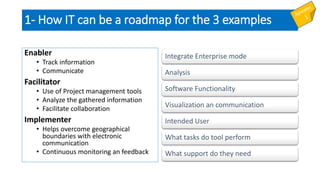
1- How IT can be a roadmap for the 3 examples
Enabler
• Track information
• Communicate
Facilitator
• Use of Project management tools
• Analyze the gathered information
• Facilitate collaboration
Implementer
• Helps overcome geographical
boundaries with electronic
communication
• Continuous monitoring an feedback
Integrate Enterprise mode
Analysis
Software Functionality
Visualization an communication
Intended User
What tasks do tool perform
What support do they need
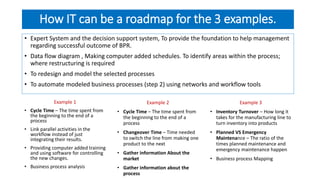
How IT can be a roadmap for the 3 examples.
• Expert System and the decision support system, To provide the foundation to help management
regarding successful outcome of BPR.
• Data flow diagram , Making computer added schedules. To identify areas within the process;
where restructuring is required
• To redesign and model the selected processes
• To automate modeled business processes (step 2) using networks and workflow tools
Example 1
• Cycle Time – The time spent from
the beginning to the end of a
process
• Link parallel activities in the
workflow instead of just
integrating their results.
• Providing computer added training
and using software for controlling
the new changes.
• Business process analysis
Example 2
• Cycle Time – The time spent from
the beginning to the end of a
process
• Changeover Time – Time needed
to switch the line from making one
product to the next
• Gather information About the
market
• Gather information about the
process
Example 3
• Inventory Turnover – How long it
takes for the manufacturing line to
turn inventory into products
• Planned VS Emergency
Maintenance – The ratio of the
times planned maintenance and
emergency maintenance happen
• Business process Mapping
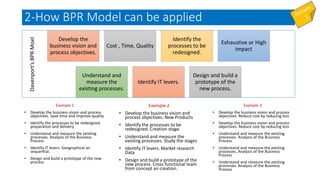
2-How BPR Model can be applied
Develop the
business vision and
process objectives.
Cost , Time, Quality
Identify the
processes to be
redesigned.
Exhaustive or High
Impact
Understand and
measure the
existing processes.
Identify IT levers.
Design and build a
prototype of the
new process.
Example 1
• Develop the business vision and process
objectives. Save time and Improve quality
• Identify the processes to be redesigned.
preparation and delivery
• Understand and measure the existing
processes. Analysis of the Business
Process
• Identify IT levers. Geographical an
sequential.
• Design and build a prototype of the new
process
Davenport’sBPRMoel
Example 2
• Develop the business vision and
process objectives. New Products
• Identify the processes to be
redesigned. Creation stage.
• Understand and measure the
existing processes. Study the stages
• Identify IT levers. Market research
Data
• Design and build a prototype of the
new process. Cross functional team
from concept an creation.
Example 3
• Develop the business vision and process
objectives. Reduce cost by reducing loss
• Develop the business vision and process
objectives. Reduce cost by reducing loss
• Understand and measure the existing
processes. Analysis of the Business
Process
• Understand and measure the existing
processes. Analysis of the Business
Process
• Understand and measure the existing
processes. Analysis of the Business
Process
3-Suggestion for changing the existing working
Example 1
• Analyse the business process
an identify the key
processes.
• Make use of analytics by
predicting the demand for
the products in a give day
• Information ddirectly
appears in the delivery or
service area
• Customer Profiling
• Demand Forecasting
• Process Integration
Example 2
• Prepare the theme
base on market
research
• Categorize themes into
related content
• Develop related
content simultaneously
• Cross Functional Team
• Customer feedback
Integration
• Personalization
Example 3
• Use business process
mapping
• Inventory management
• Reduce Logistics and
Bottleneck
• Efficient distribution
linkages
• Reduction in cycle time
• Product Handling
Case Study 2
Business Process Reengineering
Deloitte
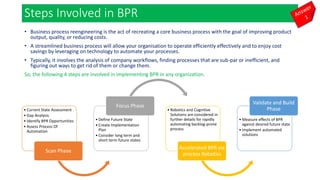
Steps Involved in BPR
• Current State Assessment
• Gap Analysis
• Identify BPR Opportunities
• Assess Process Of
Automation
Scan Phase
• Define Future State
• Create Implementation
Plan
• Consider long term and
short term future states
Focus Phase
• Robotics and Cognitive
Solutions are considered in
further details for rapidly
automating backlog-prone
process
Accelerated BPR via
process Robotics
• Measure effects of BPR
against desired future state
• Implement automated
solutions
Validate and Build
Phase
• Business process reengineering is the act of recreating a core business process with the goal of improving product
output, quality, or reducing costs.
• A streamlined business process will allow your organisation to operate efficiently effectively and to enjoy cost
savings by leveraging on technology to automate your processes.
• Typically, it involves the analysis of company workflows, finding processes that are sub-par or inefficient, and
figuring out ways to get rid of them or change them.
So, the following 4 steps are involved in implementing BPR in any organization.
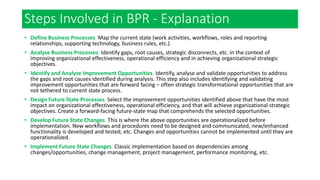
Steps Involved in BPR - Explanation
• Define Business Processes. Map the current state (work activities, workflows, roles and reporting
relationships, supporting technology, business rules, etc.).
• Analyse Business Processes. Identify gaps, root causes, strategic disconnects, etc. in the context of
improving organizational effectiveness, operational efficiency and in achieving organizational strategic
objectives.
• Identify and Analyse Improvement Opportunities. Identify, analyse and validate opportunities to address
the gaps and root causes identified during analysis. This step also includes identifying and validating
improvement opportunities that are forward facing – often strategic transformational opportunities that are
not tethered to current state process.
• Design Future State Processes. Select the improvement opportunities identified above that have the most
impact on organizational effectiveness, operational efficiency, and that will achieve organizational strategic
objectives. Create a forward-facing future-state map that comprehends the selected opportunities.
• Develop Future State Changes. This is where the above opportunities are operationalized before
implementation. New workflows and procedures need to be designed and communicated, new/enhanced
functionality is developed and tested, etc. Changes and opportunities cannot be implemented until they are
operationalized.
• Implement Future State Changes. Classic implementation based on dependencies among
changes/opportunities, change management, project management, performance monitoring, etc.
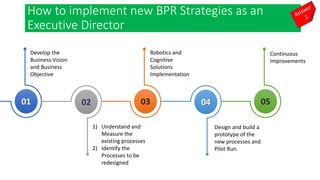
0504030201
Develop the
Business Vision
and Business
Objective
1) Understand and
Measure the
existing processes
2) Identify the
Processes to be
redesigned
Robotics and
Cognitive
Solutions
Implementation
Design and build a
prototype of the
new processes and
Pilot Run.
Continuous
Improvements
How to implement new BPR Strategies as an
Executive Director
• Step 1: Since the objective of reengineering is to provide competitive advantage of Enterprise. So being
an Executive director this step becomes crucial as visioning of the process can be perceived as an
integrated whole, rather than sum of departmental or functional activities with conflicting interests. So
at the end of this step we would be clear that 1) What are the key processes and 2) How will
reengineered process perform qualitatively and quantitatively.
• Step 2: The Objective is to identify and analyze both the internal and external processes against three
measures i.e. Effectiveness, Efficiency and adaptability. Then we will choose and identify the processes
to be redesigned and assign priority to each processes which will be done by taking into the account of
Core Business division and relative importance of the each identified process requirement.
• Step 3: Now we will use the process robotics to provide insights into how much potential exist for the
organization to utilize the process robotics and cognitive automation to modernize their core business
operations and identified processes.
• Step 4: As a next step we will design and build a prototype of the few processes which will help us in
understanding 1) whether the engineered business operations will meet the production goals. 2)
whether there are any hidden bottlenecks or any other problem that must be fixed. 3) If any
organizational issues or problems exist that were previously ignored. 4) Mistaken assumptions about
how the business actually operates.
• Step 5: As a final step, we would ensure that improvement is continuous otherwise all the above steps
won’t reap any benefits if the improvement is not continuous. For this we could post implementation
activities like system audits, version upgrades, ongoing system maintenance and change management.
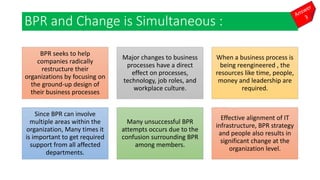
BPR and Change is Simultaneous :
BPR seeks to help
companies radically
restructure their
organizations by focusing on
the ground-up design of
their business processes
Major changes to business
processes have a direct
effect on processes,
technology, job roles, and
workplace culture.
When a business process is
being reengineered , the
resources like time, people,
money and leadership are
required.
Since BPR can involve
multiple areas within the
organization, Many times it
is important to get required
support from all affected
departments.
Many unsuccessful BPR
attempts occurs due to the
confusion surrounding BPR
among members.
Effective alignment of IT
infrastructure, BPR strategy
and people also results in
significant change at the
organization level.
Case Study 3
Cultural issues in mergers and
acquisitions
1. Make culture a major component of the change management work stream.
2. Identify who owns corporate culture and have them report to senior management.
3. Insist that the cultural work focuses on the tangible and the measurable.
4. Consider the strengths of both existing cultures, not just the weaknesses.
5. Implement a decision making process that is not hampered by cultural differences.
6. Build the employee brand with the view towards how it will be understood by employees.
7. Put people with culture change knowledge and experience on the teams that define the
key interfaces in the new organisational model.
8. Embrace the existing culture and workplace norms and work in line with them to
propagate change slowly rather than fighting them and creating an undesirable and
vulnerable to conflict situation.
What steps a manager should take for the successful implementation
of culture in his organisation?
Similarities Differences
Both are a related to rigidity Culture is positive. Resistance to change is negative
Both require majority consent Culture is long term. Resistance to change is short term
Both can cause situational conflict Culture is hard to trace, resistance to change is not
Both require catalyst agents to remedy
Resistance to change is comparatively easier to
influence than culture
Both are persistent
Resistance to change may be connected to certain
employees. Culture is not
Both are omnipresent in all organisations
Resistance to change may or may not be present in
some organisations but culture is specific to every
organisation
Both are related to human nature
Resistance to change is rebellious in nature. Culture is
more than that.
Despite best efforts, it is hard to see results of change
after implementation of change process
Resistance to change may flow from bottom up whereas
culture is always from top down.
How Culture is similar and different from resistance to change?
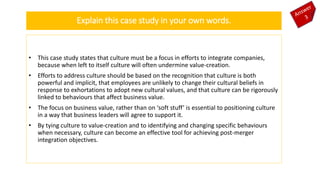
• This case study states that culture must be a focus in efforts to integrate companies,
because when left to itself culture will often undermine value-creation.
• Efforts to address culture should be based on the recognition that culture is both
powerful and implicit, that employees are unlikely to change their cultural beliefs in
response to exhortations to adopt new cultural values, and that culture can be rigorously
linked to behaviours that affect business value.
• The focus on business value, rather than on ‘soft stuff’ is essential to positioning culture
in a way that business leaders will agree to support it.
• By tying culture to value-creation and to identifying and changing specific behaviours
when necessary, culture can become an effective tool for achieving post-merger
integration objectives.
Explain this case study in your own words.
References:
• https://www.inteqgroup.com/blog/6-key-business-process-
reengineering-steps
• https://en.wikipedia.org/wiki/Business_process_re-engineering
• https://www.researchgate.net/publication/279391898_Business_Pro
cess_Reengineering_Framework_and_Approach
• https://www.bain.com/insights/management-tools-business-process-
reengineering/
• https://www.productplan.com/what-is-an-it-roadmap/
Thank You

Business Process Reengineering | Case studies

  • 1.
    Management Of Transformations (Ms.Priya Saha) Assignment 2 (Case Studies) (By - Group 2) Akash Yadav, Anurag Singh, Rajanikanta Nayak & Sumit Singh
  • 2.
    Case Study 1 BPRexamples Fast food Company
  • 3.
    1- How ITcan be a roadmap for the 3 examples Enabler • Track information • Communicate Facilitator • Use of Project management tools • Analyze the gathered information • Facilitate collaboration Implementer • Helps overcome geographical boundaries with electronic communication • Continuous monitoring an feedback Integrate Enterprise mode Analysis Software Functionality Visualization an communication Intended User What tasks do tool perform What support do they need
  • 4.
    How IT canbe a roadmap for the 3 examples. • Expert System and the decision support system, To provide the foundation to help management regarding successful outcome of BPR. • Data flow diagram , Making computer added schedules. To identify areas within the process; where restructuring is required • To redesign and model the selected processes • To automate modeled business processes (step 2) using networks and workflow tools Example 1 • Cycle Time – The time spent from the beginning to the end of a process • Link parallel activities in the workflow instead of just integrating their results. • Providing computer added training and using software for controlling the new changes. • Business process analysis Example 2 • Cycle Time – The time spent from the beginning to the end of a process • Changeover Time – Time needed to switch the line from making one product to the next • Gather information About the market • Gather information about the process Example 3 • Inventory Turnover – How long it takes for the manufacturing line to turn inventory into products • Planned VS Emergency Maintenance – The ratio of the times planned maintenance and emergency maintenance happen • Business process Mapping
  • 5.
    2-How BPR Modelcan be applied Develop the business vision and process objectives. Cost , Time, Quality Identify the processes to be redesigned. Exhaustive or High Impact Understand and measure the existing processes. Identify IT levers. Design and build a prototype of the new process. Example 1 • Develop the business vision and process objectives. Save time and Improve quality • Identify the processes to be redesigned. preparation and delivery • Understand and measure the existing processes. Analysis of the Business Process • Identify IT levers. Geographical an sequential. • Design and build a prototype of the new process Davenport’sBPRMoel Example 2 • Develop the business vision and process objectives. New Products • Identify the processes to be redesigned. Creation stage. • Understand and measure the existing processes. Study the stages • Identify IT levers. Market research Data • Design and build a prototype of the new process. Cross functional team from concept an creation. Example 3 • Develop the business vision and process objectives. Reduce cost by reducing loss • Develop the business vision and process objectives. Reduce cost by reducing loss • Understand and measure the existing processes. Analysis of the Business Process • Understand and measure the existing processes. Analysis of the Business Process • Understand and measure the existing processes. Analysis of the Business Process
  • 6.
    3-Suggestion for changingthe existing working Example 1 • Analyse the business process an identify the key processes. • Make use of analytics by predicting the demand for the products in a give day • Information ddirectly appears in the delivery or service area • Customer Profiling • Demand Forecasting • Process Integration Example 2 • Prepare the theme base on market research • Categorize themes into related content • Develop related content simultaneously • Cross Functional Team • Customer feedback Integration • Personalization Example 3 • Use business process mapping • Inventory management • Reduce Logistics and Bottleneck • Efficient distribution linkages • Reduction in cycle time • Product Handling
  • 7.
    Case Study 2 BusinessProcess Reengineering Deloitte
  • 8.
    Steps Involved inBPR • Current State Assessment • Gap Analysis • Identify BPR Opportunities • Assess Process Of Automation Scan Phase • Define Future State • Create Implementation Plan • Consider long term and short term future states Focus Phase • Robotics and Cognitive Solutions are considered in further details for rapidly automating backlog-prone process Accelerated BPR via process Robotics • Measure effects of BPR against desired future state • Implement automated solutions Validate and Build Phase • Business process reengineering is the act of recreating a core business process with the goal of improving product output, quality, or reducing costs. • A streamlined business process will allow your organisation to operate efficiently effectively and to enjoy cost savings by leveraging on technology to automate your processes. • Typically, it involves the analysis of company workflows, finding processes that are sub-par or inefficient, and figuring out ways to get rid of them or change them. So, the following 4 steps are involved in implementing BPR in any organization.
  • 9.
    Steps Involved inBPR - Explanation • Define Business Processes. Map the current state (work activities, workflows, roles and reporting relationships, supporting technology, business rules, etc.). • Analyse Business Processes. Identify gaps, root causes, strategic disconnects, etc. in the context of improving organizational effectiveness, operational efficiency and in achieving organizational strategic objectives. • Identify and Analyse Improvement Opportunities. Identify, analyse and validate opportunities to address the gaps and root causes identified during analysis. This step also includes identifying and validating improvement opportunities that are forward facing – often strategic transformational opportunities that are not tethered to current state process. • Design Future State Processes. Select the improvement opportunities identified above that have the most impact on organizational effectiveness, operational efficiency, and that will achieve organizational strategic objectives. Create a forward-facing future-state map that comprehends the selected opportunities. • Develop Future State Changes. This is where the above opportunities are operationalized before implementation. New workflows and procedures need to be designed and communicated, new/enhanced functionality is developed and tested, etc. Changes and opportunities cannot be implemented until they are operationalized. • Implement Future State Changes. Classic implementation based on dependencies among changes/opportunities, change management, project management, performance monitoring, etc.
  • 10.
    0504030201 Develop the Business Vision andBusiness Objective 1) Understand and Measure the existing processes 2) Identify the Processes to be redesigned Robotics and Cognitive Solutions Implementation Design and build a prototype of the new processes and Pilot Run. Continuous Improvements How to implement new BPR Strategies as an Executive Director
  • 11.
    • Step 1:Since the objective of reengineering is to provide competitive advantage of Enterprise. So being an Executive director this step becomes crucial as visioning of the process can be perceived as an integrated whole, rather than sum of departmental or functional activities with conflicting interests. So at the end of this step we would be clear that 1) What are the key processes and 2) How will reengineered process perform qualitatively and quantitatively. • Step 2: The Objective is to identify and analyze both the internal and external processes against three measures i.e. Effectiveness, Efficiency and adaptability. Then we will choose and identify the processes to be redesigned and assign priority to each processes which will be done by taking into the account of Core Business division and relative importance of the each identified process requirement. • Step 3: Now we will use the process robotics to provide insights into how much potential exist for the organization to utilize the process robotics and cognitive automation to modernize their core business operations and identified processes. • Step 4: As a next step we will design and build a prototype of the few processes which will help us in understanding 1) whether the engineered business operations will meet the production goals. 2) whether there are any hidden bottlenecks or any other problem that must be fixed. 3) If any organizational issues or problems exist that were previously ignored. 4) Mistaken assumptions about how the business actually operates. • Step 5: As a final step, we would ensure that improvement is continuous otherwise all the above steps won’t reap any benefits if the improvement is not continuous. For this we could post implementation activities like system audits, version upgrades, ongoing system maintenance and change management.
  • 12.
    BPR and Changeis Simultaneous : BPR seeks to help companies radically restructure their organizations by focusing on the ground-up design of their business processes Major changes to business processes have a direct effect on processes, technology, job roles, and workplace culture. When a business process is being reengineered , the resources like time, people, money and leadership are required. Since BPR can involve multiple areas within the organization, Many times it is important to get required support from all affected departments. Many unsuccessful BPR attempts occurs due to the confusion surrounding BPR among members. Effective alignment of IT infrastructure, BPR strategy and people also results in significant change at the organization level.
  • 13.
    Case Study 3 Culturalissues in mergers and acquisitions
  • 14.
    1. Make culturea major component of the change management work stream. 2. Identify who owns corporate culture and have them report to senior management. 3. Insist that the cultural work focuses on the tangible and the measurable. 4. Consider the strengths of both existing cultures, not just the weaknesses. 5. Implement a decision making process that is not hampered by cultural differences. 6. Build the employee brand with the view towards how it will be understood by employees. 7. Put people with culture change knowledge and experience on the teams that define the key interfaces in the new organisational model. 8. Embrace the existing culture and workplace norms and work in line with them to propagate change slowly rather than fighting them and creating an undesirable and vulnerable to conflict situation. What steps a manager should take for the successful implementation of culture in his organisation?
  • 15.
    Similarities Differences Both area related to rigidity Culture is positive. Resistance to change is negative Both require majority consent Culture is long term. Resistance to change is short term Both can cause situational conflict Culture is hard to trace, resistance to change is not Both require catalyst agents to remedy Resistance to change is comparatively easier to influence than culture Both are persistent Resistance to change may be connected to certain employees. Culture is not Both are omnipresent in all organisations Resistance to change may or may not be present in some organisations but culture is specific to every organisation Both are related to human nature Resistance to change is rebellious in nature. Culture is more than that. Despite best efforts, it is hard to see results of change after implementation of change process Resistance to change may flow from bottom up whereas culture is always from top down. How Culture is similar and different from resistance to change?
  • 16.
    • This casestudy states that culture must be a focus in efforts to integrate companies, because when left to itself culture will often undermine value-creation. • Efforts to address culture should be based on the recognition that culture is both powerful and implicit, that employees are unlikely to change their cultural beliefs in response to exhortations to adopt new cultural values, and that culture can be rigorously linked to behaviours that affect business value. • The focus on business value, rather than on ‘soft stuff’ is essential to positioning culture in a way that business leaders will agree to support it. • By tying culture to value-creation and to identifying and changing specific behaviours when necessary, culture can become an effective tool for achieving post-merger integration objectives. Explain this case study in your own words.
  • 17.
    References: • https://www.inteqgroup.com/blog/6-key-business-process- reengineering-steps • https://en.wikipedia.org/wiki/Business_process_re-engineering •https://www.researchgate.net/publication/279391898_Business_Pro cess_Reengineering_Framework_and_Approach • https://www.bain.com/insights/management-tools-business-process- reengineering/ • https://www.productplan.com/what-is-an-it-roadmap/
  • 18.