




BUSINESS PROCESS 
REENGINEERING 
“An organizational make-over” 
“Reengineering is new, and it has to be done.” 
Presented by 
S.Esther Shilpa 
Peter F. Drucker
Business Process Re-engineering 
(BPR) is basically rethinking and radically 
redesigning an organization's existing 
resources to achieve dramatic 
improvements in critical, contemporary 
measures of performance, such as cost, 
quality, service, and speed.
PRINCIPLES 
OF BPR
PRINCIPLES 
Six principles for redesigning business 
processes: 
1. Organize business processes around 
outcomes, not tasks 
2. Assign those who use the output to 
perform the process 
3. Integrate information processing into the 
work that produces the information
4. Create a virtual enterprise by treating 
geographically distributed resources as 
though they were centralized 
5. Link parallel activities instead of 
integrating their results 
6. Have the people who do the work make 
all the decisions, and let controls built 
into the system monitor the process
STEPS IN 
IMPLEMENTING 
BPR
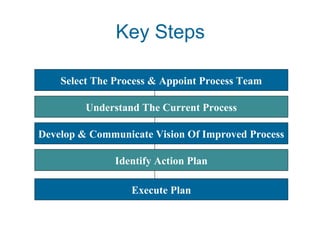
Key Steps 
Select The Process & Appoint Process Team 
Understand The Current Process 
Develop & Communicate Vision Of Improved Process 
Identify Action Plan 
Execute Plan
Select the Process & Appoint Process 
Team 
• Two Crucial Tasks 
– Select The Process to be Reengineered 
– Appoint the Process Team to Lead the 
Reengineering Initiative
Selecting the Process 
• Review Business Strategy and Customer 
Requirements 
• Select Core Processes 
• Understand Customer Needs 
• Don’t Assume Anything 
• Select Correct Path for Change 
• Remember Assumptions can Hide Failures 
• Competition and Choice to Go Elsewhere 
• Ask - Questionnaires, Meetings, Focus Groups
Appoint the Process Team 
• Appoint BPR Champion 
• Identify Process Owners 
• Establish Executive Improvement Team 
• Provide Training to Executive Team
Understand the Current Process 
• Develop a Process Overview 
• Clearly define the process 
– Mission 
– Scope 
– Boundaries 
• Set business and customer measurements 
• Understand customers expectations from the 
process (staff including process team) 
• Clearly Identify Improvement Opportunities 
– Quality 
– Rework
Understand the Current Process 
• Document the Process 
– Cost 
– Time 
– Value Data 
• Carefully resolve any inconsistencies 
– Existing -- New Process 
– Ideal -- Realistic Process
Develop & Communicate Vision of 
Improved Process 
• Communicate with all employees so that they 
are aware of the vision of the future 
• Always provide information on the progress of 
the BPR initiative - good and bad. 
• Demonstrate assurance that the BPR initiative is 
both necessary and properly managed
Develop & Communicate Vision of 
Improved Process 
• Promote individual development by indicating 
options that are available 
• Indicate actions required and those responsible 
• Tackle any actions that need resolution 
• Direct communication to reinforce new patterns 
of desired behavior
Identify Action Plan 
• Develop an Improvement Plan 
• Appoint Process Owners 
• Simplify the Process to Reduce Process 
Time 
• Remove any Bureaucracy that may hinder 
implementation 
• Remove no-value-added activities 
• Standardize Process and Automate 
Where Possible
Identify Action Plan 
• Up-grade Equipment 
• Plan/schedule the changes 
• Construct in-house metrics and targets 
• Introduce and firmly establish a feedback 
system 
• Audit, Audit, Audit
Execute Plan 
• Qualify/certify the process 
• Perform periodic qualification reviews 
• Define and eliminate process problems 
• Evaluate the change impact on the 
business and on customers 
• Benchmark the process 
• Provide advanced team training
Four Key Words for Reengineering 
• Fundamental 
• Radical 
• Dramatic 
• Process
Fundamental 
• Why do we do what we do? 
• Why do we do it the way we do? 
• Reengineering begins with no 
assumptions and no givens. 
• It ignores what is and concentrates on 
what should be.
Radical 
• Getting to the root of things: not making 
superficial changes or fiddling with what is 
already in place 
• Disregarding all existing structures and 
procedures and inventing completely new 
ways of accomplishing work. 
• Throwing away the old. Business 
reinvention.
Dramatic 
Dramatic improvement demands blowing up 
the old and replacing it with something 
new
Process 
• Collection of activities that takes one or 
more kinds of input and creates an output 
that is of value to the customer.
PHASES OF 
BPR
Phases of BPR 
Phase 1 
• Trigger: 
– Performance problem 
– Competitive e-Business move 
– Supply chain partner pressure 
• Deliberation / Discussion 
• Proposal 
• Management go-ahead
Phase 2 
• Project leader 
• Core team 
• Preliminary assessment of IT-infrastructure around 
processes 
• BPR Plan & Budget
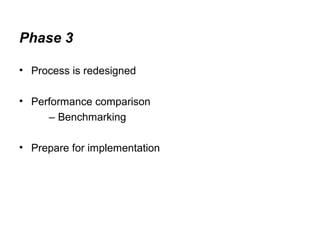
Phase 3 
• Process is redesigned 
• Performance comparison 
– Benchmarking 
• Prepare for implementation
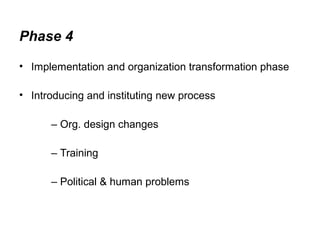
Phase 4 
• Implementation and organization transformation phase 
• Introducing and instituting new process 
– Org. design changes 
– Training 
– Political & human problems
Phase 5 
• Continuous monitoring 
• Modified as needed.
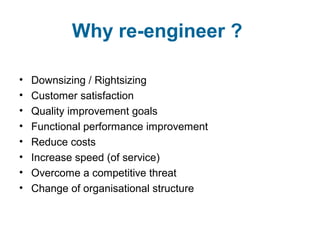
Why re-engineer ? 
• Downsizing / Rightsizing 
• Customer satisfaction 
• Quality improvement goals 
• Functional performance improvement 
• Reduce costs 
• Increase speed (of service) 
• Overcome a competitive threat 
• Change of organisational structure
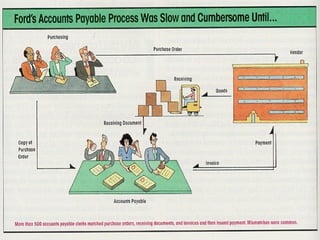
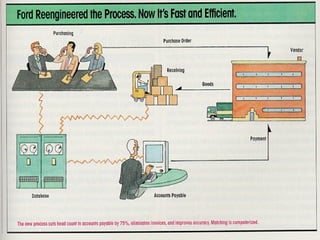
AN EXAMPLE
APPLICATION 
OF BPR
APPLICATION OF BPR 
• Many public and private sector 
organizations and Small / Medium 
Enterprises World-wide had undergone 
major reengineering efforts. 
• First applied to multinational co-operations, 
such as IBM, AT&T, SONY, 
GENERAL ELECTRIC, WALL MART, 
HEWLLET PACKARD, DEC, KRAFT 
FOODS having as a result major 
downsizing
APPLICATION OF BPR 
• Later, the Banking sector began to 
reengineer with a great degree of success 
such as CITIBANK , NORTHWESTERN 
BANK, BANK OF AMERICA and others. 
• Utility companies used reengineering as 
a technique to improve service like OTE 
(Our Town Electricity), ELTA.
Types of firms / organizations that 
BPR can be applied 
• BRP could by implemented to all firms 
(manufacturing firms, retailers, services, 
etc.) 
• Public organizations that satisfy the 
following criteria: 
 Minimum Number of employees: 20. 
 Strong management commitment to new 
ways of working and innovation. 
 Well formed IT infrastructure
BPR could be applied to companies that 
confront problems 
such as the following: 
• High operational costs 
• Low quality offered to customers 
• High level of ''bottleneck" processes at 
peak seasons 
• Poor performance of middle level 
managers 
• Inappropriate distribution of resources 
and jobs in order to achieve maximum 
performance, etc.
SUMMARY 
• Reengineering is a fundamental rethinking 
and redesign of business processes to 
achieve dramatic improvements 
• BPR has emerged from key management 
traditions such as scientific management 
and systems thinking
Thank You

Business Process Reengineering

  • 1.
    BUSINESS PROCESS REENGINEERING “An organizational make-over” “Reengineering is new, and it has to be done.” Presented by S.Esther Shilpa Peter F. Drucker
  • 3.
    Business Process Re-engineering (BPR) is basically rethinking and radically redesigning an organization's existing resources to achieve dramatic improvements in critical, contemporary measures of performance, such as cost, quality, service, and speed.
  • 4.
  • 5.
    PRINCIPLES Six principlesfor redesigning business processes: 1. Organize business processes around outcomes, not tasks 2. Assign those who use the output to perform the process 3. Integrate information processing into the work that produces the information
  • 6.
    4. Create avirtual enterprise by treating geographically distributed resources as though they were centralized 5. Link parallel activities instead of integrating their results 6. Have the people who do the work make all the decisions, and let controls built into the system monitor the process
  • 7.
  • 8.
    Key Steps SelectThe Process & Appoint Process Team Understand The Current Process Develop & Communicate Vision Of Improved Process Identify Action Plan Execute Plan
  • 9.
    Select the Process& Appoint Process Team • Two Crucial Tasks – Select The Process to be Reengineered – Appoint the Process Team to Lead the Reengineering Initiative
  • 10.
    Selecting the Process • Review Business Strategy and Customer Requirements • Select Core Processes • Understand Customer Needs • Don’t Assume Anything • Select Correct Path for Change • Remember Assumptions can Hide Failures • Competition and Choice to Go Elsewhere • Ask - Questionnaires, Meetings, Focus Groups
  • 11.
    Appoint the ProcessTeam • Appoint BPR Champion • Identify Process Owners • Establish Executive Improvement Team • Provide Training to Executive Team
  • 12.
    Understand the CurrentProcess • Develop a Process Overview • Clearly define the process – Mission – Scope – Boundaries • Set business and customer measurements • Understand customers expectations from the process (staff including process team) • Clearly Identify Improvement Opportunities – Quality – Rework
  • 13.
    Understand the CurrentProcess • Document the Process – Cost – Time – Value Data • Carefully resolve any inconsistencies – Existing -- New Process – Ideal -- Realistic Process
  • 14.
    Develop & CommunicateVision of Improved Process • Communicate with all employees so that they are aware of the vision of the future • Always provide information on the progress of the BPR initiative - good and bad. • Demonstrate assurance that the BPR initiative is both necessary and properly managed
  • 15.
    Develop & CommunicateVision of Improved Process • Promote individual development by indicating options that are available • Indicate actions required and those responsible • Tackle any actions that need resolution • Direct communication to reinforce new patterns of desired behavior
  • 16.
    Identify Action Plan • Develop an Improvement Plan • Appoint Process Owners • Simplify the Process to Reduce Process Time • Remove any Bureaucracy that may hinder implementation • Remove no-value-added activities • Standardize Process and Automate Where Possible
  • 17.
    Identify Action Plan • Up-grade Equipment • Plan/schedule the changes • Construct in-house metrics and targets • Introduce and firmly establish a feedback system • Audit, Audit, Audit
  • 18.
    Execute Plan •Qualify/certify the process • Perform periodic qualification reviews • Define and eliminate process problems • Evaluate the change impact on the business and on customers • Benchmark the process • Provide advanced team training
  • 19.
    Four Key Wordsfor Reengineering • Fundamental • Radical • Dramatic • Process
  • 20.
    Fundamental • Whydo we do what we do? • Why do we do it the way we do? • Reengineering begins with no assumptions and no givens. • It ignores what is and concentrates on what should be.
  • 21.
    Radical • Gettingto the root of things: not making superficial changes or fiddling with what is already in place • Disregarding all existing structures and procedures and inventing completely new ways of accomplishing work. • Throwing away the old. Business reinvention.
  • 22.
    Dramatic Dramatic improvementdemands blowing up the old and replacing it with something new
  • 23.
    Process • Collectionof activities that takes one or more kinds of input and creates an output that is of value to the customer.
  • 24.
  • 25.
    Phases of BPR Phase 1 • Trigger: – Performance problem – Competitive e-Business move – Supply chain partner pressure • Deliberation / Discussion • Proposal • Management go-ahead
  • 26.
    Phase 2 •Project leader • Core team • Preliminary assessment of IT-infrastructure around processes • BPR Plan & Budget
  • 27.
    Phase 3 •Process is redesigned • Performance comparison – Benchmarking • Prepare for implementation
  • 28.
    Phase 4 •Implementation and organization transformation phase • Introducing and instituting new process – Org. design changes – Training – Political & human problems
  • 29.
    Phase 5 •Continuous monitoring • Modified as needed.
  • 30.
    Why re-engineer ? • Downsizing / Rightsizing • Customer satisfaction • Quality improvement goals • Functional performance improvement • Reduce costs • Increase speed (of service) • Overcome a competitive threat • Change of organisational structure
  • 31.
  • 34.
  • 35.
    APPLICATION OF BPR • Many public and private sector organizations and Small / Medium Enterprises World-wide had undergone major reengineering efforts. • First applied to multinational co-operations, such as IBM, AT&T, SONY, GENERAL ELECTRIC, WALL MART, HEWLLET PACKARD, DEC, KRAFT FOODS having as a result major downsizing
  • 36.
    APPLICATION OF BPR • Later, the Banking sector began to reengineer with a great degree of success such as CITIBANK , NORTHWESTERN BANK, BANK OF AMERICA and others. • Utility companies used reengineering as a technique to improve service like OTE (Our Town Electricity), ELTA.
  • 37.
    Types of firms/ organizations that BPR can be applied • BRP could by implemented to all firms (manufacturing firms, retailers, services, etc.) • Public organizations that satisfy the following criteria:  Minimum Number of employees: 20.  Strong management commitment to new ways of working and innovation.  Well formed IT infrastructure
  • 38.
    BPR could beapplied to companies that confront problems such as the following: • High operational costs • Low quality offered to customers • High level of ''bottleneck" processes at peak seasons • Poor performance of middle level managers • Inappropriate distribution of resources and jobs in order to achieve maximum performance, etc.
  • 39.
    SUMMARY • Reengineeringis a fundamental rethinking and redesign of business processes to achieve dramatic improvements • BPR has emerged from key management traditions such as scientific management and systems thinking
  • 40.