Topics:
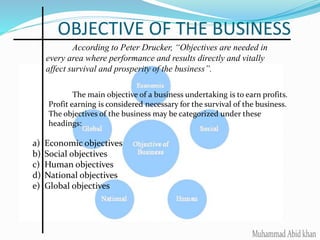
OBJECTIVE OF THE BUSINESS
According to Peter Drucker, “Objectives are needed in
every area where performance and results directly and vitally
affect survival and prosperity of the business”.
The main objective of a business undertaking is to earn profits.
Profit earning is considered necessary for the survival of the business.
The objectives of the business may be categorized under these
headings:
a) Economic objectives
b) Social objectives
c) Human objectives
d) National objectives
e) Global objectives
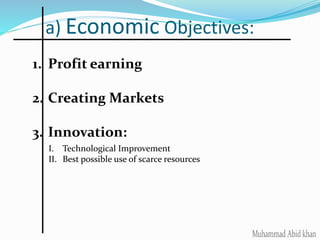
a) Economic Objectives:
1. Profit earning
2. Creating Markets
3. Innovation:
I. Technological Improvement
II. Best possible use of scarce resources
B) Human Objectives:
1) Welfare of employees
2) Satisfaction of Consumers
3) Satisfaction of Shareholders
c) Social Objectives:
The interdependency of business and society
cannot be ruled out. Without the society, business
cannot exist and society expects more from the
business than merely earning profits. The business
should undertake those activities, which are
essential for the betterment of the society. The
business should not undertake anything, which is
against the interest of the society.
The social responsibility of the business can be
studied as follows:
c) Social Objectives:
1) To make Goods and Services available
2) To Supply good Quality Goods
3) To Supply Quality Goods at reasonable prices
4) Co-operation with the Government
5) To avoid anti-social practices
6) To decide Location of Plant
7) To avoid slums and pollution
8) Research
9) Dynamic Leadership
d) National Objectives:
1) Creation of employment opportunities.
2) Promotion of social justice.
3) Produce and supply goods in accordance with the national
interest and priorities.
4) Payment of taxes and other dues honestly and regularly.
5) Contribution to the revenue of the country.
6) Implementing government’s economic and financial policies
framed from time to time.
7) To raise the general living standard of the Nation.
e) Global Objectives:
1) Making available globally competitive goods and
services.
2) Reducing disparities among rich and poor nations
by expanding its operations.
3) To raise general standard of the people.
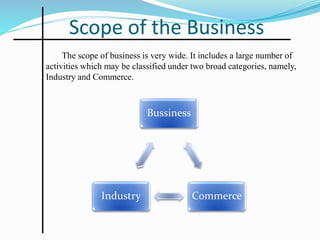
Scope of the Business
The scope of business is very wide. It includes a large number of
activities which may be classified under two broad categories, namely,
Industry and Commerce.
Bussiness
CommerceIndustry
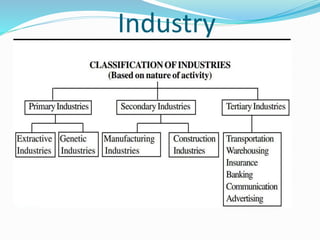
Industry
Commerce
Definition:
Commerce is defined as the sum total of
activities involving removal of hindrances in the process of
exchange of goods and services and facilitates the
availability for consumption or use.
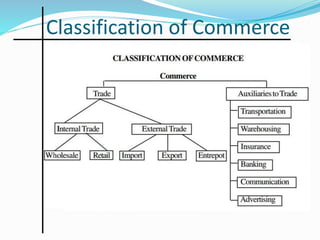
The commerce is further divided into two groups:
(1) Trade.
(2) Auxiliaries to trade.
Let us know in detail about the above two activities of commerce.
Classification of Commerce
Trade
The term trade refers to the sale, transfer or exchange of
goods and services and constitutes the central activity around which the
ancillary functions like Banking, Transportation, insurance, Packaging,
Warehousing and Advertising cluster. It helps in making the goods and
services available to ultimate consumers.
Definition:
Trade may be classified into three broad categories as follows:
• Internal or Domestic Trade
• International or Foreign Trade
• Enter pot Trade
a) Internal or Domestic Trade
It consists of buying and selling of goods within the boundaries
of a country and the payment for the same is made in national currency
either directly or through the banking system. Internal trade may be further
sub- classified into wholesale trade and retail trade.
•WHOLESALE TRADE - An industrial category composed of establishments
primarily engaged in selling merchandise to retailers; to industrial, commercial,
institutional, farm, or professional business users; or to other wholesales; or acting as
agents or brokers in buying merchandise for or selling merchandise to such persons or
companies.
•RETAIL TRADE - An industrial category composed of establishments engaged in
selling merchandise for personal or household consumption, and rendering services
incidental to the sale of the goods.
International or Foreign Trade
When trade takes place between two countries, it is called
foreign trade. Two countries are involved in foreign trade.
Import: When goods are purchased from, outside countries, it is called
import trade.
Export: when goods are sold to other countries, it is called export trade.
Enter-pot Trade
Enter -pot Trade: When goods are bought from one foreign country to
be sold in some other foreign country it is known as Enter-pot trade.
Auxiliaries to Trade
T o facilitate buying and selling of goods (trade) a variety of
other activities are required to be performed. These include, transport
of goods, storage of goods, financial transactions, insurance of goods
etc.
These activities are–
Banking
Transportation
Warehousing
Insurance
Advertising
Obj & scope of the business

Obj & scope of the business

  • 1.
  • 2.
    OBJECTIVE OF THEBUSINESS According to Peter Drucker, “Objectives are needed in every area where performance and results directly and vitally affect survival and prosperity of the business”. The main objective of a business undertaking is to earn profits. Profit earning is considered necessary for the survival of the business. The objectives of the business may be categorized under these headings: a) Economic objectives b) Social objectives c) Human objectives d) National objectives e) Global objectives
  • 3.
    a) Economic Objectives: 1.Profit earning 2. Creating Markets 3. Innovation: I. Technological Improvement II. Best possible use of scarce resources
  • 4.
    B) Human Objectives: 1)Welfare of employees 2) Satisfaction of Consumers 3) Satisfaction of Shareholders
  • 5.
    c) Social Objectives: Theinterdependency of business and society cannot be ruled out. Without the society, business cannot exist and society expects more from the business than merely earning profits. The business should undertake those activities, which are essential for the betterment of the society. The business should not undertake anything, which is against the interest of the society. The social responsibility of the business can be studied as follows:
  • 6.
    c) Social Objectives: 1)To make Goods and Services available 2) To Supply good Quality Goods 3) To Supply Quality Goods at reasonable prices 4) Co-operation with the Government 5) To avoid anti-social practices 6) To decide Location of Plant 7) To avoid slums and pollution 8) Research 9) Dynamic Leadership
  • 7.
    d) National Objectives: 1)Creation of employment opportunities. 2) Promotion of social justice. 3) Produce and supply goods in accordance with the national interest and priorities. 4) Payment of taxes and other dues honestly and regularly. 5) Contribution to the revenue of the country. 6) Implementing government’s economic and financial policies framed from time to time. 7) To raise the general living standard of the Nation.
  • 8.
    e) Global Objectives: 1)Making available globally competitive goods and services. 2) Reducing disparities among rich and poor nations by expanding its operations. 3) To raise general standard of the people.
  • 9.
    Scope of theBusiness The scope of business is very wide. It includes a large number of activities which may be classified under two broad categories, namely, Industry and Commerce. Bussiness CommerceIndustry
  • 10.
  • 11.
    Commerce Definition: Commerce is definedas the sum total of activities involving removal of hindrances in the process of exchange of goods and services and facilitates the availability for consumption or use. The commerce is further divided into two groups: (1) Trade. (2) Auxiliaries to trade. Let us know in detail about the above two activities of commerce.
  • 12.
  • 13.
    Trade The term traderefers to the sale, transfer or exchange of goods and services and constitutes the central activity around which the ancillary functions like Banking, Transportation, insurance, Packaging, Warehousing and Advertising cluster. It helps in making the goods and services available to ultimate consumers. Definition: Trade may be classified into three broad categories as follows: • Internal or Domestic Trade • International or Foreign Trade • Enter pot Trade
  • 14.
    a) Internal orDomestic Trade It consists of buying and selling of goods within the boundaries of a country and the payment for the same is made in national currency either directly or through the banking system. Internal trade may be further sub- classified into wholesale trade and retail trade. •WHOLESALE TRADE - An industrial category composed of establishments primarily engaged in selling merchandise to retailers; to industrial, commercial, institutional, farm, or professional business users; or to other wholesales; or acting as agents or brokers in buying merchandise for or selling merchandise to such persons or companies. •RETAIL TRADE - An industrial category composed of establishments engaged in selling merchandise for personal or household consumption, and rendering services incidental to the sale of the goods.
  • 15.
    International or ForeignTrade When trade takes place between two countries, it is called foreign trade. Two countries are involved in foreign trade. Import: When goods are purchased from, outside countries, it is called import trade. Export: when goods are sold to other countries, it is called export trade. Enter-pot Trade Enter -pot Trade: When goods are bought from one foreign country to be sold in some other foreign country it is known as Enter-pot trade.
  • 16.
    Auxiliaries to Trade To facilitate buying and selling of goods (trade) a variety of other activities are required to be performed. These include, transport of goods, storage of goods, financial transactions, insurance of goods etc. These activities are– Banking Transportation Warehousing Insurance Advertising