• Six Sigma is a business management strategy originally
  Six Sigma is a business management strategy originally 
  developed by Bill Smith at Motorola, USA in 1986.
• The maturity of a manufacturing process can be described 
              y                     gp
  by a sigma rating indicating its yield, or the percentage of 
  defect‐free products it creates. 
• A six sigma process is one in which 99 99966% of the
  A six sigma process is one in which 99.99966% of the 
  products manufactured are statistically expected to be free 
  of defects (3.4 defects per million). 
• Motorola set a goal of "six sigma" for all of its 
           l          l f"           "f    ll f
  manufacturing operations, and this goal became a byword 
  for the management and engineering practices used to 
                g               g        gp
  achieve it.
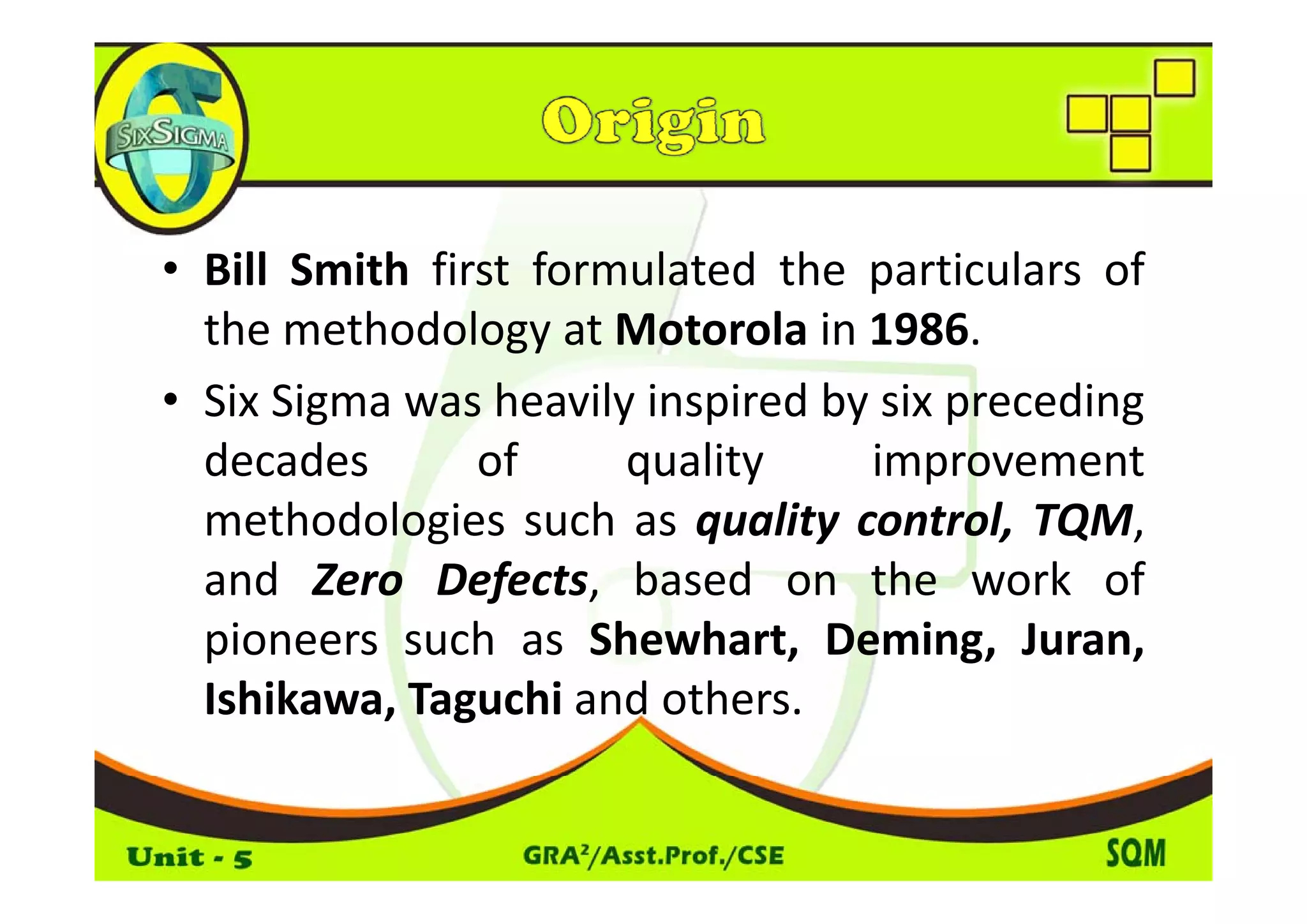
• Bill Smith f
    ill   i h first f
                    formulated the particulars of
                         l d h             l    f
  the methodology at Motorola in 1986.
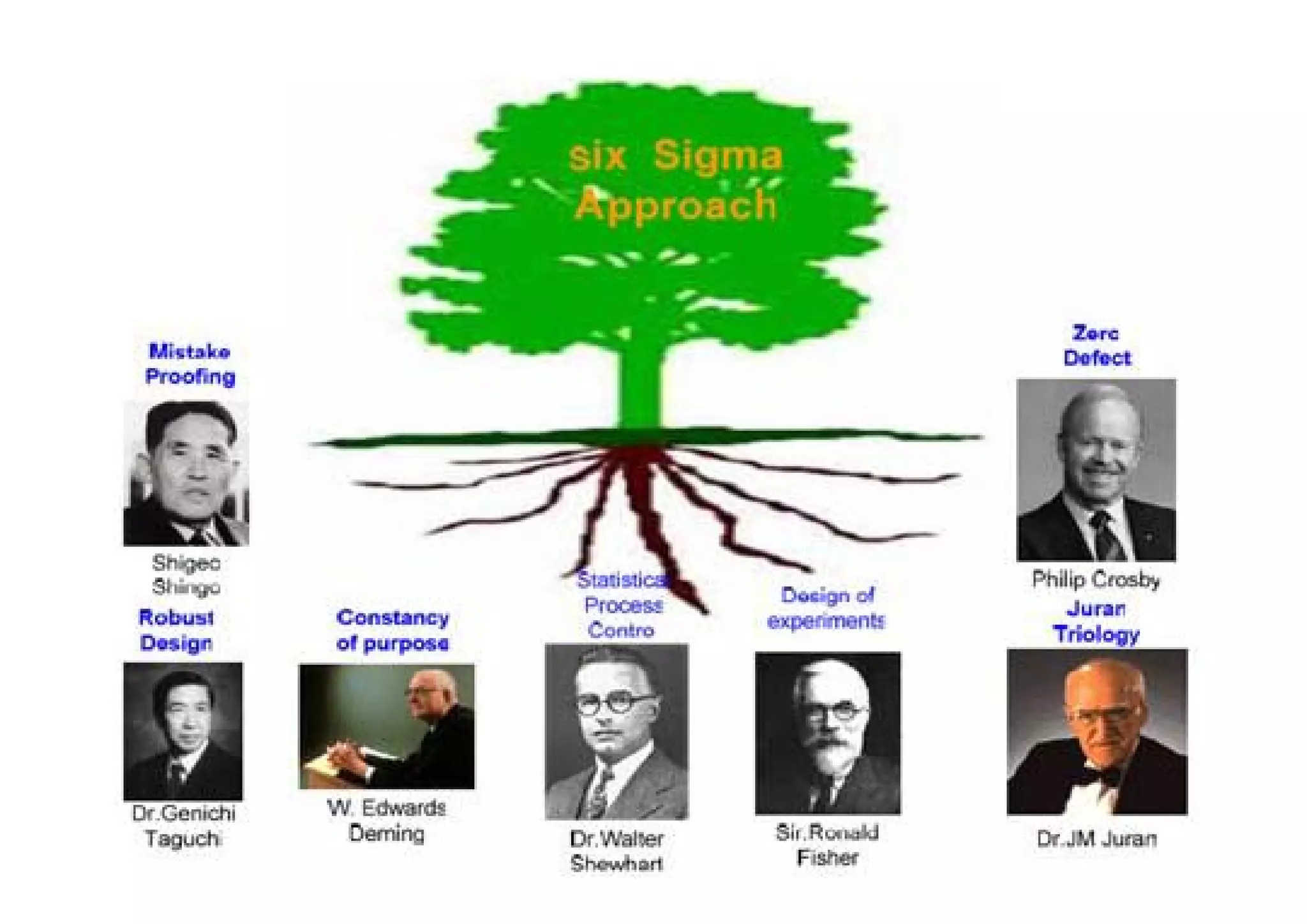
• Six Sigma was heavily inspired by six preceding
  decades        of     quality    improvement
  methodologies such as quality control, TQM,
  and Z
      d Zero D f t b d on th work of
              Defects, based       the       k f
  pioneers such as Shewhart, Deming, Juran,
  Ishikawa, Taguchi and others.
• Six Sigma seeks to improve the quality of process outputs
  by identifying and removing the causes of defects (errors)
  and minimizing variability in manufacturing and business
  processes.
  processes
• Continuous efforts to achieve stable and predictable
  p
  process results (i.e., reduce process variation) are of vital
                  ( ,           p                )
  importance to business success.
• Manufacturing and business processes have characteristics
  that can be measured analyzed improved and controlled
              measured, analyzed,                  controlled.
• Achieving sustained quality improvement requires
  commitment from the entire organization, particularly from
  top‐level management.
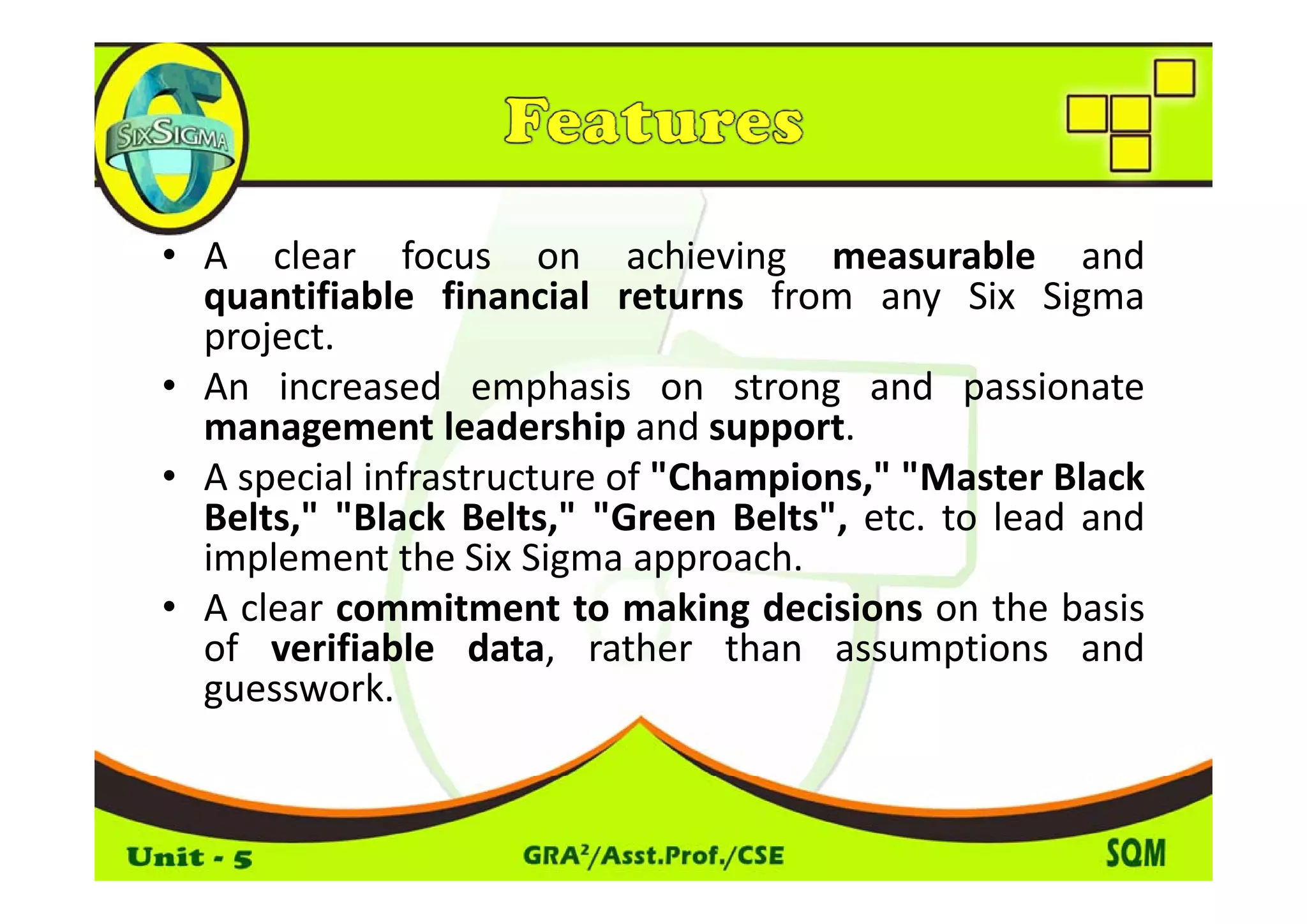
• A clear focus on achieving measurable and
  quantifiable financial returns from any Six Sigma
  project.
• An increased emphasis on strong and passionate
  management leadership and support.
• A special infrastructure of " h
           l f              f "Champions," "
                                         " "Master Black
                                                     l k
  Belts," "Black Belts," "Green Belts", etc. to lead and
  implement the Six Sigma approach.
• A clear commitment to making decisions on the basis
  of verifiable data, rather than assumptions and
  guesswork.
• Six Sigma projects follow two project
  Six Sigma projects follow two project 
  methodologies inspired by Deming's Plan‐Do‐
  Check Act Cycle. These methodologies, 
  Check‐Act Cycle. These methodologies,
  composed of five phases each, bear the acronyms 
  DMAIC and DMADV.
  – DMAIC is used for projects aimed at improving an 
    existing business process. DMAIC is pronounced as 
    "duh‐may‐ick".
     duh‐may‐ick
  – DMADV is used for projects aimed at creating new 
    p
    product or process designs. DMADV is pronounced as 
               p           g              p
    "duh‐mad‐vee".
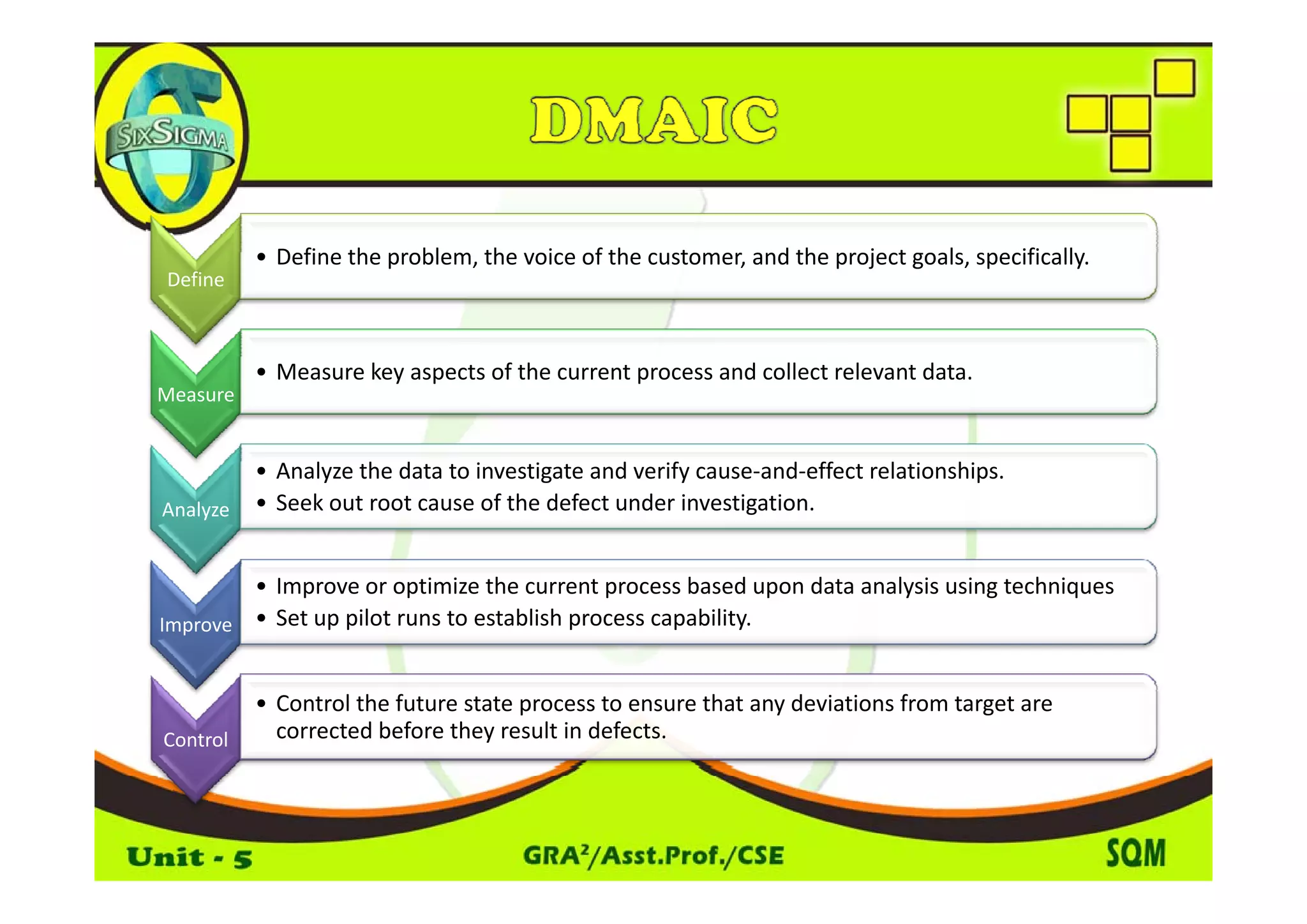
• D fi th
            Define the problem, the voice of the customer, and the project goals, specifically.
                          bl    th    i    f th     t        d th     j t     l       ifi ll
Define


          • Measure key aspects of the current process and collect relevant data.
Measure


          • Analyze the data to investigate and verify cause‐and‐effect relationships.
               l     h d                      d     f          d ff       l      h
Analyze   • Seek out root cause of the defect under investigation.


        • Improve or optimize the current process based upon data analysis using techniques
Improve • Set up pilot runs to establish process capability.


         • Control the future state process to ensure that any deviations from target are 
Control    corrected before they result in defects. 
• Define design goals that are consistent with customer demands and the enterprise 
                       g g                                                             p
 Define     strategy.


        • Measure and identify CTQs (characteristics that are Critical To Quality) product
          Measure and identify CTQs (characteristics that are Critical To Quality), product 
Measure   capabilities, production process capability, and risks.


        • Analyze to develop and design alternatives create a high level design and evaluate
          Analyze to develop and design alternatives, create a high‐level design and evaluate 
Analyze   design capability to select the best design.


          • Design details, optimize the design, and plan for design verification. This phase may 
Design      require simulations.


          • Verify the design, set up pilot runs, implement the production process and hand it over 
 Verify     to the process owner(s).
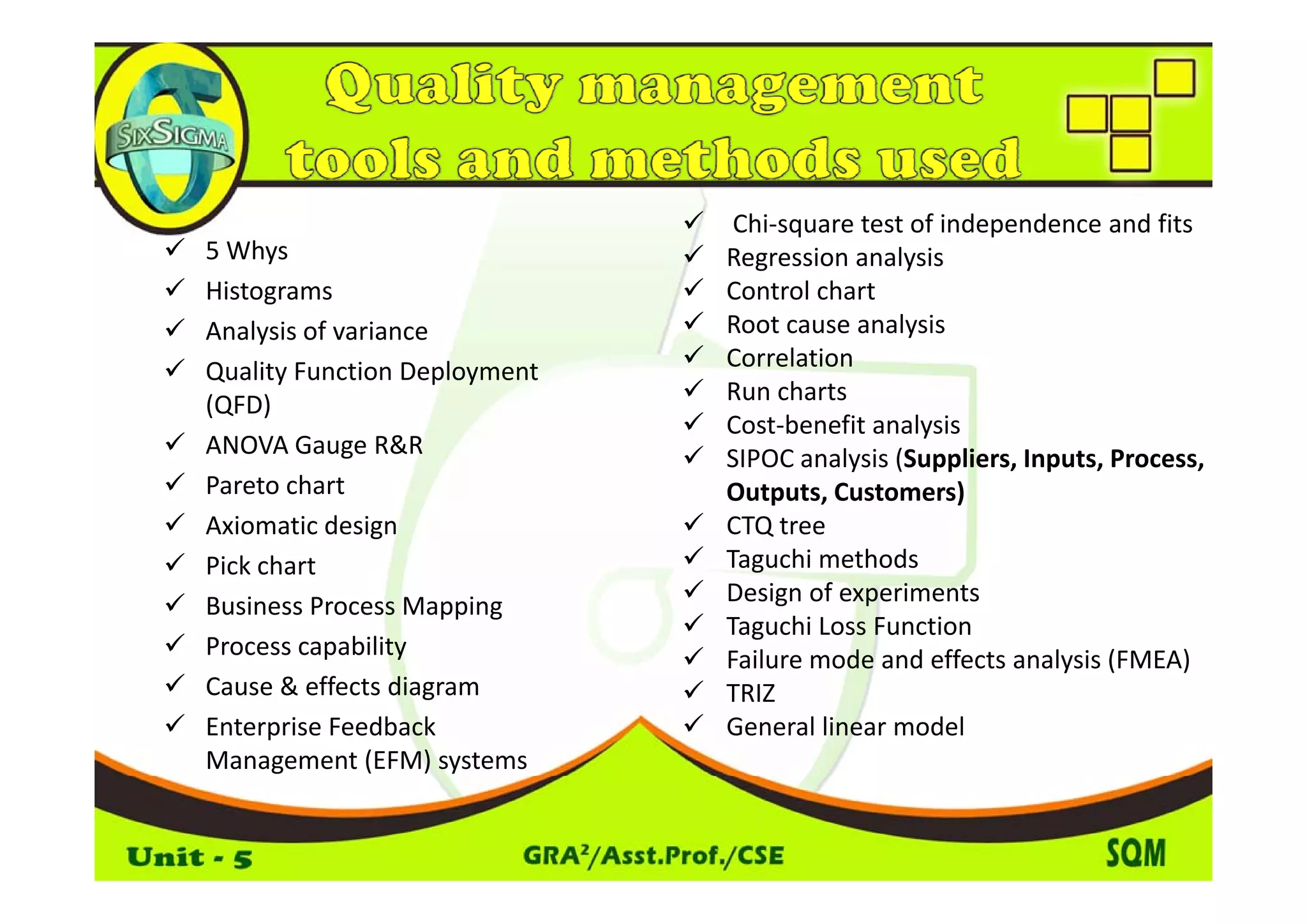
Chi‐square test of independence and fits 
5 Whys
5 Whys                         Regression analysis
                               R       i      l i
Histograms                     Control chart
Analysis of variance           Root cause analysis
Quality Function Deployment    Correlation 
                               Correlation
(QFD)                          Run charts
                               Cost‐benefit analysis 
ANOVA Gauge R&R                SIPOC analysis (Suppliers, Inputs, Process, 
                               SIPOC analysis (Suppliers Inputs Process
Pareto chart                   Outputs, Customers)
Axiomatic design               CTQ tree 
Pick chart
Pick chart                     Taguchi methods
                               Taguchi methods
Business Process Mapping       Design of experiments 
                               Taguchi Loss Function
Process capability             Failure mode and effects analysis (FMEA)
                                                             y (        )
Cause & effects diagram        TRIZ
Enterprise Feedback            General linear model
Management (EFM) systems
Six Sigma identifies several key roles for its successful implementation.
Six Sigma identifies several key roles for its successful implementation
• Executive Leadership includes the CEO and other members of top management. 
    They are responsible for setting up a vision for Six Sigma implementation. 
• Champions take responsibility for Six Sigma implementation across the 
    organization. Champions also act as mentors to Black Belts.
• Master Black Belts act as in‐house coaches on Six Sigma Apart from statistical
    Master Black Belts act as in house coaches on Six Sigma. Apart from statistical 
    tasks, they ensure consistent application of Six Sigma across various functions 
    and departments.
• Bl k B l
    Black Belts apply Six Sigma methodology to specific projects. They primarily 
                    l Si Si           h d l             ifi    j    Th      i    il
    focus on Six Sigma project execution, whereas Champions and Master Black 
    Belts focus on identifying projects/functions for Six Sigma.
• Green Belts are the employees who take up Six Sigma implementation along 
    with their other job responsibilities, operating under the guidance of Black Belts.
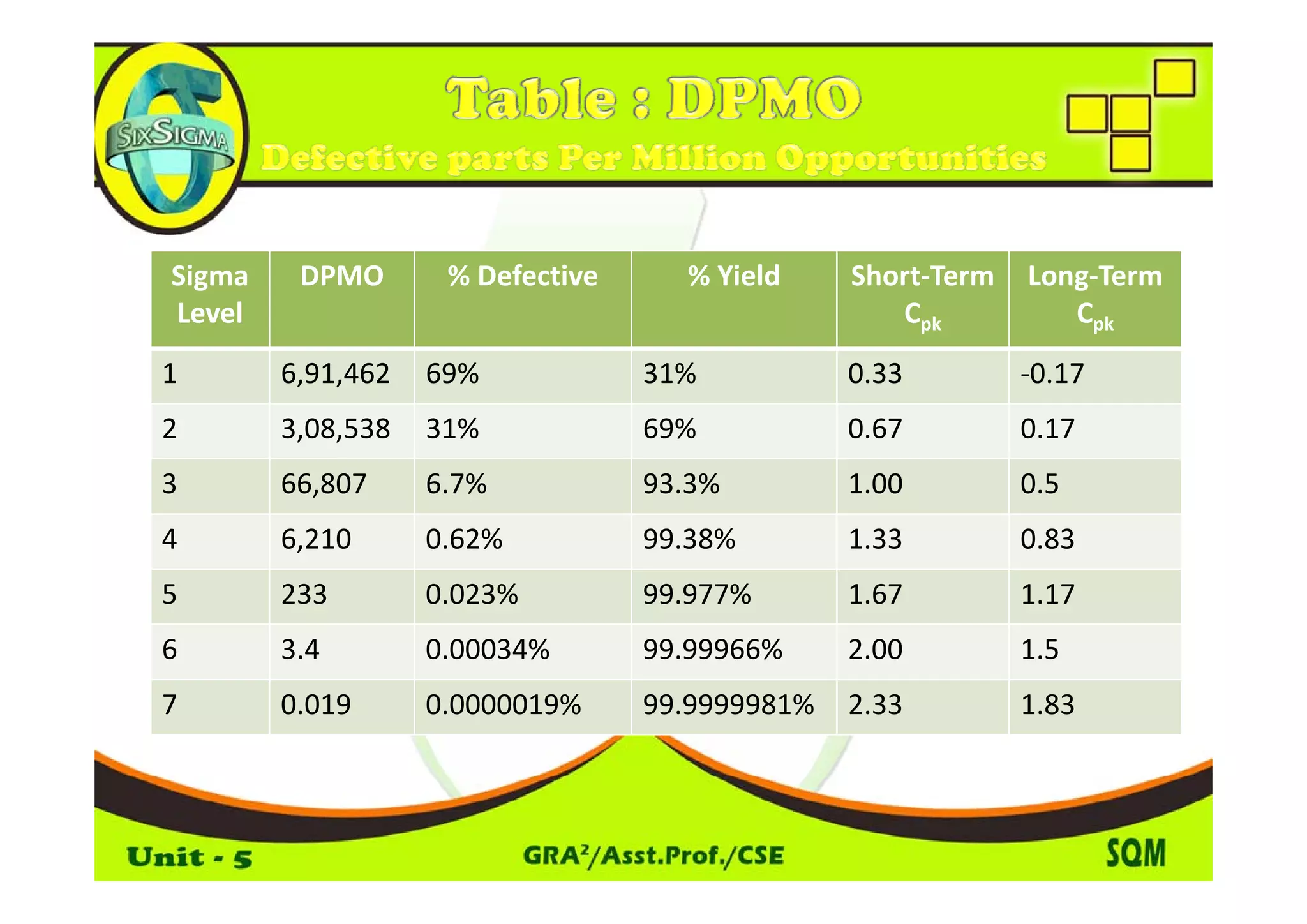
Sigma     DPMO       % Defective     % Yield     Short‐Term   Long‐Term 
Level                                               Cpk          Cpk
1        6,91,462   69%            31%           0.33         ‐0.17
2        3,08,538   31%            69%           0.67         0.17
3        66,807     6.7%           93.3%         1.00         0.5
4        6,210      0.62%          99.38%        1.33         0.83
5        233        0.023%         99.977%       1.67         1.17
6        3.4        0.00034%       99.99966%     2.00         1.5
7        0.019      0.0000019%     99.9999981%   2.33         1.83
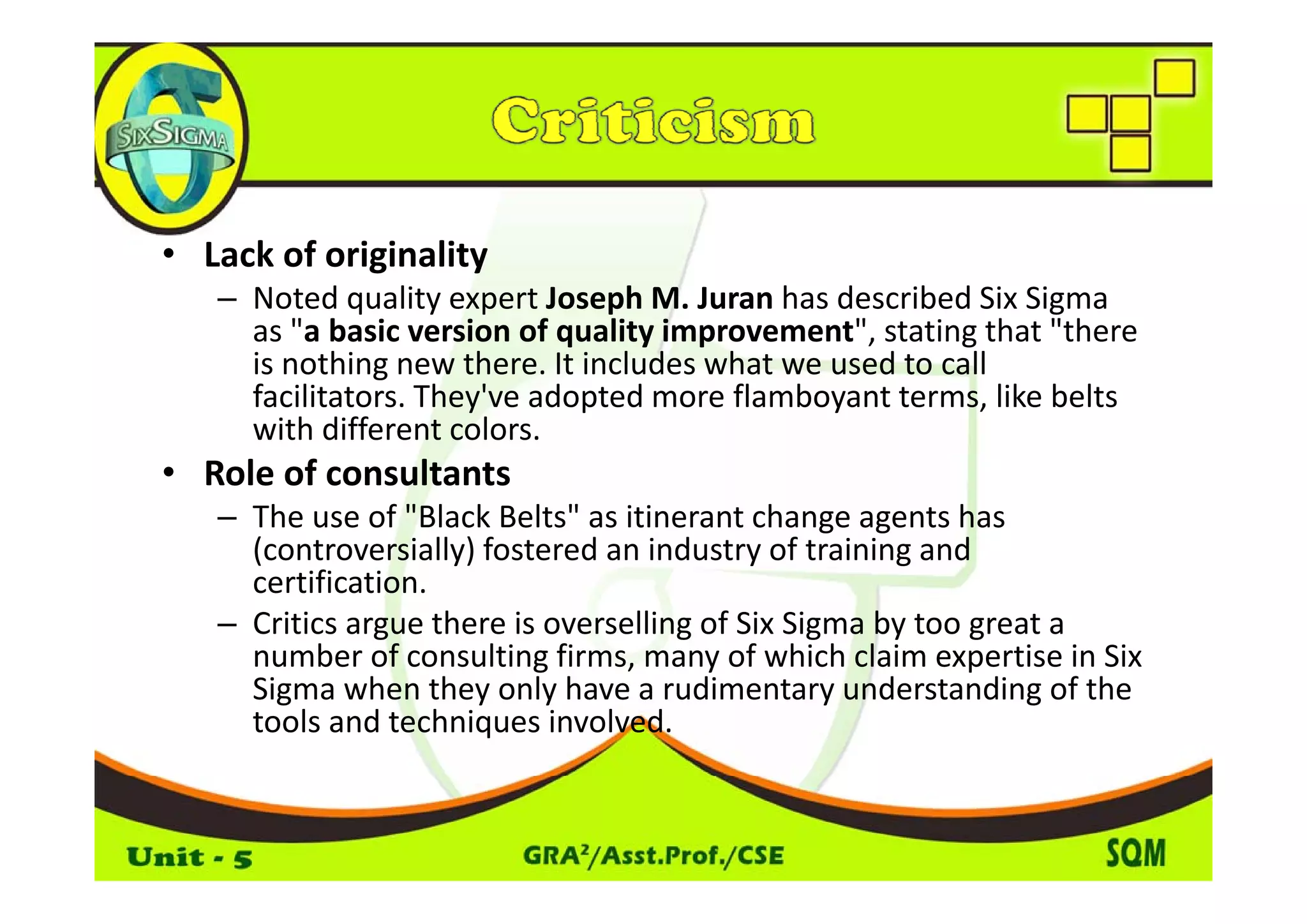
• Lack of originality
  Lack of originality
   – Noted quality expert Joseph M. Juran has described Six Sigma 
     as "a basic version of quality improvement", stating that "there 
     is nothing new there. It includes what we used to call 
     i     thi        th     It i l d   h t       dt     ll
     facilitators. They've adopted more flamboyant terms, like belts 
     with different colors.
• R l f
  Role of consultants
               l
   – The use of "Black Belts" as itinerant change agents has 
     (controversially) fostered an industry of training and 
     certification. 
   – Critics argue there is overselling of Six Sigma by too great a 
     number of consulting firms, many of which claim expertise in Six 
                           g      ,     y                   p
     Sigma when they only have a rudimentary understanding of the 
     tools and techniques involved.
• P t ti l
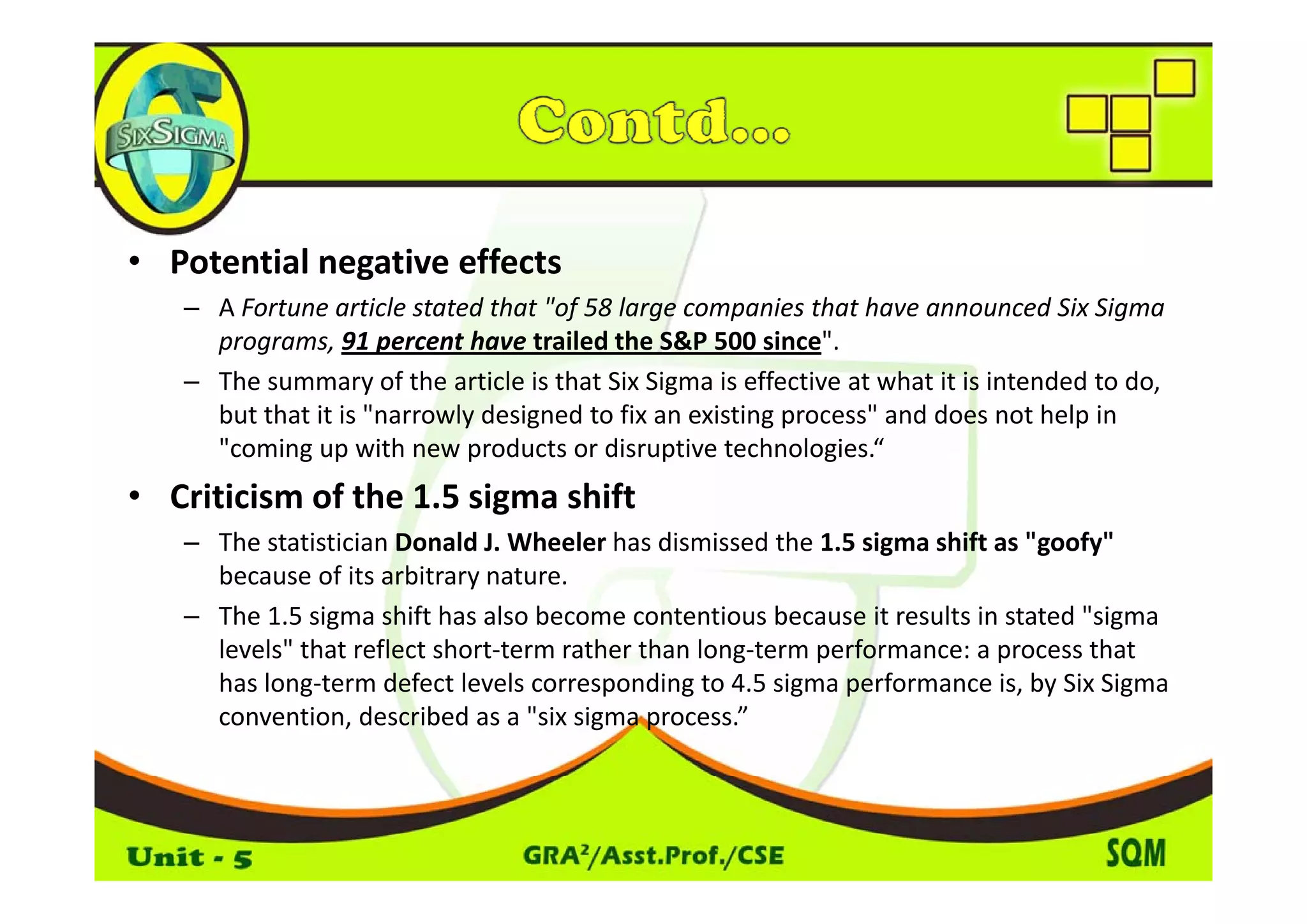
  Potential negative effects
                ti    ff t
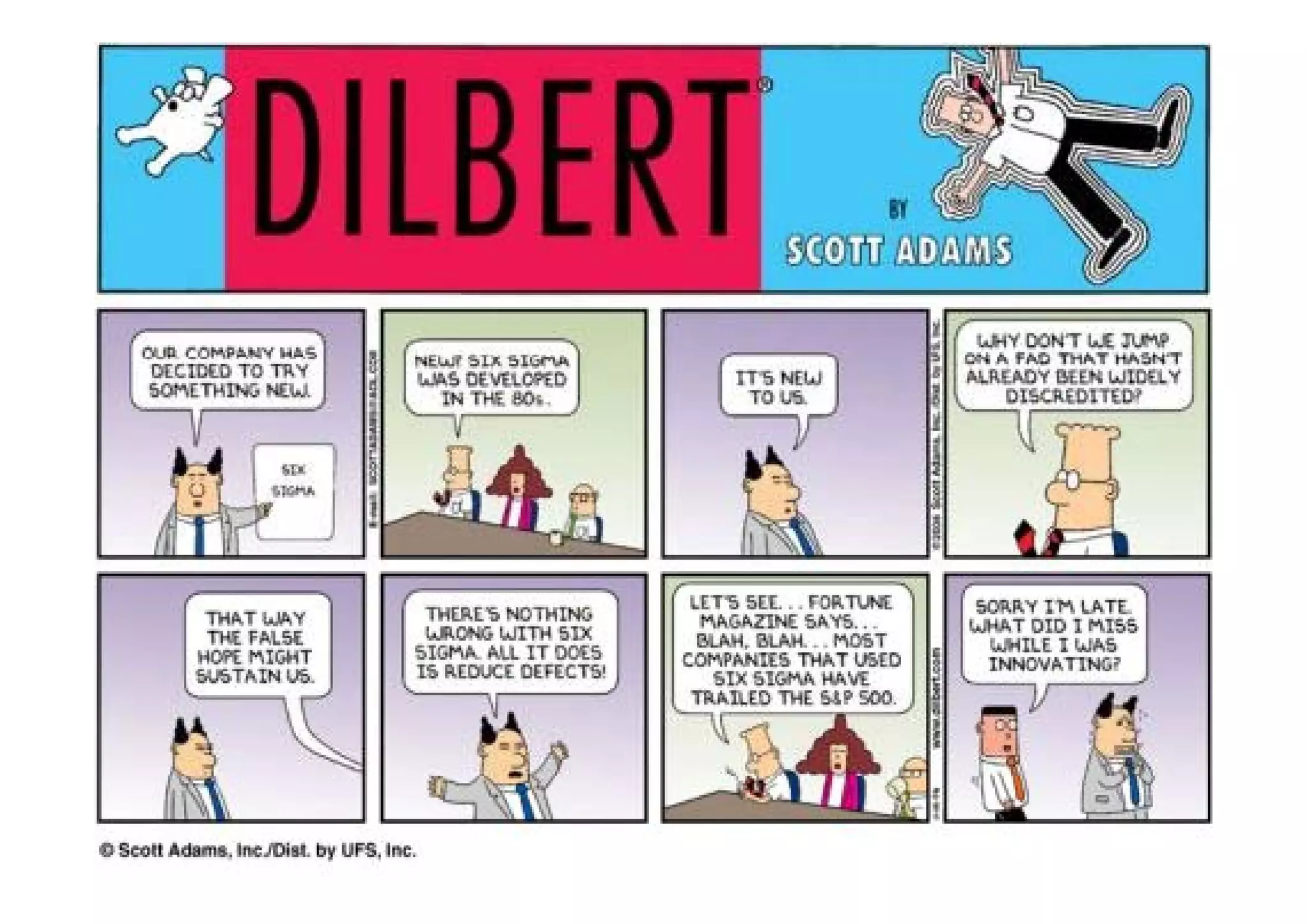
   – A Fortune article stated that "of 58 large companies that have announced Six Sigma 
     programs, 91 percent have trailed the S&P 500 since". 
   – The summary of the article is that Six Sigma is effective at what it is intended to do, 
     but that it is "narrowly designed to fix an existing process" and does not help in 
     "coming up with new products or disruptive technologies.“
            g p             p                  p             g
• Criticism of the 1.5 sigma shift
   – The statistician Donald J. Wheeler has dismissed the 1.5 sigma shift as "goofy" 
     because of its arbitrary nature. 
     b          fi     bi
   – The 1.5 sigma shift has also become contentious because it results in stated "sigma 
     levels" that reflect short‐term rather than long‐term performance: a process that 
     has long‐term defect levels corresponding to 4.5 sigma performance is, by Six Sigma 
     convention, described as a "six sigma process.”
• Based on arbitrary standards
  Based on arbitrary standards
  – While 3.4 defects per million opportunities might work well for certain 
    products/processes, it might not operate optimally or cost effectively for 
    others. 
  – A pacemaker process might need higher standards, for example, whereas a 
    Safety bin process might not need higher standards. 
    Safety bin process might not need higher standards.
  – The basis and justification for choosing 6 (as opposed to 5 or 7, for 
    example) as the number of standard deviations is not clearly explained. 
  – In addition, the Six Sigma model assumes that the process data always 
    conform to the normal distribution. The calculation of defect rates for 
    situations where the normal distribution model does not apply is not 
    properly addressed in the current Six Sigma literature.
6 sigma

6 sigma

  • 2.
    • Six Sigmais a business management strategy originally Six Sigma is a business management strategy originally  developed by Bill Smith at Motorola, USA in 1986. • The maturity of a manufacturing process can be described  y gp by a sigma rating indicating its yield, or the percentage of  defect‐free products it creates.  • A six sigma process is one in which 99 99966% of the A six sigma process is one in which 99.99966% of the  products manufactured are statistically expected to be free  of defects (3.4 defects per million).  • Motorola set a goal of "six sigma" for all of its  l l f" "f ll f manufacturing operations, and this goal became a byword  for the management and engineering practices used to  g g gp achieve it.
  • 3.
    • Bill Smithf ill i h first f formulated the particulars of l d h l f the methodology at Motorola in 1986. • Six Sigma was heavily inspired by six preceding decades of quality improvement methodologies such as quality control, TQM, and Z d Zero D f t b d on th work of Defects, based the k f pioneers such as Shewhart, Deming, Juran, Ishikawa, Taguchi and others.
  • 5.
    • Six Sigmaseeks to improve the quality of process outputs by identifying and removing the causes of defects (errors) and minimizing variability in manufacturing and business processes. processes • Continuous efforts to achieve stable and predictable p process results (i.e., reduce process variation) are of vital ( , p ) importance to business success. • Manufacturing and business processes have characteristics that can be measured analyzed improved and controlled measured, analyzed, controlled. • Achieving sustained quality improvement requires commitment from the entire organization, particularly from top‐level management.
  • 7.
    • A clearfocus on achieving measurable and quantifiable financial returns from any Six Sigma project. • An increased emphasis on strong and passionate management leadership and support. • A special infrastructure of " h l f f "Champions," " " "Master Black l k Belts," "Black Belts," "Green Belts", etc. to lead and implement the Six Sigma approach. • A clear commitment to making decisions on the basis of verifiable data, rather than assumptions and guesswork.
  • 8.
    • Six Sigmaprojects follow two project Six Sigma projects follow two project  methodologies inspired by Deming's Plan‐Do‐ Check Act Cycle. These methodologies,  Check‐Act Cycle. These methodologies, composed of five phases each, bear the acronyms  DMAIC and DMADV. – DMAIC is used for projects aimed at improving an  existing business process. DMAIC is pronounced as  "duh‐may‐ick". duh‐may‐ick – DMADV is used for projects aimed at creating new  p product or process designs. DMADV is pronounced as  p g p "duh‐mad‐vee".
  • 9.
    • D fith Define the problem, the voice of the customer, and the project goals, specifically. bl th i f th t d th j t l ifi ll Define • Measure key aspects of the current process and collect relevant data. Measure • Analyze the data to investigate and verify cause‐and‐effect relationships. l h d d f d ff l h Analyze • Seek out root cause of the defect under investigation. • Improve or optimize the current process based upon data analysis using techniques Improve • Set up pilot runs to establish process capability. • Control the future state process to ensure that any deviations from target are  Control  corrected before they result in defects. 
  • 10.
    • Define design goals that are consistent with customer demands and the enterprise  g g p Define strategy. • Measure and identify CTQs (characteristics that are Critical To Quality) product Measure and identify CTQs (characteristics that are Critical To Quality), product  Measure capabilities, production process capability, and risks. • Analyze to develop and design alternatives create a high level design and evaluate Analyze to develop and design alternatives, create a high‐level design and evaluate  Analyze design capability to select the best design. • Design details, optimize the design, and plan for design verification. This phase may  Design require simulations. • Verify the design, set up pilot runs, implement the production process and hand it over  Verify to the process owner(s).
  • 11.
    Chi‐square test of independence and fits  5 Whys 5 Whys Regression analysis R i l i Histograms Control chart Analysis of variance  Root cause analysis Quality Function Deployment  Correlation  Correlation (QFD) Run charts Cost‐benefit analysis  ANOVA Gauge R&R  SIPOC analysis (Suppliers, Inputs, Process,  SIPOC analysis (Suppliers Inputs Process Pareto chart Outputs, Customers) Axiomatic design  CTQ tree  Pick chart Pick chart Taguchi methods Taguchi methods Business Process Mapping  Design of experiments  Taguchi Loss Function Process capability Failure mode and effects analysis (FMEA) y ( ) Cause & effects diagram TRIZ Enterprise Feedback  General linear model Management (EFM) systems
  • 12.
    Six Sigma identifies several key roles for its successful implementation. Six Sigma identifiesseveral key roles for its successful implementation • Executive Leadership includes the CEO and other members of top management.  They are responsible for setting up a vision for Six Sigma implementation.  • Champions take responsibility for Six Sigma implementation across the  organization. Champions also act as mentors to Black Belts. • Master Black Belts act as in‐house coaches on Six Sigma Apart from statistical Master Black Belts act as in house coaches on Six Sigma. Apart from statistical  tasks, they ensure consistent application of Six Sigma across various functions  and departments. • Bl k B l Black Belts apply Six Sigma methodology to specific projects. They primarily  l Si Si h d l ifi j Th i il focus on Six Sigma project execution, whereas Champions and Master Black  Belts focus on identifying projects/functions for Six Sigma. • Green Belts are the employees who take up Six Sigma implementation along  with their other job responsibilities, operating under the guidance of Black Belts.
  • 13.
    Sigma  DPMO % Defective % Yield Short‐Term Long‐Term  Level Cpk Cpk 1 6,91,462 69% 31% 0.33 ‐0.17 2 3,08,538 31% 69% 0.67 0.17 3 66,807 6.7% 93.3% 1.00 0.5 4 6,210 0.62% 99.38% 1.33 0.83 5 233 0.023% 99.977% 1.67 1.17 6 3.4 0.00034% 99.99966% 2.00 1.5 7 0.019 0.0000019% 99.9999981% 2.33 1.83
  • 14.
    • Lack oforiginality Lack of originality – Noted quality expert Joseph M. Juran has described Six Sigma  as "a basic version of quality improvement", stating that "there  is nothing new there. It includes what we used to call  i thi th It i l d h t dt ll facilitators. They've adopted more flamboyant terms, like belts  with different colors. • R l f Role of consultants l – The use of "Black Belts" as itinerant change agents has  (controversially) fostered an industry of training and  certification.  – Critics argue there is overselling of Six Sigma by too great a  number of consulting firms, many of which claim expertise in Six  g , y p Sigma when they only have a rudimentary understanding of the  tools and techniques involved.
  • 15.
    • P tti l Potential negative effects ti ff t – A Fortune article stated that "of 58 large companies that have announced Six Sigma  programs, 91 percent have trailed the S&P 500 since".  – The summary of the article is that Six Sigma is effective at what it is intended to do,  but that it is "narrowly designed to fix an existing process" and does not help in  "coming up with new products or disruptive technologies.“ g p p p g • Criticism of the 1.5 sigma shift – The statistician Donald J. Wheeler has dismissed the 1.5 sigma shift as "goofy"  because of its arbitrary nature.  b fi bi – The 1.5 sigma shift has also become contentious because it results in stated "sigma  levels" that reflect short‐term rather than long‐term performance: a process that  has long‐term defect levels corresponding to 4.5 sigma performance is, by Six Sigma  convention, described as a "six sigma process.”
  • 16.
    • Based onarbitrary standards Based on arbitrary standards – While 3.4 defects per million opportunities might work well for certain  products/processes, it might not operate optimally or cost effectively for  others.  – A pacemaker process might need higher standards, for example, whereas a  Safety bin process might not need higher standards.  Safety bin process might not need higher standards. – The basis and justification for choosing 6 (as opposed to 5 or 7, for  example) as the number of standard deviations is not clearly explained.  – In addition, the Six Sigma model assumes that the process data always  conform to the normal distribution. The calculation of defect rates for  situations where the normal distribution model does not apply is not  properly addressed in the current Six Sigma literature.