1
SCHOOL OF ARCHITECHTURE, BUILDING AND DESIGN
BACHELOR OF QUANTITY SURVEYING
FIELDWORK 2
TRAVERSING
NAME STUDENT ID
STEVEN CHAN KAI TIONG 0319850
TAY SY MIN 0320813
VOON SZE LUN 0315032
WONG GENG SEN 0321690
2
Content
Content Pages
Cover page 1
Content page 2
Introduction 3
Outline Apparatus 4 - 6
Objective 7
Tabulation Data 8
Adjustment Data 9 - 11
Conclusion 12
Reference s 13
3
Introduction
Traverse survey
- Traversing is one kind of method that used in the field of surveying to establish control
networks. A traverse is a series of straight lines that are used to connect a series of selected
points. These selected points are called traverse stations where distance and angle
measurements are made. The relative positions of the traverse stations are then computed
using some coordinate systems.
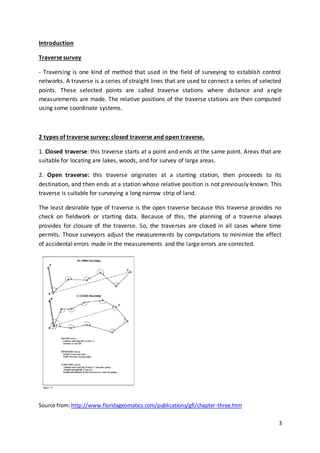
2 types of traverse survey: closed traverse and open traverse.
1. Closed traverse: this traverse starts at a point and ends at the same point. Areas that are
suitable for locating are lakes, woods, and for survey of large areas.
2. Open traverse: this traverse originates at a starting station, then proceeds to its
destination, and then ends at a station whose relative position is not previously known. This
traverse is suitable for surveying a long narrow strip of land.
The least desirable type of traverse is the open traverse because this traverse provides no
check on fieldwork or starting data. Because of this, the planning of a traverse always
provides for closure of the traverse. So, the traverses are closed in all cases where time
permits. Those surveyors adjust the measurements by computations to minimize the effect
of accidental errors made in the measurements and the large errors are corrected.
Source from:http://www.floridageomatics.com/publications/gfl/chapter-three.htm
4
Outline Apparatus
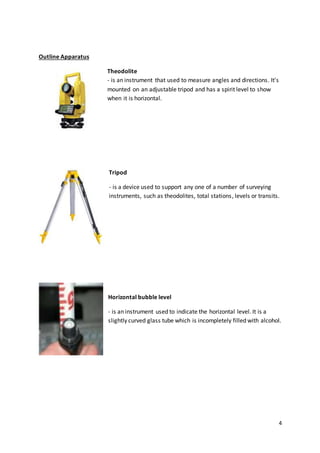
Theodolite
- is an instrument that used to measure angles and directions. It's
mounted on an adjustable tripod and has a spirit level to show
when it is horizontal.
Tripod
- is a device used to support any one of a number of surveying
instruments, such as theodolites, total stations, levels or transits.
Horizontal bubble level
- is an instrument used to indicate the horizontal level. It is a
slightly curved glass tube which is incompletely filled with alcohol.
5
Plumb bob
- is a weight which is suspended from a string and used as a
vertical reference line. Set the instrument exactly over a fixed
survey marker, or to transcribe positions onto the ground for
placing a marker.
Theodolite pole
- used as a stand to indicate the angle
betweentwoormore pointsinan enclosedarea.
6
Theodolite
All theodolites have the same common features which can be described as follows:
1. Targeting sight
2. Objective lens
3. Horizontal clamp knob
4. Horizontal tangent screw
5. Display window
6. Operating keys
7. Levelling screws
8. Tripod base plate
9. Optical plummet
10. Instrument centre mark
7
Objectives
1. To allow student to have a better understanding on the process of using theodolite rather
than listening to the lecture in class.
2. To allow student to gain experience on how to use theodolite, for example: setting up,
collaborating, calculating and recording data.
3. To enable student to know the methods of measuring the angles and lines.
4. To enable student to know the precautions that should be taken while using the
Theodolite.
5. To allow student to have the experience of doing fieldwork under actual working
environment in site such as working under the hot weather.
6. To allow student to understand the importance of teamwork while carrying out the
fieldwork.
7. To determine how to analyse the data collected from the fieldwork.
8. To allow student to understand how to distribute different types of error from the data
collected on field.
9. To enable student to learn how to read the positions on ranging rods.
10. To enhance the knowledge on how to set up the points for the fieldwork.
11. To allow student to have the ability to finish the site measurements and calculations
8
Field Data
Station Field Angles
A 89°07’ 20”
B 92° 24’ 40”
C 88° 45’ 00”
D 89° 55’ 20”
Sum 360° 12’ 20”
A
89°07’ 20” B
92° 24’ 40”
D
89° 55’ 20”
28.35 m
62.24 m
29.51 m
61.60 m
C
88° 45’ 00’’
9
AUNGULAR ERROR AND ANGULAR ADJUSTMENTS
(4-2)(180°) = 2(180°) = 360° , the sum of interior angles of the traverse must be 360°.
Hence, total angle errors = (360° 00’ 00’) - (360° 12’ 20’’) = -0° 12’ 20’’
Therefore, error per angle = (-0° 12’ 20’’)/4 = -0° 3’ 5’’
Station Field Angles Correction Adjusted Angles
A 89°07’ 20” -0° 3’ 5” 89° 4’ 15”
B 92° 24’ 40” -0° 3’ 5” 92° 21’ 35”
C 88° 45’ 00” -0° 3’ 5” 88° 41’ 55”
D 89° 55’ 20” -0° 3’ 5” 89° 52’ 15”
Sum 360° 12’ 20” 360° 00’ 00”
Computation for course azimuths
Station Adjusted Angles Course Azimuths
A-B 89° 4’ 15” 89° 4’ 15”
B-C 92° 21’ 35” 89° 4’ 15” + 92° 21’ 35” - 180° = 1° 25’ 50’’
C-D 88° 41’ 55” 1° 25’ 50” + 88° 41’ 55” + 180° = 270° 7’ 45’’
D-A 89° 52’ 15” 270° 7’ 45” + 89° 52’ 15” - 180° = 180° 0’ 0’’
10
Computationsfor Latitude and Departure
Length Cos β Sin β L cos β L sin β
Station Azimuth, β L(m) Cosine Sine Latitude Departure
A
89° 4’ 15” 61.60 +0.0162 +0.9999 +0.9989 +61.5919
B
1° 25’ 50” 28.35 0.9997 +0.0250 +28.3412 +0.7078
C
270° 7’ 45” 62.24 +0.0023 -1.0000 +0.1403 -62.2398
D
180° 0’ 0” 29.51 -1.0000 0.0000 -29.5100 0.0000
A
Perimeter(P) = 181.70 m Sum of latitudes = ∑∆y = -0.0296 m
Sum of departures = ∑∆x = 0.0599m
Error in departure ∑∆x = 0.0599 m
Error inlatitude
∑∆y = -0.0296 m
Accuracy = 1: (P/Ec)
Therefore,the accuracy= 1: (181.70/0.0668)
= 1: 2720.05988
= 1: 2700
For average landsurveying anaccuracy of about 1: 3000 is typical.
Hence,the accuracy of fieldisacceptable.
Total Error = 0.0668m
11
AdjustedCourse Latitudes and Departures
Computationof Station Coordinates
Assume thatthe coordinatesof A is (100.000, 100.000)
Station
Adjusted
Latitude
Adjusted
Departure
N Coordinate
Latitude
E Coordinates
Departure
A 100.000 100.000
+1.0090 +61.5716
B 101.0090 161.5716
+28.3458 +0.6985
C 129.3548 162.2701
+0.1504 -62.2603
D 129.5052 100.0098
-29.5052 -0.0098
A 100.00 100.000
Unadjusted Corrections Adjusted
Station Latitude Departure Latitude Departure Latitude Departure
A
+0.9989 +61.5919 0.0101 -0.0203 +1.0090 +61.5716
B
+28.3412 +0.7078 0.0046 -0.0093 +28.3458 +0.6985
C
+0.1403 -62.2398 0.0101 -0.0205 +0.1504 -62.2603
D
-29.5100 0.0000 0.0048 -0.0098 -29.5052 -0.0098
A
Sum -0.0296 0.0599 0.0296 -0.0599 0.0000 0.0000
Correction in Latitude of AB =
𝑇𝑜𝑡𝑎𝑙 𝐿𝑎𝑡𝑖𝑡𝑢𝑑𝑒 𝑀𝑖𝑠𝑐𝑙𝑜𝑠𝑢𝑟𝑒
𝑇𝑟𝑎𝑣𝑒𝑟𝑠𝑒 𝑃𝑒𝑟𝑖𝑚𝑒𝑡𝑒𝑟
× 𝐿𝑒𝑛𝑔𝑡ℎ 𝑜𝑓 𝐴𝐵
Correction in Departure of AB =
𝑇𝑜𝑡𝑎𝑙 𝐷𝑒𝑝𝑎𝑟𝑡𝑢𝑟𝑒 𝑀𝑖𝑠𝑐𝑙 𝑜 𝑠𝑢𝑟𝑒
𝑇𝑟𝑎𝑣𝑒𝑟𝑠𝑒 𝑃𝑒𝑟𝑖𝑚𝑒𝑡𝑒𝑟
× 𝐿𝑒𝑛𝑔𝑡ℎ 𝑜𝑓 𝐴𝐵
12
Summary
In this fieldwork, a theodolite is being used. There were only four theodolite in the
campus hence we shared the theodolite with another group and used the pacing method to
obtain our length of each course but we failed to get an accuracy of at least 1:3000. After
that, we used the tape-measure the length of each course. In order to get the most accurate
reading possible, our lecturer, Mr. Chai taught us to use the theodolite to guide our tape-
measure to make it is in as straight line.
Our error in departure is 0.0599 and our error in latitude is -0.0274. The total error is
0.0659. Using the following formula, we calculated the accuracy of our traverse survey:
Accuracy = 1: Perimeter/ Error Closure
We obtained an accuracy of 1:2700. For average land surveying an accuracy of 1:3000
is typical. Therefore, our traverse survey is acceptable.
The result of this fieldwork is interesting and satisfying. Thank to our lecturer, Mr. Chai
who taught us how to do the fieldwork and helped us to gain some knowledge on how to
use a theodolite so we can do the fieldwork smoothly and successfully.
13
Reference
Bob Vila (n.d.). The Plumb Bob. (Website). Retrieved on 20 November 2014 from
http://www.bobvila.com/articles/495-the-plumb-bob/#.VHbzzTGLUeoh
EngineerSupply, LLC © Copyright 1999-2015. (Website)
http://www.engineersupply.com/theodolites.aspx
Federal Geodetic Control Committee (1984). Standard Specifications for Geodetic Control
Networks. Retrieved on 20 November form
http://www.ngs.noaa.gov/FGCS/tech_pub/1984-stda-specs-geodetic-control-networks.pdf
Farlex clipart collection. © 2003-2012 Princeton University, Farlex Inc.
http://www.thefreedictionary.com/ranging+rod
http://nptel.ac.in/courses/105107122/modules/module9/html/28-5.htm#

Fieldwork 2 (Traversing)

  • 1.
    1 SCHOOL OF ARCHITECHTURE,BUILDING AND DESIGN BACHELOR OF QUANTITY SURVEYING FIELDWORK 2 TRAVERSING NAME STUDENT ID STEVEN CHAN KAI TIONG 0319850 TAY SY MIN 0320813 VOON SZE LUN 0315032 WONG GENG SEN 0321690
  • 2.
    2 Content Content Pages Cover page1 Content page 2 Introduction 3 Outline Apparatus 4 - 6 Objective 7 Tabulation Data 8 Adjustment Data 9 - 11 Conclusion 12 Reference s 13
  • 3.
    3 Introduction Traverse survey - Traversingis one kind of method that used in the field of surveying to establish control networks. A traverse is a series of straight lines that are used to connect a series of selected points. These selected points are called traverse stations where distance and angle measurements are made. The relative positions of the traverse stations are then computed using some coordinate systems. 2 types of traverse survey: closed traverse and open traverse. 1. Closed traverse: this traverse starts at a point and ends at the same point. Areas that are suitable for locating are lakes, woods, and for survey of large areas. 2. Open traverse: this traverse originates at a starting station, then proceeds to its destination, and then ends at a station whose relative position is not previously known. This traverse is suitable for surveying a long narrow strip of land. The least desirable type of traverse is the open traverse because this traverse provides no check on fieldwork or starting data. Because of this, the planning of a traverse always provides for closure of the traverse. So, the traverses are closed in all cases where time permits. Those surveyors adjust the measurements by computations to minimize the effect of accidental errors made in the measurements and the large errors are corrected. Source from:http://www.floridageomatics.com/publications/gfl/chapter-three.htm
  • 4.
    4 Outline Apparatus Theodolite - isan instrument that used to measure angles and directions. It's mounted on an adjustable tripod and has a spirit level to show when it is horizontal. Tripod - is a device used to support any one of a number of surveying instruments, such as theodolites, total stations, levels or transits. Horizontal bubble level - is an instrument used to indicate the horizontal level. It is a slightly curved glass tube which is incompletely filled with alcohol.
  • 5.
    5 Plumb bob - isa weight which is suspended from a string and used as a vertical reference line. Set the instrument exactly over a fixed survey marker, or to transcribe positions onto the ground for placing a marker. Theodolite pole - used as a stand to indicate the angle betweentwoormore pointsinan enclosedarea.
  • 6.
    6 Theodolite All theodolites havethe same common features which can be described as follows: 1. Targeting sight 2. Objective lens 3. Horizontal clamp knob 4. Horizontal tangent screw 5. Display window 6. Operating keys 7. Levelling screws 8. Tripod base plate 9. Optical plummet 10. Instrument centre mark
  • 7.
    7 Objectives 1. To allowstudent to have a better understanding on the process of using theodolite rather than listening to the lecture in class. 2. To allow student to gain experience on how to use theodolite, for example: setting up, collaborating, calculating and recording data. 3. To enable student to know the methods of measuring the angles and lines. 4. To enable student to know the precautions that should be taken while using the Theodolite. 5. To allow student to have the experience of doing fieldwork under actual working environment in site such as working under the hot weather. 6. To allow student to understand the importance of teamwork while carrying out the fieldwork. 7. To determine how to analyse the data collected from the fieldwork. 8. To allow student to understand how to distribute different types of error from the data collected on field. 9. To enable student to learn how to read the positions on ranging rods. 10. To enhance the knowledge on how to set up the points for the fieldwork. 11. To allow student to have the ability to finish the site measurements and calculations
  • 8.
    8 Field Data Station FieldAngles A 89°07’ 20” B 92° 24’ 40” C 88° 45’ 00” D 89° 55’ 20” Sum 360° 12’ 20” A 89°07’ 20” B 92° 24’ 40” D 89° 55’ 20” 28.35 m 62.24 m 29.51 m 61.60 m C 88° 45’ 00’’
  • 9.
    9 AUNGULAR ERROR ANDANGULAR ADJUSTMENTS (4-2)(180°) = 2(180°) = 360° , the sum of interior angles of the traverse must be 360°. Hence, total angle errors = (360° 00’ 00’) - (360° 12’ 20’’) = -0° 12’ 20’’ Therefore, error per angle = (-0° 12’ 20’’)/4 = -0° 3’ 5’’ Station Field Angles Correction Adjusted Angles A 89°07’ 20” -0° 3’ 5” 89° 4’ 15” B 92° 24’ 40” -0° 3’ 5” 92° 21’ 35” C 88° 45’ 00” -0° 3’ 5” 88° 41’ 55” D 89° 55’ 20” -0° 3’ 5” 89° 52’ 15” Sum 360° 12’ 20” 360° 00’ 00” Computation for course azimuths Station Adjusted Angles Course Azimuths A-B 89° 4’ 15” 89° 4’ 15” B-C 92° 21’ 35” 89° 4’ 15” + 92° 21’ 35” - 180° = 1° 25’ 50’’ C-D 88° 41’ 55” 1° 25’ 50” + 88° 41’ 55” + 180° = 270° 7’ 45’’ D-A 89° 52’ 15” 270° 7’ 45” + 89° 52’ 15” - 180° = 180° 0’ 0’’
  • 10.
    10 Computationsfor Latitude andDeparture Length Cos β Sin β L cos β L sin β Station Azimuth, β L(m) Cosine Sine Latitude Departure A 89° 4’ 15” 61.60 +0.0162 +0.9999 +0.9989 +61.5919 B 1° 25’ 50” 28.35 0.9997 +0.0250 +28.3412 +0.7078 C 270° 7’ 45” 62.24 +0.0023 -1.0000 +0.1403 -62.2398 D 180° 0’ 0” 29.51 -1.0000 0.0000 -29.5100 0.0000 A Perimeter(P) = 181.70 m Sum of latitudes = ∑∆y = -0.0296 m Sum of departures = ∑∆x = 0.0599m Error in departure ∑∆x = 0.0599 m Error inlatitude ∑∆y = -0.0296 m Accuracy = 1: (P/Ec) Therefore,the accuracy= 1: (181.70/0.0668) = 1: 2720.05988 = 1: 2700 For average landsurveying anaccuracy of about 1: 3000 is typical. Hence,the accuracy of fieldisacceptable. Total Error = 0.0668m
  • 11.
    11 AdjustedCourse Latitudes andDepartures Computationof Station Coordinates Assume thatthe coordinatesof A is (100.000, 100.000) Station Adjusted Latitude Adjusted Departure N Coordinate Latitude E Coordinates Departure A 100.000 100.000 +1.0090 +61.5716 B 101.0090 161.5716 +28.3458 +0.6985 C 129.3548 162.2701 +0.1504 -62.2603 D 129.5052 100.0098 -29.5052 -0.0098 A 100.00 100.000 Unadjusted Corrections Adjusted Station Latitude Departure Latitude Departure Latitude Departure A +0.9989 +61.5919 0.0101 -0.0203 +1.0090 +61.5716 B +28.3412 +0.7078 0.0046 -0.0093 +28.3458 +0.6985 C +0.1403 -62.2398 0.0101 -0.0205 +0.1504 -62.2603 D -29.5100 0.0000 0.0048 -0.0098 -29.5052 -0.0098 A Sum -0.0296 0.0599 0.0296 -0.0599 0.0000 0.0000 Correction in Latitude of AB = 𝑇𝑜𝑡𝑎𝑙 𝐿𝑎𝑡𝑖𝑡𝑢𝑑𝑒 𝑀𝑖𝑠𝑐𝑙𝑜𝑠𝑢𝑟𝑒 𝑇𝑟𝑎𝑣𝑒𝑟𝑠𝑒 𝑃𝑒𝑟𝑖𝑚𝑒𝑡𝑒𝑟 × 𝐿𝑒𝑛𝑔𝑡ℎ 𝑜𝑓 𝐴𝐵 Correction in Departure of AB = 𝑇𝑜𝑡𝑎𝑙 𝐷𝑒𝑝𝑎𝑟𝑡𝑢𝑟𝑒 𝑀𝑖𝑠𝑐𝑙 𝑜 𝑠𝑢𝑟𝑒 𝑇𝑟𝑎𝑣𝑒𝑟𝑠𝑒 𝑃𝑒𝑟𝑖𝑚𝑒𝑡𝑒𝑟 × 𝐿𝑒𝑛𝑔𝑡ℎ 𝑜𝑓 𝐴𝐵
  • 12.
    12 Summary In this fieldwork,a theodolite is being used. There were only four theodolite in the campus hence we shared the theodolite with another group and used the pacing method to obtain our length of each course but we failed to get an accuracy of at least 1:3000. After that, we used the tape-measure the length of each course. In order to get the most accurate reading possible, our lecturer, Mr. Chai taught us to use the theodolite to guide our tape- measure to make it is in as straight line. Our error in departure is 0.0599 and our error in latitude is -0.0274. The total error is 0.0659. Using the following formula, we calculated the accuracy of our traverse survey: Accuracy = 1: Perimeter/ Error Closure We obtained an accuracy of 1:2700. For average land surveying an accuracy of 1:3000 is typical. Therefore, our traverse survey is acceptable. The result of this fieldwork is interesting and satisfying. Thank to our lecturer, Mr. Chai who taught us how to do the fieldwork and helped us to gain some knowledge on how to use a theodolite so we can do the fieldwork smoothly and successfully.
  • 13.
    13 Reference Bob Vila (n.d.).The Plumb Bob. (Website). Retrieved on 20 November 2014 from http://www.bobvila.com/articles/495-the-plumb-bob/#.VHbzzTGLUeoh EngineerSupply, LLC © Copyright 1999-2015. (Website) http://www.engineersupply.com/theodolites.aspx Federal Geodetic Control Committee (1984). Standard Specifications for Geodetic Control Networks. Retrieved on 20 November form http://www.ngs.noaa.gov/FGCS/tech_pub/1984-stda-specs-geodetic-control-networks.pdf Farlex clipart collection. © 2003-2012 Princeton University, Farlex Inc. http://www.thefreedictionary.com/ranging+rod http://nptel.ac.in/courses/105107122/modules/module9/html/28-5.htm#