1
School of Architecture, Building & Design
Bachelor of Quantity Surveying (Honours)
Fieldwork Report - Leveling
Names Student ID Marks
Andrew Mah Koon Yan 0318798
Chong Kai Xiang 0322935
Chuang Jing 0322934
Darren Loong Chi Yoong 0318029
Lecturer : Mr. Chai Voon Chiet
Comments :
(marking purposes)
2
Index
Cover Page ………………….……………………1
Index ………………………….…………............. 2
Introduction ...……………………………………. 3
Objective …………………………………………. 3
Traverse ………..………………………………… 4
Apparatus ………………………………………… 6
Site & Procedure ………………………………… 8
Data ……………………………………………… 10
Conclusion ………………………………………. 14
Reference ……………………………………….. 15
3
Introduction
A group of students were grouped together for this fieldwork report
completion. There are 4 students which are Andrew Mah Koon Yan, Chong Kai
Xiang, Chuang Jing, and Darren Loong Chi Yoong, all from the same tutorial group.
In this fieldwork, we were taught theoretically by our lecturer, Mr. Chai, how to use
the Theodolites. After practising, we are then required to obtain the traversing results
and type a report out with the obtained data and information.
Objective
The objectives of carrying out this fieldwork on traversing is:
1. To develop knowledge about the use and application of the traversing
instruments.
2. To learn how to interpret the data obtained and make adjustments and
analyzing the data.
3. To determine the error of misclosure in order to determine whether the
traversing is acceptable or not.
4. To learn about the correct method to use the traversing instruments.
4
Introduction to Traversing
What is Traverse?
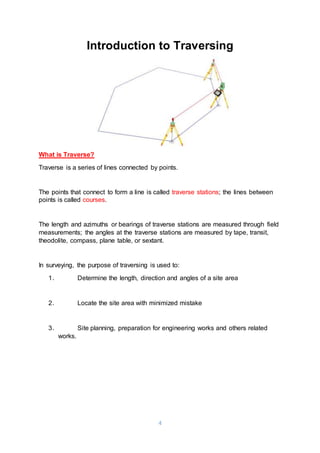
Traverse is a series of lines connected by points.
The points that connect to form a line is called traverse stations; the lines between
points is called courses.
The length and azimuths or bearings of traverse stations are measured through field
measurements; the angles at the traverse stations are measured by tape, transit,
theodolite, compass, plane table, or sextant.
In surveying, the purpose of traversing is used to:
1. Determine the length, direction and angles of a site area
2. Locate the site area with minimized mistake
3. Site planning, preparation for engineering works and others related
works.
5
Introduction to Traversing
Types of Traverse
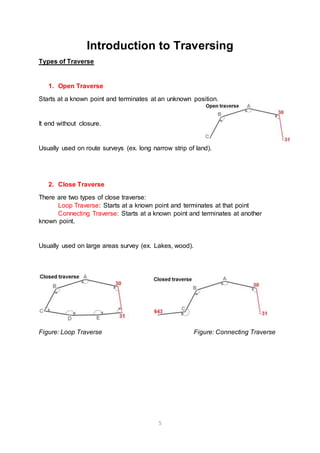
1. Open Traverse
Starts at a known point and terminates at an unknown position.
It end without closure.
Usually used on route surveys (ex. long narrow strip of land).
2. Close Traverse
There are two types of close traverse:
Loop Traverse: Starts at a known point and terminates at that point
Connecting Traverse: Starts at a known point and terminates at another
known point.
Usually used on large areas survey (ex. Lakes, wood).
Figure: Loop Traverse Figure: Connecting Traverse
6
Apparatus of Traverse
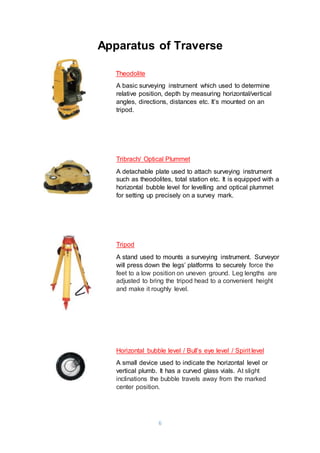
Theodolite
A basic surveying instrument which used to determine
relative position, depth by measuring horizontal/vertical
angles, directions, distances etc. It’s mounted on an
tripod.
Tribrach/ Optical Plummet
A detachable plate used to attach surveying instrument
such as theodolites, total station etc. It is equipped with a
horizontal bubble level for levelling and optical plummet
for setting up precisely on a survey mark.
Tripod
A stand used to mounts a surveying instrument. Surveyor
will press down the legs’ platforms to securely force the
feet to a low position on uneven ground. Leg lengths are
adjusted to bring the tripod head to a convenient height
and make it roughly level.
Horizontal bubble level / Bull’s eye level / Spirit level
A small device used to indicate the horizontal level or
vertical plumb. It has a curved glass vials. At slight
inclinations the bubble travels away from the marked
center position.
7
Apparatus of Traverse
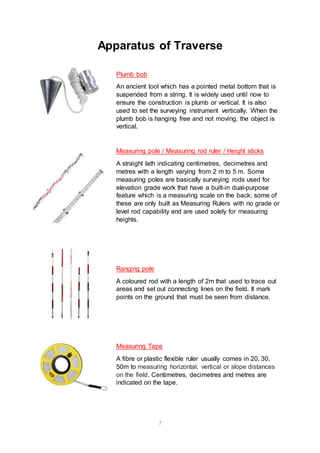
Plumb bob
An ancient tool which has a pointed metal bottom that is
suspended from a string. It is widely used until now to
ensure the construction is plumb or vertical. It is also
used to set the surveying instrument vertically. When the
plumb bob is hanging free and not moving, the object is
vertical.
Measuring pole / Measuring rod ruler / Height sticks
A straight lath indicating centimetres, decimetres and
metres with a length varying from 2 m to 5 m. Some
measuring poles are basically surveying rods used for
elevation grade work that have a built-in dual-purpose
feature which is a measuring scale on the back; some of
these are only built as Measuring Rulers with no grade or
level rod capability and are used solely for measuring
heights.
Ranging pole
A coloured rod with a length of 2m that used to trace out
areas and set out connecting lines on the field. It mark
points on the ground that must be seen from distance.
Measuring Tape
A fibre or plastic flexible ruler usually comes in 20, 30,
50m to measuring horizontal, vertical or slope distances
on the field. Centimetres, decimetres and metres are
indicated on the tape.
8
Site and Procedure
Site (of our fieldwork)
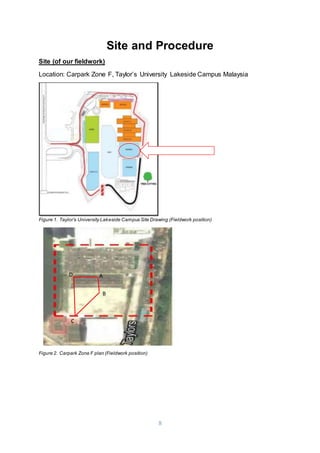
Location: Carpark Zone F, Taylor’s University Lakeside Campus Malaysia
Figure 1. Taylor’s University Lakeside Campus Site Drawing (Fieldwork position)
Figure 2. Carpark Zone F plan (Fieldwork position)
D A
B
C
9
Site and Procedure
Procedure
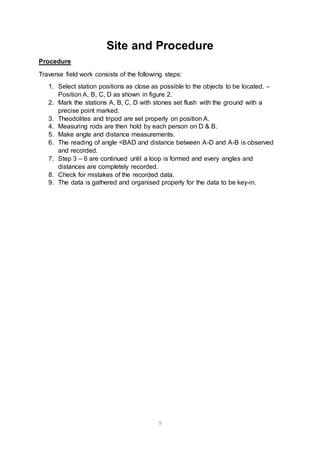
Traverse field work consists of the following steps:
1. Select station positions as close as possible to the objects to be located. –
Position A, B, C, D as shown in figure 2.
2. Mark the stations A, B, C, D with stones set flush with the ground with a
precise point marked.
3. Theodolites and tripod are set properly on position A.
4. Measuring rods are then hold by each person on D & B.
5. Make angle and distance measurements.
6. The reading of angle <BAD and distance between A-D and A-B is observed
and recorded.
7. Step 3 – 6 are continued until a loop is formed and every angles and
distances are completely recorded.
8. Check for mistakes of the recorded data.
9. The data is gathered and organised properly for the data to be key-in.
10
Data
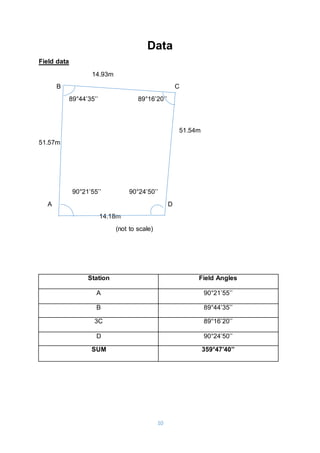
Field data
14.93m
B C
89°44’35’’ 89°16’20’’
51.54m
51.57m
90°21’55’’ 90°24’50’’
A D
14.18m
(not to scale)
Station Field Angles
A 90°21’55’’
B 89°44’35’’
3C 89°16’20’’
D 90°24’50’’
SUM 359°47’40’’
11
Data
Angular Error & Angle Adjustments
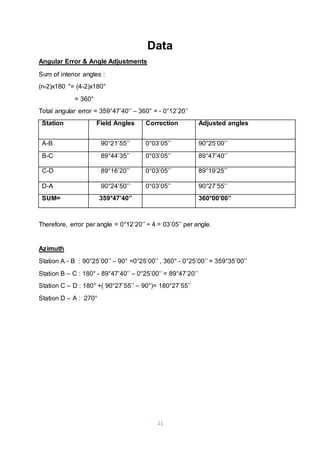
Sum of interior angles :
(n-2)x180 °= (4-2)x180°
= 360°
Total angular error = 359°47’40’’ – 360° = - 0°12’20’’
Station Field Angles Correction Adjusted angles
A-B 90°21’55’’ 0°03’05’’ 90°25’00’’
B-C 89°44’35’’ 0°03’05’’ 89°47’40’’
C-D 89°16’20’’ 0°03’05’’ 89°19’25’’
D-A 90°24’50’’ 0°03’05’’ 90°27’55’’
SUM= 359°47’40’’ 360°00’00’’
Therefore, error per angle = 0°12’20’’ ÷ 4 = 03’05’’ per angle.
Azimuth
Station A - B : 90°25’00’’ – 90° =0°25’00’’ , 360° - 0°25’00’’ = 359°35’00’’
Station B – C : 180° - 89°47’40’’ – 0°25’00’’ = 89°47’20’’
Station C – D : 180° +( 90°27’55’’ – 90°)= 180°27’55’’
Station D – A : 270°
12
Data
Adjusted data
B C
89°47’40’’ 89°19’25’’
90°25’00’’ 90°27’55’’
A D
Computations for latitude and departure.
Accuracy = 1 : (P/Ec) , typical = 1:3000
Ec = [(sum of latitude)² + (sum of departure)² ]^½
P = Total Length
Accuracy = 1 : (132.22 / 0.038) = 1 : 3442.
Therefore , the traversing is acceptable.
Length Cos Sin Latitude Departure
Station Bearing L(m) Cos θ Sin θ L Cos θ L Sin θ
A-B N 0°25’00’’ W 51.54 1.000 0.007 +51.54 -0.361
B-C N 89°47’20’’ E 14.93 0.004 1.000 +0.060 +14.93
C-D S 0°27’55’’ W 51.57 1.000 0.008 -51.57 -0.413
D-A N 90°00’00’’ W 14.18 0.000 1.000 +0.000 -14.18
Total 132.22 0.03 -0.024
13
Data
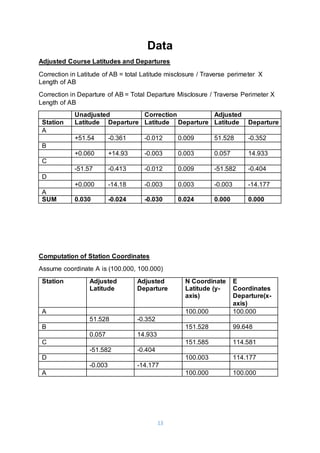
Adjusted Course Latitudes and Departures
Correction in Latitude of AB = total Latitude misclosure / Traverse perimeter X
Length of AB
Correction in Departure of AB = Total Departure Misclosure / Traverse Perimeter X
Length of AB
Unadjusted Correction Adjusted
Station Latitude Departure Latitude Departure Latitude Departure
A
+51.54 -0.361 -0.012 0.009 51.528 -0.352
B
+0.060 +14.93 -0.003 0.003 0.057 14.933
C
-51.57 -0.413 -0.012 0.009 -51.582 -0.404
D
+0.000 -14.18 -0.003 0.003 -0.003 -14.177
A
SUM 0.030 -0.024 -0.030 0.024 0.000 0.000
Computation of Station Coordinates
Assume coordinate A is (100.000, 100.000)
Station Adjusted
Latitude
Adjusted
Departure
N Coordinate
Latitude (y-
axis)
E
Coordinates
Departure(x-
axis)
A 100.000 100.000
51.528 -0.352
B 151.528 99.648
0.057 14.933
C 151.585 114.581
-51.582 -0.404
D 100.003 114.177
-0.003 -14.177
A 100.000 100.000
14
Conclusion
Traversing is the second and final fieldwork of Site Surveying and although
this fieldwork was much more challenging as compared to the first fieldwork, which is
levelling, we managed to obtain the data in the first try. From this fieldwork, we have
learned about the correct way to use the traversing instruments, such as the
theodolite and the levelling staff.
While carryout this fieldwork, we had some problems while using the
theodolite as the spirit bubble on the theodolite was very sensitive, hence, setting up
the theodolite took up a lot of time as there were also several other steps apart from
adjusting the spirit bubble on the theodolite. However, Mr Chai gave us some
advices and also taught us about the fastest and most accurate way to adjust the
theodolite. Other than that, we took our readings on the levelling staff correctly as
well as the reading on the theodolite itself and we managed to obtain a final answer
with an acceptable error.
In conclusion, carrying out the fieldwork has allowed us to gain some
experience on traversing that will definitely benefit us while we work in the future.
15
Reference
http://ecology.lifescience.ntu.edu.tw/course_932_ecology/Lab/TraverseMeasurement
.pdf
http://surveying.structural-analyser.com/chapter07/
https://en.wikipedia.org/wiki/Traverse_(surveying)
http://www.johnsonlevel.com/News/TheodolitesAllAboutTheodo
http://www.wisegeek.com/what-is-a-theodolite.htm
https://en.wikipedia.org/wiki/Tribrach_(instrument)
https://en.wikipedia.org/wiki/Tripod_(surveying)
https://en.wikipedia.org/wiki/Spirit_level
https://en.wikipedia.org/wiki/Plumb_bob
http://www.ehow.com/how_2120279_use-plumb-bob.html
http://www.bobvila.com/articles/495-the-plumb-bob/#.VlwZQPkrLWI
https://en.wikipedia.org/wiki/Tape_(surveying)
https://en.wikipedia.org/wiki/Measuring_rod
http://www.engineersupply.com/measuring-rod-rulers.aspx
http://www.fao.org/docrep/r7021e/r7021e02.htm
http://www.slideshare.net/bellakhoo/site-surveying-report-traversing
http://www.slideshare.net/enochwong7/fieldwork-2-50293334
http://www.slideshare.net/Haziq1511/site-surveying-report-2-42339915
http://www.slideshare.net/x3HwaN/site-surveying-report-ii

ABC Report - 123 (gathered with reference)

  • 1.
    1 School of Architecture,Building & Design Bachelor of Quantity Surveying (Honours) Fieldwork Report - Leveling Names Student ID Marks Andrew Mah Koon Yan 0318798 Chong Kai Xiang 0322935 Chuang Jing 0322934 Darren Loong Chi Yoong 0318029 Lecturer : Mr. Chai Voon Chiet Comments : (marking purposes)
  • 2.
    2 Index Cover Page ………………….……………………1 Index………………………….…………............. 2 Introduction ...……………………………………. 3 Objective …………………………………………. 3 Traverse ………..………………………………… 4 Apparatus ………………………………………… 6 Site & Procedure ………………………………… 8 Data ……………………………………………… 10 Conclusion ………………………………………. 14 Reference ……………………………………….. 15
  • 3.
    3 Introduction A group ofstudents were grouped together for this fieldwork report completion. There are 4 students which are Andrew Mah Koon Yan, Chong Kai Xiang, Chuang Jing, and Darren Loong Chi Yoong, all from the same tutorial group. In this fieldwork, we were taught theoretically by our lecturer, Mr. Chai, how to use the Theodolites. After practising, we are then required to obtain the traversing results and type a report out with the obtained data and information. Objective The objectives of carrying out this fieldwork on traversing is: 1. To develop knowledge about the use and application of the traversing instruments. 2. To learn how to interpret the data obtained and make adjustments and analyzing the data. 3. To determine the error of misclosure in order to determine whether the traversing is acceptable or not. 4. To learn about the correct method to use the traversing instruments.
  • 4.
    4 Introduction to Traversing Whatis Traverse? Traverse is a series of lines connected by points. The points that connect to form a line is called traverse stations; the lines between points is called courses. The length and azimuths or bearings of traverse stations are measured through field measurements; the angles at the traverse stations are measured by tape, transit, theodolite, compass, plane table, or sextant. In surveying, the purpose of traversing is used to: 1. Determine the length, direction and angles of a site area 2. Locate the site area with minimized mistake 3. Site planning, preparation for engineering works and others related works.
  • 5.
    5 Introduction to Traversing Typesof Traverse 1. Open Traverse Starts at a known point and terminates at an unknown position. It end without closure. Usually used on route surveys (ex. long narrow strip of land). 2. Close Traverse There are two types of close traverse: Loop Traverse: Starts at a known point and terminates at that point Connecting Traverse: Starts at a known point and terminates at another known point. Usually used on large areas survey (ex. Lakes, wood). Figure: Loop Traverse Figure: Connecting Traverse
  • 6.
    6 Apparatus of Traverse Theodolite Abasic surveying instrument which used to determine relative position, depth by measuring horizontal/vertical angles, directions, distances etc. It’s mounted on an tripod. Tribrach/ Optical Plummet A detachable plate used to attach surveying instrument such as theodolites, total station etc. It is equipped with a horizontal bubble level for levelling and optical plummet for setting up precisely on a survey mark. Tripod A stand used to mounts a surveying instrument. Surveyor will press down the legs’ platforms to securely force the feet to a low position on uneven ground. Leg lengths are adjusted to bring the tripod head to a convenient height and make it roughly level. Horizontal bubble level / Bull’s eye level / Spirit level A small device used to indicate the horizontal level or vertical plumb. It has a curved glass vials. At slight inclinations the bubble travels away from the marked center position.
  • 7.
    7 Apparatus of Traverse Plumbbob An ancient tool which has a pointed metal bottom that is suspended from a string. It is widely used until now to ensure the construction is plumb or vertical. It is also used to set the surveying instrument vertically. When the plumb bob is hanging free and not moving, the object is vertical. Measuring pole / Measuring rod ruler / Height sticks A straight lath indicating centimetres, decimetres and metres with a length varying from 2 m to 5 m. Some measuring poles are basically surveying rods used for elevation grade work that have a built-in dual-purpose feature which is a measuring scale on the back; some of these are only built as Measuring Rulers with no grade or level rod capability and are used solely for measuring heights. Ranging pole A coloured rod with a length of 2m that used to trace out areas and set out connecting lines on the field. It mark points on the ground that must be seen from distance. Measuring Tape A fibre or plastic flexible ruler usually comes in 20, 30, 50m to measuring horizontal, vertical or slope distances on the field. Centimetres, decimetres and metres are indicated on the tape.
  • 8.
    8 Site and Procedure Site(of our fieldwork) Location: Carpark Zone F, Taylor’s University Lakeside Campus Malaysia Figure 1. Taylor’s University Lakeside Campus Site Drawing (Fieldwork position) Figure 2. Carpark Zone F plan (Fieldwork position) D A B C
  • 9.
    9 Site and Procedure Procedure Traversefield work consists of the following steps: 1. Select station positions as close as possible to the objects to be located. – Position A, B, C, D as shown in figure 2. 2. Mark the stations A, B, C, D with stones set flush with the ground with a precise point marked. 3. Theodolites and tripod are set properly on position A. 4. Measuring rods are then hold by each person on D & B. 5. Make angle and distance measurements. 6. The reading of angle <BAD and distance between A-D and A-B is observed and recorded. 7. Step 3 – 6 are continued until a loop is formed and every angles and distances are completely recorded. 8. Check for mistakes of the recorded data. 9. The data is gathered and organised properly for the data to be key-in.
  • 10.
    10 Data Field data 14.93m B C 89°44’35’’89°16’20’’ 51.54m 51.57m 90°21’55’’ 90°24’50’’ A D 14.18m (not to scale) Station Field Angles A 90°21’55’’ B 89°44’35’’ 3C 89°16’20’’ D 90°24’50’’ SUM 359°47’40’’
  • 11.
    11 Data Angular Error &Angle Adjustments Sum of interior angles : (n-2)x180 °= (4-2)x180° = 360° Total angular error = 359°47’40’’ – 360° = - 0°12’20’’ Station Field Angles Correction Adjusted angles A-B 90°21’55’’ 0°03’05’’ 90°25’00’’ B-C 89°44’35’’ 0°03’05’’ 89°47’40’’ C-D 89°16’20’’ 0°03’05’’ 89°19’25’’ D-A 90°24’50’’ 0°03’05’’ 90°27’55’’ SUM= 359°47’40’’ 360°00’00’’ Therefore, error per angle = 0°12’20’’ ÷ 4 = 03’05’’ per angle. Azimuth Station A - B : 90°25’00’’ – 90° =0°25’00’’ , 360° - 0°25’00’’ = 359°35’00’’ Station B – C : 180° - 89°47’40’’ – 0°25’00’’ = 89°47’20’’ Station C – D : 180° +( 90°27’55’’ – 90°)= 180°27’55’’ Station D – A : 270°
  • 12.
    12 Data Adjusted data B C 89°47’40’’89°19’25’’ 90°25’00’’ 90°27’55’’ A D Computations for latitude and departure. Accuracy = 1 : (P/Ec) , typical = 1:3000 Ec = [(sum of latitude)² + (sum of departure)² ]^½ P = Total Length Accuracy = 1 : (132.22 / 0.038) = 1 : 3442. Therefore , the traversing is acceptable. Length Cos Sin Latitude Departure Station Bearing L(m) Cos θ Sin θ L Cos θ L Sin θ A-B N 0°25’00’’ W 51.54 1.000 0.007 +51.54 -0.361 B-C N 89°47’20’’ E 14.93 0.004 1.000 +0.060 +14.93 C-D S 0°27’55’’ W 51.57 1.000 0.008 -51.57 -0.413 D-A N 90°00’00’’ W 14.18 0.000 1.000 +0.000 -14.18 Total 132.22 0.03 -0.024
  • 13.
    13 Data Adjusted Course Latitudesand Departures Correction in Latitude of AB = total Latitude misclosure / Traverse perimeter X Length of AB Correction in Departure of AB = Total Departure Misclosure / Traverse Perimeter X Length of AB Unadjusted Correction Adjusted Station Latitude Departure Latitude Departure Latitude Departure A +51.54 -0.361 -0.012 0.009 51.528 -0.352 B +0.060 +14.93 -0.003 0.003 0.057 14.933 C -51.57 -0.413 -0.012 0.009 -51.582 -0.404 D +0.000 -14.18 -0.003 0.003 -0.003 -14.177 A SUM 0.030 -0.024 -0.030 0.024 0.000 0.000 Computation of Station Coordinates Assume coordinate A is (100.000, 100.000) Station Adjusted Latitude Adjusted Departure N Coordinate Latitude (y- axis) E Coordinates Departure(x- axis) A 100.000 100.000 51.528 -0.352 B 151.528 99.648 0.057 14.933 C 151.585 114.581 -51.582 -0.404 D 100.003 114.177 -0.003 -14.177 A 100.000 100.000
  • 14.
    14 Conclusion Traversing is thesecond and final fieldwork of Site Surveying and although this fieldwork was much more challenging as compared to the first fieldwork, which is levelling, we managed to obtain the data in the first try. From this fieldwork, we have learned about the correct way to use the traversing instruments, such as the theodolite and the levelling staff. While carryout this fieldwork, we had some problems while using the theodolite as the spirit bubble on the theodolite was very sensitive, hence, setting up the theodolite took up a lot of time as there were also several other steps apart from adjusting the spirit bubble on the theodolite. However, Mr Chai gave us some advices and also taught us about the fastest and most accurate way to adjust the theodolite. Other than that, we took our readings on the levelling staff correctly as well as the reading on the theodolite itself and we managed to obtain a final answer with an acceptable error. In conclusion, carrying out the fieldwork has allowed us to gain some experience on traversing that will definitely benefit us while we work in the future.
  • 15.
    15 Reference http://ecology.lifescience.ntu.edu.tw/course_932_ecology/Lab/TraverseMeasurement .pdf http://surveying.structural-analyser.com/chapter07/ https://en.wikipedia.org/wiki/Traverse_(surveying) http://www.johnsonlevel.com/News/TheodolitesAllAboutTheodo http://www.wisegeek.com/what-is-a-theodolite.htm https://en.wikipedia.org/wiki/Tribrach_(instrument) https://en.wikipedia.org/wiki/Tripod_(surveying) https://en.wikipedia.org/wiki/Spirit_level https://en.wikipedia.org/wiki/Plumb_bob http://www.ehow.com/how_2120279_use-plumb-bob.html http://www.bobvila.com/articles/495-the-plumb-bob/#.VlwZQPkrLWI https://en.wikipedia.org/wiki/Tape_(surveying) https://en.wikipedia.org/wiki/Measuring_rod http://www.engineersupply.com/measuring-rod-rulers.aspx http://www.fao.org/docrep/r7021e/r7021e02.htm http://www.slideshare.net/bellakhoo/site-surveying-report-traversing http://www.slideshare.net/enochwong7/fieldwork-2-50293334 http://www.slideshare.net/Haziq1511/site-surveying-report-2-42339915 http://www.slideshare.net/x3HwaN/site-surveying-report-ii