P a g e 1 | 20
SCHOOL OF ARCHITECTURE, BUILDING AND DESIGN
BACHELOR OF QUANTITY SURVEYING (HONOURS)
QSB60103 - SITE SURVEYING
Fieldwork 2 Report
Traversing
NAME STUDENT ID MARKS
Nicholas Wong Chin Khai 0331773
Ngiam Lok Yee 0327695
Orlando Wong Kueng Khung 0331859
Khairi Fariz Bin Modh Fiesal 0331177
P a g e 2 | 20
Table of Content
Content Page
Cover page 1
Table of content 2
1.0 Introduction 3-5
1.1 Open traverse
1.2 Closed traverse
1.3 Traversestation
1.4 Terms used
2.0 Instruments 5-6
3.0 Objective 7
4.0 Field data 8-15
4.1 Compute the angular error and adjustthe angles.
4.2 Calculate the horizontaland vertical distance
between the survey pointand the theodolite.
4.3 Coursebearing and azimuth.
4.4 Compute latitude and departure.
4.5 Determine the error of closure.
5.0 Adjusted CourseLatitude and Departure 16-17
6.0 Table & Graph of Station Coordinates 18-19
7.0 Conclusion 20
P a g e 3 | 20
1.0 Introduction
This report will be focusing on traversing fieldwork assigned to the students by our lecturer,
Mr Chai.
A traverse is usually a control survey and is employed in all forms of legal, mapping, and
engineering surveys. Traverse survey is a method of establishing control points, their
positions being determined by measuring the distances between the traverse stations which
serve as control points and the angles subtended at the various stations by their adjacent
stations. The angles are measured using theodolites, or total stations, whereas the distances
can be measured using total stations, steel tapes or electronic distance-measurement
instruments (EDM’s).
There are two types of Traverse which are Open Traverse, and Closed Traverse which are
defined as such in the following.
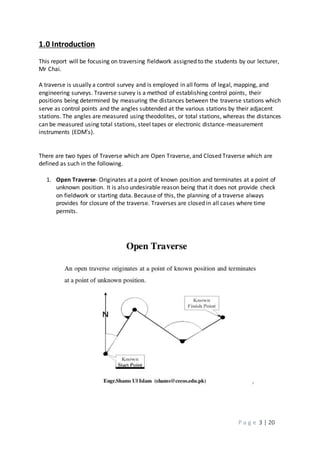
1. Open Traverse- Originates at a point of known position and terminates at a point of
unknown position. It is also undesirable reason being that it does not provide check
on fieldwork or starting data. Because of this, the planning of a traverse always
provides for closure of the traverse. Traverses are closed in all cases where time
permits.
P a g e 4 | 20
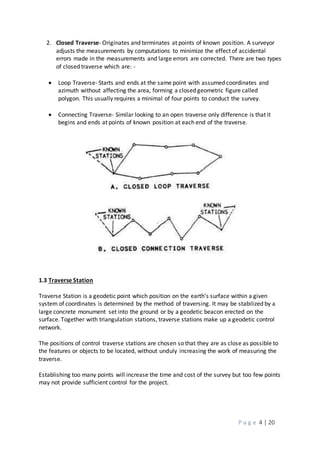
2. Closed Traverse- Originates and terminates at points of known position. A surveyor
adjusts the measurements by computations to minimize the effect of accidental
errors made in the measurements and large errors are corrected. There are two types
of closed traverse which are: -
 Loop Traverse- Starts and ends at the same point with assumed coordinates and
azimuth without affecting the area, forming a closed geometric figure called
polygon. This usually requires a minimal of four points to conduct the survey.
 Connecting Traverse- Similar looking to an open traverse only difference is that it
begins and ends at points of known position at each end of the traverse.
1.3 Traverse Station
Traverse Station is a geodetic point which position on the earth’s surface within a given
system of coordinates is determined by the method of traversing. It may be stabilized by a
large concrete monument set into the ground or by a geodetic beacon erected on the
surface. Together with triangulation stations, traverse stations make up a geodetic control
network.
The positions of control traverse stations are chosen so that they are as close as possible to
the features or objects to be located, without unduly increasing the work of measuring the
traverse.
Establishing too many points will increase the time and cost of the survey but too few points
may not provide sufficient control for the project.
P a g e 5 | 20
1.4 Terms used
Azimuth
 Azimuth is defined as horizontal angle turned from the reference line, in a clockwise
motion. When one refers to azimuth, it is a determination of a direction with the use
of a compass. The reference is North, which is 0° or 360°
Bearing
 Bearings is any acute angles that is less than 90°. It is referenced from north or south
and the angle to the east or west from the north-south meridian, and the true
bearings are based on true north.
2.0 Instruments
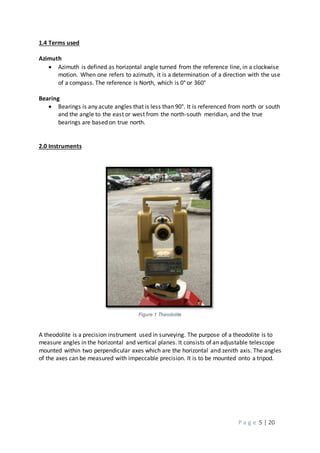
Figure 1 Theodolite
A theodolite is a precision instrument used in surveying. The purpose of a theodolite is to
measure angles in the horizontal and vertical planes. It consists of an adjustable telescope
mounted within two perpendicular axes which are the horizontal and zenith axis. The angles
of the axes can be measured with impeccable precision. It is to be mounted onto a tripod.
P a g e 6 | 20
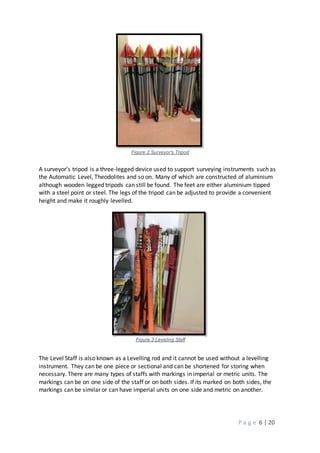
Figure 2 Surveyor's Tripod
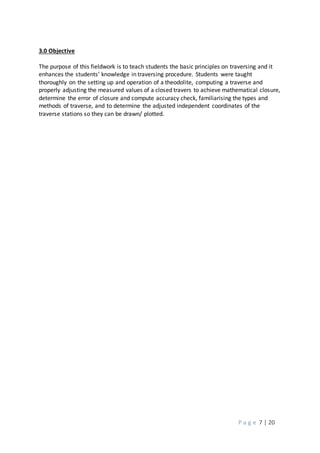
Figure 3 Leveling Staff
A surveyor’s tripod is a three-legged device used to support surveying instruments such as
the Automatic Level, Theodolites and so on. Many of which are constructed of aluminium
although wooden legged tripods can still be found. The feet are either aluminium tipped
with a steel point or steel. The legs of the tripod can be adjusted to provide a convenient
height and make it roughly levelled.
The Level Staff is also known as a Levelling rod and it cannot be used without a levelling
instrument. They can be one piece or sectional and can be shortened for storing when
necessary. There are many types of staffs with markings in imperial or metric units. The
markings can be on one side of the staff or on both sides. If its marked on both sides, the
markings can be similar or can have imperial units on one side and metric on another.
P a g e 7 | 20
3.0 Objective
The purpose of this fieldwork is to teach students the basic principles on traversing and it
enhances the students’ knowledge in traversing procedure. Students were taught
thoroughly on the setting up and operation of a theodolite, computing a traverse and
properly adjusting the measured values of a closed travers to achieve mathematical closure,
determine the error of closure and compute accuracy check, familiarising the types and
methods of traverse, and to determine the adjusted independent coordinates of the
traverse stations so they can be drawn/ plotted.
P a g e 8 | 20
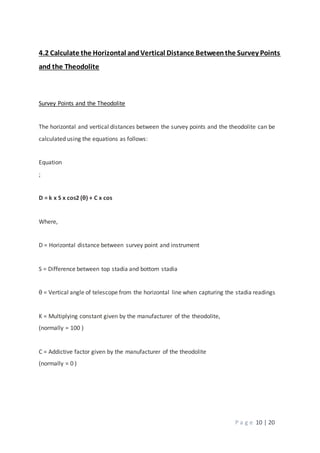
4.0 FieldData
Station Field Angles
A 51°29’20’’
B 147°41’20’’
C 80°19’30’’
D 79°40’50’’
Sum 359°11’00’’
A
C
B
D
51°29’20’’
147°41’20’’
80°19’30’’
79°40’50’’
36.79m
30.74m
44.74m
Field Data
Unadjusted
P a g e 9 | 20
4.1 Compute the angular error and adjust the angles
The sum of the interior angles in any loop must be equal (n - 2)(180°) for geometric
consistency ;
Sum of interior angle = (n - 2)(180º)
= (4 - 2)(180º)
= 360º
Total angular error = 360º 00’ 00’’ - 359º 11’ 0’’
= 0º 49’ 0’’
Error per angle = 0º 49’ 0’’ / 4
= 0º 12’ 15’’
Station Angles Correction Adjusted Angles
A 51°29’20’’ + 0º 12’ 15’’ 51°41’35’’
B 147°41’20’’ + 0º 12’ 15’’ 147°53’35’’
C 80°19’30’’ + 0º 12’ 15’’ 80°31’45’’
D 79°40’50’’ + 0º 12’ 15’’ 79°53’5’’
Sum 359°11’00’’ 360°00’00’’
P a g e 10 | 20
4.2 Calculate the Horizontal andVertical Distance Betweenthe Survey Points
and the Theodolite
Survey Points and the Theodolite
The horizontal and vertical distances between the survey points and the theodolite can be
calculated using the equations as follows:
Equation
;
D = k x S x cos2 (θ) + C x cos
Where,
D = Horizontal distance between survey point and instrument
S = Difference between top stadia and bottom stadia
θ = Vertical angle of telescope from the horizontal line when capturing the stadia readings
K = Multiplying constant given by the manufacturer of the theodolite,
(normally = 100 )
C = Addictive factor given by the manufacturer of the theodolite
(normally = 0 )
P a g e 11 | 20
Top Stadia : 1.857
Bottom Stadia : 1.735
Top Stadia : 1.856
Bottom Stadia : 1.735
Distance A-B = [ (K x s x Cos² θ) + ( C x Cos θ )
= [ 100 x (1.857-1.735) 0.9971 ] + (0 x Cos θ)
= 12.165m
Top Stadia : 1.859
Bottom Stadia : 1.735
Top Stadia : 1.860
Bottom Stadia : 1.735
Distance B-A = [ (K x s x Cos² θ) + ( C x Cos θ )
= [ 100 x (1.860-1.735) 0.9988 ] + (0 x Cos θ)
= 12.485m
Top Stadia : 1.988
Bottom Stadia : 1.623
Top Stadia : 1.989
Bottom Stadia : 1.623
Distance B-C = [ (K x s x Cos² θ) + ( C x Cos θ )
= [ 100 x (1.989-1.623) 0.9999 ] + (0 x Cos θ)
= 36.596m
Top Stadia : 1.993
Bottom Stadia : 1.624
Top Stadia : 1.994
Bottom Stadia : 1.624
Distance C-B = [ (K x s x Cos² θ) + ( C x Cos θ )
= [ 100 x (1.994-1.624) 0.9999 ] + (0 x Cos θ)
= 36.996m
P a g e 12 | 20
Top Stadia : 1.994
Bottom Stadia : 1.685
Top Stadia : 1.995
Bottom Stadia : 1.685
Distance C-D = [ (K x s x Cos² θ) + ( C x Cos θ )
= [ 100 x (1.995-1.685) 0.9996 ] + (0 x Cos θ)
= 30.988m
Top Stadia : 1.990
Bottom Stadia : 1.685
Top Stadia : 1.990
Bottom Stadia : 1.684
Distance D-C = [ (K x s x Cos² θ) + ( C x Cos θ )
= [ 100 x (1.990-1.685) 0.9996 ] + (0 x Cos θ)
= 30.488m
Top Stadia : 2.019
Bottom Stadia : 1.573
Top Stadia : 2.019
Bottom Stadia : 1.573
Distance D-A = [ (K x s x Cos² θ) + ( C x Cos θ )
= [ 100 x (2.019-1.573) 0.9998 ] + (0 x Cos θ)
= 44.591m
Top Stadia : 2.020
Bottom Stadia : 1.574
Top Stadia : 2.026
Bottom Stadia : 1.574
Distance A-D = [ (K x s x Cos² θ) + ( C x Cos θ )
= [ 100 x (2.023-1.574) 0.9999 ] + (0 x Cos θ)
= 44.896m
P a g e 13 | 20
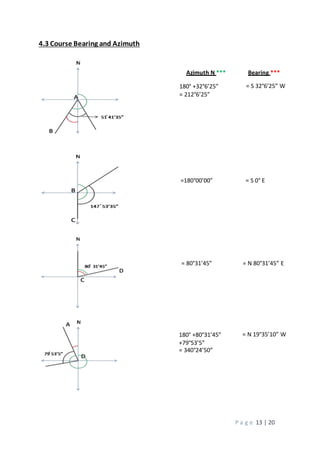
4.3 Course Bearing and Azimuth
Azimuth N *** Bearing ***
180° +32°6’25”
= 212°6’25”
= S 32°6’25” W
=180°00’00” = S 0° E
= 80°31’45” = N 80°31’45” E
180° +80°31’45”
+79°53’5”
= 340°24’50”
= N 19°35’10” W
P a g e 14 | 20
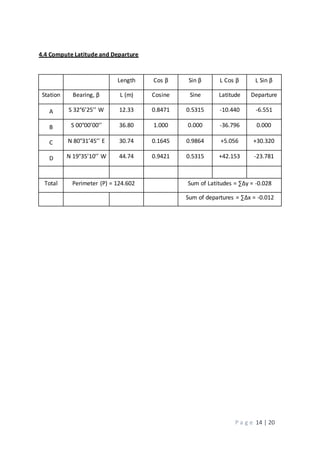
4.4 Compute Latitude and Departure
Length Cos β Sin β L Cos β L Sin β
Station Bearing, β L (m) Cosine Sine Latitude Departure
A S 32°6’25’’ W 12.33 0.8471 0.5315 -10.440 -6.551
B S 00°00’00’’ 36.80 1.000 0.000 -36.796 0.000
C N 80°31’45’’ E 30.74 0.1645 0.9864 +5.056 +30.320
D N 19°35’10’’ W 44.74 0.9421 0.5315 +42.153 -23.781
Total Perimeter (P) = 124.602 Sum of Latitudes = ∑∆y = -0.028
Sum of departures = ∑∆x = -0.012
P a g e 15 | 20
4.5 Determine The Error of Closure
Accuracy = 1 : (P/Ec)
Ec = [(sum of latitude)² + (sumof departure)²]^½
= [(-0.028) ²+(-0.012) ²]^ ½
= 0.0305 m
Therefore, the accuracy is = 1 : ( 124.602/0.0305)
= 1 : 4085.3115
= 1 : 4085
For average land surveying an accuracy of about 1 : 3000 is typical.
Hence, the accuracy of field is acceptable.
Error in departure ∑∆x = -0.012m
Error in latitude ∑∆y = -0.028m
Total Error = 0.030m
P a g e 16 | 20
5.0 Adjusted Course Latitude and Departure
The Compass Pule
Correction = - [ΣΔy] / P x L or - [ΣΔx] / P x L
Where,
∑∆y and ∑∆x = the error in latitude or in departure
P = the total length or perimeter of the traverse
L = the length of a particular course
Latitude Correction
The correction to the latitude of course AB is
- (-0.028/124.602) × 12.325 = 0.0028
The correction to the latitude of course BC is
- (-0.028/124.602) x 36.796 = 0.0083
The correction to the latitude of course CD is
- (-0.028/124.602) x 30.738 = 0.0069
The correction to the latitude of course DA is
- (-0.028/124.602) x 44.743 = 0.0101
Departure Correction
The correction to the departure of course AB is
- (-0.012/124.602) × 12.325 = 0.0012
The correction to the departure of course BC is
- (-0.012/124.602) x 36.796 = 0.0035
The correction to the departure of course CD is
- (-0.012/124.602) x 30.738 = 0.0030
The correction to the departure of course DA is
- (-0.012/124.602) x 44.743 = 0.0043
P a g e 17 | 20
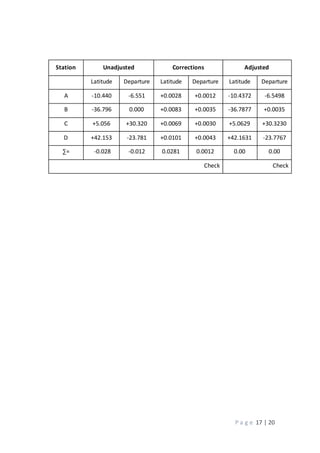
Station Unadjusted Corrections Adjusted
Latitude Departure Latitude Departure Latitude Departure
A -10.440 -6.551 +0.0028 +0.0012 -10.4372 -6.5498
B -36.796 0.000 +0.0083 +0.0035 -36.7877 +0.0035
C +5.056 +30.320 +0.0069 +0.0030 +5.0629 +30.3230
D +42.153 -23.781 +0.0101 +0.0043 +42.1631 -23.7767
∑= -0.028 -0.012 0.0281 0.0012 0.00 0.00
Check Check
P a g e 18 | 20
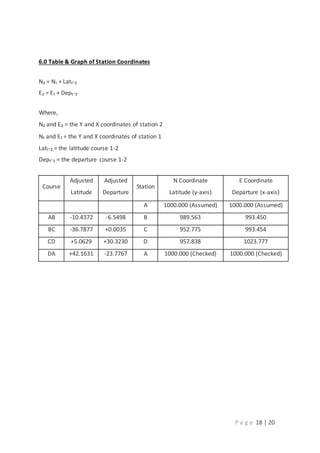
6.0 Table & Graph of Station Coordinates
N₂ = N₁ + Lat₁-₂
E₂ = E₁ + Dep₁-₂
Where,
N₂ and E₂ = the Y and X coordinates of station 2
N₁ and E₁ = the Y and X coordinates of station 1
Lat₁-₂ = the latitude course 1-2
Dep₁-₂ = the departure course 1-2
Course
Adjusted
Latitude
Adjusted
Departure
Station
N Coordinate
Latitude (y-axis)
E Coordinate
Departure (x-axis)
A 1000.000 (Assumed) 1000.000 (Assumed)
AB -10.4372 -6.5498 B 989.563 993.450
BC -36.7877 +0.0035 C 952.775 993.454
CD +5.0629 +30.3230 D 957.838 1023.777
DA +42.1631 -23.7767 A 1000.000 (Checked) 1000.000 (Checked)
P a g e 19 | 20
FIGURE The adjusted loop traverse plotted by coordinates.
Area = ½ x {[(EAxNB)+(EBxNC)+(ECxND)+(EDxNA)] -[(NAxEB)+(NBxEC)+(NCxED)+(NDxEA)]}
Area = ½ x {[(1000x989.563)+(993.450x952.775)+(993.454x957.838)+(1023.777)] –
[(1000x993.450)+(989.563x993.454)+(952.775x1023.777)+(957.838x1000)]}
= 819.932
P a g e 20 | 20
Figure 4 Group Photo
7.0 Conclusion
To conclude this report, a closed loop traverse survey was carried out at the given
points A, B, C, and D within the perimeter of Taylor’s University carpark. The closed loop
traverse starts and ends at the same point forming a polygon. We utilized the theodolite to
measure the angles of the four points/ stations as data. When the theodolite was placed at
point A, the angle was achieved by reading the theodolite through point D to B in a
clockwise manner because the angles must be taken from left to right to obtain an accurate
reading. We repeated the process at every given point/ station to obtain the angles. We also
recorded the vertical and horizontal angles that were previewed on the theodolite. Along
with that, the top, middle and bottom stadia readings were taken as well to be able to
calculate the horizontal and vertical distances between the survey points. Furthermore, the
error in latitude is -0.028 and the error in departure is -0.012. The error of closure is 0.0305.
By using the formula to calculate the accuracy of our traverse survey, the accuracy is 1: 4085
which is acceptable.
From our understanding, surveying is required to be able to build levelled buildings
and structures, to determine the boundaries of a property/ land, etc. This can be done with
the proper instruments and knowledge in the surveying field.

Site survey report 2

  • 1.
    P a ge 1 | 20 SCHOOL OF ARCHITECTURE, BUILDING AND DESIGN BACHELOR OF QUANTITY SURVEYING (HONOURS) QSB60103 - SITE SURVEYING Fieldwork 2 Report Traversing NAME STUDENT ID MARKS Nicholas Wong Chin Khai 0331773 Ngiam Lok Yee 0327695 Orlando Wong Kueng Khung 0331859 Khairi Fariz Bin Modh Fiesal 0331177
  • 2.
    P a ge 2 | 20 Table of Content Content Page Cover page 1 Table of content 2 1.0 Introduction 3-5 1.1 Open traverse 1.2 Closed traverse 1.3 Traversestation 1.4 Terms used 2.0 Instruments 5-6 3.0 Objective 7 4.0 Field data 8-15 4.1 Compute the angular error and adjustthe angles. 4.2 Calculate the horizontaland vertical distance between the survey pointand the theodolite. 4.3 Coursebearing and azimuth. 4.4 Compute latitude and departure. 4.5 Determine the error of closure. 5.0 Adjusted CourseLatitude and Departure 16-17 6.0 Table & Graph of Station Coordinates 18-19 7.0 Conclusion 20
  • 3.
    P a ge 3 | 20 1.0 Introduction This report will be focusing on traversing fieldwork assigned to the students by our lecturer, Mr Chai. A traverse is usually a control survey and is employed in all forms of legal, mapping, and engineering surveys. Traverse survey is a method of establishing control points, their positions being determined by measuring the distances between the traverse stations which serve as control points and the angles subtended at the various stations by their adjacent stations. The angles are measured using theodolites, or total stations, whereas the distances can be measured using total stations, steel tapes or electronic distance-measurement instruments (EDM’s). There are two types of Traverse which are Open Traverse, and Closed Traverse which are defined as such in the following. 1. Open Traverse- Originates at a point of known position and terminates at a point of unknown position. It is also undesirable reason being that it does not provide check on fieldwork or starting data. Because of this, the planning of a traverse always provides for closure of the traverse. Traverses are closed in all cases where time permits.
  • 4.
    P a ge 4 | 20 2. Closed Traverse- Originates and terminates at points of known position. A surveyor adjusts the measurements by computations to minimize the effect of accidental errors made in the measurements and large errors are corrected. There are two types of closed traverse which are: -  Loop Traverse- Starts and ends at the same point with assumed coordinates and azimuth without affecting the area, forming a closed geometric figure called polygon. This usually requires a minimal of four points to conduct the survey.  Connecting Traverse- Similar looking to an open traverse only difference is that it begins and ends at points of known position at each end of the traverse. 1.3 Traverse Station Traverse Station is a geodetic point which position on the earth’s surface within a given system of coordinates is determined by the method of traversing. It may be stabilized by a large concrete monument set into the ground or by a geodetic beacon erected on the surface. Together with triangulation stations, traverse stations make up a geodetic control network. The positions of control traverse stations are chosen so that they are as close as possible to the features or objects to be located, without unduly increasing the work of measuring the traverse. Establishing too many points will increase the time and cost of the survey but too few points may not provide sufficient control for the project.
  • 5.
    P a ge 5 | 20 1.4 Terms used Azimuth  Azimuth is defined as horizontal angle turned from the reference line, in a clockwise motion. When one refers to azimuth, it is a determination of a direction with the use of a compass. The reference is North, which is 0° or 360° Bearing  Bearings is any acute angles that is less than 90°. It is referenced from north or south and the angle to the east or west from the north-south meridian, and the true bearings are based on true north. 2.0 Instruments Figure 1 Theodolite A theodolite is a precision instrument used in surveying. The purpose of a theodolite is to measure angles in the horizontal and vertical planes. It consists of an adjustable telescope mounted within two perpendicular axes which are the horizontal and zenith axis. The angles of the axes can be measured with impeccable precision. It is to be mounted onto a tripod.
  • 6.
    P a ge 6 | 20 Figure 2 Surveyor's Tripod Figure 3 Leveling Staff A surveyor’s tripod is a three-legged device used to support surveying instruments such as the Automatic Level, Theodolites and so on. Many of which are constructed of aluminium although wooden legged tripods can still be found. The feet are either aluminium tipped with a steel point or steel. The legs of the tripod can be adjusted to provide a convenient height and make it roughly levelled. The Level Staff is also known as a Levelling rod and it cannot be used without a levelling instrument. They can be one piece or sectional and can be shortened for storing when necessary. There are many types of staffs with markings in imperial or metric units. The markings can be on one side of the staff or on both sides. If its marked on both sides, the markings can be similar or can have imperial units on one side and metric on another.
  • 7.
    P a ge 7 | 20 3.0 Objective The purpose of this fieldwork is to teach students the basic principles on traversing and it enhances the students’ knowledge in traversing procedure. Students were taught thoroughly on the setting up and operation of a theodolite, computing a traverse and properly adjusting the measured values of a closed travers to achieve mathematical closure, determine the error of closure and compute accuracy check, familiarising the types and methods of traverse, and to determine the adjusted independent coordinates of the traverse stations so they can be drawn/ plotted.
  • 8.
    P a ge 8 | 20 4.0 FieldData Station Field Angles A 51°29’20’’ B 147°41’20’’ C 80°19’30’’ D 79°40’50’’ Sum 359°11’00’’ A C B D 51°29’20’’ 147°41’20’’ 80°19’30’’ 79°40’50’’ 36.79m 30.74m 44.74m Field Data Unadjusted
  • 9.
    P a ge 9 | 20 4.1 Compute the angular error and adjust the angles The sum of the interior angles in any loop must be equal (n - 2)(180°) for geometric consistency ; Sum of interior angle = (n - 2)(180º) = (4 - 2)(180º) = 360º Total angular error = 360º 00’ 00’’ - 359º 11’ 0’’ = 0º 49’ 0’’ Error per angle = 0º 49’ 0’’ / 4 = 0º 12’ 15’’ Station Angles Correction Adjusted Angles A 51°29’20’’ + 0º 12’ 15’’ 51°41’35’’ B 147°41’20’’ + 0º 12’ 15’’ 147°53’35’’ C 80°19’30’’ + 0º 12’ 15’’ 80°31’45’’ D 79°40’50’’ + 0º 12’ 15’’ 79°53’5’’ Sum 359°11’00’’ 360°00’00’’
  • 10.
    P a ge 10 | 20 4.2 Calculate the Horizontal andVertical Distance Betweenthe Survey Points and the Theodolite Survey Points and the Theodolite The horizontal and vertical distances between the survey points and the theodolite can be calculated using the equations as follows: Equation ; D = k x S x cos2 (θ) + C x cos Where, D = Horizontal distance between survey point and instrument S = Difference between top stadia and bottom stadia θ = Vertical angle of telescope from the horizontal line when capturing the stadia readings K = Multiplying constant given by the manufacturer of the theodolite, (normally = 100 ) C = Addictive factor given by the manufacturer of the theodolite (normally = 0 )
  • 11.
    P a ge 11 | 20 Top Stadia : 1.857 Bottom Stadia : 1.735 Top Stadia : 1.856 Bottom Stadia : 1.735 Distance A-B = [ (K x s x Cos² θ) + ( C x Cos θ ) = [ 100 x (1.857-1.735) 0.9971 ] + (0 x Cos θ) = 12.165m Top Stadia : 1.859 Bottom Stadia : 1.735 Top Stadia : 1.860 Bottom Stadia : 1.735 Distance B-A = [ (K x s x Cos² θ) + ( C x Cos θ ) = [ 100 x (1.860-1.735) 0.9988 ] + (0 x Cos θ) = 12.485m Top Stadia : 1.988 Bottom Stadia : 1.623 Top Stadia : 1.989 Bottom Stadia : 1.623 Distance B-C = [ (K x s x Cos² θ) + ( C x Cos θ ) = [ 100 x (1.989-1.623) 0.9999 ] + (0 x Cos θ) = 36.596m Top Stadia : 1.993 Bottom Stadia : 1.624 Top Stadia : 1.994 Bottom Stadia : 1.624 Distance C-B = [ (K x s x Cos² θ) + ( C x Cos θ ) = [ 100 x (1.994-1.624) 0.9999 ] + (0 x Cos θ) = 36.996m
  • 12.
    P a ge 12 | 20 Top Stadia : 1.994 Bottom Stadia : 1.685 Top Stadia : 1.995 Bottom Stadia : 1.685 Distance C-D = [ (K x s x Cos² θ) + ( C x Cos θ ) = [ 100 x (1.995-1.685) 0.9996 ] + (0 x Cos θ) = 30.988m Top Stadia : 1.990 Bottom Stadia : 1.685 Top Stadia : 1.990 Bottom Stadia : 1.684 Distance D-C = [ (K x s x Cos² θ) + ( C x Cos θ ) = [ 100 x (1.990-1.685) 0.9996 ] + (0 x Cos θ) = 30.488m Top Stadia : 2.019 Bottom Stadia : 1.573 Top Stadia : 2.019 Bottom Stadia : 1.573 Distance D-A = [ (K x s x Cos² θ) + ( C x Cos θ ) = [ 100 x (2.019-1.573) 0.9998 ] + (0 x Cos θ) = 44.591m Top Stadia : 2.020 Bottom Stadia : 1.574 Top Stadia : 2.026 Bottom Stadia : 1.574 Distance A-D = [ (K x s x Cos² θ) + ( C x Cos θ ) = [ 100 x (2.023-1.574) 0.9999 ] + (0 x Cos θ) = 44.896m
  • 13.
    P a ge 13 | 20 4.3 Course Bearing and Azimuth Azimuth N *** Bearing *** 180° +32°6’25” = 212°6’25” = S 32°6’25” W =180°00’00” = S 0° E = 80°31’45” = N 80°31’45” E 180° +80°31’45” +79°53’5” = 340°24’50” = N 19°35’10” W
  • 14.
    P a ge 14 | 20 4.4 Compute Latitude and Departure Length Cos β Sin β L Cos β L Sin β Station Bearing, β L (m) Cosine Sine Latitude Departure A S 32°6’25’’ W 12.33 0.8471 0.5315 -10.440 -6.551 B S 00°00’00’’ 36.80 1.000 0.000 -36.796 0.000 C N 80°31’45’’ E 30.74 0.1645 0.9864 +5.056 +30.320 D N 19°35’10’’ W 44.74 0.9421 0.5315 +42.153 -23.781 Total Perimeter (P) = 124.602 Sum of Latitudes = ∑∆y = -0.028 Sum of departures = ∑∆x = -0.012
  • 15.
    P a ge 15 | 20 4.5 Determine The Error of Closure Accuracy = 1 : (P/Ec) Ec = [(sum of latitude)² + (sumof departure)²]^½ = [(-0.028) ²+(-0.012) ²]^ ½ = 0.0305 m Therefore, the accuracy is = 1 : ( 124.602/0.0305) = 1 : 4085.3115 = 1 : 4085 For average land surveying an accuracy of about 1 : 3000 is typical. Hence, the accuracy of field is acceptable. Error in departure ∑∆x = -0.012m Error in latitude ∑∆y = -0.028m Total Error = 0.030m
  • 16.
    P a ge 16 | 20 5.0 Adjusted Course Latitude and Departure The Compass Pule Correction = - [ΣΔy] / P x L or - [ΣΔx] / P x L Where, ∑∆y and ∑∆x = the error in latitude or in departure P = the total length or perimeter of the traverse L = the length of a particular course Latitude Correction The correction to the latitude of course AB is - (-0.028/124.602) × 12.325 = 0.0028 The correction to the latitude of course BC is - (-0.028/124.602) x 36.796 = 0.0083 The correction to the latitude of course CD is - (-0.028/124.602) x 30.738 = 0.0069 The correction to the latitude of course DA is - (-0.028/124.602) x 44.743 = 0.0101 Departure Correction The correction to the departure of course AB is - (-0.012/124.602) × 12.325 = 0.0012 The correction to the departure of course BC is - (-0.012/124.602) x 36.796 = 0.0035 The correction to the departure of course CD is - (-0.012/124.602) x 30.738 = 0.0030 The correction to the departure of course DA is - (-0.012/124.602) x 44.743 = 0.0043
  • 17.
    P a ge 17 | 20 Station Unadjusted Corrections Adjusted Latitude Departure Latitude Departure Latitude Departure A -10.440 -6.551 +0.0028 +0.0012 -10.4372 -6.5498 B -36.796 0.000 +0.0083 +0.0035 -36.7877 +0.0035 C +5.056 +30.320 +0.0069 +0.0030 +5.0629 +30.3230 D +42.153 -23.781 +0.0101 +0.0043 +42.1631 -23.7767 ∑= -0.028 -0.012 0.0281 0.0012 0.00 0.00 Check Check
  • 18.
    P a ge 18 | 20 6.0 Table & Graph of Station Coordinates N₂ = N₁ + Lat₁-₂ E₂ = E₁ + Dep₁-₂ Where, N₂ and E₂ = the Y and X coordinates of station 2 N₁ and E₁ = the Y and X coordinates of station 1 Lat₁-₂ = the latitude course 1-2 Dep₁-₂ = the departure course 1-2 Course Adjusted Latitude Adjusted Departure Station N Coordinate Latitude (y-axis) E Coordinate Departure (x-axis) A 1000.000 (Assumed) 1000.000 (Assumed) AB -10.4372 -6.5498 B 989.563 993.450 BC -36.7877 +0.0035 C 952.775 993.454 CD +5.0629 +30.3230 D 957.838 1023.777 DA +42.1631 -23.7767 A 1000.000 (Checked) 1000.000 (Checked)
  • 19.
    P a ge 19 | 20 FIGURE The adjusted loop traverse plotted by coordinates. Area = ½ x {[(EAxNB)+(EBxNC)+(ECxND)+(EDxNA)] -[(NAxEB)+(NBxEC)+(NCxED)+(NDxEA)]} Area = ½ x {[(1000x989.563)+(993.450x952.775)+(993.454x957.838)+(1023.777)] – [(1000x993.450)+(989.563x993.454)+(952.775x1023.777)+(957.838x1000)]} = 819.932
  • 20.
    P a ge 20 | 20 Figure 4 Group Photo 7.0 Conclusion To conclude this report, a closed loop traverse survey was carried out at the given points A, B, C, and D within the perimeter of Taylor’s University carpark. The closed loop traverse starts and ends at the same point forming a polygon. We utilized the theodolite to measure the angles of the four points/ stations as data. When the theodolite was placed at point A, the angle was achieved by reading the theodolite through point D to B in a clockwise manner because the angles must be taken from left to right to obtain an accurate reading. We repeated the process at every given point/ station to obtain the angles. We also recorded the vertical and horizontal angles that were previewed on the theodolite. Along with that, the top, middle and bottom stadia readings were taken as well to be able to calculate the horizontal and vertical distances between the survey points. Furthermore, the error in latitude is -0.028 and the error in departure is -0.012. The error of closure is 0.0305. By using the formula to calculate the accuracy of our traverse survey, the accuracy is 1: 4085 which is acceptable. From our understanding, surveying is required to be able to build levelled buildings and structures, to determine the boundaries of a property/ land, etc. This can be done with the proper instruments and knowledge in the surveying field.