CMgt2340 Surveying

Chapter 6 Traverse
Surveys
Objectives





Match terms related to traversing with the
correct definitions.
List major sources of error in traverse
operations.
Perform traverse calculations in order to
determine closure, accuracy, and area.
Perform a closed loop traverse.
Terms and Definitions
 Angular

Error
 Closed Traverse
 Departure
 Error of Closure
 Latitude
 Open Traverse
Sources of Error in Traverse Operations





Errors in measurement of angles and
distances.
Poor selection of traverse points resulting in
bad sighting conditions (into sun, through
timber, etc.)
Failing to measure the angles an equal
number of times direct and reversed
(doubling and averaging)
9 Steps to Computing a Traverse’s
Closure, Accuracy, and Area










1. Draw a sketch of the traverse with points and angles.
2. Compute the angular error and adjust the angles.
3. Compute the bearings or azimuths.
4. Compute Latitudes and Departures.
5. Compute the error of closure.
6. Compute the measure of accuracy.
7. Compute corrections for latitudes and departures.
8. Calculate Adjusted Latitudes and Departures.
9. Calculate the area of the traverse using the Double Meridian
Distance (DMD) method.
Problem (see figure 6.4 in text)




A five-sided closed field traverse has the
following angles: A=101°24’00”,
B=149°13’00”, C=80°58’30”, D=116° 19’00”,
E=92°04’30”. The lengths of the sides are as
follows: AE 350.10’, ED 579.03’, DC 368.28’,
CB 382.20’, BA 401.58’.
Determine the traverse’s closure, accuracy,
and area.
Closure (steps 1-5)


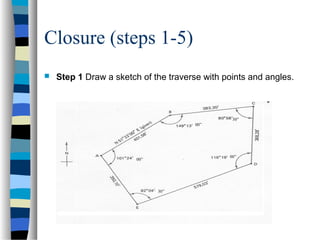
Step 1 Draw a sketch of the traverse with points and angles.

30”
00”

00”

00”

30”
Closure (steps 1-5)



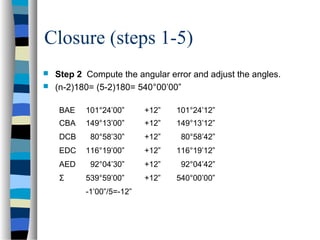
Step 2 Compute the angular error and adjust the angles.
(n-2)180= (5-2)180= 540°00’00”
BAE

101°24’00”

+12”

101°24’12”

CBA

149°13’00”

+12”

149°13’12”

DCB

80°58’30”

+12”

80°58’42”

EDC

116°19’00”

+12”

116°19’12”

AED

92°04’30”

+12”

92°04’42”

539°59’00”

+12”

540°00’00”

Σ

-1’00”/5=-12”
Closure (steps 1-5)


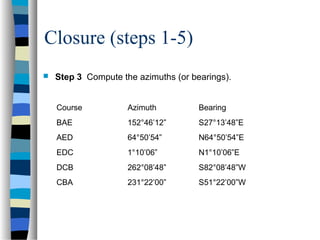
Step 3 Compute the azimuths (or bearings).
Course

Azimuth

Bearing

BAE

152°46’12”

S27°13’48”E

AED

64°50’54”

N64°50’54”E

EDC

1°10’06”

N1°10’06”E

DCB

262°08’48”

S82°08’48”W

CBA

231°22’00”

S51°22’00”W
Closure (steps 1-5)







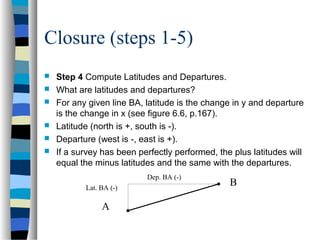
Step 4 Compute Latitudes and Departures.
What are latitudes and departures?
For any given line BA, latitude is the change in y and departure
is the change in x (see figure 6.6, p.167).
Latitude (north is +, south is -).
Departure (west is -, east is +).
If a survey has been perfectly performed, the plus latitudes will
equal the minus latitudes and the same with the departures.
Dep. BA (-)
Lat. BA (-)

A

B
Closure (steps 1-5)


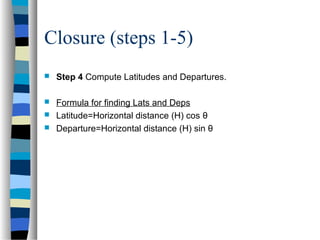
Step 4 Compute Latitudes and Departures.



Formula for finding Lats and Deps
Latitude=Horizontal distance (H) cos θ
Departure=Horizontal distance (H) sin θ



Closure (steps 1-5)
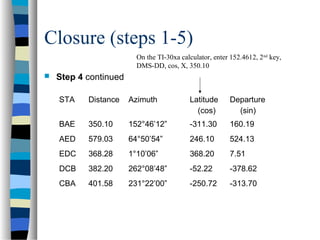
On the TI-30xa calculator, enter 152.4612, 2nd key,
DMS-DD, cos, X, 350.10


Step 4 continued
STA

Distance

Azimuth

Latitude
(cos)

Departure
(sin)

BAE

350.10

152°46’12”

-311.30

160.19

AED

579.03

64°50’54”

246.10

524.13

EDC

368.28

1°10’06”

368.20

7.51

DCB

382.20

262°08’48”

-52.22

-378.62

CBA

401.58

231°22’00”

-250.72

-313.70
Closure (steps 1-5)
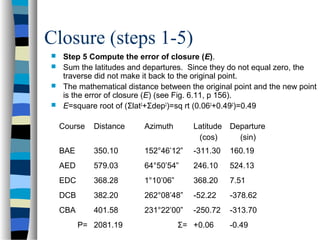
Step 5 Compute the error of closure (E).
 Sum the latitudes and departures. Since they do not equal zero, the
traverse did not make it back to the original point.
 The mathematical distance between the original point and the new point
is the error of closure (E) (see Fig. 6.11, p 156).
 E=square root of (Σlat2+Σdep2)=sq rt (0.062+0.492)=0.49


Course

Distance

Azimuth

Latitude Departure
(cos)
(sin)

BAE

350.10

152°46’12”

-311.30

160.19

AED

579.03

64°50’54”

246.10

524.13

EDC

368.28

1°10’06”

368.20

7.51

DCB

382.20

262°08’48”

-52.22

-378.62

CBA

401.58

231°22’00”

-250.72

-313.70

P= 2081.19

Σ= +0.06

-0.49
Accuracy (step 6)








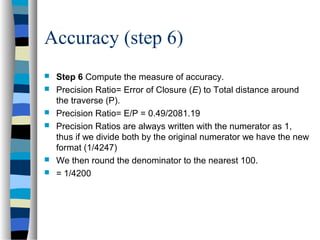
Step 6 Compute the measure of accuracy.
Precision Ratio= Error of Closure (E) to Total distance around
the traverse (P).
Precision Ratio= E/P = 0.49/2081.19
Precision Ratios are always written with the numerator as 1,
thus if we divide both by the original numerator we have the new
format (1/4247)
We then round the denominator to the nearest 100.
= 1/4200
Accuracy (step 6)






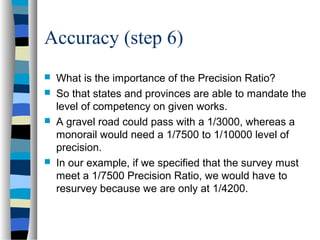
What is the importance of the Precision Ratio?
So that states and provinces are able to mandate the
level of competency on given works.
A gravel road could pass with a 1/3000, whereas a
monorail would need a 1/7500 to 1/10000 level of
precision.
In our example, if we specified that the survey must
meet a 1/7500 Precision Ratio, we would have to
resurvey because we are only at 1/4200.
Area (step 7)






Step 7 Compute corrections for latitudes and departures.
Just like balancing angles, once we identify the sum of the
latitudes and departures, we need to distribute that error before
proceeding.
One way to distribute the error is through the compass rule.
This technique distributes errors in latitude and departure for
each course in the same proportion as the course distance is to
the traverse perimeter.
Area (step 7)








The formula is as follows:
C lat AB = Σ lat x AB/P
Where C lat AB = correction in latitude AB
Σ lat = error of closure in latitude
AB = distance AB
P = Perimeter of traverse
(the formula for departure is the same, just substitute
dep for lat)
Area (step 7)




Using the calculator, we can set up a
constant in memory such as .06/2081.19 and
then multiply this by each course distance.
For example, for the latitudes, perform the
above calculation and store it as M1. Then
for each course, enter RCL1, X, the next
course distance.
Area (step 7)


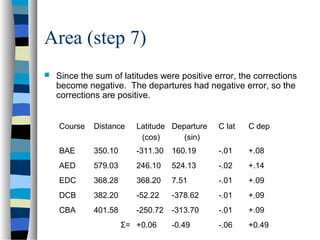
Since the sum of latitudes were positive error, the corrections
become negative. The departures had negative error, so the
corrections are positive.
Course

Distance

Latitude Departure
(cos)
(sin)

C lat

C dep

BAE

350.10

-311.30

160.19

-.01

+.08

AED

579.03

246.10

524.13

-.02

+.14

EDC

368.28

368.20

7.51

-.01

+.09

DCB

382.20

-52.22

-378.62

-.01

+.09

CBA

401.58

-250.72

-313.70

-.01

+.09

-0.49

-.06

+0.49

Σ= +0.06
Area (step 8)



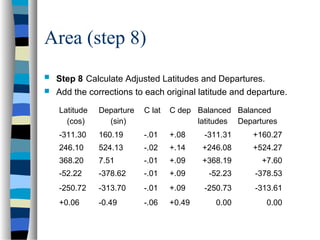
Step 8 Calculate Adjusted Latitudes and Departures.
Add the corrections to each original latitude and departure.
Latitude
(cos)

Departure
(sin)

C lat

C dep Balanced Balanced
latitudes Departures

-311.30

160.19

-.01

+.08

-311.31

+160.27

246.10

524.13

-.02

+.14

+246.08

+524.27

368.20

7.51

-.01

+.09

+368.19

+7.60

-52.22

-378.62

-.01

+.09

-52.23

-378.53

-250.72

-313.70

-.01

+.09

-250.73

-313.61

+0.06

-0.49

-.06

+0.49

0.00

0.00
Area (step 9)
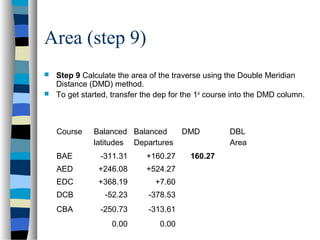
Step 9 Calculate the area of the traverse using the Double Meridian
Distance (DMD) method.
 To get started, transfer the dep for the 1st course into the DMD column.


Course

Balanced Balanced
latitudes Departures

BAE

-311.31

+160.27

AED

+246.08

+524.27

EDC

+368.19

+7.60

DCB

-52.23

-378.53

CBA

-250.73

-313.61

0.00

0.00

DMD
160.27

DBL
Area
Area (step 9)


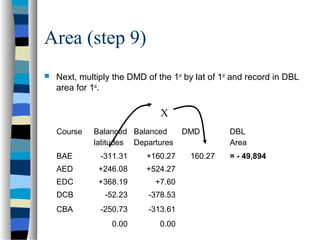
Next, multiply the DMD of the 1st by lat of 1st and record in DBL
area for 1st.

X
Course

Balanced Balanced
latitudes Departures

BAE

-311.31

+160.27

AED

+246.08

+524.27

EDC

+368.19

+7.60

DCB

-52.23

-378.53

CBA

-250.73

-313.61

0.00

0.00

DMD
160.27

DBL
Area
= - 49,894
Area (step 9)


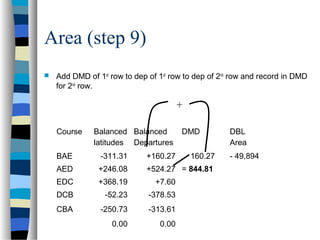
Add DMD of 1st row to dep of 1st row to dep of 2nd row and record in DMD
for 2nd row.

+
Course

Balanced Balanced
latitudes Departures

DMD

BAE

-311.31

+160.27

160.27

AED

+246.08

+524.27 = 844.81

EDC

+368.19

+7.60

DCB

-52.23

-378.53

CBA

-250.73

-313.61

0.00

0.00

DBL
Area
- 49,894
Area (step 9)


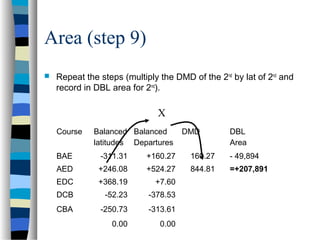
Repeat the steps (multiply the DMD of the 2nd by lat of 2nd and
record in DBL area for 2nd).

X
Course

Balanced Balanced
latitudes Departures

DMD

DBL
Area

BAE

-311.31

+160.27

160.27

- 49,894

AED

+246.08

+524.27

844.81

=+207,891

EDC

+368.19

+7.60

DCB

-52.23

-378.53

CBA

-250.73

-313.61

0.00

0.00
Area (step 9)


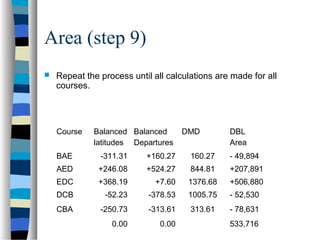
Repeat the process until all calculations are made for all
courses.

Course

Balanced Balanced
latitudes Departures

DMD

DBL
Area

BAE

-311.31

+160.27

160.27

- 49,894

AED

+246.08

+524.27

844.81

+207,891

EDC

+368.19

+7.60

1376.68

+506,880

DCB

-52.23

-378.53

1005.75

- 52,530

CBA

-250.73

-313.61

313.61

- 78,631

0.00

0.00

533,716
Area (step 9)





Sum all of DBL areas and divide by 2
533,716 sq ft /2=266,858 sq ft
Divide by 43,560 sq ft /acre to find answer in acres
266,858/43,560 = 6.126 acres
References Cited
 Examples

and step by step tutorials
were copied directly from the following:
 Mid-America Vocational Curriculum
Consortium, Inc., Basic Surveying
Technology, Stillwater, OK: Oklahoma
State Department of Vocational
Technical Education, 1987

Chap.6 traverse surveys

  • 1.
  • 2.
    Objectives     Match terms relatedto traversing with the correct definitions. List major sources of error in traverse operations. Perform traverse calculations in order to determine closure, accuracy, and area. Perform a closed loop traverse.
  • 3.
    Terms and Definitions Angular Error  Closed Traverse  Departure  Error of Closure  Latitude  Open Traverse
  • 4.
    Sources of Errorin Traverse Operations    Errors in measurement of angles and distances. Poor selection of traverse points resulting in bad sighting conditions (into sun, through timber, etc.) Failing to measure the angles an equal number of times direct and reversed (doubling and averaging)
  • 5.
    9 Steps toComputing a Traverse’s Closure, Accuracy, and Area          1. Draw a sketch of the traverse with points and angles. 2. Compute the angular error and adjust the angles. 3. Compute the bearings or azimuths. 4. Compute Latitudes and Departures. 5. Compute the error of closure. 6. Compute the measure of accuracy. 7. Compute corrections for latitudes and departures. 8. Calculate Adjusted Latitudes and Departures. 9. Calculate the area of the traverse using the Double Meridian Distance (DMD) method.
  • 6.
    Problem (see figure6.4 in text)   A five-sided closed field traverse has the following angles: A=101°24’00”, B=149°13’00”, C=80°58’30”, D=116° 19’00”, E=92°04’30”. The lengths of the sides are as follows: AE 350.10’, ED 579.03’, DC 368.28’, CB 382.20’, BA 401.58’. Determine the traverse’s closure, accuracy, and area.
  • 7.
    Closure (steps 1-5)  Step1 Draw a sketch of the traverse with points and angles. 30” 00” 00” 00” 30”
  • 8.
    Closure (steps 1-5)   Step2 Compute the angular error and adjust the angles. (n-2)180= (5-2)180= 540°00’00” BAE 101°24’00” +12” 101°24’12” CBA 149°13’00” +12” 149°13’12” DCB 80°58’30” +12” 80°58’42” EDC 116°19’00” +12” 116°19’12” AED 92°04’30” +12” 92°04’42” 539°59’00” +12” 540°00’00” Σ -1’00”/5=-12”
  • 9.
    Closure (steps 1-5)  Step3 Compute the azimuths (or bearings). Course Azimuth Bearing BAE 152°46’12” S27°13’48”E AED 64°50’54” N64°50’54”E EDC 1°10’06” N1°10’06”E DCB 262°08’48” S82°08’48”W CBA 231°22’00” S51°22’00”W
  • 10.
    Closure (steps 1-5)       Step4 Compute Latitudes and Departures. What are latitudes and departures? For any given line BA, latitude is the change in y and departure is the change in x (see figure 6.6, p.167). Latitude (north is +, south is -). Departure (west is -, east is +). If a survey has been perfectly performed, the plus latitudes will equal the minus latitudes and the same with the departures. Dep. BA (-) Lat. BA (-) A B
  • 11.
    Closure (steps 1-5)  Step4 Compute Latitudes and Departures.  Formula for finding Lats and Deps Latitude=Horizontal distance (H) cos θ Departure=Horizontal distance (H) sin θ  
  • 12.
    Closure (steps 1-5) Onthe TI-30xa calculator, enter 152.4612, 2nd key, DMS-DD, cos, X, 350.10  Step 4 continued STA Distance Azimuth Latitude (cos) Departure (sin) BAE 350.10 152°46’12” -311.30 160.19 AED 579.03 64°50’54” 246.10 524.13 EDC 368.28 1°10’06” 368.20 7.51 DCB 382.20 262°08’48” -52.22 -378.62 CBA 401.58 231°22’00” -250.72 -313.70
  • 13.
    Closure (steps 1-5) Step5 Compute the error of closure (E).  Sum the latitudes and departures. Since they do not equal zero, the traverse did not make it back to the original point.  The mathematical distance between the original point and the new point is the error of closure (E) (see Fig. 6.11, p 156).  E=square root of (Σlat2+Σdep2)=sq rt (0.062+0.492)=0.49  Course Distance Azimuth Latitude Departure (cos) (sin) BAE 350.10 152°46’12” -311.30 160.19 AED 579.03 64°50’54” 246.10 524.13 EDC 368.28 1°10’06” 368.20 7.51 DCB 382.20 262°08’48” -52.22 -378.62 CBA 401.58 231°22’00” -250.72 -313.70 P= 2081.19 Σ= +0.06 -0.49
  • 14.
    Accuracy (step 6)       Step6 Compute the measure of accuracy. Precision Ratio= Error of Closure (E) to Total distance around the traverse (P). Precision Ratio= E/P = 0.49/2081.19 Precision Ratios are always written with the numerator as 1, thus if we divide both by the original numerator we have the new format (1/4247) We then round the denominator to the nearest 100. = 1/4200
  • 15.
    Accuracy (step 6)     Whatis the importance of the Precision Ratio? So that states and provinces are able to mandate the level of competency on given works. A gravel road could pass with a 1/3000, whereas a monorail would need a 1/7500 to 1/10000 level of precision. In our example, if we specified that the survey must meet a 1/7500 Precision Ratio, we would have to resurvey because we are only at 1/4200.
  • 16.
    Area (step 7)     Step7 Compute corrections for latitudes and departures. Just like balancing angles, once we identify the sum of the latitudes and departures, we need to distribute that error before proceeding. One way to distribute the error is through the compass rule. This technique distributes errors in latitude and departure for each course in the same proportion as the course distance is to the traverse perimeter.
  • 17.
    Area (step 7)        Theformula is as follows: C lat AB = Σ lat x AB/P Where C lat AB = correction in latitude AB Σ lat = error of closure in latitude AB = distance AB P = Perimeter of traverse (the formula for departure is the same, just substitute dep for lat)
  • 18.
    Area (step 7)   Usingthe calculator, we can set up a constant in memory such as .06/2081.19 and then multiply this by each course distance. For example, for the latitudes, perform the above calculation and store it as M1. Then for each course, enter RCL1, X, the next course distance.
  • 19.
    Area (step 7)  Sincethe sum of latitudes were positive error, the corrections become negative. The departures had negative error, so the corrections are positive. Course Distance Latitude Departure (cos) (sin) C lat C dep BAE 350.10 -311.30 160.19 -.01 +.08 AED 579.03 246.10 524.13 -.02 +.14 EDC 368.28 368.20 7.51 -.01 +.09 DCB 382.20 -52.22 -378.62 -.01 +.09 CBA 401.58 -250.72 -313.70 -.01 +.09 -0.49 -.06 +0.49 Σ= +0.06
  • 20.
    Area (step 8)   Step8 Calculate Adjusted Latitudes and Departures. Add the corrections to each original latitude and departure. Latitude (cos) Departure (sin) C lat C dep Balanced Balanced latitudes Departures -311.30 160.19 -.01 +.08 -311.31 +160.27 246.10 524.13 -.02 +.14 +246.08 +524.27 368.20 7.51 -.01 +.09 +368.19 +7.60 -52.22 -378.62 -.01 +.09 -52.23 -378.53 -250.72 -313.70 -.01 +.09 -250.73 -313.61 +0.06 -0.49 -.06 +0.49 0.00 0.00
  • 21.
    Area (step 9) Step9 Calculate the area of the traverse using the Double Meridian Distance (DMD) method.  To get started, transfer the dep for the 1st course into the DMD column.  Course Balanced Balanced latitudes Departures BAE -311.31 +160.27 AED +246.08 +524.27 EDC +368.19 +7.60 DCB -52.23 -378.53 CBA -250.73 -313.61 0.00 0.00 DMD 160.27 DBL Area
  • 22.
    Area (step 9)  Next,multiply the DMD of the 1st by lat of 1st and record in DBL area for 1st. X Course Balanced Balanced latitudes Departures BAE -311.31 +160.27 AED +246.08 +524.27 EDC +368.19 +7.60 DCB -52.23 -378.53 CBA -250.73 -313.61 0.00 0.00 DMD 160.27 DBL Area = - 49,894
  • 23.
    Area (step 9)  AddDMD of 1st row to dep of 1st row to dep of 2nd row and record in DMD for 2nd row. + Course Balanced Balanced latitudes Departures DMD BAE -311.31 +160.27 160.27 AED +246.08 +524.27 = 844.81 EDC +368.19 +7.60 DCB -52.23 -378.53 CBA -250.73 -313.61 0.00 0.00 DBL Area - 49,894
  • 24.
    Area (step 9)  Repeatthe steps (multiply the DMD of the 2nd by lat of 2nd and record in DBL area for 2nd). X Course Balanced Balanced latitudes Departures DMD DBL Area BAE -311.31 +160.27 160.27 - 49,894 AED +246.08 +524.27 844.81 =+207,891 EDC +368.19 +7.60 DCB -52.23 -378.53 CBA -250.73 -313.61 0.00 0.00
  • 25.
    Area (step 9)  Repeatthe process until all calculations are made for all courses. Course Balanced Balanced latitudes Departures DMD DBL Area BAE -311.31 +160.27 160.27 - 49,894 AED +246.08 +524.27 844.81 +207,891 EDC +368.19 +7.60 1376.68 +506,880 DCB -52.23 -378.53 1005.75 - 52,530 CBA -250.73 -313.61 313.61 - 78,631 0.00 0.00 533,716
  • 26.
    Area (step 9)     Sumall of DBL areas and divide by 2 533,716 sq ft /2=266,858 sq ft Divide by 43,560 sq ft /acre to find answer in acres 266,858/43,560 = 6.126 acres
  • 27.
    References Cited  Examples andstep by step tutorials were copied directly from the following:  Mid-America Vocational Curriculum Consortium, Inc., Basic Surveying Technology, Stillwater, OK: Oklahoma State Department of Vocational Technical Education, 1987